×
Deadspin | Jose Soriano still dealing as Angels defeat Reds  Los Angeles Angels pitcher José Soriano (59) delivers a pitch in the first inning of a MLB game between the Cincinnati Reds and Los Angeles Angels, Sunday, April 12, 2026, at Great American Ball Park in downtown Cincinnati.   Jose Soriano continued his hot start with 10 strikeouts over seven shutout innings and Oswald Peraza homered to lead the Los Angeles Angels to a 9-6 victory over the host Cincinnati Reds in the rubber-game of their three-game series on Sunday afternoon.    It was the second consecutive start that Soriano (4-0), who allowed two singles and walked three, struck out 10 batters. He left after throwing 106 pitches, 69 for strikes, while lowering his ERA to 0.33, tops in the majors.    Soriano has allowed just nine hits and just one run – a homer by Atlanta catcher Drake Baldwin – in 27 innings this season. He has walked nine and while striking out a major league-leading 31 batters.    Mike Trout went 2-for-4 with a double, a walk, three runs and an RBI and Nolan Schanuel had two hits, two walks and three RBIs for Los Angeles, which won a series in Cincinnati for the first time since 2007. Logan O’Hoppe and Jo Adell each added two hits and an RBI, and Zach Neto walked three times and scored a run for the Angels.    Elly De La Cruz hit a three-run homer and had two hits for Cincinnati, which lost for the fourth time in the last five games. Andrew Abbott (0-2) suffered the loss, allowing seven runs on eight hits in three-plus innings. He walked two and struck out one.     Los Angeles parlayed five singles into three runs in the top of the first inning. Schanuel made it 2-0 with a bases-loaded single to left-center, and O’Hoppe followed with another RBI single.    The Angels extended the lead to 5-0 in the second inning when Neto walked and scored on a double into the left field corner by Trout, who advanced to third on single by Adell. Jorge Soler then drove in Trout with a sacrifice fly.    Peraza led off the fourth with a line-drive homer to left, and Adell added a bases-loaded fielder’s choice to drive in another run to make it 7-0. Peraza drove in another run in the seventh with a groundout, and Schanuel made it 9-0 in the eighth with a bases-loaded walk.    The Reds made things interesting at the end, scoring three runs in the eighth, including two on a bases-loaded wild pitch, and De La Cruz’s two-out, three-run homer to center in the bottom of the ninth.  –Field Level Media    #Deadspin #Jose #Soriano #dealing #Angels #defeat #Reds
Deadspin | Jose Soriano still dealing as Angels defeat Reds
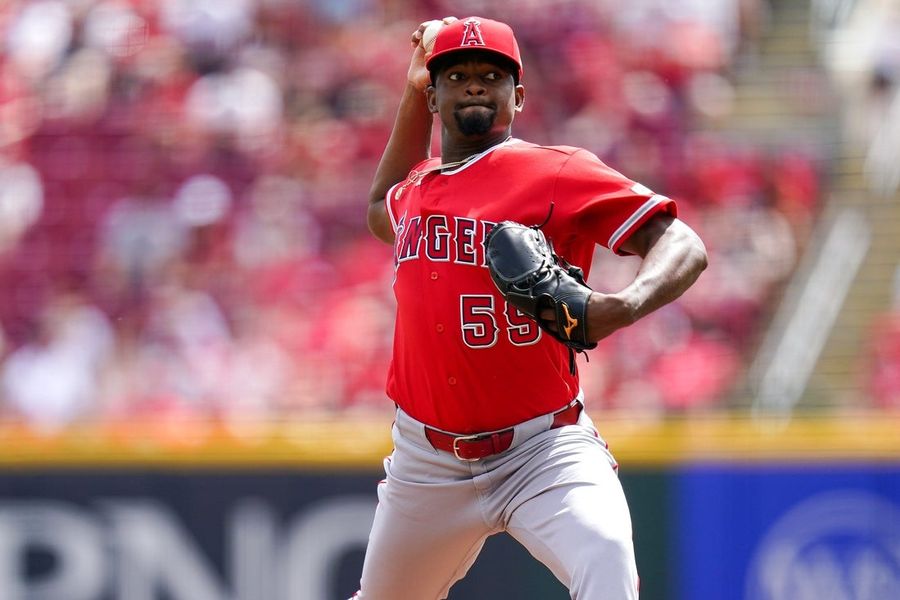
Deadspin | Jose Soriano still dealing as Angels defeat Reds  Los Angeles Angels pitcher José Soriano (59) delivers a pitch in the first inning of a MLB game between the Cincinnati Reds and Los Angeles Angels, Sunday, April 12, 2026, at Great American Ball Park in downtown Cincinnati.   Jose Soriano continued his hot start with 10 strikeouts over seven shutout innings and Oswald Peraza homered to lead the Los Angeles Angels to a 9-6 victory over the host Cincinnati Reds in the rubber-game of their three-game series on Sunday afternoon.    It was the second consecutive start that Soriano (4-0), who allowed two singles and walked three, struck out 10 batters. He left after throwing 106 pitches, 69 for strikes, while lowering his ERA to 0.33, tops in the majors.    Soriano has allowed just nine hits and just one run – a homer by Atlanta catcher Drake Baldwin – in 27 innings this season. He has walked nine and while striking out a major league-leading 31 batters.    Mike Trout went 2-for-4 with a double, a walk, three runs and an RBI and Nolan Schanuel had two hits, two walks and three RBIs for Los Angeles, which won a series in Cincinnati for the first time since 2007. Logan O’Hoppe and Jo Adell each added two hits and an RBI, and Zach Neto walked three times and scored a run for the Angels.    Elly De La Cruz hit a three-run homer and had two hits for Cincinnati, which lost for the fourth time in the last five games. Andrew Abbott (0-2) suffered the loss, allowing seven runs on eight hits in three-plus innings. He walked two and struck out one.     Los Angeles parlayed five singles into three runs in the top of the first inning. Schanuel made it 2-0 with a bases-loaded single to left-center, and O’Hoppe followed with another RBI single.    The Angels extended the lead to 5-0 in the second inning when Neto walked and scored on a double into the left field corner by Trout, who advanced to third on single by Adell. Jorge Soler then drove in Trout with a sacrifice fly.    Peraza led off the fourth with a line-drive homer to left, and Adell added a bases-loaded fielder’s choice to drive in another run to make it 7-0. Peraza drove in another run in the seventh with a groundout, and Schanuel made it 9-0 in the eighth with a bases-loaded walk.    The Reds made things interesting at the end, scoring three runs in the eighth, including two on a bases-loaded wild pitch, and De La Cruz’s two-out, three-run homer to center in the bottom of the ninth.  –Field Level Media    #Deadspin #Jose #Soriano #dealing #Angels #defeat #RedsLos Angeles Angels pitcher José Soriano (59) delivers a pitch in the first inning of a MLB game between the Cincinnati Reds and Los Angeles Angels, Sunday, April 12, 2026, at Great American Ball Park in downtown Cincinnati.

Jose Soriano continued his hot start with 10 strikeouts over seven shutout innings and Oswald Peraza homered to lead the Los Angeles Angels to a 9-6 victory over the host Cincinnati Reds in the rubber-game of their three-game series on Sunday afternoon.

It was the second consecutive start that Soriano (4-0), who allowed two singles and walked three, struck out 10 batters. He left after throwing 106 pitches, 69 for strikes, while lowering his ERA to 0.33, tops in the majors.

Soriano has allowed just nine hits and just one run – a homer by Atlanta catcher Drake Baldwin – in 27 innings this season. He has walked nine and while striking out a major league-leading 31 batters.

Mike Trout went 2-for-4 with a double, a walk, three runs and an RBI and Nolan Schanuel had two hits, two walks and three RBIs for Los Angeles, which won a series in Cincinnati for the first time since 2007. Logan O’Hoppe and Jo Adell each added two hits and an RBI, and Zach Neto walked three times and scored a run for the Angels.


Elly De La Cruz hit a three-run homer and had two hits for Cincinnati, which lost for the fourth time in the last five games. Andrew Abbott (0-2) suffered the loss, allowing seven runs on eight hits in three-plus innings. He walked two and struck out one.

Los Angeles parlayed five singles into three runs in the top of the first inning. Schanuel made it 2-0 with a bases-loaded single to left-center, and O’Hoppe followed with another RBI single.

The Angels extended the lead to 5-0 in the second inning when Neto walked and scored on a double into the left field corner by Trout, who advanced to third on single by Adell. Jorge Soler then drove in Trout with a sacrifice fly.

Peraza led off the fourth with a line-drive homer to left, and Adell added a bases-loaded fielder’s choice to drive in another run to make it 7-0. Peraza drove in another run in the seventh with a groundout, and Schanuel made it 9-0 in the eighth with a bases-loaded walk.

The Reds made things interesting at the end, scoring three runs in the eighth, including two on a bases-loaded wild pitch, and De La Cruz’s two-out, three-run homer to center in the bottom of the ninth.


–Field Level Media

#Deadspin #Jose #Soriano #dealing #Angels #defeat #Reds

Los Angeles Angels pitcher José Soriano (59) delivers a pitch in the first inning of a MLB game between the Cincinnati Reds and Los Angeles Angels, Sunday, April 12, 2026, at Great American Ball Park in downtown Cincinnati.

Jose Soriano continued his hot start with 10 strikeouts over seven shutout innings and Oswald Peraza homered to lead the Los Angeles Angels to a 9-6 victory over the host Cincinnati Reds in the rubber-game of their three-game series on Sunday afternoon.

It was the second consecutive start that Soriano (4-0), who allowed two singles and walked three, struck out 10 batters. He left after throwing 106 pitches, 69 for strikes, while lowering his ERA to 0.33, tops in the majors.

Soriano has allowed just nine hits and just one run – a homer by Atlanta catcher Drake Baldwin – in 27 innings this season. He has walked nine and while striking out a major league-leading 31 batters.

Mike Trout went 2-for-4 with a double, a walk, three runs and an RBI and Nolan Schanuel had two hits, two walks and three RBIs for Los Angeles, which won a series in Cincinnati for the first time since 2007. Logan O’Hoppe and Jo Adell each added two hits and an RBI, and Zach Neto walked three times and scored a run for the Angels.

Elly De La Cruz hit a three-run homer and had two hits for Cincinnati, which lost for the fourth time in the last five games. Andrew Abbott (0-2) suffered the loss, allowing seven runs on eight hits in three-plus innings. He walked two and struck out one.

Los Angeles parlayed five singles into three runs in the top of the first inning. Schanuel made it 2-0 with a bases-loaded single to left-center, and O’Hoppe followed with another RBI single.

The Angels extended the lead to 5-0 in the second inning when Neto walked and scored on a double into the left field corner by Trout, who advanced to third on single by Adell. Jorge Soler then drove in Trout with a sacrifice fly.

Peraza led off the fourth with a line-drive homer to left, and Adell added a bases-loaded fielder’s choice to drive in another run to make it 7-0. Peraza drove in another run in the seventh with a groundout, and Schanuel made it 9-0 in the eighth with a bases-loaded walk.

The Reds made things interesting at the end, scoring three runs in the eighth, including two on a bases-loaded wild pitch, and De La Cruz’s two-out, three-run homer to center in the bottom of the ninth.

–Field Level Media

Source link
#Deadspin #Jose #Soriano #dealing #Angels #defeat #Reds

Previous post

Phone in IPL dugout controversy — RR manager Bhinder under scrutiny from Anti-Corruption Unit <div id="content-body-70854796" itemprop="articleBody"><p>Rajasthan Royals’ long-time team manager Romi Bhinder has found himself in the middle of a controversy after television cameras caught him using a mobile phone in the team dugout during an Indian Premier League fixture against Royal Challengers Bengaluru in Guwahati earlier this week.</p><p>While the Board of Control for Cricket in India’s Anti-Corruption Unit (ACU) has swung into action and initiated a probe, Board secretary Devajit Saikia said the “veracity of the incident” would be established before any conclusion is drawn.</p><p>“Managers using a mobile phone is permissible, but we need to find out whether there was any violation of rules. That fact-finding exercise is now on. Once it is complete, we will take necessary steps depending on the outcome,” Saikia told  <i>Sportstar</i>.</p><p>Footage of the incident, showing Bhinder on his phone with Vaibhav Suryavanshi seated beside him, quickly went viral on social media, prompting the ACU to take cognisance.</p><p>However, Saikia reiterated that due process would be followed. “We will conduct an internal examination before reaching a logical conclusion. We need to review the video footage and gather evidence,” he added.</p><p>According to the IPL’s official guidelines under the PMOA (Players and Match Officials Area) protocol (2026), “The Team Manager may use a phone in the dressing room but NOT in the dugout.”</p><p>Ahead of every season, the IPL conducts mandatory briefings for team captains and managers, taking them through the PMOA framework and anti-corruption protocols.</p><p>Bhinder, a long-serving figure with Rajasthan Royals, has been part of that system for years. During the franchise’s suspension between 2016 and 2018, he also worked with Rising Pune Supergiant as team manager, before returning to his old franchise in 2018.</p><p class="publish-time" id="end-of-article">Published on Apr 12, 2026</p></div> #Phone #IPL #dugout #controversy #manager #Bhinder #scrutiny #AntiCorruption #Unit

Next post

Premier League 2025-26: Tottenham Hotspur remains in relegation zone after defeat at Sunderland <div id="content-body-70854837" itemprop="articleBody"><p>Tottenham Hotspur’s relegation fears ​deepened as manager Roberto de ‌Zerbi’s first game in ​charge ended in ⁠a 1-0 defeat by Sunderland that left the London club ‌third from bottom of the Premier League ‌on Sunday.</p><p>It was a ‌familiar ⁠tale of woe for ⁠Tottenham as Nordi Mukiele’s deflected shot just past the hour ​mark sealed the ‌points for Sunderland who boosted its own European hopes.</p><p>Tottenham showed plenty of ‌battling spirit but not ​a great deal of attacking quality as its ⁠winless run in the Premier League stretched to ‌14 games.</p><p>Spurs have 30 points from 32 games, two points behind West Ham United, which is one place above the ‌drop zone. Sunderland’s first Premier ​League win against Tottenham since 2010 left them ⁠in 10th with 46 points, ⁠two points behind sixth-placed Chelsea who are ‌in action later at home to Manchester City. </p><p class="publish-time" id="end-of-article">Published on Apr 12, 2026</p></div> #Premier #League #Tottenham #Hotspur #remains #relegation #zone #defeat #Sunderland

Deadspin | NC State-UVA opener moved from Brazil to Charlottesville  Sep 22, 2023; Charlottesville, Virginia, USA; Virginia Cavaliers quarterback Anthony Colandrea (10) scrambles from North Carolina State Wolfpack defensive lineman Noah Potter (97) during the fourth quarter at Scott Stadium. Mandatory Credit: Geoff Burke-Imagn Images   The season-opening football game between North Carolina State and Virginia will no longer be played in Brazil.  Both ACC schools announced Wednesday that the contest will be held on Aug. 29 in Charlottesville, Va.  Billed as the first college football game played in South America, it originally was scheduled to take place at Nilton Santos Stadium in Rio de Janeiro.  The decision to relocate came after an “extensive review with the operational partners and international stakeholders” involved in the game, according to a press release.   “This change follows communication from Athlete Advantage, which informed the ACC and participating schools that the event could not be conducted,” the release said.  Fans who purchased tickets or travel packages will receive refunds.  –Field Level Media   #Deadspin #StateUVA #opener #moved #Brazil #CharlottesvilleSep 22, 2023; Charlottesville, Virginia, USA; Virginia Cavaliers quarterback Anthony Colandrea (10) scrambles from North Carolina State Wolfpack defensive lineman Noah Potter (97) during the fourth quarter at Scott Stadium. Mandatory Credit: Geoff Burke-Imagn Images

The season-opening football game between North Carolina State and Virginia will no longer be played in Brazil.

Both ACC schools announced Wednesday that the contest will be held on Aug. 29 in Charlottesville, Va.

Billed as the first college football game played in South America, it originally was scheduled to take place at Nilton Santos Stadium in Rio de Janeiro.


The decision to relocate came after an “extensive review with the operational partners and international stakeholders” involved in the game, according to a press release.

“This change follows communication from Athlete Advantage, which informed the ACC and participating schools that the event could not be conducted,” the release said.

Fans who purchased tickets or travel packages will receive refunds.

–Field Level Media

#Deadspin #StateUVA #opener #moved #Brazil #Charlottesville">Deadspin | NC State-UVA opener moved from Brazil to Charlottesville  Sep 22, 2023; Charlottesville, Virginia, USA; Virginia Cavaliers quarterback Anthony Colandrea (10) scrambles from North Carolina State Wolfpack defensive lineman Noah Potter (97) during the fourth quarter at Scott Stadium. Mandatory Credit: Geoff Burke-Imagn Images   The season-opening football game between North Carolina State and Virginia will no longer be played in Brazil.  Both ACC schools announced Wednesday that the contest will be held on Aug. 29 in Charlottesville, Va.  Billed as the first college football game played in South America, it originally was scheduled to take place at Nilton Santos Stadium in Rio de Janeiro.  The decision to relocate came after an “extensive review with the operational partners and international stakeholders” involved in the game, according to a press release.   “This change follows communication from Athlete Advantage, which informed the ACC and participating schools that the event could not be conducted,” the release said.  Fans who purchased tickets or travel packages will receive refunds.  –Field Level Media   #Deadspin #StateUVA #opener #moved #Brazil #Charlottesville

For as unpredictable as the NBA can be, it doesn’t get many sea changes. That is, big, overhauling alterations to its topography or behavioral patterns – those things take more time. The 2025-2026 Playoffs have been mercurial, surprising, even enlightening, but it’s still not the basketball that’s brought about the most marked development.

It was clear something was different when the tenor of the NBA aggregator infographics changed. Early in the playoffs the images looked familiar, the usual contextless photos of athletes looking gassed or frustrated churned out with blunt, all-caps missives (OUT, ELIMINATED, CHOKED, BUILT DIFFERENT) from NBA media properties’ social platforms and aggregator sites alike. But then, following the first round, there was a blip.

After the Spurs beat the Blazers in a five-game series, Victor Wembanyama answered a postgame question from L’Equipe’s Maxime Aubin about the cliché that showing emotions signals weakness. As that game ended, Wembanyama visibly choked up on the Spurs bench.

“I think it’s first and foremost a fear of judgment,” Wembanyama told Aubin. “Like, this feeling that you have to act a certain way, social codes, I guess. Personally, I refuse to carry the burden of having to hide my emotions.”

In rapid succession, the quote was aggregated, but it wasn’t blunted. At most, the “personally” was lopped off, but infographics of all shapes and sizes (or just two, whatever the optimised dimensions are for Instagram and Twitter) stated, like an awkwardly short affirmation, “I refuse to carry the burden of having to hide my emotions.” There were photos of Wembanyama looking thoughtfully into the middle distance, photos of him screaming in triumph, lots of photos of him crying, face scrunched or buried into the shoulder of a teammate.

That was early May, when the stakes for the Spurs felt light and low. The team has since advanced through two more rounds, besting the Timberwolves in six and dumbfounding the Thunder in seven games of high-flying, arduous, gorgeous basketball. Throughout those 13 contests, Wembanyama’s emotional peaks and valleys have continued to be on prominent display: there have been more tears, more tension, more frustrations and more joy. In the month backdropping those games, the appreciation, even obsession, with Wembanyama’s expressiveness has also grown. Creators outside the traditional NBA media and fan ecosystem have latched on, touting Wembanyama for normalising vulnerability and bringing back demonstratively caring about things. Even within the typically contradictory and oftentimes dour NBA media space of which I am a part, he’s been similarly lauded.

But Wembanyama isn’t the first athlete to articulate how badly he wants to win and to ugly cry when he does. Nor is he the first to grapple with the juxtaposition of that desirousness against the appearance of cold control we still require of our stars. So, what is it about this moment that’s made Wembanyama resonate so deeply, well beyond the NBA? Why do we care so much about Wembanyama caring so much?

Loathe as we are to admit it, we’re creatures of the contemporary world; frogs boiling in whatever noxious soup du jour each new news cycle dumps more ingredients into. Against the backdrop of accumulating global conflicts and the warped language used by our leaders to justify them — “deescalate” into violent escalation, “winding down” that only serves to ramp up — the plain-spoken rejection of a convoluted and long-held status quo hits like a gulp of cold water. Wembanyama handed us the proverbial glass when he rejected the need to be responsible for other people’s discomfort with his emotions, and he’s topped the glass up each time he’s doubled down on being expressive.

There’s a two-fold distinction in Wembanyama’s direct and considered articulation. The first is that he has the perspective of an outsider, because he is one. Basketball is the common ground, a shared language as much as shorthand between him and a majority American NBA fanbase, but his clarity comes from a lifetime prior to now of looking in. The requisite distance needed to hold a place up like a prism and have it catch different streams of light. It was apparent this past winter, when he was one of just a few NBA players to speak up about ICE violently clamping down on people in Minneapolis.

“Every day I wake up and see the news and I’m horrified. It’s crazy that some people might make it sound like it’s acceptable, the murder of civilians. Every day I read the news and I’m asking very deep questions about my own life. But I’m conscious also that saying everything that’s on my mind that would have a cost that’s too great for me right now,” he told media. “I’m a foreigner, I live in this country, I am concerned.”

Asked to clarify if his hesitation to speak came from being a foreigner, Wembanyama said yes.

It was a glimpse into his thought process as a person navigating the delicate intersection he stood at as a French national and non U.S. citizen, as a high-profile athlete, arguably no longer an abstract “future face of the NBA” but the very one actively eclipsing the last generation, and as, foremost, a person who saw injustice and harm and was compelled to speak up. All athletes exist in something of a suspended state of personhood, expected to perform as their outward persona even when they’re off the court. International athletes — especially those in the U.S. in its current sociopolitical climate — exist in a much more temporal state of belonging and tend to keep below the radar.

His articulation has also been bodily. At his stature, his face is a little like a lighthouse. Whatever expression flashes there is impossible to miss. The difference between Wembanyama’s competitive expressiveness and, say, an athlete blowing up on court with vitriol, is that we’re almost more accustomed to the latter. To expressions of frustration and aggression: fights breaking out, equipment being smashed. We’re conditioned to think of these eruptions as part and parcel with the high-stakes and effort of pro sports, proof of concept. But it’s a little bit of crying that, traditionally, had the potential to send the whole system spiraling. At least it was, until a highly visible — 7’4, towering tears — athlete started doing it.

It’s this visibility of emotion, specifically the emotions we equate with sensitivity and vulnerability, that’s so unique when paired with Wembanyama’s expression of them. It reads as oversimplified, even rude (giant man has giant feelings), but when seemingly softer emotions are expressed at billboard-size scale, it’s almost like exposure therapy.

And it’s high-stakes exposure. Prime-time and now, entering the Finals, under the brightest lights and biggest production the NBA has to offer. There’s been a sense that, as the playoffs wore on and the Spurs gained experience, they’d mature, harden. Wembanyama as their leader perhaps most of all. There is, in some corners of fandom and analysis, even a thirst for this. For a young team like San Antonio to get the hope and all these softer expressions — aspiration, jitters, overwhelming joy — roughly knocked out of them.

But this is it. In a world where we’re told not to care, a mindset reinforced daily by the blithe destruction and ravaging of people, their humanity, far and close to home; where a social veer to aggressive, self-serving apathy is threatening to become — if not already — the norm, a demonstrative example of a person extolling the opposite is jarring. That initial jolt can be taken as a threat, or as an opportunity to recalibrate. To be a little more willing to put your own vulnerabilities on display in return.

My interpretation of Wembanyama being put up as face, or saviour, of the league is not that the NBA was lacking the hyper-unique, once-in-an-era skillset he has prior to this; it’s that he offers an alternative to the majority viewing experience of the world writ large right now. You can certainly watch to be entertained, but you can also watch to be infused with a wallop of emotion. The scale of those feelings is difficult to simply switch off with the game, chances are that they will flash over you in the days, months, and more to come. Against disorienting, intolerant darkness, Wembanyama is a roving light to borrow from or burn with.

#care #Victor #Wembanyama #cares">Why do we care so much that Victor Wembanyama cares so much?  For as unpredictable as the NBA can be, it doesn’t get many sea changes. That is, big, overhauling alterations to its topography or behavioral patterns – those things take more time. The 2025-2026 Playoffs have been mercurial, surprising, even enlightening, but it’s still not the basketball that’s brought about the most marked development.It was clear something was different when the tenor of the NBA aggregator infographics changed. Early in the playoffs the images looked familiar, the usual contextless photos of athletes looking gassed or frustrated churned out with blunt, all-caps missives (OUT, ELIMINATED, CHOKED, BUILT DIFFERENT) from NBA media properties’ social platforms and aggregator sites alike. But then, following the first round, there was a blip.After the Spurs beat the Blazers in a five-game series, Victor Wembanyama answered a postgame question from L’Equipe’s Maxime Aubin about the cliché that showing emotions signals weakness. As that game ended, Wembanyama visibly choked up on the Spurs bench.“I think it’s first and foremost a fear of judgment,” Wembanyama told Aubin. “Like, this feeling that you have to act a certain way, social codes, I guess. Personally, I refuse to carry the burden of having to hide my emotions.”In rapid succession, the quote was aggregated, but it wasn’t blunted. At most, the “personally” was lopped off, but infographics of all shapes and sizes (or just two, whatever the optimised dimensions are for Instagram and Twitter) stated, like an awkwardly short affirmation, “I refuse to carry the burden of having to hide my emotions.” There were photos of Wembanyama looking thoughtfully into the middle distance, photos of him screaming in triumph, lots of photos of him crying, face scrunched or buried into the shoulder of a teammate.That was early May, when the stakes for the Spurs felt light and low. The team has since advanced through two more rounds, besting the Timberwolves in six and dumbfounding the Thunder in seven games of high-flying, arduous, gorgeous basketball. Throughout those 13 contests, Wembanyama’s emotional peaks and valleys have continued to be on prominent display: there have been more tears, more tension, more frustrations and more joy. In the month backdropping those games, the appreciation, even obsession, with Wembanyama’s expressiveness has also grown. Creators outside the traditional NBA media and fan ecosystem have latched on, touting Wembanyama for normalising vulnerability and bringing back demonstratively caring about things. Even within the typically contradictory and oftentimes dour NBA media space of which I am a part, he’s been similarly lauded.But Wembanyama isn’t the first athlete to articulate how badly he wants to win and to ugly cry when he does. Nor is he the first to grapple with the juxtaposition of that desirousness against the appearance of cold control we still require of our stars. So, what is it about this moment that’s made Wembanyama resonate so deeply, well beyond the NBA? Why do we care so much about Wembanyama caring so much?Loathe as we are to admit it, we’re creatures of the contemporary world; frogs boiling in whatever noxious soup du jour each new news cycle dumps more ingredients into. Against the backdrop of accumulating global conflicts and the warped language used by our leaders to justify them — “deescalate” into violent escalation, “winding down” that only serves to ramp up — the plain-spoken rejection of a convoluted and long-held status quo hits like a gulp of cold water. Wembanyama handed us the proverbial glass when he rejected the need to be responsible for other people’s discomfort with his emotions, and he’s topped the glass up each time he’s doubled down on being expressive.There’s a two-fold distinction in Wembanyama’s direct and considered articulation. The first is that he has the perspective of an outsider, because he is one. Basketball is the common ground, a shared language as much as shorthand between him and a majority American NBA fanbase, but his clarity comes from a lifetime prior to now of looking in. The requisite distance needed to hold a place up like a prism and have it catch different streams of light. It was apparent this past winter, when he was one of just a few NBA players to speak up about ICE violently clamping down on people in Minneapolis.“Every day I wake up and see the news and I’m horrified. It’s crazy that some people might make it sound like it’s acceptable, the murder of civilians. Every day I read the news and I’m asking very deep questions about my own life. But I’m conscious also that saying everything that’s on my mind that would have a cost that’s too great for me right now,” he told media. “I’m a foreigner, I live in this country, I am concerned.”Asked to clarify if his hesitation to speak came from being a foreigner, Wembanyama said yes.It was a glimpse into his thought process as a person navigating the delicate intersection he stood at as a French national and non U.S. citizen, as a high-profile athlete, arguably no longer an abstract “future face of the NBA” but the very one actively eclipsing the last generation, and as, foremost, a person who saw injustice and harm and was compelled to speak up. All athletes exist in something of a suspended state of personhood, expected to perform as their outward persona even when they’re off the court. International athletes — especially those in the U.S. in its current sociopolitical climate — exist in a much more temporal state of belonging and tend to keep below the radar.His articulation has also been bodily. At his stature, his face is a little like a lighthouse. Whatever expression flashes there is impossible to miss. The difference between Wembanyama’s competitive expressiveness and, say, an athlete blowing up on court with vitriol, is that we’re almost more accustomed to the latter. To expressions of frustration and aggression: fights breaking out, equipment being smashed. We’re conditioned to think of these eruptions as part and parcel with the high-stakes and effort of pro sports, proof of concept. But it’s a little bit of crying that, traditionally, had the potential to send the whole system spiraling. At least it was, until a highly visible — 7’4, towering tears — athlete started doing it.It’s this visibility of emotion, specifically the emotions we equate with sensitivity and vulnerability, that’s so unique when paired with Wembanyama’s expression of them. It reads as oversimplified, even rude (giant man has giant feelings), but when seemingly softer emotions are expressed at billboard-size scale, it’s almost like exposure therapy.And it’s high-stakes exposure. Prime-time and now, entering the Finals, under the brightest lights and biggest production the NBA has to offer. There’s been a sense that, as the playoffs wore on and the Spurs gained experience, they’d mature, harden. Wembanyama as their leader perhaps most of all. There is, in some corners of fandom and analysis, even a thirst for this. For a young team like San Antonio to get the hope and all these softer expressions — aspiration, jitters, overwhelming joy — roughly knocked out of them.But this is it. In a world where we’re told not to care, a mindset reinforced daily by the blithe destruction and ravaging of people, their humanity, far and close to home; where a social veer to aggressive, self-serving apathy is threatening to become — if not already — the norm, a demonstrative example of a person extolling the opposite is jarring. That initial jolt can be taken as a threat, or as an opportunity to recalibrate. To be a little more willing to put your own vulnerabilities on display in return.My interpretation of Wembanyama being put up as face, or saviour, of the league is not that the NBA was lacking the hyper-unique, once-in-an-era skillset he has prior to this; it’s that he offers an alternative to the majority viewing experience of the world writ large right now. You can certainly watch to be entertained, but you can also watch to be infused with a wallop of emotion. The scale of those feelings is difficult to simply switch off with the game, chances are that they will flash over you in the days, months, and more to come. Against disorienting, intolerant darkness, Wembanyama is a roving light to borrow from or burn with.  #care #Victor #Wembanyama #cares

postgame question from L’Equipe’s Maxime Aubin about the cliché that showing emotions signals weakness. As that game ended, Wembanyama visibly choked up on the Spurs bench.

“I think it’s first and foremost a fear of judgment,” Wembanyama told Aubin. “Like, this feeling that you have to act a certain way, social codes, I guess. Personally, I refuse to carry the burden of having to hide my emotions.”

In rapid succession, the quote was aggregated, but it wasn’t blunted. At most, the “personally” was lopped off, but infographics of all shapes and sizes (or just two, whatever the optimised dimensions are for Instagram and Twitter) stated, like an awkwardly short affirmation, “I refuse to carry the burden of having to hide my emotions.” There were photos of Wembanyama looking thoughtfully into the middle distance, photos of him screaming in triumph, lots of photos of him crying, face scrunched or buried into the shoulder of a teammate.

That was early May, when the stakes for the Spurs felt light and low. The team has since advanced through two more rounds, besting the Timberwolves in six and dumbfounding the Thunder in seven games of high-flying, arduous, gorgeous basketball. Throughout those 13 contests, Wembanyama’s emotional peaks and valleys have continued to be on prominent display: there have been more tears, more tension, more frustrations and more joy. In the month backdropping those games, the appreciation, even obsession, with Wembanyama’s expressiveness has also grown. Creators outside the traditional NBA media and fan ecosystem have latched on, touting Wembanyama for normalising vulnerability and bringing back demonstratively caring about things. Even within the typically contradictory and oftentimes dour NBA media space of which I am a part, he’s been similarly lauded.

But Wembanyama isn’t the first athlete to articulate how badly he wants to win and to ugly cry when he does. Nor is he the first to grapple with the juxtaposition of that desirousness against the appearance of cold control we still require of our stars. So, what is it about this moment that’s made Wembanyama resonate so deeply, well beyond the NBA? Why do we care so much about Wembanyama caring so much?

Loathe as we are to admit it, we’re creatures of the contemporary world; frogs boiling in whatever noxious soup du jour each new news cycle dumps more ingredients into. Against the backdrop of accumulating global conflicts and the warped language used by our leaders to justify them — “deescalate” into violent escalation, “winding down” that only serves to ramp up — the plain-spoken rejection of a convoluted and long-held status quo hits like a gulp of cold water. Wembanyama handed us the proverbial glass when he rejected the need to be responsible for other people’s discomfort with his emotions, and he’s topped the glass up each time he’s doubled down on being expressive.

There’s a two-fold distinction in Wembanyama’s direct and considered articulation. The first is that he has the perspective of an outsider, because he is one. Basketball is the common ground, a shared language as much as shorthand between him and a majority American NBA fanbase, but his clarity comes from a lifetime prior to now of looking in. The requisite distance needed to hold a place up like a prism and have it catch different streams of light. It was apparent this past winter, when he was one of just a few NBA players to speak up about ICE violently clamping down on people in Minneapolis.

“Every day I wake up and see the news and I’m horrified. It’s crazy that some people might make it sound like it’s acceptable, the murder of civilians. Every day I read the news and I’m asking very deep questions about my own life. But I’m conscious also that saying everything that’s on my mind that would have a cost that’s too great for me right now,” he told media. “I’m a foreigner, I live in this country, I am concerned.”

Asked to clarify if his hesitation to speak came from being a foreigner, Wembanyama said yes.

It was a glimpse into his thought process as a person navigating the delicate intersection he stood at as a French national and non U.S. citizen, as a high-profile athlete, arguably no longer an abstract “future face of the NBA” but the very one actively eclipsing the last generation, and as, foremost, a person who saw injustice and harm and was compelled to speak up. All athletes exist in something of a suspended state of personhood, expected to perform as their outward persona even when they’re off the court. International athletes — especially those in the U.S. in its current sociopolitical climate — exist in a much more temporal state of belonging and tend to keep below the radar.

His articulation has also been bodily. At his stature, his face is a little like a lighthouse. Whatever expression flashes there is impossible to miss. The difference between Wembanyama’s competitive expressiveness and, say, an athlete blowing up on court with vitriol, is that we’re almost more accustomed to the latter. To expressions of frustration and aggression: fights breaking out, equipment being smashed. We’re conditioned to think of these eruptions as part and parcel with the high-stakes and effort of pro sports, proof of concept. But it’s a little bit of crying that, traditionally, had the potential to send the whole system spiraling. At least it was, until a highly visible — 7’4, towering tears — athlete started doing it.

It’s this visibility of emotion, specifically the emotions we equate with sensitivity and vulnerability, that’s so unique when paired with Wembanyama’s expression of them. It reads as oversimplified, even rude (giant man has giant feelings), but when seemingly softer emotions are expressed at billboard-size scale, it’s almost like exposure therapy.

And it’s high-stakes exposure. Prime-time and now, entering the Finals, under the brightest lights and biggest production the NBA has to offer. There’s been a sense that, as the playoffs wore on and the Spurs gained experience, they’d mature, harden. Wembanyama as their leader perhaps most of all. There is, in some corners of fandom and analysis, even a thirst for this. For a young team like San Antonio to get the hope and all these softer expressions — aspiration, jitters, overwhelming joy — roughly knocked out of them.

But this is it. In a world where we’re told not to care, a mindset reinforced daily by the blithe destruction and ravaging of people, their humanity, far and close to home; where a social veer to aggressive, self-serving apathy is threatening to become — if not already — the norm, a demonstrative example of a person extolling the opposite is jarring. That initial jolt can be taken as a threat, or as an opportunity to recalibrate. To be a little more willing to put your own vulnerabilities on display in return.

My interpretation of Wembanyama being put up as face, or saviour, of the league is not that the NBA was lacking the hyper-unique, once-in-an-era skillset he has prior to this; it’s that he offers an alternative to the majority viewing experience of the world writ large right now. You can certainly watch to be entertained, but you can also watch to be infused with a wallop of emotion. The scale of those feelings is difficult to simply switch off with the game, chances are that they will flash over you in the days, months, and more to come. Against disorienting, intolerant darkness, Wembanyama is a roving light to borrow from or burn with.

#care #Victor #Wembanyama #cares">Why do we care so much that Victor Wembanyama cares so much?

For as unpredictable as the NBA can be, it doesn’t get many sea changes. That is, big, overhauling alterations to its topography or behavioral patterns – those things take more time. The 2025-2026 Playoffs have been mercurial, surprising, even enlightening, but it’s still not the basketball that’s brought about the most marked development.

It was clear something was different when the tenor of the NBA aggregator infographics changed. Early in the playoffs the images looked familiar, the usual contextless photos of athletes looking gassed or frustrated churned out with blunt, all-caps missives (OUT, ELIMINATED, CHOKED, BUILT DIFFERENT) from NBA media properties’ social platforms and aggregator sites alike. But then, following the first round, there was a blip.

After the Spurs beat the Blazers in a five-game series, Victor Wembanyama answered a postgame question from L’Equipe’s Maxime Aubin about the cliché that showing emotions signals weakness. As that game ended, Wembanyama visibly choked up on the Spurs bench.

“I think it’s first and foremost a fear of judgment,” Wembanyama told Aubin. “Like, this feeling that you have to act a certain way, social codes, I guess. Personally, I refuse to carry the burden of having to hide my emotions.”

In rapid succession, the quote was aggregated, but it wasn’t blunted. At most, the “personally” was lopped off, but infographics of all shapes and sizes (or just two, whatever the optimised dimensions are for Instagram and Twitter) stated, like an awkwardly short affirmation, “I refuse to carry the burden of having to hide my emotions.” There were photos of Wembanyama looking thoughtfully into the middle distance, photos of him screaming in triumph, lots of photos of him crying, face scrunched or buried into the shoulder of a teammate.

That was early May, when the stakes for the Spurs felt light and low. The team has since advanced through two more rounds, besting the Timberwolves in six and dumbfounding the Thunder in seven games of high-flying, arduous, gorgeous basketball. Throughout those 13 contests, Wembanyama’s emotional peaks and valleys have continued to be on prominent display: there have been more tears, more tension, more frustrations and more joy. In the month backdropping those games, the appreciation, even obsession, with Wembanyama’s expressiveness has also grown. Creators outside the traditional NBA media and fan ecosystem have latched on, touting Wembanyama for normalising vulnerability and bringing back demonstratively caring about things. Even within the typically contradictory and oftentimes dour NBA media space of which I am a part, he’s been similarly lauded.

But Wembanyama isn’t the first athlete to articulate how badly he wants to win and to ugly cry when he does. Nor is he the first to grapple with the juxtaposition of that desirousness against the appearance of cold control we still require of our stars. So, what is it about this moment that’s made Wembanyama resonate so deeply, well beyond the NBA? Why do we care so much about Wembanyama caring so much?

Loathe as we are to admit it, we’re creatures of the contemporary world; frogs boiling in whatever noxious soup du jour each new news cycle dumps more ingredients into. Against the backdrop of accumulating global conflicts and the warped language used by our leaders to justify them — “deescalate” into violent escalation, “winding down” that only serves to ramp up — the plain-spoken rejection of a convoluted and long-held status quo hits like a gulp of cold water. Wembanyama handed us the proverbial glass when he rejected the need to be responsible for other people’s discomfort with his emotions, and he’s topped the glass up each time he’s doubled down on being expressive.

There’s a two-fold distinction in Wembanyama’s direct and considered articulation. The first is that he has the perspective of an outsider, because he is one. Basketball is the common ground, a shared language as much as shorthand between him and a majority American NBA fanbase, but his clarity comes from a lifetime prior to now of looking in. The requisite distance needed to hold a place up like a prism and have it catch different streams of light. It was apparent this past winter, when he was one of just a few NBA players to speak up about ICE violently clamping down on people in Minneapolis.

“Every day I wake up and see the news and I’m horrified. It’s crazy that some people might make it sound like it’s acceptable, the murder of civilians. Every day I read the news and I’m asking very deep questions about my own life. But I’m conscious also that saying everything that’s on my mind that would have a cost that’s too great for me right now,” he told media. “I’m a foreigner, I live in this country, I am concerned.”

Asked to clarify if his hesitation to speak came from being a foreigner, Wembanyama said yes.

It was a glimpse into his thought process as a person navigating the delicate intersection he stood at as a French national and non U.S. citizen, as a high-profile athlete, arguably no longer an abstract “future face of the NBA” but the very one actively eclipsing the last generation, and as, foremost, a person who saw injustice and harm and was compelled to speak up. All athletes exist in something of a suspended state of personhood, expected to perform as their outward persona even when they’re off the court. International athletes — especially those in the U.S. in its current sociopolitical climate — exist in a much more temporal state of belonging and tend to keep below the radar.

His articulation has also been bodily. At his stature, his face is a little like a lighthouse. Whatever expression flashes there is impossible to miss. The difference between Wembanyama’s competitive expressiveness and, say, an athlete blowing up on court with vitriol, is that we’re almost more accustomed to the latter. To expressions of frustration and aggression: fights breaking out, equipment being smashed. We’re conditioned to think of these eruptions as part and parcel with the high-stakes and effort of pro sports, proof of concept. But it’s a little bit of crying that, traditionally, had the potential to send the whole system spiraling. At least it was, until a highly visible — 7’4, towering tears — athlete started doing it.

It’s this visibility of emotion, specifically the emotions we equate with sensitivity and vulnerability, that’s so unique when paired with Wembanyama’s expression of them. It reads as oversimplified, even rude (giant man has giant feelings), but when seemingly softer emotions are expressed at billboard-size scale, it’s almost like exposure therapy.

And it’s high-stakes exposure. Prime-time and now, entering the Finals, under the brightest lights and biggest production the NBA has to offer. There’s been a sense that, as the playoffs wore on and the Spurs gained experience, they’d mature, harden. Wembanyama as their leader perhaps most of all. There is, in some corners of fandom and analysis, even a thirst for this. For a young team like San Antonio to get the hope and all these softer expressions — aspiration, jitters, overwhelming joy — roughly knocked out of them.

But this is it. In a world where we’re told not to care, a mindset reinforced daily by the blithe destruction and ravaging of people, their humanity, far and close to home; where a social veer to aggressive, self-serving apathy is threatening to become — if not already — the norm, a demonstrative example of a person extolling the opposite is jarring. That initial jolt can be taken as a threat, or as an opportunity to recalibrate. To be a little more willing to put your own vulnerabilities on display in return.

My interpretation of Wembanyama being put up as face, or saviour, of the league is not that the NBA was lacking the hyper-unique, once-in-an-era skillset he has prior to this; it’s that he offers an alternative to the majority viewing experience of the world writ large right now. You can certainly watch to be entertained, but you can also watch to be infused with a wallop of emotion. The scale of those feelings is difficult to simply switch off with the game, chances are that they will flash over you in the days, months, and more to come. Against disorienting, intolerant darkness, Wembanyama is a roving light to borrow from or burn with.

#care #Victor #Wembanyama #cares

Post Comment