×
Deadspin | Kyle Schwarber, Bryce Harper power Phillies past D-backs  Apr 11, 2026; Philadelphia, Pennsylvania, USA; Philadelphia Phillies infielder Bryce Harper (3) hits a home run against the Arizona Diamondbacks in the third inning at Citizens Bank Park. Mandatory Credit: Kyle Ross-Imagn Images   Kyle Schwarber and Bryce Harper hit back-to-back home runs to highlight the Philadelphia Phillies’ 4-3 victory over the visiting Arizona Diamondbacks on Saturday afternoon.  Taijuan Walker (1-2) bounced back after a rough first inning to get the Phillies through five frames. He gave up two runs – both in the first – on four hits and two walks, striking out six to help Philadelphia snap a three-game slide.  Adrian Del Castillo had three hits and Ketel Marte homered for Arizona, which had won five of its previous six games. Diamondbacks starter Brandon Pfaadt (0-1) gave up four runs – three earned – and five hits over six innings, walking three and striking out six.  Arizona got off to a great start, as Marte hit Walker’s third pitch of the game over the wall in right-center field for a 1-0 lead.  Corbin Carroll followed with a walk and advanced on a groundout. The next hitter was Del Castillo, who delivered an RBI single to make it 2-0.  Philadelphia went down quietly against Pfaadt in the first and second innings before an error by shortstop Geraldo Perdomo led to a four-run rally in the third.  After Alec Bohm reached on Perdomo’s miscue, Justin Crawford singled and Trea Turner struck out. Pfaadt then tried to get a 1-0 changeup past Schwarber, who launched it into the seats in right field to put the hosts ahead.   Two pitches later, Harper sent a fastball into the Phillies’ bullpen in right-center, making it 4-2.  Schwarber’s fourth home run and Harper’s third of the season proved to be enough support for Walker, who induced a double play to get through the fifth.  Tim Mayza, Orion Kerkering and Jose Alvarado combined to get through the sixth and seventh innings.  Brad Keller ran into some two-out trouble in the eighth, as he allowed a walk and two hits – including Jose Fernandez’s single that sliced Arizona’s deficit to 4-3. However, Keller struck out Nolan Arenado with the tying run on third base to end the inning.  Jhoan Duran had no issues in the ninth, retiring the side in order for his fifth save.  –Field Level Media   #Deadspin #Kyle #Schwarber #Bryce #Harper #power #Phillies #Dbacks
Deadspin | Kyle Schwarber, Bryce Harper power Phillies past D-backs
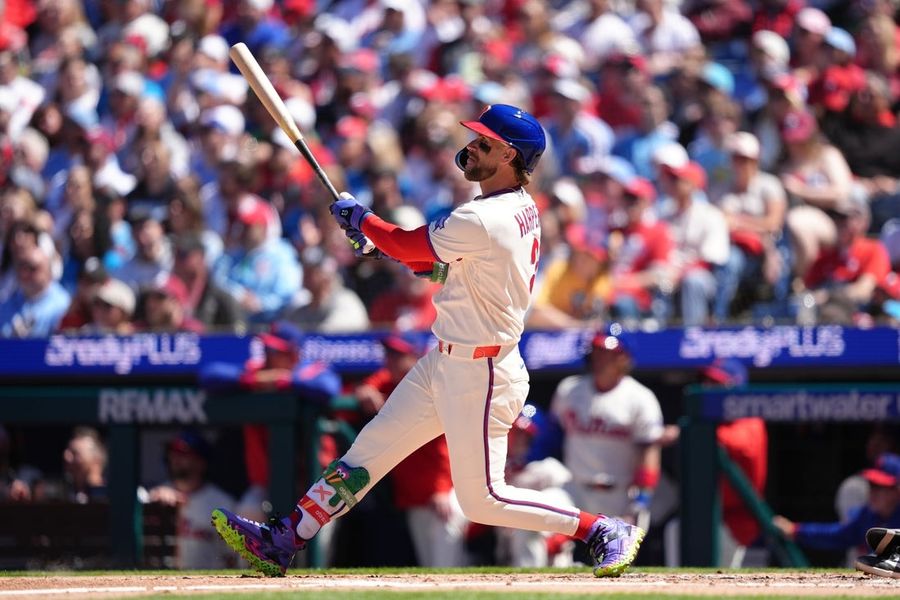
Deadspin | Kyle Schwarber, Bryce Harper power Phillies past D-backs  Apr 11, 2026; Philadelphia, Pennsylvania, USA; Philadelphia Phillies infielder Bryce Harper (3) hits a home run against the Arizona Diamondbacks in the third inning at Citizens Bank Park. Mandatory Credit: Kyle Ross-Imagn Images   Kyle Schwarber and Bryce Harper hit back-to-back home runs to highlight the Philadelphia Phillies’ 4-3 victory over the visiting Arizona Diamondbacks on Saturday afternoon.  Taijuan Walker (1-2) bounced back after a rough first inning to get the Phillies through five frames. He gave up two runs – both in the first – on four hits and two walks, striking out six to help Philadelphia snap a three-game slide.  Adrian Del Castillo had three hits and Ketel Marte homered for Arizona, which had won five of its previous six games. Diamondbacks starter Brandon Pfaadt (0-1) gave up four runs – three earned – and five hits over six innings, walking three and striking out six.  Arizona got off to a great start, as Marte hit Walker’s third pitch of the game over the wall in right-center field for a 1-0 lead.  Corbin Carroll followed with a walk and advanced on a groundout. The next hitter was Del Castillo, who delivered an RBI single to make it 2-0.  Philadelphia went down quietly against Pfaadt in the first and second innings before an error by shortstop Geraldo Perdomo led to a four-run rally in the third.  After Alec Bohm reached on Perdomo’s miscue, Justin Crawford singled and Trea Turner struck out. Pfaadt then tried to get a 1-0 changeup past Schwarber, who launched it into the seats in right field to put the hosts ahead.   Two pitches later, Harper sent a fastball into the Phillies’ bullpen in right-center, making it 4-2.  Schwarber’s fourth home run and Harper’s third of the season proved to be enough support for Walker, who induced a double play to get through the fifth.  Tim Mayza, Orion Kerkering and Jose Alvarado combined to get through the sixth and seventh innings.  Brad Keller ran into some two-out trouble in the eighth, as he allowed a walk and two hits – including Jose Fernandez’s single that sliced Arizona’s deficit to 4-3. However, Keller struck out Nolan Arenado with the tying run on third base to end the inning.  Jhoan Duran had no issues in the ninth, retiring the side in order for his fifth save.  –Field Level Media   #Deadspin #Kyle #Schwarber #Bryce #Harper #power #Phillies #DbacksApr 11, 2026; Philadelphia, Pennsylvania, USA; Philadelphia Phillies infielder Bryce Harper (3) hits a home run against the Arizona Diamondbacks in the third inning at Citizens Bank Park. Mandatory Credit: Kyle Ross-Imagn Images

Kyle Schwarber and Bryce Harper hit back-to-back home runs to highlight the Philadelphia Phillies’ 4-3 victory over the visiting Arizona Diamondbacks on Saturday afternoon.

Taijuan Walker (1-2) bounced back after a rough first inning to get the Phillies through five frames. He gave up two runs – both in the first – on four hits and two walks, striking out six to help Philadelphia snap a three-game slide.

Adrian Del Castillo had three hits and Ketel Marte homered for Arizona, which had won five of its previous six games. Diamondbacks starter Brandon Pfaadt (0-1) gave up four runs – three earned – and five hits over six innings, walking three and striking out six.

Arizona got off to a great start, as Marte hit Walker’s third pitch of the game over the wall in right-center field for a 1-0 lead.

Corbin Carroll followed with a walk and advanced on a groundout. The next hitter was Del Castillo, who delivered an RBI single to make it 2-0.

Philadelphia went down quietly against Pfaadt in the first and second innings before an error by shortstop Geraldo Perdomo led to a four-run rally in the third.


After Alec Bohm reached on Perdomo’s miscue, Justin Crawford singled and Trea Turner struck out. Pfaadt then tried to get a 1-0 changeup past Schwarber, who launched it into the seats in right field to put the hosts ahead.

Two pitches later, Harper sent a fastball into the Phillies’ bullpen in right-center, making it 4-2.

Schwarber’s fourth home run and Harper’s third of the season proved to be enough support for Walker, who induced a double play to get through the fifth.

Tim Mayza, Orion Kerkering and Jose Alvarado combined to get through the sixth and seventh innings.

Brad Keller ran into some two-out trouble in the eighth, as he allowed a walk and two hits – including Jose Fernandez’s single that sliced Arizona’s deficit to 4-3. However, Keller struck out Nolan Arenado with the tying run on third base to end the inning.

Jhoan Duran had no issues in the ninth, retiring the side in order for his fifth save.

–Field Level Media

#Deadspin #Kyle #Schwarber #Bryce #Harper #power #Phillies #Dbacks

Apr 11, 2026; Philadelphia, Pennsylvania, USA; Philadelphia Phillies infielder Bryce Harper (3) hits a home run against the Arizona Diamondbacks in the third inning at Citizens Bank Park. Mandatory Credit: Kyle Ross-Imagn Images

Kyle Schwarber and Bryce Harper hit back-to-back home runs to highlight the Philadelphia Phillies’ 4-3 victory over the visiting Arizona Diamondbacks on Saturday afternoon.

Taijuan Walker (1-2) bounced back after a rough first inning to get the Phillies through five frames. He gave up two runs – both in the first – on four hits and two walks, striking out six to help Philadelphia snap a three-game slide.

Adrian Del Castillo had three hits and Ketel Marte homered for Arizona, which had won five of its previous six games. Diamondbacks starter Brandon Pfaadt (0-1) gave up four runs – three earned – and five hits over six innings, walking three and striking out six.

Arizona got off to a great start, as Marte hit Walker’s third pitch of the game over the wall in right-center field for a 1-0 lead.

Corbin Carroll followed with a walk and advanced on a groundout. The next hitter was Del Castillo, who delivered an RBI single to make it 2-0.

Philadelphia went down quietly against Pfaadt in the first and second innings before an error by shortstop Geraldo Perdomo led to a four-run rally in the third.

After Alec Bohm reached on Perdomo’s miscue, Justin Crawford singled and Trea Turner struck out. Pfaadt then tried to get a 1-0 changeup past Schwarber, who launched it into the seats in right field to put the hosts ahead.

Two pitches later, Harper sent a fastball into the Phillies’ bullpen in right-center, making it 4-2.

Schwarber’s fourth home run and Harper’s third of the season proved to be enough support for Walker, who induced a double play to get through the fifth.

Tim Mayza, Orion Kerkering and Jose Alvarado combined to get through the sixth and seventh innings.

Brad Keller ran into some two-out trouble in the eighth, as he allowed a walk and two hits – including Jose Fernandez’s single that sliced Arizona’s deficit to 4-3. However, Keller struck out Nolan Arenado with the tying run on third base to end the inning.

Jhoan Duran had no issues in the ninth, retiring the side in order for his fifth save.

–Field Level Media

Source link
#Deadspin #Kyle #Schwarber #Bryce #Harper #power #Phillies #Dbacks

Previous post

Bangladesh retains squad for first two New Zealand ODIs <div id="content-body-70850544" itemprop="articleBody"><p>Bangladesh named an unchanged squad on Saturday for the first two matches of the upcoming three-match ODI series against New Zealand, the first announcement by a newly formed selection panel.</p><p>The four-member panel, led by Habibul Bashar Sumon, opted to stick with the same group that featured in the ODI series against Pakistan last month, citing continuity and overall team performance.</p><p>Bangladesh beat Pakistan 2-1 in the home ODI series.</p><p>“Our policy is to give adequate opportunities to anyone who comes into the team. We believe in continuity, which is why we did not change the team for this series,” Habibul, who took over last month, told reporters.</p><p>The selectors also backed out-of-form opener Saif Hassan, who managed just 52 runs in three matches in the Pakistan series.</p><p>“We want to give him more opportunities before making a decision. We do not want to go into a chop-and-change approach,” he said.</p><p><b>READ: <a href="https://sportstar.thehindu.com/cricket/ipl/virat-kohli-vaibhav-suryavanshi-orange-cap-signed-autograph-rr-vs-rcb/article70850297.ece" target="_blank">Virat Kohli signs Vaibhav Suryavanshi’s cap, pens sweet message</a></b></p><p>New Zealand is scheduled to arrive in Bangladesh on Monday for the white-ball tour, which includes three ODIs and three T20Is.</p><p>The opening two ODIs will be held at the Sher-e-Bangla National Cricket Stadium in Dhaka on April 17 and 20, followed by the third on April 23 at Chattogram.</p><p>The T20I series will begin in Chattogram with matches on April 27 and 29, before concluding in Dhaka on May 2.</p><div class="fact-box"><h5 class="main-title"> SQUAD </h5><p> Litton Das, Tanzid Hasan, Soumya Sarkar, Saif Hassan, Najmul Hossain Shanto, Towhid Hridoy, Mahidul Islam, Afif Hossain, Mehidy Hasan Miraz (captain), Rishad Hossain, Tanvir Islam, Taskin Ahmed, Nahid Rana, Shoriful Islam, Mustafizur Rahman. </p></div><p class="publish-time" id="end-of-article">Published on Apr 11, 2026</p></div> #Bangladesh #retains #squad #Zealand #ODIs

Next post

Deadspin | Heat, Hawks clash with major playoff implications <div id=""><section id="0" class=" w-full"><div class="xl:container mx-0 !px-4 py-0 pb-4 !mx-0 !px-0"><img src="https://images.deadspin.com/tr:w-900/28298528.jpg" srcset="https://images.deadspin.com/tr:w-900/28298528.jpg" alt="NBA: Miami Heat at Atlanta Hawks" class="w-full" fetchpriority="high" loading="eager"/><span class="text-0.8 leading-tight">Feb 20, 2026; Atlanta, Georgia, USA; Atlanta Hawks forward Jalen Johnson (1) shoots over Miami Heat guard Davion Mitchell (45) in the third quarter at State Farm Arena. Mandatory Credit: Brett Davis-Imagn Images<!-- --> <!-- --> </span></div></section><section id="section-1"> <p>The Miami Heat are guaranteed a fourth straight year in the play-in round, but — with one game left in the regular season — there’s still something for Miami to chase.</p> </section><section id="section-2"> <p>On Sunday night, the Heat (42-39) will host the Atlanta Hawks (46-35). If Miami beats Atlanta and Charlotte loses at the New York Knicks, the Heat will have home-court advantage against the Hornets in a do-or-die play-in game next week.</p> </section><section id="section-3"> <p>Heat coach Erik Spoelstra said he would’ve preferred to have made the playoff round outright, but …</p> </section><section id="section-4"> <p>“We’re there (in the play-in),” he said. “We still have an opportunity to get home court (against Charlotte). We want to maximize that opportunity.”</p> </section><section id="section-5"> <p>On Friday, the Heat broke a two-game losing streak with a 140-117 win at Washington. The Heat are just 4-10 over their past 14 games but are 7-1 in games in which they make at least 20 3-pointers.</p> </section><section id="section-6"> <p>Indeed, Miami shot 20 of 37 from deep on Friday, and the Heat did that despite playing without several key players who are injured: Tyler Herro (right foot), Norman Powell (groin), Davion Mitchell (right shoulder), Dru Smith (right foot), and Nikola Jovic (left ankle).</p> </section><section id="section-7"> <p>Their status for the game vs. the Hawks is uncertain, but the Heat have solid depth, as they showed on Friday with Simone Fontecchio and Pelle Larsson scoring 24 points each, and Jaime Jaquez Jr. adding 23. Bam Adebayo contributed 20 points, 11 rebounds and eight assists.</p> </section><section id="section-8"> <p>Fontecchio, who has played 70 games this season, got just his ninth start of the campaign on Friday, and he earned praise from Spoelstra.</p> </section><br/><section id="section-9"> <p>“He has always kept himself ready,” Spoelstra said. “He’s done a lot of things that have made me take notice. He’s one of our better rebounders. He gives us positional size, and he’s ignitable as a shooter. If he sees a couple go down, it can be an avalanche from there.”</p> </section> <section id="section-10"> <p>Meanwhile, the Hawks have clinched their first playoff berth since 2023. Atlanta, the Southeast Division champion, will be seeded either fifth or sixth. The team’s first-round opponent will be either the Cavaliers if Atlanta holds on to the fifth seed, or the Knicks if the Hawks slip to sixth.</p> </section><section id="section-11"> <p>Atlanta, which has not won a playoff series since 2021, is led by Jalen Johnson, a first-time All-Star this season. He tops the Hawks in scoring (22.5 points per game), rebounds (10.3 per game), and assists (7.9).</p> </section><section id="section-12"> <p>Johnson had 18 points, nine rebounds, and two assists in just 25 minutes in Atlanta’s 124-102 playoff-clinching win over visiting Cleveland on Friday.</p> </section><section id="section-13"> <p>Dyson Daniels, CJ McCollum, and Nickeil Alexander-Walker are three more Hawks players to watch.</p> </section><section id="section-14"> <p>Daniels had his second career triple-double on Friday with 13 points, 12 assists and 10 rebounds. For the season, he averages 11.9 points, 6.8 rebounds, 5.9 assists and a team-high 2.0 steals.</p> </section><section id="section-15"> <p>Alexander-Walker is second on the Hawks in scoring (20.8 ppg), and McCollum is third (18.7). McCollum scored a game-high 29 points on Friday.</p> </section><section id="section-16"> <p>“These guys believed we could do this,” Hawks coach Quin Snyder said when asked about making the playoffs. “This year is about building a foundation. That, regardless of what happens going forward, is a win. We’re excited.”</p> </section><section id="section-17"> <p>–Field Level Media</p> </section></div> #Deadspin #Heat #Hawks #clash #major #playoff #implications

Soccer Meets America focuses around the meteoric rise in popularity, from the North American Soccer League days of the 1970s and 1980s to the 1984 Olympics, leading up to the 1994 World Cup. At the center of that history was Alan Rothenberg, who served as soccer commissioner for the 1984 Olympics, the president of the U.S. Soccer Federation from 1990 to 1998, and the CEO of the 1994 World Cup. He also had a hand in the start of Major League Soccer, adding women’s soccer to the Olympic program in 1996, and bringing the 1999 Women’s World Cup to the United States.

Rothenberg recently released a new book entitled The Big Bounce: The Surge that Shaped the Future of U.S. Soccer. In the book, Rothenberg gives an inside account at how American soccer went from the days where leagues were not organized and fizzled quickly to some of the success we have today with leagues like Major League Soccer, the National Women’s Soccer League, and the United Soccer Leagues. He details his firsthand knowledge of what it took for the United States to host a successful soccer tournament at the 1984 Olympics, how the nation won the bid to host the 1994 World Cup, and how he was able to organize the federation to get everything done and push the game forward. He recently sat down for an interview on the USA Soccercast, and in that interview, he mentioned that the rise in popularity of the game wasn’t based on one big moment, but a sustained buildup of momentum.

“[American soccer] sort of grew when I was starting in 1990,” Alan Rothenberg, former U.S. Soccer president and CEO of the 1994 World Cup, said in an interview for the USA Soccercast. “I had a glimpse of it back in the 70s when we had a team in Los Angeles ,and obviously the Cosmos set the world on fire at that time with Pelé and [Franz] Beckebauer…you had Giants Stadium. So there were those glimpses of what the future could hold. But as we started to build the soccer federation, our [1994] World cup team and the World cup organization, it just started to accelerate. So there wasn’t one ‘a ha!’ moment.”

Soccer Meets America takes the unique yet unexpected path of professional soccer in the United States andn gives the story some definition. Through people like Rothenberg, we see that the history is shaped by chance, persistence, and communities that kept the game alive long before it found mainstream recognition. Starting with the sport’s deep roots in immigrant communities in the 1920s, each episode of the docuseries explores soccer on a personal and professional level. Both nostalgic and forward-facing, the series features a variety of influential figures in American soccer and aims to resonate with new and old fans of the sport alike.

But there’s also the legacy of the 2026 World Cup, which will be different from what it was in 1994. “Well, obviously we’re starting from a different baseline,” Rothenberg said. “We started at virtually zero back in [1990], and now we’re starting from level 60 or 75…so the dramatic consequences will not be the same as they were after 94, but I think it’s going to be a huge spike in interest in the sport at all levels.”

To grow the history, you must learn from it. And Soccer Meets America gives you a review of America’s soccer history and strengthes the foundations from which the sport’s culture and passion were created. As we approach the World Cup, that knowledge will be essential to craft the legacy that will carry long after the tournament ends.

#Vox #Creative #Roku #debut #docuseries #history #American #soccer">Vox Creative, Roku debut new docuseries on history of American soccer  The history of American soccer has spanned well over 120 years, and to date there hasn’t been many opportunities to look back at that history. With the 2026 World Cup about a month away, we now have a chance to do just that. Yesterday, SB Nation collaborated with Vox Creative and Roku to release Soccer Meets America, a 3-part docuseries that focuses on the rise of soccer in the United States.Soccer Meets America focuses around the meteoric rise in popularity, from the North American Soccer League days of the 1970s and 1980s to the 1984 Olympics, leading up to the 1994 World Cup. At the center of that history was Alan Rothenberg, who served as soccer commissioner for the 1984 Olympics, the president of the U.S. Soccer Federation from 1990 to 1998, and the CEO of the 1994 World Cup. He also had a hand in the start of Major League Soccer, adding women’s soccer to the Olympic program in 1996, and bringing the 1999 Women’s World Cup to the United States.Rothenberg recently released a new book entitled The Big Bounce: The Surge that Shaped the Future of U.S. Soccer. In the book, Rothenberg gives an inside account at how American soccer went from the days where leagues were not organized and fizzled quickly to some of the success we have today with leagues like Major League Soccer, the National Women’s Soccer League, and the United Soccer Leagues. He details his firsthand knowledge of what it took for the United States to host a successful soccer tournament at the 1984 Olympics, how the nation won the bid to host the 1994 World Cup, and how he was able to organize the federation to get everything done and push the game forward. He recently sat down for an interview on the USA Soccercast, and in that interview, he mentioned that the rise in popularity of the game wasn’t based on one big moment, but a sustained buildup of momentum.“[American soccer] sort of grew when I was starting in 1990,” Alan Rothenberg, former U.S. Soccer president and CEO of the 1994 World Cup, said in an interview for the USA Soccercast. “I had a glimpse of it back in the 70s when we had a team in Los Angeles ,and obviously the Cosmos set the world on fire at that time with Pelé and [Franz] Beckebauer…you had Giants Stadium. So there were those glimpses of what the future could hold. But as we started to build the soccer federation, our [1994] World cup team and the World cup organization, it just started to accelerate. So there wasn’t one ‘a ha!’ moment.”Soccer Meets America takes the unique yet unexpected path of professional soccer in the United States andn gives the story some definition. Through people like Rothenberg, we see that the history is shaped by chance, persistence, and communities that kept the game alive long before it found mainstream recognition. Starting with the sport’s deep roots in immigrant communities in the 1920s, each episode of the docuseries explores soccer on a personal and professional level. Both nostalgic and forward-facing, the series features a variety of influential figures in American soccer and aims to resonate with new and old fans of the sport alike.But there’s also the legacy of the 2026 World Cup, which will be different from what it was in 1994. “Well, obviously we’re starting from a different baseline,” Rothenberg said. “We started at virtually zero back in [1990], and now we’re starting from level 60 or 75…so the dramatic consequences will not be the same as they were after 94, but I think it’s going to be a huge spike in interest in the sport at all levels.”To grow the history, you must learn from it. And Soccer Meets America gives you a review of America’s soccer history and strengthes the foundations from which the sport’s culture and passion were created. As we approach the World Cup, that knowledge will be essential to craft the legacy that will carry long after the tournament ends.  #Vox #Creative #Roku #debut #docuseries #history #American #soccer

Soccer Meets America, a 3-part docuseries that focuses on the rise of soccer in the United States.

Soccer Meets America focuses around the meteoric rise in popularity, from the North American Soccer League days of the 1970s and 1980s to the 1984 Olympics, leading up to the 1994 World Cup. At the center of that history was Alan Rothenberg, who served as soccer commissioner for the 1984 Olympics, the president of the U.S. Soccer Federation from 1990 to 1998, and the CEO of the 1994 World Cup. He also had a hand in the start of Major League Soccer, adding women’s soccer to the Olympic program in 1996, and bringing the 1999 Women’s World Cup to the United States.

Rothenberg recently released a new book entitled The Big Bounce: The Surge that Shaped the Future of U.S. Soccer. In the book, Rothenberg gives an inside account at how American soccer went from the days where leagues were not organized and fizzled quickly to some of the success we have today with leagues like Major League Soccer, the National Women’s Soccer League, and the United Soccer Leagues. He details his firsthand knowledge of what it took for the United States to host a successful soccer tournament at the 1984 Olympics, how the nation won the bid to host the 1994 World Cup, and how he was able to organize the federation to get everything done and push the game forward. He recently sat down for an interview on the USA Soccercast, and in that interview, he mentioned that the rise in popularity of the game wasn’t based on one big moment, but a sustained buildup of momentum.

“[American soccer] sort of grew when I was starting in 1990,” Alan Rothenberg, former U.S. Soccer president and CEO of the 1994 World Cup, said in an interview for the USA Soccercast. “I had a glimpse of it back in the 70s when we had a team in Los Angeles ,and obviously the Cosmos set the world on fire at that time with Pelé and [Franz] Beckebauer…you had Giants Stadium. So there were those glimpses of what the future could hold. But as we started to build the soccer federation, our [1994] World cup team and the World cup organization, it just started to accelerate. So there wasn’t one ‘a ha!’ moment.”

Soccer Meets America takes the unique yet unexpected path of professional soccer in the United States andn gives the story some definition. Through people like Rothenberg, we see that the history is shaped by chance, persistence, and communities that kept the game alive long before it found mainstream recognition. Starting with the sport’s deep roots in immigrant communities in the 1920s, each episode of the docuseries explores soccer on a personal and professional level. Both nostalgic and forward-facing, the series features a variety of influential figures in American soccer and aims to resonate with new and old fans of the sport alike.

But there’s also the legacy of the 2026 World Cup, which will be different from what it was in 1994. “Well, obviously we’re starting from a different baseline,” Rothenberg said. “We started at virtually zero back in [1990], and now we’re starting from level 60 or 75…so the dramatic consequences will not be the same as they were after 94, but I think it’s going to be a huge spike in interest in the sport at all levels.”

To grow the history, you must learn from it. And Soccer Meets America gives you a review of America’s soccer history and strengthes the foundations from which the sport’s culture and passion were created. As we approach the World Cup, that knowledge will be essential to craft the legacy that will carry long after the tournament ends.

#Vox #Creative #Roku #debut #docuseries #history #American #soccer">Vox Creative, Roku debut new docuseries on history of American soccer

The history of American soccer has spanned well over 120 years, and to date there hasn’t been many opportunities to look back at that history. With the 2026 World Cup about a month away, we now have a chance to do just that. Yesterday, SB Nation collaborated with Vox Creative and Roku to release Soccer Meets America, a 3-part docuseries that focuses on the rise of soccer in the United States.

Soccer Meets America focuses around the meteoric rise in popularity, from the North American Soccer League days of the 1970s and 1980s to the 1984 Olympics, leading up to the 1994 World Cup. At the center of that history was Alan Rothenberg, who served as soccer commissioner for the 1984 Olympics, the president of the U.S. Soccer Federation from 1990 to 1998, and the CEO of the 1994 World Cup. He also had a hand in the start of Major League Soccer, adding women’s soccer to the Olympic program in 1996, and bringing the 1999 Women’s World Cup to the United States.

Rothenberg recently released a new book entitled The Big Bounce: The Surge that Shaped the Future of U.S. Soccer. In the book, Rothenberg gives an inside account at how American soccer went from the days where leagues were not organized and fizzled quickly to some of the success we have today with leagues like Major League Soccer, the National Women’s Soccer League, and the United Soccer Leagues. He details his firsthand knowledge of what it took for the United States to host a successful soccer tournament at the 1984 Olympics, how the nation won the bid to host the 1994 World Cup, and how he was able to organize the federation to get everything done and push the game forward. He recently sat down for an interview on the USA Soccercast, and in that interview, he mentioned that the rise in popularity of the game wasn’t based on one big moment, but a sustained buildup of momentum.

“[American soccer] sort of grew when I was starting in 1990,” Alan Rothenberg, former U.S. Soccer president and CEO of the 1994 World Cup, said in an interview for the USA Soccercast. “I had a glimpse of it back in the 70s when we had a team in Los Angeles ,and obviously the Cosmos set the world on fire at that time with Pelé and [Franz] Beckebauer…you had Giants Stadium. So there were those glimpses of what the future could hold. But as we started to build the soccer federation, our [1994] World cup team and the World cup organization, it just started to accelerate. So there wasn’t one ‘a ha!’ moment.”

Soccer Meets America takes the unique yet unexpected path of professional soccer in the United States andn gives the story some definition. Through people like Rothenberg, we see that the history is shaped by chance, persistence, and communities that kept the game alive long before it found mainstream recognition. Starting with the sport’s deep roots in immigrant communities in the 1920s, each episode of the docuseries explores soccer on a personal and professional level. Both nostalgic and forward-facing, the series features a variety of influential figures in American soccer and aims to resonate with new and old fans of the sport alike.

But there’s also the legacy of the 2026 World Cup, which will be different from what it was in 1994. “Well, obviously we’re starting from a different baseline,” Rothenberg said. “We started at virtually zero back in [1990], and now we’re starting from level 60 or 75…so the dramatic consequences will not be the same as they were after 94, but I think it’s going to be a huge spike in interest in the sport at all levels.”

To grow the history, you must learn from it. And Soccer Meets America gives you a review of America’s soccer history and strengthes the foundations from which the sport’s culture and passion were created. As we approach the World Cup, that knowledge will be essential to craft the legacy that will carry long after the tournament ends.

#Vox #Creative #Roku #debut #docuseries #history #American #soccer

Delhi Capitals will host Chennai Super Kings at the Arun Jaitley Stadium in Delhi on Wednesday. Both teams have won four out of the nine games they have played.

In the reverse fixture, CSK beat DC by 23 runs in Chennai.

Here are the complete stats and head-to-head numbers you need to know before the teams face off:

DC vs CSK Head-to-Head Record in IPL

Matches Played: 32

Delhi Capitals: 12

Chennai Super Kings: 20

MOST RUNS IN DC vs CSK IPL MATCHES

Batter Innings Runs Average Strike Rate HS
MS Dhoni 29 696 38.66 142.04 63*
Suresh Raina 22 552 29.05 132.05 59
Shikhar Dhawan 10 433 54.12 136.16 101*
Rishabh Pant 11 375 46.87 156.9 79
Murali Vijay 12 346 34.6 136.22 113

MOST WICKETS IN DC vs CSK IPL MATCHES

Bowler Innings Wickets Economy Average BBI
Ravichandran Ashwin 17 19 6.52 21 3/23
Dwayne Bravo 17 19 8.06 22.42 3/33
Ravindra Jadeja 20 19 7.75 25.78 3/9
Deepak Chahar 12 13 8.06 26.69 3/22
Albie Morkel 14 13 8.29 29.76 3/32

Published on May 04, 2026

#CSK #headtohead #record #IPL #Delhi #Capitals #Chennai #Super #Kings #stats #runs #wickets">DC vs CSK head-to-head record, IPL 2026: Delhi Capitals vs Chennai Super Kings stats, runs, wickets  Delhi Capitals will host Chennai Super Kings at the Arun Jaitley Stadium in Delhi on Wednesday. Both teams have won four out of the nine games they have played.In the reverse fixture, CSK beat DC by 23 runs in Chennai.Here are the complete stats and head-to-head numbers you need to know before the teams face off:
DC vs CSK Head-to-Head Record in IPL

Matches Played: 32

Delhi Capitals: 12

Chennai Super Kings: 20
MOST RUNS IN DC vs CSK IPL MATCHES  Batter  Innings  Runs  Average  Strike Rate  HS   MS Dhoni  29  696  38.66  142.04  63*  Suresh Raina  22  552  29.05  132.05  59  Shikhar Dhawan  10  433  54.12  136.16  101*  Rishabh Pant  11  375  46.87  156.9  79  Murali Vijay  12  346  34.6  136.22  113MOST WICKETS IN DC vs CSK IPL MATCHES  Bowler  Innings  Wickets  Economy  Average  BBI  Ravichandran Ashwin  17  19  6.52  21  3/23  Dwayne Bravo  17  19  8.06  22.42  3/33  Ravindra Jadeja  20  19  7.75  25.78  3/9  Deepak Chahar  12  13  8.06  26.69  3/22  Albie Morkel  14  13  8.29  29.76  3/32Published on May 04, 2026  #CSK #headtohead #record #IPL #Delhi #Capitals #Chennai #Super #Kings #stats #runs #wickets

Post Comment