×
Deadspin | Lightning, Canadiens enter pivotal Game 5 of closely contested series  Apr 26, 2026; Montreal, Quebec, CAN; Tampa Bay Lightning defenseman Darren Raddysh (43) defends the puck against Montreal Canadiens right wing Josh Anderson (17) during the third period in game four of the first round of the 2026 Stanley Cup Playoffs at Bell Centre. Mandatory Credit: David Kirouac-Imagn Images   The Tampa Bay Lightning have returned home tied 2-2 in their Eastern Conference first-round matchup with the Montreal Canadiens, and according to coach Jon Cooper, it may not be that way if not for the play of Max Crozier.   Game 5 takes place in Tampa on Wednesday night after a two-day break following Sunday’s 3-2 Lightning victory in Montreal in front of a boisterous bunch of Habs fans, both inside the NHL’s largest arena and outside watching on a giant screen broadcast.  If one glaring point is gleaned through four contests between the Atlantic Division foes, it is that this best-of-seven series has been the tightest of the first round’s eight matchups, about as evenly played as is mathematically possible.  In addition to splitting the four matches, each side has produced 11 goals and three of the four meetings have required extra time.  On the power play thus far, Montreal, which finished 10th during the regular season, has connected on 5 of 19 chances (26.3%). The Lightning were middling, ranking 17th this season, but have potted four goals in their 20 times on the man advantage (20%).   When the numbers are that close, a play out of the ordinary that generally does not jump off the scoresheet can make a big difference.  Something like Crozier’s Sunday second-period high hit on Montreal’s star winger Juraj Slafkovsky, who netted a hat trick in Game 1 in Tampa on three power-plays tallies, including the game-winner in overtime.   The defenseman, who only played in 35 games due to surgery, waylaid Slafkovsky at center ice at high speed, sending the 2022 No. 1 overall selection straight to the dressing room to regroup.  The Lightning were outhit 50-28 by the Habs, but Crozier’s lone leveling body blow altered the tone.  “The hit obviously got our bench out of their seats,” Cooper said. “But you still have to take advantage of that. We score in the last minute of the second and in the first (two minutes) of the third, and all of a sudden, the game’s completely changed.    “(Crozier’s hit) helped take the crowd out of it.”  Instead of maintaining or building on its 2-0 lead that could have resulted in a 3-1 series advantage, Montreal watched it all slip away by allowing three unanswered goals to the visitors.   Brandon Hagel hit the net for the game-tying and game-winning markers in the third to send the series back to Tampa all square.  Montreal has relied on its top forward line of Cole Caufield (goal, three assists), Nick Suzuki (four helpers) and Slafkovsky (three tallies) for much of the offense, and second-line forward Alex Newhook said the Habs’ secondary scoring must improve.  Newhook plays with center Oliver Kapanen and right winger Ivan Demidov. Only Demidov has produced a point by assisting on Slafkovsky’s first power-play goal in Game 1’s 4-3 shocker.  “It’s something we talk over and try to find solutions (for) here throughout the series as to how,” said Newhook, who posted 13 goals and 25 points in 42 games after fracturing his ankle in mid-November. ” … Fundamentally, getting back to some basics is important this time of the year.  “I think we found some success when we’re keeping it simple and throwing it behind them. Then being able to go and win a battle.”  Game 6, the series’ first elimination game regardless of Wednesday’s result, is Friday in Montreal.   –Field Level Media   #Deadspin #Lightning #Canadiens #enter #pivotal #Game #closely #contested #series
Deadspin | Lightning, Canadiens enter pivotal Game 5 of closely contested series
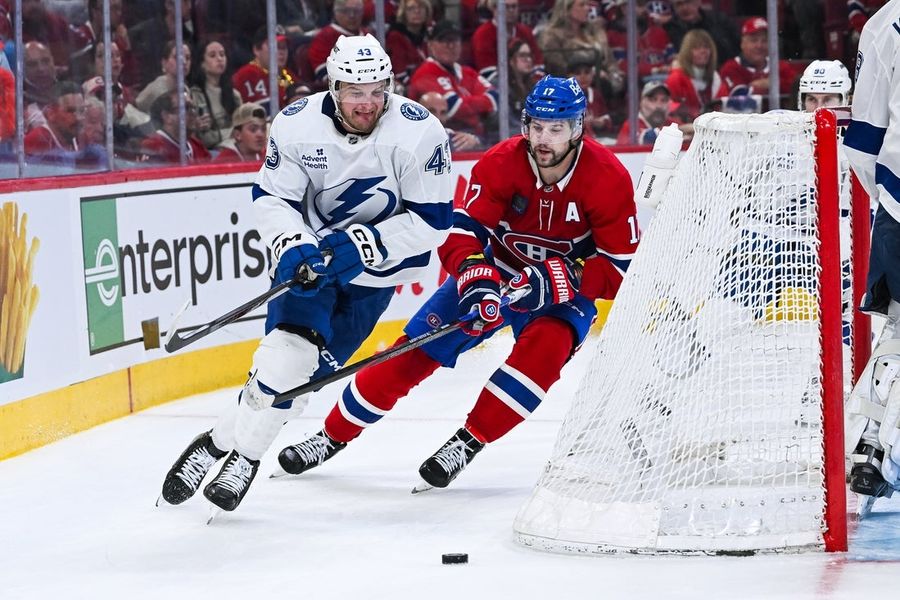
Deadspin | Lightning, Canadiens enter pivotal Game 5 of closely contested series  Apr 26, 2026; Montreal, Quebec, CAN; Tampa Bay Lightning defenseman Darren Raddysh (43) defends the puck against Montreal Canadiens right wing Josh Anderson (17) during the third period in game four of the first round of the 2026 Stanley Cup Playoffs at Bell Centre. Mandatory Credit: David Kirouac-Imagn Images   The Tampa Bay Lightning have returned home tied 2-2 in their Eastern Conference first-round matchup with the Montreal Canadiens, and according to coach Jon Cooper, it may not be that way if not for the play of Max Crozier.   Game 5 takes place in Tampa on Wednesday night after a two-day break following Sunday’s 3-2 Lightning victory in Montreal in front of a boisterous bunch of Habs fans, both inside the NHL’s largest arena and outside watching on a giant screen broadcast.  If one glaring point is gleaned through four contests between the Atlantic Division foes, it is that this best-of-seven series has been the tightest of the first round’s eight matchups, about as evenly played as is mathematically possible.  In addition to splitting the four matches, each side has produced 11 goals and three of the four meetings have required extra time.  On the power play thus far, Montreal, which finished 10th during the regular season, has connected on 5 of 19 chances (26.3%). The Lightning were middling, ranking 17th this season, but have potted four goals in their 20 times on the man advantage (20%).   When the numbers are that close, a play out of the ordinary that generally does not jump off the scoresheet can make a big difference.  Something like Crozier’s Sunday second-period high hit on Montreal’s star winger Juraj Slafkovsky, who netted a hat trick in Game 1 in Tampa on three power-plays tallies, including the game-winner in overtime.   The defenseman, who only played in 35 games due to surgery, waylaid Slafkovsky at center ice at high speed, sending the 2022 No. 1 overall selection straight to the dressing room to regroup.  The Lightning were outhit 50-28 by the Habs, but Crozier’s lone leveling body blow altered the tone.  “The hit obviously got our bench out of their seats,” Cooper said. “But you still have to take advantage of that. We score in the last minute of the second and in the first (two minutes) of the third, and all of a sudden, the game’s completely changed.    “(Crozier’s hit) helped take the crowd out of it.”  Instead of maintaining or building on its 2-0 lead that could have resulted in a 3-1 series advantage, Montreal watched it all slip away by allowing three unanswered goals to the visitors.   Brandon Hagel hit the net for the game-tying and game-winning markers in the third to send the series back to Tampa all square.  Montreal has relied on its top forward line of Cole Caufield (goal, three assists), Nick Suzuki (four helpers) and Slafkovsky (three tallies) for much of the offense, and second-line forward Alex Newhook said the Habs’ secondary scoring must improve.  Newhook plays with center Oliver Kapanen and right winger Ivan Demidov. Only Demidov has produced a point by assisting on Slafkovsky’s first power-play goal in Game 1’s 4-3 shocker.  “It’s something we talk over and try to find solutions (for) here throughout the series as to how,” said Newhook, who posted 13 goals and 25 points in 42 games after fracturing his ankle in mid-November. ” … Fundamentally, getting back to some basics is important this time of the year.  “I think we found some success when we’re keeping it simple and throwing it behind them. Then being able to go and win a battle.”  Game 6, the series’ first elimination game regardless of Wednesday’s result, is Friday in Montreal.   –Field Level Media   #Deadspin #Lightning #Canadiens #enter #pivotal #Game #closely #contested #seriesApr 26, 2026; Montreal, Quebec, CAN; Tampa Bay Lightning defenseman Darren Raddysh (43) defends the puck against Montreal Canadiens right wing Josh Anderson (17) during the third period in game four of the first round of the 2026 Stanley Cup Playoffs at Bell Centre. Mandatory Credit: David Kirouac-Imagn Images

The Tampa Bay Lightning have returned home tied 2-2 in their Eastern Conference first-round matchup with the Montreal Canadiens, and according to coach Jon Cooper, it may not be that way if not for the play of Max Crozier.

Game 5 takes place in Tampa on Wednesday night after a two-day break following Sunday’s 3-2 Lightning victory in Montreal in front of a boisterous bunch of Habs fans, both inside the NHL’s largest arena and outside watching on a giant screen broadcast.

If one glaring point is gleaned through four contests between the Atlantic Division foes, it is that this best-of-seven series has been the tightest of the first round’s eight matchups, about as evenly played as is mathematically possible.

In addition to splitting the four matches, each side has produced 11 goals and three of the four meetings have required extra time.

On the power play thus far, Montreal, which finished 10th during the regular season, has connected on 5 of 19 chances (26.3%). The Lightning were middling, ranking 17th this season, but have potted four goals in their 20 times on the man advantage (20%).

When the numbers are that close, a play out of the ordinary that generally does not jump off the scoresheet can make a big difference.

Something like Crozier’s Sunday second-period high hit on Montreal’s star winger Juraj Slafkovsky, who netted a hat trick in Game 1 in Tampa on three power-plays tallies, including the game-winner in overtime.

The defenseman, who only played in 35 games due to surgery, waylaid Slafkovsky at center ice at high speed, sending the 2022 No. 1 overall selection straight to the dressing room to regroup.

The Lightning were outhit 50-28 by the Habs, but Crozier’s lone leveling body blow altered the tone.


“The hit obviously got our bench out of their seats,” Cooper said. “But you still have to take advantage of that. We score in the last minute of the second and in the first (two minutes) of the third, and all of a sudden, the game’s completely changed.

“(Crozier’s hit) helped take the crowd out of it.”

Instead of maintaining or building on its 2-0 lead that could have resulted in a 3-1 series advantage, Montreal watched it all slip away by allowing three unanswered goals to the visitors.

Brandon Hagel hit the net for the game-tying and game-winning markers in the third to send the series back to Tampa all square.

Montreal has relied on its top forward line of Cole Caufield (goal, three assists), Nick Suzuki (four helpers) and Slafkovsky (three tallies) for much of the offense, and second-line forward Alex Newhook said the Habs’ secondary scoring must improve.

Newhook plays with center Oliver Kapanen and right winger Ivan Demidov. Only Demidov has produced a point by assisting on Slafkovsky’s first power-play goal in Game 1’s 4-3 shocker.

“It’s something we talk over and try to find solutions (for) here throughout the series as to how,” said Newhook, who posted 13 goals and 25 points in 42 games after fracturing his ankle in mid-November. ” … Fundamentally, getting back to some basics is important this time of the year.

“I think we found some success when we’re keeping it simple and throwing it behind them. Then being able to go and win a battle.”

Game 6, the series’ first elimination game regardless of Wednesday’s result, is Friday in Montreal.

–Field Level Media

#Deadspin #Lightning #Canadiens #enter #pivotal #Game #closely #contested #series

Apr 26, 2026; Montreal, Quebec, CAN; Tampa Bay Lightning defenseman Darren Raddysh (43) defends the puck against Montreal Canadiens right wing Josh Anderson (17) during the third period in game four of the first round of the 2026 Stanley Cup Playoffs at Bell Centre. Mandatory Credit: David Kirouac-Imagn Images

The Tampa Bay Lightning have returned home tied 2-2 in their Eastern Conference first-round matchup with the Montreal Canadiens, and according to coach Jon Cooper, it may not be that way if not for the play of Max Crozier.

Game 5 takes place in Tampa on Wednesday night after a two-day break following Sunday’s 3-2 Lightning victory in Montreal in front of a boisterous bunch of Habs fans, both inside the NHL’s largest arena and outside watching on a giant screen broadcast.

If one glaring point is gleaned through four contests between the Atlantic Division foes, it is that this best-of-seven series has been the tightest of the first round’s eight matchups, about as evenly played as is mathematically possible.

In addition to splitting the four matches, each side has produced 11 goals and three of the four meetings have required extra time.

On the power play thus far, Montreal, which finished 10th during the regular season, has connected on 5 of 19 chances (26.3%). The Lightning were middling, ranking 17th this season, but have potted four goals in their 20 times on the man advantage (20%).

When the numbers are that close, a play out of the ordinary that generally does not jump off the scoresheet can make a big difference.

Something like Crozier’s Sunday second-period high hit on Montreal’s star winger Juraj Slafkovsky, who netted a hat trick in Game 1 in Tampa on three power-plays tallies, including the game-winner in overtime.

The defenseman, who only played in 35 games due to surgery, waylaid Slafkovsky at center ice at high speed, sending the 2022 No. 1 overall selection straight to the dressing room to regroup.

The Lightning were outhit 50-28 by the Habs, but Crozier’s lone leveling body blow altered the tone.

“The hit obviously got our bench out of their seats,” Cooper said. “But you still have to take advantage of that. We score in the last minute of the second and in the first (two minutes) of the third, and all of a sudden, the game’s completely changed.

“(Crozier’s hit) helped take the crowd out of it.”

Instead of maintaining or building on its 2-0 lead that could have resulted in a 3-1 series advantage, Montreal watched it all slip away by allowing three unanswered goals to the visitors.

Brandon Hagel hit the net for the game-tying and game-winning markers in the third to send the series back to Tampa all square.

Montreal has relied on its top forward line of Cole Caufield (goal, three assists), Nick Suzuki (four helpers) and Slafkovsky (three tallies) for much of the offense, and second-line forward Alex Newhook said the Habs’ secondary scoring must improve.

Newhook plays with center Oliver Kapanen and right winger Ivan Demidov. Only Demidov has produced a point by assisting on Slafkovsky’s first power-play goal in Game 1’s 4-3 shocker.

“It’s something we talk over and try to find solutions (for) here throughout the series as to how,” said Newhook, who posted 13 goals and 25 points in 42 games after fracturing his ankle in mid-November. ” … Fundamentally, getting back to some basics is important this time of the year.

“I think we found some success when we’re keeping it simple and throwing it behind them. Then being able to go and win a battle.”

Game 6, the series’ first elimination game regardless of Wednesday’s result, is Friday in Montreal.

–Field Level Media

Source link
#Deadspin #Lightning #Canadiens #enter #pivotal #Game #closely #contested #series

Previous post

It’s primetime for conspiracy theorist video creators<div><p class="duet--article--dangerously-set-cms-markup duet--article--standard-paragraph _1ymtmqpi _17nnmdy1 _17nnmdy0 _1xwtict1">In the days since this year’s White House Correspondents’ Dinner was cut short <a href="https://www.nytimes.com/interactive/2026/04/26/us/white-house-correspondents-hilton-shots.html">when shots were fired at the event</a>, there has been a boom of conspiracy theory videos created by people who <a href="https://www.theverge.com/news/919244/whcd-shooting-trump-social-media-conspiracy-theories">insist that the entire situation was a false flag operation</a>. These kinds of theories are nothing new, but the way they’re spreading now is a reflection of how reaction video culture is reshaping our social media landscape. And even though the initial chaos around the shooting has started to die down, content creators are still posting about what “really” happened.</p></div><div><p class="duet--article--dangerously-set-cms-markup duet--article--standard-paragraph _1ymtmqpi _17nnmdy1 _17nnmdy0 _1xwtict1">There is still much we do not know about Cole Allen, the 31-year-old suspected shooter who <a href="https://www.nytimes.com/live/2026/04/26/us/correspondents-dinner-shooting-trump">allegedly traveled from Los Angeles to Washington, DC,</a> ahead of the WCHD and was staying in the same Hilton where the event was held. But that has not stopped content creators from flooding platforms like <a href="https://www.youtube.com/shorts/q5pIbIQtyVw">YouTube</a>, TikTok, <a href="https://www.instagram.com/reel/DXmLxQADrwE/?igsh=YmxjazB3bHRxZnpk">Instagram</a>, and X with videos purporting to have more insightful takes on the situation than what’s being reported by the mainstream media.</p></div><div><p class="duet--article--dangerously-set-cms-markup duet--article--standard-paragraph _1ymtmqpi _17nnmdy1 _17nnmdy0 _1xwtict1">None of these videos reveal anything that hasn’t already been reported out via traditional media outlets. But each of them speaks to the way that this brand of content has become a normal part of people’s media consumption habits and something that creators see as a viable way to capture attention. In the US, <a href="https://news.gallup.com/poll/695762/trust-media-new-low.aspx">trust in traditional media outlets is at a historic low</a> and more people are <a href="https://www.bbc.com/news/articles/c93lzyxkklpo">turning to social media</a> to stay informed about world events. And that shift has given conspiracy-minded content creators a choice opportunity to influence the way people understand reality.</p></div><div><p class="duet--article--dangerously-set-cms-markup duet--article--standard-paragraph _1ymtmqpi _17nnmdy1 _17nnmdy0 _1xwtict1">All of this is similar to what happened in 2024 when <a href="https://www.theverge.com/2024/7/15/24199116/trump-shooting-assassination-attempt-rally-presidential-race">Donald Trump survived an assassination attempt</a> while campaigning for the presidency. Then, creators <a href="https://www.theverge.com/2024/7/15/24199146/donald-trump-rally-shooting-assassination-picture-merch-tshirts-etsy-amazon">rushed to capitalize on the event</a> while also writing it off as a false flag designed to garner sympathy for the Republican nominee. That news cycle and subsequent discourse dragged on for weeks, both because it was a significant moment in an election year and because it was difficult to understand how Trump could have been shot in his ear without sustaining any visible damage afterward.</p></div><div><p class="duet--article--dangerously-set-cms-markup duet--article--standard-paragraph _1ymtmqpi _17nnmdy1 _17nnmdy0 _1xwtict1">Many of the newer videos about the WHCD shooting suggest that we should look at these events as a response to the Trump administration’s propensity for spreading misinformation. And while there is no evidence to suggest that the WHCD shooting was, in fact, orchestrated with Trump’s approval, one could argue the administration is at least partially responsible for the way that this idea has gained traction across the internet.</p></div><div><p class="duet--article--dangerously-set-cms-markup duet--article--standard-paragraph _1ymtmqpi _17nnmdy1 _17nnmdy0 _1xwtict1">As easy as it is to laugh at <a href="https://www.theverge.com/column/861476/trump-memes-venezuela-ice-shooting">the constant barrage of shitposts</a> coming out of the president’s social media accounts and other official governmental channels, they have undoubtedly had an impact on the way that the public thinks about the current administration. By sharing ugly, immature memes and <a href="https://www.theguardian.com/us-news/2026/jan/29/the-slopaganda-era-10-ai-images-posted-by-the-white-house-and-what-they-teach-us">AI-generated images</a> of Trump as a Christlike figure, the White House has told people that nothing is to be taken seriously and everything can be turned into a crude joke. And at a time when all of the internet’s biggest social media platforms have begun <a href="https://www.theverge.com/2024/7/9/24195277/instagram-long-form-video-adam-mosseri">encouraging their users to upload videos</a> of themselves while chasing engagement, it makes sense that many would see this past weekend’s shooting as a chance to boost their profiles.</p></div><div><p class="duet--article--dangerously-set-cms-markup duet--article--standard-paragraph _1ymtmqpi _17nnmdy1 _17nnmdy0 _1xwtict1">Trump has made nonsensical “jokes” a significant part of his political brand, and people are responding with very similar energy.</p></div><script async src="//www.instagram.com/embed.js"></script>#primetime #conspiracy #theorist #video #creatorsCreators,Instagram,Meta,Streaming,Tech,TikTok,YouTube

Next post

Deadspin | Hailey Baptiste saves six match points to stun Aryna Sabalenka in Madrid <div id=""><section id="0" class=" w-full"><div class="xl:container mx-0 !px-4 py-0 pb-4 !mx-0 !px-0"><img src="https://images.deadspin.com/tr:w-900/28432161.jpg" srcset="https://images.deadspin.com/tr:w-900/28432161.jpg" alt="Tennis: BNP Paribas Open-Day 7" class="w-full" fetchpriority="high" loading="eager"/><span class="text-0.8 leading-tight">Mar 7, 2026; Indian Wells, CA, USA; Hailey Baptiste (USA) reacts after winning the second set during her second round match against Elena Rybakina (KAZ) in the BNP Paribas Open at the Indian Wells Tennis Garden. Mandatory Credit: Jayne Kamin-Oncea-Imagn Images<!-- --> <!-- --> </span></div></section><section id="section-1"> <p>Hailey Baptiste upset World No. 1 Aryna Sabalenka and did so in dramatic fashion, saving six match points en route to a 2-6, 6-2, 7-6 (6) victory in the quarterfinals of the Madrid Open on Tuesday.</p> </section><section id="section-2"> <p>The 30th-seeded Baptiste earned the first top-five victory of her young career by handing Sabalenka only her second loss of the season. The Belarusian saw a 15-match win streak come to a halt.</p> </section><section id="section-3"> <p>Baptiste, a 24-year-old from Washington, D.C., advanced to the semifinals of a WTA 1000 event for the first time after reaching the Miami Open quarterfinals last month — where she fell to Sabalenka.</p> </section><section id="section-4"> <p>“It just shows me where my game was. I’ve always believed it, and I feel like now I’m starting to put it into action and the world is seeing it as well,” Baptiste told Tennis Channel in a post-match interview.</p> </section><section id="section-5"> <p>Five of Baptiste’s six saved match points came during a marathon 10th game in the third set. Up 5-4, Sabalenka raced out to a 40-15 lead and had double match point. But it was Baptiste’s service game, and she fired an ace past Sabalenka before another big serve led to a Sabalenka shot in the net.</p> </section><section id="section-6"> <p>Sabalenka soon earned three advantages in a row, only for Baptiste to counter all three.</p> </section><section id="section-7"> <p>In the tiebreaker, Sabalenka squeaked ahead 6-5 but Baptiste saved match point No. 6 and won two more points from there to finish off the upset.</p> </section><br/><section id="section-8"> <p>“I definitely had a lot of nerves, but I had 28 chances yesterday and I didn’t get it done,” Baptiste said, referring to Monday’s marathon win in which Switzerland’s Belinda Bencic saved six of Baptiste’s match points.</p> </section> <section id="section-9"> <p>“I was able to get it on the first one, and I told my team, when I get my match point today, I’m going to win the first one that I get.”</p> </section><section id="section-10"> <p>Baptiste finished with 12 aces and saved 11 of 17 break points, while Sabalenka saved 8 of 14 break points and won exactly one fewer point than her opponent. Sabalenka had won the Sunshine Double (Indian Wells, Miami) plus her first three matches of the Madrid Open.</p> </section><section id="section-11"> <p>Baptiste’s next challenge will be a match against No. 9 seed Mirra Andreeva of Russia. In the only other match on Tuesday’s slate, Andreeva defeated Canadian 24th seed Leylah Fernandez 7-6 (1), 6-3.</p> </section><section id="section-12"> <p>On the day before her 19th birthday, Andreeva advanced to the semifinals of a WTA 1000 event for the first time since her victories at Dubai and Indian Wells last year.</p> </section><section id="section-13"> <p>“I’m so happy I cannot take the smile away from my face,” Andreeva said. “I’m extremely happy about the way I played and the result. It wouldn’t be a perfect birthday if I would lose today. I really didn’t want that to happen, and I was trying to give everything I had to be in a good mood tomorrow.”</p> </section><section id="section-14"> <p>Andreeva saved 12 of 15 break points while benefiting from Fernandez’s five double faults without an ace.</p> </section><section id="section-15"> <p>–Field Level Media</p> </section></div> #Deadspin #Hailey #Baptiste #saves #match #points #stun #Aryna #Sabalenka #Madrid

Bunting in Major League Baseball is the ultimate tool of confirmation bias, stretching from the most anti-analytics “he’s got a great swing” truthers to those who watch baseball on a spreadsheet — all of them can love the bunt.

Traditionalists will enjoy the old-school approach of bunting as a way to advance runners into scoring position. Some who hate the pitcher-dominant game will delight in the refusal to indulge the swing-and-miss world by just not swinging. Others, who love analytics and Moneyball, will point out that bunting in 2026 could be the ultimate edge in a world that has embraced strikeout-embracing power hitting. There’s something for everyone with the bunt.

But is that something actually there? With the 2026 MLB Bunting Revolution very much taking place, we must investigate if the success of the American League-leading Tampa Bay Rays is actually due to a statistically significant increase in bunts, or if the Buntassiance is actually a Bunt Mirage. In short: I’m team Bunt Mirage.

First, some rudimentary statistics about bunting in our postmodern society: bunting has increased overall this year, though it would be incorrect to say teams are bunting more across the board. Plenty of MLB teams have actually been bunting less than in 2025, including some powerhouses like the New York Yankees, Atlanta Braves and the sport’s hottest team: the Philadelphia Phillies. All three essentially never bunt. Meanwhile, the San Diego Padres, who were the MLB’s top bunting team last year at .30 sacrifice bunts per game, have cut that down by two-thirds amid their bid to win the National League West over the Los Angeles Dodgers. It is, however, true that the Tampa Bay Rays are bunting more than any team since pitchers stopped hitting in 2021 and the most period since the 2017 Colorado Rockies.

As of this writing, the Rays are 32-15, and hold a three game lead over the bunt-avoidant Yankees in the American League East. This has led to some discussions about if high-contact teams that skimp on power might be the next thing, and it has been heralded with much rejoicing by the bunt community. But I am supremely skeptical.

First and foremost, we are talking about 17 bunts here. Tampa Bay is fourth in the MLB in hits with 416, so right off the bat (pun moderately intended) we are hit with a sample size problem: any suggestion that bunts are correlated with wins relies on a problematically low number of events relative to other data we could be using. Saying “bunting” is why the Tampa Bay Rays are winning is like saying you and your neighbor’s lawn signs specifically swung the local school committee race. Like … maybe, but there were probably more powerful forces at work.

Using data that is sufficiently large, the Rays simply do not have the underlying analytics of the best team in the American League. Offensively, they have the largest positive difference between expected and actual average, slugging, and contact quality. Their pitching has enjoyed similar aberrations, with the best of those expected versus actual metrics from opposing hitters save for slugging, in which they are second-best.

That’s a mouthful, but all any of that really means is that the Rays have been hitting far better and their opponents have been hitting far worse than the data suggests they should be. In short, they’ve been lucky with whatever cosmic, intergalactic soup controls how baseballs fly on any given day. None of those metrics are influenced significantly by their 17 sacrifice bunts, which do not actually count against the hitters on base percentage for some completely unknown reason.

As for bunting itself, I’m not breaking new ground here when I tell you that bunting is almost-always bad for your baseball team. Using fancy-schmancy, albeit a tad-outmoded run-expectancy metrics, we find that all but the most specific sacrifice bunts reduce your chances of scoring runs. When Brad Pitt said “no bunting whatsoever” in Moneyball, that’s what he was talking about.

Using slightly more in-moded win probability metrics and this wonderful thing call the Game Strategy explorer on BaseballSavant.com, we discover that there are sacrifice bunts that increase your win probability, but only hyper specific ones: if there is a runner on second with zero outs and the game is tied in the bottom of the 8th, top of the 9th, bottom of the ninth or bottom of the 10th inning, a sacrifice bunt increases your probability of winning. That is it. It is literally never good when you are winning, it is literally never good if you are losing, it is literally never good anytime before the 8th inning or with more than zero outs, heck it is literally never good when the game is tied in the top of 10th inning. And all of that still implies that the bunt is successful, which is by no means a guarantee. Are you starting to see where I’m coming from?

Most notably, the beloved “bunt with a man on first with no outs” is never a good idea under any circumstances, but I think it’s better to unpack this one intuitively rather than just tell you it’s bad. Why would a manager bunt with a man on first? Because it puts a runner in scoring position roughly 65 percent of the time (the success rate of your average sac bunt attempt). Seems good right? Sure, but that also implies there is a radically better chance of getting an RBI hit in the next at bat rather than the current one, often why you see nine-hole hitters bunt to bring up the top of the order.

And perhaps there is, under extremely specific circumstances, an opportunity to raise your chances of an RBI hit by five to eight percent by bringing up a hitter with a better batting average. But it does not raise your chances of scoring a run, just that of an RBI hit in the next at-bat. And that is not, under any circumstances, worth an entire out. Bunting with a man on first with no outs is an effort by managers to control a game that often feels like a progression of random events. But no data or intuitive explanation supports that strategy.

Much has been written about the specific situations when bunting is good (tied, man on second, no outs, late innings), but just because those situations exist does not mean bunting is broadly a good strategy. In the big picture, laying down these ultra-specific bunts is too rare an occurrence to suggest they are the reasons for wins and losses. It’s just too small a data set and too specific an ask.

I concede that the Rays are constructed basically to ignore power hitting in favor of making contact to keep runners moving, but I do not concede that has anything to do with bunting now being a good idea. The argument for bunting put forth by Rays Manager Kevin Cash that “hitting is (bad word) hard” does not mean bunting has somehow gotten easier — sac bunt success rates has improved since pitchers stopped hitting, but only marginally.

There are specific instances when bunting is good, but I do not believe those instances are common enough nor statistically significant to suggest that bunting is somehow the great edge in Major League Baseball and everyone needs to follow the Rays to bunting Valhalla. It can be surprising and even effective if it results in a bunt-hit, but the skill set required to do that is so rare and esoteric that it is never worthwhile to invest in. I’d rather my hitters just swing the bat, which is cooler, more exciting and, wonderfully, just analytically better.

#MLBs #bunting #boom #mirage">Why MLB’s bunting boom is a mirage  Bunting in Major League Baseball is the ultimate tool of confirmation bias, stretching from the most anti-analytics “he’s got a great swing” truthers to those who watch baseball on a spreadsheet — all of them can love the bunt.Traditionalists will enjoy the old-school approach of bunting as a way to advance runners into scoring position. Some who hate the pitcher-dominant game will delight in the refusal to indulge the swing-and-miss world by just not swinging. Others, who love analytics and Moneyball, will point out that bunting in 2026 could be the ultimate edge in a world that has embraced strikeout-embracing power hitting. There’s something for everyone with the bunt.But is that something actually there? With the 2026 MLB Bunting Revolution very much taking place, we must investigate if the success of the American League-leading Tampa Bay Rays is actually due to a statistically significant increase in bunts, or if the Buntassiance is actually a Bunt Mirage. In short: I’m team Bunt Mirage.First, some rudimentary statistics about bunting in our postmodern society: bunting has increased overall this year, though it would be incorrect to say teams are bunting more across the board. Plenty of MLB teams have actually been bunting less than in 2025, including some powerhouses like the New York Yankees, Atlanta Braves and the sport’s hottest team: the Philadelphia Phillies. All three essentially never bunt. Meanwhile, the San Diego Padres, who were the MLB’s top bunting team last year at .30 sacrifice bunts per game, have cut that down by two-thirds amid their bid to win the National League West over the Los Angeles Dodgers. It is, however, true that the Tampa Bay Rays are bunting more than any team since pitchers stopped hitting in 2021 and the most period since the 2017 Colorado Rockies.As of this writing, the Rays are 32-15, and hold a three game lead over the bunt-avoidant Yankees in the American League East. This has led to some discussions about if high-contact teams that skimp on power might be the next thing, and it has been heralded with much rejoicing by the bunt community. But I am supremely skeptical.First and foremost, we are talking about 17 bunts here. Tampa Bay is fourth in the MLB in hits with 416, so right off the bat (pun moderately intended) we are hit with a sample size problem: any suggestion that bunts are correlated with wins relies on a problematically low number of events relative to other data we could be using. Saying “bunting” is why the Tampa Bay Rays are winning is like saying you and your neighbor’s lawn signs specifically swung the local school committee race. Like … maybe, but there were probably more powerful forces at work.Using data that is sufficiently large, the Rays simply do not have the underlying analytics of the best team in the American League. Offensively, they have the largest positive difference between expected and actual average, slugging, and contact quality. Their pitching has enjoyed similar aberrations, with the best of those expected versus actual metrics from opposing hitters save for slugging, in which they are second-best.That’s a mouthful, but all any of that really means is that the Rays have been hitting far better and their opponents have been hitting far worse than the data suggests they should be. In short, they’ve been lucky with whatever cosmic, intergalactic soup controls how baseballs fly on any given day. None of those metrics are influenced significantly by their 17 sacrifice bunts, which do not actually count against the hitters on base percentage for some completely unknown reason.As for bunting itself, I’m not breaking new ground here when I tell you that bunting is almost-always bad for your baseball team. Using fancy-schmancy, albeit a tad-outmoded run-expectancy metrics, we find that all but the most specific sacrifice bunts reduce your chances of scoring runs. When Brad Pitt said “no bunting whatsoever” in Moneyball, that’s what he was talking about.Using slightly more in-moded win probability metrics and this wonderful thing call the Game Strategy explorer on BaseballSavant.com, we discover that there are sacrifice bunts that increase your win probability, but only hyper specific ones: if there is a runner on second with zero outs and the game is tied in the bottom of the 8th, top of the 9th, bottom of the ninth or bottom of the 10th inning, a sacrifice bunt increases your probability of winning. That is it. It is literally never good when you are winning, it is literally never good if you are losing, it is literally never good anytime before the 8th inning or with more than zero outs, heck it is literally never good when the game is tied in the top of 10th inning. And all of that still implies that the bunt is successful, which is by no means a guarantee. Are you starting to see where I’m coming from?Most notably, the beloved “bunt with a man on first with no outs” is never a good idea under any circumstances, but I think it’s better to unpack this one intuitively rather than just tell you it’s bad. Why would a manager bunt with a man on first? Because it puts a runner in scoring position roughly 65 percent of the time (the success rate of your average sac bunt attempt). Seems good right? Sure, but that also implies there is a radically better chance of getting an RBI hit in the next at bat rather than the current one, often why you see nine-hole hitters bunt to bring up the top of the order.And perhaps there is, under extremely specific circumstances, an opportunity to raise your chances of an RBI hit by five to eight percent by bringing up a hitter with a better batting average. But it does not raise your chances of scoring a run, just that of an RBI hit in the next at-bat. And that is not, under any circumstances, worth an entire out. Bunting with a man on first with no outs is an effort by managers to control a game that often feels like a progression of random events. But no data or intuitive explanation supports that strategy.Much has been written about the specific situations when bunting is good (tied, man on second, no outs, late innings), but just because those situations exist does not mean bunting is broadly a good strategy. In the big picture, laying down these ultra-specific bunts is too rare an occurrence to suggest they are the reasons for wins and losses. It’s just too small a data set and too specific an ask.I concede that the Rays are constructed basically to ignore power hitting in favor of making contact to keep runners moving, but I do not concede that has anything to do with bunting now being a good idea. The argument for bunting put forth by Rays Manager Kevin Cash that “hitting is (bad word) hard” does not mean bunting has somehow gotten easier — sac bunt success rates has improved since pitchers stopped hitting, but only marginally. There are specific instances when bunting is good, but I do not believe those instances are common enough nor statistically significant to suggest that bunting is somehow the great edge in Major League Baseball and everyone needs to follow the Rays to bunting Valhalla. It can be surprising and even effective if it results in a bunt-hit, but the skill set required to do that is so rare and esoteric that it is never worthwhile to invest in. I’d rather my hitters just swing the bat, which is cooler, more exciting and, wonderfully, just analytically better.  #MLBs #bunting #boom #mirage

that bunting in 2026 could be the ultimate edge in a world that has embraced strikeout-embracing power hitting. There’s something for everyone with the bunt.

But is that something actually there? With the 2026 MLB Bunting Revolution very much taking place, we must investigate if the success of the American League-leading Tampa Bay Rays is actually due to a statistically significant increase in bunts, or if the Buntassiance is actually a Bunt Mirage. In short: I’m team Bunt Mirage.

First, some rudimentary statistics about bunting in our postmodern society: bunting has increased overall this year, though it would be incorrect to say teams are bunting more across the board. Plenty of MLB teams have actually been bunting less than in 2025, including some powerhouses like the New York Yankees, Atlanta Braves and the sport’s hottest team: the Philadelphia Phillies. All three essentially never bunt. Meanwhile, the San Diego Padres, who were the MLB’s top bunting team last year at .30 sacrifice bunts per game, have cut that down by two-thirds amid their bid to win the National League West over the Los Angeles Dodgers. It is, however, true that the Tampa Bay Rays are bunting more than any team since pitchers stopped hitting in 2021 and the most period since the 2017 Colorado Rockies.

As of this writing, the Rays are 32-15, and hold a three game lead over the bunt-avoidant Yankees in the American League East. This has led to some discussions about if high-contact teams that skimp on power might be the next thing, and it has been heralded with much rejoicing by the bunt community. But I am supremely skeptical.

First and foremost, we are talking about 17 bunts here. Tampa Bay is fourth in the MLB in hits with 416, so right off the bat (pun moderately intended) we are hit with a sample size problem: any suggestion that bunts are correlated with wins relies on a problematically low number of events relative to other data we could be using. Saying “bunting” is why the Tampa Bay Rays are winning is like saying you and your neighbor’s lawn signs specifically swung the local school committee race. Like … maybe, but there were probably more powerful forces at work.

Using data that is sufficiently large, the Rays simply do not have the underlying analytics of the best team in the American League. Offensively, they have the largest positive difference between expected and actual average, slugging, and contact quality. Their pitching has enjoyed similar aberrations, with the best of those expected versus actual metrics from opposing hitters save for slugging, in which they are second-best.

That’s a mouthful, but all any of that really means is that the Rays have been hitting far better and their opponents have been hitting far worse than the data suggests they should be. In short, they’ve been lucky with whatever cosmic, intergalactic soup controls how baseballs fly on any given day. None of those metrics are influenced significantly by their 17 sacrifice bunts, which do not actually count against the hitters on base percentage for some completely unknown reason.

As for bunting itself, I’m not breaking new ground here when I tell you that bunting is almost-always bad for your baseball team. Using fancy-schmancy, albeit a tad-outmoded run-expectancy metrics, we find that all but the most specific sacrifice bunts reduce your chances of scoring runs. When Brad Pitt said “no bunting whatsoever” in Moneyball, that’s what he was talking about.

Using slightly more in-moded win probability metrics and this wonderful thing call the Game Strategy explorer on BaseballSavant.com, we discover that there are sacrifice bunts that increase your win probability, but only hyper specific ones: if there is a runner on second with zero outs and the game is tied in the bottom of the 8th, top of the 9th, bottom of the ninth or bottom of the 10th inning, a sacrifice bunt increases your probability of winning. That is it. It is literally never good when you are winning, it is literally never good if you are losing, it is literally never good anytime before the 8th inning or with more than zero outs, heck it is literally never good when the game is tied in the top of 10th inning. And all of that still implies that the bunt is successful, which is by no means a guarantee. Are you starting to see where I’m coming from?

Most notably, the beloved “bunt with a man on first with no outs” is never a good idea under any circumstances, but I think it’s better to unpack this one intuitively rather than just tell you it’s bad. Why would a manager bunt with a man on first? Because it puts a runner in scoring position roughly 65 percent of the time (the success rate of your average sac bunt attempt). Seems good right? Sure, but that also implies there is a radically better chance of getting an RBI hit in the next at bat rather than the current one, often why you see nine-hole hitters bunt to bring up the top of the order.

And perhaps there is, under extremely specific circumstances, an opportunity to raise your chances of an RBI hit by five to eight percent by bringing up a hitter with a better batting average. But it does not raise your chances of scoring a run, just that of an RBI hit in the next at-bat. And that is not, under any circumstances, worth an entire out. Bunting with a man on first with no outs is an effort by managers to control a game that often feels like a progression of random events. But no data or intuitive explanation supports that strategy.

Much has been written about the specific situations when bunting is good (tied, man on second, no outs, late innings), but just because those situations exist does not mean bunting is broadly a good strategy. In the big picture, laying down these ultra-specific bunts is too rare an occurrence to suggest they are the reasons for wins and losses. It’s just too small a data set and too specific an ask.

I concede that the Rays are constructed basically to ignore power hitting in favor of making contact to keep runners moving, but I do not concede that has anything to do with bunting now being a good idea. The argument for bunting put forth by Rays Manager Kevin Cash that “hitting is (bad word) hard” does not mean bunting has somehow gotten easier — sac bunt success rates has improved since pitchers stopped hitting, but only marginally.

There are specific instances when bunting is good, but I do not believe those instances are common enough nor statistically significant to suggest that bunting is somehow the great edge in Major League Baseball and everyone needs to follow the Rays to bunting Valhalla. It can be surprising and even effective if it results in a bunt-hit, but the skill set required to do that is so rare and esoteric that it is never worthwhile to invest in. I’d rather my hitters just swing the bat, which is cooler, more exciting and, wonderfully, just analytically better.

#MLBs #bunting #boom #mirage">Why MLB’s bunting boom is a mirage

Bunting in Major League Baseball is the ultimate tool of confirmation bias, stretching from the most anti-analytics “he’s got a great swing” truthers to those who watch baseball on a spreadsheet — all of them can love the bunt.

Traditionalists will enjoy the old-school approach of bunting as a way to advance runners into scoring position. Some who hate the pitcher-dominant game will delight in the refusal to indulge the swing-and-miss world by just not swinging. Others, who love analytics and Moneyball, will point out that bunting in 2026 could be the ultimate edge in a world that has embraced strikeout-embracing power hitting. There’s something for everyone with the bunt.

But is that something actually there? With the 2026 MLB Bunting Revolution very much taking place, we must investigate if the success of the American League-leading Tampa Bay Rays is actually due to a statistically significant increase in bunts, or if the Buntassiance is actually a Bunt Mirage. In short: I’m team Bunt Mirage.

First, some rudimentary statistics about bunting in our postmodern society: bunting has increased overall this year, though it would be incorrect to say teams are bunting more across the board. Plenty of MLB teams have actually been bunting less than in 2025, including some powerhouses like the New York Yankees, Atlanta Braves and the sport’s hottest team: the Philadelphia Phillies. All three essentially never bunt. Meanwhile, the San Diego Padres, who were the MLB’s top bunting team last year at .30 sacrifice bunts per game, have cut that down by two-thirds amid their bid to win the National League West over the Los Angeles Dodgers. It is, however, true that the Tampa Bay Rays are bunting more than any team since pitchers stopped hitting in 2021 and the most period since the 2017 Colorado Rockies.

As of this writing, the Rays are 32-15, and hold a three game lead over the bunt-avoidant Yankees in the American League East. This has led to some discussions about if high-contact teams that skimp on power might be the next thing, and it has been heralded with much rejoicing by the bunt community. But I am supremely skeptical.

First and foremost, we are talking about 17 bunts here. Tampa Bay is fourth in the MLB in hits with 416, so right off the bat (pun moderately intended) we are hit with a sample size problem: any suggestion that bunts are correlated with wins relies on a problematically low number of events relative to other data we could be using. Saying “bunting” is why the Tampa Bay Rays are winning is like saying you and your neighbor’s lawn signs specifically swung the local school committee race. Like … maybe, but there were probably more powerful forces at work.

Using data that is sufficiently large, the Rays simply do not have the underlying analytics of the best team in the American League. Offensively, they have the largest positive difference between expected and actual average, slugging, and contact quality. Their pitching has enjoyed similar aberrations, with the best of those expected versus actual metrics from opposing hitters save for slugging, in which they are second-best.

That’s a mouthful, but all any of that really means is that the Rays have been hitting far better and their opponents have been hitting far worse than the data suggests they should be. In short, they’ve been lucky with whatever cosmic, intergalactic soup controls how baseballs fly on any given day. None of those metrics are influenced significantly by their 17 sacrifice bunts, which do not actually count against the hitters on base percentage for some completely unknown reason.

As for bunting itself, I’m not breaking new ground here when I tell you that bunting is almost-always bad for your baseball team. Using fancy-schmancy, albeit a tad-outmoded run-expectancy metrics, we find that all but the most specific sacrifice bunts reduce your chances of scoring runs. When Brad Pitt said “no bunting whatsoever” in Moneyball, that’s what he was talking about.

Using slightly more in-moded win probability metrics and this wonderful thing call the Game Strategy explorer on BaseballSavant.com, we discover that there are sacrifice bunts that increase your win probability, but only hyper specific ones: if there is a runner on second with zero outs and the game is tied in the bottom of the 8th, top of the 9th, bottom of the ninth or bottom of the 10th inning, a sacrifice bunt increases your probability of winning. That is it. It is literally never good when you are winning, it is literally never good if you are losing, it is literally never good anytime before the 8th inning or with more than zero outs, heck it is literally never good when the game is tied in the top of 10th inning. And all of that still implies that the bunt is successful, which is by no means a guarantee. Are you starting to see where I’m coming from?

Most notably, the beloved “bunt with a man on first with no outs” is never a good idea under any circumstances, but I think it’s better to unpack this one intuitively rather than just tell you it’s bad. Why would a manager bunt with a man on first? Because it puts a runner in scoring position roughly 65 percent of the time (the success rate of your average sac bunt attempt). Seems good right? Sure, but that also implies there is a radically better chance of getting an RBI hit in the next at bat rather than the current one, often why you see nine-hole hitters bunt to bring up the top of the order.

And perhaps there is, under extremely specific circumstances, an opportunity to raise your chances of an RBI hit by five to eight percent by bringing up a hitter with a better batting average. But it does not raise your chances of scoring a run, just that of an RBI hit in the next at-bat. And that is not, under any circumstances, worth an entire out. Bunting with a man on first with no outs is an effort by managers to control a game that often feels like a progression of random events. But no data or intuitive explanation supports that strategy.

Much has been written about the specific situations when bunting is good (tied, man on second, no outs, late innings), but just because those situations exist does not mean bunting is broadly a good strategy. In the big picture, laying down these ultra-specific bunts is too rare an occurrence to suggest they are the reasons for wins and losses. It’s just too small a data set and too specific an ask.

I concede that the Rays are constructed basically to ignore power hitting in favor of making contact to keep runners moving, but I do not concede that has anything to do with bunting now being a good idea. The argument for bunting put forth by Rays Manager Kevin Cash that “hitting is (bad word) hard” does not mean bunting has somehow gotten easier — sac bunt success rates has improved since pitchers stopped hitting, but only marginally.

There are specific instances when bunting is good, but I do not believe those instances are common enough nor statistically significant to suggest that bunting is somehow the great edge in Major League Baseball and everyone needs to follow the Rays to bunting Valhalla. It can be surprising and even effective if it results in a bunt-hit, but the skill set required to do that is so rare and esoteric that it is never worthwhile to invest in. I’d rather my hitters just swing the bat, which is cooler, more exciting and, wonderfully, just analytically better.

#MLBs #bunting #boom #mirage

Post Comment