×
Deadspin | Marlins avoid sweep vs. Yankees thanks to eighth-inning surge  Apr 5, 2026; Bronx, New York, USA; Miami Marlins third baseman Graham Pauley (21) runs the bases after hitting a two RBI double against the New York Yankees during the eighth inning at Yankee Stadium. Mandatory Credit: John Jones-Imagn Images   Pinch hitter Graham Pauley lined a go-ahead two-run double with the bases loaded against Jake Bird to spark a four-run eighth inning and the Miami Marlins hung on for a 7-6 victory over the host New York Yankees after a lengthy rain delay Sunday.  The Marlins chipped away at an early 4-1 deficit following a pregame delay of three hours and 35 minutes and took their first lead in the eighth.  Bird (1-1) replaced Fernando Cruz after Jakob Marsee drew a one-out walk. After Bird walked Otto Lopez and hit pinch hitter Griffin Conine on the left foot, Pauley batted for Connor Norby.  Pauley gave the Marlins a 5-4 lead when he lined a sweeper down the right field line.  Xavier Edwards, who drove in three runs, followed with a two-run single off Ryan Yarbrough for a three-run lead.  New York’s Ben Rice hit a three-run homer in the first off opener Pete Fairbanks. Aaron Judge scored in the third when Lopez dropped a throw at second from Norby on a grounder by Rice.  After throwing 13 1/3 scoreless innings in his first two starts, New York’s Max Fried allowed three runs on five hits in 6 2/3 innings. Fried struck out four and walked three.   Lopez hit an RBI single off Fried as the Marlins took a lead in the first inning for the third straight game.   Edwards hit a run-scoring double in the fourth and Marsee scored in the sixth on a throwing error by shortstop Jose Caballero, trimming it to 4-3.  Fairbanks allowed three runs on three hits in a 27-pitch first inning. He served as the opener Sunday so he can leave the team and join his wife, who is expecting a child on Monday.  After Fairbanks exited and Andrew Nardi pitched the second, Chris Paddack allowed one unearned run on three hits in 4 2/3 innings. Paddack struck out four and walked four.  John King (1-0) notched the last out of the seventh and Calvin Faucher stranded a runner in the eighth. Anthony Bender allowed a two-run double to Jazz Chisholm Jr. before fanning pinch hitter J.C. Escarra to secure his first save.  The Marlins allowed nine more walks and issued 30 walks in the three-game series.  –Field Level Media    #Deadspin #Marlins #avoid #sweep #Yankees #eighthinning #surge
Deadspin | Marlins avoid sweep vs. Yankees thanks to eighth-inning surge
Deadspin | Marlins avoid sweep vs. Yankees thanks to eighth-inning surge  Apr 5, 2026; Bronx, New York, USA; Miami Marlins third baseman Graham Pauley (21) runs the bases after hitting a two RBI double against the New York Yankees during the eighth inning at Yankee Stadium. Mandatory Credit: John Jones-Imagn Images   Pinch hitter Graham Pauley lined a go-ahead two-run double with the bases loaded against Jake Bird to spark a four-run eighth inning and the Miami Marlins hung on for a 7-6 victory over the host New York Yankees after a lengthy rain delay Sunday.  The Marlins chipped away at an early 4-1 deficit following a pregame delay of three hours and 35 minutes and took their first lead in the eighth.  Bird (1-1) replaced Fernando Cruz after Jakob Marsee drew a one-out walk. After Bird walked Otto Lopez and hit pinch hitter Griffin Conine on the left foot, Pauley batted for Connor Norby.  Pauley gave the Marlins a 5-4 lead when he lined a sweeper down the right field line.  Xavier Edwards, who drove in three runs, followed with a two-run single off Ryan Yarbrough for a three-run lead.  New York’s Ben Rice hit a three-run homer in the first off opener Pete Fairbanks. Aaron Judge scored in the third when Lopez dropped a throw at second from Norby on a grounder by Rice.  After throwing 13 1/3 scoreless innings in his first two starts, New York’s Max Fried allowed three runs on five hits in 6 2/3 innings. Fried struck out four and walked three.   Lopez hit an RBI single off Fried as the Marlins took a lead in the first inning for the third straight game.   Edwards hit a run-scoring double in the fourth and Marsee scored in the sixth on a throwing error by shortstop Jose Caballero, trimming it to 4-3.  Fairbanks allowed three runs on three hits in a 27-pitch first inning. He served as the opener Sunday so he can leave the team and join his wife, who is expecting a child on Monday.  After Fairbanks exited and Andrew Nardi pitched the second, Chris Paddack allowed one unearned run on three hits in 4 2/3 innings. Paddack struck out four and walked four.  John King (1-0) notched the last out of the seventh and Calvin Faucher stranded a runner in the eighth. Anthony Bender allowed a two-run double to Jazz Chisholm Jr. before fanning pinch hitter J.C. Escarra to secure his first save.  The Marlins allowed nine more walks and issued 30 walks in the three-game series.  –Field Level Media    #Deadspin #Marlins #avoid #sweep #Yankees #eighthinning #surgeApr 5, 2026; Bronx, New York, USA; Miami Marlins third baseman Graham Pauley (21) runs the bases after hitting a two RBI double against the New York Yankees during the eighth inning at Yankee Stadium. Mandatory Credit: John Jones-Imagn Images

Pinch hitter Graham Pauley lined a go-ahead two-run double with the bases loaded against Jake Bird to spark a four-run eighth inning and the Miami Marlins hung on for a 7-6 victory over the host New York Yankees after a lengthy rain delay Sunday.

The Marlins chipped away at an early 4-1 deficit following a pregame delay of three hours and 35 minutes and took their first lead in the eighth.

Bird (1-1) replaced Fernando Cruz after Jakob Marsee drew a one-out walk. After Bird walked Otto Lopez and hit pinch hitter Griffin Conine on the left foot, Pauley batted for Connor Norby.

Pauley gave the Marlins a 5-4 lead when he lined a sweeper down the right field line.

Xavier Edwards, who drove in three runs, followed with a two-run single off Ryan Yarbrough for a three-run lead.

New York’s Ben Rice hit a three-run homer in the first off opener Pete Fairbanks. Aaron Judge scored in the third when Lopez dropped a throw at second from Norby on a grounder by Rice.


After throwing 13 1/3 scoreless innings in his first two starts, New York’s Max Fried allowed three runs on five hits in 6 2/3 innings. Fried struck out four and walked three.

Lopez hit an RBI single off Fried as the Marlins took a lead in the first inning for the third straight game.

Edwards hit a run-scoring double in the fourth and Marsee scored in the sixth on a throwing error by shortstop Jose Caballero, trimming it to 4-3.

Fairbanks allowed three runs on three hits in a 27-pitch first inning. He served as the opener Sunday so he can leave the team and join his wife, who is expecting a child on Monday.

After Fairbanks exited and Andrew Nardi pitched the second, Chris Paddack allowed one unearned run on three hits in 4 2/3 innings. Paddack struck out four and walked four.

John King (1-0) notched the last out of the seventh and Calvin Faucher stranded a runner in the eighth. Anthony Bender allowed a two-run double to Jazz Chisholm Jr. before fanning pinch hitter J.C. Escarra to secure his first save.

The Marlins allowed nine more walks and issued 30 walks in the three-game series.


–Field Level Media

#Deadspin #Marlins #avoid #sweep #Yankees #eighthinning #surge

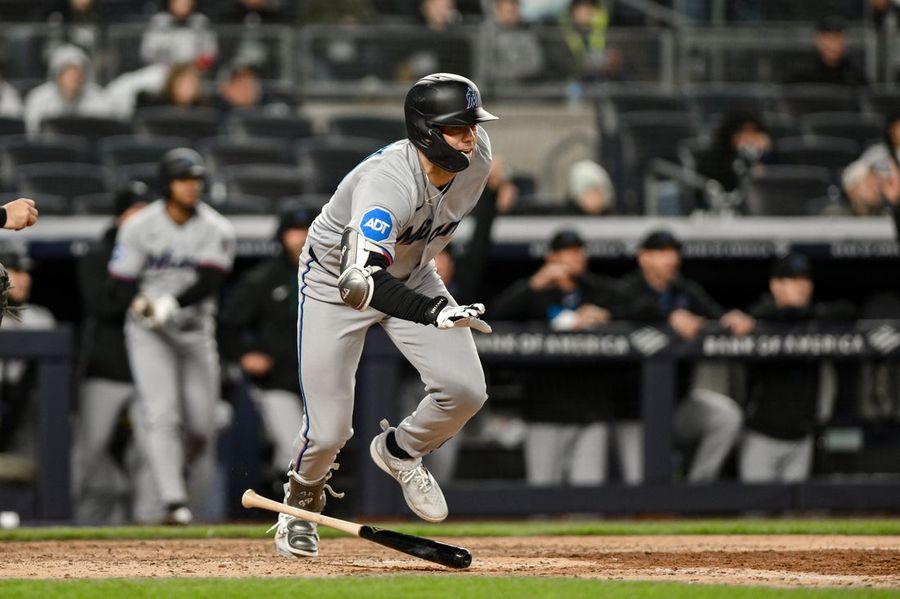
Apr 5, 2026; Bronx, New York, USA; Miami Marlins third baseman Graham Pauley (21) runs the bases after hitting a two RBI double against the New York Yankees during the eighth inning at Yankee Stadium. Mandatory Credit: John Jones-Imagn Images

Pinch hitter Graham Pauley lined a go-ahead two-run double with the bases loaded against Jake Bird to spark a four-run eighth inning and the Miami Marlins hung on for a 7-6 victory over the host New York Yankees after a lengthy rain delay Sunday.

The Marlins chipped away at an early 4-1 deficit following a pregame delay of three hours and 35 minutes and took their first lead in the eighth.

Bird (1-1) replaced Fernando Cruz after Jakob Marsee drew a one-out walk. After Bird walked Otto Lopez and hit pinch hitter Griffin Conine on the left foot, Pauley batted for Connor Norby.

Pauley gave the Marlins a 5-4 lead when he lined a sweeper down the right field line.

Xavier Edwards, who drove in three runs, followed with a two-run single off Ryan Yarbrough for a three-run lead.

New York’s Ben Rice hit a three-run homer in the first off opener Pete Fairbanks. Aaron Judge scored in the third when Lopez dropped a throw at second from Norby on a grounder by Rice.

After throwing 13 1/3 scoreless innings in his first two starts, New York’s Max Fried allowed three runs on five hits in 6 2/3 innings. Fried struck out four and walked three.

Lopez hit an RBI single off Fried as the Marlins took a lead in the first inning for the third straight game.

Edwards hit a run-scoring double in the fourth and Marsee scored in the sixth on a throwing error by shortstop Jose Caballero, trimming it to 4-3.

Fairbanks allowed three runs on three hits in a 27-pitch first inning. He served as the opener Sunday so he can leave the team and join his wife, who is expecting a child on Monday.

After Fairbanks exited and Andrew Nardi pitched the second, Chris Paddack allowed one unearned run on three hits in 4 2/3 innings. Paddack struck out four and walked four.

John King (1-0) notched the last out of the seventh and Calvin Faucher stranded a runner in the eighth. Anthony Bender allowed a two-run double to Jazz Chisholm Jr. before fanning pinch hitter J.C. Escarra to secure his first save.

The Marlins allowed nine more walks and issued 30 walks in the three-game series.

–Field Level Media

Source link
#Deadspin #Marlins #avoid #sweep #Yankees #eighthinning #surge

Previous post

Top Free Tools for Converting MP4 to GIF –

Next post

Indian Sports Wrap, April 6: Aditi finishes T-27 as Lauren Coughlin wins in Las Vegas <div id="content-body-70830957" itemprop="articleBody"><h4 class="sub_head">GOLF</h4><p>Indian golfer Aditi Ashok carded a three-over 75 in her final round to finish tied 27th at the Aramco Championship here, ending the week with an overall total of eight-over par.</p><p>Aditi dropped three bogeys in her final round — on the fourth, sixth and 17th holes — and with no birdies to offset them, signed off with a three-over par round.</p><p>She had earlier returned rounds of 74, 71 and 76 in the first three days.</p><p>Pranavi Urs carded a four-over 76 to finish tied 66th with a total of 17-over par (76-75-78-76), while Avani Prashanth returned a five-over 77 to end the week in 73rd position with an overall score of 21-over par (75-76-81-77).</p><p>Lauren Coughlin secured her third LPGA Tour title, with the 33-year-old ending her title drought since winning her second at the ISPS Handa Women’s Scottish Open in 2024.</p><p>Coughlin carded a final round of even-par 72 to beat Leona Maguire and Nelly Korda to the title by five strokes.</p><p><i>-PTI</i></p><p><b>Yellamaraju finishes T-14 at Valero Texas Open</b></p><p>Sudarshan Yellamaraju continued his fine run this week, finishing T-14 with a score of 10-under par (69-73-66-70) at the Valero Texas Open here.</p><p>Yellamaraju put together a bogey-free third round of 6-under 66, including six birdies despite rain interruptions and followed it up with a 2-under 70 final round to climb up from T-41 on the leaderboard when play was suspended on the third day to T-14 by the end of the week.</p><p>The final round included birdies on the 14th, 15th, fourth and sixth holes, and later two consecutive bogeys on the eighth and ninth holes to close the round, costing Yellamaraju miss out on his third straight top 10 finish.</p><p>All eyes were focused on Robert MacIntyre and Ludvig Aberg when play was suspended on the third day. The two looked to be in a dominant position with less than two rounds left to play.</p><p>However, it was a different story as JJ Spaun (69-69-66-67) finished the week at 17-under par after carding 6-under 66 for the third round followed by 5-under 67 to win the title by one shot as MacIntyre (66-64-72-70) finished the week in T-2 alongside Matt Wallace (71-69-64-68) and Michael Kim (72-65-66-69).</p><p><i>-PTI</i></p><p><b>India’s latest super star Kochhar all set for Mauritius after a fine show in Japan</b></p><p>Fresh from a brilliant week in Japan, Karandeep Kochhar is excited about getting to Mauritius for the IGPL Invitational 2026, hosted by Leander Paes, which is the start of the 3-leg Africa segment of the event.</p><p>The Africa leg will feature events in Mauritius, South Africa and Congo, besides one event in each of the franchise’s cities, plus two more international events.</p><p>The team format will see the two best scores being counted for each round, and the points will accumulate through the season to decide the top finishing teams among the 10 franchises. The individual winners, apart from prize money, also play for positions on the IGPL Order of Merit, which can earn them spots in the $2m International Series events across Asia, Africa and Europe.</p><p>The season-long International Series Rankings in turn provides a direct pathway to the LIV Golf League.</p><p>The 27-year-old Kochhar, who is flying in straight from Japan to Mauritius, finished tied-fifth in Japan for his second top-5 finish in three starts on the Asian Tour this year.</p><p>He is also keen to add to his tally of IGPL wins after his success at the Dubai event.</p><p>Even as he got himself ready for the event, Kochhar said, “I am excited about getting to Mauritius. I played there some years ago (2019) in the AfrAsia Bank Mauritius Open at the Anahita Course, when it was co-sanctioned by the Asian Tour, the European Tour and the Sunshine Tour. And now to be getting there for the IGPL at the same golf course is awesome.”</p><p>Kochhar commented, “I have said earlier also that to put together a Tour like the IGPL, which started not even a year ago, actually six months, and to have associations like the one with the International Series and bring events to Mauritius shows how strong the leadership is. It is awesome and kudos to the leadership and international Series, Liv Golf, and everyone involved.”</p><p><i>-PTI</i></p><h4 class="sub_head">FOOTBALL</h4><p><b>CISF men’s team secures All India Police Games title</b></p><p>The Central Industrial Security Force (CISF) secured the 74th BN Mullick Memorial All India Police Games Football Championship title after beating Goa Police 1-0 in the final at Hyderabad on Sunday.</p><p>CISF emerged as champion among a strong field of 35 teams, clinching the coveted gold medal for just the second time.</p><p>Adding further pride to the Force, the CISF women’s team, which has been recently constituted, delivered an impressive performance by securing the bronze medal among 9 participating teams. The team defeated SSB 2–0 in the third-place playoff.</p><p><i>-Team Sportstar</i></p><p class="publish-time" id="end-of-article">Published on Apr 06, 2026</p></div> #Indian #Sports #Wrap #April #Aditi #finishes #T27 #Lauren #Coughlin #wins #Las #Vegas

Victor Wembanyama gave NBA fans a good reminder not to overreact to Las Vegas Summer League after the San Antonio Spurs selected him at No. 1 overall in the 2023 NBA Draft. Wembanyama’s summer league debut was a dud as he finished with nine points on 2-of-13 shooting from the field. It’s safe to say Wemby’s career would turn out just fine after he led the Spurs to the NBA Finals in his third season at age-22.

Still, it’s hard to shake a bad first impression for rookies entering the league. Fans want to think their new players are bound to be stars, or at least dependable role players. When rookies disappoint in summer league, it’s still a bummer even it means basically nothing for the long-term outlook of their career.

Here are the rookies who have underwhelmed in summer league so far. If nothing else, it will be helpful to look back on this list if and when these players become solid contributors to show future rookies that a bad start to summer league isn’t that big of a deal.

Aday Mara, C, Oklahoma City Thunder

Mara was arguably the biggest winner of March Madness, going from a player typically projected in the mid-20s to a surefire lottery pick after Michigan’s national championship run. The Thunder selected him at No. 12 overall, and his rim protection plus high-level passing ability felt like a natural fit for their system. I was on the Mara bandwagon in the predraft process, but during my conversations with front office people and other writers I started to notice that he was perhaps the most polarizing player in the class. Some people viewed him as a low ceiling center who should be a fringe first-round pick, while others had him in the top-10.

Mara has struggled a bit away from Michigan’s amazing infrastructure at the start of his summer league run. He’s only shot 46 percent from the field through his first four games, which is pretty underwhelming for a 7’3 guy. His touch has looked shaky around the rim, and there are moments of passivity defensively. There are positive flashes on the tape too of course, like this overpowering drive and dunk, and some of his signature passing to cutters on the move. I do think it’s fair to question Mara’s scoring utility if he struggles to get deep post position because of a high center of gravity, and there’s no doubt he has to earn his early minutes on the defensive end. I’m not worried, but the Mara skeptics have a little more ammunition after this summer league run.

Dailyn Swain, G, Chicago Bulls

I had a front row seat at the NBA Draft Combine scrimmages, and was surprised to see Dailyn Swain on the court. The combine scrimmages are typically only for fringe draft picks, and by this point Swain had already solidified himself as a mid first-rounder. Even more surprising was that Swain did not play particularly well in a setting where he should have been the best player on the floor, showing a slow and hitchy release on his jumper and looking a bit lost offensively. The Bulls were undeterred and selected Swain at No. 15, but his struggles have continued through his first couple games in summer league.

Swain shot 3-of-10 from the floor in Chicago’s opener in Las Vegas, then shot 0-of-9 from the floor in his second game and 0-of-7 from the floor in the third game. The Bulls have indicated that they see him as a ball handler long-term, but he’s clearly struggled to handle against pressure thus far. That would be less of an issue if Swain had a reliable off-ball game, but right now his jumper looks as broken as ever. The Bulls did Swain no favors with this roster construction, failing to put a dependable point guard next to him that could handle against ball pressure and get him some easier shots. Instead, Swain has admitted he’s overthinking every move on the court. There have been some flashes of the downhill driving that popped this past season at Texas, but for now it’s clear Swain isn’t a point guard and needs to put plenty of work in on fixing his jumper.

Darius Acuff, G, Sacramento Kings

Acuff had a legendary scoring season at Arkansas, but sharp scouts noticed concerns with process on both ends of the floor. The point guard’s shot profile was pretty mid-range heavy, and while his three-point shooting numbers were excellent in the small college sample, they were more concerning if you include the high school data. Acuff’s real questions came on the defensive end, where he didn’t show much effort in addition to having poor tools. These concerns have continued in summer league, where Acuff has posted underwhelming scoring efficiency and ghastly defensive tape while still showing the talent that made him a certain lottery pick.

Acuff hasn’t done anything to show that his NBA defense will be better than the level he showed in college. So far, lazy closeouts, spacey off-ball defense, and a lack of hustle have been all over the tape. It often feels like he’s not actively engaged in the game when his team doesn’t have the ball. There’s going to be a high bar to meet offensively for a guard who is this poor on defense, and Acuff hasn’t been close to it yet. He’s scored 78 points on 82 shots through four games. His decision-making hasn’t been great as a passer either with 18 assists to 14 turnovers. I was way low on Acuff on my mid-season board before he started to win me over by consistently delivering in big games at Arkansas. Will the Kings ever play in any big games while he’s on the team? I hope so, because that fanbase deserves better.

Keaton Wagler, G, Los Angeles Clippers

Wagler hasn’t made anything look easy in summer league. The No. 5 pick has struggled to create separation off the dribble, he hasn’t been a plus with his playmaking, and he’s basically a non-factor on the glass. Wagler’s 8.2 PER is the worst of any top-10 pick through two summer league games despite getting hot in the second half against Utah in his second game. The athletic concerns entering the draft appear to be valid for now. Wagler just doesn’t have a lot of burst as a ball handler, and even some of his effective drives have been pretty ugly. He got dusted by Darryn Peterson on a couple occasions, including on the No. 2 pick’s poster slam where he struggled to get under a screen. With five assists and four turnovers, he looks better suited for shooting guard than point guard at the moment. Wagler has admitted that leaving Illinois’ five-out system has been challenging, and I suspected that would be the case entering the draft. Wagler is naturally going to add muscle to his thin frame as he goes on in the league, and being in an NBA strength and conditioning program should be very good for him long-term. The Clippers can give him both on-ball and off-ball reps this year, and that should be good for his development. When the off-the-dribble shot-making is falling, Wagler looks terrific. He’s far from a finished product, but Clippers fans should still be feeling encouraged long-term.

Christian Anderson, G, Charlotte Hornets

Anderson should have a shot to be Coby White’s backup as a rookie after the Hornets traded LaMelo Ball, but he’s looked pretty far away from being a real contributor during his summer league run. Through three games, Anderson has been unable to catch a rhythm with his shot while struggling with turnovers and not doing much on the defensive end. Anderson had a reputation as one of the draft’s best shooters, but his inability to play to contact inside the arc means he’s settling for a lot of tough pull-up threes right now, which has hurt his scoring efficiency (43.2 percent true shooting). I liked his live-dribble passing at Texas Tech, but the passing windows haven’t been there yet, and it’s resulted in a 6.7 percent assist rate compared to a 20.1 percent turnover rate. Anderson isn’t too big or too athletic, so it’s hard to expect him to be a monster driving to the rim. That means he’s likely going to have to live off tough shots. It’s a good thing the Hornets are one of the best offensive rebounding teams around.

Nate Ament, F, Milwaukee Bucks

While Brayden Burries has been arguably the most impressive rookie at summer league thus far, the Bucks’ other lottery pick Nate Ament hasn’t looked very assertive or effective. Ament has only scored 21 points in 65 minutes, and just doesn’t seem very comfortable getting into his shot yet. He knocked down a couple threes against the Suns, and focusing on spacing the floor and making an impact on defense is probably his best path forward early in his career. Ament has the frame to be a good defender in time, but he’s just not there yet. His awareness is pretty poor right now, and he can struggle with physicality. As long as Ament is a good three-point shooter, he’ll have some immediate utility on offense, and his defense should improve in time as the Bucks continue to beef him up. Until then, just enjoy the Brayden Burries show, Bucks fans.

#NBA #Summer #League #rookies #struggling #live #hype">6 NBA Summer League rookies struggling to live up to the hype so far  Victor Wembanyama gave NBA fans a good reminder not to overreact to Las Vegas Summer League after the San Antonio Spurs selected him at No. 1 overall in the 2023 NBA Draft. Wembanyama’s summer league debut was a dud as he finished with nine points on 2-of-13 shooting from the field. It’s safe to say Wemby’s career would turn out just fine after he led the Spurs to the NBA Finals in his third season at age-22.Still, it’s hard to shake a bad first impression for rookies entering the league. Fans want to think their new players are bound to be stars, or at least dependable role players. When rookies disappoint in summer league, it’s still a bummer even it means basically nothing for the long-term outlook of their career.Here are the rookies who have underwhelmed in summer league so far. If nothing else, it will be helpful to look back on this list if and when these players become solid contributors to show future rookies that a bad start to summer league isn’t that big of a deal.Aday Mara, C, Oklahoma City ThunderMara was arguably the biggest winner of March Madness, going from a player typically projected in the mid-20s to a surefire lottery pick after Michigan’s national championship run. The Thunder selected him at No. 12 overall, and his rim protection plus high-level passing ability felt like a natural fit for their system. I was on the Mara bandwagon in the predraft process, but during my conversations with front office people and other writers I started to notice that he was perhaps the most polarizing player in the class. Some people viewed him as a low ceiling center who should be a fringe first-round pick, while others had him in the top-10.Mara has struggled a bit away from Michigan’s amazing infrastructure at the start of his summer league run. He’s only shot 46 percent from the field through his first four games, which is pretty underwhelming for a 7’3 guy. His touch has looked shaky around the rim, and there are moments of passivity defensively. There are positive flashes on the tape too of course, like this overpowering drive and dunk, and some of his signature passing to cutters on the move. I do think it’s fair to question Mara’s scoring utility if he struggles to get deep post position because of a high center of gravity, and there’s no doubt he has to earn his early minutes on the defensive end. I’m not worried, but the Mara skeptics have a little more ammunition after this summer league run.Dailyn Swain, G, Chicago BullsI had a front row seat at the NBA Draft Combine scrimmages, and was surprised to see Dailyn Swain on the court. The combine scrimmages are typically only for fringe draft picks, and by this point Swain had already solidified himself as a mid first-rounder. Even more surprising was that Swain did not play particularly well in a setting where he should have been the best player on the floor, showing a slow and hitchy release on his jumper and looking a bit lost offensively. The Bulls were undeterred and selected Swain at No. 15, but his struggles have continued through his first couple games in summer league.Swain shot 3-of-10 from the floor in Chicago’s opener in Las Vegas, then shot 0-of-9 from the floor in his second game and 0-of-7 from the floor in the third game. The Bulls have indicated that they see him as a ball handler long-term, but he’s clearly struggled to handle against pressure thus far. That would be less of an issue if Swain had a reliable off-ball game, but right now his jumper looks as broken as ever. The Bulls did Swain no favors with this roster construction, failing to put a dependable point guard next to him that could handle against ball pressure and get him some easier shots. Instead, Swain has admitted he’s overthinking every move on the court. There have been some flashes of the downhill driving that popped this past season at Texas, but for now it’s clear Swain isn’t a point guard and needs to put plenty of work in on fixing his jumper.Darius Acuff, G, Sacramento KingsAcuff had a legendary scoring season at Arkansas, but sharp scouts noticed concerns with process on both ends of the floor. The point guard’s shot profile was pretty mid-range heavy, and while his three-point shooting numbers were excellent in the small college sample, they were more concerning if you include the high school data. Acuff’s real questions came on the defensive end, where he didn’t show much effort in addition to having poor tools. These concerns have continued in summer league, where Acuff has posted underwhelming scoring efficiency and ghastly defensive tape while still showing the talent that made him a certain lottery pick.Acuff hasn’t done anything to show that his NBA defense will be better than the level he showed in college. So far, lazy closeouts, spacey off-ball defense, and a lack of hustle have been all over the tape. It often feels like he’s not actively engaged in the game when his team doesn’t have the ball. There’s going to be a high bar to meet offensively for a guard who is this poor on defense, and Acuff hasn’t been close to it yet. He’s scored 78 points on 82 shots through four games. His decision-making hasn’t been great as a passer either with 18 assists to 14 turnovers. I was way low on Acuff on my mid-season board before he started to win me over by consistently delivering in big games at Arkansas. Will the Kings ever play in any big games while he’s on the team? I hope so, because that fanbase deserves better.Keaton Wagler, G, Los Angeles ClippersWagler hasn’t made anything look easy in summer league. The No. 5 pick has struggled to create separation off the dribble, he hasn’t been a plus with his playmaking, and he’s basically a non-factor on the glass. Wagler’s 8.2 PER is the worst of any top-10 pick through two summer league games despite getting hot in the second half against Utah in his second game. The athletic concerns entering the draft appear to be valid for now. Wagler just doesn’t have a lot of burst as a ball handler, and even some of his effective drives have been pretty ugly. He got dusted by Darryn Peterson on a couple occasions, including on the No. 2 pick’s poster slam where he struggled to get under a screen. With five assists and four turnovers, he looks better suited for shooting guard than point guard at the moment. Wagler has admitted that leaving Illinois’ five-out system has been challenging, and I suspected that would be the case entering the draft. Wagler is naturally going to add muscle to his thin frame as he goes on in the league, and being in an NBA strength and conditioning program should be very good for him long-term. The Clippers can give him both on-ball and off-ball reps this year, and that should be good for his development. When the off-the-dribble shot-making is falling, Wagler looks terrific. He’s far from a finished product, but Clippers fans should still be feeling encouraged long-term.Christian Anderson, G, Charlotte HornetsAnderson should have a shot to be Coby White’s backup as a rookie after the Hornets traded LaMelo Ball, but he’s looked pretty far away from being a real contributor during his summer league run. Through three games, Anderson has been unable to catch a rhythm with his shot while struggling with turnovers and not doing much on the defensive end. Anderson had a reputation as one of the draft’s best shooters, but his inability to play to contact inside the arc means he’s settling for a lot of tough pull-up threes right now, which has hurt his scoring efficiency (43.2 percent true shooting). I liked his live-dribble passing at Texas Tech, but the passing windows haven’t been there yet, and it’s resulted in a 6.7 percent assist rate compared to a 20.1 percent turnover rate. Anderson isn’t too big or too athletic, so it’s hard to expect him to be a monster driving to the rim. That means he’s likely going to have to live off tough shots. It’s a good thing the Hornets are one of the best offensive rebounding teams around.Nate Ament, F, Milwaukee BucksWhile Brayden Burries has been arguably the most impressive rookie at summer league thus far, the Bucks’ other lottery pick Nate Ament hasn’t looked very assertive or effective. Ament has only scored 21 points in 65 minutes, and just doesn’t seem very comfortable getting into his shot yet. He knocked down a couple threes against the Suns, and focusing on spacing the floor and making an impact on defense is probably his best path forward early in his career. Ament has the frame to be a good defender in time, but he’s just not there yet. His awareness is pretty poor right now, and he can struggle with physicality. As long as Ament is a good three-point shooter, he’ll have some immediate utility on offense, and his defense should improve in time as the Bucks continue to beef him up. Until then, just enjoy the Brayden Burries show, Bucks fans.  #NBA #Summer #League #rookies #struggling #live #hype

Wembanyama’s summer league debut was a dud as he finished with nine points on 2-of-13 shooting from the field. It’s safe to say Wemby’s career would turn out just fine after he led the Spurs to the NBA Finals in his third season at age-22.

Still, it’s hard to shake a bad first impression for rookies entering the league. Fans want to think their new players are bound to be stars, or at least dependable role players. When rookies disappoint in summer league, it’s still a bummer even it means basically nothing for the long-term outlook of their career.

Here are the rookies who have underwhelmed in summer league so far. If nothing else, it will be helpful to look back on this list if and when these players become solid contributors to show future rookies that a bad start to summer league isn’t that big of a deal.

Aday Mara, C, Oklahoma City Thunder

Mara was arguably the biggest winner of March Madness, going from a player typically projected in the mid-20s to a surefire lottery pick after Michigan’s national championship run. The Thunder selected him at No. 12 overall, and his rim protection plus high-level passing ability felt like a natural fit for their system. I was on the Mara bandwagon in the predraft process, but during my conversations with front office people and other writers I started to notice that he was perhaps the most polarizing player in the class. Some people viewed him as a low ceiling center who should be a fringe first-round pick, while others had him in the top-10.

Mara has struggled a bit away from Michigan’s amazing infrastructure at the start of his summer league run. He’s only shot 46 percent from the field through his first four games, which is pretty underwhelming for a 7’3 guy. His touch has looked shaky around the rim, and there are moments of passivity defensively. There are positive flashes on the tape too of course, like this overpowering drive and dunk, and some of his signature passing to cutters on the move. I do think it’s fair to question Mara’s scoring utility if he struggles to get deep post position because of a high center of gravity, and there’s no doubt he has to earn his early minutes on the defensive end. I’m not worried, but the Mara skeptics have a little more ammunition after this summer league run.

Dailyn Swain, G, Chicago Bulls

I had a front row seat at the NBA Draft Combine scrimmages, and was surprised to see Dailyn Swain on the court. The combine scrimmages are typically only for fringe draft picks, and by this point Swain had already solidified himself as a mid first-rounder. Even more surprising was that Swain did not play particularly well in a setting where he should have been the best player on the floor, showing a slow and hitchy release on his jumper and looking a bit lost offensively. The Bulls were undeterred and selected Swain at No. 15, but his struggles have continued through his first couple games in summer league.

Swain shot 3-of-10 from the floor in Chicago’s opener in Las Vegas, then shot 0-of-9 from the floor in his second game and 0-of-7 from the floor in the third game. The Bulls have indicated that they see him as a ball handler long-term, but he’s clearly struggled to handle against pressure thus far. That would be less of an issue if Swain had a reliable off-ball game, but right now his jumper looks as broken as ever. The Bulls did Swain no favors with this roster construction, failing to put a dependable point guard next to him that could handle against ball pressure and get him some easier shots. Instead, Swain has admitted he’s overthinking every move on the court. There have been some flashes of the downhill driving that popped this past season at Texas, but for now it’s clear Swain isn’t a point guard and needs to put plenty of work in on fixing his jumper.

Darius Acuff, G, Sacramento Kings

Acuff had a legendary scoring season at Arkansas, but sharp scouts noticed concerns with process on both ends of the floor. The point guard’s shot profile was pretty mid-range heavy, and while his three-point shooting numbers were excellent in the small college sample, they were more concerning if you include the high school data. Acuff’s real questions came on the defensive end, where he didn’t show much effort in addition to having poor tools. These concerns have continued in summer league, where Acuff has posted underwhelming scoring efficiency and ghastly defensive tape while still showing the talent that made him a certain lottery pick.

Acuff hasn’t done anything to show that his NBA defense will be better than the level he showed in college. So far, lazy closeouts, spacey off-ball defense, and a lack of hustle have been all over the tape. It often feels like he’s not actively engaged in the game when his team doesn’t have the ball. There’s going to be a high bar to meet offensively for a guard who is this poor on defense, and Acuff hasn’t been close to it yet. He’s scored 78 points on 82 shots through four games. His decision-making hasn’t been great as a passer either with 18 assists to 14 turnovers. I was way low on Acuff on my mid-season board before he started to win me over by consistently delivering in big games at Arkansas. Will the Kings ever play in any big games while he’s on the team? I hope so, because that fanbase deserves better.

Keaton Wagler, G, Los Angeles Clippers

Wagler hasn’t made anything look easy in summer league. The No. 5 pick has struggled to create separation off the dribble, he hasn’t been a plus with his playmaking, and he’s basically a non-factor on the glass. Wagler’s 8.2 PER is the worst of any top-10 pick through two summer league games despite getting hot in the second half against Utah in his second game. The athletic concerns entering the draft appear to be valid for now. Wagler just doesn’t have a lot of burst as a ball handler, and even some of his effective drives have been pretty ugly. He got dusted by Darryn Peterson on a couple occasions, including on the No. 2 pick’s poster slam where he struggled to get under a screen. With five assists and four turnovers, he looks better suited for shooting guard than point guard at the moment. Wagler has admitted that leaving Illinois’ five-out system has been challenging, and I suspected that would be the case entering the draft. Wagler is naturally going to add muscle to his thin frame as he goes on in the league, and being in an NBA strength and conditioning program should be very good for him long-term. The Clippers can give him both on-ball and off-ball reps this year, and that should be good for his development. When the off-the-dribble shot-making is falling, Wagler looks terrific. He’s far from a finished product, but Clippers fans should still be feeling encouraged long-term.

Christian Anderson, G, Charlotte Hornets

Anderson should have a shot to be Coby White’s backup as a rookie after the Hornets traded LaMelo Ball, but he’s looked pretty far away from being a real contributor during his summer league run. Through three games, Anderson has been unable to catch a rhythm with his shot while struggling with turnovers and not doing much on the defensive end. Anderson had a reputation as one of the draft’s best shooters, but his inability to play to contact inside the arc means he’s settling for a lot of tough pull-up threes right now, which has hurt his scoring efficiency (43.2 percent true shooting). I liked his live-dribble passing at Texas Tech, but the passing windows haven’t been there yet, and it’s resulted in a 6.7 percent assist rate compared to a 20.1 percent turnover rate. Anderson isn’t too big or too athletic, so it’s hard to expect him to be a monster driving to the rim. That means he’s likely going to have to live off tough shots. It’s a good thing the Hornets are one of the best offensive rebounding teams around.

Nate Ament, F, Milwaukee Bucks

While Brayden Burries has been arguably the most impressive rookie at summer league thus far, the Bucks’ other lottery pick Nate Ament hasn’t looked very assertive or effective. Ament has only scored 21 points in 65 minutes, and just doesn’t seem very comfortable getting into his shot yet. He knocked down a couple threes against the Suns, and focusing on spacing the floor and making an impact on defense is probably his best path forward early in his career. Ament has the frame to be a good defender in time, but he’s just not there yet. His awareness is pretty poor right now, and he can struggle with physicality. As long as Ament is a good three-point shooter, he’ll have some immediate utility on offense, and his defense should improve in time as the Bucks continue to beef him up. Until then, just enjoy the Brayden Burries show, Bucks fans.

#NBA #Summer #League #rookies #struggling #live #hype">6 NBA Summer League rookies struggling to live up to the hype so far

Victor Wembanyama gave NBA fans a good reminder not to overreact to Las Vegas Summer League after the San Antonio Spurs selected him at No. 1 overall in the 2023 NBA Draft. Wembanyama’s summer league debut was a dud as he finished with nine points on 2-of-13 shooting from the field. It’s safe to say Wemby’s career would turn out just fine after he led the Spurs to the NBA Finals in his third season at age-22.

Still, it’s hard to shake a bad first impression for rookies entering the league. Fans want to think their new players are bound to be stars, or at least dependable role players. When rookies disappoint in summer league, it’s still a bummer even it means basically nothing for the long-term outlook of their career.

Here are the rookies who have underwhelmed in summer league so far. If nothing else, it will be helpful to look back on this list if and when these players become solid contributors to show future rookies that a bad start to summer league isn’t that big of a deal.

Aday Mara, C, Oklahoma City Thunder

Mara was arguably the biggest winner of March Madness, going from a player typically projected in the mid-20s to a surefire lottery pick after Michigan’s national championship run. The Thunder selected him at No. 12 overall, and his rim protection plus high-level passing ability felt like a natural fit for their system. I was on the Mara bandwagon in the predraft process, but during my conversations with front office people and other writers I started to notice that he was perhaps the most polarizing player in the class. Some people viewed him as a low ceiling center who should be a fringe first-round pick, while others had him in the top-10.

Mara has struggled a bit away from Michigan’s amazing infrastructure at the start of his summer league run. He’s only shot 46 percent from the field through his first four games, which is pretty underwhelming for a 7’3 guy. His touch has looked shaky around the rim, and there are moments of passivity defensively. There are positive flashes on the tape too of course, like this overpowering drive and dunk, and some of his signature passing to cutters on the move. I do think it’s fair to question Mara’s scoring utility if he struggles to get deep post position because of a high center of gravity, and there’s no doubt he has to earn his early minutes on the defensive end. I’m not worried, but the Mara skeptics have a little more ammunition after this summer league run.

Dailyn Swain, G, Chicago Bulls

I had a front row seat at the NBA Draft Combine scrimmages, and was surprised to see Dailyn Swain on the court. The combine scrimmages are typically only for fringe draft picks, and by this point Swain had already solidified himself as a mid first-rounder. Even more surprising was that Swain did not play particularly well in a setting where he should have been the best player on the floor, showing a slow and hitchy release on his jumper and looking a bit lost offensively. The Bulls were undeterred and selected Swain at No. 15, but his struggles have continued through his first couple games in summer league.

Swain shot 3-of-10 from the floor in Chicago’s opener in Las Vegas, then shot 0-of-9 from the floor in his second game and 0-of-7 from the floor in the third game. The Bulls have indicated that they see him as a ball handler long-term, but he’s clearly struggled to handle against pressure thus far. That would be less of an issue if Swain had a reliable off-ball game, but right now his jumper looks as broken as ever. The Bulls did Swain no favors with this roster construction, failing to put a dependable point guard next to him that could handle against ball pressure and get him some easier shots. Instead, Swain has admitted he’s overthinking every move on the court. There have been some flashes of the downhill driving that popped this past season at Texas, but for now it’s clear Swain isn’t a point guard and needs to put plenty of work in on fixing his jumper.

Darius Acuff, G, Sacramento Kings

Acuff had a legendary scoring season at Arkansas, but sharp scouts noticed concerns with process on both ends of the floor. The point guard’s shot profile was pretty mid-range heavy, and while his three-point shooting numbers were excellent in the small college sample, they were more concerning if you include the high school data. Acuff’s real questions came on the defensive end, where he didn’t show much effort in addition to having poor tools. These concerns have continued in summer league, where Acuff has posted underwhelming scoring efficiency and ghastly defensive tape while still showing the talent that made him a certain lottery pick.

Acuff hasn’t done anything to show that his NBA defense will be better than the level he showed in college. So far, lazy closeouts, spacey off-ball defense, and a lack of hustle have been all over the tape. It often feels like he’s not actively engaged in the game when his team doesn’t have the ball. There’s going to be a high bar to meet offensively for a guard who is this poor on defense, and Acuff hasn’t been close to it yet. He’s scored 78 points on 82 shots through four games. His decision-making hasn’t been great as a passer either with 18 assists to 14 turnovers. I was way low on Acuff on my mid-season board before he started to win me over by consistently delivering in big games at Arkansas. Will the Kings ever play in any big games while he’s on the team? I hope so, because that fanbase deserves better.

Keaton Wagler, G, Los Angeles Clippers

Wagler hasn’t made anything look easy in summer league. The No. 5 pick has struggled to create separation off the dribble, he hasn’t been a plus with his playmaking, and he’s basically a non-factor on the glass. Wagler’s 8.2 PER is the worst of any top-10 pick through two summer league games despite getting hot in the second half against Utah in his second game. The athletic concerns entering the draft appear to be valid for now. Wagler just doesn’t have a lot of burst as a ball handler, and even some of his effective drives have been pretty ugly. He got dusted by Darryn Peterson on a couple occasions, including on the No. 2 pick’s poster slam where he struggled to get under a screen. With five assists and four turnovers, he looks better suited for shooting guard than point guard at the moment. Wagler has admitted that leaving Illinois’ five-out system has been challenging, and I suspected that would be the case entering the draft. Wagler is naturally going to add muscle to his thin frame as he goes on in the league, and being in an NBA strength and conditioning program should be very good for him long-term. The Clippers can give him both on-ball and off-ball reps this year, and that should be good for his development. When the off-the-dribble shot-making is falling, Wagler looks terrific. He’s far from a finished product, but Clippers fans should still be feeling encouraged long-term.

Christian Anderson, G, Charlotte Hornets

Anderson should have a shot to be Coby White’s backup as a rookie after the Hornets traded LaMelo Ball, but he’s looked pretty far away from being a real contributor during his summer league run. Through three games, Anderson has been unable to catch a rhythm with his shot while struggling with turnovers and not doing much on the defensive end. Anderson had a reputation as one of the draft’s best shooters, but his inability to play to contact inside the arc means he’s settling for a lot of tough pull-up threes right now, which has hurt his scoring efficiency (43.2 percent true shooting). I liked his live-dribble passing at Texas Tech, but the passing windows haven’t been there yet, and it’s resulted in a 6.7 percent assist rate compared to a 20.1 percent turnover rate. Anderson isn’t too big or too athletic, so it’s hard to expect him to be a monster driving to the rim. That means he’s likely going to have to live off tough shots. It’s a good thing the Hornets are one of the best offensive rebounding teams around.

Nate Ament, F, Milwaukee Bucks

While Brayden Burries has been arguably the most impressive rookie at summer league thus far, the Bucks’ other lottery pick Nate Ament hasn’t looked very assertive or effective. Ament has only scored 21 points in 65 minutes, and just doesn’t seem very comfortable getting into his shot yet. He knocked down a couple threes against the Suns, and focusing on spacing the floor and making an impact on defense is probably his best path forward early in his career. Ament has the frame to be a good defender in time, but he’s just not there yet. His awareness is pretty poor right now, and he can struggle with physicality. As long as Ament is a good three-point shooter, he’ll have some immediate utility on offense, and his defense should improve in time as the Bucks continue to beef him up. Until then, just enjoy the Brayden Burries show, Bucks fans.

#NBA #Summer #League #rookies #struggling #live #hype

By breakfast, the World Cup semifinal had already begun. Hotel lobbies, elevators and street corners around downtown had become meeting points for two of football’s most passionate travelling nations. Argentinians, draped in sky blue and white, cradled their morning mate long before the first beer found its way into their hands. England supporters, wrapped in the white of the Three Lions, preferred to begin the day at the nearest pub, where breakfast arrived mostly in liquid form.

They exchanged smiles, songs and the occasional jab, but beneath the banter was the unmistakable tension that only England against Argentina can summon. This was never just another World Cup semifinal. It was a rivalry that had travelled from Antonio Rattín to Diego Maradona, from David Beckham to Lionel Messi, and was now in Atlanta for the latest battle.

Match Report –Argentina beats England to reach final

Argentina appeared to understand the emotional assignment from the opening whistle. There was an extra spring in every stride and greater force in every collision. Its players clattered into challenges, chased lost causes and celebrated tackles.

More than four decades have passed since the Falklands War, but in Argentina, the islands remain Las Malvinas, part of a national wound that has never completely healed. The 1982 conflict lasted from April 2 to June 14 and ended with Argentina’s surrender. Six hundred and forty-nine Argentine servicemen, 255 British personnel and three civilians were killed.

The dispute has endured across politics, public memory and football. For many Argentinians, an encounter with England cannot be separated entirely from the young men who left for the South Atlantic and never returned.

Maradona understood that instinctively. Four years after the war, he scored twice against England at the Azteca, first with the Hand of God and then with perhaps the greatest goal the World Cup has ever witnessed. Maradona would later describe the victory as revenge. For Argentina, those four minutes in 1986 are more than sporting history. They became part of the country’s mythology.

Malvinas, Maradona and Messi: Argentina draws strength from past and present to defeat England  By breakfast, the World Cup semifinal had already begun. Hotel lobbies, elevators and street corners around downtown had become meeting points for two of football’s most passionate travelling nations. Argentinians, draped in sky blue and white, cradled their morning mate long before the first beer found its way into their hands. England supporters, wrapped in the white of the Three Lions, preferred to begin the day at the nearest pub, where breakfast arrived mostly in liquid form.They exchanged smiles, songs and the occasional jab, but beneath the banter was the unmistakable tension that only England against Argentina can summon. This was never just another World Cup semifinal. It was a rivalry that had travelled from Antonio Rattín to Diego Maradona, from David Beckham to Lionel Messi, and was now in Atlanta for the latest battle.Match Report –Argentina beats England to reach finalArgentina appeared to understand the emotional assignment from the opening whistle. There was an extra spring in every stride and greater force in every collision. Its players clattered into challenges, chased lost causes and celebrated tackles.More than four decades have passed since the Falklands War, but in Argentina, the islands remain Las Malvinas, part of a national wound that has never completely healed. The 1982 conflict lasted from April 2 to June 14 and ended with Argentina’s surrender. Six hundred and forty-nine Argentine servicemen, 255 British personnel and three civilians were killed.The dispute has endured across politics, public memory and football. For many Argentinians, an encounter with England cannot be separated entirely from the young men who left for the South Atlantic and never returned.Maradona understood that instinctively. Four years after the war, he scored twice against England at the Azteca, first with the Hand of God and then with perhaps the greatest goal the World Cup has ever witnessed. Maradona would later describe the victory as revenge. For Argentina, those four minutes in 1986 are more than sporting history. They became part of the country’s mythology. Maradona gave Argentina one of football’s defining moments. Messi ensured the story would continue, not as a replay but as another chapter.
                                                            | Photo Credit: 
                                REUTERS
                            

                            Maradona gave Argentina one of football’s defining moments. Messi ensured the story would continue, not as a replay but as another chapter.
                                                            | Photo Credit: 
                                REUTERS
                                                    Maradona’s image has appeared across stadiums in the United States, along with those of Messi, the heir who eventually delivered the trophy Diego had once lifted. His name has been sung from Dallas to Atlanta, invoked not as a distant memory but as a continuing presence.After Argentina’s dramatic victory over Egypt in the round of 16, the players sang and danced in their dressing room to        La Cuarta Estrella (The Fourth Star), the anthem that has followed the team through its title defence.“I’m Argentine from the cradle to the grave,For Malvinas, for Diego, for Leo’s last one,Argentina, I want to see you become champions again.”The words place the Malvinas, Maradona and Messi within the same national story, where sacrifice, memory and football are intertwined.On Wednesday, Argentina played as though it all still mattered.And when the victory was finally secured, there was a connection between the past and present. Giovani Lo Celso and Nicolas Otamendi unfurled a banner reading: “       Las Malvinas son Argentinas”, or “The Malvinas (Falkland Islands) are Argentine.”It was neither an incidental gesture nor an improvised celebration. It was a message delivered after England was defeated again.Long after the final whistle, Argentina’s players and supporters remained united in celebration. The team stood facing the sky-blue-and-white end, singing and dancing with those who had followed it across cities, time zones and thousands of miles. Players drifted towards the tunnel only to return, lured back by another chorus from the stands.For Argentina, England has never been just another opponent. Forty-four years after the Falklands War and four decades after Maradona transformed this rivalry forever, another generation had carried that history into another World Cup final.Published on Jul 16, 2026  #Malvinas #Maradona #Messi #Argentina #draws #strength #present #defeat #England

Maradona gave Argentina one of football’s defining moments. Messi ensured the story would continue, not as a replay but as another chapter. | Photo Credit: REUTERS

lightbox-info

Maradona gave Argentina one of football’s defining moments. Messi ensured the story would continue, not as a replay but as another chapter. | Photo Credit: REUTERS

Maradona’s image has appeared across stadiums in the United States, along with those of Messi, the heir who eventually delivered the trophy Diego had once lifted. His name has been sung from Dallas to Atlanta, invoked not as a distant memory but as a continuing presence.

After Argentina’s dramatic victory over Egypt in the round of 16, the players sang and danced in their dressing room to La Cuarta Estrella (The Fourth Star), the anthem that has followed the team through its title defence.

“I’m Argentine from the cradle to the grave,

For Malvinas, for Diego, for Leo’s last one,

Argentina, I want to see you become champions again.”

The words place the Malvinas, Maradona and Messi within the same national story, where sacrifice, memory and football are intertwined.

On Wednesday, Argentina played as though it all still mattered.

And when the victory was finally secured, there was a connection between the past and present. Giovani Lo Celso and Nicolas Otamendi unfurled a banner reading: “ Las Malvinas son Argentinas”, or “The Malvinas (Falkland Islands) are Argentine.”

It was neither an incidental gesture nor an improvised celebration. It was a message delivered after England was defeated again.

Long after the final whistle, Argentina’s players and supporters remained united in celebration. The team stood facing the sky-blue-and-white end, singing and dancing with those who had followed it across cities, time zones and thousands of miles. Players drifted towards the tunnel only to return, lured back by another chorus from the stands.

For Argentina, England has never been just another opponent. Forty-four years after the Falklands War and four decades after Maradona transformed this rivalry forever, another generation had carried that history into another World Cup final.

Published on Jul 16, 2026

#Malvinas #Maradona #Messi #Argentina #draws #strength #present #defeat #England">Malvinas, Maradona and Messi: Argentina draws strength from past and present to defeat England  By breakfast, the World Cup semifinal had already begun. Hotel lobbies, elevators and street corners around downtown had become meeting points for two of football’s most passionate travelling nations. Argentinians, draped in sky blue and white, cradled their morning mate long before the first beer found its way into their hands. England supporters, wrapped in the white of the Three Lions, preferred to begin the day at the nearest pub, where breakfast arrived mostly in liquid form.They exchanged smiles, songs and the occasional jab, but beneath the banter was the unmistakable tension that only England against Argentina can summon. This was never just another World Cup semifinal. It was a rivalry that had travelled from Antonio Rattín to Diego Maradona, from David Beckham to Lionel Messi, and was now in Atlanta for the latest battle.Match Report –Argentina beats England to reach finalArgentina appeared to understand the emotional assignment from the opening whistle. There was an extra spring in every stride and greater force in every collision. Its players clattered into challenges, chased lost causes and celebrated tackles.More than four decades have passed since the Falklands War, but in Argentina, the islands remain Las Malvinas, part of a national wound that has never completely healed. The 1982 conflict lasted from April 2 to June 14 and ended with Argentina’s surrender. Six hundred and forty-nine Argentine servicemen, 255 British personnel and three civilians were killed.The dispute has endured across politics, public memory and football. For many Argentinians, an encounter with England cannot be separated entirely from the young men who left for the South Atlantic and never returned.Maradona understood that instinctively. Four years after the war, he scored twice against England at the Azteca, first with the Hand of God and then with perhaps the greatest goal the World Cup has ever witnessed. Maradona would later describe the victory as revenge. For Argentina, those four minutes in 1986 are more than sporting history. They became part of the country’s mythology. Maradona gave Argentina one of football’s defining moments. Messi ensured the story would continue, not as a replay but as another chapter.
                                                            | Photo Credit: 
                                REUTERS
                            

                            Maradona gave Argentina one of football’s defining moments. Messi ensured the story would continue, not as a replay but as another chapter.
                                                            | Photo Credit: 
                                REUTERS
                                                    Maradona’s image has appeared across stadiums in the United States, along with those of Messi, the heir who eventually delivered the trophy Diego had once lifted. His name has been sung from Dallas to Atlanta, invoked not as a distant memory but as a continuing presence.After Argentina’s dramatic victory over Egypt in the round of 16, the players sang and danced in their dressing room to        La Cuarta Estrella (The Fourth Star), the anthem that has followed the team through its title defence.“I’m Argentine from the cradle to the grave,For Malvinas, for Diego, for Leo’s last one,Argentina, I want to see you become champions again.”The words place the Malvinas, Maradona and Messi within the same national story, where sacrifice, memory and football are intertwined.On Wednesday, Argentina played as though it all still mattered.And when the victory was finally secured, there was a connection between the past and present. Giovani Lo Celso and Nicolas Otamendi unfurled a banner reading: “       Las Malvinas son Argentinas”, or “The Malvinas (Falkland Islands) are Argentine.”It was neither an incidental gesture nor an improvised celebration. It was a message delivered after England was defeated again.Long after the final whistle, Argentina’s players and supporters remained united in celebration. The team stood facing the sky-blue-and-white end, singing and dancing with those who had followed it across cities, time zones and thousands of miles. Players drifted towards the tunnel only to return, lured back by another chorus from the stands.For Argentina, England has never been just another opponent. Forty-four years after the Falklands War and four decades after Maradona transformed this rivalry forever, another generation had carried that history into another World Cup final.Published on Jul 16, 2026  #Malvinas #Maradona #Messi #Argentina #draws #strength #present #defeat #England

Argentina beats England to reach final

Argentina appeared to understand the emotional assignment from the opening whistle. There was an extra spring in every stride and greater force in every collision. Its players clattered into challenges, chased lost causes and celebrated tackles.

More than four decades have passed since the Falklands War, but in Argentina, the islands remain Las Malvinas, part of a national wound that has never completely healed. The 1982 conflict lasted from April 2 to June 14 and ended with Argentina’s surrender. Six hundred and forty-nine Argentine servicemen, 255 British personnel and three civilians were killed.

The dispute has endured across politics, public memory and football. For many Argentinians, an encounter with England cannot be separated entirely from the young men who left for the South Atlantic and never returned.

Maradona understood that instinctively. Four years after the war, he scored twice against England at the Azteca, first with the Hand of God and then with perhaps the greatest goal the World Cup has ever witnessed. Maradona would later describe the victory as revenge. For Argentina, those four minutes in 1986 are more than sporting history. They became part of the country’s mythology.

Malvinas, Maradona and Messi: Argentina draws strength from past and present to defeat England  By breakfast, the World Cup semifinal had already begun. Hotel lobbies, elevators and street corners around downtown had become meeting points for two of football’s most passionate travelling nations. Argentinians, draped in sky blue and white, cradled their morning mate long before the first beer found its way into their hands. England supporters, wrapped in the white of the Three Lions, preferred to begin the day at the nearest pub, where breakfast arrived mostly in liquid form.They exchanged smiles, songs and the occasional jab, but beneath the banter was the unmistakable tension that only England against Argentina can summon. This was never just another World Cup semifinal. It was a rivalry that had travelled from Antonio Rattín to Diego Maradona, from David Beckham to Lionel Messi, and was now in Atlanta for the latest battle.Match Report –Argentina beats England to reach finalArgentina appeared to understand the emotional assignment from the opening whistle. There was an extra spring in every stride and greater force in every collision. Its players clattered into challenges, chased lost causes and celebrated tackles.More than four decades have passed since the Falklands War, but in Argentina, the islands remain Las Malvinas, part of a national wound that has never completely healed. The 1982 conflict lasted from April 2 to June 14 and ended with Argentina’s surrender. Six hundred and forty-nine Argentine servicemen, 255 British personnel and three civilians were killed.The dispute has endured across politics, public memory and football. For many Argentinians, an encounter with England cannot be separated entirely from the young men who left for the South Atlantic and never returned.Maradona understood that instinctively. Four years after the war, he scored twice against England at the Azteca, first with the Hand of God and then with perhaps the greatest goal the World Cup has ever witnessed. Maradona would later describe the victory as revenge. For Argentina, those four minutes in 1986 are more than sporting history. They became part of the country’s mythology. Maradona gave Argentina one of football’s defining moments. Messi ensured the story would continue, not as a replay but as another chapter.
                                                            | Photo Credit: 
                                REUTERS
                            

                            Maradona gave Argentina one of football’s defining moments. Messi ensured the story would continue, not as a replay but as another chapter.
                                                            | Photo Credit: 
                                REUTERS
                                                    Maradona’s image has appeared across stadiums in the United States, along with those of Messi, the heir who eventually delivered the trophy Diego had once lifted. His name has been sung from Dallas to Atlanta, invoked not as a distant memory but as a continuing presence.After Argentina’s dramatic victory over Egypt in the round of 16, the players sang and danced in their dressing room to        La Cuarta Estrella (The Fourth Star), the anthem that has followed the team through its title defence.“I’m Argentine from the cradle to the grave,For Malvinas, for Diego, for Leo’s last one,Argentina, I want to see you become champions again.”The words place the Malvinas, Maradona and Messi within the same national story, where sacrifice, memory and football are intertwined.On Wednesday, Argentina played as though it all still mattered.And when the victory was finally secured, there was a connection between the past and present. Giovani Lo Celso and Nicolas Otamendi unfurled a banner reading: “       Las Malvinas son Argentinas”, or “The Malvinas (Falkland Islands) are Argentine.”It was neither an incidental gesture nor an improvised celebration. It was a message delivered after England was defeated again.Long after the final whistle, Argentina’s players and supporters remained united in celebration. The team stood facing the sky-blue-and-white end, singing and dancing with those who had followed it across cities, time zones and thousands of miles. Players drifted towards the tunnel only to return, lured back by another chorus from the stands.For Argentina, England has never been just another opponent. Forty-four years after the Falklands War and four decades after Maradona transformed this rivalry forever, another generation had carried that history into another World Cup final.Published on Jul 16, 2026  #Malvinas #Maradona #Messi #Argentina #draws #strength #present #defeat #England

Maradona gave Argentina one of football’s defining moments. Messi ensured the story would continue, not as a replay but as another chapter. | Photo Credit: REUTERS

lightbox-info

Maradona gave Argentina one of football’s defining moments. Messi ensured the story would continue, not as a replay but as another chapter. | Photo Credit: REUTERS

Maradona’s image has appeared across stadiums in the United States, along with those of Messi, the heir who eventually delivered the trophy Diego had once lifted. His name has been sung from Dallas to Atlanta, invoked not as a distant memory but as a continuing presence.

After Argentina’s dramatic victory over Egypt in the round of 16, the players sang and danced in their dressing room to La Cuarta Estrella (The Fourth Star), the anthem that has followed the team through its title defence.

“I’m Argentine from the cradle to the grave,

For Malvinas, for Diego, for Leo’s last one,

Argentina, I want to see you become champions again.”

The words place the Malvinas, Maradona and Messi within the same national story, where sacrifice, memory and football are intertwined.

On Wednesday, Argentina played as though it all still mattered.

And when the victory was finally secured, there was a connection between the past and present. Giovani Lo Celso and Nicolas Otamendi unfurled a banner reading: “ Las Malvinas son Argentinas”, or “The Malvinas (Falkland Islands) are Argentine.”

It was neither an incidental gesture nor an improvised celebration. It was a message delivered after England was defeated again.

Long after the final whistle, Argentina’s players and supporters remained united in celebration. The team stood facing the sky-blue-and-white end, singing and dancing with those who had followed it across cities, time zones and thousands of miles. Players drifted towards the tunnel only to return, lured back by another chorus from the stands.

For Argentina, England has never been just another opponent. Forty-four years after the Falklands War and four decades after Maradona transformed this rivalry forever, another generation had carried that history into another World Cup final.

Published on Jul 16, 2026

#Malvinas #Maradona #Messi #Argentina #draws #strength #present #defeat #England">Malvinas, Maradona and Messi: Argentina draws strength from past and present to defeat England

By breakfast, the World Cup semifinal had already begun. Hotel lobbies, elevators and street corners around downtown had become meeting points for two of football’s most passionate travelling nations. Argentinians, draped in sky blue and white, cradled their morning mate long before the first beer found its way into their hands. England supporters, wrapped in the white of the Three Lions, preferred to begin the day at the nearest pub, where breakfast arrived mostly in liquid form.

They exchanged smiles, songs and the occasional jab, but beneath the banter was the unmistakable tension that only England against Argentina can summon. This was never just another World Cup semifinal. It was a rivalry that had travelled from Antonio Rattín to Diego Maradona, from David Beckham to Lionel Messi, and was now in Atlanta for the latest battle.

Match Report –Argentina beats England to reach final

Argentina appeared to understand the emotional assignment from the opening whistle. There was an extra spring in every stride and greater force in every collision. Its players clattered into challenges, chased lost causes and celebrated tackles.

More than four decades have passed since the Falklands War, but in Argentina, the islands remain Las Malvinas, part of a national wound that has never completely healed. The 1982 conflict lasted from April 2 to June 14 and ended with Argentina’s surrender. Six hundred and forty-nine Argentine servicemen, 255 British personnel and three civilians were killed.

The dispute has endured across politics, public memory and football. For many Argentinians, an encounter with England cannot be separated entirely from the young men who left for the South Atlantic and never returned.

Maradona understood that instinctively. Four years after the war, he scored twice against England at the Azteca, first with the Hand of God and then with perhaps the greatest goal the World Cup has ever witnessed. Maradona would later describe the victory as revenge. For Argentina, those four minutes in 1986 are more than sporting history. They became part of the country’s mythology.

Malvinas, Maradona and Messi: Argentina draws strength from past and present to defeat England  By breakfast, the World Cup semifinal had already begun. Hotel lobbies, elevators and street corners around downtown had become meeting points for two of football’s most passionate travelling nations. Argentinians, draped in sky blue and white, cradled their morning mate long before the first beer found its way into their hands. England supporters, wrapped in the white of the Three Lions, preferred to begin the day at the nearest pub, where breakfast arrived mostly in liquid form.They exchanged smiles, songs and the occasional jab, but beneath the banter was the unmistakable tension that only England against Argentina can summon. This was never just another World Cup semifinal. It was a rivalry that had travelled from Antonio Rattín to Diego Maradona, from David Beckham to Lionel Messi, and was now in Atlanta for the latest battle.Match Report –Argentina beats England to reach finalArgentina appeared to understand the emotional assignment from the opening whistle. There was an extra spring in every stride and greater force in every collision. Its players clattered into challenges, chased lost causes and celebrated tackles.More than four decades have passed since the Falklands War, but in Argentina, the islands remain Las Malvinas, part of a national wound that has never completely healed. The 1982 conflict lasted from April 2 to June 14 and ended with Argentina’s surrender. Six hundred and forty-nine Argentine servicemen, 255 British personnel and three civilians were killed.The dispute has endured across politics, public memory and football. For many Argentinians, an encounter with England cannot be separated entirely from the young men who left for the South Atlantic and never returned.Maradona understood that instinctively. Four years after the war, he scored twice against England at the Azteca, first with the Hand of God and then with perhaps the greatest goal the World Cup has ever witnessed. Maradona would later describe the victory as revenge. For Argentina, those four minutes in 1986 are more than sporting history. They became part of the country’s mythology. Maradona gave Argentina one of football’s defining moments. Messi ensured the story would continue, not as a replay but as another chapter.
                                                            | Photo Credit: 
                                REUTERS
                            

                            Maradona gave Argentina one of football’s defining moments. Messi ensured the story would continue, not as a replay but as another chapter.
                                                            | Photo Credit: 
                                REUTERS
                                                    Maradona’s image has appeared across stadiums in the United States, along with those of Messi, the heir who eventually delivered the trophy Diego had once lifted. His name has been sung from Dallas to Atlanta, invoked not as a distant memory but as a continuing presence.After Argentina’s dramatic victory over Egypt in the round of 16, the players sang and danced in their dressing room to        La Cuarta Estrella (The Fourth Star), the anthem that has followed the team through its title defence.“I’m Argentine from the cradle to the grave,For Malvinas, for Diego, for Leo’s last one,Argentina, I want to see you become champions again.”The words place the Malvinas, Maradona and Messi within the same national story, where sacrifice, memory and football are intertwined.On Wednesday, Argentina played as though it all still mattered.And when the victory was finally secured, there was a connection between the past and present. Giovani Lo Celso and Nicolas Otamendi unfurled a banner reading: “       Las Malvinas son Argentinas”, or “The Malvinas (Falkland Islands) are Argentine.”It was neither an incidental gesture nor an improvised celebration. It was a message delivered after England was defeated again.Long after the final whistle, Argentina’s players and supporters remained united in celebration. The team stood facing the sky-blue-and-white end, singing and dancing with those who had followed it across cities, time zones and thousands of miles. Players drifted towards the tunnel only to return, lured back by another chorus from the stands.For Argentina, England has never been just another opponent. Forty-four years after the Falklands War and four decades after Maradona transformed this rivalry forever, another generation had carried that history into another World Cup final.Published on Jul 16, 2026  #Malvinas #Maradona #Messi #Argentina #draws #strength #present #defeat #England

Maradona gave Argentina one of football’s defining moments. Messi ensured the story would continue, not as a replay but as another chapter. | Photo Credit: REUTERS

lightbox-info

Maradona gave Argentina one of football’s defining moments. Messi ensured the story would continue, not as a replay but as another chapter. | Photo Credit: REUTERS

Maradona’s image has appeared across stadiums in the United States, along with those of Messi, the heir who eventually delivered the trophy Diego had once lifted. His name has been sung from Dallas to Atlanta, invoked not as a distant memory but as a continuing presence.

After Argentina’s dramatic victory over Egypt in the round of 16, the players sang and danced in their dressing room to La Cuarta Estrella (The Fourth Star), the anthem that has followed the team through its title defence.

“I’m Argentine from the cradle to the grave,

For Malvinas, for Diego, for Leo’s last one,

Argentina, I want to see you become champions again.”

The words place the Malvinas, Maradona and Messi within the same national story, where sacrifice, memory and football are intertwined.

On Wednesday, Argentina played as though it all still mattered.

And when the victory was finally secured, there was a connection between the past and present. Giovani Lo Celso and Nicolas Otamendi unfurled a banner reading: “ Las Malvinas son Argentinas”, or “The Malvinas (Falkland Islands) are Argentine.”

It was neither an incidental gesture nor an improvised celebration. It was a message delivered after England was defeated again.

Long after the final whistle, Argentina’s players and supporters remained united in celebration. The team stood facing the sky-blue-and-white end, singing and dancing with those who had followed it across cities, time zones and thousands of miles. Players drifted towards the tunnel only to return, lured back by another chorus from the stands.

For Argentina, England has never been just another opponent. Forty-four years after the Falklands War and four decades after Maradona transformed this rivalry forever, another generation had carried that history into another World Cup final.

Published on Jul 16, 2026

#Malvinas #Maradona #Messi #Argentina #draws #strength #present #defeat #England

Post Comment