×
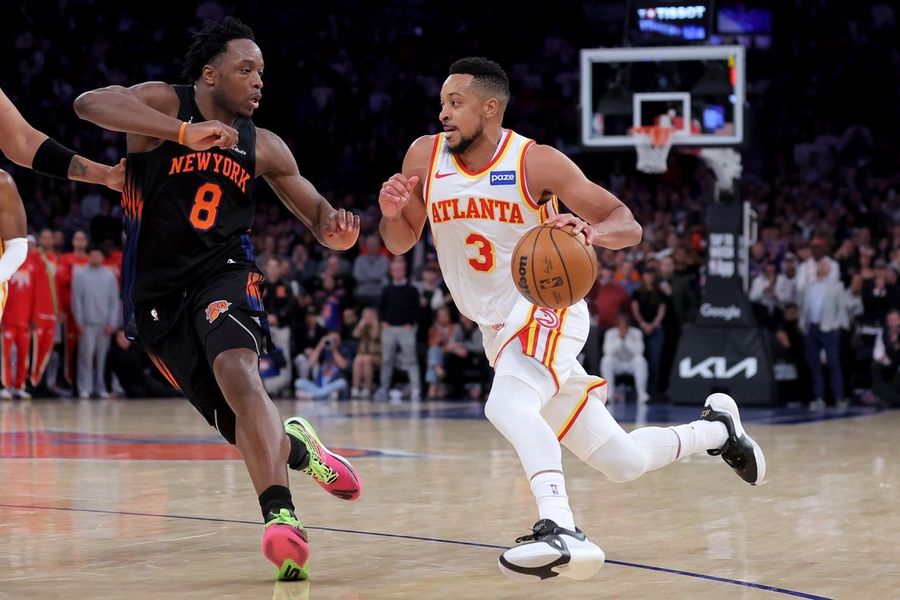
Deadspin | NBA roundup: Behind CJ McCollum, Hawks rally to even series with Knicks  Apr 20, 2026; New York, New York, USA; Atlanta Hawks guard CJ McCollum (3) drives to the basket against New York Knicks forward OG Anunoby (8) during the fourth quarter of game two of the first round of the 2026 NBA Playoffs at Madison Square Garden. Mandatory Credit: Brad Penner-Imagn Images   CJ McCollum scored six of his game-high 32 points in the final two-plus minutes Monday night for the visiting Atlanta Hawks, who stormed back from an eight-point deficit in the last five minutes to stun the New York Knicks 107-106 in Game 2 of an Eastern Conference first-round series.  The Hawks ended on a 15-6 run to even the best-of-seven series at a game apiece.  McCollum missed two free throws with 5.6 seconds left. The Knicks had a timeout left, but they pushed the ball up the court and Josh Hart dished to Mikal Bridges, who missed a 12-foot attempt for the win from the left wing as time expired.  Jonathan Kuminga had 19 points off the bench for the Hawks while Jalen Johnson (17 points) and Onyeka Okongwu (15 points) also got into double figures. Jalen Brunson scored 29 points for the Knicks. Hart recorded 15 points and 13 rebounds, while Karl-Anthony Towns had 18 points.  Cavaliers 115, Raptors 105  Donovan Mitchell scored nine of his 30 points in the fourth quarter and James Harden had 28 points, lifting Cleveland over visiting Toronto for a 2-0 lead in their Eastern Conference first-round series.  The Cavaliers beat Toronto for the 12th straight time in the playoffs, tying the NBA record for consecutive playoff wins over a single opponent. Mitchell added seven boards and five assists, while Harden also had five steals and four assists. Evan Mobley had 25 points and eight rebounds.   Scottie Barnes scored a playoff career-high 26 points for the Raptors, who never led.  Timberwolves 119, Nuggets 114  Anthony Edwards posted 30 points and 10 rebounds, Donte DiVincenzo hit a clutch 3-pointer with 1:05 left, and visiting Minnesota rallied from a 19-point deficit to beat Denver in Game 2 to level their playoff series.  Julius Randle had 24 points and nine rebounds and hit two free throws with 18.8 seconds left to help Minnesota even the Western Conference quarterfinal matchup. DiVincenzo finished with 16 points and Jaden McDaniels had 14 points.  Jamal Murray had 30 points for the second straight game and Nikola Jokic added 24 points, 15 rebounds and eight assists for Denver, which lost for the first time since March 18.  –Field Level Media   #Deadspin #NBA #roundup #McCollum #Hawks #rally #series #Knicks
Deadspin | NBA roundup: Behind CJ McCollum, Hawks rally to even series with Knicks
Deadspin | NBA roundup: Behind CJ McCollum, Hawks rally to even series with Knicks  Apr 20, 2026; New York, New York, USA; Atlanta Hawks guard CJ McCollum (3) drives to the basket against New York Knicks forward OG Anunoby (8) during the fourth quarter of game two of the first round of the 2026 NBA Playoffs at Madison Square Garden. Mandatory Credit: Brad Penner-Imagn Images   CJ McCollum scored six of his game-high 32 points in the final two-plus minutes Monday night for the visiting Atlanta Hawks, who stormed back from an eight-point deficit in the last five minutes to stun the New York Knicks 107-106 in Game 2 of an Eastern Conference first-round series.  The Hawks ended on a 15-6 run to even the best-of-seven series at a game apiece.  McCollum missed two free throws with 5.6 seconds left. The Knicks had a timeout left, but they pushed the ball up the court and Josh Hart dished to Mikal Bridges, who missed a 12-foot attempt for the win from the left wing as time expired.  Jonathan Kuminga had 19 points off the bench for the Hawks while Jalen Johnson (17 points) and Onyeka Okongwu (15 points) also got into double figures. Jalen Brunson scored 29 points for the Knicks. Hart recorded 15 points and 13 rebounds, while Karl-Anthony Towns had 18 points.  Cavaliers 115, Raptors 105  Donovan Mitchell scored nine of his 30 points in the fourth quarter and James Harden had 28 points, lifting Cleveland over visiting Toronto for a 2-0 lead in their Eastern Conference first-round series.  The Cavaliers beat Toronto for the 12th straight time in the playoffs, tying the NBA record for consecutive playoff wins over a single opponent. Mitchell added seven boards and five assists, while Harden also had five steals and four assists. Evan Mobley had 25 points and eight rebounds.   Scottie Barnes scored a playoff career-high 26 points for the Raptors, who never led.  Timberwolves 119, Nuggets 114  Anthony Edwards posted 30 points and 10 rebounds, Donte DiVincenzo hit a clutch 3-pointer with 1:05 left, and visiting Minnesota rallied from a 19-point deficit to beat Denver in Game 2 to level their playoff series.  Julius Randle had 24 points and nine rebounds and hit two free throws with 18.8 seconds left to help Minnesota even the Western Conference quarterfinal matchup. DiVincenzo finished with 16 points and Jaden McDaniels had 14 points.  Jamal Murray had 30 points for the second straight game and Nikola Jokic added 24 points, 15 rebounds and eight assists for Denver, which lost for the first time since March 18.  –Field Level Media   #Deadspin #NBA #roundup #McCollum #Hawks #rally #series #KnicksApr 20, 2026; New York, New York, USA; Atlanta Hawks guard CJ McCollum (3) drives to the basket against New York Knicks forward OG Anunoby (8) during the fourth quarter of game two of the first round of the 2026 NBA Playoffs at Madison Square Garden. Mandatory Credit: Brad Penner-Imagn Images

CJ McCollum scored six of his game-high 32 points in the final two-plus minutes Monday night for the visiting Atlanta Hawks, who stormed back from an eight-point deficit in the last five minutes to stun the New York Knicks 107-106 in Game 2 of an Eastern Conference first-round series.

The Hawks ended on a 15-6 run to even the best-of-seven series at a game apiece.

McCollum missed two free throws with 5.6 seconds left. The Knicks had a timeout left, but they pushed the ball up the court and Josh Hart dished to Mikal Bridges, who missed a 12-foot attempt for the win from the left wing as time expired.

Jonathan Kuminga had 19 points off the bench for the Hawks while Jalen Johnson (17 points) and Onyeka Okongwu (15 points) also got into double figures. Jalen Brunson scored 29 points for the Knicks. Hart recorded 15 points and 13 rebounds, while Karl-Anthony Towns had 18 points.

Cavaliers 115, Raptors 105

Donovan Mitchell scored nine of his 30 points in the fourth quarter and James Harden had 28 points, lifting Cleveland over visiting Toronto for a 2-0 lead in their Eastern Conference first-round series.


The Cavaliers beat Toronto for the 12th straight time in the playoffs, tying the NBA record for consecutive playoff wins over a single opponent. Mitchell added seven boards and five assists, while Harden also had five steals and four assists. Evan Mobley had 25 points and eight rebounds.

Scottie Barnes scored a playoff career-high 26 points for the Raptors, who never led.

Timberwolves 119, Nuggets 114

Anthony Edwards posted 30 points and 10 rebounds, Donte DiVincenzo hit a clutch 3-pointer with 1:05 left, and visiting Minnesota rallied from a 19-point deficit to beat Denver in Game 2 to level their playoff series.

Julius Randle had 24 points and nine rebounds and hit two free throws with 18.8 seconds left to help Minnesota even the Western Conference quarterfinal matchup. DiVincenzo finished with 16 points and Jaden McDaniels had 14 points.

Jamal Murray had 30 points for the second straight game and Nikola Jokic added 24 points, 15 rebounds and eight assists for Denver, which lost for the first time since March 18.

–Field Level Media

#Deadspin #NBA #roundup #McCollum #Hawks #rally #series #Knicks

Apr 20, 2026; New York, New York, USA; Atlanta Hawks guard CJ McCollum (3) drives to the basket against New York Knicks forward OG Anunoby (8) during the fourth quarter of game two of the first round of the 2026 NBA Playoffs at Madison Square Garden. Mandatory Credit: Brad Penner-Imagn Images

CJ McCollum scored six of his game-high 32 points in the final two-plus minutes Monday night for the visiting Atlanta Hawks, who stormed back from an eight-point deficit in the last five minutes to stun the New York Knicks 107-106 in Game 2 of an Eastern Conference first-round series.

The Hawks ended on a 15-6 run to even the best-of-seven series at a game apiece.

McCollum missed two free throws with 5.6 seconds left. The Knicks had a timeout left, but they pushed the ball up the court and Josh Hart dished to Mikal Bridges, who missed a 12-foot attempt for the win from the left wing as time expired.

Jonathan Kuminga had 19 points off the bench for the Hawks while Jalen Johnson (17 points) and Onyeka Okongwu (15 points) also got into double figures. Jalen Brunson scored 29 points for the Knicks. Hart recorded 15 points and 13 rebounds, while Karl-Anthony Towns had 18 points.

Cavaliers 115, Raptors 105

Donovan Mitchell scored nine of his 30 points in the fourth quarter and James Harden had 28 points, lifting Cleveland over visiting Toronto for a 2-0 lead in their Eastern Conference first-round series.

The Cavaliers beat Toronto for the 12th straight time in the playoffs, tying the NBA record for consecutive playoff wins over a single opponent. Mitchell added seven boards and five assists, while Harden also had five steals and four assists. Evan Mobley had 25 points and eight rebounds.

Scottie Barnes scored a playoff career-high 26 points for the Raptors, who never led.

Timberwolves 119, Nuggets 114

Anthony Edwards posted 30 points and 10 rebounds, Donte DiVincenzo hit a clutch 3-pointer with 1:05 left, and visiting Minnesota rallied from a 19-point deficit to beat Denver in Game 2 to level their playoff series.

Julius Randle had 24 points and nine rebounds and hit two free throws with 18.8 seconds left to help Minnesota even the Western Conference quarterfinal matchup. DiVincenzo finished with 16 points and Jaden McDaniels had 14 points.

Jamal Murray had 30 points for the second straight game and Nikola Jokic added 24 points, 15 rebounds and eight assists for Denver, which lost for the first time since March 18.

–Field Level Media

Source link
#Deadspin #NBA #roundup #McCollum #Hawks #rally #series #Knicks

Previous post

AAI reminds archers of whereabouts obligations in light of Prathamesh, Sukhmani suspensions <div id="content-body-70888395" itemprop="articleBody"><p>Compound archer Prathamesh Jawkar’s whereabouts failure resulting in a two-year suspension has prompted the Archery Association of India (AAI) to remind archers of their obligation to comply with the mandatory whereabouts requirements under anti-doping rules.</p><p>Recently, Jawkar, an Asian Games men’s team gold winner and a World Cup medallist, accepted a two-year suspension after being charged by the International Testing Agency (ITA) for missing deadlines to file his whereabouts three times within 12 months. His suspension, which will continue up to the third week of April in 2028, will make him ineligible to participate in this year’s Asian Games and the Los Angeles Olympics (as he cannot participate in the selection trials).</p><p>An AAI circular on Tuesday underlined that all athletes, especially those who are in the registered testing pool (RTP), “are personally responsible” to submit accurate and complete whereabouts information on a quarterly basis through Anti-Doping Administration and Management System (ADAMS).</p><p><b>ALSO READ | <a href="https://sportstar.thehindu.com/other-sports/prathamesh-jawkar-2-year-ban-whereabouts-failure-admits-negligence/article70881023.ece" target="_blank" rel="nofollow">Asiad gold medallist Prathamesh banned for two years for whereabouts failure, admits ‘sheer negligence’ on his part</a></b></p><p>It instructed coaches and other support staff to ensure that archers stayed fully informed about their anti-doping responsibilities, assist them in understanding and using the ADAMS, monitor compliance timelines and reinforce adherence to submission requirements and encourage disciplined and proactive management of whereabouts obligations.</p><p>“In view of upcoming international competition calendar(s), including the Asian Games and the 2028 Los Angeles Olympic Games, all athletes are strongly advised to treat whereabouts compliance as a critical and integral part of their professional responsibilities.”</p><p>Meanwhile, recurve archer Sukhmani Babrekar, a World youth team silver medallist, has been provisionally suspended after testing positive for a banned substance.</p><p class="publish-time" id="end-of-article">Published on Apr 21, 2026</p></div> #AAI #reminds #archers #whereabouts #obligations #light #Prathamesh #Sukhmani #suspensions

Next post

I’ve Tested Gaming Laptops for Over a Decade. This Is What I Think You Should Buy<div><div data-testid="feature-large-callout" class="CalloutFeatureLargeWrapper-hpnRzB cHvmdz"><div class="UnifiedProductCardBody-fMbTZU bUpxRz product-embed" data-item="{"ctaHref":"https://cna.st/p/22c1wduVeXVMKFq3ccSg4AqLJefrJzurhfmMoKwnQvRn7kANGpz6UQ3Jp1KHsH4eG5e8QJVNhxme6ADLDmDVGyxYYpVfr3Zhx3z11nu9GBWDnKWjSujjz7nkh9K1LRDe2GV3SV4oJSddxYeYrihy6EZVFG7smXxe7vQiESb7ih3jGxPH5rDH7Kw7PzUfCQcHHSt5qoC3KA5P25g74mymHuWgZUAztLb6KSrZYeKecSDo2Z2EYCsBLR4RhMmz9BfcQineWsfq8UepzavG4CgQozgRoWTui96kvHAkweKnihBGvjkjrCpKd7mXqUnFxkJyPYUQvE9UvWseaNBUronXBgJhdw65373D9q1adhCmiB3wLzw6ZztKxQp8R64w1qfW65otSkhEws6t4wvoNavqyWpf6Comn4yDndcuRZ3rkL9L5pNNfoB7JtpHspByLcdY6gbPzGQjoZmvw1eQpTnyZM7SJiypTBfKVY7oNt6tjLQVyoQA86mCGGaLZDc9GD7UtxLSNCgKUx2Lz","dangerousDek":"","productBrand":"Lenovo","dangerousHed":"Legion 7i Gen 10 (16 Inch, Intel)","embedSize":"feature-medium","isFirstProduct":false,"isSponsored":false,"offerRetailer":"Best Buy","offerUrl":"https://www.bestbuy.com/product/lenovo-legion-7i-16-2-5k-oled-gaming-laptop-intel-core-ultra-7-255hx-32gb-memory-nvidia-geforce-rtx-5060-1tb-ssd-glacier-white/JJGSH3Y5RG","contentType":"product","productId":"68c1d0536ac3209ef6d5ac2d","showOfferUrl":false,"showPriceOnButton":true,"showAffiliateDisclaimerOnFirstProduct":false,"dangerousCredit":"Photograph: Luke Larsen","showLocalisedOffers":true,"hasCheckPriceFeature":false,"isUpcEnabled":true,"showClampedProductDescription":true,"productDescriptionLineLength":5,"hasReadMoreFeature":false,"index":2,"hasAffiliateLinkDisabled":false,"isMobileView":false,"showMultipleImageCount":4,"hasProsConsFeature":false,"hasRatingFeature":false,"pros":[],"cons":[],"rating":"","shouldUseAmazonPrimeDayLiveAPIData":true,"contentInfo":{"contentUrl":"https://www.wired.com/story/best-gaming-laptops/","contentName":"The Best Gaming Laptops"},"enableGtmFixesIntersectionObserver":true,"enableGtmFixesUseRef":true,"textBadge":null,"seal":null,"id":"68c1d0536ac3209ef6d5ac2d","brand":{"name":"Lenovo"},"offers":[{"offerUrl":"https://www.bestbuy.com/product/lenovo-legion-7i-16-2-5k-oled-gaming-laptop-intel-core-ultra-7-255hx-32gb-memory-nvidia-geforce-rtx-5060-1tb-ssd-glacier-white/JJGSH3Y5RG","price":"$1,900","currency":"USD","purchaseUri":"https://cna.st/p/22c1wduVeXVMKFq3ccSg4AqLJefrJzurhfmMoKwnQvRn7kANGpz6UQ3Jp1KHsH4eG5e8QJVNhxme6ADLDmDVGyxYYpVfr3Zhx3z11nu9GBWDnKWjSujjz7nkh9K1LRDe2GV3SV4oJSddxYeYrihy6EZVFG7smXxe7vQiESb7ih3jGxPH5rDH7Kw7PzUfCQcHHSt5qoC3KA5P25g74mymHuWgZUAztLb6KSrZYeKecSDo2Z2EYCsBLR4RhMmz9BfcQineWsfq8UepzavG4CgQozgRoWTui96kvHAkweKnihBGvjkjrCpKd7mXqUnFxkJyPYUQvE9UvWseaNBUronXBgJhdw65373D9q1adhCmiB3wLzw6ZztKxQp8R64w1qfW65otSkhEws6t4wvoNavqyWpf6Comn4yDndcuRZ3rkL9L5pNNfoB7JtpHspByLcdY6gbPzGQjoZmvw1eQpTnyZM7SJiypTBfKVY7oNt6tjLQVyoQA86mCGGaLZDc9GD7UtxLSNCgKUx2Lz","sellerName":"Best Buy","countryCode":"US","offerId":"68c1d0da2d65008dfd6c8982","reducedPrice":""},{"offerUrl":"https://www.lenovo.com/us/en/p/laptops/legion-laptops/legion-7-series/lenovo-legion-7i-gen-10-16-inch-intel/len101g0044","price":"$1,870","currency":"USD","purchaseUri":"https://cna.st/p/KtzSRSAm7Y9UgitW7ze4FkZxYpgwPcxtuXkeUFHJ55abfDGugbqaZ3Gz7WTee3yFtDyRkmPhqDK4njUKdZ54tdVfH4Jb8dzmoyZZWw2Q2pEHqCdrpUNsx8oxTJM2xAFi2KAGdFnoWLXuL4mohdjMob8zoU52WGW4zCCkAHNzUvQ6seTNexLtc83WqxJJiebMAAEF9gYvhm1fJnEZaquzdazBqSXSKyN44yLuocTrmA2Y3t8pytydsx2kQiQUS5Tcye2NvAh6BP91SaT3p4qjmoM7Awy9ouvuAJsmbY2hYuyCdG3aoMoupoBM3zCd9zcjZh43fJ5B2tbGzfUQB5FhnLYmEkeZ7fvXpqqYvGkDuVUTSeGmtSqBFYMcsrkyGgjUb6GEPnvou8UyMiRTqzmq9uawWmMo7o2v3DHxz4BdXgZNNTZrqtT14tsVVv3kKCCqYfV9hmP8","sellerName":"Lenovo","countryCode":"US","offerId":"68c1d0da2d65008dfd6c8983","reducedPrice":""}],"component":"enhanced_product_card","total_index":4,"hasMultipleImage":true,"showProsConsData":false,"videoIds":[],"offersLength":2,"hasBookmarkingFeature":true}"><div id="68c1d0536ac3209ef6d5ac2d" class="UnifiedLandscapeProductCardWrapper-hlWSjM ikhoaM"><div class="UnifiedProductCardContainer-kDfsJX cHmSPP"><div class="UnifiedProductCardDetailsContainer-jCVwIh iJkbMI"><div class="UnifiedProductCardDetailsWrapper-cqZhsd btLktU"><div class="UnifiedProductCardDetails-bjjeGO liVXRw"><p class="BaseText-fEwdHD UnifiedProductCardBrandName-jTSGxk cnPGxR hwMlki upc-brandName">Lenovo</p><p><h3 id="upc_68c1d0536ac3209ef6d5ac2d" type="embed" class="BaseText-fEwdHD UnifiedProductCardName-jkGINH gILlPd dbzJAn">Legion 7i Gen 10 (16 Inch, Intel)</h3></p></div></div></div></div></div></div></div><p class="paywall">Now, there’s another class of high-end gaming laptop that focuses more on performance than being thin or portable. The <a href="https://www.wired.com/review/lenovo-legion-7i-gen-10/" target="_blank" class="text link">Lenovo Legion 7i Gen 10</a> is one of my favorites in this class, featuring a beautiful white chassis and glossy OLED display. Unlike some OLED displays, the Legion 7i’s screen can be cranked up to over 1,000 nits of brightness. The result is some really splendid HDR performance that brings games to life. HDR is a powerful way of improving the visuals of your games without a performance cost. The Legion 7i Gen 10 is one of the very best in this regard.</p><p class="paywall">It’s still fairly thin at 0.7 inches thick too, while a lot of the ports are found on the back. It’s the definition of a “clean” gaming laptop. It’s no slouch when it comes to performance either, offering either the RTX 5070 Ti or RTX 5080 for graphics.</p><p><h2 class="paywall">Cheap Gaming Laptops That Are Worth It</h2></p><p class="paywall">No gaming laptops worth buying are actually cheap. High-refresh rate displays and discrete graphics will always make them more expensive than standard laptops. But as you get closer to $1,000, there is one laptop I always come back to: the <a href="https://www.wired.com/review/lenovo-loq-15/" target="_blank" class="text link">Lenovo LOQ 15</a>. Pronounced “Lock,” this Lenovo subbrand is known for cutting the fluff and focusing on giving gamers the performance they need at an affordable price. No laptop does that better than the LOQ 15. Many laptop manufacturers sell their RTX 5060 configurations for hundreds of dollars more. In reality, if you’re shopping around $1,000, there’s no reason to not buy the LOQ 15. Just do it.</p><p class="paywall">If you do want to save some extra cash, there is another option that is cheaper than the LOQ 15 with a few compromises in key areas. The <a href="https://www.wired.com/review/acer-nitro-v-16-ai/" target="_blank" class="text link">Acer Nitro V 16</a> is that laptop, which comes with an RTX 5050. This was as affordable as $600 at one point last year—before prices on laptops have risen due to the ongoing <a href="https://www.wired.com/story/solving-the-pc-memory-crisis/" class="text link">memory shortage</a>—but it remains the only laptop cheaper than the Lenovo LOQ 15 that’s actually worth it. It’s fairly powerful for the RTX 5050, and while the screen is pretty shoddy, it’s not a bad-looking laptop. The one big caveat is that the 135-watt power supply it comes with doesn’t deliver quite enough power to keep it charged in Performance mode. Read more about this issue in my review, as it’s important to know about if you’re planning to buy it.</p><p class="paywall">There are other <a href="https://www.wired.com/gallery/best-cheap-gaming-laptops/" target="_blank" class="text link">cheap gaming laptops</a> out there I’ve tested, such as the <a data-offer-url="https://www.bestbuy.com/product/msi-cyborg-a15-ai-15-144hz-fhd-gaming-laptop-amd-r7-260-nvidia-geforce-rtx-5060-16gb-memory-1tb-ssd-translucent-black/J3P7TXH78T/sku/6643263?utm_source=feed&extStoreId=&ref=212&loc=18517490525&gclsrc=aw.ds&gad_source=1&gad_campaignid=18511379706&gbraid=0AAAAAD-ORIgY63loZdrStEy0dVCZKnTb5&gclid=CjwKCAjwtIfPBhAzEiwAv9RTJpJw4G2wfxKY4Rz4NAL1BV3oVf75uUDj8yPleuX-nWq_n_JbTS1msRoCHIQQAvD_BwE" class="external-link text link" data-event-click="{"element":"ExternalLink","outgoingURL":"https://cna.st/affiliate-link/25h1MWpop8vwnrVJARkE6KpHoNYC6wKCGee3xe6djQJDCcBeK6B5qAZ814Re5TPSsuaQKsLnuHxc62PNEdpEMYAUaAz91NsHy8iVGZrKJ2P8Cre4Jqbi7Gs2iZ5xTsMaStKhhMi7gKFE414isyGC8eHs92FSx8vh1SShuULSgYDEdSrqjBbdK1cnkhBgeRYEZSf65PAW6QWDVG3bTU91gGRx9pdJfrxFEQGr6ShTUZAhVeDXq8wWi9ZGB2Dmh5Logz2bdmTHZFRDKdkiqr65dJcnsGR3dup83Zew82S9izueT6og5dp7JkNW37zrJE3etiottiDsmeaxA6Nw6u8sn7cGQgnfQ99psjYjvkJAcGgz8C8nymS2mLuKQVp8UZK9V4CPN92arpyoRLA112msF4TTMpQUKdnAZcDRC2xJ2jbBLKKXdVdNaeUAenxC8WbLWYkcMgnemjqqimk9JCaNoG3vNoQrdYKaUUHaA4PX5mokzr9QNHLHsG9837K8eHHxmKWB5si44mm3AUJMGJLj3qF63CnerpRRuHsxXvPNYXV97Mhdedbd5fijtcqPBbd1t7R8bVfn1JVnBik7J1CzSJE6ugo9CUrD5H5a5MoVg9Y6tannwrQ2ehQiukW8CJ1GXbYEnoBoMTrDGF2F76fNC6zSkxi8LCziXhAVtKGsbK6csuQ4veuWb9bBQEiWFPSXc6EUqXeKxDGGLAq5jftWpfqtduGTCH5EwbeVcV2q3uDhMGwQw9zhn7aN7M5XRaqhz3QeQw2Hz4r"}" href="https://cna.st/affiliate-link/25h1MWpop8vwnrVJARkE6KpHoNYC6wKCGee3xe6djQJDCcBeK6B5qAZ814Re5TPSsuaQKsLnuHxc62PNEdpEMYAUaAz91NsHy8iVGZrKJ2P8Cre4Jqbi7Gs2iZ5xTsMaStKhhMi7gKFE414isyGC8eHs92FSx8vh1SShuULSgYDEdSrqjBbdK1cnkhBgeRYEZSf65PAW6QWDVG3bTU91gGRx9pdJfrxFEQGr6ShTUZAhVeDXq8wWi9ZGB2Dmh5Logz2bdmTHZFRDKdkiqr65dJcnsGR3dup83Zew82S9izueT6og5dp7JkNW37zrJE3etiottiDsmeaxA6Nw6u8sn7cGQgnfQ99psjYjvkJAcGgz8C8nymS2mLuKQVp8UZK9V4CPN92arpyoRLA112msF4TTMpQUKdnAZcDRC2xJ2jbBLKKXdVdNaeUAenxC8WbLWYkcMgnemjqqimk9JCaNoG3vNoQrdYKaUUHaA4PX5mokzr9QNHLHsG9837K8eHHxmKWB5si44mm3AUJMGJLj3qF63CnerpRRuHsxXvPNYXV97Mhdedbd5fijtcqPBbd1t7R8bVfn1JVnBik7J1CzSJE6ugo9CUrD5H5a5MoVg9Y6tannwrQ2ehQiukW8CJ1GXbYEnoBoMTrDGF2F76fNC6zSkxi8LCziXhAVtKGsbK6csuQ4veuWb9bBQEiWFPSXc6EUqXeKxDGGLAq5jftWpfqtduGTCH5EwbeVcV2q3uDhMGwQw9zhn7aN7M5XRaqhz3QeQw2Hz4r" rel="sponsored" target="_blank" data-aps-asin="J3P7TXH78T" data-aps-asc-tag="w050b-20">MSI Cyborg A15</a>, but either the Acer Nitro V 16 or Lenovo LOQ 15 are better, cheaper options. You will also find lots of gaming laptops under $1,000 that use older graphics cards, such as the RTX 4050 or 3050. In general, I’d recommend staying away from these. They’re only one or two generations back, but remember: Nvidia only releases new laptop graphics cards every couple of years. So, an RTX 4050 laptop may be well over two years old already, and an RTX 3050 is over five years old. Not only do you get worse graphics performance, these laptops are much more likely to need to be replaced sooner.</p><p><h2 class="paywall">Experimental Stuff</h2></p><p class="paywall">One of the exciting things about the world of gaming laptops right now is the experimentation. While clamshell gaming laptops with a conventional Nvidia GPU are the most standard way to go, there’s a few different ways to take your PC games on the go that stretch the boundaries. You might consider a <a href="https://www.wired.com/gallery/best-gaming-handhelds/" target="_blank" class="text link">gaming handheld</a>, for example, like the Steam Deck or <a data-offer-url="https://www.amazon.com/dp/B0FM6C3ZMN" class="external-link text link" data-event-click="{"element":"ExternalLink","outgoingURL":"https://cna.st/affiliate-link/JPgapTEkadqSqezutS26aQoEoA3UP2nKnfQBXaNbWJkYejXSy8Fv6Ciwidf8sf8umdUKUKhJCzukFHaTUg9JEY8UsgSbhmA3PJA9TB9rDbmnx7mqcq1PurSVd2q7c6XBNA7Ubbhoh8EwDgZKa3dg7sa6AQyHZyQsuguVqGYnwKdGckLQFcrxqnSW9Xf5x639cpmTvtEsdUXVxtaHJdZz26eeU2aKzeL4HoWn9d6qSCqVBHgMCBZ28Nj7hWWaU4SpU2"}" href="https://cna.st/affiliate-link/JPgapTEkadqSqezutS26aQoEoA3UP2nKnfQBXaNbWJkYejXSy8Fv6Ciwidf8sf8umdUKUKhJCzukFHaTUg9JEY8UsgSbhmA3PJA9TB9rDbmnx7mqcq1PurSVd2q7c6XBNA7Ubbhoh8EwDgZKa3dg7sa6AQyHZyQsuguVqGYnwKdGckLQFcrxqnSW9Xf5x639cpmTvtEsdUXVxtaHJdZz26eeU2aKzeL4HoWn9d6qSCqVBHgMCBZ28Nj7hWWaU4SpU2" rel="sponsored" target="_blank" data-aps-asin="B0FM6C3ZMN" data-aps-asc-tag="w050b-20">Xbox Ally X</a>. These handhelds have their fans, and while you can’t also do your homework on these devices, they’re great on couches, trains, and planes.</p><div data-testid="feature-large-callout" class="CalloutFeatureLargeWrapper-hpnRzB cHvmdz"><div class="UnifiedProductCardBody-fMbTZU bUpxRz product-embed" data-item="{"ctaHref":"https://cna.st/p/2dJkVVomr493wZpxNmNZuXEaketYsYCxbPNBSSdqBnA5FRcc4F9XBupcv3GAAwEP59chQAspwpJL7NwqbaiQmMzgMXKneZABFMFDJ1uesMbCy7aaoUGaABSk9DZQg2FiiZyJbDoQLDWvQafi3v3ZHGFKADnRonPc4ijpxNEK1ez1nN3caZwgRAHivZsXJzXtXatBD7RvwkBmdyWDkTq4w8oQHg8Cq7oYkVLJo7HkV6NKCh3MaotQRPZdevetkLPd3wD3EcX263qra4rKuZzSyNC3eUELqRBhmS8wPC1KRoqSJf11z8urwvbvvg7cDpe3ocHimUSoJVqwYmFEmi7BDxBjVG4Yk52cYhMMnUJfQDmJvkuANCedBPex1MwqPo6Dd8B8JhhCSXAAiQMv2ePbJuHd2XnCoMn9p","dangerousDek":"","productBrand":"Asus","dangerousHed":"ROG Flow Z13 (2025)","embedSize":"feature-medium","isFirstProduct":false,"isSponsored":false,"offerRetailer":"Asus","offerUrl":"https://shop.asus.com/us/rog/90nr0jy1-m001l0-rog-flow-z13-2025.html?config=90NR0JY1-M001L0","contentType":"product","productId":"67f364f36f8031630dc3c1cc","showOfferUrl":false,"showPriceOnButton":true,"showAffiliateDisclaimerOnFirstProduct":false,"dangerousCredit":"Photograph: Luke Larsen","showLocalisedOffers":true,"hasCheckPriceFeature":false,"isUpcEnabled":true,"showClampedProductDescription":true,"productDescriptionLineLength":5,"hasReadMoreFeature":false,"index":5,"hasAffiliateLinkDisabled":false,"isMobileView":false,"showMultipleImageCount":4,"hasProsConsFeature":false,"hasRatingFeature":false,"pros":[],"cons":[],"rating":"","shouldUseAmazonPrimeDayLiveAPIData":true,"contentInfo":{"contentUrl":"https://www.wired.com/story/best-gaming-laptops/","contentName":"The Best Gaming Laptops"},"enableGtmFixesIntersectionObserver":true,"enableGtmFixesUseRef":true,"textBadge":null,"seal":null,"id":"67f364f36f8031630dc3c1cc","brand":{"name":"Asus"},"offers":[{"offerUrl":"https://shop.asus.com/us/rog/90nr0jy1-m001l0-rog-flow-z13-2025.html?config=90NR0JY1-M001L0","price":"$2,100","currency":"USD","purchaseUri":"https://cna.st/p/2dJkVVomr493wZpxNmNZuXEaketYsYCxbPNBSSdqBnA5FRcc4F9XBupcv3GAAwEP59chQAspwpJL7NwqbaiQmMzgMXKneZABFMFDJ1uesMbCy7aaoUGaABSk9DZQg2FiiZyJbDoQLDWvQafi3v3ZHGFKADnRonPc4ijpxNEK1ez1nN3caZwgRAHivZsXJzXtXatBD7RvwkBmdyWDkTq4w8oQHg8Cq7oYkVLJo7HkV6NKCh3MaotQRPZdevetkLPd3wD3EcX263qra4rKuZzSyNC3eUELqRBhmS8wPC1KRoqSJf11z8urwvbvvg7cDpe3ocHimUSoJVqwYmFEmi7BDxBjVG4Yk52cYhMMnUJfQDmJvkuANCedBPex1MwqPo6Dd8B8JhhCSXAAiQMv2ePbJuHd2XnCoMn9p","reducedPrice":"$1,800","sellerName":"Asus","countryCode":"US","offerId":"684b55941fa606b527ffec62"},{"offerUrl":"https://www.amazon.com/ASUS-Nebula-Touchscreen-Convertible-Notebook/dp/B0DT7MNLTD?th=1","price":"$2,300","currency":"USD","purchaseUri":"https://cna.st/p/FQtSsbCs7qxyX6GEHMbPJtVGtJZebTaY47scu66bDWhuGLDh8er1UekufYQ7ty9KWMWWVhbiCTH2E9cgVMQfaGKVsqxc8oXjgv4reiX1o64JUsGM9eGNMHZCJyCJAYJX8ntuUWc6WYGFXHwVk96kG4CTgsWFT7BJ59Uj3JSmeBRxaA3QA3oLowch5ruiCGeNpyfxeoyeHDG8RA53UeCvhtiDafGXT8YfCbJvbczZFnxYM7y5FYaqQFtQ54XVHuNhfUrdKN1dZAiahjekbCQkTPKj7oyVMfnZ4f95h2zuJ7jcTtTrL4qbEZofo1xLVHnfrv7vBzkU11zXUU28ePFA2UctuowfC7UJ1BysgMBmPRZYktcpxt1ZzWS7guW9AF6H5cVVmMA29umxbEyMUtiVFYGJn8J","reducedPrice":"$2,069","sellerName":"Amazon","countryCode":"US","offerId":"684b55941fa606b527ffec61"},{"offerUrl":"https://www.bestbuy.com/site/asus-rog-flow-z13-13-4-2-5k-180hz-touch-screen-gaming-laptop-copilot-pc-amd-ryzen-ai-max-395-32gb-ram-1tb-ssd-off-black/6619034.p?skuId=6619034","price":"$2,300","currency":"USD","purchaseUri":"https://cna.st/p/2XNBbD7bbMZjz442S8EBXL9qbZYUvYZLxziTnwKrbLE5TUsZcZyXpptUAyNDzQuoxG9ypGNkZDm1jZCLcBQwDQMZLjBzyFoD3avcFDy1jjRZ7qBpsqLRv9ehEDATs1iBTZei8bvKGjW6NM26bzrayWbexhU2BHQgtCtQz65zAyseNVhmB7QcjafwoL9m3fhHrqiD1bjJghgWXtntPJVSibKLwgSsYo4H68pzs1Qg381NRZp7owd2LpCdGGEGs5BUxcevYmkehmt4f9cF5G9do7fNXJc6JRDfb4fJWWfKm74Mr2jnQf8mEmYvFZAPeGGHaArt99TzqD7CL9SWFTaNioe1jbYUyoNYjESno58QiVHEYoRD7AYGHD9g8VmcbicU4geTP5VmTvAZM6Y6mp88PM343bdYGRZSgJSCnmLT3MFS3wFqrh6F4NHuhkZfiR2EgAZ7uoYdCogUSWhhRBGjyd9jSs6JF7PqfPk5rLQnjuPsYjcuHyLxCB1Ggi5mcU655WYuEHRxhAqmfyHPQ","reducedPrice":"$2,070","sellerName":"Best Buy","countryCode":"US","offerId":"684b55941fa606b527ffec63"}],"component":"unified_product_card","total_index":1,"hasMultipleImage":false,"showProsConsData":false,"videoIds":[],"offersLength":3,"hasBookmarkingFeature":true}"><div id="67f364f36f8031630dc3c1cc" class="UnifiedLandscapeProductCardWrapper-hlWSjM ikhoaM"><div class="UnifiedProductCardContainer-kDfsJX cHmSPP"><div class="UnifiedProductCardImageContainer-fEKXGA jiCnjH"><div class="upcSingleImageWrapper-bCVnT iExvso"><div class="UnifiedProductCardImageWrapper-jKuOXk irChok"><a class="BaseLink-haTOKm UnifiedProductEmbedImageLink-jPiQIQ eponQs jPBxW image" href="https://cna.st/p/2dJkVVomr493wZpxNmNZuXEaketYsYCxbPNBSSdqBnA5FRcc4F9XBupcv3GAAwEP59chQAspwpJL7NwqbaiQmMzgMXKneZABFMFDJ1uesMbCy7aaoUGaABSk9DZQg2FiiZyJbDoQLDWvQafi3v3ZHGFKADnRonPc4ijpxNEK1ez1nN3caZwgRAHivZsXJzXtXatBD7RvwkBmdyWDkTq4w8oQHg8Cq7oYkVLJo7HkV6NKCh3MaotQRPZdevetkLPd3wD3EcX263qra4rKuZzSyNC3eUELqRBhmS8wPC1KRoqSJf11z8urwvbvvg7cDpe3ocHimUSoJVqwYmFEmi7BDxBjVG4Yk52cYhMMnUJfQDmJvkuANCedBPex1MwqPo6Dd8B8JhhCSXAAiQMv2ePbJuHd2XnCoMn9p" target="_blank" rel="noreferrer noopener sponsored" tabindex="-1" data-offer-url="https://shop.asus.com/us/rog/90nr0jy1-m001l0-rog-flow-z13-2025.html?config=90NR0JY1-M001L0"><span class="SpanWrapper-kFnjvc fvrhBe responsive-asset"><picture class="ResponsiveImagePicture-jKunQM gjCCFj responsive-image"><img loading="lazy" alt="Image may contain: Computer, Electronics, Laptop, Pc, Desk, Furniture, Table, Tablet Computer, and Surface Computer" class="ResponsiveImageContainer-dkeESL cQPiWi responsive-image__image" srcset="https://media.wired.com/photos/67f453e8cf286e2014ae71ae/4:3/w_120,c_limit/Asus-ROG-Flow-Z13_flow-z13-05_Photo-SOURCE-Luke-Larsen.jpg 120w, https://media.wired.com/photos/67f453e8cf286e2014ae71ae/4:3/w_240,c_limit/Asus-ROG-Flow-Z13_flow-z13-05_Photo-SOURCE-Luke-Larsen.jpg 240w, https://media.wired.com/photos/67f453e8cf286e2014ae71ae/4:3/w_320,c_limit/Asus-ROG-Flow-Z13_flow-z13-05_Photo-SOURCE-Luke-Larsen.jpg 320w, https://media.wired.com/photos/67f453e8cf286e2014ae71ae/4:3/w_640,c_limit/Asus-ROG-Flow-Z13_flow-z13-05_Photo-SOURCE-Luke-Larsen.jpg 640w" sizes="100vw" src="https://media.wired.com/photos/67f453e8cf286e2014ae71ae/4:3/w_640%2Cc_limit/Asus-ROG-Flow-Z13_flow-z13-05_Photo-SOURCE-Luke-Larsen.jpg"/></picture></span></a></div></div></div></div></div></div></div></div>#Ive #Tested #Gaming #Laptops #Decade #Buylaptops,computers,shopping,buying guides,gaming,windows pcs

Deadspin | NC State-UVA opener moved from Brazil to Charlottesville  Sep 22, 2023; Charlottesville, Virginia, USA; Virginia Cavaliers quarterback Anthony Colandrea (10) scrambles from North Carolina State Wolfpack defensive lineman Noah Potter (97) during the fourth quarter at Scott Stadium. Mandatory Credit: Geoff Burke-Imagn Images   The season-opening football game between North Carolina State and Virginia will no longer be played in Brazil.  Both ACC schools announced Wednesday that the contest will be held on Aug. 29 in Charlottesville, Va.  Billed as the first college football game played in South America, it originally was scheduled to take place at Nilton Santos Stadium in Rio de Janeiro.  The decision to relocate came after an “extensive review with the operational partners and international stakeholders” involved in the game, according to a press release.   “This change follows communication from Athlete Advantage, which informed the ACC and participating schools that the event could not be conducted,” the release said.  Fans who purchased tickets or travel packages will receive refunds.  –Field Level Media   #Deadspin #StateUVA #opener #moved #Brazil #CharlottesvilleSep 22, 2023; Charlottesville, Virginia, USA; Virginia Cavaliers quarterback Anthony Colandrea (10) scrambles from North Carolina State Wolfpack defensive lineman Noah Potter (97) during the fourth quarter at Scott Stadium. Mandatory Credit: Geoff Burke-Imagn Images

The season-opening football game between North Carolina State and Virginia will no longer be played in Brazil.

Both ACC schools announced Wednesday that the contest will be held on Aug. 29 in Charlottesville, Va.

Billed as the first college football game played in South America, it originally was scheduled to take place at Nilton Santos Stadium in Rio de Janeiro.


The decision to relocate came after an “extensive review with the operational partners and international stakeholders” involved in the game, according to a press release.

“This change follows communication from Athlete Advantage, which informed the ACC and participating schools that the event could not be conducted,” the release said.

Fans who purchased tickets or travel packages will receive refunds.

–Field Level Media

#Deadspin #StateUVA #opener #moved #Brazil #Charlottesville">Deadspin | NC State-UVA opener moved from Brazil to Charlottesville  Sep 22, 2023; Charlottesville, Virginia, USA; Virginia Cavaliers quarterback Anthony Colandrea (10) scrambles from North Carolina State Wolfpack defensive lineman Noah Potter (97) during the fourth quarter at Scott Stadium. Mandatory Credit: Geoff Burke-Imagn Images   The season-opening football game between North Carolina State and Virginia will no longer be played in Brazil.  Both ACC schools announced Wednesday that the contest will be held on Aug. 29 in Charlottesville, Va.  Billed as the first college football game played in South America, it originally was scheduled to take place at Nilton Santos Stadium in Rio de Janeiro.  The decision to relocate came after an “extensive review with the operational partners and international stakeholders” involved in the game, according to a press release.   “This change follows communication from Athlete Advantage, which informed the ACC and participating schools that the event could not be conducted,” the release said.  Fans who purchased tickets or travel packages will receive refunds.  –Field Level Media   #Deadspin #StateUVA #opener #moved #Brazil #Charlottesville

For as unpredictable as the NBA can be, it doesn’t get many sea changes. That is, big, overhauling alterations to its topography or behavioral patterns – those things take more time. The 2025-2026 Playoffs have been mercurial, surprising, even enlightening, but it’s still not the basketball that’s brought about the most marked development.

It was clear something was different when the tenor of the NBA aggregator infographics changed. Early in the playoffs the images looked familiar, the usual contextless photos of athletes looking gassed or frustrated churned out with blunt, all-caps missives (OUT, ELIMINATED, CHOKED, BUILT DIFFERENT) from NBA media properties’ social platforms and aggregator sites alike. But then, following the first round, there was a blip.

After the Spurs beat the Blazers in a five-game series, Victor Wembanyama answered a postgame question from L’Equipe’s Maxime Aubin about the cliché that showing emotions signals weakness. As that game ended, Wembanyama visibly choked up on the Spurs bench.

“I think it’s first and foremost a fear of judgment,” Wembanyama told Aubin. “Like, this feeling that you have to act a certain way, social codes, I guess. Personally, I refuse to carry the burden of having to hide my emotions.”

In rapid succession, the quote was aggregated, but it wasn’t blunted. At most, the “personally” was lopped off, but infographics of all shapes and sizes (or just two, whatever the optimised dimensions are for Instagram and Twitter) stated, like an awkwardly short affirmation, “I refuse to carry the burden of having to hide my emotions.” There were photos of Wembanyama looking thoughtfully into the middle distance, photos of him screaming in triumph, lots of photos of him crying, face scrunched or buried into the shoulder of a teammate.

That was early May, when the stakes for the Spurs felt light and low. The team has since advanced through two more rounds, besting the Timberwolves in six and dumbfounding the Thunder in seven games of high-flying, arduous, gorgeous basketball. Throughout those 13 contests, Wembanyama’s emotional peaks and valleys have continued to be on prominent display: there have been more tears, more tension, more frustrations and more joy. In the month backdropping those games, the appreciation, even obsession, with Wembanyama’s expressiveness has also grown. Creators outside the traditional NBA media and fan ecosystem have latched on, touting Wembanyama for normalising vulnerability and bringing back demonstratively caring about things. Even within the typically contradictory and oftentimes dour NBA media space of which I am a part, he’s been similarly lauded.

But Wembanyama isn’t the first athlete to articulate how badly he wants to win and to ugly cry when he does. Nor is he the first to grapple with the juxtaposition of that desirousness against the appearance of cold control we still require of our stars. So, what is it about this moment that’s made Wembanyama resonate so deeply, well beyond the NBA? Why do we care so much about Wembanyama caring so much?

Loathe as we are to admit it, we’re creatures of the contemporary world; frogs boiling in whatever noxious soup du jour each new news cycle dumps more ingredients into. Against the backdrop of accumulating global conflicts and the warped language used by our leaders to justify them — “deescalate” into violent escalation, “winding down” that only serves to ramp up — the plain-spoken rejection of a convoluted and long-held status quo hits like a gulp of cold water. Wembanyama handed us the proverbial glass when he rejected the need to be responsible for other people’s discomfort with his emotions, and he’s topped the glass up each time he’s doubled down on being expressive.

There’s a two-fold distinction in Wembanyama’s direct and considered articulation. The first is that he has the perspective of an outsider, because he is one. Basketball is the common ground, a shared language as much as shorthand between him and a majority American NBA fanbase, but his clarity comes from a lifetime prior to now of looking in. The requisite distance needed to hold a place up like a prism and have it catch different streams of light. It was apparent this past winter, when he was one of just a few NBA players to speak up about ICE violently clamping down on people in Minneapolis.

“Every day I wake up and see the news and I’m horrified. It’s crazy that some people might make it sound like it’s acceptable, the murder of civilians. Every day I read the news and I’m asking very deep questions about my own life. But I’m conscious also that saying everything that’s on my mind that would have a cost that’s too great for me right now,” he told media. “I’m a foreigner, I live in this country, I am concerned.”

Asked to clarify if his hesitation to speak came from being a foreigner, Wembanyama said yes.

It was a glimpse into his thought process as a person navigating the delicate intersection he stood at as a French national and non U.S. citizen, as a high-profile athlete, arguably no longer an abstract “future face of the NBA” but the very one actively eclipsing the last generation, and as, foremost, a person who saw injustice and harm and was compelled to speak up. All athletes exist in something of a suspended state of personhood, expected to perform as their outward persona even when they’re off the court. International athletes — especially those in the U.S. in its current sociopolitical climate — exist in a much more temporal state of belonging and tend to keep below the radar.

His articulation has also been bodily. At his stature, his face is a little like a lighthouse. Whatever expression flashes there is impossible to miss. The difference between Wembanyama’s competitive expressiveness and, say, an athlete blowing up on court with vitriol, is that we’re almost more accustomed to the latter. To expressions of frustration and aggression: fights breaking out, equipment being smashed. We’re conditioned to think of these eruptions as part and parcel with the high-stakes and effort of pro sports, proof of concept. But it’s a little bit of crying that, traditionally, had the potential to send the whole system spiraling. At least it was, until a highly visible — 7’4, towering tears — athlete started doing it.

It’s this visibility of emotion, specifically the emotions we equate with sensitivity and vulnerability, that’s so unique when paired with Wembanyama’s expression of them. It reads as oversimplified, even rude (giant man has giant feelings), but when seemingly softer emotions are expressed at billboard-size scale, it’s almost like exposure therapy.

And it’s high-stakes exposure. Prime-time and now, entering the Finals, under the brightest lights and biggest production the NBA has to offer. There’s been a sense that, as the playoffs wore on and the Spurs gained experience, they’d mature, harden. Wembanyama as their leader perhaps most of all. There is, in some corners of fandom and analysis, even a thirst for this. For a young team like San Antonio to get the hope and all these softer expressions — aspiration, jitters, overwhelming joy — roughly knocked out of them.

But this is it. In a world where we’re told not to care, a mindset reinforced daily by the blithe destruction and ravaging of people, their humanity, far and close to home; where a social veer to aggressive, self-serving apathy is threatening to become — if not already — the norm, a demonstrative example of a person extolling the opposite is jarring. That initial jolt can be taken as a threat, or as an opportunity to recalibrate. To be a little more willing to put your own vulnerabilities on display in return.

My interpretation of Wembanyama being put up as face, or saviour, of the league is not that the NBA was lacking the hyper-unique, once-in-an-era skillset he has prior to this; it’s that he offers an alternative to the majority viewing experience of the world writ large right now. You can certainly watch to be entertained, but you can also watch to be infused with a wallop of emotion. The scale of those feelings is difficult to simply switch off with the game, chances are that they will flash over you in the days, months, and more to come. Against disorienting, intolerant darkness, Wembanyama is a roving light to borrow from or burn with.

#care #Victor #Wembanyama #cares">Why do we care so much that Victor Wembanyama cares so much?  For as unpredictable as the NBA can be, it doesn’t get many sea changes. That is, big, overhauling alterations to its topography or behavioral patterns – those things take more time. The 2025-2026 Playoffs have been mercurial, surprising, even enlightening, but it’s still not the basketball that’s brought about the most marked development.It was clear something was different when the tenor of the NBA aggregator infographics changed. Early in the playoffs the images looked familiar, the usual contextless photos of athletes looking gassed or frustrated churned out with blunt, all-caps missives (OUT, ELIMINATED, CHOKED, BUILT DIFFERENT) from NBA media properties’ social platforms and aggregator sites alike. But then, following the first round, there was a blip.After the Spurs beat the Blazers in a five-game series, Victor Wembanyama answered a postgame question from L’Equipe’s Maxime Aubin about the cliché that showing emotions signals weakness. As that game ended, Wembanyama visibly choked up on the Spurs bench.“I think it’s first and foremost a fear of judgment,” Wembanyama told Aubin. “Like, this feeling that you have to act a certain way, social codes, I guess. Personally, I refuse to carry the burden of having to hide my emotions.”In rapid succession, the quote was aggregated, but it wasn’t blunted. At most, the “personally” was lopped off, but infographics of all shapes and sizes (or just two, whatever the optimised dimensions are for Instagram and Twitter) stated, like an awkwardly short affirmation, “I refuse to carry the burden of having to hide my emotions.” There were photos of Wembanyama looking thoughtfully into the middle distance, photos of him screaming in triumph, lots of photos of him crying, face scrunched or buried into the shoulder of a teammate.That was early May, when the stakes for the Spurs felt light and low. The team has since advanced through two more rounds, besting the Timberwolves in six and dumbfounding the Thunder in seven games of high-flying, arduous, gorgeous basketball. Throughout those 13 contests, Wembanyama’s emotional peaks and valleys have continued to be on prominent display: there have been more tears, more tension, more frustrations and more joy. In the month backdropping those games, the appreciation, even obsession, with Wembanyama’s expressiveness has also grown. Creators outside the traditional NBA media and fan ecosystem have latched on, touting Wembanyama for normalising vulnerability and bringing back demonstratively caring about things. Even within the typically contradictory and oftentimes dour NBA media space of which I am a part, he’s been similarly lauded.But Wembanyama isn’t the first athlete to articulate how badly he wants to win and to ugly cry when he does. Nor is he the first to grapple with the juxtaposition of that desirousness against the appearance of cold control we still require of our stars. So, what is it about this moment that’s made Wembanyama resonate so deeply, well beyond the NBA? Why do we care so much about Wembanyama caring so much?Loathe as we are to admit it, we’re creatures of the contemporary world; frogs boiling in whatever noxious soup du jour each new news cycle dumps more ingredients into. Against the backdrop of accumulating global conflicts and the warped language used by our leaders to justify them — “deescalate” into violent escalation, “winding down” that only serves to ramp up — the plain-spoken rejection of a convoluted and long-held status quo hits like a gulp of cold water. Wembanyama handed us the proverbial glass when he rejected the need to be responsible for other people’s discomfort with his emotions, and he’s topped the glass up each time he’s doubled down on being expressive.There’s a two-fold distinction in Wembanyama’s direct and considered articulation. The first is that he has the perspective of an outsider, because he is one. Basketball is the common ground, a shared language as much as shorthand between him and a majority American NBA fanbase, but his clarity comes from a lifetime prior to now of looking in. The requisite distance needed to hold a place up like a prism and have it catch different streams of light. It was apparent this past winter, when he was one of just a few NBA players to speak up about ICE violently clamping down on people in Minneapolis.“Every day I wake up and see the news and I’m horrified. It’s crazy that some people might make it sound like it’s acceptable, the murder of civilians. Every day I read the news and I’m asking very deep questions about my own life. But I’m conscious also that saying everything that’s on my mind that would have a cost that’s too great for me right now,” he told media. “I’m a foreigner, I live in this country, I am concerned.”Asked to clarify if his hesitation to speak came from being a foreigner, Wembanyama said yes.It was a glimpse into his thought process as a person navigating the delicate intersection he stood at as a French national and non U.S. citizen, as a high-profile athlete, arguably no longer an abstract “future face of the NBA” but the very one actively eclipsing the last generation, and as, foremost, a person who saw injustice and harm and was compelled to speak up. All athletes exist in something of a suspended state of personhood, expected to perform as their outward persona even when they’re off the court. International athletes — especially those in the U.S. in its current sociopolitical climate — exist in a much more temporal state of belonging and tend to keep below the radar.His articulation has also been bodily. At his stature, his face is a little like a lighthouse. Whatever expression flashes there is impossible to miss. The difference between Wembanyama’s competitive expressiveness and, say, an athlete blowing up on court with vitriol, is that we’re almost more accustomed to the latter. To expressions of frustration and aggression: fights breaking out, equipment being smashed. We’re conditioned to think of these eruptions as part and parcel with the high-stakes and effort of pro sports, proof of concept. But it’s a little bit of crying that, traditionally, had the potential to send the whole system spiraling. At least it was, until a highly visible — 7’4, towering tears — athlete started doing it.It’s this visibility of emotion, specifically the emotions we equate with sensitivity and vulnerability, that’s so unique when paired with Wembanyama’s expression of them. It reads as oversimplified, even rude (giant man has giant feelings), but when seemingly softer emotions are expressed at billboard-size scale, it’s almost like exposure therapy.And it’s high-stakes exposure. Prime-time and now, entering the Finals, under the brightest lights and biggest production the NBA has to offer. There’s been a sense that, as the playoffs wore on and the Spurs gained experience, they’d mature, harden. Wembanyama as their leader perhaps most of all. There is, in some corners of fandom and analysis, even a thirst for this. For a young team like San Antonio to get the hope and all these softer expressions — aspiration, jitters, overwhelming joy — roughly knocked out of them.But this is it. In a world where we’re told not to care, a mindset reinforced daily by the blithe destruction and ravaging of people, their humanity, far and close to home; where a social veer to aggressive, self-serving apathy is threatening to become — if not already — the norm, a demonstrative example of a person extolling the opposite is jarring. That initial jolt can be taken as a threat, or as an opportunity to recalibrate. To be a little more willing to put your own vulnerabilities on display in return.My interpretation of Wembanyama being put up as face, or saviour, of the league is not that the NBA was lacking the hyper-unique, once-in-an-era skillset he has prior to this; it’s that he offers an alternative to the majority viewing experience of the world writ large right now. You can certainly watch to be entertained, but you can also watch to be infused with a wallop of emotion. The scale of those feelings is difficult to simply switch off with the game, chances are that they will flash over you in the days, months, and more to come. Against disorienting, intolerant darkness, Wembanyama is a roving light to borrow from or burn with.  #care #Victor #Wembanyama #cares

postgame question from L’Equipe’s Maxime Aubin about the cliché that showing emotions signals weakness. As that game ended, Wembanyama visibly choked up on the Spurs bench.

“I think it’s first and foremost a fear of judgment,” Wembanyama told Aubin. “Like, this feeling that you have to act a certain way, social codes, I guess. Personally, I refuse to carry the burden of having to hide my emotions.”

In rapid succession, the quote was aggregated, but it wasn’t blunted. At most, the “personally” was lopped off, but infographics of all shapes and sizes (or just two, whatever the optimised dimensions are for Instagram and Twitter) stated, like an awkwardly short affirmation, “I refuse to carry the burden of having to hide my emotions.” There were photos of Wembanyama looking thoughtfully into the middle distance, photos of him screaming in triumph, lots of photos of him crying, face scrunched or buried into the shoulder of a teammate.

That was early May, when the stakes for the Spurs felt light and low. The team has since advanced through two more rounds, besting the Timberwolves in six and dumbfounding the Thunder in seven games of high-flying, arduous, gorgeous basketball. Throughout those 13 contests, Wembanyama’s emotional peaks and valleys have continued to be on prominent display: there have been more tears, more tension, more frustrations and more joy. In the month backdropping those games, the appreciation, even obsession, with Wembanyama’s expressiveness has also grown. Creators outside the traditional NBA media and fan ecosystem have latched on, touting Wembanyama for normalising vulnerability and bringing back demonstratively caring about things. Even within the typically contradictory and oftentimes dour NBA media space of which I am a part, he’s been similarly lauded.

But Wembanyama isn’t the first athlete to articulate how badly he wants to win and to ugly cry when he does. Nor is he the first to grapple with the juxtaposition of that desirousness against the appearance of cold control we still require of our stars. So, what is it about this moment that’s made Wembanyama resonate so deeply, well beyond the NBA? Why do we care so much about Wembanyama caring so much?

Loathe as we are to admit it, we’re creatures of the contemporary world; frogs boiling in whatever noxious soup du jour each new news cycle dumps more ingredients into. Against the backdrop of accumulating global conflicts and the warped language used by our leaders to justify them — “deescalate” into violent escalation, “winding down” that only serves to ramp up — the plain-spoken rejection of a convoluted and long-held status quo hits like a gulp of cold water. Wembanyama handed us the proverbial glass when he rejected the need to be responsible for other people’s discomfort with his emotions, and he’s topped the glass up each time he’s doubled down on being expressive.

There’s a two-fold distinction in Wembanyama’s direct and considered articulation. The first is that he has the perspective of an outsider, because he is one. Basketball is the common ground, a shared language as much as shorthand between him and a majority American NBA fanbase, but his clarity comes from a lifetime prior to now of looking in. The requisite distance needed to hold a place up like a prism and have it catch different streams of light. It was apparent this past winter, when he was one of just a few NBA players to speak up about ICE violently clamping down on people in Minneapolis.

“Every day I wake up and see the news and I’m horrified. It’s crazy that some people might make it sound like it’s acceptable, the murder of civilians. Every day I read the news and I’m asking very deep questions about my own life. But I’m conscious also that saying everything that’s on my mind that would have a cost that’s too great for me right now,” he told media. “I’m a foreigner, I live in this country, I am concerned.”

Asked to clarify if his hesitation to speak came from being a foreigner, Wembanyama said yes.

It was a glimpse into his thought process as a person navigating the delicate intersection he stood at as a French national and non U.S. citizen, as a high-profile athlete, arguably no longer an abstract “future face of the NBA” but the very one actively eclipsing the last generation, and as, foremost, a person who saw injustice and harm and was compelled to speak up. All athletes exist in something of a suspended state of personhood, expected to perform as their outward persona even when they’re off the court. International athletes — especially those in the U.S. in its current sociopolitical climate — exist in a much more temporal state of belonging and tend to keep below the radar.

His articulation has also been bodily. At his stature, his face is a little like a lighthouse. Whatever expression flashes there is impossible to miss. The difference between Wembanyama’s competitive expressiveness and, say, an athlete blowing up on court with vitriol, is that we’re almost more accustomed to the latter. To expressions of frustration and aggression: fights breaking out, equipment being smashed. We’re conditioned to think of these eruptions as part and parcel with the high-stakes and effort of pro sports, proof of concept. But it’s a little bit of crying that, traditionally, had the potential to send the whole system spiraling. At least it was, until a highly visible — 7’4, towering tears — athlete started doing it.

It’s this visibility of emotion, specifically the emotions we equate with sensitivity and vulnerability, that’s so unique when paired with Wembanyama’s expression of them. It reads as oversimplified, even rude (giant man has giant feelings), but when seemingly softer emotions are expressed at billboard-size scale, it’s almost like exposure therapy.

And it’s high-stakes exposure. Prime-time and now, entering the Finals, under the brightest lights and biggest production the NBA has to offer. There’s been a sense that, as the playoffs wore on and the Spurs gained experience, they’d mature, harden. Wembanyama as their leader perhaps most of all. There is, in some corners of fandom and analysis, even a thirst for this. For a young team like San Antonio to get the hope and all these softer expressions — aspiration, jitters, overwhelming joy — roughly knocked out of them.

But this is it. In a world where we’re told not to care, a mindset reinforced daily by the blithe destruction and ravaging of people, their humanity, far and close to home; where a social veer to aggressive, self-serving apathy is threatening to become — if not already — the norm, a demonstrative example of a person extolling the opposite is jarring. That initial jolt can be taken as a threat, or as an opportunity to recalibrate. To be a little more willing to put your own vulnerabilities on display in return.

My interpretation of Wembanyama being put up as face, or saviour, of the league is not that the NBA was lacking the hyper-unique, once-in-an-era skillset he has prior to this; it’s that he offers an alternative to the majority viewing experience of the world writ large right now. You can certainly watch to be entertained, but you can also watch to be infused with a wallop of emotion. The scale of those feelings is difficult to simply switch off with the game, chances are that they will flash over you in the days, months, and more to come. Against disorienting, intolerant darkness, Wembanyama is a roving light to borrow from or burn with.

#care #Victor #Wembanyama #cares">Why do we care so much that Victor Wembanyama cares so much?

For as unpredictable as the NBA can be, it doesn’t get many sea changes. That is, big, overhauling alterations to its topography or behavioral patterns – those things take more time. The 2025-2026 Playoffs have been mercurial, surprising, even enlightening, but it’s still not the basketball that’s brought about the most marked development.

It was clear something was different when the tenor of the NBA aggregator infographics changed. Early in the playoffs the images looked familiar, the usual contextless photos of athletes looking gassed or frustrated churned out with blunt, all-caps missives (OUT, ELIMINATED, CHOKED, BUILT DIFFERENT) from NBA media properties’ social platforms and aggregator sites alike. But then, following the first round, there was a blip.

After the Spurs beat the Blazers in a five-game series, Victor Wembanyama answered a postgame question from L’Equipe’s Maxime Aubin about the cliché that showing emotions signals weakness. As that game ended, Wembanyama visibly choked up on the Spurs bench.

“I think it’s first and foremost a fear of judgment,” Wembanyama told Aubin. “Like, this feeling that you have to act a certain way, social codes, I guess. Personally, I refuse to carry the burden of having to hide my emotions.”

In rapid succession, the quote was aggregated, but it wasn’t blunted. At most, the “personally” was lopped off, but infographics of all shapes and sizes (or just two, whatever the optimised dimensions are for Instagram and Twitter) stated, like an awkwardly short affirmation, “I refuse to carry the burden of having to hide my emotions.” There were photos of Wembanyama looking thoughtfully into the middle distance, photos of him screaming in triumph, lots of photos of him crying, face scrunched or buried into the shoulder of a teammate.

That was early May, when the stakes for the Spurs felt light and low. The team has since advanced through two more rounds, besting the Timberwolves in six and dumbfounding the Thunder in seven games of high-flying, arduous, gorgeous basketball. Throughout those 13 contests, Wembanyama’s emotional peaks and valleys have continued to be on prominent display: there have been more tears, more tension, more frustrations and more joy. In the month backdropping those games, the appreciation, even obsession, with Wembanyama’s expressiveness has also grown. Creators outside the traditional NBA media and fan ecosystem have latched on, touting Wembanyama for normalising vulnerability and bringing back demonstratively caring about things. Even within the typically contradictory and oftentimes dour NBA media space of which I am a part, he’s been similarly lauded.

But Wembanyama isn’t the first athlete to articulate how badly he wants to win and to ugly cry when he does. Nor is he the first to grapple with the juxtaposition of that desirousness against the appearance of cold control we still require of our stars. So, what is it about this moment that’s made Wembanyama resonate so deeply, well beyond the NBA? Why do we care so much about Wembanyama caring so much?

Loathe as we are to admit it, we’re creatures of the contemporary world; frogs boiling in whatever noxious soup du jour each new news cycle dumps more ingredients into. Against the backdrop of accumulating global conflicts and the warped language used by our leaders to justify them — “deescalate” into violent escalation, “winding down” that only serves to ramp up — the plain-spoken rejection of a convoluted and long-held status quo hits like a gulp of cold water. Wembanyama handed us the proverbial glass when he rejected the need to be responsible for other people’s discomfort with his emotions, and he’s topped the glass up each time he’s doubled down on being expressive.

There’s a two-fold distinction in Wembanyama’s direct and considered articulation. The first is that he has the perspective of an outsider, because he is one. Basketball is the common ground, a shared language as much as shorthand between him and a majority American NBA fanbase, but his clarity comes from a lifetime prior to now of looking in. The requisite distance needed to hold a place up like a prism and have it catch different streams of light. It was apparent this past winter, when he was one of just a few NBA players to speak up about ICE violently clamping down on people in Minneapolis.

“Every day I wake up and see the news and I’m horrified. It’s crazy that some people might make it sound like it’s acceptable, the murder of civilians. Every day I read the news and I’m asking very deep questions about my own life. But I’m conscious also that saying everything that’s on my mind that would have a cost that’s too great for me right now,” he told media. “I’m a foreigner, I live in this country, I am concerned.”

Asked to clarify if his hesitation to speak came from being a foreigner, Wembanyama said yes.

It was a glimpse into his thought process as a person navigating the delicate intersection he stood at as a French national and non U.S. citizen, as a high-profile athlete, arguably no longer an abstract “future face of the NBA” but the very one actively eclipsing the last generation, and as, foremost, a person who saw injustice and harm and was compelled to speak up. All athletes exist in something of a suspended state of personhood, expected to perform as their outward persona even when they’re off the court. International athletes — especially those in the U.S. in its current sociopolitical climate — exist in a much more temporal state of belonging and tend to keep below the radar.

His articulation has also been bodily. At his stature, his face is a little like a lighthouse. Whatever expression flashes there is impossible to miss. The difference between Wembanyama’s competitive expressiveness and, say, an athlete blowing up on court with vitriol, is that we’re almost more accustomed to the latter. To expressions of frustration and aggression: fights breaking out, equipment being smashed. We’re conditioned to think of these eruptions as part and parcel with the high-stakes and effort of pro sports, proof of concept. But it’s a little bit of crying that, traditionally, had the potential to send the whole system spiraling. At least it was, until a highly visible — 7’4, towering tears — athlete started doing it.

It’s this visibility of emotion, specifically the emotions we equate with sensitivity and vulnerability, that’s so unique when paired with Wembanyama’s expression of them. It reads as oversimplified, even rude (giant man has giant feelings), but when seemingly softer emotions are expressed at billboard-size scale, it’s almost like exposure therapy.

And it’s high-stakes exposure. Prime-time and now, entering the Finals, under the brightest lights and biggest production the NBA has to offer. There’s been a sense that, as the playoffs wore on and the Spurs gained experience, they’d mature, harden. Wembanyama as their leader perhaps most of all. There is, in some corners of fandom and analysis, even a thirst for this. For a young team like San Antonio to get the hope and all these softer expressions — aspiration, jitters, overwhelming joy — roughly knocked out of them.

But this is it. In a world where we’re told not to care, a mindset reinforced daily by the blithe destruction and ravaging of people, their humanity, far and close to home; where a social veer to aggressive, self-serving apathy is threatening to become — if not already — the norm, a demonstrative example of a person extolling the opposite is jarring. That initial jolt can be taken as a threat, or as an opportunity to recalibrate. To be a little more willing to put your own vulnerabilities on display in return.

My interpretation of Wembanyama being put up as face, or saviour, of the league is not that the NBA was lacking the hyper-unique, once-in-an-era skillset he has prior to this; it’s that he offers an alternative to the majority viewing experience of the world writ large right now. You can certainly watch to be entertained, but you can also watch to be infused with a wallop of emotion. The scale of those feelings is difficult to simply switch off with the game, chances are that they will flash over you in the days, months, and more to come. Against disorienting, intolerant darkness, Wembanyama is a roving light to borrow from or burn with.

#care #Victor #Wembanyama #cares

Post Comment