×
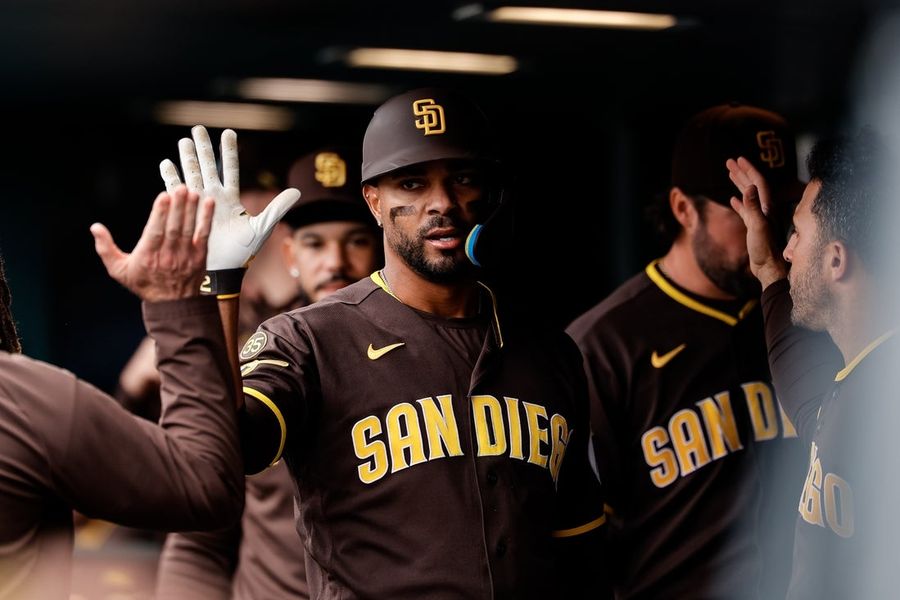
Deadspin | Padres score 5 in ninth to rally past Rockies  Apr 23, 2026; Denver, Colorado, USA; San Diego Padres shortstop Xander Bogaerts (2) celebrates in the dugout on a solo home run in the fifth inning against the Colorado Rockies at Coors Field. Mandatory Credit: Isaiah J. Downing-Imagn Images   Gavin Sheets’ three-run homer in the top of the ninth inning Thursday capped a five-run rally enabling the San Diego Padres to outslug the host Colorado Rockies 10-8 in Denver.  Sheets’ third homer of the year, all against Colorado pitching, scored Xander Bogaerts and pinch runner Bryce Johnson. It slapped a blown save on Victor Vodnik (0-2), who fanned Fernando Tatis Jr. as the potential tying run to end the eighth.  But Vodnik gave up a leadoff walk to Jackson Merrill, followed by a single to Manny Machado. Bogaerts and Miguel Andujar then supplied RBI singles that preceded Sheets’ dramatic blast on his 30th birthday.  Ron Marinaccio (1-0) picked up his first MLB win in two years by pitching two innings in relief. Closer Mason Miller locked down his ninth save with a scoreless ninth, enabling him to tie Cla Meredith for the franchise record for consecutive scoreless innings with 33 2/3.  Wasted in the loss for the Rockies was Mickey Moniak’s second two-homer game of the year against San Diego. Moniak went 4-for-5 with three runs to lead a 14-hit attack.  The Padres’ rally took starter Matt Waldron off the hook after he was roughed up for eight hits and six runs in five innings with three walks and three strikeouts. Colorado starter Ryan Feltner, who left after two innings with right triceps tightness, allowed two hits and a run with a walk and three strikeouts.   Moniak’s solo blast in the first started the scoring, but Andujar lined a two-run double in the second. The Rockies scored four two-out runs in their half of the inning, sandwiching RBI singles from Edouard Julien and Troy Johnston around TJ Rumfield’s two-run double.  Ramon Laureano’s run-scoring triple in the fourth got San Diego within 5-3, but Tyler Freeman’s squeeze bunt plated a run in Colorado’s half of the inning. Bogaerts belted a solo homer in the fifth, his fourth of the year, for a 6-4 deficit.  Moniak drilled his second homer in the sixth and Johnston tacked on his second RBI single in the seventh. Laureano singled home a run in the eighth to get the Padres within 8-5.  Laureano collected three of the Padres’ 13 hits and Andujar drove in three runs.  –Field Level Media   #Deadspin #Padres #score #ninth #rally #Rockies
Deadspin | Padres score 5 in ninth to rally past Rockies
Deadspin | Padres score 5 in ninth to rally past Rockies  Apr 23, 2026; Denver, Colorado, USA; San Diego Padres shortstop Xander Bogaerts (2) celebrates in the dugout on a solo home run in the fifth inning against the Colorado Rockies at Coors Field. Mandatory Credit: Isaiah J. Downing-Imagn Images   Gavin Sheets’ three-run homer in the top of the ninth inning Thursday capped a five-run rally enabling the San Diego Padres to outslug the host Colorado Rockies 10-8 in Denver.  Sheets’ third homer of the year, all against Colorado pitching, scored Xander Bogaerts and pinch runner Bryce Johnson. It slapped a blown save on Victor Vodnik (0-2), who fanned Fernando Tatis Jr. as the potential tying run to end the eighth.  But Vodnik gave up a leadoff walk to Jackson Merrill, followed by a single to Manny Machado. Bogaerts and Miguel Andujar then supplied RBI singles that preceded Sheets’ dramatic blast on his 30th birthday.  Ron Marinaccio (1-0) picked up his first MLB win in two years by pitching two innings in relief. Closer Mason Miller locked down his ninth save with a scoreless ninth, enabling him to tie Cla Meredith for the franchise record for consecutive scoreless innings with 33 2/3.  Wasted in the loss for the Rockies was Mickey Moniak’s second two-homer game of the year against San Diego. Moniak went 4-for-5 with three runs to lead a 14-hit attack.  The Padres’ rally took starter Matt Waldron off the hook after he was roughed up for eight hits and six runs in five innings with three walks and three strikeouts. Colorado starter Ryan Feltner, who left after two innings with right triceps tightness, allowed two hits and a run with a walk and three strikeouts.   Moniak’s solo blast in the first started the scoring, but Andujar lined a two-run double in the second. The Rockies scored four two-out runs in their half of the inning, sandwiching RBI singles from Edouard Julien and Troy Johnston around TJ Rumfield’s two-run double.  Ramon Laureano’s run-scoring triple in the fourth got San Diego within 5-3, but Tyler Freeman’s squeeze bunt plated a run in Colorado’s half of the inning. Bogaerts belted a solo homer in the fifth, his fourth of the year, for a 6-4 deficit.  Moniak drilled his second homer in the sixth and Johnston tacked on his second RBI single in the seventh. Laureano singled home a run in the eighth to get the Padres within 8-5.  Laureano collected three of the Padres’ 13 hits and Andujar drove in three runs.  –Field Level Media   #Deadspin #Padres #score #ninth #rally #RockiesApr 23, 2026; Denver, Colorado, USA; San Diego Padres shortstop Xander Bogaerts (2) celebrates in the dugout on a solo home run in the fifth inning against the Colorado Rockies at Coors Field. Mandatory Credit: Isaiah J. Downing-Imagn Images

Gavin Sheets’ three-run homer in the top of the ninth inning Thursday capped a five-run rally enabling the San Diego Padres to outslug the host Colorado Rockies 10-8 in Denver.

Sheets’ third homer of the year, all against Colorado pitching, scored Xander Bogaerts and pinch runner Bryce Johnson. It slapped a blown save on Victor Vodnik (0-2), who fanned Fernando Tatis Jr. as the potential tying run to end the eighth.

But Vodnik gave up a leadoff walk to Jackson Merrill, followed by a single to Manny Machado. Bogaerts and Miguel Andujar then supplied RBI singles that preceded Sheets’ dramatic blast on his 30th birthday.

Ron Marinaccio (1-0) picked up his first MLB win in two years by pitching two innings in relief. Closer Mason Miller locked down his ninth save with a scoreless ninth, enabling him to tie Cla Meredith for the franchise record for consecutive scoreless innings with 33 2/3.

Wasted in the loss for the Rockies was Mickey Moniak’s second two-homer game of the year against San Diego. Moniak went 4-for-5 with three runs to lead a 14-hit attack.


The Padres’ rally took starter Matt Waldron off the hook after he was roughed up for eight hits and six runs in five innings with three walks and three strikeouts. Colorado starter Ryan Feltner, who left after two innings with right triceps tightness, allowed two hits and a run with a walk and three strikeouts.

Moniak’s solo blast in the first started the scoring, but Andujar lined a two-run double in the second. The Rockies scored four two-out runs in their half of the inning, sandwiching RBI singles from Edouard Julien and Troy Johnston around TJ Rumfield’s two-run double.

Ramon Laureano’s run-scoring triple in the fourth got San Diego within 5-3, but Tyler Freeman’s squeeze bunt plated a run in Colorado’s half of the inning. Bogaerts belted a solo homer in the fifth, his fourth of the year, for a 6-4 deficit.

Moniak drilled his second homer in the sixth and Johnston tacked on his second RBI single in the seventh. Laureano singled home a run in the eighth to get the Padres within 8-5.

Laureano collected three of the Padres’ 13 hits and Andujar drove in three runs.

–Field Level Media

#Deadspin #Padres #score #ninth #rally #Rockies

Apr 23, 2026; Denver, Colorado, USA; San Diego Padres shortstop Xander Bogaerts (2) celebrates in the dugout on a solo home run in the fifth inning against the Colorado Rockies at Coors Field. Mandatory Credit: Isaiah J. Downing-Imagn Images

Gavin Sheets’ three-run homer in the top of the ninth inning Thursday capped a five-run rally enabling the San Diego Padres to outslug the host Colorado Rockies 10-8 in Denver.

Sheets’ third homer of the year, all against Colorado pitching, scored Xander Bogaerts and pinch runner Bryce Johnson. It slapped a blown save on Victor Vodnik (0-2), who fanned Fernando Tatis Jr. as the potential tying run to end the eighth.

But Vodnik gave up a leadoff walk to Jackson Merrill, followed by a single to Manny Machado. Bogaerts and Miguel Andujar then supplied RBI singles that preceded Sheets’ dramatic blast on his 30th birthday.

Ron Marinaccio (1-0) picked up his first MLB win in two years by pitching two innings in relief. Closer Mason Miller locked down his ninth save with a scoreless ninth, enabling him to tie Cla Meredith for the franchise record for consecutive scoreless innings with 33 2/3.

Wasted in the loss for the Rockies was Mickey Moniak’s second two-homer game of the year against San Diego. Moniak went 4-for-5 with three runs to lead a 14-hit attack.

The Padres’ rally took starter Matt Waldron off the hook after he was roughed up for eight hits and six runs in five innings with three walks and three strikeouts. Colorado starter Ryan Feltner, who left after two innings with right triceps tightness, allowed two hits and a run with a walk and three strikeouts.

Moniak’s solo blast in the first started the scoring, but Andujar lined a two-run double in the second. The Rockies scored four two-out runs in their half of the inning, sandwiching RBI singles from Edouard Julien and Troy Johnston around TJ Rumfield’s two-run double.

Ramon Laureano’s run-scoring triple in the fourth got San Diego within 5-3, but Tyler Freeman’s squeeze bunt plated a run in Colorado’s half of the inning. Bogaerts belted a solo homer in the fifth, his fourth of the year, for a 6-4 deficit.

Moniak drilled his second homer in the sixth and Johnston tacked on his second RBI single in the seventh. Laureano singled home a run in the eighth to get the Padres within 8-5.

Laureano collected three of the Padres’ 13 hits and Andujar drove in three runs.

–Field Level Media

Source link
#Deadspin #Padres #score #ninth #rally #Rockies

Previous post

Deadspin | Andrew Benintendi hits tiebreaking 3-run HR as White Sox down Diamondbacks <div id=""><section id="0" class=" w-full"><div class="xl:container mx-0 !px-4 py-0 pb-4 !mx-0 !px-0"><img src="https://images.deadspin.com/tr:w-900/28794234.jpg" srcset="https://images.deadspin.com/tr:w-900/28794234.jpg" alt="MLB: Chicago White Sox at Arizona Diamondbacks" class="w-full" fetchpriority="high" loading="eager"/><span class="text-0.8 leading-tight">Apr 23, 2026; Phoenix, Arizona, USA; Arizona Diamondbacks second baseman Ildemaro Vargas (6) hits against the Chicago White Sox in the first inning at Chase Field. Mandatory Credit: Rick Scuteri-Imagn Images<!-- --> <!-- --> </span></div></section><section id="section-1"> <p>Andrew Benintendi hit a three-run homer with one out in the ninth to lift the Chicago White Sox to a 4-1 victory over the Arizona Diamondbacks in Phoenix on Thursday afternoon.</p> </section><section id="section-2"> <p>Chase Meidroth walked off Paul Sewald (0-3) to open the ninth and took second on a sacrifice bunt before pinch-hitter Edgar Quero walked, bringing up Benintendi. His 410-foot homer landed near the pool area in right-center.</p> </section><section id="section-3"> <p>The White Sox had eight homers while winning two of three in the series and have 15 homers in the last five games. </p> </section><section id="section-4"> <p>White Sox first baseman Munetaka Murakami was 1 for 5 with a single, ending his five-game home run streak. He struck out three times, the last on a 99 mph fastball from Juan Morillo to end the seventh.</p> </section><section id="section-5"> <p>Arizona first baseman Ildemaro Vargas extended his season-opening hitting streak to 18 games, a franchise record. It is the longest active streak in the majors and the second-longest such streak since 2012, after Pablo Sandoval’s 20-gamer in 2012. </p> </section><section id="section-6"> <p>Vargas has a 21-game hitting streak dating to 2025.</p> </section><section id="section-7"> <p>Colson Montgomery had three hits and Meidorth had two hits for the White Sox, who had 10 hits, nine singles until Benintendi’s homer. They have won four of six.</p> </section><br/><section id="section-8"> <p>Seranthony Dominguez struck out two in a 1-2-3 ninth for his fifth save in seven chances. </p> </section> <section id="section-9"> <p>Ketel Marte had two of Arizona’s eight hits. Geraldo Perdomo extended his hitting streak to seven games.</p> </section><section id="section-10"> <p>The Diamondbacks lost their first series since being swept at the Los Angeles Dodgers to open the season.</p> </section><section id="section-11"> <p>Grant Taylor (1-0) gave up two hits and struck out three after relieving Davis Martin with one out in the seventh. Taylor struck out pinch-hitter Jose Fernandez on a 100 mph fastball with runners on second and third to end the seventh.</p> </section><section id="section-12"> <p>Martin gave up one run and six hits in 6 1/3 innings, his fourth straight quality start. He struck out a season high seven and walked one.</p> </section><section id="section-13"> <p>Arizona starter Michael Soroka gave up one run on seven hits, all singles, in five innings. He had six strikeouts and walked one.</p> </section><section id="section-14"> <p>Marte singled and scored on Adrian Del Castillo’s double for a 1-0 lead in the first.</p> </section><section id="section-15"> <p>The White Sox tied it at 1-1 in the third on Miguel Vargas’ one-out single.</p> </section><br/><section id="section-16"> <p>–Field Level Media</p> </section> </div> #Deadspin #Andrew #Benintendi #hits #tiebreaking #3run #White #Sox #Diamondbacks

Next post

DC vs PBKS, IPL 2026: Head-to-head record, most runs, wickets ahead of Delhi Capitals vs Punjab Kings <div id="content-body-70901345" itemprop="articleBody"><p>Delhi Capitals will host Punjab Kings at the Arun Jaitley Stadium in Delhi on Saturday. Delhi search for momentum having won three out of its six games whereas Punjab will look to extend its unbeaten run, winning five out of its six games where one ended in no result.</p><p>DC beat PBKS by six wickets in the same fixture in the 2025 season.</p><p><i>Here’s a look at their head-to-head record in the tournament: </i></p><div class="fact-box"><h5 class="main-title"> DC vs PBKS <b> head-to-head record in IPL</b></h5><p> Matches played: 34 </p><p> Delhi Capitals wins: 16 </p><p> Punjab Kings wins: 17 </p><p> Tied: 1 </p></div><h4 class="sub_head">Most runs in DC vs PBKS matches</h4><div class="article-table my-3"><table class="table"><tr><td> Batter</td><td> Innings</td><td> Runs</td><td> Average</td><td> Strike Rate</td><td> HS</td></tr><tr><td> Mayank Agarwal</td><td> 14</td><td> 450</td><td> 37.50</td><td> 143.31</td><td> 99*</td></tr><tr><td> David Warner</td><td> 12</td><td> 434</td><td> 39.45</td><td> 151.21</td><td> 79</td></tr><tr><td> Shikhar Dhawan</td><td> 13</td><td> 418</td><td> 38.00</td><td> 148.75</td><td> 106*</td></tr><tr><td> Shreyas Iyer</td><td> 14</td><td> 351</td><td> 31.9</td><td> 125.8</td><td> 58*</td></tr><tr><td> Virender Sehwag</td><td> 14</td><td> 330</td><td> 27.5</td><td> 148.64</td><td> 77</td></tr></table></div><h4 class="sub_head">Most wicket in DC vs PBKS matches</h4><div class="article-table my-3"><table class="table"><tr><td> Bowlers</td><td> Innings</td><td> Wickets</td><td> Economy</td><td> Average</td><td> BBI</td></tr><tr><td> Axar Patel</td><td> 18</td><td> 20</td><td> 6.46</td><td> 21.55</td><td> 2/10</td></tr><tr><td> Irfan Pathan</td><td> 12</td><td> 14</td><td> 7.03</td><td> 19.85</td><td> 3/24</td></tr><tr><td> Kagiso Rabada</td><td> 11</td><td> 14</td><td> 8.66</td><td> 24.14</td><td> 3/36</td></tr><tr><td> Sandeep Sharma</td><td> 8</td><td> 14</td><td> 6.93</td><td> 14.35</td><td> 4/20</td></tr><tr><td> Mohammed Shami</td><td> 11</td><td> 11</td><td> 8.78</td><td> 29.54</td><td> 3/15</td></tr></table></div><p class="publish-time" id="end-of-article">Published on Apr 25, 2026</p></div> #PBKS #IPL #Headtohead #record #runs #wickets #ahead #Delhi #Capitals #Punjab #Kings

At first, you don’t see him. Like the rest of the 19,812 people in the Garden, or the 23.2 million viewers watching elsewhere, you’re following the ball. Jalen Brunson takes one jabbing step forward before Victor Wembanyama and De’Aaron Fox rush to converge on him, and then he uses the momentum from springing back to jump and lightly launch the ball on a rainbow arc toward the basket. There are a few milliseconds where nobody on the floor appears to move or react and then, as they reflexively all fall in toward the basket, OG Anunoby is there.

It’s hard to track even in replay because Anunoby is moving so fast there isn’t a point you can pause the tape and his body won’t be blurred. All the regular metaphors don’t work. He’s not an arrow, nor a missile (easy, warmonger), maybe the closest is a diving bird of prey, but then we can’t know for sure if a raptor factors in faith with its instincts.

In about five strides, starting from the end of the scorer’s table where he inbounded to Brunson, Anunoby catches up with the ball. By then Stephon Castle and Dylan Harper are also jumping after him, so that three long arms are tangling toward pebbled orange leather. Anunoby is not first because he’s fast, or because he didn’t hesitate to start his thundering run toward the rim, or because he’s stronger or more athletic. They’re all factors, but the main reason is that each component — the long stride, knowing when to lift from the floor, the ability to soften touch just enough to tip a ball rather than swat it with momentum’s full force — is reflexive. Practiced alone or in sequence hundreds of times. In games, in actual practice, in his head, stakes varying but stakes not really a factor. He did it all not knowing whether Castle or Harper would throw him off course with their bodies, or whether the ball might bounce wide. He did it because Anunoby’s career arc that led to, well, that arc, has been one of effort, willingness and the ability to take himself out of any given moment as its main actor, even if he is. Benevolence, you could say (Karl-Anthony Towns did: “The right hand of god, can’t spell god without OG”), but mostly, very mortal work.

OG Anunoby didn’t officially play in the AAU tournament where he was discovered and recruited by Indiana University. He was on the floor grabbing steals, sprinting up and down the court, dunking, hitting threes, and of course, tipping the ball, but his name wasn’t listed in any of the Atlanta tournament’s programs. Tom Crean, Indiana’s then-coach, was posted at the baseline with his assistants to watch a couple other highly touted prospects and found themselves instead captivated by Anunoby. They flipped through the tournament’s compiled player guides and found no record of him.

Anunoby had initially been scratched because of a broken wrist that ended his junior year at Jefferson City early, so his name wasn’t in any of the tournament material. Crean tracked him down through the tournament’s director and invited Anunoby to campus, then recruited him.

There is the sense with much of the NBA draft and scouting pipeline that beyond the more highly touted names, you have to go searching. Not only for talent, but for fit, style, skill, all weighed against a young athlete’s health and longevity, prospects must be “future-proofed.” Even the very best at this kind of scouting get it wrong, and the very best also acknowledge how much luck and timing play a part. When you really start to consider the conditions necessary for a person to get drafted, and then land on a team that will have a complementary development program or a plan for that person at all, it becomes even more of a wonder who makes it and who sticks around in the league.

Anunoby wound up being drafted by the Toronto Raptors because he was coming off a devastating ACL injury that ended his sophomore year at Indiana after 16 games. Masai Ujiri, then the Raptors President, admitted it, saying on draft night that “If he doesn’t have that injury, I don’t think we have a shot.” Anunoby had slipped to 23rd.

Even if the Raptors weren’t expecting Anunoby, they were ready for him. A group that had doggedly lost in only the most wrenching ways for seasons, even before the three sequential postseason defeats that coined the term “LeBronto”, the locker room Anunoby joined had a particularly honed hard-nosed ethos with the bone-deep understanding of what it means to chip away. The Raptors were pests. For an athlete who used to call his high school coaches relentlessly to let him into the gym, and then call the middle school coaches when the high school coaches stopped answering, the fit felt like home.

The Raptors’ style was all ugly intangibles, cumulative play that pushed high-touch, share-the-ball offense that while not blistering, was as relentless as the defense that sparked it. All of it backed by high-IQ decision-making, driven by floor savant Kyle Lowry.

There is perhaps more elegance in the way the 2025-2026 NBA Finals Knicks are playing — have evolved throughout the postseason to play — but there is also a familiar DNA coursing through the team. Jalen Brunson is the engine and the ballast, Karl-Anthony Towns the wily big able to shift opponents around him at whim; Mikal Bridges the ace shooter, and Josh Hart the Swiss Army knife skillset deploying what’s needed beyond the boxscore. If trying to mirror this Knicks team with that Raptors group, then Anunoby is the player he was comp’d to in his own draft’s scouting: Kawhi Leonard. And yet, he’s more.

In his rookie season, Anunoby started his first NBA game on November 14th because Norman Powell suffered a hip injury that had him out for four games. A month later, Anunoby led all starter rookies in offensive and defensive rating, had the best turnover-to-assist ratio for a non-guard position, and held the third highest true shooting percentage.

“Sometimes, as a young player, you think too much and you try to get everything right. But when he comes in, he just plays,” Raptors coach Dwane Casey said at the time. “That young man is doing a good job.”

Anunoby cut his professional teeth on basketball that required repetition, work for the sake of the work. Those Raptors also had the kind of self-awareness that only comes after suffering big losses together, the sort of knocks that force the ego out of you. The team had plenty on the court, then lost DeMar DeRozan, and just before his second season began in Toronto, Anunoby’s father, his namesake, died. Anunoby was away from the team twice that fall, for a memorial for his father in Jefferson City and then for his burial in Nigeria.

As in life, lows — and loss — can bring clarity. There was a deep level of care and regard for each other within that Raptors group. It only crystallized as the season continued. The saying “play for each other” is leaned on a lot in basketball, but with how changeable NBA rosters are teams don’t consistently do it; unlikelier still that when watching, you can actually see it happening. Anunoby also missed Toronto’s championship run with what felt like the flukiest appendicitis timing on earth; there’s a sensation watching him win for, play for his Knicks teammates now that it’s that past version of Anunoby merging with the present one, finally unleashing the moves and motivation he had to put on ice in 2019.

Of course, that’s oversimplifying it. As The Athletic’s senior Raptors writer Eric Koreen laid out, Anunoby has come this far, improved to this point, because he works steadily on what needs improvement until he fixes it. It sounds simple, but it’s a rare and mercurial trait. It’s common for a player to add one skill to their utility belt at a time – a passable three-point shot, or getting better playing through contact – and be finished for a while. Anunoby has worked with the same quiet persistence on his entire toolkit, and has flashed one or more of those sharpened and polished improvements in each game of this series.

Going all the way back to his ghostly appearance in that AAU game, where he was a presence without a name, Anunoby has always been good at unsettling his defensive mark. He’ll hang out in the corner, lulling opponents to think the defense is set, only to pop in and deflect the ball, or suddenly be behind them, a brick wall of a screen they turn right into. He’s been menacing Stephon Castle, De’Aaron Fox, even Victor Wembanyama the same way. But Anunoby’s also guarded every NBA superstar with the cool unflappability on display now.

It’s been beautiful to see so many more people get acquainted with Anunoby’s nonplussed demeanour, a trait that’s either a long-running bit or goes back to Anunoby Sr., who told his children to choose their words precisely and that “if you have to talk, you should say something that doesn’t take away from the conversation, but enriches it.”

There’s so little space given to one of the most common emotional phenomena felt as a fan, which is when a favorite leaves you. Whether the departure is drawn out or abrupt, amicable or acrimonious, the only constant is the recognition that it’s all part of the NBA’s larger machine. A churning system. A system that, in its speed and mechanisation, enforces the idea that you are not supposed to care so much about what happens to a person whose footwork you memorised like steps to a dance.

Perhaps that’s the silver lining in losing a favorite player to a trade, that when they go on to bigger things, on much larger stages, you see flashes that take you back in your own fandom. Still, it’s disingenuous to Anunoby to suggest that what he’s showing in this series is somehow out of nowhere, or wholly unexpected. It’s just as false to point to the draft, or development, as ways to get the same result in a new form.

NBA arcs aren’t replicable, as much as GMs and scouts pine for that to be true. There are beautiful, fleeting moments where an athlete’s past lines up with the present to flash a clear view back to potential as it unfolded, but that clarity is all in retrospect.

The chain of events that led Anunoby to what could be his second title and first played-in Finals run are so individually keyed to his development: the physical setbacks, the group he grew with in Toronto, patience he had playing behind Pascal Siakam, then Kawhi Leonard; arriving in New York and to some degree starting again — then again with Mike Brown. His competitive profile is just as tied to his lived experience, his family and upbringing, the dual confidence and necessity to be of service to others instilled in him by his father and mom, a Nigerian national track athlete, who he lost at just a year old.

It’s the singularity that makes him — any athlete’s arc that traces these unique-as-fingerprint highs — so special, that makes watching it happen all the more astonishing. It’s only going to happen once.

#Anunobys #life #prepared #Knicks #moment">OG Anunoby’s whole life prepared him for this Knicks moment  At first, you don’t see him. Like the rest of the 19,812 people in the Garden, or the 23.2 million viewers watching elsewhere, you’re following the ball. Jalen Brunson takes one jabbing step forward before Victor Wembanyama and De’Aaron Fox rush to converge on him, and then he uses the momentum from springing back to jump and lightly launch the ball on a rainbow arc toward the basket. There are a few milliseconds where nobody on the floor appears to move or react and then, as they reflexively all fall in toward the basket, OG Anunoby is there.It’s hard to track even in replay because Anunoby is moving so fast there isn’t a point you can pause the tape and his body won’t be blurred. All the regular metaphors don’t work. He’s not an arrow, nor a missile (easy, warmonger), maybe the closest is a diving bird of prey, but then we can’t know for sure if a raptor factors in faith with its instincts.In about five strides, starting from the end of the scorer’s table where he inbounded to Brunson, Anunoby catches up with the ball. By then Stephon Castle and Dylan Harper are also jumping after him, so that three long arms are tangling toward pebbled orange leather. Anunoby is not first because he’s fast, or because he didn’t hesitate to start his thundering run toward the rim, or because he’s stronger or more athletic. They’re all factors, but the main reason is that each component — the long stride, knowing when to lift from the floor, the ability to soften touch just enough to tip a ball rather than swat it with momentum’s full force — is reflexive. Practiced alone or in sequence hundreds of times. In games, in actual practice, in his head, stakes varying but stakes not really a factor. He did it all not knowing whether Castle or Harper would throw him off course with their bodies, or whether the ball might bounce wide. He did it because Anunoby’s career arc that led to, well, that arc, has been one of effort, willingness and the ability to take himself out of any given moment as its main actor, even if he is. Benevolence, you could say (Karl-Anthony Towns did: “The right hand of god, can’t spell god without OG”), but mostly, very mortal work.OG Anunoby didn’t officially play in the AAU tournament where he was discovered and recruited by Indiana University. He was on the floor grabbing steals, sprinting up and down the court, dunking, hitting threes, and of course, tipping the ball, but his name wasn’t listed in any of the Atlanta tournament’s programs. Tom Crean, Indiana’s then-coach, was posted at the baseline with his assistants to watch a couple other highly touted prospects and found themselves instead captivated by Anunoby. They flipped through the tournament’s compiled player guides and found no record of him.Anunoby had initially been scratched because of a broken wrist that ended his junior year at Jefferson City early, so his name wasn’t in any of the tournament material. Crean tracked him down through the tournament’s director and invited Anunoby to campus, then recruited him.There is the sense with much of the NBA draft and scouting pipeline that beyond the more highly touted names, you have to go searching. Not only for talent, but for fit, style, skill, all weighed against a young athlete’s health and longevity, prospects must be “future-proofed.” Even the very best at this kind of scouting get it wrong, and the very best also acknowledge how much luck and timing play a part. When you really start to consider the conditions necessary for a person to get drafted, and then land on a team that will have a complementary development program or a plan for that person at all, it becomes even more of a wonder who makes it and who sticks around in the league.Anunoby wound up being drafted by the Toronto Raptors because he was coming off a devastating ACL injury that ended his sophomore year at Indiana after 16 games. Masai Ujiri, then the Raptors President, admitted it, saying on draft night that “If he doesn’t have that injury, I don’t think we have a shot.” Anunoby had slipped to 23rd.Even if the Raptors weren’t expecting Anunoby, they were ready for him. A group that had doggedly lost in only the most wrenching ways for seasons, even before the three sequential postseason defeats that coined the term “LeBronto”, the locker room Anunoby joined had a particularly honed hard-nosed ethos with the bone-deep understanding of what it means to chip away. The Raptors were pests. For an athlete who used to call his high school coaches relentlessly to let him into the gym, and then call the middle school coaches when the high school coaches stopped answering, the fit felt like home.The Raptors’ style was all ugly intangibles, cumulative play that pushed high-touch, share-the-ball offense that while not blistering, was as relentless as the defense that sparked it. All of it backed by high-IQ decision-making, driven by floor savant Kyle Lowry.There is perhaps more elegance in the way the 2025-2026 NBA Finals Knicks are playing — have evolved throughout the postseason to play — but there is also a familiar DNA coursing through the team. Jalen Brunson is the engine and the ballast, Karl-Anthony Towns the wily big able to shift opponents around him at whim; Mikal Bridges the ace shooter, and Josh Hart the Swiss Army knife skillset deploying what’s needed beyond the boxscore. If trying to mirror this Knicks team with that Raptors group, then Anunoby is the player he was comp’d to in his own draft’s scouting: Kawhi Leonard. And yet, he’s more.In his rookie season, Anunoby started his first NBA game on November 14th because Norman Powell suffered a hip injury that had him out for four games. A month later, Anunoby led all starter rookies in offensive and defensive rating, had the best turnover-to-assist ratio for a non-guard position, and held the third highest true shooting percentage.“Sometimes, as a young player, you think too much and you try to get everything right. But when he comes in, he just plays,” Raptors coach Dwane Casey said at the time. “That young man is doing a good job.”Anunoby cut his professional teeth on basketball that required repetition, work for the sake of the work. Those Raptors also had the kind of self-awareness that only comes after suffering big losses together, the sort of knocks that force the ego out of you. The team had plenty on the court, then lost DeMar DeRozan, and just before his second season began in Toronto, Anunoby’s father, his namesake, died. Anunoby was away from the team twice that fall, for a memorial for his father in Jefferson City and then for his burial in Nigeria.As in life, lows — and loss — can bring clarity. There was a deep level of care and regard for each other within that Raptors group. It only crystallized as the season continued. The saying “play for each other” is leaned on a lot in basketball, but with how changeable NBA rosters are teams don’t consistently do it; unlikelier still that when watching, you can actually see it happening. Anunoby also missed Toronto’s championship run with what felt like the flukiest appendicitis timing on earth; there’s a sensation watching him win for, play for his Knicks teammates now that it’s that past version of Anunoby merging with the present one, finally unleashing the moves and motivation he had to put on ice in 2019.Of course, that’s oversimplifying it. As The Athletic’s senior Raptors writer Eric Koreen laid out, Anunoby has come this far, improved to this point, because he works steadily on what needs improvement until he fixes it. It sounds simple, but it’s a rare and mercurial trait. It’s common for a player to add one skill to their utility belt at a time – a passable three-point shot, or getting better playing through contact – and be finished for a while. Anunoby has worked with the same quiet persistence on his entire toolkit, and has flashed one or more of those sharpened and polished improvements in each game of this series.Going all the way back to his ghostly appearance in that AAU game, where he was a presence without a name, Anunoby has always been good at unsettling his defensive mark. He’ll hang out in the corner, lulling opponents to think the defense is set, only to pop in and deflect the ball, or suddenly be behind them, a brick wall of a screen they turn right into. He’s been menacing Stephon Castle, De’Aaron Fox, even Victor Wembanyama the same way. But Anunoby’s also guarded every NBA superstar with the cool unflappability on display now.It’s been beautiful to see so many more people get acquainted with Anunoby’s nonplussed demeanour, a trait that’s either a long-running bit or goes back to Anunoby Sr., who told his children to choose their words precisely and that “if you have to talk, you should say something that doesn’t take away from the conversation, but enriches it.”There’s so little space given to one of the most common emotional phenomena felt as a fan, which is when a favorite leaves you. Whether the departure is drawn out or abrupt, amicable or acrimonious, the only constant is the recognition that it’s all part of the NBA’s larger machine. A churning system. A system that, in its speed and mechanisation, enforces the idea that you are not supposed to care so much about what happens to a person whose footwork you memorised like steps to a dance.Perhaps that’s the silver lining in losing a favorite player to a trade, that when they go on to bigger things, on much larger stages, you see flashes that take you back in your own fandom. Still, it’s disingenuous to Anunoby to suggest that what he’s showing in this series is somehow out of nowhere, or wholly unexpected. It’s just as false to point to the draft, or development, as ways to get the same result in a new form.NBA arcs aren’t replicable, as much as GMs and scouts pine for that to be true. There are beautiful, fleeting moments where an athlete’s past lines up with the present to flash a clear view back to potential as it unfolded, but that clarity is all in retrospect.The chain of events that led Anunoby to what could be his second title and first played-in Finals run are so individually keyed to his development: the physical setbacks, the group he grew with in Toronto, patience he had playing behind Pascal Siakam, then Kawhi Leonard; arriving in New York and to some degree starting again — then again with Mike Brown. His competitive profile is just as tied to his lived experience, his family and upbringing, the dual confidence and necessity to be of service to others instilled in him by his father and mom, a Nigerian national track athlete, who he lost at just a year old.It’s the singularity that makes him — any athlete’s arc that traces these unique-as-fingerprint highs — so special, that makes watching it happen all the more astonishing. It’s only going to happen once.  #Anunobys #life #prepared #Knicks #moment

did: “The right hand of god, can’t spell god without OG”), but mostly, very mortal work.

OG Anunoby didn’t officially play in the AAU tournament where he was discovered and recruited by Indiana University. He was on the floor grabbing steals, sprinting up and down the court, dunking, hitting threes, and of course, tipping the ball, but his name wasn’t listed in any of the Atlanta tournament’s programs. Tom Crean, Indiana’s then-coach, was posted at the baseline with his assistants to watch a couple other highly touted prospects and found themselves instead captivated by Anunoby. They flipped through the tournament’s compiled player guides and found no record of him.

Anunoby had initially been scratched because of a broken wrist that ended his junior year at Jefferson City early, so his name wasn’t in any of the tournament material. Crean tracked him down through the tournament’s director and invited Anunoby to campus, then recruited him.

There is the sense with much of the NBA draft and scouting pipeline that beyond the more highly touted names, you have to go searching. Not only for talent, but for fit, style, skill, all weighed against a young athlete’s health and longevity, prospects must be “future-proofed.” Even the very best at this kind of scouting get it wrong, and the very best also acknowledge how much luck and timing play a part. When you really start to consider the conditions necessary for a person to get drafted, and then land on a team that will have a complementary development program or a plan for that person at all, it becomes even more of a wonder who makes it and who sticks around in the league.

Anunoby wound up being drafted by the Toronto Raptors because he was coming off a devastating ACL injury that ended his sophomore year at Indiana after 16 games. Masai Ujiri, then the Raptors President, admitted it, saying on draft night that “If he doesn’t have that injury, I don’t think we have a shot.” Anunoby had slipped to 23rd.

Even if the Raptors weren’t expecting Anunoby, they were ready for him. A group that had doggedly lost in only the most wrenching ways for seasons, even before the three sequential postseason defeats that coined the term “LeBronto”, the locker room Anunoby joined had a particularly honed hard-nosed ethos with the bone-deep understanding of what it means to chip away. The Raptors were pests. For an athlete who used to call his high school coaches relentlessly to let him into the gym, and then call the middle school coaches when the high school coaches stopped answering, the fit felt like home.

The Raptors’ style was all ugly intangibles, cumulative play that pushed high-touch, share-the-ball offense that while not blistering, was as relentless as the defense that sparked it. All of it backed by high-IQ decision-making, driven by floor savant Kyle Lowry.

There is perhaps more elegance in the way the 2025-2026 NBA Finals Knicks are playing — have evolved throughout the postseason to play — but there is also a familiar DNA coursing through the team. Jalen Brunson is the engine and the ballast, Karl-Anthony Towns the wily big able to shift opponents around him at whim; Mikal Bridges the ace shooter, and Josh Hart the Swiss Army knife skillset deploying what’s needed beyond the boxscore. If trying to mirror this Knicks team with that Raptors group, then Anunoby is the player he was comp’d to in his own draft’s scouting: Kawhi Leonard. And yet, he’s more.

In his rookie season, Anunoby started his first NBA game on November 14th because Norman Powell suffered a hip injury that had him out for four games. A month later, Anunoby led all starter rookies in offensive and defensive rating, had the best turnover-to-assist ratio for a non-guard position, and held the third highest true shooting percentage.

“Sometimes, as a young player, you think too much and you try to get everything right. But when he comes in, he just plays,” Raptors coach Dwane Casey said at the time. “That young man is doing a good job.”

Anunoby cut his professional teeth on basketball that required repetition, work for the sake of the work. Those Raptors also had the kind of self-awareness that only comes after suffering big losses together, the sort of knocks that force the ego out of you. The team had plenty on the court, then lost DeMar DeRozan, and just before his second season began in Toronto, Anunoby’s father, his namesake, died. Anunoby was away from the team twice that fall, for a memorial for his father in Jefferson City and then for his burial in Nigeria.

As in life, lows — and loss — can bring clarity. There was a deep level of care and regard for each other within that Raptors group. It only crystallized as the season continued. The saying “play for each other” is leaned on a lot in basketball, but with how changeable NBA rosters are teams don’t consistently do it; unlikelier still that when watching, you can actually see it happening. Anunoby also missed Toronto’s championship run with what felt like the flukiest appendicitis timing on earth; there’s a sensation watching him win for, play for his Knicks teammates now that it’s that past version of Anunoby merging with the present one, finally unleashing the moves and motivation he had to put on ice in 2019.

Of course, that’s oversimplifying it. As The Athletic’s senior Raptors writer Eric Koreen laid out, Anunoby has come this far, improved to this point, because he works steadily on what needs improvement until he fixes it. It sounds simple, but it’s a rare and mercurial trait. It’s common for a player to add one skill to their utility belt at a time – a passable three-point shot, or getting better playing through contact – and be finished for a while. Anunoby has worked with the same quiet persistence on his entire toolkit, and has flashed one or more of those sharpened and polished improvements in each game of this series.

Going all the way back to his ghostly appearance in that AAU game, where he was a presence without a name, Anunoby has always been good at unsettling his defensive mark. He’ll hang out in the corner, lulling opponents to think the defense is set, only to pop in and deflect the ball, or suddenly be behind them, a brick wall of a screen they turn right into. He’s been menacing Stephon Castle, De’Aaron Fox, even Victor Wembanyama the same way. But Anunoby’s also guarded every NBA superstar with the cool unflappability on display now.

It’s been beautiful to see so many more people get acquainted with Anunoby’s nonplussed demeanour, a trait that’s either a long-running bit or goes back to Anunoby Sr., who told his children to choose their words precisely and that “if you have to talk, you should say something that doesn’t take away from the conversation, but enriches it.”

There’s so little space given to one of the most common emotional phenomena felt as a fan, which is when a favorite leaves you. Whether the departure is drawn out or abrupt, amicable or acrimonious, the only constant is the recognition that it’s all part of the NBA’s larger machine. A churning system. A system that, in its speed and mechanisation, enforces the idea that you are not supposed to care so much about what happens to a person whose footwork you memorised like steps to a dance.

Perhaps that’s the silver lining in losing a favorite player to a trade, that when they go on to bigger things, on much larger stages, you see flashes that take you back in your own fandom. Still, it’s disingenuous to Anunoby to suggest that what he’s showing in this series is somehow out of nowhere, or wholly unexpected. It’s just as false to point to the draft, or development, as ways to get the same result in a new form.

NBA arcs aren’t replicable, as much as GMs and scouts pine for that to be true. There are beautiful, fleeting moments where an athlete’s past lines up with the present to flash a clear view back to potential as it unfolded, but that clarity is all in retrospect.

The chain of events that led Anunoby to what could be his second title and first played-in Finals run are so individually keyed to his development: the physical setbacks, the group he grew with in Toronto, patience he had playing behind Pascal Siakam, then Kawhi Leonard; arriving in New York and to some degree starting again — then again with Mike Brown. His competitive profile is just as tied to his lived experience, his family and upbringing, the dual confidence and necessity to be of service to others instilled in him by his father and mom, a Nigerian national track athlete, who he lost at just a year old.

It’s the singularity that makes him — any athlete’s arc that traces these unique-as-fingerprint highs — so special, that makes watching it happen all the more astonishing. It’s only going to happen once.

#Anunobys #life #prepared #Knicks #moment">OG Anunoby’s whole life prepared him for this Knicks moment

At first, you don’t see him. Like the rest of the 19,812 people in the Garden, or the 23.2 million viewers watching elsewhere, you’re following the ball. Jalen Brunson takes one jabbing step forward before Victor Wembanyama and De’Aaron Fox rush to converge on him, and then he uses the momentum from springing back to jump and lightly launch the ball on a rainbow arc toward the basket. There are a few milliseconds where nobody on the floor appears to move or react and then, as they reflexively all fall in toward the basket, OG Anunoby is there.

It’s hard to track even in replay because Anunoby is moving so fast there isn’t a point you can pause the tape and his body won’t be blurred. All the regular metaphors don’t work. He’s not an arrow, nor a missile (easy, warmonger), maybe the closest is a diving bird of prey, but then we can’t know for sure if a raptor factors in faith with its instincts.

In about five strides, starting from the end of the scorer’s table where he inbounded to Brunson, Anunoby catches up with the ball. By then Stephon Castle and Dylan Harper are also jumping after him, so that three long arms are tangling toward pebbled orange leather. Anunoby is not first because he’s fast, or because he didn’t hesitate to start his thundering run toward the rim, or because he’s stronger or more athletic. They’re all factors, but the main reason is that each component — the long stride, knowing when to lift from the floor, the ability to soften touch just enough to tip a ball rather than swat it with momentum’s full force — is reflexive. Practiced alone or in sequence hundreds of times. In games, in actual practice, in his head, stakes varying but stakes not really a factor. He did it all not knowing whether Castle or Harper would throw him off course with their bodies, or whether the ball might bounce wide. He did it because Anunoby’s career arc that led to, well, that arc, has been one of effort, willingness and the ability to take himself out of any given moment as its main actor, even if he is. Benevolence, you could say (Karl-Anthony Towns did: “The right hand of god, can’t spell god without OG”), but mostly, very mortal work.

OG Anunoby didn’t officially play in the AAU tournament where he was discovered and recruited by Indiana University. He was on the floor grabbing steals, sprinting up and down the court, dunking, hitting threes, and of course, tipping the ball, but his name wasn’t listed in any of the Atlanta tournament’s programs. Tom Crean, Indiana’s then-coach, was posted at the baseline with his assistants to watch a couple other highly touted prospects and found themselves instead captivated by Anunoby. They flipped through the tournament’s compiled player guides and found no record of him.

Anunoby had initially been scratched because of a broken wrist that ended his junior year at Jefferson City early, so his name wasn’t in any of the tournament material. Crean tracked him down through the tournament’s director and invited Anunoby to campus, then recruited him.

There is the sense with much of the NBA draft and scouting pipeline that beyond the more highly touted names, you have to go searching. Not only for talent, but for fit, style, skill, all weighed against a young athlete’s health and longevity, prospects must be “future-proofed.” Even the very best at this kind of scouting get it wrong, and the very best also acknowledge how much luck and timing play a part. When you really start to consider the conditions necessary for a person to get drafted, and then land on a team that will have a complementary development program or a plan for that person at all, it becomes even more of a wonder who makes it and who sticks around in the league.

Anunoby wound up being drafted by the Toronto Raptors because he was coming off a devastating ACL injury that ended his sophomore year at Indiana after 16 games. Masai Ujiri, then the Raptors President, admitted it, saying on draft night that “If he doesn’t have that injury, I don’t think we have a shot.” Anunoby had slipped to 23rd.

Even if the Raptors weren’t expecting Anunoby, they were ready for him. A group that had doggedly lost in only the most wrenching ways for seasons, even before the three sequential postseason defeats that coined the term “LeBronto”, the locker room Anunoby joined had a particularly honed hard-nosed ethos with the bone-deep understanding of what it means to chip away. The Raptors were pests. For an athlete who used to call his high school coaches relentlessly to let him into the gym, and then call the middle school coaches when the high school coaches stopped answering, the fit felt like home.

The Raptors’ style was all ugly intangibles, cumulative play that pushed high-touch, share-the-ball offense that while not blistering, was as relentless as the defense that sparked it. All of it backed by high-IQ decision-making, driven by floor savant Kyle Lowry.

There is perhaps more elegance in the way the 2025-2026 NBA Finals Knicks are playing — have evolved throughout the postseason to play — but there is also a familiar DNA coursing through the team. Jalen Brunson is the engine and the ballast, Karl-Anthony Towns the wily big able to shift opponents around him at whim; Mikal Bridges the ace shooter, and Josh Hart the Swiss Army knife skillset deploying what’s needed beyond the boxscore. If trying to mirror this Knicks team with that Raptors group, then Anunoby is the player he was comp’d to in his own draft’s scouting: Kawhi Leonard. And yet, he’s more.

In his rookie season, Anunoby started his first NBA game on November 14th because Norman Powell suffered a hip injury that had him out for four games. A month later, Anunoby led all starter rookies in offensive and defensive rating, had the best turnover-to-assist ratio for a non-guard position, and held the third highest true shooting percentage.

“Sometimes, as a young player, you think too much and you try to get everything right. But when he comes in, he just plays,” Raptors coach Dwane Casey said at the time. “That young man is doing a good job.”

Anunoby cut his professional teeth on basketball that required repetition, work for the sake of the work. Those Raptors also had the kind of self-awareness that only comes after suffering big losses together, the sort of knocks that force the ego out of you. The team had plenty on the court, then lost DeMar DeRozan, and just before his second season began in Toronto, Anunoby’s father, his namesake, died. Anunoby was away from the team twice that fall, for a memorial for his father in Jefferson City and then for his burial in Nigeria.

As in life, lows — and loss — can bring clarity. There was a deep level of care and regard for each other within that Raptors group. It only crystallized as the season continued. The saying “play for each other” is leaned on a lot in basketball, but with how changeable NBA rosters are teams don’t consistently do it; unlikelier still that when watching, you can actually see it happening. Anunoby also missed Toronto’s championship run with what felt like the flukiest appendicitis timing on earth; there’s a sensation watching him win for, play for his Knicks teammates now that it’s that past version of Anunoby merging with the present one, finally unleashing the moves and motivation he had to put on ice in 2019.

Of course, that’s oversimplifying it. As The Athletic’s senior Raptors writer Eric Koreen laid out, Anunoby has come this far, improved to this point, because he works steadily on what needs improvement until he fixes it. It sounds simple, but it’s a rare and mercurial trait. It’s common for a player to add one skill to their utility belt at a time – a passable three-point shot, or getting better playing through contact – and be finished for a while. Anunoby has worked with the same quiet persistence on his entire toolkit, and has flashed one or more of those sharpened and polished improvements in each game of this series.

Going all the way back to his ghostly appearance in that AAU game, where he was a presence without a name, Anunoby has always been good at unsettling his defensive mark. He’ll hang out in the corner, lulling opponents to think the defense is set, only to pop in and deflect the ball, or suddenly be behind them, a brick wall of a screen they turn right into. He’s been menacing Stephon Castle, De’Aaron Fox, even Victor Wembanyama the same way. But Anunoby’s also guarded every NBA superstar with the cool unflappability on display now.

It’s been beautiful to see so many more people get acquainted with Anunoby’s nonplussed demeanour, a trait that’s either a long-running bit or goes back to Anunoby Sr., who told his children to choose their words precisely and that “if you have to talk, you should say something that doesn’t take away from the conversation, but enriches it.”

There’s so little space given to one of the most common emotional phenomena felt as a fan, which is when a favorite leaves you. Whether the departure is drawn out or abrupt, amicable or acrimonious, the only constant is the recognition that it’s all part of the NBA’s larger machine. A churning system. A system that, in its speed and mechanisation, enforces the idea that you are not supposed to care so much about what happens to a person whose footwork you memorised like steps to a dance.

Perhaps that’s the silver lining in losing a favorite player to a trade, that when they go on to bigger things, on much larger stages, you see flashes that take you back in your own fandom. Still, it’s disingenuous to Anunoby to suggest that what he’s showing in this series is somehow out of nowhere, or wholly unexpected. It’s just as false to point to the draft, or development, as ways to get the same result in a new form.

NBA arcs aren’t replicable, as much as GMs and scouts pine for that to be true. There are beautiful, fleeting moments where an athlete’s past lines up with the present to flash a clear view back to potential as it unfolded, but that clarity is all in retrospect.

The chain of events that led Anunoby to what could be his second title and first played-in Finals run are so individually keyed to his development: the physical setbacks, the group he grew with in Toronto, patience he had playing behind Pascal Siakam, then Kawhi Leonard; arriving in New York and to some degree starting again — then again with Mike Brown. His competitive profile is just as tied to his lived experience, his family and upbringing, the dual confidence and necessity to be of service to others instilled in him by his father and mom, a Nigerian national track athlete, who he lost at just a year old.

It’s the singularity that makes him — any athlete’s arc that traces these unique-as-fingerprint highs — so special, that makes watching it happen all the more astonishing. It’s only going to happen once.

#Anunobys #life #prepared #Knicks #moment
AUS-W vs SA-W Live Score, Women’s T20 World Cup 2026: South Africa in early trouble, two wickets down in first three overs  Australia: Beth Mooney (wk), Georgia Voll, Phoebe Litchfield, Ellyse Perry, Ashleigh Gardner, Georgia Wareham, Annabel Sutherland, Nicola Carey, Sophie Molineux (capt), Kim Garth, Alana KingLitchfield fit to play. Kim Garth will now become the 2nd player to play for two countries in this World Cup’s history. South Africa: Laura Wolvaardt (capt), Sune Luus, Annerie Dercksen, Nadine de Klerk, Marizanne Kapp, Chloe Tryon, Kayla Reyneke, Sinalo Jafta (wk), Shabnim Ismail, Nonkululeko Mlaba, Ayabonga KhakaShabnim in. No Dane van Niekerk.   #AUSW #Live #Score #Womens #T20 #World #Cup #South #Africa #early #trouble #wickets #overs

Post Comment