×
Deadspin | Predators blank Ducks to move into playoff position  Apr 4, 2026; Anaheim, California, USA; Nashville Predators left wing Reid Schaefer (49) moves the puck following a face off during the second period against the Anaheim Ducks at Honda Center. Mandatory Credit: Corinne Votaw-Imagn Images   Goaltender Justus Annunen posted his first shutout of the season and Erik Haula netted one goal and one assist to pace the visiting Nashville Predators to a 5-0 victory over the slumping Anaheim Ducks on Tuesday.  Annunen made 43 saves for his third career shutout as the Predators jumped into a playoff position.  Filip Forsberg, Brady Skjei, Zachary L’Heureux and Fedor Svechkov all tallied once for the Predators (37-31-10, 84 points).  Ryan O’Reilly and Joakim Kemell both collected a pair of assists.  The victory is the first shutout of the season for the Predators.  Nashville, which was last in the league standings on Dec. 8, jumped one point ahead of the Los Angeles Kings in the chase for the Western Conference’s second wild-card spot.  Nashville has four games remaining in the regular season, one fewer than the Kings. The San Jose Sharks are three points back of Nashville but with two games in hand.   Goalie Lukas Dostal stopped 20 shots for the Ducks (41-32-5, 87 points), who have lost six straight games, five of them in regulation time.  The Ducks are one point behind the Pacific Division-leading Edmonton Oilers, but in the third spot. The Vegas Golden Knights are tied with the Oilers in points but trail via the tiebreaker. All three teams have four games remaining in the regular season.  After a blanked first period, the Predators opened the scoring when Haula went untouched to the slot and while using a defender as a screen fired a top-corner shot at 7:07 of the second period.  Forsberg doubled the Nashville lead on the power play by firing a shot through a collection of players screening the goaltender and finding the mark at 11:26 for his fifth goal in as many outings.  Skjei gave Nashville a three-goal edge when he went top corner on a short-handed breakaway opportunity with one minute remaining in the second period.  L’Heureux extended the edge just before the midway point of the third period by scoring on an odd-man rush, and Svechkov rounded out the scoring by redirecting Tyson Jost’s pass at 15:07 of the final frame.  –Field Level Media    #Deadspin #Predators #blank #Ducks #move #playoff #position

Deadspin | Predators blank Ducks to move into playoff position
Deadspin | Predators blank Ducks to move into playoff position  Apr 4, 2026; Anaheim, California, USA; Nashville Predators left wing Reid Schaefer (49) moves the puck following a face off during the second period against the Anaheim Ducks at Honda Center. Mandatory Credit: Corinne Votaw-Imagn Images   Goaltender Justus Annunen posted his first shutout of the season and Erik Haula netted one goal and one assist to pace the visiting Nashville Predators to a 5-0 victory over the slumping Anaheim Ducks on Tuesday.  Annunen made 43 saves for his third career shutout as the Predators jumped into a playoff position.  Filip Forsberg, Brady Skjei, Zachary L’Heureux and Fedor Svechkov all tallied once for the Predators (37-31-10, 84 points).  Ryan O’Reilly and Joakim Kemell both collected a pair of assists.  The victory is the first shutout of the season for the Predators.  Nashville, which was last in the league standings on Dec. 8, jumped one point ahead of the Los Angeles Kings in the chase for the Western Conference’s second wild-card spot.  Nashville has four games remaining in the regular season, one fewer than the Kings. The San Jose Sharks are three points back of Nashville but with two games in hand.   Goalie Lukas Dostal stopped 20 shots for the Ducks (41-32-5, 87 points), who have lost six straight games, five of them in regulation time.  The Ducks are one point behind the Pacific Division-leading Edmonton Oilers, but in the third spot. The Vegas Golden Knights are tied with the Oilers in points but trail via the tiebreaker. All three teams have four games remaining in the regular season.  After a blanked first period, the Predators opened the scoring when Haula went untouched to the slot and while using a defender as a screen fired a top-corner shot at 7:07 of the second period.  Forsberg doubled the Nashville lead on the power play by firing a shot through a collection of players screening the goaltender and finding the mark at 11:26 for his fifth goal in as many outings.  Skjei gave Nashville a three-goal edge when he went top corner on a short-handed breakaway opportunity with one minute remaining in the second period.  L’Heureux extended the edge just before the midway point of the third period by scoring on an odd-man rush, and Svechkov rounded out the scoring by redirecting Tyson Jost’s pass at 15:07 of the final frame.  –Field Level Media    #Deadspin #Predators #blank #Ducks #move #playoff #positionApr 4, 2026; Anaheim, California, USA; Nashville Predators left wing Reid Schaefer (49) moves the puck following a face off during the second period against the Anaheim Ducks at Honda Center. Mandatory Credit: Corinne Votaw-Imagn Images

Goaltender Justus Annunen posted his first shutout of the season and Erik Haula netted one goal and one assist to pace the visiting Nashville Predators to a 5-0 victory over the slumping Anaheim Ducks on Tuesday.

Annunen made 43 saves for his third career shutout as the Predators jumped into a playoff position.

Filip Forsberg, Brady Skjei, Zachary L’Heureux and Fedor Svechkov all tallied once for the Predators (37-31-10, 84 points).

Ryan O’Reilly and Joakim Kemell both collected a pair of assists.

The victory is the first shutout of the season for the Predators.

Nashville, which was last in the league standings on Dec. 8, jumped one point ahead of the Los Angeles Kings in the chase for the Western Conference’s second wild-card spot.


Nashville has four games remaining in the regular season, one fewer than the Kings. The San Jose Sharks are three points back of Nashville but with two games in hand.

Goalie Lukas Dostal stopped 20 shots for the Ducks (41-32-5, 87 points), who have lost six straight games, five of them in regulation time.

The Ducks are one point behind the Pacific Division-leading Edmonton Oilers, but in the third spot. The Vegas Golden Knights are tied with the Oilers in points but trail via the tiebreaker. All three teams have four games remaining in the regular season.

After a blanked first period, the Predators opened the scoring when Haula went untouched to the slot and while using a defender as a screen fired a top-corner shot at 7:07 of the second period.

Forsberg doubled the Nashville lead on the power play by firing a shot through a collection of players screening the goaltender and finding the mark at 11:26 for his fifth goal in as many outings.

Skjei gave Nashville a three-goal edge when he went top corner on a short-handed breakaway opportunity with one minute remaining in the second period.

L’Heureux extended the edge just before the midway point of the third period by scoring on an odd-man rush, and Svechkov rounded out the scoring by redirecting Tyson Jost’s pass at 15:07 of the final frame.


–Field Level Media

#Deadspin #Predators #blank #Ducks #move #playoff #position

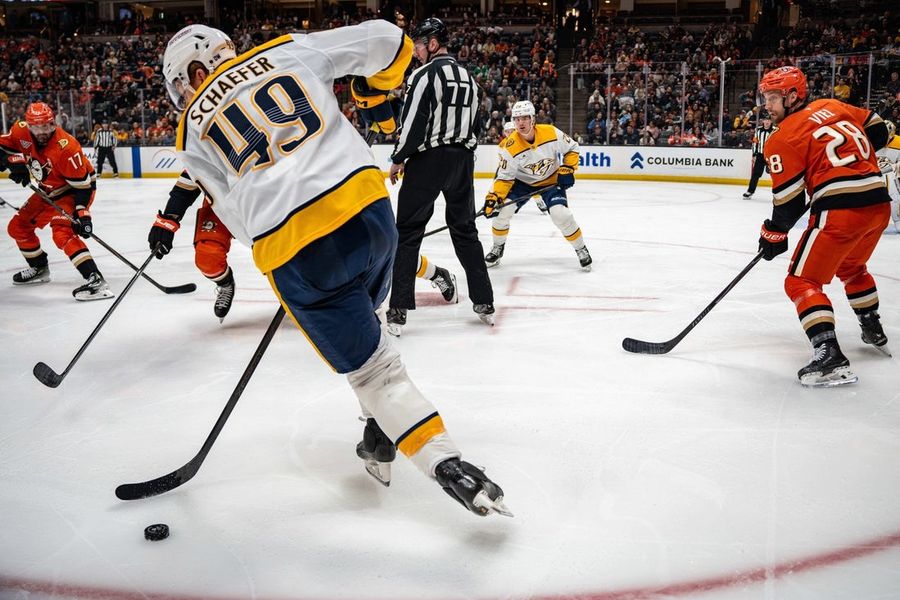
Apr 4, 2026; Anaheim, California, USA; Nashville Predators left wing Reid Schaefer (49) moves the puck following a face off during the second period against the Anaheim Ducks at Honda Center. Mandatory Credit: Corinne Votaw-Imagn Images

Goaltender Justus Annunen posted his first shutout of the season and Erik Haula netted one goal and one assist to pace the visiting Nashville Predators to a 5-0 victory over the slumping Anaheim Ducks on Tuesday.

Annunen made 43 saves for his third career shutout as the Predators jumped into a playoff position.

Filip Forsberg, Brady Skjei, Zachary L’Heureux and Fedor Svechkov all tallied once for the Predators (37-31-10, 84 points).

Ryan O’Reilly and Joakim Kemell both collected a pair of assists.

The victory is the first shutout of the season for the Predators.

Nashville, which was last in the league standings on Dec. 8, jumped one point ahead of the Los Angeles Kings in the chase for the Western Conference’s second wild-card spot.

Nashville has four games remaining in the regular season, one fewer than the Kings. The San Jose Sharks are three points back of Nashville but with two games in hand.

Goalie Lukas Dostal stopped 20 shots for the Ducks (41-32-5, 87 points), who have lost six straight games, five of them in regulation time.

The Ducks are one point behind the Pacific Division-leading Edmonton Oilers, but in the third spot. The Vegas Golden Knights are tied with the Oilers in points but trail via the tiebreaker. All three teams have four games remaining in the regular season.

After a blanked first period, the Predators opened the scoring when Haula went untouched to the slot and while using a defender as a screen fired a top-corner shot at 7:07 of the second period.

Forsberg doubled the Nashville lead on the power play by firing a shot through a collection of players screening the goaltender and finding the mark at 11:26 for his fifth goal in as many outings.

Skjei gave Nashville a three-goal edge when he went top corner on a short-handed breakaway opportunity with one minute remaining in the second period.

L’Heureux extended the edge just before the midway point of the third period by scoring on an odd-man rush, and Svechkov rounded out the scoring by redirecting Tyson Jost’s pass at 15:07 of the final frame.

–Field Level Media

Source link
#Deadspin #Predators #blank #Ducks #move #playoff #position

Previous post

Interim chief Tamim Iqbal vows to repair Bangladesh cricket’s reputation <div id="content-body-70838275" itemprop="articleBody"><p>Bangladesh’s interim cricket chief Tamim Iqbal has vowed to repair the country’s damaged reputation in the game, following the board’s dismissal over alleged “gross irregularities”.</p><p>Cricket and politics are intertwined in Bangladesh with the sport affected by the turmoil following the uprising in 2024 that ousted long-time ruler Sheikh Hasina.</p><p>A new government was elected in February and on Tuesday the National Sports Council said it had dissolved the Bangladesh Cricket Board (BCB) after finding “gross irregularities” in its 2025 election.</p><p>An interim board was appointed, led by the 37-year-old former captain Tamim, who retired from international cricket in 2023.</p><p><b>Also read | <a href="https://sportstar.thehindu.com/cricket/ipl/lalit-modi-ipl-origin-story-indian-premier-league-history/article70837809.ece" target="_blank" rel="nofollow">“Nobody came in. Everybody came back with a no”: Lalit Modi on the IPL pitch that failed 999 times</a></b></p><p>“Our first and foremost duty is to restore the lost glory of Bangladesh cricket,” said Tamim.</p><p>“Our biggest priority is to amend the loss to our reputation in the last 18 months.”</p><p>Under the previous board, Bangladesh refused to play in India at this year’s T20 World Cup, citing security concerns after fast bowler Mustafizur Rahman was dumped by IPL team Kolkata Knight Riders.</p><p>The International Cricket Council refused a Bangladesh request to play its matches in Sri Lanka and kicked it out of the tournament.</p><p>Tamim pledged to hold fair elections to replace his caretaker administration as soon as possible.</p><p>But sacked BCB president Aminul Islam insisted he was still in charge, calling the dissolution a “constitutional coup” and “government interference”.</p><p>“Such actions risk eroding investor confidence, threatening hosting rights and damaging Bangladesh’s standing within the international cricketing community,” said Aminul.</p><p>Tamim scored more than 15,000 runs for Bangladesh in a career spanning 15 years and remains the only Bangladeshi to make centuries in all three formats of international cricket.</p><p class="publish-time" id="end-of-article">Published on Apr 08, 2026</p></div> #Interim #chief #Tamim #Iqbal #vows #repair #Bangladesh #crickets #reputation

Next post

Tori Spelling Breaks Silence on Car Crash, Hospitalization Involving 4 of Her Kids

Australia booked its place in the knockout stage of the FIFA World Cup after playing out a goalless draw against Paraguay on Thursday.

The result was enough for the Socceroos to finish second behind the United States in the group, with Australia’s superior goal difference ensuring it stayed ahead of Paraguay despite both teams ending level on points.

The draw also lifted Paraguay to four points, leaving it well placed to qualify for the knockout stage as one of the best third-placed teams, although it must wait for the remaining group matches to confirm its progress.

Australia has now reached the World Cup knockout stage for the third time, having previously advanced in 2006 and 2022 before exiting in the Round of 16 on both occasions. The Socceroos will face the runner-up from Group G in the Round of 32 in Arlington, Texas, on July 3.

Paraguay, meanwhile, remains in contention to reach the knockout rounds for the fifth time in its history.

Player Ratings

Paraguay

Gill (8.2), Velázquez (7.1), Gómez (7.1), Alderete (7.3), Cáceres (6.7), Maidana (6.4), Gómez (7.3), Cubas (7.8), Galarza (8.1), Ávalos (6.3), Enciso (5.6) | Substitutes: Mauricio (6.7), Arce (6.0)

Australia

Beach (7.8), Souttar (7.3), Circati (7.6), Herrington (7.2), O’Neill (7.3), Irvine (6.7), Bos (7.9), Metcalfe (6.8), Volpato (6.2), Irankunda (6.4), Behich (6.8) | Substitutes: Hrustic (6.5), Okon-Engstler (6.6), Yengi (6.4)

Published on Jun 26, 2026

#FIFA #World #Cup #Australia #qualifies #knockouts #Paraguay #stalemate #Complete #player #ratings">FIFA World Cup 2026: Australia qualifies for knockouts after Paraguay stalemate – Complete player ratings  Australia booked its place in the knockout stage of the FIFA World Cup after playing out a goalless draw against Paraguay on Thursday.The result was enough for the Socceroos to finish second behind the United States in the group, with Australia’s superior goal difference ensuring it stayed ahead of Paraguay despite both teams ending level on points.The draw also lifted Paraguay to four points, leaving it well placed to qualify for the knockout stage as one of the best third-placed teams, although it must wait for the remaining group matches to confirm its progress.Australia has now reached the World Cup knockout stage for the third time, having previously advanced in 2006 and 2022 before exiting in the Round of 16 on both occasions. The Socceroos will face the runner-up from Group G in the Round of 32 in Arlington, Texas, on July 3.Paraguay, meanwhile, remains in contention to reach the knockout rounds for the fifth time in its history.
Player Ratings
Paraguay
Gill (8.2), Velázquez (7.1), Gómez (7.1), Alderete (7.3), Cáceres (6.7), Maidana (6.4), Gómez (7.3), Cubas (7.8), Galarza (8.1), Ávalos (6.3), Enciso (5.6) | Substitutes: Mauricio (6.7), Arce (6.0)
Australia
Beach (7.8), Souttar (7.3), Circati (7.6), Herrington (7.2), O’Neill (7.3), Irvine (6.7), Bos (7.9), Metcalfe (6.8), Volpato (6.2), Irankunda (6.4), Behich (6.8) | Substitutes: Hrustic (6.5), Okon-Engstler (6.6), Yengi (6.4)
Published on Jun 26, 2026  #FIFA #World #Cup #Australia #qualifies #knockouts #Paraguay #stalemate #Complete #player #ratings

Earlier this week, Argentina’s Lionel Messi added the new title of World Cup Goals King to his CV.

By the end of the tournament, it could be Kylian Mbappe holding that honor. Down the line, Erling Haaland and Vinicius Junior are young enough to get in the mix. And if everything goes right, the teenage Lamine Yamal has the time and talent to obliterate them all.

This is an amazing era for elite international goal-scorers. But maybe even more exciting, the convergence of those talents could be symbolic of a World Cup that is ushering in a new era of international competition, one that comes closer to the increasingly attack-oriented model that defines the modern club game.

Under the influence of rapidly improving data, modern soccer at the highest levels has become predicated on pressure and transition.

For sure, it’s not the aesthetic preference of every soccer critic.

Listen closely enough, and you’ll hear the cries of someone in Brazil whining that Carlo Ancelotti’s Selecao rejected the Jogo Bonito in favor of a modern devotion to backpressing that proved critical in their emphatic 3-0 win over Scotland on Wednesday night.

But for the average neutral, it’s hard to deny how much more compelling the club game has become as a result of data that shows the benefits of a higher octane approach.

You can see this in the UEFA Champions League, where goals per game have risen from 2.65 in 2015-16 to 3.45 in 2025-26.

Or you can see it in which teams are and aren’t succeeding at the international level.

Arguably, no side has fallen further than Italy, a nation whose footballing identity is most irrationally opposed to the ongoing tactical revolution.

Similarly, teams like Ecuador and Paraguay, who rode cynical tactics to success in South American qualifying, have so far been exposed by teams with more time to build attacking chemistry.

Yes, some teams have still succeeded out of a low block. But the Ghanas and Cape Verdes of the world have only done so when they could muster at least some threat of a vertical counterattack.

And now, with many of the same managers who orchestrated that rise in attacking play now coaching at this World Cup, goals are up here as well. If the rate of roughly 3.0 goals per game continues, it would be the highest scoring edition since 17-year-old Pele and Brazil dazzled their way to their first championship in Sweden in 1958.

The greatest attacking players are also staying great longer.

At 41, Ronaldo may come with baggage, but he’s still the best finisher on his Portugal team. At 32, Harry Kane’s career is only middle-aged when it would’ve been considered in its twilight era a generation ago.

And the engrossing all-time scoring chase is only possible because Messi is still playing at age 39, and arguably better at a World Cup than he ever has before.

There’s still a lot of time for this World Cup to go sideways. The knockout stages have a way of bringing out the worst conservative instincts in coaches. Oppressive summer weather could become more of a factor as June turns to July, and as more of the kickoffs fall before sunset to appease European TV audiences.

And there’s always the danger for off-the-field controversies to grow louder once the competitive field shrinks.

But on the evidence so far, this tournament has shown that the future of the game on the field is arguably the brightest it’s ever been. And whether it’s Messi or Mbappe who finishes on top of the all-time World Cup scoring chart this summer, you get the sense neither one will stay there for all that long.

#Lionel #Messi #Kylian #Mbappe #Headline #Era #World #Cup #Scoring #Deadspin.com">Lionel Messi and Kylian Mbappe Headline a New Era of World Cup Scoring | Deadspin.com   Earlier this week, Argentina’s Lionel Messi added the new title of World Cup Goals King to his CV.By the end of the tournament, it could be Kylian Mbappe holding that honor. Down the line, Erling Haaland and Vinicius Junior are young enough to get in the mix. And if everything goes right, the teenage Lamine Yamal has the time and talent to obliterate them all.This is an amazing era for elite international goal-scorers. But maybe even more exciting, the convergence of those talents could be symbolic of a World Cup that is ushering in a new era of international competition, one that comes closer to the increasingly attack-oriented model that defines the modern club game.Under the influence of rapidly improving data, modern soccer at the highest levels has become predicated on pressure and transition.For sure, it’s not the aesthetic preference of every soccer critic.Listen closely enough, and you’ll hear the cries of someone in Brazil whining that Carlo Ancelotti’s Selecao rejected the Jogo Bonito in favor of a modern devotion to backpressing that proved critical in their emphatic 3-0 win over Scotland on Wednesday night.But for the average neutral, it’s hard to deny how much more compelling the club game has become as a result of data that shows the benefits of a higher octane approach.You can see this in the UEFA Champions League, where goals per game have risen from 2.65 in 2015-16 to 3.45 in 2025-26.Or you can see it in which teams are and aren’t succeeding at the international level.Arguably, no side has fallen further than Italy, a nation whose footballing identity is most irrationally opposed to the ongoing tactical revolution.Similarly, teams like Ecuador and Paraguay, who rode cynical tactics to success in South American qualifying, have so far been exposed by teams with more time to build attacking chemistry.Yes, some teams have still succeeded out of a low block. But the Ghanas and Cape Verdes of the world have only done so when they could muster at least some threat of a vertical counterattack.And now, with many of the same managers who orchestrated that rise in attacking play now coaching at this World Cup, goals are up here as well. If the rate of roughly 3.0 goals per game continues, it would be the highest scoring edition since 17-year-old Pele and Brazil dazzled their way to their first championship in Sweden in 1958.The greatest attacking players are also staying great longer.At 41, Ronaldo may come with baggage, but he’s still the best finisher on his Portugal team. At 32, Harry Kane’s career is only middle-aged when it would’ve been considered in its twilight era a generation ago.And the engrossing all-time scoring chase is only possible because Messi is still playing at age 39, and arguably better at a World Cup than he ever has before.There’s still a lot of time for this World Cup to go sideways. The knockout stages have a way of bringing out the worst conservative instincts in coaches. Oppressive summer weather could become more of a factor as June turns to July, and as more of the kickoffs fall before sunset to appease European TV audiences.And there’s always the danger for off-the-field controversies to grow louder once the competitive field shrinks.But on the evidence so far, this tournament has shown that the future of the game on the field is arguably the brightest it’s ever been. And whether it’s Messi or Mbappe who finishes on top of the all-time World Cup scoring chart this summer, you get the sense neither one will stay there for all that long.   #Lionel #Messi #Kylian #Mbappe #Headline #Era #World #Cup #Scoring #Deadspin.com

symbolic of a World Cup that is ushering in a new era of international competition, one that comes closer to the increasingly attack-oriented model that defines the modern club game.

Under the influence of rapidly improving data, modern soccer at the highest levels has become predicated on pressure and transition.

For sure, it’s not the aesthetic preference of every soccer critic.

Listen closely enough, and you’ll hear the cries of someone in Brazil whining that Carlo Ancelotti’s Selecao rejected the Jogo Bonito in favor of a modern devotion to backpressing that proved critical in their emphatic 3-0 win over Scotland on Wednesday night.

But for the average neutral, it’s hard to deny how much more compelling the club game has become as a result of data that shows the benefits of a higher octane approach.

You can see this in the UEFA Champions League, where goals per game have risen from 2.65 in 2015-16 to 3.45 in 2025-26.

Or you can see it in which teams are and aren’t succeeding at the international level.

Arguably, no side has fallen further than Italy, a nation whose footballing identity is most irrationally opposed to the ongoing tactical revolution.

Similarly, teams like Ecuador and Paraguay, who rode cynical tactics to success in South American qualifying, have so far been exposed by teams with more time to build attacking chemistry.

Yes, some teams have still succeeded out of a low block. But the Ghanas and Cape Verdes of the world have only done so when they could muster at least some threat of a vertical counterattack.

And now, with many of the same managers who orchestrated that rise in attacking play now coaching at this World Cup, goals are up here as well. If the rate of roughly 3.0 goals per game continues, it would be the highest scoring edition since 17-year-old Pele and Brazil dazzled their way to their first championship in Sweden in 1958.

The greatest attacking players are also staying great longer.

At 41, Ronaldo may come with baggage, but he’s still the best finisher on his Portugal team. At 32, Harry Kane’s career is only middle-aged when it would’ve been considered in its twilight era a generation ago.

And the engrossing all-time scoring chase is only possible because Messi is still playing at age 39, and arguably better at a World Cup than he ever has before.

There’s still a lot of time for this World Cup to go sideways. The knockout stages have a way of bringing out the worst conservative instincts in coaches. Oppressive summer weather could become more of a factor as June turns to July, and as more of the kickoffs fall before sunset to appease European TV audiences.

And there’s always the danger for off-the-field controversies to grow louder once the competitive field shrinks.

But on the evidence so far, this tournament has shown that the future of the game on the field is arguably the brightest it’s ever been. And whether it’s Messi or Mbappe who finishes on top of the all-time World Cup scoring chart this summer, you get the sense neither one will stay there for all that long.

#Lionel #Messi #Kylian #Mbappe #Headline #Era #World #Cup #Scoring #Deadspin.com">Lionel Messi and Kylian Mbappe Headline a New Era of World Cup Scoring | Deadspin.com

Earlier this week, Argentina’s Lionel Messi added the new title of World Cup Goals King to his CV.

By the end of the tournament, it could be Kylian Mbappe holding that honor. Down the line, Erling Haaland and Vinicius Junior are young enough to get in the mix. And if everything goes right, the teenage Lamine Yamal has the time and talent to obliterate them all.

This is an amazing era for elite international goal-scorers. But maybe even more exciting, the convergence of those talents could be symbolic of a World Cup that is ushering in a new era of international competition, one that comes closer to the increasingly attack-oriented model that defines the modern club game.

Under the influence of rapidly improving data, modern soccer at the highest levels has become predicated on pressure and transition.

For sure, it’s not the aesthetic preference of every soccer critic.

Listen closely enough, and you’ll hear the cries of someone in Brazil whining that Carlo Ancelotti’s Selecao rejected the Jogo Bonito in favor of a modern devotion to backpressing that proved critical in their emphatic 3-0 win over Scotland on Wednesday night.

But for the average neutral, it’s hard to deny how much more compelling the club game has become as a result of data that shows the benefits of a higher octane approach.

You can see this in the UEFA Champions League, where goals per game have risen from 2.65 in 2015-16 to 3.45 in 2025-26.

Or you can see it in which teams are and aren’t succeeding at the international level.

Arguably, no side has fallen further than Italy, a nation whose footballing identity is most irrationally opposed to the ongoing tactical revolution.

Similarly, teams like Ecuador and Paraguay, who rode cynical tactics to success in South American qualifying, have so far been exposed by teams with more time to build attacking chemistry.

Yes, some teams have still succeeded out of a low block. But the Ghanas and Cape Verdes of the world have only done so when they could muster at least some threat of a vertical counterattack.

And now, with many of the same managers who orchestrated that rise in attacking play now coaching at this World Cup, goals are up here as well. If the rate of roughly 3.0 goals per game continues, it would be the highest scoring edition since 17-year-old Pele and Brazil dazzled their way to their first championship in Sweden in 1958.

The greatest attacking players are also staying great longer.

At 41, Ronaldo may come with baggage, but he’s still the best finisher on his Portugal team. At 32, Harry Kane’s career is only middle-aged when it would’ve been considered in its twilight era a generation ago.

And the engrossing all-time scoring chase is only possible because Messi is still playing at age 39, and arguably better at a World Cup than he ever has before.

There’s still a lot of time for this World Cup to go sideways. The knockout stages have a way of bringing out the worst conservative instincts in coaches. Oppressive summer weather could become more of a factor as June turns to July, and as more of the kickoffs fall before sunset to appease European TV audiences.

And there’s always the danger for off-the-field controversies to grow louder once the competitive field shrinks.

But on the evidence so far, this tournament has shown that the future of the game on the field is arguably the brightest it’s ever been. And whether it’s Messi or Mbappe who finishes on top of the all-time World Cup scoring chart this summer, you get the sense neither one will stay there for all that long.

#Lionel #Messi #Kylian #Mbappe #Headline #Era #World #Cup #Scoring #Deadspin.com

Post Comment