×
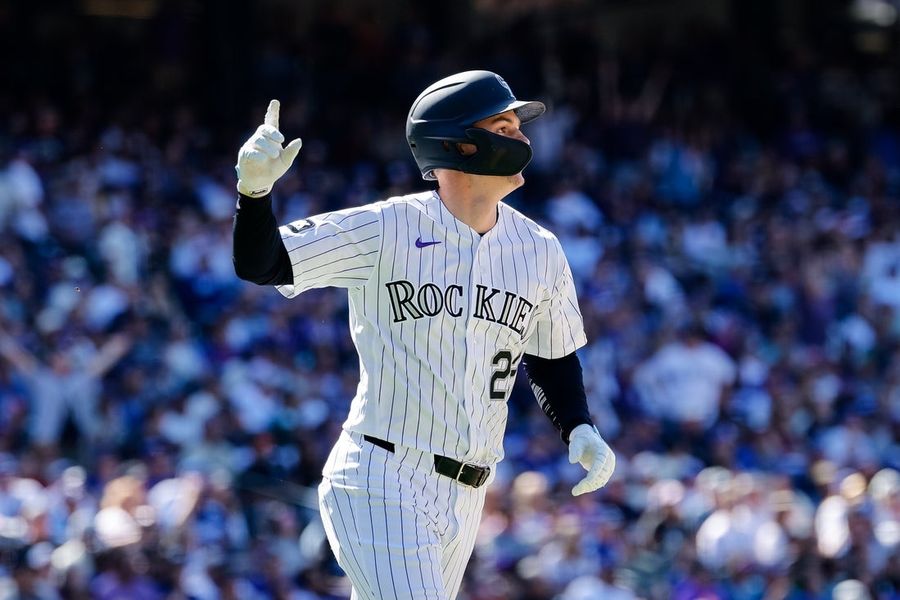
Deadspin | Rockies use long ball to hand Dodgers first consecutive losses of ’26  Apr 19, 2026; Denver, Colorado, USA; Colorado Rockies left fielder Mickey Moniak (22) gestures on a solo home run in the seventh inning against the Los Angeles Dodgers at Coors Field. Mandatory Credit: Isaiah J. Downing-Imagn Images   Mickey Moniak and Kyle Karros each homered among their two hits, and the Colorado Rockies came from behind to beat the Los Angeles Dodgers 9-6 in Denver on Sunday.  Edouard Julien had three hits and three RBIs, Troy Johnston added two hits and Antonio Senzatela (1-0) pitched two innings of relief for Colorado.  Max Muncy had three hits, Ryan Ward had two hits in his major league debut and Hyeseong Kim and Alex Freeland had two hits apiece for Los Angeles, which has lost consecutive games for the first time this season. The teams will conclude their four-game set Monday.  Shohei Ohtani had two hits to extend his on-base streak to 51 games. He is third in franchise history behind Shawn Green’s 53-game streak in 2000 and Duke Snider, who did it in 58 consecutive games in 1954.  The Dodgers nearly rallied in the ninth off Victor Vodnik. Will Smith had an RBI single and Dalton Rushing’s bases-loaded groundout scored another run. Ward had a chance with two on and two outs, but Johnston made a diving catch of his blooper to right.  Colorado went ahead for good in the seventh off reliever Blake Treinen (1-1) on Moniak’s two-run homer to right-center and an RBI single by Tyler Freeman.   Julien delivered a two-run single in the eighth to stretch the lead to 8-4, and Moniak drove in another run with a groundout.  Freeland’s single and Ohtani’s RBI double in the third gave Los Angeles a 2-0 lead, and Ward drove in another with a single to right in the fourth off Colorado starter Michael Lorenzen.  That was all Lorenzen gave up in his five innings of work. The Rockies got a run back in the bottom of the fourth when TJ Rumfield hit an RBI single off Roki Sasaki, and they added two runs in the fifth.  Karros led off with his first homer of the season. Jake McCarthy legged out a double and scored on Julien’s single. Sasaki left after a two-out walk to Freeman.  Los Angeles retook the lead in the sixth. Alex Call and Ward singled with one out, Call advanced to third on a fielder’s choice and he scored on Freeland’s line single to right.  –Field Level Media    #Deadspin #Rockies #long #ball #hand #Dodgers #consecutive #losses
Deadspin | Rockies use long ball to hand Dodgers first consecutive losses of ’26
Deadspin | Rockies use long ball to hand Dodgers first consecutive losses of ’26  Apr 19, 2026; Denver, Colorado, USA; Colorado Rockies left fielder Mickey Moniak (22) gestures on a solo home run in the seventh inning against the Los Angeles Dodgers at Coors Field. Mandatory Credit: Isaiah J. Downing-Imagn Images   Mickey Moniak and Kyle Karros each homered among their two hits, and the Colorado Rockies came from behind to beat the Los Angeles Dodgers 9-6 in Denver on Sunday.  Edouard Julien had three hits and three RBIs, Troy Johnston added two hits and Antonio Senzatela (1-0) pitched two innings of relief for Colorado.  Max Muncy had three hits, Ryan Ward had two hits in his major league debut and Hyeseong Kim and Alex Freeland had two hits apiece for Los Angeles, which has lost consecutive games for the first time this season. The teams will conclude their four-game set Monday.  Shohei Ohtani had two hits to extend his on-base streak to 51 games. He is third in franchise history behind Shawn Green’s 53-game streak in 2000 and Duke Snider, who did it in 58 consecutive games in 1954.  The Dodgers nearly rallied in the ninth off Victor Vodnik. Will Smith had an RBI single and Dalton Rushing’s bases-loaded groundout scored another run. Ward had a chance with two on and two outs, but Johnston made a diving catch of his blooper to right.  Colorado went ahead for good in the seventh off reliever Blake Treinen (1-1) on Moniak’s two-run homer to right-center and an RBI single by Tyler Freeman.   Julien delivered a two-run single in the eighth to stretch the lead to 8-4, and Moniak drove in another run with a groundout.  Freeland’s single and Ohtani’s RBI double in the third gave Los Angeles a 2-0 lead, and Ward drove in another with a single to right in the fourth off Colorado starter Michael Lorenzen.  That was all Lorenzen gave up in his five innings of work. The Rockies got a run back in the bottom of the fourth when TJ Rumfield hit an RBI single off Roki Sasaki, and they added two runs in the fifth.  Karros led off with his first homer of the season. Jake McCarthy legged out a double and scored on Julien’s single. Sasaki left after a two-out walk to Freeman.  Los Angeles retook the lead in the sixth. Alex Call and Ward singled with one out, Call advanced to third on a fielder’s choice and he scored on Freeland’s line single to right.  –Field Level Media    #Deadspin #Rockies #long #ball #hand #Dodgers #consecutive #lossesApr 19, 2026; Denver, Colorado, USA; Colorado Rockies left fielder Mickey Moniak (22) gestures on a solo home run in the seventh inning against the Los Angeles Dodgers at Coors Field. Mandatory Credit: Isaiah J. Downing-Imagn Images

Mickey Moniak and Kyle Karros each homered among their two hits, and the Colorado Rockies came from behind to beat the Los Angeles Dodgers 9-6 in Denver on Sunday.

Edouard Julien had three hits and three RBIs, Troy Johnston added two hits and Antonio Senzatela (1-0) pitched two innings of relief for Colorado.

Max Muncy had three hits, Ryan Ward had two hits in his major league debut and Hyeseong Kim and Alex Freeland had two hits apiece for Los Angeles, which has lost consecutive games for the first time this season. The teams will conclude their four-game set Monday.

Shohei Ohtani had two hits to extend his on-base streak to 51 games. He is third in franchise history behind Shawn Green’s 53-game streak in 2000 and Duke Snider, who did it in 58 consecutive games in 1954.

The Dodgers nearly rallied in the ninth off Victor Vodnik. Will Smith had an RBI single and Dalton Rushing’s bases-loaded groundout scored another run. Ward had a chance with two on and two outs, but Johnston made a diving catch of his blooper to right.


Colorado went ahead for good in the seventh off reliever Blake Treinen (1-1) on Moniak’s two-run homer to right-center and an RBI single by Tyler Freeman.

Julien delivered a two-run single in the eighth to stretch the lead to 8-4, and Moniak drove in another run with a groundout.

Freeland’s single and Ohtani’s RBI double in the third gave Los Angeles a 2-0 lead, and Ward drove in another with a single to right in the fourth off Colorado starter Michael Lorenzen.

That was all Lorenzen gave up in his five innings of work. The Rockies got a run back in the bottom of the fourth when TJ Rumfield hit an RBI single off Roki Sasaki, and they added two runs in the fifth.

Karros led off with his first homer of the season. Jake McCarthy legged out a double and scored on Julien’s single. Sasaki left after a two-out walk to Freeman.

Los Angeles retook the lead in the sixth. Alex Call and Ward singled with one out, Call advanced to third on a fielder’s choice and he scored on Freeland’s line single to right.


–Field Level Media

#Deadspin #Rockies #long #ball #hand #Dodgers #consecutive #losses

Apr 19, 2026; Denver, Colorado, USA; Colorado Rockies left fielder Mickey Moniak (22) gestures on a solo home run in the seventh inning against the Los Angeles Dodgers at Coors Field. Mandatory Credit: Isaiah J. Downing-Imagn Images

Mickey Moniak and Kyle Karros each homered among their two hits, and the Colorado Rockies came from behind to beat the Los Angeles Dodgers 9-6 in Denver on Sunday.

Edouard Julien had three hits and three RBIs, Troy Johnston added two hits and Antonio Senzatela (1-0) pitched two innings of relief for Colorado.

Max Muncy had three hits, Ryan Ward had two hits in his major league debut and Hyeseong Kim and Alex Freeland had two hits apiece for Los Angeles, which has lost consecutive games for the first time this season. The teams will conclude their four-game set Monday.

Shohei Ohtani had two hits to extend his on-base streak to 51 games. He is third in franchise history behind Shawn Green’s 53-game streak in 2000 and Duke Snider, who did it in 58 consecutive games in 1954.

The Dodgers nearly rallied in the ninth off Victor Vodnik. Will Smith had an RBI single and Dalton Rushing’s bases-loaded groundout scored another run. Ward had a chance with two on and two outs, but Johnston made a diving catch of his blooper to right.

Colorado went ahead for good in the seventh off reliever Blake Treinen (1-1) on Moniak’s two-run homer to right-center and an RBI single by Tyler Freeman.

Julien delivered a two-run single in the eighth to stretch the lead to 8-4, and Moniak drove in another run with a groundout.

Freeland’s single and Ohtani’s RBI double in the third gave Los Angeles a 2-0 lead, and Ward drove in another with a single to right in the fourth off Colorado starter Michael Lorenzen.

That was all Lorenzen gave up in his five innings of work. The Rockies got a run back in the bottom of the fourth when TJ Rumfield hit an RBI single off Roki Sasaki, and they added two runs in the fifth.

Karros led off with his first homer of the season. Jake McCarthy legged out a double and scored on Julien’s single. Sasaki left after a two-out walk to Freeman.

Los Angeles retook the lead in the sixth. Alex Call and Ward singled with one out, Call advanced to third on a fielder’s choice and he scored on Freeland’s line single to right.

–Field Level Media

Source link
#Deadspin #Rockies #long #ball #hand #Dodgers #consecutive #losses

Previous post

Who is John Ternus, the incoming Apple CEO? | TechCrunch<div> <p id="speakable-summary" class="wp-block-paragraph">After 15 years, Tim Cook will <a href="https://techcrunch.com/2026/04/20/tim-cook-stepping-down-as-apple-ceo-john-ternus-taking-over/" target="_blank" rel="noreferrer noopener">hand off the Apple CEO role</a> to John Ternus, the company’s senior vice president of hardware engineering. Starting on September 1, Ternus will lead one of the world’s most valuable companies, but if you’re not a dedicated Apple enthusiast, you’ve probably never heard of this man, who has largely remained out of the spotlight until now.</p> <h2 class="wp-block-heading" id="h-how-long-has-john-ternus-worked-at-apple">How long has John Ternus worked at Apple?</h2> <p class="wp-block-paragraph">Ternus has worked at Apple for nearly half of his life — now 51 years old, he has been with the company for 25 years.</p> <p class="wp-block-paragraph">He joined Apple’s product design team in 2001 as only his second job out of college (his first was at a small maker of virtual-reality devices called Virtual Research Systems). By 2013, Ternus was a VP of hardware engineering and was promoted to the SVP role in 2021. </p> <p class="wp-block-paragraph">Ternus — who is 15 years younger than Cook — was among the youngest of top Apple executives who had been <a href="https://techcrunch.com/2025/11/16/are-we-nearing-the-end-of-apples-tim-cook-era/" target="_blank" rel="noreferrer noopener">rumored</a> as a possible successor, implying that Apple could be looking for someone to lead the company for a long time. After all, Apple has only had two CEOs in this millennium, so it seems that leadership continuity is important to the company.</p> <p class="wp-block-paragraph">Ternus reports to Cook, who he considers a mentor, and leads all of hardware engineering at Apple. That’s a pretty big deal for a company that’s known for ubiquitous hardware like the iPhone and the MacBook.</p> <p class="wp-block-paragraph">In his 2024 commencement speech at his alma mater, the University of Pennsylvania’s engineering school, Ternus reflected on the lessons he learned at Apple, which perhaps can tell us a bit about his character — or at least a sanitized version of it. </p> <p class="wp-block-paragraph">“Always assume you’re as smart as anyone else in the room, but never assume that you know as much as they do,” Ternus said in the <a href="https://events.seas.upenn.edu/commencement/2024-undergraduate-ceremony/" target="_blank" rel="noreferrer noopener nofollow">speech</a>. “With this mindset, you’ll find the confidence you need to push forward, but more importantly, the humility to ask questions.”</p> <div class="wp-block-techcrunch-inline-cta"> <div class="inline-cta__wrapper"> <p>Techcrunch event</p> <div class="inline-cta__content"> <p> <span class="inline-cta__location">San Francisco, CA</span> <span class="inline-cta__separator">|</span> <span class="inline-cta__date">October 13-15, 2026</span> </p> </div> </div> </div> <p class="wp-block-paragraph">In a tech ecosystem populated with abrasive egos, it’s refreshing to hear Ternus utter the word “humility.” Better yet, he doesn’t appear to have an X account.</p> <figure class="wp-block-image aligncenter size-large"><img loading="lazy" decoding="async" height="383" width="680" src="https://techcrunch.com/wp-content/uploads/2026/04/Apple-John-Ternus-Tim-Cook_Full-Bleed-Image.jpg.xlarge_2x.jpg?w=680" alt="" class="wp-image-3114388" srcset="https://techcrunch.com/wp-content/uploads/2026/04/Apple-John-Ternus-Tim-Cook_Full-Bleed-Image.jpg.xlarge_2x.jpg 1468w, https://techcrunch.com/wp-content/uploads/2026/04/Apple-John-Ternus-Tim-Cook_Full-Bleed-Image.jpg.xlarge_2x.jpg?resize=150,84 150w, https://techcrunch.com/wp-content/uploads/2026/04/Apple-John-Ternus-Tim-Cook_Full-Bleed-Image.jpg.xlarge_2x.jpg?resize=300,169 300w, https://techcrunch.com/wp-content/uploads/2026/04/Apple-John-Ternus-Tim-Cook_Full-Bleed-Image.jpg.xlarge_2x.jpg?resize=768,432 768w, https://techcrunch.com/wp-content/uploads/2026/04/Apple-John-Ternus-Tim-Cook_Full-Bleed-Image.jpg.xlarge_2x.jpg?resize=680,383 680w, https://techcrunch.com/wp-content/uploads/2026/04/Apple-John-Ternus-Tim-Cook_Full-Bleed-Image.jpg.xlarge_2x.jpg?resize=1200,675 1200w, https://techcrunch.com/wp-content/uploads/2026/04/Apple-John-Ternus-Tim-Cook_Full-Bleed-Image.jpg.xlarge_2x.jpg?resize=1280,720 1280w, https://techcrunch.com/wp-content/uploads/2026/04/Apple-John-Ternus-Tim-Cook_Full-Bleed-Image.jpg.xlarge_2x.jpg?resize=430,242 430w, https://techcrunch.com/wp-content/uploads/2026/04/Apple-John-Ternus-Tim-Cook_Full-Bleed-Image.jpg.xlarge_2x.jpg?resize=720,405 720w, https://techcrunch.com/wp-content/uploads/2026/04/Apple-John-Ternus-Tim-Cook_Full-Bleed-Image.jpg.xlarge_2x.jpg?resize=900,506 900w, https://techcrunch.com/wp-content/uploads/2026/04/Apple-John-Ternus-Tim-Cook_Full-Bleed-Image.jpg.xlarge_2x.jpg?resize=800,450 800w, https://techcrunch.com/wp-content/uploads/2026/04/Apple-John-Ternus-Tim-Cook_Full-Bleed-Image.jpg.xlarge_2x.jpg?resize=668,376 668w, https://techcrunch.com/wp-content/uploads/2026/04/Apple-John-Ternus-Tim-Cook_Full-Bleed-Image.jpg.xlarge_2x.jpg?resize=666,375 666w, https://techcrunch.com/wp-content/uploads/2026/04/Apple-John-Ternus-Tim-Cook_Full-Bleed-Image.jpg.xlarge_2x.jpg?resize=1097,617 1097w, https://techcrunch.com/wp-content/uploads/2026/04/Apple-John-Ternus-Tim-Cook_Full-Bleed-Image.jpg.xlarge_2x.jpg?resize=708,398 708w, https://techcrunch.com/wp-content/uploads/2026/04/Apple-John-Ternus-Tim-Cook_Full-Bleed-Image.jpg.xlarge_2x.jpg?resize=50,28 50w" sizes="auto, (max-width: 680px) 100vw, 680px"/><figcaption class="wp-element-caption"><span class="wp-block-image__credits"><strong>Image Credits:</strong>Apple</span></figcaption></figure> <h2 class="wp-block-heading" id="h-what-projects-did-john-ternus-lead-at-apple">What projects did John Ternus lead at Apple?</h2> <p class="wp-block-paragraph">Ternus’ earliest project at Apple involved scrutinizing parts for the Apple Cinema Display, an early desktop monitor.</p> <p class="wp-block-paragraph">“At some point in my first year, I found myself at a supplier facility. I was far away from home. Well past midnight, I was using a magnifying glass to count the number of grooves on the head of a screw … and I was arguing with the supplier because these parts had 35 grooves. They were supposed to have 25,” Ternus recalled in his commencement speech. “I distinctly remember stepping back for a minute and thinking, ‘What the hell am I doing? Is this normal?’”</p> <p class="wp-block-paragraph">As Ternus climbed the corporate ladder, his responsibilities grew. He may no longer spend as much time analyzing screws, but he still seems to take pride in getting the little details right. In a recent <a href="https://www.youtube.com/watch?v=kkBudtxgor0" target="_blank" rel="noreferrer noopener nofollow">interview</a>, when Ternus was asked about his favorite memory of Steve Jobs, he mentioned the former Apple co-founder’s attention to craftsmanship.</p> <p class="wp-block-paragraph">“[Jobs] was moving a piece of furniture, a chest of drawers, and pulled it away from the wall and looked at the back and was just reflecting on, you know, that the carpenter who made it had made it beautiful,” Ternus said. “It finished the back as beautifully as the rest of it, even though nobody was going to see it, right? And I think about that all the time because I think that perfectly exemplifies what we do here.”</p> <p class="wp-block-paragraph">From there, he went on to lead the hardware development behind products across the Apple ecosystem, overseeing launches like AirPods, Apple Watch, and the Vision Pro. He also had a hand in major technical upgrades at Apple, like Apple’s transition from Intel chips to its own proprietary <a href="https://techcrunch.com/2021/04/25/interview-apple-executives-on-the-2021-ipad-pro-stunting-with-the-m1-and-creating-headroom/" target="_blank" rel="noreferrer noopener">Apple silicon</a>.</p> <p class="wp-block-paragraph">Most recently, Ternus was involved in the production of the <a href="https://techcrunch.com/2026/03/04/meet-the-macbook-neo-apples-colorful-answer-to-the-chromebook-starting-at-599/" target="_blank" rel="noreferrer noopener">MacBook Neo</a>, Apple’s new, more affordable laptop model that lowers costs through some clever trade-offs in hardware design, like using an iPhone chip to power the device.</p> <p class="wp-block-paragraph">“We never want to ship junk. We want to ship great products that have that Apple experience, that Apple quality. To do that with the Neo required building something completely new from the ground up … leveraging both the technologies we’d been developing like Apple silicon, but also the kind of expertise that we’ve developed over many, many years of building Macs, and building phones, and building iPads, and all of these things,” Ternus told <a href="https://www.youtube.com/watch?v=kkBudtxgor0" target="_blank" rel="noreferrer noopener nofollow">Tom’s Guide</a>.</p> <p class="wp-block-paragraph">As CEO, Ternus will have to steer Apple through its challenge to catch up in the AI race and figure out what to do with the underlying tech behind the Vision Pro.</p> <h2 class="wp-block-heading" id="h-what-else-do-we-know-about-john-ternus">What else do we know about John Ternus?</h2> <p class="wp-block-paragraph">Ternus was on the swim team at Penn. For his senior project, he built a feeding arm that people with quadriplegia could control with head movements.</p> <p class="wp-block-paragraph">According to <a href="https://www.opensecrets.org/donor-lookup/results?name=john+ternus" target="_blank" rel="noreferrer noopener nofollow">public records</a> of political donations, Ternus donated $2,900 to Senator Chuck Schumer (D-NY) in 2021.</p> <p class="wp-block-paragraph">Otherwise, Ternus has maintained a relatively low profile.</p> </div>#John #Ternus #incoming #Apple #CEO #TechCrunchApple,ceo,John Ternus,Tim Cook

Next post

Indore News: अब महिलाएं सिखा रहीं प्राकृतिक खेती और किचन गार्डन के आधुनिक तरीके, महू से शुरू हुई अनूठी पहल

Deadspin | Jim Colbert, 35-time professional winner, dies at 85  May 13, 2006; Sandestin, FL, USA; Jim Colbert tees off on the 14th hole of the Raven course during the second round of the Boeing Championships at Sandestin. Mandatory Credit: Jason Parkhurst Copyright © 2006 Jason Parkhurst    Jim Colbert, an eight-time winner on the PGA Tour and a 35-time professional winner overall, died on Sunday at the age of 85.  From 1969 to 1983, Colbert won eight tournaments on the tour, earning two playoff victories (2-0) in the process. One of those came in 1983 — a high mark calendar year for Colbert, the only year he won two tournaments — against Fuzzy Zoeller in the Colonial National Invitation.  Constantly adorned in his signature bucket hat, Colbert made an even bigger splash on the senior circuit, earning 20 senior PGA tour wins over a 10-year span from 1991 to 2001.  On that hat, Colbert came to embrace his signature look, after finding that people wouldn’t recognize him without it.  “Lee Trevino has the sombrero. Jack Nicklaus has the bear,” Colbert said. “I have my hat.”   Born in New Jersey, Colbert played golf and football before earning a football scholarship to attend Kansas State University. Following an injury, Colbert re-dedicated himself to golf, finishing runner-up at the 1964 NCAA Championship. He turned professional shortly thereafter.   After his turn on the PGA Tour, Colbert served as a golf analyst on ESPN before re-entering the game on the PGA Tour Champions circuit. He was an instant success there, winning three times in 1991 to earn Rookie of the Year honors.  Colbert had a public battle with prostate cancer in the late 1990s, but he rebounded to win another tournament in 1998, which resulted in his being named Comeback Player of the Year.  His continued involvement with his alma mater led to a friendship with longtime Kansas State football coach Bill Snyder and the construction of a golf course named in his honor, Colbert Hills, located in Manhattan, Kan.   “Jim had a positive influence on many, many lives,” Snyder said. “He never failed to step up to help when he was in a position to help his community and people in need.”  Colbert has been enshrined in the Kansas State Athletic Hall of Fame, the Kansas Sports Hall of Fame and the Las Vegas Golf Hall of Fame, among other honors.  –Field Level Media    #Deadspin #Jim #Colbert #35time #professional #winner #diesMay 13, 2006; Sandestin, FL, USA; Jim Colbert tees off on the 14th hole of the Raven course during the second round of the Boeing Championships at Sandestin. Mandatory Credit: Jason Parkhurst Copyright © 2006 Jason Parkhurst

Jim Colbert, an eight-time winner on the PGA Tour and a 35-time professional winner overall, died on Sunday at the age of 85.

From 1969 to 1983, Colbert won eight tournaments on the tour, earning two playoff victories (2-0) in the process. One of those came in 1983 — a high mark calendar year for Colbert, the only year he won two tournaments — against Fuzzy Zoeller in the Colonial National Invitation.

Constantly adorned in his signature bucket hat, Colbert made an even bigger splash on the senior circuit, earning 20 senior PGA tour wins over a 10-year span from 1991 to 2001.

On that hat, Colbert came to embrace his signature look, after finding that people wouldn’t recognize him without it.

“Lee Trevino has the sombrero. Jack Nicklaus has the bear,” Colbert said. “I have my hat.”


Born in New Jersey, Colbert played golf and football before earning a football scholarship to attend Kansas State University. Following an injury, Colbert re-dedicated himself to golf, finishing runner-up at the 1964 NCAA Championship. He turned professional shortly thereafter.

After his turn on the PGA Tour, Colbert served as a golf analyst on ESPN before re-entering the game on the PGA Tour Champions circuit. He was an instant success there, winning three times in 1991 to earn Rookie of the Year honors.

Colbert had a public battle with prostate cancer in the late 1990s, but he rebounded to win another tournament in 1998, which resulted in his being named Comeback Player of the Year.

His continued involvement with his alma mater led to a friendship with longtime Kansas State football coach Bill Snyder and the construction of a golf course named in his honor, Colbert Hills, located in Manhattan, Kan.

“Jim had a positive influence on many, many lives,” Snyder said. “He never failed to step up to help when he was in a position to help his community and people in need.”

Colbert has been enshrined in the Kansas State Athletic Hall of Fame, the Kansas Sports Hall of Fame and the Las Vegas Golf Hall of Fame, among other honors.


–Field Level Media

#Deadspin #Jim #Colbert #35time #professional #winner #dies">Deadspin | Jim Colbert, 35-time professional winner, dies at 85  May 13, 2006; Sandestin, FL, USA; Jim Colbert tees off on the 14th hole of the Raven course during the second round of the Boeing Championships at Sandestin. Mandatory Credit: Jason Parkhurst Copyright © 2006 Jason Parkhurst    Jim Colbert, an eight-time winner on the PGA Tour and a 35-time professional winner overall, died on Sunday at the age of 85.  From 1969 to 1983, Colbert won eight tournaments on the tour, earning two playoff victories (2-0) in the process. One of those came in 1983 — a high mark calendar year for Colbert, the only year he won two tournaments — against Fuzzy Zoeller in the Colonial National Invitation.  Constantly adorned in his signature bucket hat, Colbert made an even bigger splash on the senior circuit, earning 20 senior PGA tour wins over a 10-year span from 1991 to 2001.  On that hat, Colbert came to embrace his signature look, after finding that people wouldn’t recognize him without it.  “Lee Trevino has the sombrero. Jack Nicklaus has the bear,” Colbert said. “I have my hat.”   Born in New Jersey, Colbert played golf and football before earning a football scholarship to attend Kansas State University. Following an injury, Colbert re-dedicated himself to golf, finishing runner-up at the 1964 NCAA Championship. He turned professional shortly thereafter.   After his turn on the PGA Tour, Colbert served as a golf analyst on ESPN before re-entering the game on the PGA Tour Champions circuit. He was an instant success there, winning three times in 1991 to earn Rookie of the Year honors.  Colbert had a public battle with prostate cancer in the late 1990s, but he rebounded to win another tournament in 1998, which resulted in his being named Comeback Player of the Year.  His continued involvement with his alma mater led to a friendship with longtime Kansas State football coach Bill Snyder and the construction of a golf course named in his honor, Colbert Hills, located in Manhattan, Kan.   “Jim had a positive influence on many, many lives,” Snyder said. “He never failed to step up to help when he was in a position to help his community and people in need.”  Colbert has been enshrined in the Kansas State Athletic Hall of Fame, the Kansas Sports Hall of Fame and the Las Vegas Golf Hall of Fame, among other honors.  –Field Level Media    #Deadspin #Jim #Colbert #35time #professional #winner #dies

The Carolina Hurricanes are either the best team in hockey, or the biggest frauds in the Stanley Cup Playoffs — it all depends on who you ask. The Canes made history on Saturday night in Philadelphia with their eighth straight playoff win, and their second sweep in a row. It made them the first team in NHL history to sweep their first two series since the 1987 best-of-seven format began, the first team to start 8-0 in the playoffs since 1985, and only the fifth team in NHL history to start the playoffs 8-0.

Yet nobody can settle on whether this team is really a Stanley Cup favorite yet.

A lot of factors go into the acrimony when discussing Carolina. There’s long-standing bitterness over southern hockey being a thing, especially following back-to-back years of the Florida Panthers hoisting the cup. There’s the fact that the team plays hockey in a manner that runs counter to everything we know about success in the modern NHL. Also, there’s simply a reality that the Canes have had a pretty easy path through the postseason thus far, facing two teams that were bad strategic mismatches for them.

What that doesn’t mean, however, is that either the Ottawa Senators or Philadelphia Flyers are “bad teams.” Finishing with 99 and 98 points on the season, respectively, the Sens and Flyers were better than the entire Western Conference Pacific Division, better than the Utah Mammoth who the Golden Knights beat in the first round, and just one win worse than the Bruins, who the Sabres bested in the opening round. Yet, it’s become cool to hate on the Hurricanes’ opponents thus far as a means to discredit Carolina as being a legitimate team — foisting them with criticism no other team in the field is left with.

It’s absolutely fair to say that both Ottawa and Philadelphia were thrown into a mismatch blender. Both teams thrived during the regular season when playing on clean ice, with open passing lanes and room to set up plays. This is what the Hurricanes excel at stopping, running brutal forechecks with gutsy defensive rotations that flip the formation to send defensemen up ice to hassle opposing defenseman on the puck, allowing the forwards to stay home.

One of the hallmarks of Carolina hockey is to forget the model of play that wins in the NHL, and instead change the game into Hurricanes hockey. They thrive in limiting the effectiveness of star players, making the game be about depth rather than top-line strength, then take over when their third and fourth lines are stronger than their opponents. There’s no coincidence that hockey fans were wondering why Brady Tkachuk and Tim Stützle disappeared in the Sens series, or why Trevor Zegras and Travis Konecny couldn’t make inroads in round two. This was the Canes’ doing, and it worked.

This past week Brady Tkachuk explained why it was near-impossible to deal with the Hurricanes’ defense in his series, and noticing that it was happening to the Flyers as well.

“Their D… they have the best sticks I’ve ever seen. It was crazy. Some of the plays you’d just be like ‘I can get this through,’ like Slav [Jaccob Slavin] has probably the best stick in the league. I had two Grade-A’s [scoring chances] and they hit his stick and up in the netting. I was like ‘how on earth is that not in the back of the net?’”

The length of the Carolina blueliners is causing massive problems for any team trying to play pretty, puck rotation hockey. Throughout the Flyers series we saw the Philly attack get decimated due to deflections from Slavin, K’Andre Miller, and Alexander Nikishin — with their pairings in Jalen Chatfield, Shayne Gostisbehere, and Sean Walker serving more as the more traditional net battlers. This layered defense has been impenetrable in the playoffs and has been offset with the Canes showing more fight and edge that they have previously.

So why is there so much doubt that this can carry over to the cup? There are three fair statements to make:

  1. The Hurricanes haven’t faced an elite, 90+ point player yet in the playoffs
  2. They’ve been so good defensively that it seems impossible to keep it up
  3. Carolina’s best players really haven’t turned up yet

Forgive the pun, but you can see the storm brewing for Carolina that this incredible run could go south quickly (another pun, sorry). Getting the better of Stützle or Konecny is one thing, but when that caliber of player changes to Nathan McKinnon, Martin Nečas, Nick Suzuki, or Kirill Kaprizov — can this same approach still work? Is there a break point to this defensive dominance where Carolina can be overwhelmed by star players, and if that happens can the Canes recover?

That is the real worry right now, and it’s fair to question what is happening with the Carolina top line. The heroes of the playoffs thus far for the Canes has been the Hall/Stankoven/Blake line two, which has been phenomenal — but there has been pronounced quietness from Andrei Svechnikov, Sebastian Aho, and Seth Jarvis on the top line, outside of a few glimmers of magic. We know that historically the NHL playoffs have been won through star power, even by teams like the Panthers who were bruising, but still leaned on Matthew Tkachuk, Sam Bennett, and Brad Marchand to drag them through.

If the Canes can’t get that top-line performance firing then there’s a chance they can’t assert their will on the game, which has a domino effect on the rest of the lines, thereby putting more pressure on the defense to bail the team out.

The biggest questions about the Hurricanes won’t get answered for some time, with Saturday being the earliest their next series can begin. Whether the Sabres or Canadiens come out of the Atlantic, either team will be the best opposition Carolina has faced, with more star power and deeper lines. If the Canes are able to keep up this dominance in the Eastern Conference Finals then we can really talk about their chances to beat the Avs or Wild in the West.

So are the Canes really cup favorites or pretenders? They’re both, and neither, and bizarrely somewhere in the middle. Carolina is a unique Rod Brind’Amour team that approaches hockey in a way no one else does, which means we can’t use the typical yardsticks to measure their potential. It’s all a big guessing game, but that’s what make these playoffs so much fun.

#Carolina #Hurricanes #history #Stanley #Cup #story">The Carolina Hurricanes made history, but the Stanley Cup is a different story  The Carolina Hurricanes are either the best team in hockey, or the biggest frauds in the Stanley Cup Playoffs — it all depends on who you ask. The Canes made history on Saturday night in Philadelphia with their eighth straight playoff win, and their second sweep in a row. It made them the first team in NHL history to sweep their first two series since the 1987 best-of-seven format began, the first team to start 8-0 in the playoffs since 1985, and only the fifth team in NHL history to start the playoffs 8-0.Yet nobody can settle on whether this team is really a Stanley Cup favorite yet.A lot of factors go into the acrimony when discussing Carolina. There’s long-standing bitterness over southern hockey being a thing, especially following back-to-back years of the Florida Panthers hoisting the cup. There’s the fact that the team plays hockey in a manner that runs counter to everything we know about success in the modern NHL. Also, there’s simply a reality that the Canes have had a pretty easy path through the postseason thus far, facing two teams that were bad strategic mismatches for them.What that doesn’t mean, however, is that either the Ottawa Senators or Philadelphia Flyers are “bad teams.” Finishing with 99 and 98 points on the season, respectively, the Sens and Flyers were better than the entire Western Conference Pacific Division, better than the Utah Mammoth who the Golden Knights beat in the first round, and just one win worse than the Bruins, who the Sabres bested in the opening round. Yet, it’s become cool to hate on the Hurricanes’ opponents thus far as a means to discredit Carolina as being a legitimate team — foisting them with criticism no other team in the field is left with.It’s absolutely fair to say that both Ottawa and Philadelphia were thrown into a mismatch blender. Both teams thrived during the regular season when playing on clean ice, with open passing lanes and room to set up plays. This is what the Hurricanes excel at stopping, running brutal forechecks with gutsy defensive rotations that flip the formation to send defensemen up ice to hassle opposing defenseman on the puck, allowing the forwards to stay home.One of the hallmarks of Carolina hockey is to forget the model of play that wins in the NHL, and instead change the game into Hurricanes hockey. They thrive in limiting the effectiveness of star players, making the game be about depth rather than top-line strength, then take over when their third and fourth lines are stronger than their opponents. There’s no coincidence that hockey fans were wondering why Brady Tkachuk and Tim Stützle disappeared in the Sens series, or why Trevor Zegras and Travis Konecny couldn’t make inroads in round two. This was the Canes’ doing, and it worked.This past week Brady Tkachuk explained why it was near-impossible to deal with the Hurricanes’ defense in his series, and noticing that it was happening to the Flyers as well.“Their D… they have the best sticks I’ve ever seen. It was crazy. Some of the plays you’d just be like ‘I can get this through,’ like Slav [Jaccob Slavin] has probably the best stick in the league. I had two Grade-A’s [scoring chances] and they hit his stick and up in the netting. I was like ‘how on earth is that not in the back of the net?’”The length of the Carolina blueliners is causing massive problems for any team trying to play pretty, puck rotation hockey. Throughout the Flyers series we saw the Philly attack get decimated due to deflections from Slavin, K’Andre Miller, and Alexander Nikishin — with their pairings in Jalen Chatfield, Shayne Gostisbehere, and Sean Walker serving more as the more traditional net battlers. This layered defense has been impenetrable in the playoffs and has been offset with the Canes showing more fight and edge that they have previously.So why is there so much doubt that this can carry over to the cup? There are three fair statements to make:The Hurricanes haven’t faced an elite, 90+ point player yet in the playoffsThey’ve been so good defensively that it seems impossible to keep it upCarolina’s best players really haven’t turned up yetForgive the pun, but you can see the storm brewing for Carolina that this incredible run could go south quickly (another pun, sorry). Getting the better of Stützle or Konecny is one thing, but when that caliber of player changes to Nathan McKinnon, Martin Nečas, Nick Suzuki, or Kirill Kaprizov — can this same approach still work? Is there a break point to this defensive dominance where Carolina can be overwhelmed by star players, and if that happens can the Canes recover?That is the real worry right now, and it’s fair to question what is happening with the Carolina top line. The heroes of the playoffs thus far for the Canes has been the Hall/Stankoven/Blake line two, which has been phenomenal — but there has been pronounced quietness from Andrei Svechnikov, Sebastian Aho, and Seth Jarvis on the top line, outside of a few glimmers of magic. We know that historically the NHL playoffs have been won through star power, even by teams like the Panthers who were bruising, but still leaned on Matthew Tkachuk, Sam Bennett, and Brad Marchand to drag them through.If the Canes can’t get that top-line performance firing then there’s a chance they can’t assert their will on the game, which has a domino effect on the rest of the lines, thereby putting more pressure on the defense to bail the team out.The biggest questions about the Hurricanes won’t get answered for some time, with Saturday being the earliest their next series can begin. Whether the Sabres or Canadiens come out of the Atlantic, either team will be the best opposition Carolina has faced, with more star power and deeper lines. If the Canes are able to keep up this dominance in the Eastern Conference Finals then we can really talk about their chances to beat the Avs or Wild in the West.So are the Canes really cup favorites or pretenders? They’re both, and neither, and bizarrely somewhere in the middle. Carolina is a unique Rod Brind’Amour team that approaches hockey in a way no one else does, which means we can’t use the typical yardsticks to measure their potential. It’s all a big guessing game, but that’s what make these playoffs so much fun.  #Carolina #Hurricanes #history #Stanley #Cup #story

The Canes made history on Saturday night in Philadelphia with their eighth straight playoff win, and their second sweep in a row. It made them the first team in NHL history to sweep their first two series since the 1987 best-of-seven format began, the first team to start 8-0 in the playoffs since 1985, and only the fifth team in NHL history to start the playoffs 8-0.

Yet nobody can settle on whether this team is really a Stanley Cup favorite yet.

A lot of factors go into the acrimony when discussing Carolina. There’s long-standing bitterness over southern hockey being a thing, especially following back-to-back years of the Florida Panthers hoisting the cup. There’s the fact that the team plays hockey in a manner that runs counter to everything we know about success in the modern NHL. Also, there’s simply a reality that the Canes have had a pretty easy path through the postseason thus far, facing two teams that were bad strategic mismatches for them.

What that doesn’t mean, however, is that either the Ottawa Senators or Philadelphia Flyers are “bad teams.” Finishing with 99 and 98 points on the season, respectively, the Sens and Flyers were better than the entire Western Conference Pacific Division, better than the Utah Mammoth who the Golden Knights beat in the first round, and just one win worse than the Bruins, who the Sabres bested in the opening round. Yet, it’s become cool to hate on the Hurricanes’ opponents thus far as a means to discredit Carolina as being a legitimate team — foisting them with criticism no other team in the field is left with.

It’s absolutely fair to say that both Ottawa and Philadelphia were thrown into a mismatch blender. Both teams thrived during the regular season when playing on clean ice, with open passing lanes and room to set up plays. This is what the Hurricanes excel at stopping, running brutal forechecks with gutsy defensive rotations that flip the formation to send defensemen up ice to hassle opposing defenseman on the puck, allowing the forwards to stay home.

One of the hallmarks of Carolina hockey is to forget the model of play that wins in the NHL, and instead change the game into Hurricanes hockey. They thrive in limiting the effectiveness of star players, making the game be about depth rather than top-line strength, then take over when their third and fourth lines are stronger than their opponents. There’s no coincidence that hockey fans were wondering why Brady Tkachuk and Tim Stützle disappeared in the Sens series, or why Trevor Zegras and Travis Konecny couldn’t make inroads in round two. This was the Canes’ doing, and it worked.

This past week Brady Tkachuk explained why it was near-impossible to deal with the Hurricanes’ defense in his series, and noticing that it was happening to the Flyers as well.

“Their D… they have the best sticks I’ve ever seen. It was crazy. Some of the plays you’d just be like ‘I can get this through,’ like Slav [Jaccob Slavin] has probably the best stick in the league. I had two Grade-A’s [scoring chances] and they hit his stick and up in the netting. I was like ‘how on earth is that not in the back of the net?’”

The length of the Carolina blueliners is causing massive problems for any team trying to play pretty, puck rotation hockey. Throughout the Flyers series we saw the Philly attack get decimated due to deflections from Slavin, K’Andre Miller, and Alexander Nikishin — with their pairings in Jalen Chatfield, Shayne Gostisbehere, and Sean Walker serving more as the more traditional net battlers. This layered defense has been impenetrable in the playoffs and has been offset with the Canes showing more fight and edge that they have previously.

So why is there so much doubt that this can carry over to the cup? There are three fair statements to make:

  1. The Hurricanes haven’t faced an elite, 90+ point player yet in the playoffs
  2. They’ve been so good defensively that it seems impossible to keep it up
  3. Carolina’s best players really haven’t turned up yet

Forgive the pun, but you can see the storm brewing for Carolina that this incredible run could go south quickly (another pun, sorry). Getting the better of Stützle or Konecny is one thing, but when that caliber of player changes to Nathan McKinnon, Martin Nečas, Nick Suzuki, or Kirill Kaprizov — can this same approach still work? Is there a break point to this defensive dominance where Carolina can be overwhelmed by star players, and if that happens can the Canes recover?

That is the real worry right now, and it’s fair to question what is happening with the Carolina top line. The heroes of the playoffs thus far for the Canes has been the Hall/Stankoven/Blake line two, which has been phenomenal — but there has been pronounced quietness from Andrei Svechnikov, Sebastian Aho, and Seth Jarvis on the top line, outside of a few glimmers of magic. We know that historically the NHL playoffs have been won through star power, even by teams like the Panthers who were bruising, but still leaned on Matthew Tkachuk, Sam Bennett, and Brad Marchand to drag them through.

If the Canes can’t get that top-line performance firing then there’s a chance they can’t assert their will on the game, which has a domino effect on the rest of the lines, thereby putting more pressure on the defense to bail the team out.

The biggest questions about the Hurricanes won’t get answered for some time, with Saturday being the earliest their next series can begin. Whether the Sabres or Canadiens come out of the Atlantic, either team will be the best opposition Carolina has faced, with more star power and deeper lines. If the Canes are able to keep up this dominance in the Eastern Conference Finals then we can really talk about their chances to beat the Avs or Wild in the West.

So are the Canes really cup favorites or pretenders? They’re both, and neither, and bizarrely somewhere in the middle. Carolina is a unique Rod Brind’Amour team that approaches hockey in a way no one else does, which means we can’t use the typical yardsticks to measure their potential. It’s all a big guessing game, but that’s what make these playoffs so much fun.

#Carolina #Hurricanes #history #Stanley #Cup #story">The Carolina Hurricanes made history, but the Stanley Cup is a different story

The Carolina Hurricanes are either the best team in hockey, or the biggest frauds in the Stanley Cup Playoffs — it all depends on who you ask. The Canes made history on Saturday night in Philadelphia with their eighth straight playoff win, and their second sweep in a row. It made them the first team in NHL history to sweep their first two series since the 1987 best-of-seven format began, the first team to start 8-0 in the playoffs since 1985, and only the fifth team in NHL history to start the playoffs 8-0.

Yet nobody can settle on whether this team is really a Stanley Cup favorite yet.

A lot of factors go into the acrimony when discussing Carolina. There’s long-standing bitterness over southern hockey being a thing, especially following back-to-back years of the Florida Panthers hoisting the cup. There’s the fact that the team plays hockey in a manner that runs counter to everything we know about success in the modern NHL. Also, there’s simply a reality that the Canes have had a pretty easy path through the postseason thus far, facing two teams that were bad strategic mismatches for them.

What that doesn’t mean, however, is that either the Ottawa Senators or Philadelphia Flyers are “bad teams.” Finishing with 99 and 98 points on the season, respectively, the Sens and Flyers were better than the entire Western Conference Pacific Division, better than the Utah Mammoth who the Golden Knights beat in the first round, and just one win worse than the Bruins, who the Sabres bested in the opening round. Yet, it’s become cool to hate on the Hurricanes’ opponents thus far as a means to discredit Carolina as being a legitimate team — foisting them with criticism no other team in the field is left with.

It’s absolutely fair to say that both Ottawa and Philadelphia were thrown into a mismatch blender. Both teams thrived during the regular season when playing on clean ice, with open passing lanes and room to set up plays. This is what the Hurricanes excel at stopping, running brutal forechecks with gutsy defensive rotations that flip the formation to send defensemen up ice to hassle opposing defenseman on the puck, allowing the forwards to stay home.

One of the hallmarks of Carolina hockey is to forget the model of play that wins in the NHL, and instead change the game into Hurricanes hockey. They thrive in limiting the effectiveness of star players, making the game be about depth rather than top-line strength, then take over when their third and fourth lines are stronger than their opponents. There’s no coincidence that hockey fans were wondering why Brady Tkachuk and Tim Stützle disappeared in the Sens series, or why Trevor Zegras and Travis Konecny couldn’t make inroads in round two. This was the Canes’ doing, and it worked.

This past week Brady Tkachuk explained why it was near-impossible to deal with the Hurricanes’ defense in his series, and noticing that it was happening to the Flyers as well.

“Their D… they have the best sticks I’ve ever seen. It was crazy. Some of the plays you’d just be like ‘I can get this through,’ like Slav [Jaccob Slavin] has probably the best stick in the league. I had two Grade-A’s [scoring chances] and they hit his stick and up in the netting. I was like ‘how on earth is that not in the back of the net?’”

The length of the Carolina blueliners is causing massive problems for any team trying to play pretty, puck rotation hockey. Throughout the Flyers series we saw the Philly attack get decimated due to deflections from Slavin, K’Andre Miller, and Alexander Nikishin — with their pairings in Jalen Chatfield, Shayne Gostisbehere, and Sean Walker serving more as the more traditional net battlers. This layered defense has been impenetrable in the playoffs and has been offset with the Canes showing more fight and edge that they have previously.

So why is there so much doubt that this can carry over to the cup? There are three fair statements to make:

  1. The Hurricanes haven’t faced an elite, 90+ point player yet in the playoffs
  2. They’ve been so good defensively that it seems impossible to keep it up
  3. Carolina’s best players really haven’t turned up yet

Forgive the pun, but you can see the storm brewing for Carolina that this incredible run could go south quickly (another pun, sorry). Getting the better of Stützle or Konecny is one thing, but when that caliber of player changes to Nathan McKinnon, Martin Nečas, Nick Suzuki, or Kirill Kaprizov — can this same approach still work? Is there a break point to this defensive dominance where Carolina can be overwhelmed by star players, and if that happens can the Canes recover?

That is the real worry right now, and it’s fair to question what is happening with the Carolina top line. The heroes of the playoffs thus far for the Canes has been the Hall/Stankoven/Blake line two, which has been phenomenal — but there has been pronounced quietness from Andrei Svechnikov, Sebastian Aho, and Seth Jarvis on the top line, outside of a few glimmers of magic. We know that historically the NHL playoffs have been won through star power, even by teams like the Panthers who were bruising, but still leaned on Matthew Tkachuk, Sam Bennett, and Brad Marchand to drag them through.

If the Canes can’t get that top-line performance firing then there’s a chance they can’t assert their will on the game, which has a domino effect on the rest of the lines, thereby putting more pressure on the defense to bail the team out.

The biggest questions about the Hurricanes won’t get answered for some time, with Saturday being the earliest their next series can begin. Whether the Sabres or Canadiens come out of the Atlantic, either team will be the best opposition Carolina has faced, with more star power and deeper lines. If the Canes are able to keep up this dominance in the Eastern Conference Finals then we can really talk about their chances to beat the Avs or Wild in the West.

So are the Canes really cup favorites or pretenders? They’re both, and neither, and bizarrely somewhere in the middle. Carolina is a unique Rod Brind’Amour team that approaches hockey in a way no one else does, which means we can’t use the typical yardsticks to measure their potential. It’s all a big guessing game, but that’s what make these playoffs so much fun.

#Carolina #Hurricanes #history #Stanley #Cup #story

Post Comment