×
Deadspin | Sizzling Twins work to continue run at Red Sox’s expense    Apr 13, 2026; Minneapolis, Minnesota, USA; Minnesota Twins first baseman Victor Caratini (37) celebrates with  catcher Ryan Jeffers (27) after hitting a home run against the Boston Red Sox in the second inning at Target Field. Mandatory Credit: Jesse Johnson-Imagn Images   The Minnesota Twins might lead the majors in high-fives.  Minnesota has won seven of its past eight games, including a 13-6 home victory over the Boston Red Sox on Monday night. The Twins have knocked off ace pitchers Tarik Skubal, Framber Valdez and most recently Boston’s Garrett Crochet in recent days.  First-year Twins manager Derek Shelton said he loves what he is seeing.  “The energy in our dugout, it was palpable,” Shelton said after Monday’s game. “They were after it, they were into it, and it was really cool to see.”  Minnesota will try to keep the good vibes going when it faces the Red Sox in the second installment of a three-game series Tuesday night in Minneapolis. The Twins rank second in the American League with a plus-15 run differential, and the Red Sox are scuffling with 10 losses in their first 16 games.  It’s a role reversal based on expectations for both teams in spring training.  Red Sox manager Alex Cora is focused on trying to even the series at one win apiece rather than diagnose any big-picture problems. Cora pulled Crochet after 1 2/3 innings and 11 runs (10 earned) surrendered Monday, which meant the bullpen had to pitch the bulk of the series opener.  “You still have to play seven innings,” Cora said. “It sucks. As a manager, it’s hard to watch. You’re kind of like, ‘OK, when do we take him out?’ But at the same time, you still have to cover innings and keep the bullpen quote-unquote fresh knowing that there’s two more games in the series.  “We have to turn the page very quick and be ready for (Tuesday).”  Red Sox right-hander Sonny Gray (2-0, 2.76 ERA) will try to stabilize the rotation when he takes the mound against his former team. Gray has back-to-back quality starts, and he has walked only three batters in 16 1/3 innings this season.   In 10 career starts against the Twins, Gray is 3-5 with a 5.19 ERA.  Minnesota will counter with right-hander Mick Abel (0-2, 6.08). He will look to build on his best start of the season, when he held the Detroit Tigers to four hits over six shutout innings on Thursday in his team’s 3-1 victory. Abel did not get the decision, and he hasn’t faced the Red Sox in his career.  The Twins will look to give Abel run support after scoring 11 runs in the first two innings Monday.  Shelton said players felt confident and success was proving to be contagious.  “This group really likes each other,” Shelton said. “It’s a tight-knit group … and I think the one thing about it is they all understand their roles and they’re all doing a really good job in their roles.”  A calm approach at the plate has helped, too.  “I think the biggest thing is they’re not rushing through their at-bats,” Shelton said. “You look at all those games, there’s hits in there, there’s home runs, but there’s also walks, there’s patience.  “They’re taking what’s coming to them in terms of their plate appearances, and I think when you get on a roll like that, you see them being able to string at-bats together.”  –Field Level Media   #Deadspin #Sizzling #Twins #work #continue #run #Red #Soxs #expense
Deadspin | Sizzling Twins work to continue run at Red Sox’s expense
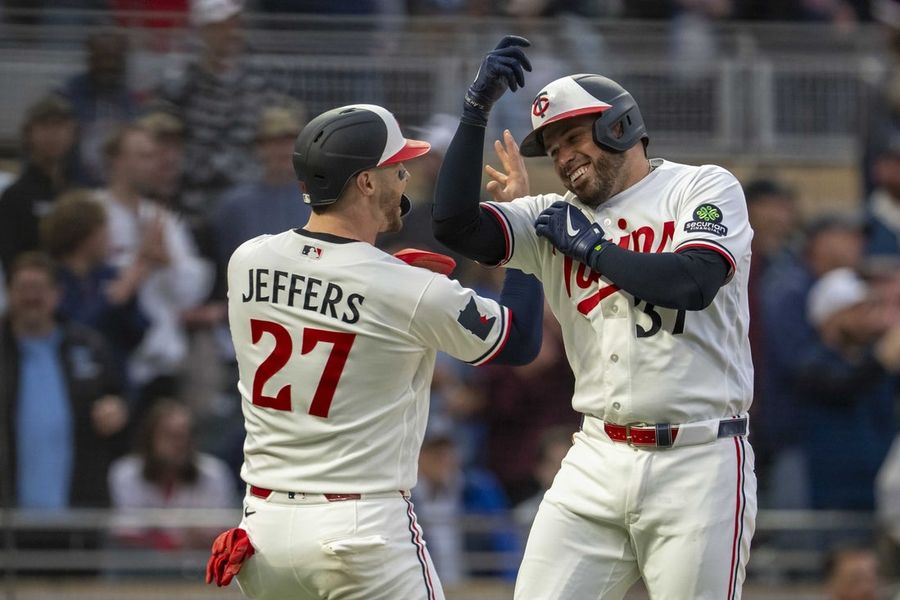
Deadspin | Sizzling Twins work to continue run at Red Sox’s expense    Apr 13, 2026; Minneapolis, Minnesota, USA; Minnesota Twins first baseman Victor Caratini (37) celebrates with  catcher Ryan Jeffers (27) after hitting a home run against the Boston Red Sox in the second inning at Target Field. Mandatory Credit: Jesse Johnson-Imagn Images   The Minnesota Twins might lead the majors in high-fives.  Minnesota has won seven of its past eight games, including a 13-6 home victory over the Boston Red Sox on Monday night. The Twins have knocked off ace pitchers Tarik Skubal, Framber Valdez and most recently Boston’s Garrett Crochet in recent days.  First-year Twins manager Derek Shelton said he loves what he is seeing.  “The energy in our dugout, it was palpable,” Shelton said after Monday’s game. “They were after it, they were into it, and it was really cool to see.”  Minnesota will try to keep the good vibes going when it faces the Red Sox in the second installment of a three-game series Tuesday night in Minneapolis. The Twins rank second in the American League with a plus-15 run differential, and the Red Sox are scuffling with 10 losses in their first 16 games.  It’s a role reversal based on expectations for both teams in spring training.  Red Sox manager Alex Cora is focused on trying to even the series at one win apiece rather than diagnose any big-picture problems. Cora pulled Crochet after 1 2/3 innings and 11 runs (10 earned) surrendered Monday, which meant the bullpen had to pitch the bulk of the series opener.  “You still have to play seven innings,” Cora said. “It sucks. As a manager, it’s hard to watch. You’re kind of like, ‘OK, when do we take him out?’ But at the same time, you still have to cover innings and keep the bullpen quote-unquote fresh knowing that there’s two more games in the series.  “We have to turn the page very quick and be ready for (Tuesday).”  Red Sox right-hander Sonny Gray (2-0, 2.76 ERA) will try to stabilize the rotation when he takes the mound against his former team. Gray has back-to-back quality starts, and he has walked only three batters in 16 1/3 innings this season.   In 10 career starts against the Twins, Gray is 3-5 with a 5.19 ERA.  Minnesota will counter with right-hander Mick Abel (0-2, 6.08). He will look to build on his best start of the season, when he held the Detroit Tigers to four hits over six shutout innings on Thursday in his team’s 3-1 victory. Abel did not get the decision, and he hasn’t faced the Red Sox in his career.  The Twins will look to give Abel run support after scoring 11 runs in the first two innings Monday.  Shelton said players felt confident and success was proving to be contagious.  “This group really likes each other,” Shelton said. “It’s a tight-knit group … and I think the one thing about it is they all understand their roles and they’re all doing a really good job in their roles.”  A calm approach at the plate has helped, too.  “I think the biggest thing is they’re not rushing through their at-bats,” Shelton said. “You look at all those games, there’s hits in there, there’s home runs, but there’s also walks, there’s patience.  “They’re taking what’s coming to them in terms of their plate appearances, and I think when you get on a roll like that, you see them being able to string at-bats together.”  –Field Level Media   #Deadspin #Sizzling #Twins #work #continue #run #Red #Soxs #expenseApr 13, 2026; Minneapolis, Minnesota, USA; Minnesota Twins first baseman Victor Caratini (37) celebrates with catcher Ryan Jeffers (27) after hitting a home run against the Boston Red Sox in the second inning at Target Field. Mandatory Credit: Jesse Johnson-Imagn Images

The Minnesota Twins might lead the majors in high-fives.

Minnesota has won seven of its past eight games, including a 13-6 home victory over the Boston Red Sox on Monday night. The Twins have knocked off ace pitchers Tarik Skubal, Framber Valdez and most recently Boston’s Garrett Crochet in recent days.

First-year Twins manager Derek Shelton said he loves what he is seeing.

“The energy in our dugout, it was palpable,” Shelton said after Monday’s game. “They were after it, they were into it, and it was really cool to see.”

Minnesota will try to keep the good vibes going when it faces the Red Sox in the second installment of a three-game series Tuesday night in Minneapolis. The Twins rank second in the American League with a plus-15 run differential, and the Red Sox are scuffling with 10 losses in their first 16 games.

It’s a role reversal based on expectations for both teams in spring training.

Red Sox manager Alex Cora is focused on trying to even the series at one win apiece rather than diagnose any big-picture problems. Cora pulled Crochet after 1 2/3 innings and 11 runs (10 earned) surrendered Monday, which meant the bullpen had to pitch the bulk of the series opener.

“You still have to play seven innings,” Cora said. “It sucks. As a manager, it’s hard to watch. You’re kind of like, ‘OK, when do we take him out?’ But at the same time, you still have to cover innings and keep the bullpen quote-unquote fresh knowing that there’s two more games in the series.

“We have to turn the page very quick and be ready for (Tuesday).”


Red Sox right-hander Sonny Gray (2-0, 2.76 ERA) will try to stabilize the rotation when he takes the mound against his former team. Gray has back-to-back quality starts, and he has walked only three batters in 16 1/3 innings this season.

In 10 career starts against the Twins, Gray is 3-5 with a 5.19 ERA.

Minnesota will counter with right-hander Mick Abel (0-2, 6.08). He will look to build on his best start of the season, when he held the Detroit Tigers to four hits over six shutout innings on Thursday in his team’s 3-1 victory. Abel did not get the decision, and he hasn’t faced the Red Sox in his career.

The Twins will look to give Abel run support after scoring 11 runs in the first two innings Monday.

Shelton said players felt confident and success was proving to be contagious.

“This group really likes each other,” Shelton said. “It’s a tight-knit group … and I think the one thing about it is they all understand their roles and they’re all doing a really good job in their roles.”

A calm approach at the plate has helped, too.

“I think the biggest thing is they’re not rushing through their at-bats,” Shelton said. “You look at all those games, there’s hits in there, there’s home runs, but there’s also walks, there’s patience.

“They’re taking what’s coming to them in terms of their plate appearances, and I think when you get on a roll like that, you see them being able to string at-bats together.”

–Field Level Media

#Deadspin #Sizzling #Twins #work #continue #run #Red #Soxs #expense

Apr 13, 2026; Minneapolis, Minnesota, USA; Minnesota Twins first baseman Victor Caratini (37) celebrates with catcher Ryan Jeffers (27) after hitting a home run against the Boston Red Sox in the second inning at Target Field. Mandatory Credit: Jesse Johnson-Imagn Images

The Minnesota Twins might lead the majors in high-fives.

Minnesota has won seven of its past eight games, including a 13-6 home victory over the Boston Red Sox on Monday night. The Twins have knocked off ace pitchers Tarik Skubal, Framber Valdez and most recently Boston’s Garrett Crochet in recent days.

First-year Twins manager Derek Shelton said he loves what he is seeing.

“The energy in our dugout, it was palpable,” Shelton said after Monday’s game. “They were after it, they were into it, and it was really cool to see.”

Minnesota will try to keep the good vibes going when it faces the Red Sox in the second installment of a three-game series Tuesday night in Minneapolis. The Twins rank second in the American League with a plus-15 run differential, and the Red Sox are scuffling with 10 losses in their first 16 games.

It’s a role reversal based on expectations for both teams in spring training.

Red Sox manager Alex Cora is focused on trying to even the series at one win apiece rather than diagnose any big-picture problems. Cora pulled Crochet after 1 2/3 innings and 11 runs (10 earned) surrendered Monday, which meant the bullpen had to pitch the bulk of the series opener.

“You still have to play seven innings,” Cora said. “It sucks. As a manager, it’s hard to watch. You’re kind of like, ‘OK, when do we take him out?’ But at the same time, you still have to cover innings and keep the bullpen quote-unquote fresh knowing that there’s two more games in the series.

“We have to turn the page very quick and be ready for (Tuesday).”

Red Sox right-hander Sonny Gray (2-0, 2.76 ERA) will try to stabilize the rotation when he takes the mound against his former team. Gray has back-to-back quality starts, and he has walked only three batters in 16 1/3 innings this season.

In 10 career starts against the Twins, Gray is 3-5 with a 5.19 ERA.

Minnesota will counter with right-hander Mick Abel (0-2, 6.08). He will look to build on his best start of the season, when he held the Detroit Tigers to four hits over six shutout innings on Thursday in his team’s 3-1 victory. Abel did not get the decision, and he hasn’t faced the Red Sox in his career.

The Twins will look to give Abel run support after scoring 11 runs in the first two innings Monday.

Shelton said players felt confident and success was proving to be contagious.

“This group really likes each other,” Shelton said. “It’s a tight-knit group … and I think the one thing about it is they all understand their roles and they’re all doing a really good job in their roles.”

A calm approach at the plate has helped, too.

“I think the biggest thing is they’re not rushing through their at-bats,” Shelton said. “You look at all those games, there’s hits in there, there’s home runs, but there’s also walks, there’s patience.

“They’re taking what’s coming to them in terms of their plate appearances, and I think when you get on a roll like that, you see them being able to string at-bats together.”

–Field Level Media

Source link
#Deadspin #Sizzling #Twins #work #continue #run #Red #Soxs #expense

Soccer Meets America focuses around the meteoric rise in popularity, from the North American Soccer League days of the 1970s and 1980s to the 1984 Olympics, leading up to the 1994 World Cup. At the center of that history was Alan Rothenberg, who served as soccer commissioner for the 1984 Olympics, the president of the U.S. Soccer Federation from 1990 to 1998, and the CEO of the 1994 World Cup. He also had a hand in the start of Major League Soccer, adding women’s soccer to the Olympic program in 1996, and bringing the 1999 Women’s World Cup to the United States.

Rothenberg recently released a new book entitled The Big Bounce: The Surge that Shaped the Future of U.S. Soccer. In the book, Rothenberg gives an inside account at how American soccer went from the days where leagues were not organized and fizzled quickly to some of the success we have today with leagues like Major League Soccer, the National Women’s Soccer League, and the United Soccer Leagues. He details his firsthand knowledge of what it took for the United States to host a successful soccer tournament at the 1984 Olympics, how the nation won the bid to host the 1994 World Cup, and how he was able to organize the federation to get everything done and push the game forward. He recently sat down for an interview on the USA Soccercast, and in that interview, he mentioned that the rise in popularity of the game wasn’t based on one big moment, but a sustained buildup of momentum.

“[American soccer] sort of grew when I was starting in 1990,” Alan Rothenberg, former U.S. Soccer president and CEO of the 1994 World Cup, said in an interview for the USA Soccercast. “I had a glimpse of it back in the 70s when we had a team in Los Angeles ,and obviously the Cosmos set the world on fire at that time with Pelé and [Franz] Beckebauer…you had Giants Stadium. So there were those glimpses of what the future could hold. But as we started to build the soccer federation, our [1994] World cup team and the World cup organization, it just started to accelerate. So there wasn’t one ‘a ha!’ moment.”

Soccer Meets America takes the unique yet unexpected path of professional soccer in the United States andn gives the story some definition. Through people like Rothenberg, we see that the history is shaped by chance, persistence, and communities that kept the game alive long before it found mainstream recognition. Starting with the sport’s deep roots in immigrant communities in the 1920s, each episode of the docuseries explores soccer on a personal and professional level. Both nostalgic and forward-facing, the series features a variety of influential figures in American soccer and aims to resonate with new and old fans of the sport alike.

But there’s also the legacy of the 2026 World Cup, which will be different from what it was in 1994. “Well, obviously we’re starting from a different baseline,” Rothenberg said. “We started at virtually zero back in [1990], and now we’re starting from level 60 or 75…so the dramatic consequences will not be the same as they were after 94, but I think it’s going to be a huge spike in interest in the sport at all levels.”

To grow the history, you must learn from it. And Soccer Meets America gives you a review of America’s soccer history and strengthes the foundations from which the sport’s culture and passion were created. As we approach the World Cup, that knowledge will be essential to craft the legacy that will carry long after the tournament ends.

#Vox #Creative #Roku #debut #docuseries #history #American #soccer">Vox Creative, Roku debut new docuseries on history of American soccer  The history of American soccer has spanned well over 120 years, and to date there hasn’t been many opportunities to look back at that history. With the 2026 World Cup about a month away, we now have a chance to do just that. Yesterday, SB Nation collaborated with Vox Creative and Roku to release Soccer Meets America, a 3-part docuseries that focuses on the rise of soccer in the United States.Soccer Meets America focuses around the meteoric rise in popularity, from the North American Soccer League days of the 1970s and 1980s to the 1984 Olympics, leading up to the 1994 World Cup. At the center of that history was Alan Rothenberg, who served as soccer commissioner for the 1984 Olympics, the president of the U.S. Soccer Federation from 1990 to 1998, and the CEO of the 1994 World Cup. He also had a hand in the start of Major League Soccer, adding women’s soccer to the Olympic program in 1996, and bringing the 1999 Women’s World Cup to the United States.Rothenberg recently released a new book entitled The Big Bounce: The Surge that Shaped the Future of U.S. Soccer. In the book, Rothenberg gives an inside account at how American soccer went from the days where leagues were not organized and fizzled quickly to some of the success we have today with leagues like Major League Soccer, the National Women’s Soccer League, and the United Soccer Leagues. He details his firsthand knowledge of what it took for the United States to host a successful soccer tournament at the 1984 Olympics, how the nation won the bid to host the 1994 World Cup, and how he was able to organize the federation to get everything done and push the game forward. He recently sat down for an interview on the USA Soccercast, and in that interview, he mentioned that the rise in popularity of the game wasn’t based on one big moment, but a sustained buildup of momentum.“[American soccer] sort of grew when I was starting in 1990,” Alan Rothenberg, former U.S. Soccer president and CEO of the 1994 World Cup, said in an interview for the USA Soccercast. “I had a glimpse of it back in the 70s when we had a team in Los Angeles ,and obviously the Cosmos set the world on fire at that time with Pelé and [Franz] Beckebauer…you had Giants Stadium. So there were those glimpses of what the future could hold. But as we started to build the soccer federation, our [1994] World cup team and the World cup organization, it just started to accelerate. So there wasn’t one ‘a ha!’ moment.”Soccer Meets America takes the unique yet unexpected path of professional soccer in the United States andn gives the story some definition. Through people like Rothenberg, we see that the history is shaped by chance, persistence, and communities that kept the game alive long before it found mainstream recognition. Starting with the sport’s deep roots in immigrant communities in the 1920s, each episode of the docuseries explores soccer on a personal and professional level. Both nostalgic and forward-facing, the series features a variety of influential figures in American soccer and aims to resonate with new and old fans of the sport alike.But there’s also the legacy of the 2026 World Cup, which will be different from what it was in 1994. “Well, obviously we’re starting from a different baseline,” Rothenberg said. “We started at virtually zero back in [1990], and now we’re starting from level 60 or 75…so the dramatic consequences will not be the same as they were after 94, but I think it’s going to be a huge spike in interest in the sport at all levels.”To grow the history, you must learn from it. And Soccer Meets America gives you a review of America’s soccer history and strengthes the foundations from which the sport’s culture and passion were created. As we approach the World Cup, that knowledge will be essential to craft the legacy that will carry long after the tournament ends.  #Vox #Creative #Roku #debut #docuseries #history #American #soccer

Soccer Meets America, a 3-part docuseries that focuses on the rise of soccer in the United States.

Soccer Meets America focuses around the meteoric rise in popularity, from the North American Soccer League days of the 1970s and 1980s to the 1984 Olympics, leading up to the 1994 World Cup. At the center of that history was Alan Rothenberg, who served as soccer commissioner for the 1984 Olympics, the president of the U.S. Soccer Federation from 1990 to 1998, and the CEO of the 1994 World Cup. He also had a hand in the start of Major League Soccer, adding women’s soccer to the Olympic program in 1996, and bringing the 1999 Women’s World Cup to the United States.

Rothenberg recently released a new book entitled The Big Bounce: The Surge that Shaped the Future of U.S. Soccer. In the book, Rothenberg gives an inside account at how American soccer went from the days where leagues were not organized and fizzled quickly to some of the success we have today with leagues like Major League Soccer, the National Women’s Soccer League, and the United Soccer Leagues. He details his firsthand knowledge of what it took for the United States to host a successful soccer tournament at the 1984 Olympics, how the nation won the bid to host the 1994 World Cup, and how he was able to organize the federation to get everything done and push the game forward. He recently sat down for an interview on the USA Soccercast, and in that interview, he mentioned that the rise in popularity of the game wasn’t based on one big moment, but a sustained buildup of momentum.

“[American soccer] sort of grew when I was starting in 1990,” Alan Rothenberg, former U.S. Soccer president and CEO of the 1994 World Cup, said in an interview for the USA Soccercast. “I had a glimpse of it back in the 70s when we had a team in Los Angeles ,and obviously the Cosmos set the world on fire at that time with Pelé and [Franz] Beckebauer…you had Giants Stadium. So there were those glimpses of what the future could hold. But as we started to build the soccer federation, our [1994] World cup team and the World cup organization, it just started to accelerate. So there wasn’t one ‘a ha!’ moment.”

Soccer Meets America takes the unique yet unexpected path of professional soccer in the United States andn gives the story some definition. Through people like Rothenberg, we see that the history is shaped by chance, persistence, and communities that kept the game alive long before it found mainstream recognition. Starting with the sport’s deep roots in immigrant communities in the 1920s, each episode of the docuseries explores soccer on a personal and professional level. Both nostalgic and forward-facing, the series features a variety of influential figures in American soccer and aims to resonate with new and old fans of the sport alike.

But there’s also the legacy of the 2026 World Cup, which will be different from what it was in 1994. “Well, obviously we’re starting from a different baseline,” Rothenberg said. “We started at virtually zero back in [1990], and now we’re starting from level 60 or 75…so the dramatic consequences will not be the same as they were after 94, but I think it’s going to be a huge spike in interest in the sport at all levels.”

To grow the history, you must learn from it. And Soccer Meets America gives you a review of America’s soccer history and strengthes the foundations from which the sport’s culture and passion were created. As we approach the World Cup, that knowledge will be essential to craft the legacy that will carry long after the tournament ends.

#Vox #Creative #Roku #debut #docuseries #history #American #soccer">Vox Creative, Roku debut new docuseries on history of American soccer

The history of American soccer has spanned well over 120 years, and to date there hasn’t been many opportunities to look back at that history. With the 2026 World Cup about a month away, we now have a chance to do just that. Yesterday, SB Nation collaborated with Vox Creative and Roku to release Soccer Meets America, a 3-part docuseries that focuses on the rise of soccer in the United States.

Soccer Meets America focuses around the meteoric rise in popularity, from the North American Soccer League days of the 1970s and 1980s to the 1984 Olympics, leading up to the 1994 World Cup. At the center of that history was Alan Rothenberg, who served as soccer commissioner for the 1984 Olympics, the president of the U.S. Soccer Federation from 1990 to 1998, and the CEO of the 1994 World Cup. He also had a hand in the start of Major League Soccer, adding women’s soccer to the Olympic program in 1996, and bringing the 1999 Women’s World Cup to the United States.

Rothenberg recently released a new book entitled The Big Bounce: The Surge that Shaped the Future of U.S. Soccer. In the book, Rothenberg gives an inside account at how American soccer went from the days where leagues were not organized and fizzled quickly to some of the success we have today with leagues like Major League Soccer, the National Women’s Soccer League, and the United Soccer Leagues. He details his firsthand knowledge of what it took for the United States to host a successful soccer tournament at the 1984 Olympics, how the nation won the bid to host the 1994 World Cup, and how he was able to organize the federation to get everything done and push the game forward. He recently sat down for an interview on the USA Soccercast, and in that interview, he mentioned that the rise in popularity of the game wasn’t based on one big moment, but a sustained buildup of momentum.

“[American soccer] sort of grew when I was starting in 1990,” Alan Rothenberg, former U.S. Soccer president and CEO of the 1994 World Cup, said in an interview for the USA Soccercast. “I had a glimpse of it back in the 70s when we had a team in Los Angeles ,and obviously the Cosmos set the world on fire at that time with Pelé and [Franz] Beckebauer…you had Giants Stadium. So there were those glimpses of what the future could hold. But as we started to build the soccer federation, our [1994] World cup team and the World cup organization, it just started to accelerate. So there wasn’t one ‘a ha!’ moment.”

Soccer Meets America takes the unique yet unexpected path of professional soccer in the United States andn gives the story some definition. Through people like Rothenberg, we see that the history is shaped by chance, persistence, and communities that kept the game alive long before it found mainstream recognition. Starting with the sport’s deep roots in immigrant communities in the 1920s, each episode of the docuseries explores soccer on a personal and professional level. Both nostalgic and forward-facing, the series features a variety of influential figures in American soccer and aims to resonate with new and old fans of the sport alike.

But there’s also the legacy of the 2026 World Cup, which will be different from what it was in 1994. “Well, obviously we’re starting from a different baseline,” Rothenberg said. “We started at virtually zero back in [1990], and now we’re starting from level 60 or 75…so the dramatic consequences will not be the same as they were after 94, but I think it’s going to be a huge spike in interest in the sport at all levels.”

To grow the history, you must learn from it. And Soccer Meets America gives you a review of America’s soccer history and strengthes the foundations from which the sport’s culture and passion were created. As we approach the World Cup, that knowledge will be essential to craft the legacy that will carry long after the tournament ends.

#Vox #Creative #Roku #debut #docuseries #history #American #soccer

Delhi Capitals will host Chennai Super Kings at the Arun Jaitley Stadium in Delhi on Wednesday. Both teams have won four out of the nine games they have played.

In the reverse fixture, CSK beat DC by 23 runs in Chennai.

Here are the complete stats and head-to-head numbers you need to know before the teams face off:

DC vs CSK Head-to-Head Record in IPL

Matches Played: 32

Delhi Capitals: 12

Chennai Super Kings: 20

MOST RUNS IN DC vs CSK IPL MATCHES

Batter Innings Runs Average Strike Rate HS
MS Dhoni 29 696 38.66 142.04 63*
Suresh Raina 22 552 29.05 132.05 59
Shikhar Dhawan 10 433 54.12 136.16 101*
Rishabh Pant 11 375 46.87 156.9 79
Murali Vijay 12 346 34.6 136.22 113

MOST WICKETS IN DC vs CSK IPL MATCHES

Bowler Innings Wickets Economy Average BBI
Ravichandran Ashwin 17 19 6.52 21 3/23
Dwayne Bravo 17 19 8.06 22.42 3/33
Ravindra Jadeja 20 19 7.75 25.78 3/9
Deepak Chahar 12 13 8.06 26.69 3/22
Albie Morkel 14 13 8.29 29.76 3/32

Published on May 04, 2026

#CSK #headtohead #record #IPL #Delhi #Capitals #Chennai #Super #Kings #stats #runs #wickets">DC vs CSK head-to-head record, IPL 2026: Delhi Capitals vs Chennai Super Kings stats, runs, wickets  Delhi Capitals will host Chennai Super Kings at the Arun Jaitley Stadium in Delhi on Wednesday. Both teams have won four out of the nine games they have played.In the reverse fixture, CSK beat DC by 23 runs in Chennai.Here are the complete stats and head-to-head numbers you need to know before the teams face off:
DC vs CSK Head-to-Head Record in IPL

Matches Played: 32

Delhi Capitals: 12

Chennai Super Kings: 20
MOST RUNS IN DC vs CSK IPL MATCHES  Batter  Innings  Runs  Average  Strike Rate  HS   MS Dhoni  29  696  38.66  142.04  63*  Suresh Raina  22  552  29.05  132.05  59  Shikhar Dhawan  10  433  54.12  136.16  101*  Rishabh Pant  11  375  46.87  156.9  79  Murali Vijay  12  346  34.6  136.22  113MOST WICKETS IN DC vs CSK IPL MATCHES  Bowler  Innings  Wickets  Economy  Average  BBI  Ravichandran Ashwin  17  19  6.52  21  3/23  Dwayne Bravo  17  19  8.06  22.42  3/33  Ravindra Jadeja  20  19  7.75  25.78  3/9  Deepak Chahar  12  13  8.06  26.69  3/22  Albie Morkel  14  13  8.29  29.76  3/32Published on May 04, 2026  #CSK #headtohead #record #IPL #Delhi #Capitals #Chennai #Super #Kings #stats #runs #wickets

Post Comment