×
Deadspin | Strong second period allows Bruins to level series with Sabres  Apr 21, 2026; Buffalo, New York, USA; Boston Bruins center Fraser Minten (93) controls the puck during the first period against the Buffalo Sabres in game two of the first round of the 2026 Stanley Cup Playoffs at KeyBank Center. Mandatory Credit: Timothy T. Ludwig-Imagn Images   The visiting Boston Bruins scored three second-period goals and held off a late Buffalo Sabres rally to post a 4-2 win on Tuesday and even their Eastern Conference quarterfinal playoff series at one victory apiece.  Viktor Arvidsson scored in the last two periods, giving the Bruins 1-0 and 4-0 leads. Morgan Geekie and Pavel Zacha also lit the lamp for Boston, which heads home for Game 3 of the best-of-seven series on Thursday.  Jonathan Aspirot, Casey Mittelstadt and David Pastrnak each dished out two assists for the Bruins, and Jeremy Swayman made 34 saves.  Bowen Byram and Peyton Krebs scored as Buffalo climbed within 4-2 in the closing minutes.  Sabres goalie Ukko-Pekka Luukkonen allowed four goals on 19 shots before Alex Lyon entered in relief following Arvidsson’s second marker, which came just 16 seconds into the third period.  Buffalo had a 36-26 shot advantage, including 20-8 in the third period, but its power play went 0-for-5. Boston finished 1-for-6 on the man advantage.  The physical contest featured 47 penalty minutes for each team.  Following a scoreless opening period, the Bruins took over in the second, scoring on three of their 11 shots against Luukkonen.   Arvidsson broke the deadlock 4:54 into the middle frame, taking Aspirot’s lob pass in ahead of the defense and beating Luukkonen five-hole with a backhander from the left circle.  A gaffe by Luukkonen helped Boston double its lead with 3:31 left in the period, as Geekie’s high backhanded dump from the far side of center ice eluded him over the glove.  The Bruins’ power play got in on the action 1:41 later. After Geekie’s one-handed keep-in at the blue line extended the play, Zacha tipped in Pastrnak’s shot from the top of the right circle while stationed in the bumper position.  Arvidsson made it 4-0 early in the third, prompting Sabres coach Lindy Ruff to change goaltenders. Aspirot banked a long feed off the boards to set up the play, leading Arvidsson down the left wing to score on a 2-on-1 rush with Zacha.  The Sabres struck twice in a 1:14 span to make things interesting. Byram accepted Beck Malenstyn’s back pass for a wrister from the top of the right circle to break Swayman’s shutout bid with 6:06 left.  Krebs soon made it 4-2, batting down and scoring the rebound of a Rasmus Dahlin point shot that caromed off the post and back into the crease.  –Field Level Media   #Deadspin #Strong #period #Bruins #level #series #Sabres
Deadspin | Strong second period allows Bruins to level series with Sabres
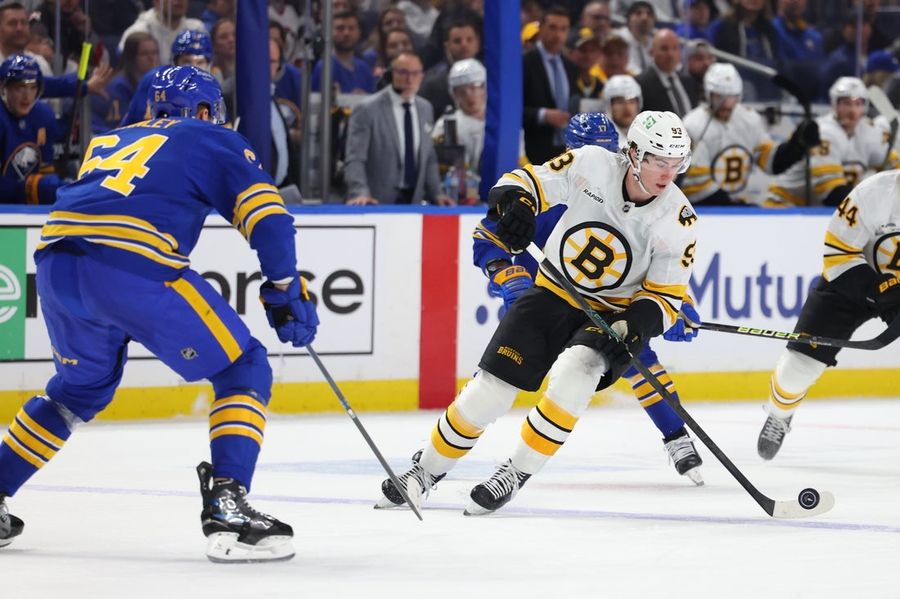
Deadspin | Strong second period allows Bruins to level series with Sabres  Apr 21, 2026; Buffalo, New York, USA; Boston Bruins center Fraser Minten (93) controls the puck during the first period against the Buffalo Sabres in game two of the first round of the 2026 Stanley Cup Playoffs at KeyBank Center. Mandatory Credit: Timothy T. Ludwig-Imagn Images   The visiting Boston Bruins scored three second-period goals and held off a late Buffalo Sabres rally to post a 4-2 win on Tuesday and even their Eastern Conference quarterfinal playoff series at one victory apiece.  Viktor Arvidsson scored in the last two periods, giving the Bruins 1-0 and 4-0 leads. Morgan Geekie and Pavel Zacha also lit the lamp for Boston, which heads home for Game 3 of the best-of-seven series on Thursday.  Jonathan Aspirot, Casey Mittelstadt and David Pastrnak each dished out two assists for the Bruins, and Jeremy Swayman made 34 saves.  Bowen Byram and Peyton Krebs scored as Buffalo climbed within 4-2 in the closing minutes.  Sabres goalie Ukko-Pekka Luukkonen allowed four goals on 19 shots before Alex Lyon entered in relief following Arvidsson’s second marker, which came just 16 seconds into the third period.  Buffalo had a 36-26 shot advantage, including 20-8 in the third period, but its power play went 0-for-5. Boston finished 1-for-6 on the man advantage.  The physical contest featured 47 penalty minutes for each team.  Following a scoreless opening period, the Bruins took over in the second, scoring on three of their 11 shots against Luukkonen.   Arvidsson broke the deadlock 4:54 into the middle frame, taking Aspirot’s lob pass in ahead of the defense and beating Luukkonen five-hole with a backhander from the left circle.  A gaffe by Luukkonen helped Boston double its lead with 3:31 left in the period, as Geekie’s high backhanded dump from the far side of center ice eluded him over the glove.  The Bruins’ power play got in on the action 1:41 later. After Geekie’s one-handed keep-in at the blue line extended the play, Zacha tipped in Pastrnak’s shot from the top of the right circle while stationed in the bumper position.  Arvidsson made it 4-0 early in the third, prompting Sabres coach Lindy Ruff to change goaltenders. Aspirot banked a long feed off the boards to set up the play, leading Arvidsson down the left wing to score on a 2-on-1 rush with Zacha.  The Sabres struck twice in a 1:14 span to make things interesting. Byram accepted Beck Malenstyn’s back pass for a wrister from the top of the right circle to break Swayman’s shutout bid with 6:06 left.  Krebs soon made it 4-2, batting down and scoring the rebound of a Rasmus Dahlin point shot that caromed off the post and back into the crease.  –Field Level Media   #Deadspin #Strong #period #Bruins #level #series #SabresApr 21, 2026; Buffalo, New York, USA; Boston Bruins center Fraser Minten (93) controls the puck during the first period against the Buffalo Sabres in game two of the first round of the 2026 Stanley Cup Playoffs at KeyBank Center. Mandatory Credit: Timothy T. Ludwig-Imagn Images

The visiting Boston Bruins scored three second-period goals and held off a late Buffalo Sabres rally to post a 4-2 win on Tuesday and even their Eastern Conference quarterfinal playoff series at one victory apiece.

Viktor Arvidsson scored in the last two periods, giving the Bruins 1-0 and 4-0 leads. Morgan Geekie and Pavel Zacha also lit the lamp for Boston, which heads home for Game 3 of the best-of-seven series on Thursday.

Jonathan Aspirot, Casey Mittelstadt and David Pastrnak each dished out two assists for the Bruins, and Jeremy Swayman made 34 saves.

Bowen Byram and Peyton Krebs scored as Buffalo climbed within 4-2 in the closing minutes.

Sabres goalie Ukko-Pekka Luukkonen allowed four goals on 19 shots before Alex Lyon entered in relief following Arvidsson’s second marker, which came just 16 seconds into the third period.

Buffalo had a 36-26 shot advantage, including 20-8 in the third period, but its power play went 0-for-5. Boston finished 1-for-6 on the man advantage.

The physical contest featured 47 penalty minutes for each team.


Following a scoreless opening period, the Bruins took over in the second, scoring on three of their 11 shots against Luukkonen.

Arvidsson broke the deadlock 4:54 into the middle frame, taking Aspirot’s lob pass in ahead of the defense and beating Luukkonen five-hole with a backhander from the left circle.

A gaffe by Luukkonen helped Boston double its lead with 3:31 left in the period, as Geekie’s high backhanded dump from the far side of center ice eluded him over the glove.

The Bruins’ power play got in on the action 1:41 later. After Geekie’s one-handed keep-in at the blue line extended the play, Zacha tipped in Pastrnak’s shot from the top of the right circle while stationed in the bumper position.

Arvidsson made it 4-0 early in the third, prompting Sabres coach Lindy Ruff to change goaltenders. Aspirot banked a long feed off the boards to set up the play, leading Arvidsson down the left wing to score on a 2-on-1 rush with Zacha.

The Sabres struck twice in a 1:14 span to make things interesting. Byram accepted Beck Malenstyn’s back pass for a wrister from the top of the right circle to break Swayman’s shutout bid with 6:06 left.

Krebs soon made it 4-2, batting down and scoring the rebound of a Rasmus Dahlin point shot that caromed off the post and back into the crease.

–Field Level Media

#Deadspin #Strong #period #Bruins #level #series #Sabres

Apr 21, 2026; Buffalo, New York, USA; Boston Bruins center Fraser Minten (93) controls the puck during the first period against the Buffalo Sabres in game two of the first round of the 2026 Stanley Cup Playoffs at KeyBank Center. Mandatory Credit: Timothy T. Ludwig-Imagn Images

The visiting Boston Bruins scored three second-period goals and held off a late Buffalo Sabres rally to post a 4-2 win on Tuesday and even their Eastern Conference quarterfinal playoff series at one victory apiece.

Viktor Arvidsson scored in the last two periods, giving the Bruins 1-0 and 4-0 leads. Morgan Geekie and Pavel Zacha also lit the lamp for Boston, which heads home for Game 3 of the best-of-seven series on Thursday.

Jonathan Aspirot, Casey Mittelstadt and David Pastrnak each dished out two assists for the Bruins, and Jeremy Swayman made 34 saves.

Bowen Byram and Peyton Krebs scored as Buffalo climbed within 4-2 in the closing minutes.

Sabres goalie Ukko-Pekka Luukkonen allowed four goals on 19 shots before Alex Lyon entered in relief following Arvidsson’s second marker, which came just 16 seconds into the third period.

Buffalo had a 36-26 shot advantage, including 20-8 in the third period, but its power play went 0-for-5. Boston finished 1-for-6 on the man advantage.

The physical contest featured 47 penalty minutes for each team.

Following a scoreless opening period, the Bruins took over in the second, scoring on three of their 11 shots against Luukkonen.

Arvidsson broke the deadlock 4:54 into the middle frame, taking Aspirot’s lob pass in ahead of the defense and beating Luukkonen five-hole with a backhander from the left circle.

A gaffe by Luukkonen helped Boston double its lead with 3:31 left in the period, as Geekie’s high backhanded dump from the far side of center ice eluded him over the glove.

The Bruins’ power play got in on the action 1:41 later. After Geekie’s one-handed keep-in at the blue line extended the play, Zacha tipped in Pastrnak’s shot from the top of the right circle while stationed in the bumper position.

Arvidsson made it 4-0 early in the third, prompting Sabres coach Lindy Ruff to change goaltenders. Aspirot banked a long feed off the boards to set up the play, leading Arvidsson down the left wing to score on a 2-on-1 rush with Zacha.

The Sabres struck twice in a 1:14 span to make things interesting. Byram accepted Beck Malenstyn’s back pass for a wrister from the top of the right circle to break Swayman’s shutout bid with 6:06 left.

Krebs soon made it 4-2, batting down and scoring the rebound of a Rasmus Dahlin point shot that caromed off the post and back into the crease.

–Field Level Media

Source link
#Deadspin #Strong #period #Bruins #level #series #Sabres

Previous post

Deadspin | 7 runs lead to 7th straight win for Cubs as Phillies’ losing streak hits 7 <div id=""><section id="0" class=" w-full"><div class="xl:container mx-0 !px-4 py-0 pb-4 !mx-0 !px-0"><img src="https://images.deadspin.com/tr:w-900/28781026.jpg" srcset="https://images.deadspin.com/tr:w-900/28781026.jpg" alt="MLB: Philadelphia Phillies at Chicago Cubs" class="w-full" fetchpriority="high" loading="eager"/><span class="text-0.8 leading-tight">Apr 21, 2026; Chicago, Illinois, USA; Chicago Cubs second baseman Nico Hoerner (2) high fives left fielder Ian Happ (8), right, after scoring during the sixth inning against the Philadelphia Phillies at Wrigley Field. Mandatory Credit: Matt Marton-Imagn Images<!-- --> <!-- --> </span></div></section><section id="section-1"> <p>Shota Imanaga tossed seven stellar innings, Seiya Suzuki and Michael Busch each drove in two runs and the streaking Chicago Cubs posted a 7-4 victory over the visiting Philadelphia Phillies on Tuesday.</p> </section><section id="section-2"> <p>Imanaga (2-1) allowed just one run on three hits, striking out one and walking one for the Cubs, who won their Major League-leading seventh straight game. Suzuki and Nico Hoerner each homered in the win.</p> </section><section id="section-3"> <p>Jesus Luzardo threw 4 2/3 innings for the Phillies, surrendering one run on five hits, walking four and striking out three. Bryce Harper and Kyle Schwarber both homered for the Phillies, who saw their losing streak extend to seven.</p> </section><section id="section-4"> <p>In the fifth, Ian Happ walked and Suzuki singled to begin the frame. After Luzardo retired Carson Kelly and Busch, Orion Kerkering relieved the Philadelphia starter. Kerkering then walked Dansby Swanson to load the bases and followed with a run-scoring walk of Moises Ballesteros, giving the Cubs a 1-0 lead.</p> </section><section id="section-5"> <p>Kerkering escaped further trouble, retiring Pete Crow-Armstrong to end the inning.</p> </section><section id="section-6"> <p>Philadelphia evened the score in the sixth, as Schwarber connected on his eighth home run of the season — a 386-foot shot to right center.</p> </section><br/><section id="section-7"> <p>Tanner Banks (0-1) replaced Kerkering in the bottom of the sixth. Hoerner led off the frame with a single and advanced to third on Happ’s one-out base hit. After Carson Kelly’s two-out walk loaded the bases, Busch drove in a pair with a single to center.</p> </section> <section id="section-8"> <p>Against Philadelphia reliever Tim Mayza, Hoerner launched a one-out solo homer to push the lead to 4-1. After Alex Bregman’s walk, Suzuki hit his first homer of the season — a 441-footer that extended the margin to five.</p> </section><section id="section-9"> <p>Riley Martin replaced Imanaga in the eighth, allowing Schwarber’s two-out walk and Harper’s two-run homer, pulling the Phillies within three.</p> </section><section id="section-10"> <p>The Cubs scored their seventh run in the bottom of the eighth, as Philadelphia’s Jose Alvarado’s wild pitch prolonged the visitors’ pitching woes.</p> </section><section id="section-11"> <p>Chicago pitcher Jacob Webb allowed Adolis Garcia’s leadoff single in the ninth, before J.T. Realmuto reached on third baseman Scott Kingery’s throwing error. Alec Bohm’s sacrifice fly drove in Garcia, cutting the deficit to 7-4.</p> </section><section id="section-12"> <p>After Brandon Marsh’s single, Caleb Thielbar entered for the Cubs. Thielbar retired Edmundo Sosa and Trea Turner to seal the win, securing his second save of the year.</p> </section><section id="section-13"> <p>–Field Level Media</p> </section></div> #Deadspin #runs #lead #7th #straight #win #Cubs #Phillies #losing #streak #hits

Next post

Bitcoin Theft: A Fake Policeman’s Guide to Stealing $1M BTC

Deadspin | Stewart Cink, Charlie Wi share first-round lead at U.S. Senior Open  Stewart Cink walks across the eighth green during the first round of the U.S. Senior Open at Scioto Country Club in Columbus on July 2, 2026.   Stewart Cink put himself in contention to win a third straight major, as he shares the lead after the first round of the U.S. Senior Open Championship on Thursday in Upper Arlington, Ohio.  Cink and co-leader Charlie Wi of South Korea each shot 3-under-par 67 at Scioto Country Club to sit atop a tightly bunched leaderboard. Wi got a boost from a five-birdie streak, while Cink shot 5-under 30 on the back nine after carding two bogeys among his first nine holes.  George McNeill, England’s Simon Griffiths and Sweden’s Freddie Jacobson are a stroke back as 15 players broke par.  Defending champion Padraig Harrington of Ireland is among 10 golfers tied for sixth at 1-under 69.  The others are Ben Crane, Tommy Gainey, Paul Stankowski, Wales’ Jamie Donaldson, Australia’s Richard Green and Greg Chalmers, Germany’s Alex Cejka, Denmark’s Soren Kjeldsen and Spain’s Miguel Angel Jimenez.  Cink opened with a bogey at the par-4 first hole and had another blemish with a bogey at No. 5 to make the turn at 2 over. He heated up on the back nine, with birdies at Nos. 10, 13, 14, 16 and 18 for a 30 and a 67 total.  “I don’t think I found anything,” Cink said of any adjustments when making the turn. “I just decided to start trusting what I’d already been in possession of. I’ve been off for a little while, and I started like I’ve been off for a little while. Middle of the fairway on 1, and I inexplicably lost my trust in the downswing and flared it out to the right in the bunker.  “I had to prove it to myself again that I could play decent golf a certain way. The back nine was really nice. I actually could have shot quite a bit lower on the back nine. I missed three very reasonably like inside — right around 10 feet or less birdie putts.”   Cink leads the Charles Schwab Cup standings after earning four wins in nine events. He captured the first two majors of the year, the Senior PGA Championship in April and the Regions Tradition in May. He also won the Mitsubishi Electric Championship at Hualalai in January and the Hoag Classic in March.  Wi, whose best result this year is a tie for third at the Insperity Invitational in May, has three top-10 finishes in 2026 as he pursues his first win on tour. He is 31st in the Charles Schwab Cup standings.  “I hit the ball pretty solid today, made a couple of putts,” Wi said. “It was a hot day. I just made sure that I stayed in the ballgame, meaning like mentally, because you could easily lose it out there. Yeah, overall it was just a solid day in the first round.”  Starting his round on the back nine, Wi carded birdies at par-4 holes Nos. 10 and 13 before a bogey at No. 18. He also bogeyed No. 1 before stringing together five consecutive birdies at Nos. 3-7 to get to 5 under.  “Today I was like, wait, did I just run off four in a row? On the fifth one I was thinking about it, come on, get it out of your brain, and I was able to make it,” said Wi, who had a five-birdie streak at the Regions Tradition.  However, disaster struck at No. 8. Wi had to take a penalty and drop on his third shot at the 496-yard par-4, which ranked the hardest hole of the round. Wi got to the green on his fourth shot and finished with a double bogey.  –Field Level Media   #Deadspin #Stewart #Cink #Charlie #share #firstround #lead #U.S #Senior #OpenStewart Cink walks across the eighth green during the first round of the U.S. Senior Open at Scioto Country Club in Columbus on July 2, 2026.

Stewart Cink put himself in contention to win a third straight major, as he shares the lead after the first round of the U.S. Senior Open Championship on Thursday in Upper Arlington, Ohio.

Cink and co-leader Charlie Wi of South Korea each shot 3-under-par 67 at Scioto Country Club to sit atop a tightly bunched leaderboard. Wi got a boost from a five-birdie streak, while Cink shot 5-under 30 on the back nine after carding two bogeys among his first nine holes.

George McNeill, England’s Simon Griffiths and Sweden’s Freddie Jacobson are a stroke back as 15 players broke par.

Defending champion Padraig Harrington of Ireland is among 10 golfers tied for sixth at 1-under 69.

The others are Ben Crane, Tommy Gainey, Paul Stankowski, Wales’ Jamie Donaldson, Australia’s Richard Green and Greg Chalmers, Germany’s Alex Cejka, Denmark’s Soren Kjeldsen and Spain’s Miguel Angel Jimenez.

Cink opened with a bogey at the par-4 first hole and had another blemish with a bogey at No. 5 to make the turn at 2 over. He heated up on the back nine, with birdies at Nos. 10, 13, 14, 16 and 18 for a 30 and a 67 total.

“I don’t think I found anything,” Cink said of any adjustments when making the turn. “I just decided to start trusting what I’d already been in possession of. I’ve been off for a little while, and I started like I’ve been off for a little while. Middle of the fairway on 1, and I inexplicably lost my trust in the downswing and flared it out to the right in the bunker.


“I had to prove it to myself again that I could play decent golf a certain way. The back nine was really nice. I actually could have shot quite a bit lower on the back nine. I missed three very reasonably like inside — right around 10 feet or less birdie putts.”

Cink leads the Charles Schwab Cup standings after earning four wins in nine events. He captured the first two majors of the year, the Senior PGA Championship in April and the Regions Tradition in May. He also won the Mitsubishi Electric Championship at Hualalai in January and the Hoag Classic in March.

Wi, whose best result this year is a tie for third at the Insperity Invitational in May, has three top-10 finishes in 2026 as he pursues his first win on tour. He is 31st in the Charles Schwab Cup standings.

“I hit the ball pretty solid today, made a couple of putts,” Wi said. “It was a hot day. I just made sure that I stayed in the ballgame, meaning like mentally, because you could easily lose it out there. Yeah, overall it was just a solid day in the first round.”

Starting his round on the back nine, Wi carded birdies at par-4 holes Nos. 10 and 13 before a bogey at No. 18. He also bogeyed No. 1 before stringing together five consecutive birdies at Nos. 3-7 to get to 5 under.

“Today I was like, wait, did I just run off four in a row? On the fifth one I was thinking about it, come on, get it out of your brain, and I was able to make it,” said Wi, who had a five-birdie streak at the Regions Tradition.

However, disaster struck at No. 8. Wi had to take a penalty and drop on his third shot at the 496-yard par-4, which ranked the hardest hole of the round. Wi got to the green on his fourth shot and finished with a double bogey.

–Field Level Media

#Deadspin #Stewart #Cink #Charlie #share #firstround #lead #U.S #Senior #Open">Deadspin | Stewart Cink, Charlie Wi share first-round lead at U.S. Senior Open  Stewart Cink walks across the eighth green during the first round of the U.S. Senior Open at Scioto Country Club in Columbus on July 2, 2026.   Stewart Cink put himself in contention to win a third straight major, as he shares the lead after the first round of the U.S. Senior Open Championship on Thursday in Upper Arlington, Ohio.  Cink and co-leader Charlie Wi of South Korea each shot 3-under-par 67 at Scioto Country Club to sit atop a tightly bunched leaderboard. Wi got a boost from a five-birdie streak, while Cink shot 5-under 30 on the back nine after carding two bogeys among his first nine holes.  George McNeill, England’s Simon Griffiths and Sweden’s Freddie Jacobson are a stroke back as 15 players broke par.  Defending champion Padraig Harrington of Ireland is among 10 golfers tied for sixth at 1-under 69.  The others are Ben Crane, Tommy Gainey, Paul Stankowski, Wales’ Jamie Donaldson, Australia’s Richard Green and Greg Chalmers, Germany’s Alex Cejka, Denmark’s Soren Kjeldsen and Spain’s Miguel Angel Jimenez.  Cink opened with a bogey at the par-4 first hole and had another blemish with a bogey at No. 5 to make the turn at 2 over. He heated up on the back nine, with birdies at Nos. 10, 13, 14, 16 and 18 for a 30 and a 67 total.  “I don’t think I found anything,” Cink said of any adjustments when making the turn. “I just decided to start trusting what I’d already been in possession of. I’ve been off for a little while, and I started like I’ve been off for a little while. Middle of the fairway on 1, and I inexplicably lost my trust in the downswing and flared it out to the right in the bunker.  “I had to prove it to myself again that I could play decent golf a certain way. The back nine was really nice. I actually could have shot quite a bit lower on the back nine. I missed three very reasonably like inside — right around 10 feet or less birdie putts.”   Cink leads the Charles Schwab Cup standings after earning four wins in nine events. He captured the first two majors of the year, the Senior PGA Championship in April and the Regions Tradition in May. He also won the Mitsubishi Electric Championship at Hualalai in January and the Hoag Classic in March.  Wi, whose best result this year is a tie for third at the Insperity Invitational in May, has three top-10 finishes in 2026 as he pursues his first win on tour. He is 31st in the Charles Schwab Cup standings.  “I hit the ball pretty solid today, made a couple of putts,” Wi said. “It was a hot day. I just made sure that I stayed in the ballgame, meaning like mentally, because you could easily lose it out there. Yeah, overall it was just a solid day in the first round.”  Starting his round on the back nine, Wi carded birdies at par-4 holes Nos. 10 and 13 before a bogey at No. 18. He also bogeyed No. 1 before stringing together five consecutive birdies at Nos. 3-7 to get to 5 under.  “Today I was like, wait, did I just run off four in a row? On the fifth one I was thinking about it, come on, get it out of your brain, and I was able to make it,” said Wi, who had a five-birdie streak at the Regions Tradition.  However, disaster struck at No. 8. Wi had to take a penalty and drop on his third shot at the 496-yard par-4, which ranked the hardest hole of the round. Wi got to the green on his fourth shot and finished with a double bogey.  –Field Level Media   #Deadspin #Stewart #Cink #Charlie #share #firstround #lead #U.S #Senior #Open

This might sound extremely confusing at first glance, so let’s break down how this would work. During the passage of a normal game (i.e. not in the final two minutes or overtime) all free-throw opportunities would be condensed into one shot, awarding points equal to the number of shots previously attempted in the past. So, a basic foul on a missed shot attempt would reward one free throw worth two points. If a player was driving, getting the bucket and the foul (the And-1), then it would result in one shot worth one point. If a player was fouled in the act of attempting a three, then they would receive one shot worth three points.

It’s that final element which is most fascinating, because it creates a significant advantage for elite shooters from beyond the arc who are also fantastic free-throw shooters. For example, the rule effectively does nothing to someone like Steph Curry, who shot 39.3% from three and 92.3% from the free-throw line last season, but it could have a big effect on someone like Anthony Edwards, who shot 39.9% from three and 79.6% on free throws.

While it’s certainly unlikely that we’re going to see some mammoth shift in fouling because of this, having an all-or-nothing approach to free throws is fascinating, because it will add significant pressure on players who already aren’t the best shooters from the charity stripe.

This isn’t the only change being proposed to NBA rules, because the other comes from innovations to the basketball itself.

Adding more technology here isn’t a bad thing and should eliminate some bad calls in the process. It seems like a win-win, so long as the technology works.

#NBA #test #free #throw #rule #WILD">NBA to test new free throw rule, and it’s WILD  The NBA is looking to speed up the flow of the game, and is tentatively planning to take a page out of the NBA G-League’s book to make it happen. The NBA made an announcement on Thursday that it would test out the “one free throw rule” during the 2026 Summer League, gauging whether or not it should become a staple of the NBA.This might sound extremely confusing at first glance, so let’s break down how this would work. During the passage of a normal game (i.e. not in the final two minutes or overtime) all free-throw opportunities would be condensed into one shot, awarding points equal to the number of shots previously attempted in the past. So, a basic foul on a missed shot attempt would reward one free throw worth two points. If a player was driving, getting the bucket and the foul (the And-1), then it would result in one shot worth one point. If a player was fouled in the act of attempting a three, then they would receive one shot worth three points.It’s that final element which is most fascinating, because it creates a significant advantage for elite shooters from beyond the arc who are also fantastic free-throw shooters. For example, the rule effectively does nothing to someone like Steph Curry, who shot 39.3% from three and 92.3% from the free-throw line last season, but it could have a big effect on someone like Anthony Edwards, who shot 39.9% from three and 79.6% on free throws.While it’s certainly unlikely that we’re going to see some mammoth shift in fouling because of this, having an all-or-nothing approach to free throws is fascinating, because it will add significant pressure on players who already aren’t the best shooters from the charity stripe.This isn’t the only change being proposed to NBA rules, because the other comes from innovations to the basketball itself.Adding more technology here isn’t a bad thing and should eliminate some bad calls in the process. It seems like a win-win, so long as the technology works.  #NBA #test #free #throw #rule #WILD

The NBA made an announcement on Thursday that it would test out the “one free throw rule” during the 2026 Summer League, gauging whether or not it should become a staple of the NBA.

This might sound extremely confusing at first glance, so let’s break down how this would work. During the passage of a normal game (i.e. not in the final two minutes or overtime) all free-throw opportunities would be condensed into one shot, awarding points equal to the number of shots previously attempted in the past. So, a basic foul on a missed shot attempt would reward one free throw worth two points. If a player was driving, getting the bucket and the foul (the And-1), then it would result in one shot worth one point. If a player was fouled in the act of attempting a three, then they would receive one shot worth three points.

It’s that final element which is most fascinating, because it creates a significant advantage for elite shooters from beyond the arc who are also fantastic free-throw shooters. For example, the rule effectively does nothing to someone like Steph Curry, who shot 39.3% from three and 92.3% from the free-throw line last season, but it could have a big effect on someone like Anthony Edwards, who shot 39.9% from three and 79.6% on free throws.

While it’s certainly unlikely that we’re going to see some mammoth shift in fouling because of this, having an all-or-nothing approach to free throws is fascinating, because it will add significant pressure on players who already aren’t the best shooters from the charity stripe.

This isn’t the only change being proposed to NBA rules, because the other comes from innovations to the basketball itself.

Adding more technology here isn’t a bad thing and should eliminate some bad calls in the process. It seems like a win-win, so long as the technology works.

#NBA #test #free #throw #rule #WILD">NBA to test new free throw rule, and it’s WILD

The NBA is looking to speed up the flow of the game, and is tentatively planning to take a page out of the NBA G-League’s book to make it happen. The NBA made an announcement on Thursday that it would test out the “one free throw rule” during the 2026 Summer League, gauging whether or not it should become a staple of the NBA.

This might sound extremely confusing at first glance, so let’s break down how this would work. During the passage of a normal game (i.e. not in the final two minutes or overtime) all free-throw opportunities would be condensed into one shot, awarding points equal to the number of shots previously attempted in the past. So, a basic foul on a missed shot attempt would reward one free throw worth two points. If a player was driving, getting the bucket and the foul (the And-1), then it would result in one shot worth one point. If a player was fouled in the act of attempting a three, then they would receive one shot worth three points.

It’s that final element which is most fascinating, because it creates a significant advantage for elite shooters from beyond the arc who are also fantastic free-throw shooters. For example, the rule effectively does nothing to someone like Steph Curry, who shot 39.3% from three and 92.3% from the free-throw line last season, but it could have a big effect on someone like Anthony Edwards, who shot 39.9% from three and 79.6% on free throws.

While it’s certainly unlikely that we’re going to see some mammoth shift in fouling because of this, having an all-or-nothing approach to free throws is fascinating, because it will add significant pressure on players who already aren’t the best shooters from the charity stripe.

This isn’t the only change being proposed to NBA rules, because the other comes from innovations to the basketball itself.

Adding more technology here isn’t a bad thing and should eliminate some bad calls in the process. It seems like a win-win, so long as the technology works.

#NBA #test #free #throw #rule #WILD

Post Comment