×
DK Metcalf Suspension Could Cost Steelers the AFC North | Deadspin.com

DK Metcalf Suspension Could Cost Steelers the AFC North | Deadspin.com

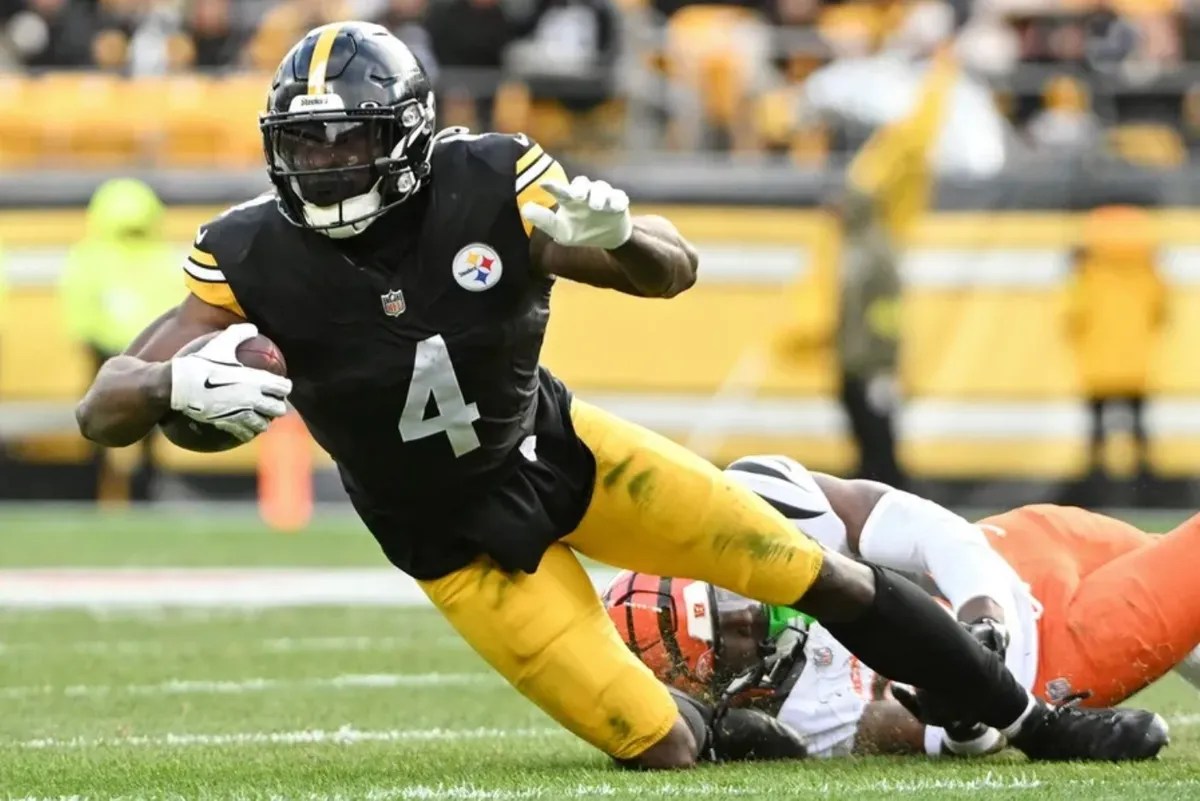
Nov 16, 2025; Pittsburgh, Pennsylvania, USA; Cincinnati Bengals safety Jordan Battle (27) tackles Pittsburgh Steelers wide receiver DK Metcalf (4) during the second half at Acrisure Stadium. Mandatory Credit: Barry Reeger-Imagn Images

There’s a proverb to teach children to ignore bullies and not retaliate physically.

“Sticks and stones may break my bones, but words will never hurt me,” it goes.

It’s a lesson the Pittsburgh Steelers’ DK Metcalf sure could have used Sunday in Detroit.

The uber-talented but often troubled wide receiver was suspended by the league for the final two regular-season games for an altercation with a fan during the second quarter of Pittsburgh’s 29-24 victory against the Lions.

Metcalf reportedly will appeal the ban, which could prove extremely costly for the wideout and perhaps damaging to his team’s playoff hopes.

The Steelers (9-6) still lead Baltimore (7-8) by two games in the NFC North, and they can clinch the division title with a Ravens loss to Green Bay or a victory of their own against Cleveland this weekend. But if neither of those happen, they could be staring at a Week 18 matchup against Baltimore for the division’s lone playoff berth without their leading receiver.

According to CBS Sports, not only would Metcalf forfeit $555,000 in salary from the final two games, but the suspension could void at least $45 million in future guaranteed money in his contract.

Videos show Metcalf walking behind the Steelers’ bench and the team’s medical tent and reaching up to grab the fan — who was leaning over the railing and wearing a blue wig — by the shirt and pulling him closer. After exchanging words, Metcalf forcibly pushed the man away.

The fan, identified by the Detroit Free Press as Ryan Kennedy from Pinckney, Mich., claimed he called Metcalf by his “government name” of DeKaylin Zecharius Metcalf.

Former NFL wide receiver Chad “Ochocinco” Johnson, on his “Nightcap” podcast, claimed he “got word” that Kennedy used a racial slur against Metcalf and a misogynistic slur against the receiver’s mother.

Metcalf didn’t speak with reporters after Sunday’s game. If what Johnson says is proven, then Kennedy should be banned from all NFL stadiums.

There are reports Metcalf reported the same fan to team security while playing last season with the Seattle Seahawks.

Which is even more reason Metcalf shouldn’t have been anywhere close to the stands Sunday at Ford Field.

He should have been lobbying quarterback Aaron Rodgers for more targets, not using rabbit ears to be distracted by a voice in the crowd — even one potentially so profane.

Metcalf took the bait and he and the Steelers are paying for it.

Former Pittsburgh safety Ryan Clark, now an ESPN analyst, said Metcalf “has to have a higher level of emotional intelligence.”

Metcalf is a physical specimen, listed at 6-foot-4 and 229 pounds. There are few receivers that have been as chiseled, despite his claims he’s a “candy person” that eats three or four bags of gummies a day.

He also has a history of emotional issues, having been fined 16 times by the NFL, according to Spotrac, since entering the league as a second-round pick out of Ole Miss in 2019. Most of those came after altercations with defenders, often after the play was long over.

In Seattle, he frequently was summoned to coach Pete Carroll’s office.

“I’m a passionate player and I’m never going to back down from anything,” Metcalf told the Seahawks’ team website after being ejected from a game in 2021. “(Carroll) understands that, but at the same time … I’ve got to grow up and continue to get better. I know that I’m still a work in progress.”

And he still has lessons to be learned.

Source link
#Metcalf #Suspension #Cost #Steelers #AFC #North #Deadspin.com
Deadspin | 2026 NBA mock draft: AJ Dybantsa best fit for Wizards at No. 1 overall  Feb 10, 2026; Waco, Texas, USA;  BYU Cougars forward AJ Dybantsa (3) dunks the ball ahead of Baylor Bears guard Cameron Carr (43) during the first half at Paul and Alejandra Foster Pavilion. Mandatory Credit: Chris Jones-Imagn Images   After a much-maligned race to the bottom of the standings, the first round of the draft board is finally set. As the pre-draft process ramps up and NBA front offices get their ducks in a row, here is my initial post-lottery 2026 mock draft (assuming the lottery order is not beset by trades). The NBA draft will be held June 23-24 in New York.  1. Washington Wizards: AJ Dybantsa  Forward, BYU, freshman, 6-foot-9, 210 pounds, 19 years old  Washington signaled an intention to expedite their rebuild by buying low on Trae Young and Anthony Davis midway through the 2025-26 campaign, and their plea for lottery glory has finally come to bear.   While the Darryn Peterson vs. AJ Dybantsa conversation depends on the eye of the beholder, Dybantsa slots in perfectly between the Wizards’ incumbent youngsters and acquired stars as the keystone for their future. Dybantsa is a swingman with high-end potential as a dribble penetrator and mid-post savant, commanding defensive attention in the middle of the floor. He is equally effective attacking closeouts and slashing into openings. Most importantly, he can be brought along at his own pace and avoid being overburdened in D.C.  2. Utah Jazz: Darryn Peterson  Guard, Kansas, freshman, 6-5, 205, 19  The Jazz fell just short of first dibs on their hometown hero but wind up with a superb consolation prize in Peterson. After pushing several of their chips in for Jaren Jackson Jr., Utah is full steam ahead for a winning trajectory.   Peterson can thrive at either guard spot because of his boundless off-ball movement and willingness to coexist with other primary creators. The Jazz have a colossal front-line to free him up off screens, a dependable lead ball carrier in Keyonte George, as well as a burgeoning wing stopper in Ace Bailey. Peterson’s frenetic zip, shot-making variety, and hybrid M.O. will allow coach Will Hardy to truly tap into his offensive ingenuity after a multi-year rebuild.  3. Memphis Grizzlies: Cameron Boozer  Forward, Duke, freshman, 6-9, 250, 18  If the Grizzlies were hellbent on making it work with Ja Morant, Caleb Wilson would be the pick here to expand Memphis’ stout, rangy supporting cast two through five. But all indicators point to a break-up and subsequent clean slate.  Boozer is a high-floor prospect with all the outlines of an offensive linchpin. His IQ, touch and floor game should provide offensive juice in the absence of a true first option, and the inside-outside nature of his skillset is compatible with Zach Edey — who Memphis has made clear is a pillar of their future. Boozer is the safest pick with projectable polish despite athletic limitations.  4. Chicago Bulls: Caleb Wilson  Forward, North Carolina, freshman, 6-10, 215, 19  Chicago’s highest selection since 2020, there is a credible argument to pursue a lead-creator at this spot in Darius Acuff Jr. or Kingston Flemings — especially with spindly young forwards Matas Buzelis and Noa Essengue in tow. However, this is a prime opportunity to take the best player available.   Wilson is a physical marvel with unmistakable all-defense potential. Bereft of a true interior force for more than a decade in the Windy City, Wilson blends interior ferocity, mid-range finesse and open floor dominance. His jump shot remains a lingering question, but he would serve as a valuable building block for a team in desperate need of competitive fervor.  5. Los Angeles Clippers: Keaton Wagler  Guard, Illinois, freshman, 6-6, 185, 19  The Clippers waited with baited breath for a 48% chance at pillaging Indiana’s pick, a gamble that should pay immense dividends for a franchise that does not own its first-round pick until 2030. Drafting a lead guard in Darius Acuff Jr. or Kingston Flemings would clash with the presence of true point guard Darius Garland, rendering Illinois’ Wagler a cleaner fit.   A late-blooming prospect that ascended as a freshman, Wagler is an off-guard that brings laser 3-point shooting and a refined off-the-dribble game. Despite his mid-tier athleticism and a slender build, Keaton profiles as an ideal secondary running mate to insert next to All-Star forward Kawhi Leonard and Garland.  6. Brooklyn Nets: Darius Acuff Jr.  Guard, Arkansas, freshman, 6-3, 190, 19  On the outside looking in once again, Nets general manager Sean Marks must make-do with his options in the mid-lottery for back-to-back drafts. Luckily for him, this range is littered with lead-initiators that check a lot of the boxes on Brooklyn’s wish list. Chief among them is Acuff, a potent scorer and on-ball self-starter who notched ridiculous counting stats and sterling efficiency under Razorbacks coach John Calipari.  The Nets have yearned for a go-to guy offensively since jettisoning Kyrie Irving and Kevin Durant. Acuff just might be the answer as a three-level menace who can eviscerate the first line of defense — although his defensive drawbacks loom large. The 6-8 guard Egor Demin’s positional size would make for a fascinating dual-wield backcourt experiment for the Nets to build on going forward.  7. Sacramento Kings: Kingston Flemings  Guard, Houston, freshman, 6-4, 190, 19  Death, taxes and lottery misery in Sac-Town. The Kings have lacked a gear-shifting guard presence since De’Aaron Fox forced his way out of town. Enter Flemings, a jitterbug lead-guard with the ball handling and creative dynamism to puncture halfcourt defenses as well as the defensive activity to remain viable on both sides of the ball.  Sacramento needs to dig itself out of a monumental, albeit entirely self-inflicted, organizational rut. Taking a swing on Flemings’ all-around scoring and facilitative upside is about as good a lifeline as you can hope for at No. 7.   8. Atlanta Hawks (via New Orleans): Brayden Burries  Guard, Arizona, freshman, 6-4, 205, 20  Atlanta’s hopes of nabbing a bona fide fortune-shifting prospect ran dry when it wound up outside the top four. While most draft evaluators may pencil in a primary creator like Acuff, Flemings or Mikel Brown Jr., Burries as an ideal fit given the Hawks’ trajectory.   He boasts a largely ancillary skillset — spot-up shooting, straight-line driving, read-and-react playmaking — and, as such, theoretically has a lower ceiling. However, he makes perfect sense orbiting, and amplifying, Jalen Johnson and Dyson Daniels’ ever-growing facilitative qualities. Most importantly, Burries is a serial transition threat that could seamlessly weaponize Johnson’s affinity for early offense in a manner that few ever could.  9. Dallas Mavericks: Mikel Brown Jr.  Guard, Louisville, freshman, 6-5, 190, 20  Brown had glimpses that could have you falling head over heels for his long-term outlook. A 6-5 lead-guard with smooth shooting mechanics and shot-making fearlessness that is impossible to ignore, Brown’s draft stock is inherently divisive. On one hand, you have a tight handle, buoyant athleticism, instinctive passing chops and limitless 3-point range. On the other, you have reckless turnovers, iffy shot selection, and a wiry build.  In a more streamlined role, Brown could blossom into one of the league’s premier dribble pull-up shooters with downhill punch to match. The Mavs could use a perimeter wild card to pair with Cooper Flagg and lighten the offensive load.  10. Milwaukee Bucks: Nate Ament  Forward, Tennessee, freshman, 6-10, 207, 19  With their future in relative shambles, a swing for the fences feels apropos in light of the Bucks’ current standoff with franchise superstar Giannis Antetokounmpo. Not to mention this being their first lottery pick since Thon Maker in 2016. A 6-10 forward who can pass, dribble and shoot (at least in theory), Ament’s freshman season was a tale of two halves with his efficiency skyrocketing at the turn of the calendar.   While his offensive game is glaringly unpolished and he has plenty of bulking up to do, there are clear outlines of a capable dribble attacker, movement shooter and auxiliary facilitator that, if they eventually bolden, could provide Milwaukee with a foundational piece in the post-Giannis era.  11. Golden State Warriors: Yaxel Lendeborg  Forward, Michigan, senior, 6-9, 240, 23  Fresh off clinching the national championship, Lendeborg is finally primed and ready to make the NBA leap after years in the draft consciousness. After extending coach Steve Kerr, the Warriors are faced with a harsh duality — maximizing Stephen Curry’s twilight years while keeping an eye to the future.   Despite turning 24 years old in September, Yaxel bridges that gap while addressing a positional need. He is a 6-10 (with shoes) forward that can scale up and down the positional spectrum defensively with his 7-4 wingspan and rock-steady base strength. Offensively, he can put the ball on the deck, set sturdy screens and improved his jump shooting to the tune of 37.2% as a super senior. Lendeborg is a seasoned, all-purpose, two-way force that can get in where he fits in for a well-traveled Warriors core.  12. Oklahoma City Thunder: Karim Lopez  Forward, Mexico/New Zealand Breakers, 6-9, 220, 19  With center Isaiah Hartenstein’s contract expiring in 2027, the stashing of 2025 first-round draft pick Thomas Sorber obviates an immediate need for frontcourt reinforcements. While Jayden Quaintance (Kentucky), Hannes Steinbach (Washington) or Aday Mara (Michigan) could each be a worthy successor, the Thunder’s rotation could use a combo-forward.   Lopez spent the past two seasons in New Zealand honing his sensibilities as a supplementary 3-and-D wing. Thunder general manager Sam Presti is familiar with the New Zealand Breakers pipeline, trading up to No. 11 in 2022 to select Ousmane Dieng. Lopez’s role player experience in a professional setting may well put him ahead of the developmental curve.  13. Miami Heat: Labaron Philon Jr.  Guard, Alabama, sophomore, 6-4, 185, 20  Stuck in basketball purgatory with options aplenty from a team building perspective, Miami once again finds itself in the mid-first round. It is difficult to identify a specific need for such a competent-but-not-elite roster, but Philon’s on-ball brilliance and massive sophomore leap makes him a frontrunner in this range.  Philon is as shifty and surgical a ball handler as you’ll find in this class. He makes up for a lack of verticality with various dribble combinations, cunning tempo changes, and a trusty floater. If guard Tyler Herro is not long for Miami, Labaron is a great contingency plan in the backcourt who can theoretically play alongside Kasparas Jakucionis for a dual-creator look.  14. Charlotte Hornets: Hannes Steinbach  Forward/center, Washington, freshman, 6-11, 220, 20  The Hornets flexed a competent defense for the first time in eons. Aday Mara presents an intriguing man-in-the-middle option to add to their center rotation of Moussa Diabate and Ryan Kalkbrenner, but Charlotte should prioritize optionality above all else. Accordingly, Steinbach stands out from the pack.   A hybrid big that vacuums rebounds on both ends with physicality and inside positioning, Steinbach’s offensive upside is a major selling point. A sophisticated low-post repertoire, deft touch, elbow playmaking and, most notably, a hint of 3-point aptitude (18-for-53 at a 34% clip as a freshman) gives coach Charles Lee much-needed versatility to work with from the high post. If Steinbach’s 3-point range manifests, he could coexist with Diabate in unprecedented double-big lineup machinations.  –Ethan Ward, Field Level Media    #Deadspin #NBA #mock #draft #Dybantsa #fit #WizardsFeb 10, 2026; Waco, Texas, USA; BYU Cougars forward AJ Dybantsa (3) dunks the ball ahead of Baylor Bears guard Cameron Carr (43) during the first half at Paul and Alejandra Foster Pavilion. Mandatory Credit: Chris Jones-Imagn Images

After a much-maligned race to the bottom of the standings, the first round of the draft board is finally set. As the pre-draft process ramps up and NBA front offices get their ducks in a row, here is my initial post-lottery 2026 mock draft (assuming the lottery order is not beset by trades). The NBA draft will be held June 23-24 in New York.

1. Washington Wizards: AJ Dybantsa

Forward, BYU, freshman, 6-foot-9, 210 pounds, 19 years old

Washington signaled an intention to expedite their rebuild by buying low on Trae Young and Anthony Davis midway through the 2025-26 campaign, and their plea for lottery glory has finally come to bear.

While the Darryn Peterson vs. AJ Dybantsa conversation depends on the eye of the beholder, Dybantsa slots in perfectly between the Wizards’ incumbent youngsters and acquired stars as the keystone for their future. Dybantsa is a swingman with high-end potential as a dribble penetrator and mid-post savant, commanding defensive attention in the middle of the floor. He is equally effective attacking closeouts and slashing into openings. Most importantly, he can be brought along at his own pace and avoid being overburdened in D.C.

2. Utah Jazz: Darryn Peterson

Guard, Kansas, freshman, 6-5, 205, 19

The Jazz fell just short of first dibs on their hometown hero but wind up with a superb consolation prize in Peterson. After pushing several of their chips in for Jaren Jackson Jr., Utah is full steam ahead for a winning trajectory.

Peterson can thrive at either guard spot because of his boundless off-ball movement and willingness to coexist with other primary creators. The Jazz have a colossal front-line to free him up off screens, a dependable lead ball carrier in Keyonte George, as well as a burgeoning wing stopper in Ace Bailey. Peterson’s frenetic zip, shot-making variety, and hybrid M.O. will allow coach Will Hardy to truly tap into his offensive ingenuity after a multi-year rebuild.

3. Memphis Grizzlies: Cameron Boozer

Forward, Duke, freshman, 6-9, 250, 18

If the Grizzlies were hellbent on making it work with Ja Morant, Caleb Wilson would be the pick here to expand Memphis’ stout, rangy supporting cast two through five. But all indicators point to a break-up and subsequent clean slate.

Boozer is a high-floor prospect with all the outlines of an offensive linchpin. His IQ, touch and floor game should provide offensive juice in the absence of a true first option, and the inside-outside nature of his skillset is compatible with Zach Edey — who Memphis has made clear is a pillar of their future. Boozer is the safest pick with projectable polish despite athletic limitations.

4. Chicago Bulls: Caleb Wilson

Forward, North Carolina, freshman, 6-10, 215, 19

Chicago’s highest selection since 2020, there is a credible argument to pursue a lead-creator at this spot in Darius Acuff Jr. or Kingston Flemings — especially with spindly young forwards Matas Buzelis and Noa Essengue in tow. However, this is a prime opportunity to take the best player available.

Wilson is a physical marvel with unmistakable all-defense potential. Bereft of a true interior force for more than a decade in the Windy City, Wilson blends interior ferocity, mid-range finesse and open floor dominance. His jump shot remains a lingering question, but he would serve as a valuable building block for a team in desperate need of competitive fervor.

5. Los Angeles Clippers: Keaton Wagler

Guard, Illinois, freshman, 6-6, 185, 19

The Clippers waited with baited breath for a 48% chance at pillaging Indiana’s pick, a gamble that should pay immense dividends for a franchise that does not own its first-round pick until 2030. Drafting a lead guard in Darius Acuff Jr. or Kingston Flemings would clash with the presence of true point guard Darius Garland, rendering Illinois’ Wagler a cleaner fit.

A late-blooming prospect that ascended as a freshman, Wagler is an off-guard that brings laser 3-point shooting and a refined off-the-dribble game. Despite his mid-tier athleticism and a slender build, Keaton profiles as an ideal secondary running mate to insert next to All-Star forward Kawhi Leonard and Garland.

6. Brooklyn Nets: Darius Acuff Jr.

Guard, Arkansas, freshman, 6-3, 190, 19

On the outside looking in once again, Nets general manager Sean Marks must make-do with his options in the mid-lottery for back-to-back drafts. Luckily for him, this range is littered with lead-initiators that check a lot of the boxes on Brooklyn’s wish list. Chief among them is Acuff, a potent scorer and on-ball self-starter who notched ridiculous counting stats and sterling efficiency under Razorbacks coach John Calipari.

The Nets have yearned for a go-to guy offensively since jettisoning Kyrie Irving and Kevin Durant. Acuff just might be the answer as a three-level menace who can eviscerate the first line of defense — although his defensive drawbacks loom large. The 6-8 guard Egor Demin’s positional size would make for a fascinating dual-wield backcourt experiment for the Nets to build on going forward.

7. Sacramento Kings: Kingston Flemings

Guard, Houston, freshman, 6-4, 190, 19

Death, taxes and lottery misery in Sac-Town. The Kings have lacked a gear-shifting guard presence since De’Aaron Fox forced his way out of town. Enter Flemings, a jitterbug lead-guard with the ball handling and creative dynamism to puncture halfcourt defenses as well as the defensive activity to remain viable on both sides of the ball.


Sacramento needs to dig itself out of a monumental, albeit entirely self-inflicted, organizational rut. Taking a swing on Flemings’ all-around scoring and facilitative upside is about as good a lifeline as you can hope for at No. 7.

8. Atlanta Hawks (via New Orleans): Brayden Burries

Guard, Arizona, freshman, 6-4, 205, 20

Atlanta’s hopes of nabbing a bona fide fortune-shifting prospect ran dry when it wound up outside the top four. While most draft evaluators may pencil in a primary creator like Acuff, Flemings or Mikel Brown Jr., Burries as an ideal fit given the Hawks’ trajectory.

He boasts a largely ancillary skillset — spot-up shooting, straight-line driving, read-and-react playmaking — and, as such, theoretically has a lower ceiling. However, he makes perfect sense orbiting, and amplifying, Jalen Johnson and Dyson Daniels’ ever-growing facilitative qualities. Most importantly, Burries is a serial transition threat that could seamlessly weaponize Johnson’s affinity for early offense in a manner that few ever could.

9. Dallas Mavericks: Mikel Brown Jr.

Guard, Louisville, freshman, 6-5, 190, 20

Brown had glimpses that could have you falling head over heels for his long-term outlook. A 6-5 lead-guard with smooth shooting mechanics and shot-making fearlessness that is impossible to ignore, Brown’s draft stock is inherently divisive. On one hand, you have a tight handle, buoyant athleticism, instinctive passing chops and limitless 3-point range. On the other, you have reckless turnovers, iffy shot selection, and a wiry build.

In a more streamlined role, Brown could blossom into one of the league’s premier dribble pull-up shooters with downhill punch to match. The Mavs could use a perimeter wild card to pair with Cooper Flagg and lighten the offensive load.

10. Milwaukee Bucks: Nate Ament

Forward, Tennessee, freshman, 6-10, 207, 19

With their future in relative shambles, a swing for the fences feels apropos in light of the Bucks’ current standoff with franchise superstar Giannis Antetokounmpo. Not to mention this being their first lottery pick since Thon Maker in 2016. A 6-10 forward who can pass, dribble and shoot (at least in theory), Ament’s freshman season was a tale of two halves with his efficiency skyrocketing at the turn of the calendar.

While his offensive game is glaringly unpolished and he has plenty of bulking up to do, there are clear outlines of a capable dribble attacker, movement shooter and auxiliary facilitator that, if they eventually bolden, could provide Milwaukee with a foundational piece in the post-Giannis era.

11. Golden State Warriors: Yaxel Lendeborg

Forward, Michigan, senior, 6-9, 240, 23

Fresh off clinching the national championship, Lendeborg is finally primed and ready to make the NBA leap after years in the draft consciousness. After extending coach Steve Kerr, the Warriors are faced with a harsh duality — maximizing Stephen Curry’s twilight years while keeping an eye to the future.

Despite turning 24 years old in September, Yaxel bridges that gap while addressing a positional need. He is a 6-10 (with shoes) forward that can scale up and down the positional spectrum defensively with his 7-4 wingspan and rock-steady base strength. Offensively, he can put the ball on the deck, set sturdy screens and improved his jump shooting to the tune of 37.2% as a super senior. Lendeborg is a seasoned, all-purpose, two-way force that can get in where he fits in for a well-traveled Warriors core.

12. Oklahoma City Thunder: Karim Lopez

Forward, Mexico/New Zealand Breakers, 6-9, 220, 19

With center Isaiah Hartenstein’s contract expiring in 2027, the stashing of 2025 first-round draft pick Thomas Sorber obviates an immediate need for frontcourt reinforcements. While Jayden Quaintance (Kentucky), Hannes Steinbach (Washington) or Aday Mara (Michigan) could each be a worthy successor, the Thunder’s rotation could use a combo-forward.

Lopez spent the past two seasons in New Zealand honing his sensibilities as a supplementary 3-and-D wing. Thunder general manager Sam Presti is familiar with the New Zealand Breakers pipeline, trading up to No. 11 in 2022 to select Ousmane Dieng. Lopez’s role player experience in a professional setting may well put him ahead of the developmental curve.

13. Miami Heat: Labaron Philon Jr.

Guard, Alabama, sophomore, 6-4, 185, 20

Stuck in basketball purgatory with options aplenty from a team building perspective, Miami once again finds itself in the mid-first round. It is difficult to identify a specific need for such a competent-but-not-elite roster, but Philon’s on-ball brilliance and massive sophomore leap makes him a frontrunner in this range.

Philon is as shifty and surgical a ball handler as you’ll find in this class. He makes up for a lack of verticality with various dribble combinations, cunning tempo changes, and a trusty floater. If guard Tyler Herro is not long for Miami, Labaron is a great contingency plan in the backcourt who can theoretically play alongside Kasparas Jakucionis for a dual-creator look.

14. Charlotte Hornets: Hannes Steinbach

Forward/center, Washington, freshman, 6-11, 220, 20

The Hornets flexed a competent defense for the first time in eons. Aday Mara presents an intriguing man-in-the-middle option to add to their center rotation of Moussa Diabate and Ryan Kalkbrenner, but Charlotte should prioritize optionality above all else. Accordingly, Steinbach stands out from the pack.

A hybrid big that vacuums rebounds on both ends with physicality and inside positioning, Steinbach’s offensive upside is a major selling point. A sophisticated low-post repertoire, deft touch, elbow playmaking and, most notably, a hint of 3-point aptitude (18-for-53 at a 34% clip as a freshman) gives coach Charles Lee much-needed versatility to work with from the high post. If Steinbach’s 3-point range manifests, he could coexist with Diabate in unprecedented double-big lineup machinations.


–Ethan Ward, Field Level Media

#Deadspin #NBA #mock #draft #Dybantsa #fit #Wizards">Deadspin | 2026 NBA mock draft: AJ Dybantsa best fit for Wizards at No. 1 overall  Feb 10, 2026; Waco, Texas, USA;  BYU Cougars forward AJ Dybantsa (3) dunks the ball ahead of Baylor Bears guard Cameron Carr (43) during the first half at Paul and Alejandra Foster Pavilion. Mandatory Credit: Chris Jones-Imagn Images   After a much-maligned race to the bottom of the standings, the first round of the draft board is finally set. As the pre-draft process ramps up and NBA front offices get their ducks in a row, here is my initial post-lottery 2026 mock draft (assuming the lottery order is not beset by trades). The NBA draft will be held June 23-24 in New York.  1. Washington Wizards: AJ Dybantsa  Forward, BYU, freshman, 6-foot-9, 210 pounds, 19 years old  Washington signaled an intention to expedite their rebuild by buying low on Trae Young and Anthony Davis midway through the 2025-26 campaign, and their plea for lottery glory has finally come to bear.   While the Darryn Peterson vs. AJ Dybantsa conversation depends on the eye of the beholder, Dybantsa slots in perfectly between the Wizards’ incumbent youngsters and acquired stars as the keystone for their future. Dybantsa is a swingman with high-end potential as a dribble penetrator and mid-post savant, commanding defensive attention in the middle of the floor. He is equally effective attacking closeouts and slashing into openings. Most importantly, he can be brought along at his own pace and avoid being overburdened in D.C.  2. Utah Jazz: Darryn Peterson  Guard, Kansas, freshman, 6-5, 205, 19  The Jazz fell just short of first dibs on their hometown hero but wind up with a superb consolation prize in Peterson. After pushing several of their chips in for Jaren Jackson Jr., Utah is full steam ahead for a winning trajectory.   Peterson can thrive at either guard spot because of his boundless off-ball movement and willingness to coexist with other primary creators. The Jazz have a colossal front-line to free him up off screens, a dependable lead ball carrier in Keyonte George, as well as a burgeoning wing stopper in Ace Bailey. Peterson’s frenetic zip, shot-making variety, and hybrid M.O. will allow coach Will Hardy to truly tap into his offensive ingenuity after a multi-year rebuild.  3. Memphis Grizzlies: Cameron Boozer  Forward, Duke, freshman, 6-9, 250, 18  If the Grizzlies were hellbent on making it work with Ja Morant, Caleb Wilson would be the pick here to expand Memphis’ stout, rangy supporting cast two through five. But all indicators point to a break-up and subsequent clean slate.  Boozer is a high-floor prospect with all the outlines of an offensive linchpin. His IQ, touch and floor game should provide offensive juice in the absence of a true first option, and the inside-outside nature of his skillset is compatible with Zach Edey — who Memphis has made clear is a pillar of their future. Boozer is the safest pick with projectable polish despite athletic limitations.  4. Chicago Bulls: Caleb Wilson  Forward, North Carolina, freshman, 6-10, 215, 19  Chicago’s highest selection since 2020, there is a credible argument to pursue a lead-creator at this spot in Darius Acuff Jr. or Kingston Flemings — especially with spindly young forwards Matas Buzelis and Noa Essengue in tow. However, this is a prime opportunity to take the best player available.   Wilson is a physical marvel with unmistakable all-defense potential. Bereft of a true interior force for more than a decade in the Windy City, Wilson blends interior ferocity, mid-range finesse and open floor dominance. His jump shot remains a lingering question, but he would serve as a valuable building block for a team in desperate need of competitive fervor.  5. Los Angeles Clippers: Keaton Wagler  Guard, Illinois, freshman, 6-6, 185, 19  The Clippers waited with baited breath for a 48% chance at pillaging Indiana’s pick, a gamble that should pay immense dividends for a franchise that does not own its first-round pick until 2030. Drafting a lead guard in Darius Acuff Jr. or Kingston Flemings would clash with the presence of true point guard Darius Garland, rendering Illinois’ Wagler a cleaner fit.   A late-blooming prospect that ascended as a freshman, Wagler is an off-guard that brings laser 3-point shooting and a refined off-the-dribble game. Despite his mid-tier athleticism and a slender build, Keaton profiles as an ideal secondary running mate to insert next to All-Star forward Kawhi Leonard and Garland.  6. Brooklyn Nets: Darius Acuff Jr.  Guard, Arkansas, freshman, 6-3, 190, 19  On the outside looking in once again, Nets general manager Sean Marks must make-do with his options in the mid-lottery for back-to-back drafts. Luckily for him, this range is littered with lead-initiators that check a lot of the boxes on Brooklyn’s wish list. Chief among them is Acuff, a potent scorer and on-ball self-starter who notched ridiculous counting stats and sterling efficiency under Razorbacks coach John Calipari.  The Nets have yearned for a go-to guy offensively since jettisoning Kyrie Irving and Kevin Durant. Acuff just might be the answer as a three-level menace who can eviscerate the first line of defense — although his defensive drawbacks loom large. The 6-8 guard Egor Demin’s positional size would make for a fascinating dual-wield backcourt experiment for the Nets to build on going forward.  7. Sacramento Kings: Kingston Flemings  Guard, Houston, freshman, 6-4, 190, 19  Death, taxes and lottery misery in Sac-Town. The Kings have lacked a gear-shifting guard presence since De’Aaron Fox forced his way out of town. Enter Flemings, a jitterbug lead-guard with the ball handling and creative dynamism to puncture halfcourt defenses as well as the defensive activity to remain viable on both sides of the ball.  Sacramento needs to dig itself out of a monumental, albeit entirely self-inflicted, organizational rut. Taking a swing on Flemings’ all-around scoring and facilitative upside is about as good a lifeline as you can hope for at No. 7.   8. Atlanta Hawks (via New Orleans): Brayden Burries  Guard, Arizona, freshman, 6-4, 205, 20  Atlanta’s hopes of nabbing a bona fide fortune-shifting prospect ran dry when it wound up outside the top four. While most draft evaluators may pencil in a primary creator like Acuff, Flemings or Mikel Brown Jr., Burries as an ideal fit given the Hawks’ trajectory.   He boasts a largely ancillary skillset — spot-up shooting, straight-line driving, read-and-react playmaking — and, as such, theoretically has a lower ceiling. However, he makes perfect sense orbiting, and amplifying, Jalen Johnson and Dyson Daniels’ ever-growing facilitative qualities. Most importantly, Burries is a serial transition threat that could seamlessly weaponize Johnson’s affinity for early offense in a manner that few ever could.  9. Dallas Mavericks: Mikel Brown Jr.  Guard, Louisville, freshman, 6-5, 190, 20  Brown had glimpses that could have you falling head over heels for his long-term outlook. A 6-5 lead-guard with smooth shooting mechanics and shot-making fearlessness that is impossible to ignore, Brown’s draft stock is inherently divisive. On one hand, you have a tight handle, buoyant athleticism, instinctive passing chops and limitless 3-point range. On the other, you have reckless turnovers, iffy shot selection, and a wiry build.  In a more streamlined role, Brown could blossom into one of the league’s premier dribble pull-up shooters with downhill punch to match. The Mavs could use a perimeter wild card to pair with Cooper Flagg and lighten the offensive load.  10. Milwaukee Bucks: Nate Ament  Forward, Tennessee, freshman, 6-10, 207, 19  With their future in relative shambles, a swing for the fences feels apropos in light of the Bucks’ current standoff with franchise superstar Giannis Antetokounmpo. Not to mention this being their first lottery pick since Thon Maker in 2016. A 6-10 forward who can pass, dribble and shoot (at least in theory), Ament’s freshman season was a tale of two halves with his efficiency skyrocketing at the turn of the calendar.   While his offensive game is glaringly unpolished and he has plenty of bulking up to do, there are clear outlines of a capable dribble attacker, movement shooter and auxiliary facilitator that, if they eventually bolden, could provide Milwaukee with a foundational piece in the post-Giannis era.  11. Golden State Warriors: Yaxel Lendeborg  Forward, Michigan, senior, 6-9, 240, 23  Fresh off clinching the national championship, Lendeborg is finally primed and ready to make the NBA leap after years in the draft consciousness. After extending coach Steve Kerr, the Warriors are faced with a harsh duality — maximizing Stephen Curry’s twilight years while keeping an eye to the future.   Despite turning 24 years old in September, Yaxel bridges that gap while addressing a positional need. He is a 6-10 (with shoes) forward that can scale up and down the positional spectrum defensively with his 7-4 wingspan and rock-steady base strength. Offensively, he can put the ball on the deck, set sturdy screens and improved his jump shooting to the tune of 37.2% as a super senior. Lendeborg is a seasoned, all-purpose, two-way force that can get in where he fits in for a well-traveled Warriors core.  12. Oklahoma City Thunder: Karim Lopez  Forward, Mexico/New Zealand Breakers, 6-9, 220, 19  With center Isaiah Hartenstein’s contract expiring in 2027, the stashing of 2025 first-round draft pick Thomas Sorber obviates an immediate need for frontcourt reinforcements. While Jayden Quaintance (Kentucky), Hannes Steinbach (Washington) or Aday Mara (Michigan) could each be a worthy successor, the Thunder’s rotation could use a combo-forward.   Lopez spent the past two seasons in New Zealand honing his sensibilities as a supplementary 3-and-D wing. Thunder general manager Sam Presti is familiar with the New Zealand Breakers pipeline, trading up to No. 11 in 2022 to select Ousmane Dieng. Lopez’s role player experience in a professional setting may well put him ahead of the developmental curve.  13. Miami Heat: Labaron Philon Jr.  Guard, Alabama, sophomore, 6-4, 185, 20  Stuck in basketball purgatory with options aplenty from a team building perspective, Miami once again finds itself in the mid-first round. It is difficult to identify a specific need for such a competent-but-not-elite roster, but Philon’s on-ball brilliance and massive sophomore leap makes him a frontrunner in this range.  Philon is as shifty and surgical a ball handler as you’ll find in this class. He makes up for a lack of verticality with various dribble combinations, cunning tempo changes, and a trusty floater. If guard Tyler Herro is not long for Miami, Labaron is a great contingency plan in the backcourt who can theoretically play alongside Kasparas Jakucionis for a dual-creator look.  14. Charlotte Hornets: Hannes Steinbach  Forward/center, Washington, freshman, 6-11, 220, 20  The Hornets flexed a competent defense for the first time in eons. Aday Mara presents an intriguing man-in-the-middle option to add to their center rotation of Moussa Diabate and Ryan Kalkbrenner, but Charlotte should prioritize optionality above all else. Accordingly, Steinbach stands out from the pack.   A hybrid big that vacuums rebounds on both ends with physicality and inside positioning, Steinbach’s offensive upside is a major selling point. A sophisticated low-post repertoire, deft touch, elbow playmaking and, most notably, a hint of 3-point aptitude (18-for-53 at a 34% clip as a freshman) gives coach Charles Lee much-needed versatility to work with from the high post. If Steinbach’s 3-point range manifests, he could coexist with Diabate in unprecedented double-big lineup machinations.  –Ethan Ward, Field Level Media    #Deadspin #NBA #mock #draft #Dybantsa #fit #Wizards

Post Comment