Fake Urine Bottles Planted In Museum Before Met Gala to Protest Jeff Bezos
A group of protesters from an organization called Everyone Hates Elon have stuck it to Jeff Bezos by planting little fake pee bottles in the Metropolitan Museum of Art in New York in the days before Monday’s Met Gala. Monday, at the event itself, there were more traditional protesters as well.
According to Fox News, Jeff Bezos avoided the red carpet on Monday and quietly went inside the event via some other entrance.
The explanation for the pee bottles, according to a statement posted on Instagram is that, “Jeff Bezos’s company Amazon is literally being sued for forcing workers to urinate in bottles.” There is indeed a proposed class action suit in Colorado over alleged “work policies that require its delivery drivers in Colorado to urinate in bottles in the back of delivery vans, defecate in bags, and, in many cases, to restrain themselves from using the bathroom at risk of serious health consequences.” When the suit was announced in 2023, Amazon declined to comment on the specifics.
A good way to draw attention to this might be to protest at one of Amazon’s many physical locations, which people sometimes do. Another way would be to stage a funny protest in the lead-up to the Bezos-affiliated Met Gala, which, in addition to being a gala is also a fundraising event for the arts—which gives it a convenient, but real, veneer of kindness.
The fake pee bottles have a message on them that says “Boycott the Bezos Met Gala,” which everyone I know is doing whether they want to or not since they just don’t have the $100,000 it costs to get in. A smaller note at the bottom of the label says “Relax, it’s just water and food coloring.”
The pee bottle stunt is cute, but seems like it was mainly just annoying for people who work at the museum. Still, the protesters got their message out, and they may have successfully put Bezos off of making a red carpet entrance. Plus it would be hard to do a funny stunt protest every time Jeff Bezos has a party on the largest sailing yacht in the world, which he owns, and which is so big it has its own little side-yacht. Though there were fresh rumors going around in the tabloids Monday that he wants to sell that because it attracts too much attention. Maybe someone planted pee bottles in that too.
A group of protesters from an organization called Everyone Hates Elon have stuck it to Jeff Bezos by planting little fake pee bottles in the Metropolitan Museum of Art in New York in the days before Monday’s Met Gala. Monday, at the event itself, there were more traditional protesters as well.
According to Fox News, Jeff Bezos avoided the red carpet on Monday and quietly went inside the event via some other entrance.
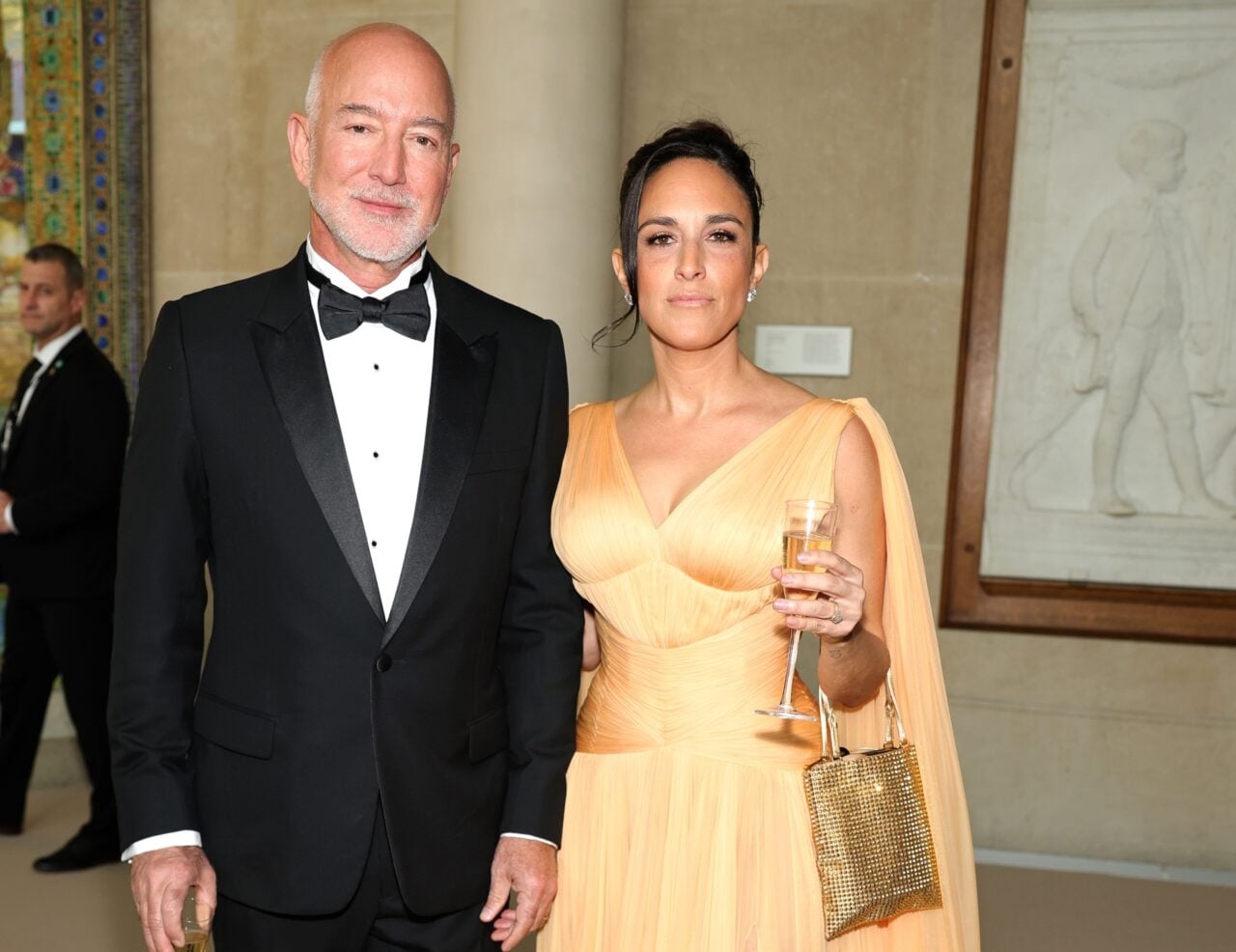
Honorary Chair, Lauren Sánchez Bezos arrives at the 2026 #MetGala pic.twitter.com/XIh9Zkoo4y
— The Hollywood Reporter (@THR) May 4, 2026
The explanation for the pee bottles, according to a statement posted on Instagram is that, “Jeff Bezos’s company Amazon is literally being sued for forcing workers to urinate in bottles.” There is indeed a proposed class action suit in Colorado over alleged “work policies that require its delivery drivers in Colorado to urinate in bottles in the back of delivery vans, defecate in bags, and, in many cases, to restrain themselves from using the bathroom at risk of serious health consequences.” When the suit was announced in 2023, Amazon declined to comment on the specifics.
The Met Gala, like the Oscars, started as a dinner for cultural elites, and then got out of hand. Now you can spark an international incident by not knowing who someone is at the Met Gala, and the House Ethics committee will investigate a dress someone wears there.
And now Jeff Bezos, the centibillionaire Amazon founder, and his wife Lauren Sanchez pay millions of dollars to be associated with the Gala—this year becoming the primary donors and honorary co-chairs of the event.
That’s unpleasant for anyone who reasonably does not care for Amazon’s gruesome alleged treatment of workers and contractors—including sometimes allegedly not allowing adequate time to pee in actual bathrooms. It’s something Amazon has denied, but then it ended up apologizing for the denial.
A good way to draw attention to this might be to protest at one of Amazon’s many physical locations, which people sometimes do. Another way would be to stage a funny protest in the lead-up to the Bezos-affiliated Met Gala, which, in addition to being a gala is also a fundraising event for the arts—which gives it a convenient, but real, veneer of kindness.
The fake pee bottles have a message on them that says “Boycott the Bezos Met Gala,” which everyone I know is doing whether they want to or not since they just don’t have the $100,000 it costs to get in. A smaller note at the bottom of the label says “Relax, it’s just water and food coloring.”
The pee bottle stunt is cute, but seems like it was mainly just annoying for people who work at the museum. Still, the protesters got their message out, and they may have successfully put Bezos off of making a red carpet entrance. Plus it would be hard to do a funny stunt protest every time Jeff Bezos has a party on the largest sailing yacht in the world, which he owns, and which is so big it has its own little side-yacht. Though there were fresh rumors going around in the tabloids Monday that he wants to sell that because it attracts too much attention. Maybe someone planted pee bottles in that too.
Instead of turning off each individual AI feature like a game of whac-o-mole, we can disable “smart features” across our Google workspace via Gmail.
First, navigate to your Gmail inbox.
From there, find the gear icon for Settings and click it.
Then, at the top of the menu, click “See all settings.” (But while you’re here, you should pick out a fun theme for your inbox. Would a little bit of whimsy kill you?)
After clicking “See all settings,” scroll about half way down the page to find “Google Workspace smart features,” then click “Manage Workspace smart feature settings.”
Image Credits:Screenshot from Gmail
Here, you’re presented with two options: one that lets you toggle off smart features in Google Workspace (like those annoying Gemini pop-ups in Google Docs), and one that applies to other smart features (which I personally find less annoying). I only toggled off the first option, but if for some reason you hate when Gmail automatically makes calendar events for your flights, this is where you can fix that.
You should now be safe from annoying Gemini pop-ups that disrupt your writing process in Google Docs. You can rest easy.
When you purchase through links in our articles, we may earn a small commission. This doesn’t affect our editorial independence.
Instead of turning off each individual AI feature like a game of whac-o-mole, we can disable “smart features” across our Google workspace via Gmail.
First, navigate to your Gmail inbox.
From there, find the gear icon for Settings and click it.
Then, at the top of the menu, click “See all settings.” (But while you’re here, you should pick out a fun theme for your inbox. Would a little bit of whimsy kill you?)
After clicking “See all settings,” scroll about half way down the page to find “Google Workspace smart features,” then click “Manage Workspace smart feature settings.”
Image Credits:Screenshot from Gmail
Here, you’re presented with two options: one that lets you toggle off smart features in Google Workspace (like those annoying Gemini pop-ups in Google Docs), and one that applies to other smart features (which I personally find less annoying). I only toggled off the first option, but if for some reason you hate when Gmail automatically makes calendar events for your flights, this is where you can fix that.
You should now be safe from annoying Gemini pop-ups that disrupt your writing process in Google Docs. You can rest easy.
When you purchase through links in our articles, we may earn a small commission. This doesn’t affect our editorial independence.
#turn #Google #Docs #TechCrunchevergreen">How to turn off AI in your Google Docs | TechCrunch
It happened to me: I opened a Google Doc to write an article, and I was immediately confronted with a text box inviting me to “write with Gemini.” I looked for some button to swipe away the garish AI display, but I could not find it. It made me mad.
Now, instead of writing the article I’m supposed to be working on, I am writing about how to get the AI pop-ups off of your Google Docs screen, since it took me some time to figure out. You’re welcome.
What is this monstrosity? Why won’t it just go away?Image Credits:Screenshot from Google Docs
The first fix is pretty straightforward:
Click “Gemini” on the top menu bar above your document.
On the drop-down menu, select “bottom bar preferences.”
You can choose to turn off that bottom bar, which will get rid of that AI box at the bottom of your screen.
Image Credits:Screenshot from Google Docs
Full disclosure: I was so enraged when I set out to find “bottom bar preferences” that I initially missed it entirely. Instead, I clicked “Ask something else” and asked Gemini to help me remove itself from my life. AI may not be human, but Gemini seemed to have some sort of survival instinct, because it told me to click the “X” icon. That does not remove Gemini. It simply closed the conversation, the one in which I was asking it how to turn itself off. Suspicious!
Image Credits:Screenshot from Google Docs
Other aggrieved Google Docs users have reported features that I have yet to encounter, like a “help me write” feature that hovers over your cursor while you work. This seems like something that would upset me, so it’s probably worth nipping that in the bud before it’s too late. Benjamin Franklin once said, “An ounce of prevention is worth a pound of cure.” (He was talking about fire safety. I am talking about product design.)
Instead of turning off each individual AI feature like a game of whac-o-mole, we can disable “smart features” across our Google workspace via Gmail.
First, navigate to your Gmail inbox.
From there, find the gear icon for Settings and click it.
Then, at the top of the menu, click “See all settings.” (But while you’re here, you should pick out a fun theme for your inbox. Would a little bit of whimsy kill you?)
After clicking “See all settings,” scroll about half way down the page to find “Google Workspace smart features,” then click “Manage Workspace smart feature settings.”
Image Credits:Screenshot from Gmail
Here, you’re presented with two options: one that lets you toggle off smart features in Google Workspace (like those annoying Gemini pop-ups in Google Docs), and one that applies to other smart features (which I personally find less annoying). I only toggled off the first option, but if for some reason you hate when Gmail automatically makes calendar events for your flights, this is where you can fix that.
You should now be safe from annoying Gemini pop-ups that disrupt your writing process in Google Docs. You can rest easy.
When you purchase through links in our articles, we may earn a small commission. This doesn’t affect our editorial independence.
#turn #Google #Docs #TechCrunchevergreen
event is scheduled to be hosted at the Jaipur Exhibition & Convention Center from 19th to 21st June. The top 16 teams have earned their place in the final stage and will battle over three days for a share of the ₹4 crore prize pool. The team that wins the BMPS Grand Final will receive ₹1 crore. The second and third-positioned teams will be awarded ₹60 lakh and ₹40 lakh, respectively.
How did the 16 finalists qualify?
Only the top teams qualified for the grand finals of BMPS 2026. First, there was a qualifying round through the group stages, from which only eight teams were qualified for the finals. Six more teams gained access to the grand finals by advancing past the semifinals held in New Delhi. It was in the semifinals that Nebula Esports won the first spot.
Apex Gaming team made a remarkable entry into the BMPS 2026 Grand Finals by qualifying for the event through the Last Chance Stage. This stage was the last opportunity for teams aspiring to qualify for the event. Led by Jonathan, the team pulled up their socks and grabbed a slot from the remaining few available. Qualifying for the Grand Finals is proof enough that the team faced many hardships throughout the event.
The BMPS 2026 Grand Finals offer more than just prize money. The tournament champions will secure a direct qualification spot for the Esports World Cup 2026 in Paris. This gives players a chance to compete against some of the best esports teams in the world. Another Indian team can also reach the event through the Krafton India Esports rankings. As a result, the finals carry both national and international importance.
Format of the BMPS 2026 Grand Finals
For the BMPS 2026 Grand Finals, there will be 18 games over three days. All sixteen qualified teams will take part in these games, and six games per day have been scheduled. The points earned by teams will depend on their rankings and elimination results in the games. Each game is crucial and counts in the final standings. Those teams that do well in all three days stand the highest chance of emerging champions.
In Jaipur, there are some of the most formidable teams present in the BGMI esports league. GodLike qualifies for the finals after performing well in the group stages. Nebula Esports displayed good form in the semi-finals and will hope to replicate their success going forward. There is another team, Team Apex Gaming, that made a name for itself by qualifying from the Last Chance Stage with determination.
event is scheduled to be hosted at the Jaipur Exhibition & Convention Center from 19th to 21st June. The top 16 teams have earned their place in the final stage and will battle over three days for a share of the ₹4 crore prize pool. The team that wins the BMPS Grand Final will receive ₹1 crore. The second and third-positioned teams will be awarded ₹60 lakh and ₹40 lakh, respectively.
How did the 16 finalists qualify?
Only the top teams qualified for the grand finals of BMPS 2026. First, there was a qualifying round through the group stages, from which only eight teams were qualified for the finals. Six more teams gained access to the grand finals by advancing past the semifinals held in New Delhi. It was in the semifinals that Nebula Esports won the first spot.
Apex Gaming team made a remarkable entry into the BMPS 2026 Grand Finals by qualifying for the event through the Last Chance Stage. This stage was the last opportunity for teams aspiring to qualify for the event. Led by Jonathan, the team pulled up their socks and grabbed a slot from the remaining few available. Qualifying for the Grand Finals is proof enough that the team faced many hardships throughout the event.
The BMPS 2026 Grand Finals offer more than just prize money. The tournament champions will secure a direct qualification spot for the Esports World Cup 2026 in Paris. This gives players a chance to compete against some of the best esports teams in the world. Another Indian team can also reach the event through the Krafton India Esports rankings. As a result, the finals carry both national and international importance.
Format of the BMPS 2026 Grand Finals
For the BMPS 2026 Grand Finals, there will be 18 games over three days. All sixteen qualified teams will take part in these games, and six games per day have been scheduled. The points earned by teams will depend on their rankings and elimination results in the games. Each game is crucial and counts in the final standings. Those teams that do well in all three days stand the highest chance of emerging champions.
In Jaipur, there are some of the most formidable teams present in the BGMI esports league. GodLike qualifies for the finals after performing well in the group stages. Nebula Esports displayed good form in the semi-finals and will hope to replicate their success going forward. There is another team, Team Apex Gaming, that made a name for itself by qualifying from the Last Chance Stage with determination.
#BMPS #Grand #Finals #Set #Jaipur #Teams #Battle #Crore #PrizeBGMI">BMPS 2026 Grand Finals Set for Jaipur as 16 Teams Battle for ₹4 Crore Prize
The Battlegrounds Mobile India Pro Series (BMPS) 2026 has finally reached its most crucial point after several tough battles. The BMPS 2026 Grand Finals event is scheduled to be hosted at the Jaipur Exhibition & Convention Center from 19th to 21st June. The top 16 teams have earned their place in the final stage and will battle over three days for a share of the ₹4 crore prize pool. The team that wins the BMPS Grand Final will receive ₹1 crore. The second and third-positioned teams will be awarded ₹60 lakh and ₹40 lakh, respectively.
How did the 16 finalists qualify?
Only the top teams qualified for the grand finals of BMPS 2026. First, there was a qualifying round through the group stages, from which only eight teams were qualified for the finals. Six more teams gained access to the grand finals by advancing past the semifinals held in New Delhi. It was in the semifinals that Nebula Esports won the first spot.
Apex Gaming team made a remarkable entry into the BMPS 2026 Grand Finals by qualifying for the event through the Last Chance Stage. This stage was the last opportunity for teams aspiring to qualify for the event. Led by Jonathan, the team pulled up their socks and grabbed a slot from the remaining few available. Qualifying for the Grand Finals is proof enough that the team faced many hardships throughout the event.
The BMPS 2026 Grand Finals offer more than just prize money. The tournament champions will secure a direct qualification spot for the Esports World Cup 2026 in Paris. This gives players a chance to compete against some of the best esports teams in the world. Another Indian team can also reach the event through the Krafton India Esports rankings. As a result, the finals carry both national and international importance.
Format of the BMPS 2026 Grand Finals
For the BMPS 2026 Grand Finals, there will be 18 games over three days. All sixteen qualified teams will take part in these games, and six games per day have been scheduled. The points earned by teams will depend on their rankings and elimination results in the games. Each game is crucial and counts in the final standings. Those teams that do well in all three days stand the highest chance of emerging champions.
In Jaipur, there are some of the most formidable teams present in the BGMI esports league. GodLike qualifies for the finals after performing well in the group stages. Nebula Esports displayed good form in the semi-finals and will hope to replicate their success going forward. There is another team, Team Apex Gaming, that made a name for itself by qualifying from the Last Chance Stage with determination.
It has unique characters, and that goes for its core cast as well as the supporting players—not to mention the weirdos who wander in to make a big impression in one or two scenes. Its setting is undeniably strange yet also cozy and familiar, a quaint New England town that has nearly every worst-case scenario and disaster you can imagine woven into its history.
The only thing we didn’t like about the season finale (which is fittingly titled “We Hope You Enjoyed Your Time!” and runs 48 minutes, a stretch longer than the usual episode length) is its arrival means we won’t be getting our weekly dose of Widow’s Bay anymore. However, we will begin counting down immediately to season two, which is thankfully officially on the way.
Last week’s episode, “Emergency Shelter,” ended with the big reveal that Ruth—the sweet but scatter-brained elderly woman who works as Tom’s assistant—is the last living descendant of Richard Warren. Wyck, Patricia, and Tom grappled with the unpleasant realization that once Ruth’s gone, the curse will end.
Wyck thought murder was justified given the circumstances; Patricia was horrified by the idea. But Tom made it clear he would handle it—and in the Widow’s Bay finale, we see him agonize about what to do as an apocalyptic storm rages across the island.
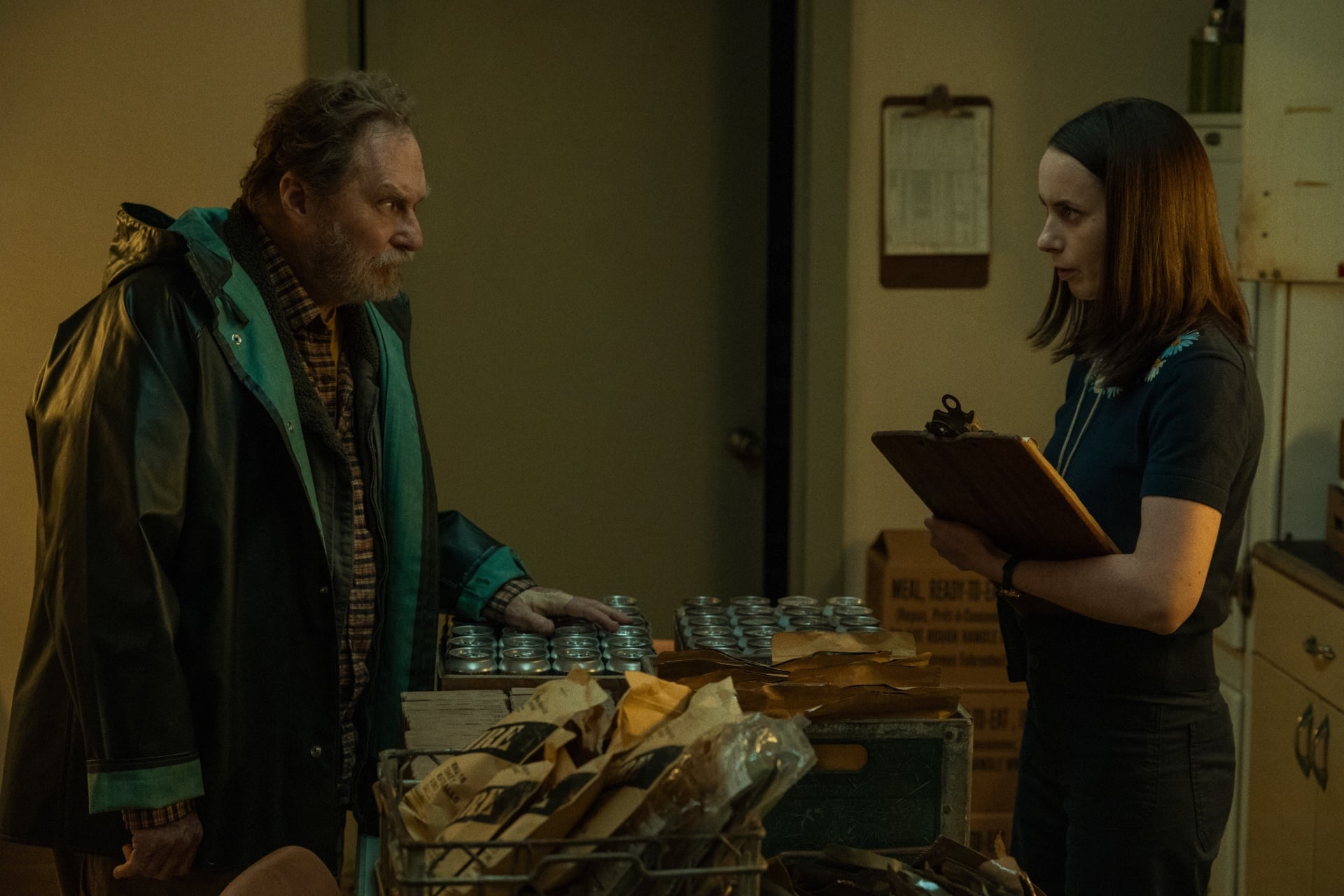
First, he checks Ruth’s medical records, hoping for something grim like cancer. No dice. There is a note about reminding her not to mix Oxycodone with Valium, which makes Tom pause for a moment.
Then, Tom drives through the thunder and rain to Ruth’s house. “You don’t have to do this,” Patricia pleads, her voice crackling over the radio. (In the background, Wyck chimes in: “Yes, you do!)
Tom’s response to Patricia is “Keep them in the shelter and keep an eye on my son.” We don’t know his plan—and neither does he—when he steps into Ruth’s house and finds her bopping along on her treadmill.
She’s surprised and delighted to see him. She assumes he’s driven over to escort her to the shelter. Thinking quickly, he points out that the roads are so flooded they should probably just stay put. She smiles and agrees, saying, “We’ve weathered storms together before, haven’t we?”
Back at the town hall, Patricia is rummaging through the emergency supplies stashed in the shelter. For an island so prone to disasters, they’re surprisingly ill-prepared. Rosemary, helpful as always, dryly recalls being warned never to go into this shelter by the “gal who had my job before me.” Ominous!
Wyck and Patricia agree that keeping everyone calm is their top priority. Just then, the lights flicker. Ominous!
In a private exam room, Dr. Morgan is humming Phantom of the Opera songs to himself as he checks over the very pregnant Chelle. “Probably a false alarm,” the doctor reassures her. To Bechir, however, he reveals the truth: “The baby’s coming tonight.” Bechir is horrified. If the baby’s born on the island, well—we know what that means.
At Ruth’s house, she’s blissfully unaware of any danger. Tom studies her calendar. It’s packed full of wholesome, do-gooder activities, including helping her neighbor up and down her porch steps every day. When she asks which flavor of tea he’d like, he inadvertently chooses the one that must steep for 27 minutes—unbearably long given the circumstances. The timer ticks, both literally and figuratively.
In the shelter, Patricia is handing out blankets when she finds an old note tucked into the folds: “If you can read this, I’m already dead.” OMINOUS! The people are quickly getting restless at the prospect of prolonged confinement, so she asks Dale to please find ways to distract everyone. Maybe there are some games tucked into one of the closets?
Bechir appears with an urgent question: where is Tom? Patricia pretends like she doesn’t know.
Elsewhere in the shelter, the teens are in search of mischief—including Evan, who swore up and down to Tom that he’d stay put. PJ has discovered a door that opens onto a shaft with a ladder built into it, very much like what we saw in Sarah Warren’s subterranean explorations in “Our History.”
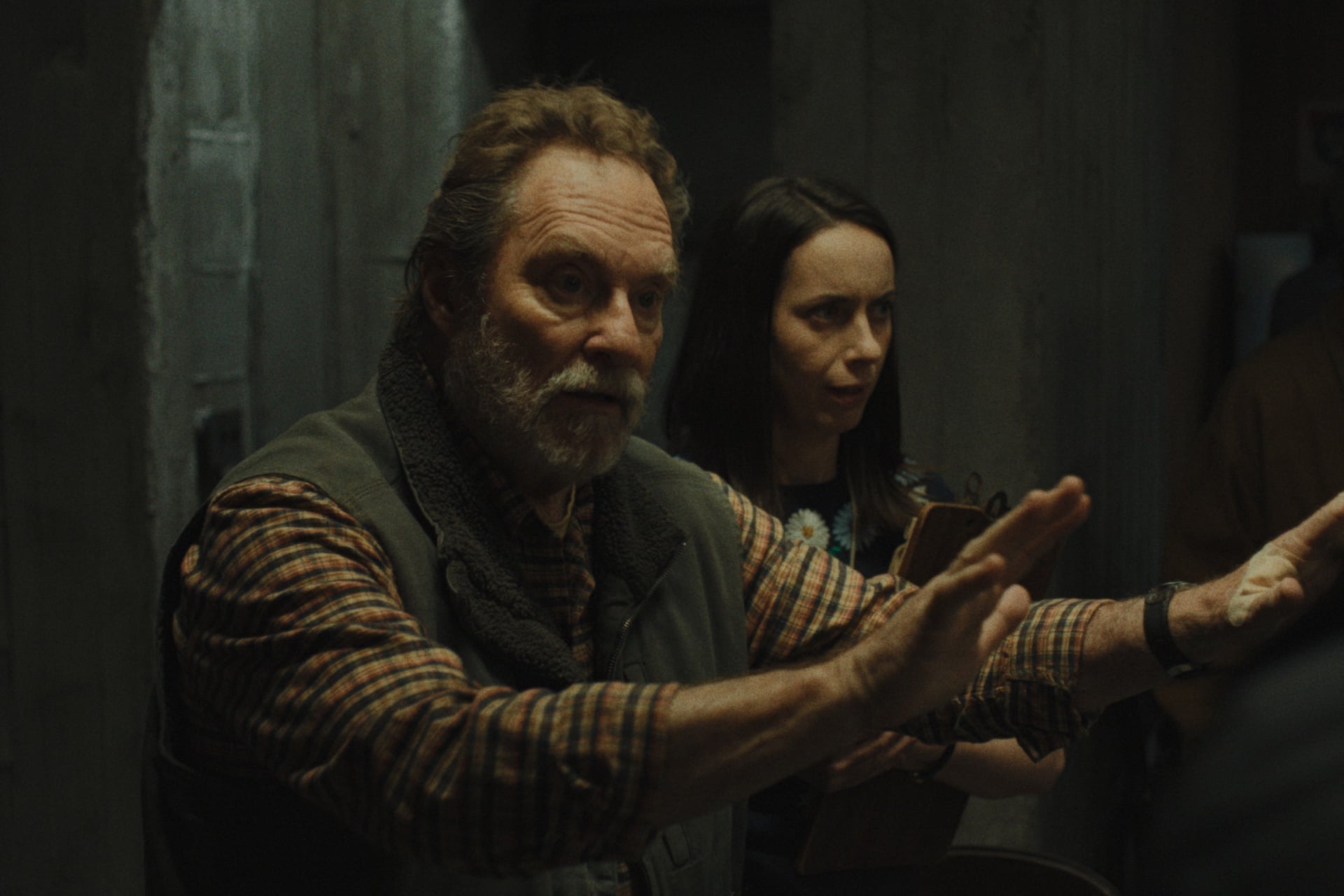
Meanwhile, Dale is dutifully looking for ways to distract the masses. In a side room—which has a gun rack with a “check and clear all weapons” sign behind it—he finds a stack of film reels and an old projector.
The first reel is labeled “FOR THEM.” Dale loads it up. A cheerful host appears: “So, you’re an offering.”
Oh dear. Oh no.
“You’ve been carefully selected by a committee of your peers in a very fair, very rigorous selection process.”
The man continues. “Take comfort in the fact that there is an absolutely unassailable reason you’re here. Accept your fate and take pride: your sacrifice will save countless members of our community from needless suffering … Widow’s Bay thanks you.”
While Dale tries to process what he’s just watched, and frankly so do we, we cut back to Ruth’s house. She shows Tom her photo album, and we get some insight into what it’s been like for her, spending 84 years living in Widow’s Bay.
There’s an old boyfriend who “got bit by an animal and became that animal.” (No further clarification, but now we’re very curious.) She talks about working with a previous mayor, “Howard the Coward,” who left Widow’s Bay because “people get scared.” She remembers all the men who made passes at her over the years. We see Ruth’s parents, and she sighs, “Something got Daddy in the lake.”
When Tom points out she’s been through a lot, she tells him, “One of the benefits of growing up in Widow’s Bay is that we learn to weather the storms.” She agrees with Tom that it shouldn’t have to be that way, but “There’s no way around it.”
That offers an opening for Tom to approach the awkward reason he’s come to Ruth’s house, though he doesn’t come right out with it, asking, “What if there was something that you could do to change things?”
He brings up the trolley problem—the classic thought experiment, not the literal ill-fated trolley that Widow’s Bay tried to build back in 1942. It’s exactly the dilemma Tom is dealing with: would you knowingly cause the death of one person if it meant you’d save many more in return?
She doesn’t give the response he expects: “If I pull that lever, it’s a choice, and I’m choosing to kill that person, and I could never do that.” With some classic Ruth difficulty, she reads a favorite Tennessee Williams quote: “We live in a perpetually burning building, and what we must save from it, all the time, is love.”
Then the conversation turns. Ruth tells Tom she’s always been worried about him because he avoids the truth. He wants Widow’s Bay to be like Martha’s Vineyard, but that will never happen: “There’s no bliss waiting at the finish line. Even if there was, it would just be taken from you because that’s just life.” Tom has no choice but to accept that, she says.
Just then, he notices a familiar-looking brooch sitting on her coffee table. A family heirloom, Ruth says; we remember it from “Our History” when Sarah gave it to her stepdaughter, Frances Warren. Frances had it on when she washed ashore, and it’s visible in her portrait with Barnabus, as we saw in “Emergency Shelter.”
The tea is finally ready. Tom slips some crushed-up pills he’s pilfered from Ruth’s medicine cabinet into her mug. She takes a sip.
At the shelter, conditions are getting worse. The people, already tense, have discovered the limitations of their food and water supply. Chelle tells Bechir she thinks this will all make for a funny story they tell their kid one day. She chuckles but then grimaces; her contractions are getting more intense.
Patricia and Rosemary bring over some water for Chelle. Bechir again asks where Tom is, and Rosemary grumbles that he made her do a whole genealogy on Ruth. (Actually, it was Wyck that asked her to do that, but no matter.) This gives the sheriff pause, and he again asks Patricia what the hell is going on. We don’t see her answer, but whatever she says is enough to make him rush back to Chelle and tell her he needs to go take care of something… but he’ll be right back.
At Ruth’s, the photo albums are still out, but she’s gotten very groggy. Tom, assuming Ruth is near the end, tells her that when Lauren died, he didn’t know what he was going to do. Lauren had tried to tell him about the island, but “I laughed it off,” he says with deep regret. “I don’t understand why I didn’t just listen.”
The fateful ferry ride is when he knew for sure. And yet, he says, “I still brought tourists here. Because I wanted more for him. And myself. And now I’ve put all these people in danger.”
He looks over at Ruth. “I’m sorry, but I had to make it right.” She’s motionless. But is she dead? Does it seem like the storm has gotten noticeably quieter outside?
Nope! She was merely asleep. When she snaps back awake, the thunder sounds with just as much fury as before.
Back at the shelter, or rather, under the shelter, Evan, PJ, and Kelly enter the tunnels that so terrified Sarah Warren. They find the room with the chair that we’ve seen both in Sarah’s time and earlier this season in the present day. Kelly playfully sits in the chair, but there’s a sinister vibe in the air.
In the shelter proper, the crowd is in full freak-out mode. Why can’t they leave? Why is the door locked? Why are the lights flickering? Why is there suddenly an eerie monotone voice coming over an unseen loudspeaker, announcing, “It’s time. It’s time. Listen to your facilitator. Move forward. Do not beg”?
Quite reasonably, someone yells, “What the fuck?” Rosemary, thinking back to that old co-worker’s warning, mutters to herself, “That’s probably what she meant.”
Meanwhile, Dale is watching another of the film reels. This one is marked “FOR YOU.” The host urges the viewer to “be strong. Honor the pact. And remember, their sacrifice is our survival. The bad times will not end until the covenant is honored, and honored fully. Life for life. The island will make its needs known: one soul for each bell toll.”
The shot cuts from the host over to a row of people in their underwear tied to the wall, their faces covered. A man, whose style of horn-rimmed glasses suggests it’s the 1960s or maybe the 1970s, consults a clipboard.
The instruction continues: “You will be tempted to comfort them. Do not. Their fear is necessary. They say it likes the taste. Now, let’s pray for a long and peaceful slumber.”
Dale’s jaw is on the floor, as is ours. In the larger room, the lights go out; Patricia (and her flashlight) does her best to reassure everybody. It seems to be working until Dale emerges and shrieks, “This place is a death trap… RUN!”
At this moment, Tom tries to check in. He’s desperate to know if Evan is OK. But the radio returns only static and screaming. His next move is to grab a pillow and move toward Ruth, who’s now snoring, but he can’t go through with it. “You’re a good person,” he murmurs. “You don’t deserve this.”
Her eyes open and she launches into a story about having an affair with a married man. Tom thinks it’s just another one of Ruth’s colorful tales, but it’s so much more. “I got pregnant,” she confesses, as the amused smile drops off Tom’s face.
At the time, Ruth wasn’t prepared to be a single mom. So she gave the child to its father, and he and his wife raised the baby as their own.
“I watched my baby girl grow up from afar,” she says. It doesn’t take long to get to the reveal: Ruth’s child was Lauren. Tom’s wife. Evan’s mom. Evan is the true last living descendent of Richard Warren.
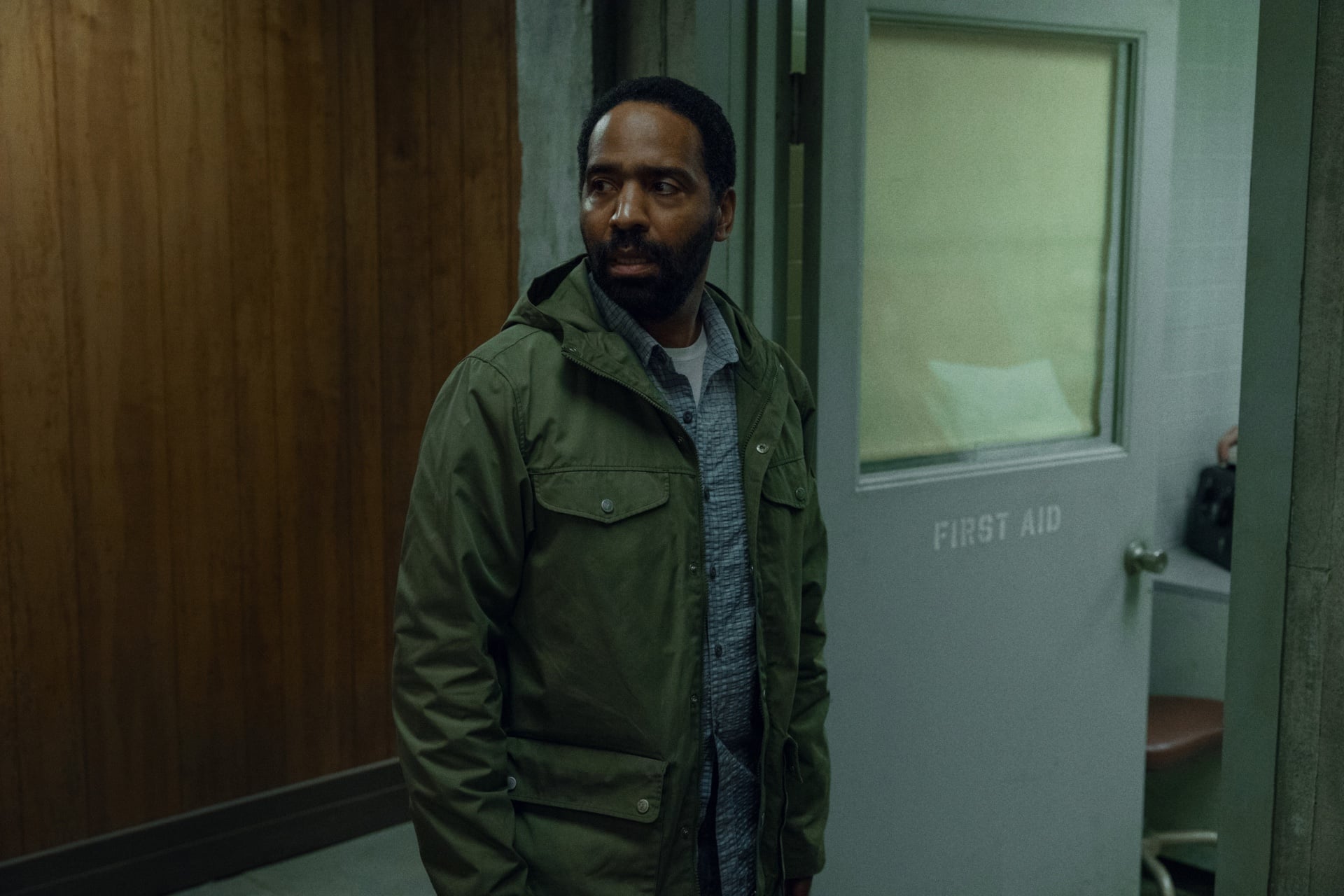
Ruth keeps talking. She’s still going to work with Tom every day because she wants to be a part of her grandson’s life. She’s relieved to finally come clean, but Tom starts freaking out about who else Ruth might have told. Just then, Bechir—another desperate father—bursts in and shoots her.
“She’s not the last descendent!” Tom screams. When he won’t say who the last descendent actually is, Bechir raises his gun again. Who is it?
“I don’t know,” Tom lies.
In the spooky room with the chair and the double doors, PJ and Kelly are still obnoxiously goofing around when Kenny the custodian suddenly appears and orders them to leave. PJ, a shithead, pulls the doors shut behind them, trapping Kenny inside.
Evan does his best to open them, but they’re locked tight. He hears Kenny cry out, “Something’s happening!” and scream in terror… and then suddenly fall silent.
At Ruth’s house, Bechir is fully prepared to blast an uncooperative Tom when the storm suddenly stops. Ruth, who’s wounded and bleeding, comes to.
In the shelter, the lights flicker back on, and the people cautiously emerge. “He must’ve done it,” Patricia says softly to Wyck.
When the lock disengages in the chair room, Evan, who’s still in the tunnel outside, peers in. It’s empty. Kenny is gone. The only way out would be through those sinister double doors.
Then, it’s the morning. The weather is calm and peaceful, but we can see there’s been significant storm damage across the island. Tom stands at the edge of the water with Sarah Warren’s brooch in his hand, which he flings into the sea, in a sort of Titanic gesture.
Evan watches him from the car, and they exchange small smiles. As Tom walks back, we hear the church bells tolling.
Eight times. “One soul for each bell toll.”
If you count up everyone who died in season one, it totals eight: Shep the sailor (the fog got him). Reverend Bryce (suicide). Richard Warren (crumbled into dust at sea). The paramedic (Boogeyman got him). The convenience store clerk (ditto). The Boogeyman himself (Patricia, bless her). Todd the shaman (tornado).
And, of course, poor Kenny, who met his end in the room utilized by previous generations to offer up their human sacrifices.
But if you go back to episode two, “Your Lodging,” you will recall the church bells rang nine times. Does that mean the only death this season that counts as a sacrifice is Kenny—and there are eight more left to go?
So, what happens next? More deaths? Or does the island take a “long and peaceful slumber” before waking up famished yet again? How much of the truth will Tom tell Evan, after all that’s happened? Will the Widow’s Bay tourism industry recover? Should it even try?
Guess we’ll have to wait until season two to find out! You can stream all of Widow’s Bay season one on Apple TV now.
It has unique characters, and that goes for its core cast as well as the supporting players—not to mention the weirdos who wander in to make a big impression in one or two scenes. Its setting is undeniably strange yet also cozy and familiar, a quaint New England town that has nearly every worst-case scenario and disaster you can imagine woven into its history.
The only thing we didn’t like about the season finale (which is fittingly titled “We Hope You Enjoyed Your Time!” and runs 48 minutes, a stretch longer than the usual episode length) is its arrival means we won’t be getting our weekly dose of Widow’s Bay anymore. However, we will begin counting down immediately to season two, which is thankfully officially on the way.
Last week’s episode, “Emergency Shelter,” ended with the big reveal that Ruth—the sweet but scatter-brained elderly woman who works as Tom’s assistant—is the last living descendant of Richard Warren. Wyck, Patricia, and Tom grappled with the unpleasant realization that once Ruth’s gone, the curse will end.
Wyck thought murder was justified given the circumstances; Patricia was horrified by the idea. But Tom made it clear he would handle it—and in the Widow’s Bay finale, we see him agonize about what to do as an apocalyptic storm rages across the island.
First, he checks Ruth’s medical records, hoping for something grim like cancer. No dice. There is a note about reminding her not to mix Oxycodone with Valium, which makes Tom pause for a moment.
Then, Tom drives through the thunder and rain to Ruth’s house. “You don’t have to do this,” Patricia pleads, her voice crackling over the radio. (In the background, Wyck chimes in: “Yes, you do!)
Tom’s response to Patricia is “Keep them in the shelter and keep an eye on my son.” We don’t know his plan—and neither does he—when he steps into Ruth’s house and finds her bopping along on her treadmill.
She’s surprised and delighted to see him. She assumes he’s driven over to escort her to the shelter. Thinking quickly, he points out that the roads are so flooded they should probably just stay put. She smiles and agrees, saying, “We’ve weathered storms together before, haven’t we?”
Back at the town hall, Patricia is rummaging through the emergency supplies stashed in the shelter. For an island so prone to disasters, they’re surprisingly ill-prepared. Rosemary, helpful as always, dryly recalls being warned never to go into this shelter by the “gal who had my job before me.” Ominous!
Wyck and Patricia agree that keeping everyone calm is their top priority. Just then, the lights flicker. Ominous!
In a private exam room, Dr. Morgan is humming Phantom of the Opera songs to himself as he checks over the very pregnant Chelle. “Probably a false alarm,” the doctor reassures her. To Bechir, however, he reveals the truth: “The baby’s coming tonight.” Bechir is horrified. If the baby’s born on the island, well—we know what that means.
At Ruth’s house, she’s blissfully unaware of any danger. Tom studies her calendar. It’s packed full of wholesome, do-gooder activities, including helping her neighbor up and down her porch steps every day. When she asks which flavor of tea he’d like, he inadvertently chooses the one that must steep for 27 minutes—unbearably long given the circumstances. The timer ticks, both literally and figuratively.
In the shelter, Patricia is handing out blankets when she finds an old note tucked into the folds: “If you can read this, I’m already dead.” OMINOUS! The people are quickly getting restless at the prospect of prolonged confinement, so she asks Dale to please find ways to distract everyone. Maybe there are some games tucked into one of the closets?
Bechir appears with an urgent question: where is Tom? Patricia pretends like she doesn’t know.
Elsewhere in the shelter, the teens are in search of mischief—including Evan, who swore up and down to Tom that he’d stay put. PJ has discovered a door that opens onto a shaft with a ladder built into it, very much like what we saw in Sarah Warren’s subterranean explorations in “Our History.”
Meanwhile, Dale is dutifully looking for ways to distract the masses. In a side room—which has a gun rack with a “check and clear all weapons” sign behind it—he finds a stack of film reels and an old projector.
The first reel is labeled “FOR THEM.” Dale loads it up. A cheerful host appears: “So, you’re an offering.”
Oh dear. Oh no.
“You’ve been carefully selected by a committee of your peers in a very fair, very rigorous selection process.”
The man continues. “Take comfort in the fact that there is an absolutely unassailable reason you’re here. Accept your fate and take pride: your sacrifice will save countless members of our community from needless suffering … Widow’s Bay thanks you.”
While Dale tries to process what he’s just watched, and frankly so do we, we cut back to Ruth’s house. She shows Tom her photo album, and we get some insight into what it’s been like for her, spending 84 years living in Widow’s Bay.
There’s an old boyfriend who “got bit by an animal and became that animal.” (No further clarification, but now we’re very curious.) She talks about working with a previous mayor, “Howard the Coward,” who left Widow’s Bay because “people get scared.” She remembers all the men who made passes at her over the years. We see Ruth’s parents, and she sighs, “Something got Daddy in the lake.”
When Tom points out she’s been through a lot, she tells him, “One of the benefits of growing up in Widow’s Bay is that we learn to weather the storms.” She agrees with Tom that it shouldn’t have to be that way, but “There’s no way around it.”
That offers an opening for Tom to approach the awkward reason he’s come to Ruth’s house, though he doesn’t come right out with it, asking, “What if there was something that you could do to change things?”
He brings up the trolley problem—the classic thought experiment, not the literal ill-fated trolley that Widow’s Bay tried to build back in 1942. It’s exactly the dilemma Tom is dealing with: would you knowingly cause the death of one person if it meant you’d save many more in return?
She doesn’t give the response he expects: “If I pull that lever, it’s a choice, and I’m choosing to kill that person, and I could never do that.” With some classic Ruth difficulty, she reads a favorite Tennessee Williams quote: “We live in a perpetually burning building, and what we must save from it, all the time, is love.”
Then the conversation turns. Ruth tells Tom she’s always been worried about him because he avoids the truth. He wants Widow’s Bay to be like Martha’s Vineyard, but that will never happen: “There’s no bliss waiting at the finish line. Even if there was, it would just be taken from you because that’s just life.” Tom has no choice but to accept that, she says.
Just then, he notices a familiar-looking brooch sitting on her coffee table. A family heirloom, Ruth says; we remember it from “Our History” when Sarah gave it to her stepdaughter, Frances Warren. Frances had it on when she washed ashore, and it’s visible in her portrait with Barnabus, as we saw in “Emergency Shelter.”
The tea is finally ready. Tom slips some crushed-up pills he’s pilfered from Ruth’s medicine cabinet into her mug. She takes a sip.
At the shelter, conditions are getting worse. The people, already tense, have discovered the limitations of their food and water supply. Chelle tells Bechir she thinks this will all make for a funny story they tell their kid one day. She chuckles but then grimaces; her contractions are getting more intense.
Patricia and Rosemary bring over some water for Chelle. Bechir again asks where Tom is, and Rosemary grumbles that he made her do a whole genealogy on Ruth. (Actually, it was Wyck that asked her to do that, but no matter.) This gives the sheriff pause, and he again asks Patricia what the hell is going on. We don’t see her answer, but whatever she says is enough to make him rush back to Chelle and tell her he needs to go take care of something… but he’ll be right back.
At Ruth’s, the photo albums are still out, but she’s gotten very groggy. Tom, assuming Ruth is near the end, tells her that when Lauren died, he didn’t know what he was going to do. Lauren had tried to tell him about the island, but “I laughed it off,” he says with deep regret. “I don’t understand why I didn’t just listen.”
The fateful ferry ride is when he knew for sure. And yet, he says, “I still brought tourists here. Because I wanted more for him. And myself. And now I’ve put all these people in danger.”
He looks over at Ruth. “I’m sorry, but I had to make it right.” She’s motionless. But is she dead? Does it seem like the storm has gotten noticeably quieter outside?
Nope! She was merely asleep. When she snaps back awake, the thunder sounds with just as much fury as before.
Back at the shelter, or rather, under the shelter, Evan, PJ, and Kelly enter the tunnels that so terrified Sarah Warren. They find the room with the chair that we’ve seen both in Sarah’s time and earlier this season in the present day. Kelly playfully sits in the chair, but there’s a sinister vibe in the air.
In the shelter proper, the crowd is in full freak-out mode. Why can’t they leave? Why is the door locked? Why are the lights flickering? Why is there suddenly an eerie monotone voice coming over an unseen loudspeaker, announcing, “It’s time. It’s time. Listen to your facilitator. Move forward. Do not beg”?
Quite reasonably, someone yells, “What the fuck?” Rosemary, thinking back to that old co-worker’s warning, mutters to herself, “That’s probably what she meant.”
Meanwhile, Dale is watching another of the film reels. This one is marked “FOR YOU.” The host urges the viewer to “be strong. Honor the pact. And remember, their sacrifice is our survival. The bad times will not end until the covenant is honored, and honored fully. Life for life. The island will make its needs known: one soul for each bell toll.”
The shot cuts from the host over to a row of people in their underwear tied to the wall, their faces covered. A man, whose style of horn-rimmed glasses suggests it’s the 1960s or maybe the 1970s, consults a clipboard.
The instruction continues: “You will be tempted to comfort them. Do not. Their fear is necessary. They say it likes the taste. Now, let’s pray for a long and peaceful slumber.”
Dale’s jaw is on the floor, as is ours. In the larger room, the lights go out; Patricia (and her flashlight) does her best to reassure everybody. It seems to be working until Dale emerges and shrieks, “This place is a death trap… RUN!”
At this moment, Tom tries to check in. He’s desperate to know if Evan is OK. But the radio returns only static and screaming. His next move is to grab a pillow and move toward Ruth, who’s now snoring, but he can’t go through with it. “You’re a good person,” he murmurs. “You don’t deserve this.”
Her eyes open and she launches into a story about having an affair with a married man. Tom thinks it’s just another one of Ruth’s colorful tales, but it’s so much more. “I got pregnant,” she confesses, as the amused smile drops off Tom’s face.
At the time, Ruth wasn’t prepared to be a single mom. So she gave the child to its father, and he and his wife raised the baby as their own.
“I watched my baby girl grow up from afar,” she says. It doesn’t take long to get to the reveal: Ruth’s child was Lauren. Tom’s wife. Evan’s mom. Evan is the true last living descendent of Richard Warren.
Ruth keeps talking. She’s still going to work with Tom every day because she wants to be a part of her grandson’s life. She’s relieved to finally come clean, but Tom starts freaking out about who else Ruth might have told. Just then, Bechir—another desperate father—bursts in and shoots her.
“She’s not the last descendent!” Tom screams. When he won’t say who the last descendent actually is, Bechir raises his gun again. Who is it?
“I don’t know,” Tom lies.
In the spooky room with the chair and the double doors, PJ and Kelly are still obnoxiously goofing around when Kenny the custodian suddenly appears and orders them to leave. PJ, a shithead, pulls the doors shut behind them, trapping Kenny inside.
Evan does his best to open them, but they’re locked tight. He hears Kenny cry out, “Something’s happening!” and scream in terror… and then suddenly fall silent.
At Ruth’s house, Bechir is fully prepared to blast an uncooperative Tom when the storm suddenly stops. Ruth, who’s wounded and bleeding, comes to.
In the shelter, the lights flicker back on, and the people cautiously emerge. “He must’ve done it,” Patricia says softly to Wyck.
When the lock disengages in the chair room, Evan, who’s still in the tunnel outside, peers in. It’s empty. Kenny is gone. The only way out would be through those sinister double doors.
Then, it’s the morning. The weather is calm and peaceful, but we can see there’s been significant storm damage across the island. Tom stands at the edge of the water with Sarah Warren’s brooch in his hand, which he flings into the sea, in a sort of Titanic gesture.
Evan watches him from the car, and they exchange small smiles. As Tom walks back, we hear the church bells tolling.
Eight times. “One soul for each bell toll.”
If you count up everyone who died in season one, it totals eight: Shep the sailor (the fog got him). Reverend Bryce (suicide). Richard Warren (crumbled into dust at sea). The paramedic (Boogeyman got him). The convenience store clerk (ditto). The Boogeyman himself (Patricia, bless her). Todd the shaman (tornado).
And, of course, poor Kenny, who met his end in the room utilized by previous generations to offer up their human sacrifices.
But if you go back to episode two, “Your Lodging,” you will recall the church bells rang nine times. Does that mean the only death this season that counts as a sacrifice is Kenny—and there are eight more left to go?
So, what happens next? More deaths? Or does the island take a “long and peaceful slumber” before waking up famished yet again? How much of the truth will Tom tell Evan, after all that’s happened? Will the Widow’s Bay tourism industry recover? Should it even try?
Guess we’ll have to wait until season two to find out! You can stream all of Widow’s Bay season one on Apple TV now.
#Widows #Bay #Ends #Surge #Delightful #DreadApple TV,TV Recap,Widow’s Bay">‘Widow’s Bay’ Ends With One Last Surge of Delightful Dread
Widow’s Bay arrived on Apple TV with minimal fanfare and soon established itself as a show unique not just to the streamer, but across the television landscape. Katie Dippold‘s horror comedy fully delivers on both of those descriptors, being genuinely scary and genuinely hilarious.
It has unique characters, and that goes for its core cast as well as the supporting players—not to mention the weirdos who wander in to make a big impression in one or two scenes. Its setting is undeniably strange yet also cozy and familiar, a quaint New England town that has nearly every worst-case scenario and disaster you can imagine woven into its history.
The only thing we didn’t like about the season finale (which is fittingly titled “We Hope You Enjoyed Your Time!” and runs 48 minutes, a stretch longer than the usual episode length) is its arrival means we won’t be getting our weekly dose of Widow’s Bay anymore. However, we will begin counting down immediately to season two, which is thankfully officially on the way.
Last week’s episode, “Emergency Shelter,” ended with the big reveal that Ruth—the sweet but scatter-brained elderly woman who works as Tom’s assistant—is the last living descendant of Richard Warren. Wyck, Patricia, and Tom grappled with the unpleasant realization that once Ruth’s gone, the curse will end.
Wyck thought murder was justified given the circumstances; Patricia was horrified by the idea. But Tom made it clear he would handle it—and in the Widow’s Bay finale, we see him agonize about what to do as an apocalyptic storm rages across the island.
First, he checks Ruth’s medical records, hoping for something grim like cancer. No dice. There is a note about reminding her not to mix Oxycodone with Valium, which makes Tom pause for a moment.
Then, Tom drives through the thunder and rain to Ruth’s house. “You don’t have to do this,” Patricia pleads, her voice crackling over the radio. (In the background, Wyck chimes in: “Yes, you do!)
Tom’s response to Patricia is “Keep them in the shelter and keep an eye on my son.” We don’t know his plan—and neither does he—when he steps into Ruth’s house and finds her bopping along on her treadmill.
She’s surprised and delighted to see him. She assumes he’s driven over to escort her to the shelter. Thinking quickly, he points out that the roads are so flooded they should probably just stay put. She smiles and agrees, saying, “We’ve weathered storms together before, haven’t we?”
Back at the town hall, Patricia is rummaging through the emergency supplies stashed in the shelter. For an island so prone to disasters, they’re surprisingly ill-prepared. Rosemary, helpful as always, dryly recalls being warned never to go into this shelter by the “gal who had my job before me.” Ominous!
Wyck and Patricia agree that keeping everyone calm is their top priority. Just then, the lights flicker. Ominous!
In a private exam room, Dr. Morgan is humming Phantom of the Opera songs to himself as he checks over the very pregnant Chelle. “Probably a false alarm,” the doctor reassures her. To Bechir, however, he reveals the truth: “The baby’s coming tonight.” Bechir is horrified. If the baby’s born on the island, well—we know what that means.
At Ruth’s house, she’s blissfully unaware of any danger. Tom studies her calendar. It’s packed full of wholesome, do-gooder activities, including helping her neighbor up and down her porch steps every day. When she asks which flavor of tea he’d like, he inadvertently chooses the one that must steep for 27 minutes—unbearably long given the circumstances. The timer ticks, both literally and figuratively.
In the shelter, Patricia is handing out blankets when she finds an old note tucked into the folds: “If you can read this, I’m already dead.” OMINOUS! The people are quickly getting restless at the prospect of prolonged confinement, so she asks Dale to please find ways to distract everyone. Maybe there are some games tucked into one of the closets?
Bechir appears with an urgent question: where is Tom? Patricia pretends like she doesn’t know.
Elsewhere in the shelter, the teens are in search of mischief—including Evan, who swore up and down to Tom that he’d stay put. PJ has discovered a door that opens onto a shaft with a ladder built into it, very much like what we saw in Sarah Warren’s subterranean explorations in “Our History.”
Meanwhile, Dale is dutifully looking for ways to distract the masses. In a side room—which has a gun rack with a “check and clear all weapons” sign behind it—he finds a stack of film reels and an old projector.
The first reel is labeled “FOR THEM.” Dale loads it up. A cheerful host appears: “So, you’re an offering.”
Oh dear. Oh no.
“You’ve been carefully selected by a committee of your peers in a very fair, very rigorous selection process.”
The man continues. “Take comfort in the fact that there is an absolutely unassailable reason you’re here. Accept your fate and take pride: your sacrifice will save countless members of our community from needless suffering … Widow’s Bay thanks you.”
While Dale tries to process what he’s just watched, and frankly so do we, we cut back to Ruth’s house. She shows Tom her photo album, and we get some insight into what it’s been like for her, spending 84 years living in Widow’s Bay.
There’s an old boyfriend who “got bit by an animal and became that animal.” (No further clarification, but now we’re very curious.) She talks about working with a previous mayor, “Howard the Coward,” who left Widow’s Bay because “people get scared.” She remembers all the men who made passes at her over the years. We see Ruth’s parents, and she sighs, “Something got Daddy in the lake.”
When Tom points out she’s been through a lot, she tells him, “One of the benefits of growing up in Widow’s Bay is that we learn to weather the storms.” She agrees with Tom that it shouldn’t have to be that way, but “There’s no way around it.”
That offers an opening for Tom to approach the awkward reason he’s come to Ruth’s house, though he doesn’t come right out with it, asking, “What if there was something that you could do to change things?”
He brings up the trolley problem—the classic thought experiment, not the literal ill-fated trolley that Widow’s Bay tried to build back in 1942. It’s exactly the dilemma Tom is dealing with: would you knowingly cause the death of one person if it meant you’d save many more in return?
She doesn’t give the response he expects: “If I pull that lever, it’s a choice, and I’m choosing to kill that person, and I could never do that.” With some classic Ruth difficulty, she reads a favorite Tennessee Williams quote: “We live in a perpetually burning building, and what we must save from it, all the time, is love.”
Then the conversation turns. Ruth tells Tom she’s always been worried about him because he avoids the truth. He wants Widow’s Bay to be like Martha’s Vineyard, but that will never happen: “There’s no bliss waiting at the finish line. Even if there was, it would just be taken from you because that’s just life.” Tom has no choice but to accept that, she says.
Just then, he notices a familiar-looking brooch sitting on her coffee table. A family heirloom, Ruth says; we remember it from “Our History” when Sarah gave it to her stepdaughter, Frances Warren. Frances had it on when she washed ashore, and it’s visible in her portrait with Barnabus, as we saw in “Emergency Shelter.”
The tea is finally ready. Tom slips some crushed-up pills he’s pilfered from Ruth’s medicine cabinet into her mug. She takes a sip.
At the shelter, conditions are getting worse. The people, already tense, have discovered the limitations of their food and water supply. Chelle tells Bechir she thinks this will all make for a funny story they tell their kid one day. She chuckles but then grimaces; her contractions are getting more intense.
Patricia and Rosemary bring over some water for Chelle. Bechir again asks where Tom is, and Rosemary grumbles that he made her do a whole genealogy on Ruth. (Actually, it was Wyck that asked her to do that, but no matter.) This gives the sheriff pause, and he again asks Patricia what the hell is going on. We don’t see her answer, but whatever she says is enough to make him rush back to Chelle and tell her he needs to go take care of something… but he’ll be right back.
At Ruth’s, the photo albums are still out, but she’s gotten very groggy. Tom, assuming Ruth is near the end, tells her that when Lauren died, he didn’t know what he was going to do. Lauren had tried to tell him about the island, but “I laughed it off,” he says with deep regret. “I don’t understand why I didn’t just listen.”
The fateful ferry ride is when he knew for sure. And yet, he says, “I still brought tourists here. Because I wanted more for him. And myself. And now I’ve put all these people in danger.”
He looks over at Ruth. “I’m sorry, but I had to make it right.” She’s motionless. But is she dead? Does it seem like the storm has gotten noticeably quieter outside?
Nope! She was merely asleep. When she snaps back awake, the thunder sounds with just as much fury as before.
Back at the shelter, or rather, under the shelter, Evan, PJ, and Kelly enter the tunnels that so terrified Sarah Warren. They find the room with the chair that we’ve seen both in Sarah’s time and earlier this season in the present day. Kelly playfully sits in the chair, but there’s a sinister vibe in the air.
In the shelter proper, the crowd is in full freak-out mode. Why can’t they leave? Why is the door locked? Why are the lights flickering? Why is there suddenly an eerie monotone voice coming over an unseen loudspeaker, announcing, “It’s time. It’s time. Listen to your facilitator. Move forward. Do not beg”?
Quite reasonably, someone yells, “What the fuck?” Rosemary, thinking back to that old co-worker’s warning, mutters to herself, “That’s probably what she meant.”
Meanwhile, Dale is watching another of the film reels. This one is marked “FOR YOU.” The host urges the viewer to “be strong. Honor the pact. And remember, their sacrifice is our survival. The bad times will not end until the covenant is honored, and honored fully. Life for life. The island will make its needs known: one soul for each bell toll.”
The shot cuts from the host over to a row of people in their underwear tied to the wall, their faces covered. A man, whose style of horn-rimmed glasses suggests it’s the 1960s or maybe the 1970s, consults a clipboard.
The instruction continues: “You will be tempted to comfort them. Do not. Their fear is necessary. They say it likes the taste. Now, let’s pray for a long and peaceful slumber.”
Dale’s jaw is on the floor, as is ours. In the larger room, the lights go out; Patricia (and her flashlight) does her best to reassure everybody. It seems to be working until Dale emerges and shrieks, “This place is a death trap… RUN!”
At this moment, Tom tries to check in. He’s desperate to know if Evan is OK. But the radio returns only static and screaming. His next move is to grab a pillow and move toward Ruth, who’s now snoring, but he can’t go through with it. “You’re a good person,” he murmurs. “You don’t deserve this.”
Her eyes open and she launches into a story about having an affair with a married man. Tom thinks it’s just another one of Ruth’s colorful tales, but it’s so much more. “I got pregnant,” she confesses, as the amused smile drops off Tom’s face.
At the time, Ruth wasn’t prepared to be a single mom. So she gave the child to its father, and he and his wife raised the baby as their own.
“I watched my baby girl grow up from afar,” she says. It doesn’t take long to get to the reveal: Ruth’s child was Lauren. Tom’s wife. Evan’s mom. Evan is the true last living descendent of Richard Warren.
Ruth keeps talking. She’s still going to work with Tom every day because she wants to be a part of her grandson’s life. She’s relieved to finally come clean, but Tom starts freaking out about who else Ruth might have told. Just then, Bechir—another desperate father—bursts in and shoots her.
“She’s not the last descendent!” Tom screams. When he won’t say who the last descendent actually is, Bechir raises his gun again. Who is it?
“I don’t know,” Tom lies.
In the spooky room with the chair and the double doors, PJ and Kelly are still obnoxiously goofing around when Kenny the custodian suddenly appears and orders them to leave. PJ, a shithead, pulls the doors shut behind them, trapping Kenny inside.
Evan does his best to open them, but they’re locked tight. He hears Kenny cry out, “Something’s happening!” and scream in terror… and then suddenly fall silent.
At Ruth’s house, Bechir is fully prepared to blast an uncooperative Tom when the storm suddenly stops. Ruth, who’s wounded and bleeding, comes to.
In the shelter, the lights flicker back on, and the people cautiously emerge. “He must’ve done it,” Patricia says softly to Wyck.
When the lock disengages in the chair room, Evan, who’s still in the tunnel outside, peers in. It’s empty. Kenny is gone. The only way out would be through those sinister double doors.
Then, it’s the morning. The weather is calm and peaceful, but we can see there’s been significant storm damage across the island. Tom stands at the edge of the water with Sarah Warren’s brooch in his hand, which he flings into the sea, in a sort of Titanic gesture.
Evan watches him from the car, and they exchange small smiles. As Tom walks back, we hear the church bells tolling.
Eight times. “One soul for each bell toll.”
If you count up everyone who died in season one, it totals eight: Shep the sailor (the fog got him). Reverend Bryce (suicide). Richard Warren (crumbled into dust at sea). The paramedic (Boogeyman got him). The convenience store clerk (ditto). The Boogeyman himself (Patricia, bless her). Todd the shaman (tornado).
And, of course, poor Kenny, who met his end in the room utilized by previous generations to offer up their human sacrifices.
But if you go back to episode two, “Your Lodging,” you will recall the church bells rang nine times. Does that mean the only death this season that counts as a sacrifice is Kenny—and there are eight more left to go?
So, what happens next? More deaths? Or does the island take a “long and peaceful slumber” before waking up famished yet again? How much of the truth will Tom tell Evan, after all that’s happened? Will the Widow’s Bay tourism industry recover? Should it even try?
Guess we’ll have to wait until season two to find out! You can stream all of Widow’s Bay season one on Apple TV now.






Post Comment