×
Girls in Kenya Are Repurposing the Invasive Mathenge Tree Into Furniture

Girls in Kenya Are Repurposing the Invasive Mathenge Tree Into Furniture

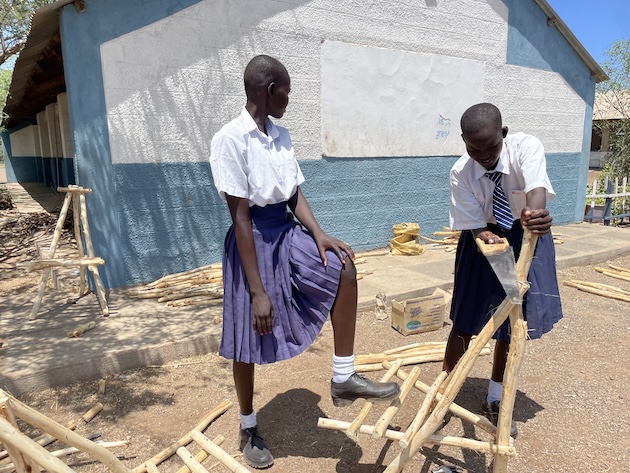
Magdalene Ngimoe and Char Tito, learners at Kakuma Arid Zone Secondary School, making chairs from mathenge wood. Credit: Farai Shawn Matiashe/IPS
  • by Farai Shawn Matiashe (kakuma, kenya)
  • Inter Press Service

KAKUMA, Kenya, Jun 06 (IPS) – Char Tito is hammering nails into wood at Kakuma Arid Zone Secondary School in Turkana County, northern Kenya. The 16-year-old is making a traditional chair under the scorching sun outside one of the classroom blocks.

The wood she is using is from an unpopular source in this community. It is from a species of mesquite named Prosopis juliflora, which is native to Central and South America and is known in Kenya as mathenge.

Many locals hate mathenge in Turkana County due to its invasiveness and its thorns that are harsh to humans and can cause injuries to livestock. Locals say rivers and dams dry fast in areas with mathenge, and it dominates other plants.

Over the years, the residents have found it an easy source of firewood and charcoal, fuel for many in this community.

But youths, including girls, are now repurposing the mathenge tree to make furniture, particularly chairs.

“Plastic chairs are expensive. This is why I started making chairs from mathenge earlier this month,” says Tito, who fled the war in South Sudan to seek refuge in Kakuma Refugee Camp in 2017.

“I was taught here at school. Mathenge is abundant. We have been using it for firewood for years. I did not know that it could be used to make chairs.”

Income-Generating Scheme

The land in Kakuma is barren with sparse vegetation and the soils are so poor that they do not support agriculture. Turkana County receives little or no rain and can go for five years without experiencing a single drop of rain.

Acacia trees and mathenge, which are always green despite the high temperatures and water scarcity, make up most of the trees in this community.

Government statistics indicate that the mathenge trees spread at a rate of 15 percent yearly and have so far colonized a million acres of land in Kenya.

Some use mathenge to fence their homes and to make livestock shelters.

Locals survive on livestock production and trading charcoal and firewood.

Dennis Mutiso, a deputy director at Girl Child Network (GCN), a grassroots non-governmental organization supporting Tito and hundreds of other refugees, says the project is equipping learners with green skills.

“It is contributing to national climate plans. It aligns with the school curriculum,” he says.

Mutiso says those youths who have been trained in making chairs partner with those untrained to pass the knowledge to the community.

Tito, who lives with her mother and her three siblings, is so far making chairs for household use but is planning to make some for sale to her neighbors.

“This is a skill that I can use for my entire life. I am looking forward to earning a living out of carpentry,” she says, smiling.

Mathenge was introduced in the 1970s in the East African country to restore degraded dry lands. It is drought resistant, with its deep roots making it ideal for afforestation in areas like Turkana. The mathenge restored the area and blocked wind erosion in some areas, but at a cost to the locals.

Despite the massive cutting down of this tree for firewood and charcoal, the mathenge regenerates fast, unlike other trees like Acacia.

Lewis Obam, a conservator at the Forestry Commission under Turkana County, says there was a negative perception of the mathenge in the community.

“Communities lost their goats after consuming the tree. Its thorns were affecting the community,” he says.

Obam says mathenge is a colonizer and spreads so fast.

“It was meant to counter desertification. The intention was good,” he says.

Obam says its hardwood is ideal for making chairs.

“It has more opportunities than we knew. It has the second hardest wood in this area. We need maximum use of the mathenge.”

Protecting Environment 

To restore other trees in this semi-arid land, Tito and other girls are planting trees at school and in their homes. She has planted five trees at home and many at school, but water is a challenge amid temperatures that can go as high as 47 degrees Celsius.

“I am proud that I am contributing to measures that reduce the effects of climate change,” she says.

Sometimes, the girls bring water from home to school to ensure that the trees survive.

Trees help mitigate climate change by absorbing carbon dioxide from the atmosphere.

Kenya is targeting to plant at least 15 billion trees by 2032 through its National Tree Growing Restoration campaign launched in December 2022.

Magdalene Ngimoe, another learner at Kakuma Arid Zone Secondary School, says she has so far planted two trees at her home in Kiwandege village in Kakuma.

“I hate mathenge. It makes our lives difficult. But I am happy that I am using it to make chairs. I am also planting trees at school, which will provide shade to other students,” says the 16-year-old Kenyan Ngimoe, the firstborn in a family of seven.

Her family survives on selling meat and she hopes she will earn some money from her newly acquired craft.

Edwin Chabari, a manager at Kakuma Refugee Camp under the Department of Refugee Services, says Mathenge has been a menace not only within the camp but also in the area.

“The local youths can get cash from a tree that we thought was a menace,” he says.

GCN, with funding from Education Above All, a global education foundation based in Qatar, has so far planted 896,000 trees in Kakuma and Dadaab and is targeting 2.4 million trees by next year.

Ngimoe’s favorite subject is science and she wants to be a lawyer representing vulnerable children.

Established in 1992, Kakuma Refugee Camp is home to 304,000 people from more than 10 countries, like South Sudan, Burundi, Somalia, and the Democratic Republic of Congo (DRC).

Joseph Ochura, sub-county director in Turkana County under the Teachers Service Commission (TSC), says the tree-planting initiative has enhanced the learning environment.

“When you visit most of the schools that have been supported, you will see big shades of trees. Whenever there is a break time, learners sit there, including the teachers. Sometimes, some lessons are even carried out under that shade,” Ochura says.

He says that of the 15 billion trees set by the government, TSC was allocated 200 million trees.

Some schools also have their tree nurseries.

When ready, they plant the seedlings at the school and supply others to the community.

“Some of the girls are at the forefront in tree planting. That is a plus. That is what we are telling the girls—outside school, you can still do this in the community,” Ochura says.

Tito, whose favorite subject is English and who wants to be a doctor, is happy to be part of the green jobs being created in Kakuma.

“As a girl, I am proud of myself. I am contributing to environmental protection,” she says.
IPS UN Bureau Report

Follow @IPSNewsUNBureau
Follow IPS News UN Bureau on Instagram

© Inter Press Service (2025) — All Rights Reserved. Original source: Inter Press Service


Source link
#Girls #Kenya #Repurposing #Invasive #Mathenge #Tree #Furniture

京都 南丹 子どもとみられる遺体が見つかる | NHKニュース捜査関係者によりますと、京都府南丹市で13日、子どもとみられる遺体が見つかったということです。南丹市では先月23日から小学生の安達結希さん(11)が行方不明になっていて、警察が捜索を進めています。警察は身元の確認を進めるとともに関連を調べることにしています。#京都 #南丹 #子どもとみられる遺体が見つかる #NHKニュースNHK,ニュース,NHK ONE,京都府,一覧

Hungarian voters turned out in force on Sunday to deliver a landslide victory to pro-European candidate Peter Magyar, who has pledged to turn the country away from its far-right, authoritarian course under Prime Minister Viktor Orban.

Magyar’s center-right Tisza party is set to gain 138 seats in Hungary’s 199-seat parliament, giving it five seats more than the two-thirds needed to push through the reforms the 45-year-old former Orban loyalist promised on the campaign trail.

The victory came despite Orban’s control of Hungary’s public media, gerrymandering of voting districts that required Tisza to gain an estimated 5% more votes than Orban’s Fidesz party and efforts both by European far-right parties and the US to urge voters to retain the government in power.

Turnout reached almost 80%, according to the National Election Office — a record number in any vote in post-communist Hungary.

Viktor Orban, gray-haired man in suit without tie raising both hands, several people behind him, clapping
Orban conceded defeat before supporters in BudapestImage: Attila Kisbenedek/AFP

What has Peter Magyar promised?

In a speech to supporters following his landslide victory, Magyar reiterated campaign promises to rebuild ties with Brussels and NATO, which were badly eroded during Orban’s rule, and vigorously fight the corruption that also flourished under the populist leader.

“With the two-thirds majority allowing us to amend the constitution, we will restore the system of checks and balances,” Magyar said.

“We will join the European Public Prosecutor’s Office and guarantee the democratic functioning of our country. We will never again allow anyone to hold free Hungary captive or to abandon it,” he said.

“Tonight, truth prevailed over lies. Today, we won because Hungarians didn’t ask what their homeland could do for them — they asked what they could do for their homeland. You found the answer. And you followed through,” he said.

Many in the crowd chanted “Europe, Europe” during his speech.

Among other things, Magyar has pledged to carry out reforms that could potentially unlock billions in European Union funding, frozen over concerns in Brussels about Orban’s dismantling of the rule of law and repression of media freedom. He has said he also wants Hungary to adopt the euro as currency.

Some diplomats and analysts say, however, that the new government must first demonstrate concrete results from its reform drive before the release of the funds, which would deliver a much-needed boost to the country’s nearly stagnant economy.

Magyar’s stance on LGBTQ+ rights, which were gravely undermined by Orban, is also unclear, as he said little about the issue during his campaign — a move observers said was aimed at keeping conservative voters on side. He has, however, said that he supports equality of all before the law.

European leaders, Ukraine welcome Magyar victory

Magyar’s win has been hailed by many leaders in the EU and Europe who hope that the change in government will lead not only to internal reforms in Hungary but also a radical change in policy toward Ukraine.

Althought Magyar, like Orban, rejects sending arms to Ukraine and opposes the country’s quick EU integration, he is unlikely to repeat his predecessor’s vituperative rhetoric toward Kyiv.

Orban repeatedly used his veto to frustrate the EU’s efforts to support Kyiv in its war against Russia’s full-scale invasion and was one of the few leaders within the bloc to maintain close ties to Russian President Vladimir Putin. He also refused to end Hungary’s dependence on Russian energy imports, which help finance Russia’s illegal war.

This Moscow-friendly approach was also rejected by many in Hungary, and chants of “Ruszkik haza!” or “Russians go home!” — a phrase used widely during Hungary’s 1956 anti-Soviet revolution — were widely heard in Budapest as Orban’s defeat became clear.

European Commission President Ursula von der Leyen hailed Magyar’s victory on X in English and Hungarian, saying “Europe’s heart is beating stronger in Hungary tonight” as the results were announced.

German Chancellor Friedrich Merz addressed Magyar on social media, saying “”I am looking forward to working with you. “Let’s join forces for a strong, secure and, above all, united Europe.”

French President Emmanuel Macron posted on X that “France welcomes this victory for democratic participation, for the Hungarian people’s commitment to the values of the European Union, and for Hungary in Europe.”  

“Today Europe wins and European values win,” Prime Minister Pedro Sanchez said on X, congratulating Hungarian citizens on “historic elections”. 

Ukrainian President Volodymyr Zelenskyy also congratulated Magyar on his “resounding victory.”

 “We are ready for meetings and joint constructive work for the benefit of both nations, as well as peace, security, and stability in Europe,” Zelenskyy said in a post on X.

Edited by: Louis Oelofse

#Hungary #Orbans #ouster #heralds #thaw #ties">Hungary: Orban’s ouster heralds thaw in EU tiesHungarian voters turned out in force on Sunday to deliver a landslide victory to pro-European candidate Peter Magyar, who has pledged to turn the country away from its far-right, authoritarian course under Prime Minister Viktor Orban.

Magyar’s center-right Tisza party is set to gain 138 seats in Hungary’s 199-seat parliament, giving it five seats more than the two-thirds needed to push through the reforms the 45-year-old former Orban loyalist promised on the campaign trail.

The victory came despite Orban’s control of Hungary’s public media, gerrymandering of voting districts that required Tisza to gain an estimated 5% more votes than Orban’s Fidesz party and efforts both by European far-right parties and the US to urge voters to retain the government in power.

Turnout reached almost 80%, according to the National Election Office — a record number in any vote in post-communist Hungary.Orban conceded defeat before supporters in BudapestImage: Attila Kisbenedek/AFP

What has Peter Magyar promised?

In a speech to supporters following his landslide victory, Magyar reiterated campaign promises to rebuild ties with Brussels and NATO, which were badly eroded during Orban’s rule, and vigorously fight the corruption that also flourished under the populist leader.

“With the two-thirds majority allowing us to amend the constitution, we will restore the system of checks and balances,” Magyar said.

“We will join the European Public Prosecutor’s Office and guarantee the democratic functioning of our country. We will never again allow anyone to hold free Hungary captive or to abandon it,” he said.

“Tonight, truth prevailed over lies. Today, we won because Hungarians didn’t ask what their homeland could do for them — they asked what they could do for their homeland. You found the answer. And you followed through,” he said.

Many in the crowd chanted “Europe, Europe” during his speech.

Among other things, Magyar has pledged to carry out reforms that could potentially unlock billions in European Union funding, frozen over concerns in Brussels about Orban’s dismantling of the rule of law and repression of media freedom. He has said he also wants Hungary to adopt the euro as currency.

Some diplomats and analysts say, however, that the new government must first demonstrate concrete results from its reform drive before the release of the funds, which would deliver a much-needed boost to the country’s nearly stagnant economy.

Magyar’s stance on LGBTQ+ rights, which were gravely undermined by Orban, is also unclear, as he said little about the issue during his campaign — a move observers said was aimed at keeping conservative voters on side. He has, however, said that he supports equality of all before the law.

European leaders, Ukraine welcome Magyar victory

Magyar’s win has been hailed by many leaders in the EU and Europe who hope that the change in government will lead not only to internal reforms in Hungary but also a radical change in policy toward Ukraine.

Althought Magyar, like Orban, rejects sending arms to Ukraine and opposes the country’s quick EU integration, he is unlikely to repeat his predecessor’s vituperative rhetoric toward Kyiv.

Orban repeatedly used his veto to frustrate the EU’s efforts to support Kyiv in its war against Russia’s full-scale invasion and was one of the few leaders within the bloc to maintain close ties to Russian President Vladimir Putin. He also refused to end Hungary’s dependence on Russian energy imports, which help finance Russia’s illegal war.

This Moscow-friendly approach was also rejected by many in Hungary, and chants of “Ruszkik haza!” or “Russians go home!” — a phrase used widely during Hungary’s 1956 anti-Soviet revolution — were widely heard in Budapest as Orban’s defeat became clear.

European Commission President Ursula von der Leyen hailed Magyar’s victory on X in English and Hungarian, saying “Europe’s heart is beating stronger in Hungary tonight” as the results were announced.

German Chancellor Friedrich Merz addressed Magyar on social media, saying “”I am looking forward to working with you. “Let’s join forces for a strong, secure and, above all, united Europe.”

French President Emmanuel Macron posted on X that “France welcomes this victory for democratic participation, for the Hungarian people’s commitment to the values of the European Union, and for Hungary in Europe.”  

“Today Europe wins and European values win,” Prime Minister Pedro Sanchez said on X, congratulating Hungarian citizens on “historic elections”. 

Ukrainian President Volodymyr Zelenskyy also congratulated Magyar on his “resounding victory.”

 “We are ready for meetings and joint constructive work for the benefit of both nations, as well as peace, security, and stability in Europe,” Zelenskyy said in a post on X.

Edited by: Louis Oelofse
#Hungary #Orbans #ouster #heralds #thaw #ties

Hungarian voters turned out in force on Sunday to deliver a landslide victory to pro-European candidate Peter Magyar, who has pledged to turn the country away from its far-right, authoritarian course under Prime Minister Viktor Orban.

Magyar’s center-right Tisza party is set to gain 138 seats in Hungary’s 199-seat parliament, giving it five seats more than the two-thirds needed to push through the reforms the 45-year-old former Orban loyalist promised on the campaign trail.

The victory came despite Orban’s control of Hungary’s public media, gerrymandering of voting districts that required Tisza to gain an estimated 5% more votes than Orban’s Fidesz party and efforts both by European far-right parties and the US to urge voters to retain the government in power.

Turnout reached almost 80%, according to the National Election Office — a record number in any vote in post-communist Hungary.

Viktor Orban, gray-haired man in suit without tie raising both hands, several people behind him, clapping
Orban conceded defeat before supporters in BudapestImage: Attila Kisbenedek/AFP

What has Peter Magyar promised?

In a speech to supporters following his landslide victory, Magyar reiterated campaign promises to rebuild ties with Brussels and NATO, which were badly eroded during Orban’s rule, and vigorously fight the corruption that also flourished under the populist leader.

“With the two-thirds majority allowing us to amend the constitution, we will restore the system of checks and balances,” Magyar said.

“We will join the European Public Prosecutor’s Office and guarantee the democratic functioning of our country. We will never again allow anyone to hold free Hungary captive or to abandon it,” he said.

“Tonight, truth prevailed over lies. Today, we won because Hungarians didn’t ask what their homeland could do for them — they asked what they could do for their homeland. You found the answer. And you followed through,” he said.

Many in the crowd chanted “Europe, Europe” during his speech.

Among other things, Magyar has pledged to carry out reforms that could potentially unlock billions in European Union funding, frozen over concerns in Brussels about Orban’s dismantling of the rule of law and repression of media freedom. He has said he also wants Hungary to adopt the euro as currency.

Some diplomats and analysts say, however, that the new government must first demonstrate concrete results from its reform drive before the release of the funds, which would deliver a much-needed boost to the country’s nearly stagnant economy.

Magyar’s stance on LGBTQ+ rights, which were gravely undermined by Orban, is also unclear, as he said little about the issue during his campaign — a move observers said was aimed at keeping conservative voters on side. He has, however, said that he supports equality of all before the law.

European leaders, Ukraine welcome Magyar victory

Magyar’s win has been hailed by many leaders in the EU and Europe who hope that the change in government will lead not only to internal reforms in Hungary but also a radical change in policy toward Ukraine.

Althought Magyar, like Orban, rejects sending arms to Ukraine and opposes the country’s quick EU integration, he is unlikely to repeat his predecessor’s vituperative rhetoric toward Kyiv.

Orban repeatedly used his veto to frustrate the EU’s efforts to support Kyiv in its war against Russia’s full-scale invasion and was one of the few leaders within the bloc to maintain close ties to Russian President Vladimir Putin. He also refused to end Hungary’s dependence on Russian energy imports, which help finance Russia’s illegal war.

This Moscow-friendly approach was also rejected by many in Hungary, and chants of “Ruszkik haza!” or “Russians go home!” — a phrase used widely during Hungary’s 1956 anti-Soviet revolution — were widely heard in Budapest as Orban’s defeat became clear.

European Commission President Ursula von der Leyen hailed Magyar’s victory on X in English and Hungarian, saying “Europe’s heart is beating stronger in Hungary tonight” as the results were announced.

German Chancellor Friedrich Merz addressed Magyar on social media, saying “”I am looking forward to working with you. “Let’s join forces for a strong, secure and, above all, united Europe.”

French President Emmanuel Macron posted on X that “France welcomes this victory for democratic participation, for the Hungarian people’s commitment to the values of the European Union, and for Hungary in Europe.”  

“Today Europe wins and European values win,” Prime Minister Pedro Sanchez said on X, congratulating Hungarian citizens on “historic elections”. 

Ukrainian President Volodymyr Zelenskyy also congratulated Magyar on his “resounding victory.”

 “We are ready for meetings and joint constructive work for the benefit of both nations, as well as peace, security, and stability in Europe,” Zelenskyy said in a post on X.

Edited by: Louis Oelofse

#Hungary #Orbans #ouster #heralds #thaw #ties">Hungary: Orban’s ouster heralds thaw in EU ties

Hungarian voters turned out in force on Sunday to deliver a landslide victory to pro-European candidate Peter Magyar, who has pledged to turn the country away from its far-right, authoritarian course under Prime Minister Viktor Orban.

Magyar’s center-right Tisza party is set to gain 138 seats in Hungary’s 199-seat parliament, giving it five seats more than the two-thirds needed to push through the reforms the 45-year-old former Orban loyalist promised on the campaign trail.

The victory came despite Orban’s control of Hungary’s public media, gerrymandering of voting districts that required Tisza to gain an estimated 5% more votes than Orban’s Fidesz party and efforts both by European far-right parties and the US to urge voters to retain the government in power.

Turnout reached almost 80%, according to the National Election Office — a record number in any vote in post-communist Hungary.

Viktor Orban, gray-haired man in suit without tie raising both hands, several people behind him, clapping
Orban conceded defeat before supporters in BudapestImage: Attila Kisbenedek/AFP

What has Peter Magyar promised?

In a speech to supporters following his landslide victory, Magyar reiterated campaign promises to rebuild ties with Brussels and NATO, which were badly eroded during Orban’s rule, and vigorously fight the corruption that also flourished under the populist leader.

“With the two-thirds majority allowing us to amend the constitution, we will restore the system of checks and balances,” Magyar said.

“We will join the European Public Prosecutor’s Office and guarantee the democratic functioning of our country. We will never again allow anyone to hold free Hungary captive or to abandon it,” he said.

“Tonight, truth prevailed over lies. Today, we won because Hungarians didn’t ask what their homeland could do for them — they asked what they could do for their homeland. You found the answer. And you followed through,” he said.

Many in the crowd chanted “Europe, Europe” during his speech.

Among other things, Magyar has pledged to carry out reforms that could potentially unlock billions in European Union funding, frozen over concerns in Brussels about Orban’s dismantling of the rule of law and repression of media freedom. He has said he also wants Hungary to adopt the euro as currency.

Some diplomats and analysts say, however, that the new government must first demonstrate concrete results from its reform drive before the release of the funds, which would deliver a much-needed boost to the country’s nearly stagnant economy.

Magyar’s stance on LGBTQ+ rights, which were gravely undermined by Orban, is also unclear, as he said little about the issue during his campaign — a move observers said was aimed at keeping conservative voters on side. He has, however, said that he supports equality of all before the law.

European leaders, Ukraine welcome Magyar victory

Magyar’s win has been hailed by many leaders in the EU and Europe who hope that the change in government will lead not only to internal reforms in Hungary but also a radical change in policy toward Ukraine.

Althought Magyar, like Orban, rejects sending arms to Ukraine and opposes the country’s quick EU integration, he is unlikely to repeat his predecessor’s vituperative rhetoric toward Kyiv.

Orban repeatedly used his veto to frustrate the EU’s efforts to support Kyiv in its war against Russia’s full-scale invasion and was one of the few leaders within the bloc to maintain close ties to Russian President Vladimir Putin. He also refused to end Hungary’s dependence on Russian energy imports, which help finance Russia’s illegal war.

This Moscow-friendly approach was also rejected by many in Hungary, and chants of “Ruszkik haza!” or “Russians go home!” — a phrase used widely during Hungary’s 1956 anti-Soviet revolution — were widely heard in Budapest as Orban’s defeat became clear.

European Commission President Ursula von der Leyen hailed Magyar’s victory on X in English and Hungarian, saying “Europe’s heart is beating stronger in Hungary tonight” as the results were announced.

German Chancellor Friedrich Merz addressed Magyar on social media, saying “”I am looking forward to working with you. “Let’s join forces for a strong, secure and, above all, united Europe.”

French President Emmanuel Macron posted on X that “France welcomes this victory for democratic participation, for the Hungarian people’s commitment to the values of the European Union, and for Hungary in Europe.”  

“Today Europe wins and European values win,” Prime Minister Pedro Sanchez said on X, congratulating Hungarian citizens on “historic elections”. 

Ukrainian President Volodymyr Zelenskyy also congratulated Magyar on his “resounding victory.”

 “We are ready for meetings and joint constructive work for the benefit of both nations, as well as peace, security, and stability in Europe,” Zelenskyy said in a post on X.

Edited by: Louis Oelofse

#Hungary #Orbans #ouster #heralds #thaw #ties

Post Comment