×
Hong Kong residents react as deadly fire tears through housing estate

Hong Kong residents react as deadly fire tears through housing estate

Phoebe Kong & Koey Lee,BBC Chinese , Hong Kong,

Danny Vincent,Hong Kongand

Kathryn Armstrong,London

Watch: Deadly fire engulfs Hong Kong apartment blocks

“When you get closer the heat rises and you can feel it and the smoke is really heavy.”

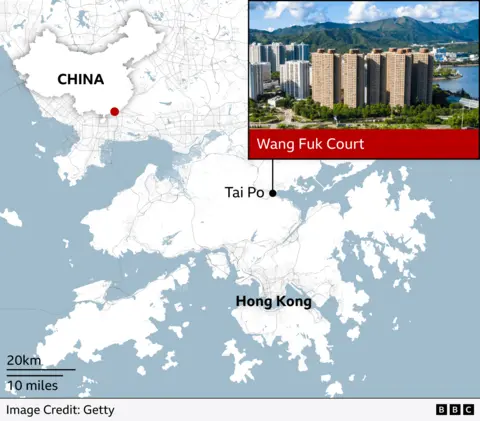
Student Thomas Liu was one of many people drawn to the scene of a deadly fire that tore through much of the eight-block Wang Fuk Court housing complex in Hong Kong’s Tai Po district.

At least 36 people have died in Wednesday’s devastating blaze so far, and with hundreds still missing it’s expected this number will rise. The cause is not yet known.

“It’s a disaster,” Thomas said of the fire, telling the BBC he had seen a body being taken away.

“Many people sent us WhatsApp messages or called us, saying they still have relatives inside or can’t find them,” Mui Siu-fung, a councillor for the Tai Po district, told BBC Chinese.

More than a thousand other people were forced to evacuate the estate as the flames spread, with some heading to centres that have been set up to house them. Police also moved people from nearby buildings.

The fire is gradually being contained but officials say they do not know when it will be fully extinguished. Flames could be seen coming from individual apartments as many people watched on in silence.

One woman said her friends live inside the building and she was waiting to hear if they managed to get out.
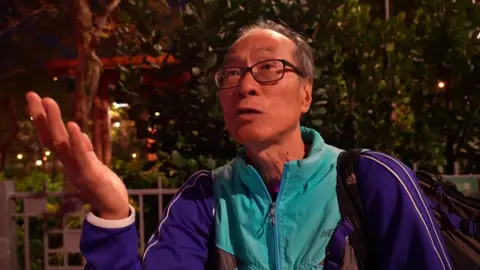
Reuters A man wearing a jacket and with a backpack slung over his shoulder speaks to the cameraReuters

Harry Cheung has lived in block two of the Wang Fuk Court complex for decades

Harry Cheung, who has lived in block two of the Wang Fuk Court complex for more than 40 years, told Reuters he heard “a very loud noise” and saw fire erupt in a nearby block.

“I immediately went back to pack up my things,” the 66-year-old resident said.

“I don’t even know how I feel right now. I’m just thinking about where I’m going to sleep tonight because I probably won’t be able to go back home.”

A woman in her sixties, whose surname is Kam and who lives in the adjacent Kwong Fuk Estate, told the South China Morning Post (SCMP) that several of her friends living in Wang Fuk Court have been accounted for – but not all.

One friend has daily afternoon naps and may have been sleeping when the fire broke out at 14:51 local time (06:51 GMT), Ms Kam said, adding that the woman’s daughters have not yet been able to contact her.

Another resident, 65-year-old Jason Kong, told Reuters that a neighbour called him and said he was still trapped inside one of the tower blocks.

“I am devastated. There are so many neighbours and friends. I do not know what is going on anymore. Look, all the apartments are just burning. I do not know what to do. I hope the government can help us to settle down after this.”

An elderly woman who lives in one of the affected blocks told the BBC she was not at home when the fire broke out but that she is worried about her apartment because it is not insured.

“I’m very upset that I have no home to go to now,” she said.

Map that labels China, Hong Kong and Tai Po, which is in the centre of the map. Tai Po has a pin, which leads to a box showing what Wang Fuk Court looked like before the fire

While the cause of the fire that engulfed the multiple high-rise blocks is unknown, the flames are believed to have spread quickly through the bamboo scaffolding that covered the buildings, which were undergoing renovations.

Some people have expressed anger that such a massive fire could have happened and criticised the response.

“When there’s a wildfire, they will deploy helicopters and drop water bombs, but why is there no such deployment and how can they leave other buildings burning?” Ms Poon, another resident of Wang Fuk Court, who is in her sixties, asked.

“The community is so close to the fire station and we thought the fire could be put out soon, but now the fire has spread. I’m so disappointed,” she told the SCMP.

Ms Poon noted that she had been given no instructions from the government on where to seek help.

The BBC spoke to some Tai Po residents who had brought supplies to the victims and affected residents – including dozens of blankets and heat packs.

Hong Kong chief executive John Lee said government departments were assisting residents affected by the fire.

When asked about their feelings about the fire, the residents said “the government is incompetent” and that they were “immensely heartbroken”.

“We don’t want to see any more casualties,” said one.

Source link
#Hong #Kong #residents #react #deadly #fire #tears #housing #estate

“米・イラン代表団がパキスタン交え対面協議” 米高官 | NHKニュースアメリカ、ホワイトハウスの高官は11日、アメリカとイランの代表団が、仲介国のパキスタンを交えて、対面での協議を行っていると明らかにしました。それによりますと、アメリカ側からは、バンス副大統領とウィトコフ特使、それにトランプ大統領の娘の夫のクシュナー氏のほか、国家安全保障に関わる担当者などが参加しているということです。この協議についてロイター通信はイラン側からは、ガリバフ議長やアラグチ外相、パキスタン側からはムニール陸軍参謀長らが参加したと伝えています。#米イラン代表団がパキスタン交え対面協議 #米高官 #NHKニュースNHK,ニュース,NHK ONE,イラン情勢,アメリカ,イラン,パキスタン,中東,ホルムズ海峡,レバノン,イスラエル,一覧

Russia’s Supreme Court announced on Telegram on April 9 that the activities of human rights organization Memorial were now banned throughout the country. This came after a closed-door hearing that was treated as “top secret.” Media representatives and diplomats from Germany, Sweden, the Czech Republic and France were only allowed to attend the announcement of the ruling, which sparked strong reactions internationally.

The Nobel Committee, which awarded the 2022 Nobel Peace Prize to Memorial, condemned the court’s decision. The European Union delegation to Russia described the ruling as a “politically motivated blow to civil society in Russia.” The diplomats pointed out that the Russian state itself had “not only officially recognized Memorial’s merits but also provided direct support, and members of the organization served on the Human Rights Council for many years.”

A judge with a file
The Supreme Court hearing took place behind closed doorsImage: Alexander Zemlianichenko/AP Photo/picture alliance

Russian Supreme Court keeps wording deliberately vague

Lawyers for Memorial pointed out that the Supreme Court had classified the “International Public Movement Memorial” as “extremist,” but they pointed out that no organization of this name existed and had not been registered either in Russia or elsewhere.

They told DW that the wording had probably been kept deliberately vague to create a legal basis for potential repression against any Memorial structures, as well as their members and supporters. “The Justice Ministry’s action itself remained secret, and the organization’s representatives were barred from attending the hearing,” Sergei Davidis, the head of Memorial’s political prisoners support program, told DW.

He also stressed that in light of growing public dissatisfaction with the Russian government, the state was attempting to eliminate independent and reputable sources of information that could foster solidarity and networking in Russian society.

Memorial documents Soviet repression and the Gulag system

The international society Memorial was founded in 1987 and went on to become the leading independent organization dedicated to documenting Soviet-era repression in Russia. Its archives contain tens of thousands of documents about the victims of Soviet repression, including thousands of memoirs, hundreds of personal collections, as well as a wealth of material from researchers on the history of the gulags, the system of labor camps that was a major instrument of political repression in the Soviet era, and other human rights violations.

According to the independent online media outlet Mediazona, the authorities could now lay claim to the archive as the “property of an extremist organization.” In 2023, the head of the Perm NGO Center of Historical Memory, Aleksandr Chernyshov, was arrested after allegedly trying to smuggle archival documents from Russia to Germany.

The persecution of the Russian branch of Memorial began in 2014 when it was placed on a list of “foreign agents” by the Russian Justice Ministry. This status was later extended to the organization’s international branch, which required all publications and reports to be labeled accordingly. In case of non-compliance, there were fines and restrictions on Memorial’s activities. 

In 2021, the Supreme Court ordered the dissolution of Memorial International for “repeated” and “gross” violations of Russia’s foreign agent laws. Memorial was also accused of depicting a false image of the Soviet Union.

Pressure continued to mount in March 2023, when the homes and offices of nine Memorial staff members, including Oleg Orlov and Yan Rachinsky, were subjected to searches as part of a targeted campaign against independent human rights organizations. The same year, Orlov was sentenced to two and a half years in prison for “discrediting” the army. He was released with other political prisoners as part of a prisoner exchange in August 2024 and has since been living in Germany.

Memorial will continue its human rights activities

Since this year’s ruling on April 9, Memorial has announced that it will have to suspend all activities in Russia but will continue its activities abroad. It has blocked the sharing and commenting of posts on social media. All supporters in Russia have been urged to follow the safety guidelines published on Memorial’s website.

Although the court has used the term “international social movement” to describe Memorial and this does not actually exist as such, all people, associations and organizations associated with the NGO could now be at risk. Memorial has called on people in Russia to not make any donations, to remove any logos and links on social media, and to delete any compromising content on all digital devices. It warned that people could draw attention from law enforcement agencies even by subscribing to Memorial channels.

It also said that though the risks outside Russia were not as high, people could still be subject to persecution abroad. Nonetheless, it said it would continue its work to protect human rights and preserve historical memory. 

Politzek — voices that defy the Kremlin

Nobel Committee: ‘Affront to fundamental values of human dignity’

Earlier this week, the chair of the Norwegian Nobel Committee Jorgen Watne Frydnes said that to designate Memorial as “extremist” was “an affront to the fundamental values of human dignity and freedom of expression.”

On his Telegram channel, the Russian political scientist Aleksandr Kynev wrote that the persecution of Memorial marked a new level of repression in Russia. He added that the new status of the organization would allow the authorities to target even ordinary employees.

Davidis pointed out that Memorial did not have a unified, centralized structure, but constituted a broad network of different groups. He said that people continued to be interested in political repression, both in the past and today. He said that the work of human rights activists had to continue despite the more difficult and risky circumstances.

Russian government strategy to suppress memory of Soviet crimes

According to Irina Sherbakova, a co-founding member of Memorial, the latest move against the organization is part of the Russian government’s overall strategy. She explained that it was in keeping with the closure of the Moscow-based Gulag History Museum in 2024, the systematic removal of commemorative plaques installed by the Last Address memorial project, the restrictions on access to official archives and the amendment to the official concept for commemorating victims of political repression, from which the mention of mass repression and later mass rehabilitation has been removed.

A picture of a smiling woman against an orange background.
Irina Sherbakova co-founded Memorial. She now lives in GermanyImage: dts-Agentur/picture alliance

Sherbakova said that these measures were all aimed at controlling the collective memory of Soviet repression and human rights work today: “This is part of [Russian President Vladimir] Putin’s ideology, which is becoming increasingly ultranationalist.”

Human rights activist Anna Karetnikova agreed, and pointed out that the initiative to persecute Memorial went back to the Russian Federal Security Service (FSB), which succeeded the Soviet secret service, the KGB, itself preceded by the NKVD. She said that the FSB viewed Memorial’s efforts to preserve the memory of Soviet repression and support of political prisoners today as a thorn in its side. She said that Memorial’s new status would lay the path for more criminal proceedings and increase pressure on civil society.

This article was originally published in Russian.

What’s really behind ‘foreign agent’ laws?

#Russian #Memorial #human #rights #NGO #labeled #extremist">Russian Memorial human rights NGO labeled ‘extremist’Russia’s Supreme Court announced on Telegram on April 9 that the activities of human rights organization Memorial were now banned throughout the country. This came after a closed-door hearing that was treated as “top secret.” Media representatives and diplomats from Germany, Sweden, the Czech Republic and France were only allowed to attend the announcement of the ruling, which sparked strong reactions internationally.

The Nobel Committee, which awarded the 2022 Nobel Peace Prize to Memorial, condemned the court’s decision. The European Union delegation to Russia described the ruling as a “politically motivated blow to civil society in Russia.” The diplomats pointed out that the Russian state itself had “not only officially recognized Memorial’s merits but also provided direct support, and members of the organization served on the Human Rights Council for many years.”The Supreme Court hearing took place behind closed doorsImage: Alexander Zemlianichenko/AP Photo/picture alliance

Russian Supreme Court keeps wording deliberately vague

Lawyers for Memorial pointed out that the Supreme Court had classified the “International Public Movement Memorial” as “extremist,” but they pointed out that no organization of this name existed and had not been registered either in Russia or elsewhere.

They told DW that the wording had probably been kept deliberately vague to create a legal basis for potential repression against any Memorial structures, as well as their members and supporters. “The Justice Ministry’s action itself remained secret, and the organization’s representatives were barred from attending the hearing,” Sergei Davidis, the head of Memorial’s political prisoners support program, told DW.

He also stressed that in light of growing public dissatisfaction with the Russian government, the state was attempting to eliminate independent and reputable sources of information that could foster solidarity and networking in Russian society.

Memorial documents Soviet repression and the Gulag system

The international society Memorial was founded in 1987 and went on to become the leading independent organization dedicated to documenting Soviet-era repression in Russia. Its archives contain tens of thousands of documents about the victims of Soviet repression, including thousands of memoirs, hundreds of personal collections, as well as a wealth of material from researchers on the history of the gulags, the system of labor camps that was a major instrument of political repression in the Soviet era, and other human rights violations.

According to the independent online media outlet Mediazona, the authorities could now lay claim to the archive as the “property of an extremist organization.” In 2023, the head of the Perm NGO Center of Historical Memory, Aleksandr Chernyshov, was arrested after allegedly trying to smuggle archival documents from Russia to Germany.

The persecution of the Russian branch of Memorial began in 2014 when it was placed on a list of “foreign agents” by the Russian Justice Ministry. This status was later extended to the organization’s international branch, which required all publications and reports to be labeled accordingly. In case of non-compliance, there were fines and restrictions on Memorial’s activities. 

In 2021, the Supreme Court ordered the dissolution of Memorial International for “repeated” and “gross” violations of Russia’s foreign agent laws. Memorial was also accused of depicting a false image of the Soviet Union.

Pressure continued to mount in March 2023, when the homes and offices of nine Memorial staff members, including Oleg Orlov and Yan Rachinsky, were subjected to searches as part of a targeted campaign against independent human rights organizations. The same year, Orlov was sentenced to two and a half years in prison for “discrediting” the army. He was released with other political prisoners as part of a prisoner exchange in August 2024 and has since been living in Germany.

Memorial will continue its human rights activities

Since this year’s ruling on April 9, Memorial has announced that it will have to suspend all activities in Russia but will continue its activities abroad. It has blocked the sharing and commenting of posts on social media. All supporters in Russia have been urged to follow the safety guidelines published on Memorial’s website.

Although the court has used the term “international social movement” to describe Memorial and this does not actually exist as such, all people, associations and organizations associated with the NGO could now be at risk. Memorial has called on people in Russia to not make any donations, to remove any logos and links on social media, and to delete any compromising content on all digital devices. It warned that people could draw attention from law enforcement agencies even by subscribing to Memorial channels.

It also said that though the risks outside Russia were not as high, people could still be subject to persecution abroad. Nonetheless, it said it would continue its work to protect human rights and preserve historical memory. Politzek — voices that defy the KremlinTo view this video please enable JavaScript, and consider upgrading to a web browser that supports HTML5 video

Nobel Committee: ‘Affront to fundamental values of human dignity’

Earlier this week, the chair of the Norwegian Nobel Committee Jorgen Watne Frydnes said that to designate Memorial as “extremist” was “an affront to the fundamental values of human dignity and freedom of expression.”

On his Telegram channel, the Russian political scientist Aleksandr Kynev wrote that the persecution of Memorial marked a new level of repression in Russia. He added that the new status of the organization would allow the authorities to target even ordinary employees.

Davidis pointed out that Memorial did not have a unified, centralized structure, but constituted a broad network of different groups. He said that people continued to be interested in political repression, both in the past and today. He said that the work of human rights activists had to continue despite the more difficult and risky circumstances.

Russian government strategy to suppress memory of Soviet crimes

According to Irina Sherbakova, a co-founding member of Memorial, the latest move against the organization is part of the Russian government’s overall strategy. She explained that it was in keeping with the closure of the Moscow-based Gulag History Museum in 2024, the systematic removal of commemorative plaques installed by the Last Address memorial project, the restrictions on access to official archives and the amendment to the official concept for commemorating victims of political repression, from which the mention of mass repression and later mass rehabilitation has been removed.Irina Sherbakova co-founded Memorial. She now lives in GermanyImage: dts-Agentur/picture alliance

Sherbakova said that these measures were all aimed at controlling the collective memory of Soviet repression and human rights work today: “This is part of [Russian President Vladimir] Putin’s ideology, which is becoming increasingly ultranationalist.”

Human rights activist Anna Karetnikova agreed, and pointed out that the initiative to persecute Memorial went back to the Russian Federal Security Service (FSB), which succeeded the Soviet secret service, the KGB, itself preceded by the NKVD. She said that the FSB viewed Memorial’s efforts to preserve the memory of Soviet repression and support of political prisoners today as a thorn in its side. She said that Memorial’s new status would lay the path for more criminal proceedings and increase pressure on civil society.

This article was originally published in Russian.

What’s really behind ‘foreign agent’ laws?  To view this video please enable JavaScript, and consider upgrading to a web browser that supports HTML5 video
#Russian #Memorial #human #rights #NGO #labeled #extremist

Russia’s Supreme Court announced on Telegram on April 9 that the activities of human rights organization Memorial were now banned throughout the country. This came after a closed-door hearing that was treated as “top secret.” Media representatives and diplomats from Germany, Sweden, the Czech Republic and France were only allowed to attend the announcement of the ruling, which sparked strong reactions internationally.

The Nobel Committee, which awarded the 2022 Nobel Peace Prize to Memorial, condemned the court’s decision. The European Union delegation to Russia described the ruling as a “politically motivated blow to civil society in Russia.” The diplomats pointed out that the Russian state itself had “not only officially recognized Memorial’s merits but also provided direct support, and members of the organization served on the Human Rights Council for many years.”

A judge with a file
The Supreme Court hearing took place behind closed doorsImage: Alexander Zemlianichenko/AP Photo/picture alliance

Russian Supreme Court keeps wording deliberately vague

Lawyers for Memorial pointed out that the Supreme Court had classified the “International Public Movement Memorial” as “extremist,” but they pointed out that no organization of this name existed and had not been registered either in Russia or elsewhere.

They told DW that the wording had probably been kept deliberately vague to create a legal basis for potential repression against any Memorial structures, as well as their members and supporters. “The Justice Ministry’s action itself remained secret, and the organization’s representatives were barred from attending the hearing,” Sergei Davidis, the head of Memorial’s political prisoners support program, told DW.

He also stressed that in light of growing public dissatisfaction with the Russian government, the state was attempting to eliminate independent and reputable sources of information that could foster solidarity and networking in Russian society.

Memorial documents Soviet repression and the Gulag system

The international society Memorial was founded in 1987 and went on to become the leading independent organization dedicated to documenting Soviet-era repression in Russia. Its archives contain tens of thousands of documents about the victims of Soviet repression, including thousands of memoirs, hundreds of personal collections, as well as a wealth of material from researchers on the history of the gulags, the system of labor camps that was a major instrument of political repression in the Soviet era, and other human rights violations.

According to the independent online media outlet Mediazona, the authorities could now lay claim to the archive as the “property of an extremist organization.” In 2023, the head of the Perm NGO Center of Historical Memory, Aleksandr Chernyshov, was arrested after allegedly trying to smuggle archival documents from Russia to Germany.

The persecution of the Russian branch of Memorial began in 2014 when it was placed on a list of “foreign agents” by the Russian Justice Ministry. This status was later extended to the organization’s international branch, which required all publications and reports to be labeled accordingly. In case of non-compliance, there were fines and restrictions on Memorial’s activities. 

In 2021, the Supreme Court ordered the dissolution of Memorial International for “repeated” and “gross” violations of Russia’s foreign agent laws. Memorial was also accused of depicting a false image of the Soviet Union.

Pressure continued to mount in March 2023, when the homes and offices of nine Memorial staff members, including Oleg Orlov and Yan Rachinsky, were subjected to searches as part of a targeted campaign against independent human rights organizations. The same year, Orlov was sentenced to two and a half years in prison for “discrediting” the army. He was released with other political prisoners as part of a prisoner exchange in August 2024 and has since been living in Germany.

Memorial will continue its human rights activities

Since this year’s ruling on April 9, Memorial has announced that it will have to suspend all activities in Russia but will continue its activities abroad. It has blocked the sharing and commenting of posts on social media. All supporters in Russia have been urged to follow the safety guidelines published on Memorial’s website.

Although the court has used the term “international social movement” to describe Memorial and this does not actually exist as such, all people, associations and organizations associated with the NGO could now be at risk. Memorial has called on people in Russia to not make any donations, to remove any logos and links on social media, and to delete any compromising content on all digital devices. It warned that people could draw attention from law enforcement agencies even by subscribing to Memorial channels.

It also said that though the risks outside Russia were not as high, people could still be subject to persecution abroad. Nonetheless, it said it would continue its work to protect human rights and preserve historical memory. 

Politzek — voices that defy the Kremlin

Nobel Committee: ‘Affront to fundamental values of human dignity’

Earlier this week, the chair of the Norwegian Nobel Committee Jorgen Watne Frydnes said that to designate Memorial as “extremist” was “an affront to the fundamental values of human dignity and freedom of expression.”

On his Telegram channel, the Russian political scientist Aleksandr Kynev wrote that the persecution of Memorial marked a new level of repression in Russia. He added that the new status of the organization would allow the authorities to target even ordinary employees.

Davidis pointed out that Memorial did not have a unified, centralized structure, but constituted a broad network of different groups. He said that people continued to be interested in political repression, both in the past and today. He said that the work of human rights activists had to continue despite the more difficult and risky circumstances.

Russian government strategy to suppress memory of Soviet crimes

According to Irina Sherbakova, a co-founding member of Memorial, the latest move against the organization is part of the Russian government’s overall strategy. She explained that it was in keeping with the closure of the Moscow-based Gulag History Museum in 2024, the systematic removal of commemorative plaques installed by the Last Address memorial project, the restrictions on access to official archives and the amendment to the official concept for commemorating victims of political repression, from which the mention of mass repression and later mass rehabilitation has been removed.

A picture of a smiling woman against an orange background.
Irina Sherbakova co-founded Memorial. She now lives in GermanyImage: dts-Agentur/picture alliance

Sherbakova said that these measures were all aimed at controlling the collective memory of Soviet repression and human rights work today: “This is part of [Russian President Vladimir] Putin’s ideology, which is becoming increasingly ultranationalist.”

Human rights activist Anna Karetnikova agreed, and pointed out that the initiative to persecute Memorial went back to the Russian Federal Security Service (FSB), which succeeded the Soviet secret service, the KGB, itself preceded by the NKVD. She said that the FSB viewed Memorial’s efforts to preserve the memory of Soviet repression and support of political prisoners today as a thorn in its side. She said that Memorial’s new status would lay the path for more criminal proceedings and increase pressure on civil society.

This article was originally published in Russian.

What’s really behind ‘foreign agent’ laws?

#Russian #Memorial #human #rights #NGO #labeled #extremist">Russian Memorial human rights NGO labeled ‘extremist’

Russia’s Supreme Court announced on Telegram on April 9 that the activities of human rights organization Memorial were now banned throughout the country. This came after a closed-door hearing that was treated as “top secret.” Media representatives and diplomats from Germany, Sweden, the Czech Republic and France were only allowed to attend the announcement of the ruling, which sparked strong reactions internationally.

The Nobel Committee, which awarded the 2022 Nobel Peace Prize to Memorial, condemned the court’s decision. The European Union delegation to Russia described the ruling as a “politically motivated blow to civil society in Russia.” The diplomats pointed out that the Russian state itself had “not only officially recognized Memorial’s merits but also provided direct support, and members of the organization served on the Human Rights Council for many years.”

A judge with a file
The Supreme Court hearing took place behind closed doorsImage: Alexander Zemlianichenko/AP Photo/picture alliance

Russian Supreme Court keeps wording deliberately vague

Lawyers for Memorial pointed out that the Supreme Court had classified the “International Public Movement Memorial” as “extremist,” but they pointed out that no organization of this name existed and had not been registered either in Russia or elsewhere.

They told DW that the wording had probably been kept deliberately vague to create a legal basis for potential repression against any Memorial structures, as well as their members and supporters. “The Justice Ministry’s action itself remained secret, and the organization’s representatives were barred from attending the hearing,” Sergei Davidis, the head of Memorial’s political prisoners support program, told DW.

He also stressed that in light of growing public dissatisfaction with the Russian government, the state was attempting to eliminate independent and reputable sources of information that could foster solidarity and networking in Russian society.

Memorial documents Soviet repression and the Gulag system

The international society Memorial was founded in 1987 and went on to become the leading independent organization dedicated to documenting Soviet-era repression in Russia. Its archives contain tens of thousands of documents about the victims of Soviet repression, including thousands of memoirs, hundreds of personal collections, as well as a wealth of material from researchers on the history of the gulags, the system of labor camps that was a major instrument of political repression in the Soviet era, and other human rights violations.

According to the independent online media outlet Mediazona, the authorities could now lay claim to the archive as the “property of an extremist organization.” In 2023, the head of the Perm NGO Center of Historical Memory, Aleksandr Chernyshov, was arrested after allegedly trying to smuggle archival documents from Russia to Germany.

The persecution of the Russian branch of Memorial began in 2014 when it was placed on a list of “foreign agents” by the Russian Justice Ministry. This status was later extended to the organization’s international branch, which required all publications and reports to be labeled accordingly. In case of non-compliance, there were fines and restrictions on Memorial’s activities. 

In 2021, the Supreme Court ordered the dissolution of Memorial International for “repeated” and “gross” violations of Russia’s foreign agent laws. Memorial was also accused of depicting a false image of the Soviet Union.

Pressure continued to mount in March 2023, when the homes and offices of nine Memorial staff members, including Oleg Orlov and Yan Rachinsky, were subjected to searches as part of a targeted campaign against independent human rights organizations. The same year, Orlov was sentenced to two and a half years in prison for “discrediting” the army. He was released with other political prisoners as part of a prisoner exchange in August 2024 and has since been living in Germany.

Memorial will continue its human rights activities

Since this year’s ruling on April 9, Memorial has announced that it will have to suspend all activities in Russia but will continue its activities abroad. It has blocked the sharing and commenting of posts on social media. All supporters in Russia have been urged to follow the safety guidelines published on Memorial’s website.

Although the court has used the term “international social movement” to describe Memorial and this does not actually exist as such, all people, associations and organizations associated with the NGO could now be at risk. Memorial has called on people in Russia to not make any donations, to remove any logos and links on social media, and to delete any compromising content on all digital devices. It warned that people could draw attention from law enforcement agencies even by subscribing to Memorial channels.

It also said that though the risks outside Russia were not as high, people could still be subject to persecution abroad. Nonetheless, it said it would continue its work to protect human rights and preserve historical memory. 

Politzek — voices that defy the Kremlin

Nobel Committee: ‘Affront to fundamental values of human dignity’

Earlier this week, the chair of the Norwegian Nobel Committee Jorgen Watne Frydnes said that to designate Memorial as “extremist” was “an affront to the fundamental values of human dignity and freedom of expression.”

On his Telegram channel, the Russian political scientist Aleksandr Kynev wrote that the persecution of Memorial marked a new level of repression in Russia. He added that the new status of the organization would allow the authorities to target even ordinary employees.

Davidis pointed out that Memorial did not have a unified, centralized structure, but constituted a broad network of different groups. He said that people continued to be interested in political repression, both in the past and today. He said that the work of human rights activists had to continue despite the more difficult and risky circumstances.

Russian government strategy to suppress memory of Soviet crimes

According to Irina Sherbakova, a co-founding member of Memorial, the latest move against the organization is part of the Russian government’s overall strategy. She explained that it was in keeping with the closure of the Moscow-based Gulag History Museum in 2024, the systematic removal of commemorative plaques installed by the Last Address memorial project, the restrictions on access to official archives and the amendment to the official concept for commemorating victims of political repression, from which the mention of mass repression and later mass rehabilitation has been removed.

A picture of a smiling woman against an orange background.
Irina Sherbakova co-founded Memorial. She now lives in GermanyImage: dts-Agentur/picture alliance

Sherbakova said that these measures were all aimed at controlling the collective memory of Soviet repression and human rights work today: “This is part of [Russian President Vladimir] Putin’s ideology, which is becoming increasingly ultranationalist.”

Human rights activist Anna Karetnikova agreed, and pointed out that the initiative to persecute Memorial went back to the Russian Federal Security Service (FSB), which succeeded the Soviet secret service, the KGB, itself preceded by the NKVD. She said that the FSB viewed Memorial’s efforts to preserve the memory of Soviet repression and support of political prisoners today as a thorn in its side. She said that Memorial’s new status would lay the path for more criminal proceedings and increase pressure on civil society.

This article was originally published in Russian.

What’s really behind ‘foreign agent’ laws?

#Russian #Memorial #human #rights #NGO #labeled #extremist

Post Comment