How GodLike Won BMPS 2026 Grand Finals And Secured A Spot At The Esports World Cup
When the BMPS 2026 Grand Finals began in Jaipur, GodLike Esports weren’t the obvious favorites. Teams like Divine Gaming, Reckoning Esports, Nebula Esports, and Victoris Sumus had all looked stronger at different stages of the tournament. Yet 18 matches later, it was GodLike lifting the trophy, claiming a share of the ₹4 crore prize pool, and securing India’s direct slot at the Esports World Cup in Paris.
What makes GodLike’s championship run so impressive is that it wasn’t built on domination. They didn’t top Day 1. They weren’t the biggest story on Day 2. They didn’t collect an absurd number of chicken dinners. Instead, they won BMPS 2026 through something far more valuable in battle royale esports: consistency.
While nearly every title contender suffered a disastrous stretch at some point during the Grand Finals, GodLike remained competitive from start to finish. Their ability to avoid costly mistakes, win critical fights against direct rivals, and consistently put themselves in strong positions ultimately made the difference.
GodLike Never Had A Bad Day
Battle royale tournaments are often decided by who avoids disaster rather than who produces the most highlights. That was certainly true in Jaipur. Divine Gaming dominated much of the opening two days but struggled to maintain the same level on Championship Sunday. Victoris Sumus exploded into contention with several standout performances before losing momentum when it mattered most. God’s Reign mounted an incredible comeback but left itself too much work to do after a slow start. SouL spent most of Day 1 fighting simply to stay relevant.
GodLike, meanwhile, never experienced that kind of collapse. They weren’t always the highest-scoring team in the lobby, but they were almost always collecting something. Whether it was finish points, placement points, or valuable late-game appearances, GodLike consistently kept itself within striking distance of the leaders. That steady accumulation of points meant they never needed a miracle comeback heading into the final day.
Their Rotations Were Among The Best In The Tournament
One of the biggest differences between GodLike and many of their rivals was their decision-making during rotations. Throughout the Grand Finals, teams repeatedly lost players while attempting risky zone entries or taking unnecessary fights outside the safe zone. SouL, TAG, and Genesis all suffered from these mistakes at different points during the event. GodLike largely avoided them. Their rotations weren’t flashy, but they were efficient. Time and time again, they secured defensible compounds before other teams arrived, forcing opponents to rotate into them rather than the other way around.
That positional advantage became especially noticeable on the final day. While other contenders were often scrambling for cover in the closing circles, GodLike repeatedly found themselves holding strong positions near the center of the zone. In a battle royale, that kind of consistency is rarely accidental.
The Turning Point Came On Day 2
If there was a moment when GodLike’s title challenge became real, it arrived during Match 3 on Day 2. At that point, Divine Gaming looked like the team to beat. They had controlled much of the tournament and appeared well on their way to extending their lead atop the standings. GodLike had other plans. During the late game, they eliminated Divine before defeating Victoris Sumus to secure a crucial chicken dinner. The victory delivered more than just points. It sent a message to the rest of the lobby that GodLike could beat the strongest teams when it mattered most.
From that moment onward, they stopped looking like outsiders and started looking like genuine championship contenders. The standings still favored Divine, but momentum had clearly shifted.
GodLike Won The Fights That Mattered Most
One of the biggest reasons GodLike eventually won BMPS 2026 was their performance against direct rivals. Championships aren’t decided by farming points against struggling teams. They’re decided by winning the battles against the teams competing for the same trophy. GodLike repeatedly did exactly that.
On Championship Sunday, they dismantled 7 Gods during a crucial Rondo match before winning several important engagements against Victoris Sumus. Later, they shut down Nebula Esports’ hopes of mounting a comeback by defending their position perfectly and wiping out the entire squad.
Their aggressive push on Vasista Esports during Match 3 was another defining moment. Rather than waiting for the zone to force a difficult rotation, GodLike identified the threat, launched a coordinated shotgun assault, and cleared the compound entirely. These weren’t simply eliminations. Each of these fights directly impacted the title race by denying points to rival contenders while simultaneously boosting GodLike’s own total.
Divine Gaming Opened The Door
As much credit as GodLike deserves, championships are often shaped by both success and failure. Divine Gaming entered the final day as the team everyone expected to beat. They had been the most consistent roster throughout the opening stages of the tournament and appeared firmly in control of the standings. Then everything changed. Several early eliminations and difficult rotations prevented Divine from building on their lead. More importantly, they failed to capitalize on any weaker match by GodLike.
Even during moments when GodLike exited early, Divine couldn’t create the separation they needed. With every missed opportunity, the pressure shifted further away from Divine and onto the chasing pack. Eventually, the standings flipped entirely. Instead of everyone chasing Divine, everyone was chasing GodLike.
When the BMPS 2026 Grand Finals began in Jaipur, GodLike Esports weren’t the obvious favorites. Teams like Divine Gaming, Reckoning Esports, Nebula Esports, and Victoris Sumus had all looked stronger at different stages of the tournament. Yet 18 matches later, it was GodLike lifting the trophy, claiming a share of the ₹4 crore prize pool, and securing India’s direct slot at the Esports World Cup in Paris.
What makes GodLike’s championship run so impressive is that it wasn’t built on domination. They didn’t top Day 1. They weren’t the biggest story on Day 2. They didn’t collect an absurd number of chicken dinners. Instead, they won BMPS 2026 through something far more valuable in battle royale esports: consistency.
While nearly every title contender suffered a disastrous stretch at some point during the Grand Finals, GodLike remained competitive from start to finish. Their ability to avoid costly mistakes, win critical fights against direct rivals, and consistently put themselves in strong positions ultimately made the difference.
GodLike Never Had A Bad Day
Battle royale tournaments are often decided by who avoids disaster rather than who produces the most highlights. That was certainly true in Jaipur. Divine Gaming dominated much of the opening two days but struggled to maintain the same level on Championship Sunday. Victoris Sumus exploded into contention with several standout performances before losing momentum when it mattered most. God’s Reign mounted an incredible comeback but left itself too much work to do after a slow start. SouL spent most of Day 1 fighting simply to stay relevant.
GodLike, meanwhile, never experienced that kind of collapse. They weren’t always the highest-scoring team in the lobby, but they were almost always collecting something. Whether it was finish points, placement points, or valuable late-game appearances, GodLike consistently kept itself within striking distance of the leaders. That steady accumulation of points meant they never needed a miracle comeback heading into the final day.
Their Rotations Were Among The Best In The Tournament
One of the biggest differences between GodLike and many of their rivals was their decision-making during rotations. Throughout the Grand Finals, teams repeatedly lost players while attempting risky zone entries or taking unnecessary fights outside the safe zone. SouL, TAG, and Genesis all suffered from these mistakes at different points during the event. GodLike largely avoided them. Their rotations weren’t flashy, but they were efficient. Time and time again, they secured defensible compounds before other teams arrived, forcing opponents to rotate into them rather than the other way around.
That positional advantage became especially noticeable on the final day. While other contenders were often scrambling for cover in the closing circles, GodLike repeatedly found themselves holding strong positions near the center of the zone. In a battle royale, that kind of consistency is rarely accidental.
The Turning Point Came On Day 2
If there was a moment when GodLike’s title challenge became real, it arrived during Match 3 on Day 2. At that point, Divine Gaming looked like the team to beat. They had controlled much of the tournament and appeared well on their way to extending their lead atop the standings. GodLike had other plans. During the late game, they eliminated Divine before defeating Victoris Sumus to secure a crucial chicken dinner. The victory delivered more than just points. It sent a message to the rest of the lobby that GodLike could beat the strongest teams when it mattered most.
From that moment onward, they stopped looking like outsiders and started looking like genuine championship contenders. The standings still favored Divine, but momentum had clearly shifted.
GodLike Won The Fights That Mattered Most
One of the biggest reasons GodLike eventually won BMPS 2026 was their performance against direct rivals. Championships aren’t decided by farming points against struggling teams. They’re decided by winning the battles against the teams competing for the same trophy. GodLike repeatedly did exactly that.
On Championship Sunday, they dismantled 7 Gods during a crucial Rondo match before winning several important engagements against Victoris Sumus. Later, they shut down Nebula Esports’ hopes of mounting a comeback by defending their position perfectly and wiping out the entire squad.
Their aggressive push on Vasista Esports during Match 3 was another defining moment. Rather than waiting for the zone to force a difficult rotation, GodLike identified the threat, launched a coordinated shotgun assault, and cleared the compound entirely. These weren’t simply eliminations. Each of these fights directly impacted the title race by denying points to rival contenders while simultaneously boosting GodLike’s own total.
Divine Gaming Opened The Door
As much credit as GodLike deserves, championships are often shaped by both success and failure. Divine Gaming entered the final day as the team everyone expected to beat. They had been the most consistent roster throughout the opening stages of the tournament and appeared firmly in control of the standings. Then everything changed. Several early eliminations and difficult rotations prevented Divine from building on their lead. More importantly, they failed to capitalize on any weaker match by GodLike.
Even during moments when GodLike exited early, Divine couldn’t create the separation they needed. With every missed opportunity, the pressure shifted further away from Divine and onto the chasing pack. Eventually, the standings flipped entirely. Instead of everyone chasing Divine, everyone was chasing GodLike.
He’s not alone in making that kind of move. Instagram co-founder Mike Krieger joined Anthropic as Chief Product Officer in 2024, and Andrej Karpathy, a founding member of OpenAI who went on to lead AI at Tesla and start his own company, Eureka Labs, joined Anthropic’s pre-training team in May, framing the decision almost identically to Blomfield’s, writing that “the next few years at the frontier of LLMs will be especially formative.”
Not everyone is joining someone else’s lab. Chamath Palihapitiya, the “SPAC King” who has mostly stuck to boardrooms and all things “All In” since leaving Facebook in 2011, just took his first full-time operating role in over a decade as CEO of 8090 Labs, his enterprise AI coding startup, which he announced a couple of weeks ago along with a $135 million Series A led by Salesforce Ventures. Wrote Palihapitiya on X, “I am convinced that what we are building now is even more important, so there was no decision to make except to be all in.”
Similarly, Eric Wu, who ran Opendoor for a decade before stepping back in 2023, recently launched NavigateAI, an AI “copilot” for construction workers, with $25 million in seed funding. Wu told me directly on a recent call about his decision to dive into an AI startup, “I knew if I looked back in 10 years and didn’t do something related to it, I would probably regret that.”
The clearest sign of how keen people who’ve already “made it” are to work on what they view as the still-early-innings of AI might be the job title itself. “Member of technical staff” is the deliberately flat, non-hierarchical label that Anthropic and OpenAI use for nearly everyone on their technical teams, regardless of seniority. It’s the same title Blomfield is taking.
It’s also the title that Peter Bailis took this March, just months after becoming Workday’s CTO, a role overseeing AI strategy across an $8 billion-revenue business. Bailis lasted less than a year before trading it for a spot at Anthropic.
When you purchase through links in our articles, we may earn a small commission. This doesn’t affect our editorial independence.
He’s not alone in making that kind of move. Instagram co-founder Mike Krieger joined Anthropic as Chief Product Officer in 2024, and Andrej Karpathy, a founding member of OpenAI who went on to lead AI at Tesla and start his own company, Eureka Labs, joined Anthropic’s pre-training team in May, framing the decision almost identically to Blomfield’s, writing that “the next few years at the frontier of LLMs will be especially formative.”
Not everyone is joining someone else’s lab. Chamath Palihapitiya, the “SPAC King” who has mostly stuck to boardrooms and all things “All In” since leaving Facebook in 2011, just took his first full-time operating role in over a decade as CEO of 8090 Labs, his enterprise AI coding startup, which he announced a couple of weeks ago along with a $135 million Series A led by Salesforce Ventures. Wrote Palihapitiya on X, “I am convinced that what we are building now is even more important, so there was no decision to make except to be all in.”
Similarly, Eric Wu, who ran Opendoor for a decade before stepping back in 2023, recently launched NavigateAI, an AI “copilot” for construction workers, with $25 million in seed funding. Wu told me directly on a recent call about his decision to dive into an AI startup, “I knew if I looked back in 10 years and didn’t do something related to it, I would probably regret that.”
The clearest sign of how keen people who’ve already “made it” are to work on what they view as the still-early-innings of AI might be the job title itself. “Member of technical staff” is the deliberately flat, non-hierarchical label that Anthropic and OpenAI use for nearly everyone on their technical teams, regardless of seniority. It’s the same title Blomfield is taking.
It’s also the title that Peter Bailis took this March, just months after becoming Workday’s CTO, a role overseeing AI strategy across an $8 billion-revenue business. Bailis lasted less than a year before trading it for a spot at Anthropic.
When you purchase through links in our articles, we may earn a small commission. This doesn’t affect our editorial independence.
#rich #successful #wave #tech #winners #grinding #TechCrunch">Already rich, already successful, why the last wave of tech winners is grinding again | TechCrunch
A pattern is emerging among people who’ve already made it big. They’re rolling up their sleeves again, seemingly out of fear of missing AI’s defining moment and, presumably, the irresistible allure of making even more money — potentially a lot more.
Tom Blomfield, who co-founded GoCardless and Monzo before spending 4.5 years mentoring founders as a Y Combinator Group Partner, announced on Monday that he is taking a leave of absence to join Anthropic’s compute team — not as an executive, but as a member of technical staff.
He’s not alone in making that kind of move. Instagram co-founder Mike Krieger joined Anthropic as Chief Product Officer in 2024, and Andrej Karpathy, a founding member of OpenAI who went on to lead AI at Tesla and start his own company, Eureka Labs, joined Anthropic’s pre-training team in May, framing the decision almost identically to Blomfield’s, writing that “the next few years at the frontier of LLMs will be especially formative.”
Not everyone is joining someone else’s lab. Chamath Palihapitiya, the “SPAC King” who has mostly stuck to boardrooms and all things “All In” since leaving Facebook in 2011, just took his first full-time operating role in over a decade as CEO of 8090 Labs, his enterprise AI coding startup, which he announced a couple of weeks ago along with a $135 million Series A led by Salesforce Ventures. Wrote Palihapitiya on X, “I am convinced that what we are building now is even more important, so there was no decision to make except to be all in.”
Similarly, Eric Wu, who ran Opendoor for a decade before stepping back in 2023, recently launched NavigateAI, an AI “copilot” for construction workers, with $25 million in seed funding. Wu told me directly on a recent call about his decision to dive into an AI startup, “I knew if I looked back in 10 years and didn’t do something related to it, I would probably regret that.”
The clearest sign of how keen people who’ve already “made it” are to work on what they view as the still-early-innings of AI might be the job title itself. “Member of technical staff” is the deliberately flat, non-hierarchical label that Anthropic and OpenAI use for nearly everyone on their technical teams, regardless of seniority. It’s the same title Blomfield is taking.
It’s also the title that Peter Bailis took this March, just months after becoming Workday’s CTO, a role overseeing AI strategy across an $8 billion-revenue business. Bailis lasted less than a year before trading it for a spot at Anthropic.
When you purchase through links in our articles, we may earn a small commission. This doesn’t affect our editorial independence.
Choose the type of files to recover or select Recover Everything.
Select the drive where the files were deleted.
Run a scan and use Deep Scan if needed.
Preview recoverable files.
Recover the selected files.
Save recovered files to a different drive.
If you need more recovery space, you can unlock an extra 1GB for free.
Steps to Get Your 2 GB Free Data Recovery
You can increase the free recovery limit by following these steps.
Click Get it Now in the activation window.
Select Upgrade Later to continue with the 1GB free version.
When you reach the limit, click the option to unlock an additional 1GB.
Share your experience on social media.
Enter the review link, your name, and your email address.
Submit the form to activate the 1GB bonus using the key sent to your email.
When Should You Use Deep Scan?
Most recovery tools start with a Quick Scan because it is faster. However, it may not find every deleted file. If the Quick Scan doesn’t show your file, try Deep Scan instead. It is also useful if the drive was formatted, the storage device became inaccessible, or the file was deleted a long time ago. Deep Scan takes longer to complete but may find additional recoverable files.
You can recover many different files that were deleted, depending on the storage device’s status. It can be documents, pictures, videos, emails, and ZIP files. The types of document files that can be recovered include Word, Excel, PDF, and PowerPoint files. At the same time, among the types of picture files that can be recovered are JPG, PNG, HEIC, and RAW. File recovery software is also compatible with Windows PCs/Laptops, SSDs, hard disks, USB drives/ SD cards.
Things to Keep in Mind
File recovery is not always successful, so it’s important to keep your expectations realistic. Once your files have been overwritten with new data, there is no way to recover them successfully. Another problem that might affect the success of file recovery is the TRIM functionality in SSDs. With the Stellar Data Recovery Free Edition, one can restore up to 2GB of data free of charge. If one needs to recover data larger than 2GB, they will have to purchase the software.
Tips to Improve Your Recovery Chances
The actions you perform after deletion could affect the ability to recover your files. It is important not to use the drive containing the deleted files, as you may overwrite them with fresh data. If possible, try installing the software on another drive. This helps avoid writing new data to the same storage location.
Always make sure to transfer the recovered files to another drive, not back to the original one. If your files are not found during a Quick Scan, a Deep Scan is available. Preview your recoverable files before recovery to ensure they are the right ones. Complete the file recovery process immediately and keep regular backups to reduce the risk of future data loss.
Final Verdict
Recovering permanently deleted files depends on how the files were deleted and whether the data has been overwritten. For instance, restoring files from the Recycle Bin or a backup is the preferred method when they are available. Whereas, when the files are deleted by pressing “Shift” and “Delete”, deleted from the Recycle Bin, or deleted from an external hard drive, then the use of Stellar Data Recovery Free Edition will be useful. It lets you scan your storage device, preview recoverable files, and recover up to 2 GB of data for free, with the option to upgrade to a paid edition if needed. For users who need to recover more than the free limit, Stellar offers paid plans starting at around $49. The paid plans are worth considering if you need to recover more than the free limit. However, the Stellar Data Recovery Free Edition is one of the best options to recover files.
#Recover #Permanently #Deleted #Files #FreeStellar Data Recovery">
Choose the type of files to recover or select Recover Everything.
Select the drive where the files were deleted.
Run a scan and use Deep Scan if needed.
Preview recoverable files.
Recover the selected files.
Save recovered files to a different drive.
If you need more recovery space, you can unlock an extra 1GB for free.
Steps to Get Your 2 GB Free Data Recovery
You can increase the free recovery limit by following these steps.
Click Get it Now in the activation window.
Select Upgrade Later to continue with the 1GB free version.
When you reach the limit, click the option to unlock an additional 1GB.
Share your experience on social media.
Enter the review link, your name, and your email address.
Submit the form to activate the 1GB bonus using the key sent to your email.
When Should You Use Deep Scan?
Most recovery tools start with a Quick Scan because it is faster. However, it may not find every deleted file. If the Quick Scan doesn’t show your file, try Deep Scan instead. It is also useful if the drive was formatted, the storage device became inaccessible, or the file was deleted a long time ago. Deep Scan takes longer to complete but may find additional recoverable files.
You can recover many different files that were deleted, depending on the storage device’s status. It can be documents, pictures, videos, emails, and ZIP files. The types of document files that can be recovered include Word, Excel, PDF, and PowerPoint files. At the same time, among the types of picture files that can be recovered are JPG, PNG, HEIC, and RAW. File recovery software is also compatible with Windows PCs/Laptops, SSDs, hard disks, USB drives/ SD cards.
Things to Keep in Mind
File recovery is not always successful, so it’s important to keep your expectations realistic. Once your files have been overwritten with new data, there is no way to recover them successfully. Another problem that might affect the success of file recovery is the TRIM functionality in SSDs. With the Stellar Data Recovery Free Edition, one can restore up to 2GB of data free of charge. If one needs to recover data larger than 2GB, they will have to purchase the software.
Tips to Improve Your Recovery Chances
The actions you perform after deletion could affect the ability to recover your files. It is important not to use the drive containing the deleted files, as you may overwrite them with fresh data. If possible, try installing the software on another drive. This helps avoid writing new data to the same storage location.
Always make sure to transfer the recovered files to another drive, not back to the original one. If your files are not found during a Quick Scan, a Deep Scan is available. Preview your recoverable files before recovery to ensure they are the right ones. Complete the file recovery process immediately and keep regular backups to reduce the risk of future data loss.
Final Verdict
Recovering permanently deleted files depends on how the files were deleted and whether the data has been overwritten. For instance, restoring files from the Recycle Bin or a backup is the preferred method when they are available. Whereas, when the files are deleted by pressing “Shift” and “Delete”, deleted from the Recycle Bin, or deleted from an external hard drive, then the use of Stellar Data Recovery Free Edition will be useful. It lets you scan your storage device, preview recoverable files, and recover up to 2 GB of data for free, with the option to upgrade to a paid edition if needed. For users who need to recover more than the free limit, Stellar offers paid plans starting at around $49. The paid plans are worth considering if you need to recover more than the free limit. However, the Stellar Data Recovery Free Edition is one of the best options to recover files.
#Recover #Permanently #Deleted #Files #FreeStellar Data Recovery">How to Recover Permanently Deleted Files for Free?
Losing an important file by mistake can be frustrating, especially if you’ve already emptied the Recycle Bin or deleted it using Shift + Delete. While it may seem like the file is gone forever, that’s not always the case. Deleted files often remain on the drive until new data overwrites them, giving you a chance to recover them. That’s why it’s important to stop using the affected drive as soon as possible. In this article, we’ll cover the best free ways to permanently recover deleted files and share important tips to avoid making the situation worse.
What Happens When a File Is Permanently Deleted?
Normal deletion and permanent deletion operate differently. A normal deletion means the file goes to the Recycle Bin, where it can be recovered later. Permanent deletion means the file will be deleted immediately or after the Recycle Bin is cleared. This can occur when deleting files on the USB drive or the SD card, or when deleting large files that cannot fit in the Recycle Bin. Until new files overwrite that space, the deleted file may still be recoverable.
Before proceeding with recovering your deleted files, ensure you stop using the drive containing them. Avoid copying, saving, installing, or downloading any data to this drive, as additional data could overwrite your deleted files. It is also a good idea to verify whether your file exists within your backup system or in your online storage. If your files have been deleted from a USB drive, an SD card, or an external hard drive, then do not use the drive anymore. Remember that SSDs use the TRIM feature, which can make file recovery more difficult if you wait too long.
Different Free Ways to Recover Permanently Deleted Files
1. Check the Recycle Bin
If you have deleted the files using the Recycle Bin or Shift + Delete, you can proceed directly to the next recovery steps. This approach will only work if the file is still in the Recycle Bin.
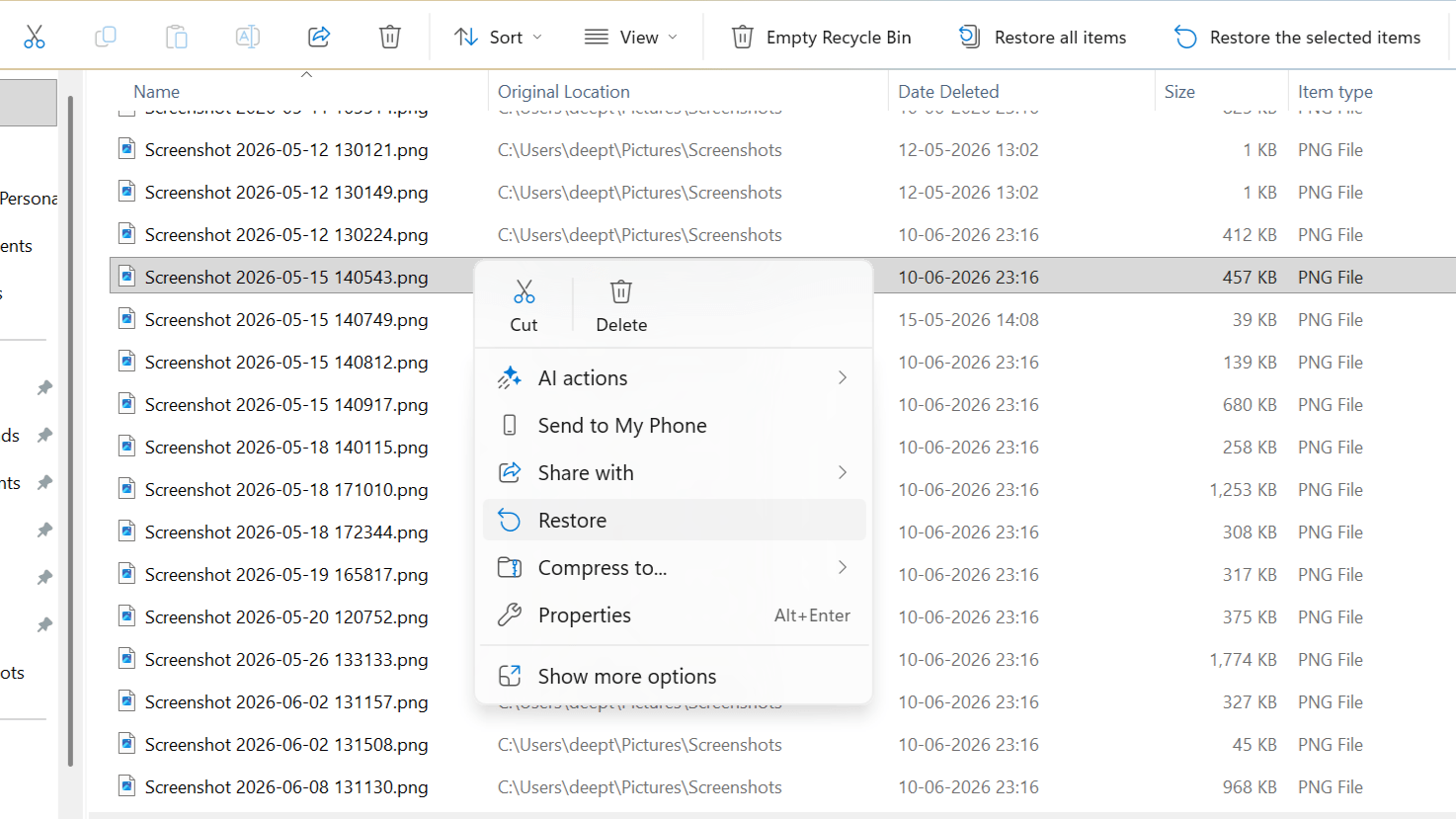
Open the Recycle Bin.
Search for the deleted file by name or file type.
Right-click on the file and choose ‘Restore.’
The file will be restored to its original place.
2. Restore from File History
Another way to recover deleted files is File History. It is a Windows feature that provides backup copies of your files. If it was enabled, you may be able to recover a previous version of your deleted file.
Search for “Restore your files with File History” on Windows.
Open the recovery window.
Browse the available file versions.
Select the file or folder you want to recover.
Click Restore to save it back to its original location.
3. Check Cloud Storage
Deleted files may remain in cloud storage for some time before being permanently deleted. If you previously uploaded the file to a cloud storage service, you may be able to restore it.
Log in to your OneDrive, Google Drive, Dropbox, or another cloud account.
Browse to the folder where the file was saved.
Open the Trash or Deleted Files folder.
Restore the file to its original location or download a copy.
4. Restore from a Backup
If you have a backup of your files, recovering them is usually quick and easy. Check your external hard drive, USB backup, or any manually created backup folders for the missing file.
Recover Permanently Deleted Files for Free Using Stellar Data Recovery Free Edition
When manual recovery methods fail, you can try Stellar Data Recovery Free Edition. This software will help retrieve deleted files from a Windows PC, a USB drive, an SD card, or other external media. The program allows scanning the disk, browsing, and restoring the retrieved files. In the Free Edition, there is up to 2GB of free data retrieval, including 1GB by default and an additional 1 GB through social networking.
Follow these steps to recover permanently deleted files using Stellar Data Recovery Free Edition.
Choose the type of files to recover or select Recover Everything.
Select the drive where the files were deleted.
Run a scan and use Deep Scan if needed.
Preview recoverable files.
Recover the selected files.
Save recovered files to a different drive.
If you need more recovery space, you can unlock an extra 1GB for free.
Steps to Get Your 2 GB Free Data Recovery
You can increase the free recovery limit by following these steps.
Click Get it Now in the activation window.
Select Upgrade Later to continue with the 1GB free version.
When you reach the limit, click the option to unlock an additional 1GB.
Share your experience on social media.
Enter the review link, your name, and your email address.
Submit the form to activate the 1GB bonus using the key sent to your email.
When Should You Use Deep Scan?
Most recovery tools start with a Quick Scan because it is faster. However, it may not find every deleted file. If the Quick Scan doesn’t show your file, try Deep Scan instead. It is also useful if the drive was formatted, the storage device became inaccessible, or the file was deleted a long time ago. Deep Scan takes longer to complete but may find additional recoverable files.
You can recover many different files that were deleted, depending on the storage device’s status. It can be documents, pictures, videos, emails, and ZIP files. The types of document files that can be recovered include Word, Excel, PDF, and PowerPoint files. At the same time, among the types of picture files that can be recovered are JPG, PNG, HEIC, and RAW. File recovery software is also compatible with Windows PCs/Laptops, SSDs, hard disks, USB drives/ SD cards.
Things to Keep in Mind
File recovery is not always successful, so it’s important to keep your expectations realistic. Once your files have been overwritten with new data, there is no way to recover them successfully. Another problem that might affect the success of file recovery is the TRIM functionality in SSDs. With the Stellar Data Recovery Free Edition, one can restore up to 2GB of data free of charge. If one needs to recover data larger than 2GB, they will have to purchase the software.
Tips to Improve Your Recovery Chances
The actions you perform after deletion could affect the ability to recover your files. It is important not to use the drive containing the deleted files, as you may overwrite them with fresh data. If possible, try installing the software on another drive. This helps avoid writing new data to the same storage location.
Always make sure to transfer the recovered files to another drive, not back to the original one. If your files are not found during a Quick Scan, a Deep Scan is available. Preview your recoverable files before recovery to ensure they are the right ones. Complete the file recovery process immediately and keep regular backups to reduce the risk of future data loss.
Final Verdict
Recovering permanently deleted files depends on how the files were deleted and whether the data has been overwritten. For instance, restoring files from the Recycle Bin or a backup is the preferred method when they are available. Whereas, when the files are deleted by pressing “Shift” and “Delete”, deleted from the Recycle Bin, or deleted from an external hard drive, then the use of Stellar Data Recovery Free Edition will be useful. It lets you scan your storage device, preview recoverable files, and recover up to 2 GB of data for free, with the option to upgrade to a paid edition if needed. For users who need to recover more than the free limit, Stellar offers paid plans starting at around $49. The paid plans are worth considering if you need to recover more than the free limit. However, the Stellar Data Recovery Free Edition is one of the best options to recover files.
#Recover #Permanently #Deleted #Files #FreeStellar Data Recovery
We are in the middle of a collectibles craze in which people are increasingly looking for things that help them feel connected with their passions and a community, but we’re really gotta do better than this. According to a report from CBS News, people paid $25 a pop for literal trash that came from Taylor Swift and Travis Kelce’s wedding at Madison Square Garden.
To be fair, it’s not loose garbage that people paid for. Instead, it’s a 1 by 1 by 0.75-inch cube filled with bits of refuse pulled from outside of the venue on July 3, the day of the pop star’s somehow very secretive and very public wedding. The trash was collected and ultimately curated by artist Justin Gignac, who said he picked up most of it from around the Garden’s perimeter.
According to CBS News, he had some interesting finds: a Ring Pop, presumably not fully eaten, a single AirPod, and an ovulation test kit, among other things. He took his findings, divided it up, and preserved it in the cubes before selling them for $25 a pop—though he did also make some larger cubes, 3.5 by 3.5 by 4.5 inches, that went for $100. He made 50 of the small cubes, and they reportedly sold out on the first day he made them available, because we as a society are sick and broken in ways that are difficult to describe.
When your side hustle is trash
While Gigac was certainly capitalizing on the matrimony, it was also kind of just any other day for the artist, who has been collecting, packaging, and selling trash from around New York City for 25 years now as part of an art project/side hustle. Per an interview with Fast Company, Gigac has sold more than 1,700 garbage cubes to patrons around the world who just want a part of the Big Apple.
There’s no authentication process for ensuring the trash in the cubes came from Swift’s wedding, but Gigac seems like a man of his word. Plus, Swifties apparently dined on pastries that they believed but could not confirm came from the wedding, so it’s not like they’re being a particularly discerning bunch about this whole thing. They just want to feel like they’ve gotten a piece of the action, real or imagined.
People can do whatever they want with their time and money, obviously, and Gigac is certainly not at fault here at all for finding an opportunity to make a little money off a thing he’s been doing for decades anyway—and frankly, there’s something cool about the whole concept of his garbage reclamation project in a “one person’s trash is another person’s treasure” kind of way. But paying money for literal scraps from a wedding of an ultra-wealthy celebrity just feels so incredibly on the nose.
We are in the middle of a collectibles craze in which people are increasingly looking for things that help them feel connected with their passions and a community, but we’re really gotta do better than this. According to a report from CBS News, people paid $25 a pop for literal trash that came from Taylor Swift and Travis Kelce’s wedding at Madison Square Garden.
To be fair, it’s not loose garbage that people paid for. Instead, it’s a 1 by 1 by 0.75-inch cube filled with bits of refuse pulled from outside of the venue on July 3, the day of the pop star’s somehow very secretive and very public wedding. The trash was collected and ultimately curated by artist Justin Gignac, who said he picked up most of it from around the Garden’s perimeter.
According to CBS News, he had some interesting finds: a Ring Pop, presumably not fully eaten, a single AirPod, and an ovulation test kit, among other things. He took his findings, divided it up, and preserved it in the cubes before selling them for $25 a pop—though he did also make some larger cubes, 3.5 by 3.5 by 4.5 inches, that went for $100. He made 50 of the small cubes, and they reportedly sold out on the first day he made them available, because we as a society are sick and broken in ways that are difficult to describe.
When your side hustle is trash
While Gigac was certainly capitalizing on the matrimony, it was also kind of just any other day for the artist, who has been collecting, packaging, and selling trash from around New York City for 25 years now as part of an art project/side hustle. Per an interview with Fast Company, Gigac has sold more than 1,700 garbage cubes to patrons around the world who just want a part of the Big Apple.
There’s no authentication process for ensuring the trash in the cubes came from Swift’s wedding, but Gigac seems like a man of his word. Plus, Swifties apparently dined on pastries that they believed but could not confirm came from the wedding, so it’s not like they’re being a particularly discerning bunch about this whole thing. They just want to feel like they’ve gotten a piece of the action, real or imagined.
People can do whatever they want with their time and money, obviously, and Gigac is certainly not at fault here at all for finding an opportunity to make a little money off a thing he’s been doing for decades anyway—and frankly, there’s something cool about the whole concept of his garbage reclamation project in a “one person’s trash is another person’s treasure” kind of way. But paying money for literal scraps from a wedding of an ultra-wealthy celebrity just feels so incredibly on the nose.
But hey, let them eat cake.
#Pay #Taylor #Swifts #Garbage #Isntgarbage,Taylor Swift,trash">How Much Would You Pay for Taylor Swift’s Garbage and Why Isn’t it $0?
We are in the middle of a collectibles craze in which people are increasingly looking for things that help them feel connected with their passions and a community, but we’re really gotta do better than this. According to a report from CBS News, people paid $25 a pop for literal trash that came from Taylor Swift and Travis Kelce’s wedding at Madison Square Garden.
To be fair, it’s not loose garbage that people paid for. Instead, it’s a 1 by 1 by 0.75-inch cube filled with bits of refuse pulled from outside of the venue on July 3, the day of the pop star’s somehow very secretive and very public wedding. The trash was collected and ultimately curated by artist Justin Gignac, who said he picked up most of it from around the Garden’s perimeter.
According to CBS News, he had some interesting finds: a Ring Pop, presumably not fully eaten, a single AirPod, and an ovulation test kit, among other things. He took his findings, divided it up, and preserved it in the cubes before selling them for $25 a pop—though he did also make some larger cubes, 3.5 by 3.5 by 4.5 inches, that went for $100. He made 50 of the small cubes, and they reportedly sold out on the first day he made them available, because we as a society are sick and broken in ways that are difficult to describe.
When your side hustle is trash
While Gigac was certainly capitalizing on the matrimony, it was also kind of just any other day for the artist, who has been collecting, packaging, and selling trash from around New York City for 25 years now as part of an art project/side hustle. Per an interview with Fast Company, Gigac has sold more than 1,700 garbage cubes to patrons around the world who just want a part of the Big Apple.
There’s no authentication process for ensuring the trash in the cubes came from Swift’s wedding, but Gigac seems like a man of his word. Plus, Swifties apparently dined on pastries that they believed but could not confirm came from the wedding, so it’s not like they’re being a particularly discerning bunch about this whole thing. They just want to feel like they’ve gotten a piece of the action, real or imagined.
People can do whatever they want with their time and money, obviously, and Gigac is certainly not at fault here at all for finding an opportunity to make a little money off a thing he’s been doing for decades anyway—and frankly, there’s something cool about the whole concept of his garbage reclamation project in a “one person’s trash is another person’s treasure” kind of way. But paying money for literal scraps from a wedding of an ultra-wealthy celebrity just feels so incredibly on the nose.





Post Comment