How record auctions are fuelling India’s art boom

How record auctions are fuelling India’s art boom

Anahita SachdevBBC News, Delhi

Saffronart A painting with golden and yellow specks depicting a play with light and texture. It was made by Modernist painter VS Gaitonde in 1971Saffronart

VS Gaitonde’s Untitled fetched $40.2m at a recent record-breaking auction in Delhi

A radiant golden canvas layered with subtle textures and faint shapes, exuding both energy and tranquillity.

This untitled 1971 painting by Vasudeo Santu Gaitonde headlined a record-breaking recent Saffronart auction in Delhi, which fetched $40.2m (£29.9m) – the highest-ever total for South Asian art. Gaitonde’s work alone sold for $7.57m, nearly three times its estimate, making it India’s second most expensive painting.

The bidding added momentum to an already strong auction season for Indian art.

Just days later, Sotheby’s sold artist Francis Newton Souza’s landscape, Houses in Hampstead, at a price marginally lower than Gaitonde’s piece, making it India’s third highest grossing painting. Earlier this year, the record for India’s most expensive painting was reset when MF Husain’s Untitled (Gram Yatra) fetched a staggering $13.8m.

Auctioneers and curators say India’s art market is witnessing an unprecedented boom, driven by a surge of art fairs, galleries, and exhibition spaces across cities and towns.

Industry insiders estimate that the market is worth $338m, up exponentially from $2m at the turn of the century, and will expand to $1.1bn by 2030.


Sotheby's Francis Newton Souza's painting Houses in Hampstead (1962), which has become India's third most expensive paintingSotheby’s

Francis Newton Souza’s Houses in Hampstead has become India’s third most expensive painting

Dinesh Vazirani, a founder of Saffronart, believes this is a “point of massive inflection”.

Marking its 25th anniversary, Saffronart’s recent auction saw a packed room, spirited bidding, and a rare “white glove” result – every lot sold, with some attendees even “squabbling” over artworks, according to an attendee.

“When we started in 2000, people said we were crazy. Who’s going to buy art online?” Mr Vazirani said.

“Seeing the art market with so much strength almost validated that what we started as maybe foolish young people has become a very mature industry.”

The boom in Indian art – which dominates South Asia’s market – comes even as global art sales slump. The 2024 Art Basel and UBS report shows a 12% drop worldwide, the second yearly decline.

Mr Vazirani predicts the auction market could double last year’s earnings, driven by rising wealth in India and among the diaspora.

Millionaire households have nearly doubled in four years. As the rich pour money into their luxurious lifestyle, art has become both a status symbol and an investment.

For these groups, art is a generational asset that can also be enjoyed, Mr Vazirani argues.

“They understand that you can’t buy it and trade in it. But if you hold it for long periods of time, the appreciation is quite dramatic.”

Recent tax cuts slashing goods and services tax (GST) on art from 12% to 5% have also helped boost the market.

While global buyers dominate, much of the demand abroad comes from diaspora collectors seeking “a slice of their heritage”, said Manjari Sihare-Sutin, co-head of Sotheby’s Indian and South Asian Art department. Its recent auction, which sold the Souza painting, was another “white glove” sale, earning $25.5m – the department’s highest total in 30 years.

“I think art has become an important conduit for both local collectors and Indian diaspora outside of India to reconnect with their roots,” Ms Sihare-Sutin said.
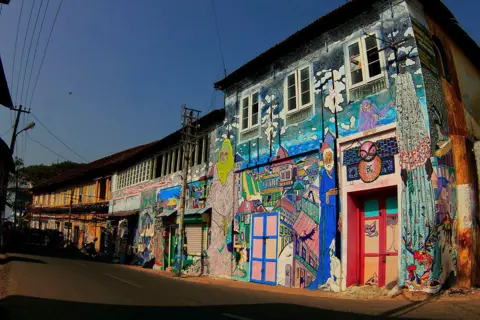
Getty A painted wall at the Kochi-Muziris Biennale in the southern state of Kerala. The event is popular for its exhibits featuring contemporary art from India and overseas.Getty

The Kochi-Muziris Biennale in the southern state of Kerala is popular for its exhibits

These trends have attracted new buyers: a third of Sotheby’s last-month bidders were first-timers with them, while Saffronart reports 25–30% of its buyers are recent entrants.

While top sales often feature established modernists like Husain, Souza, Gaitonde, and Raza, auctioneers say rising top prices lift demand and values for previously overlooked artists as well.

Unlike the brief speculative boom of the early 2000s, which collapsed in 2008, insiders say the current surge in the Indian art market feels more sustainable, going beyond galleries and auctions.

Curator Ina Puri notes a resurgence in India’s art scene, driven by growing recognition of Indian artists and increased investment in spaces for public engagement.

“I feel that Indian art has made a comeback,” Ms Puri said.

“Across the country, there are new institutions, museums and spaces coming up to showcase art.”

Government funding for the arts has long lagged behind other priorities, leaving the private sector to lead. A notable example is Kiran Nadar Museum of Art’s new Delhi building, set to open in 2026, spanning 100,000 sq m and showcasing both visual and performance art.

Other examples: Hampi Art Labs in Karnataka offers exhibitions and artist residencies; Art Mumbai fair’s third edition in November expects 40,000 visitors; and Renault’s planned Chennai design centre will merge technology with artistic collaboration.

These join established events like the India Art Fair in Delhi and Kochi-Muziris Biennale in Kerala, which draw record crowds annually.

Galleries are increasingly showcasing indigenous and marginalised art, Ms Puri said, though more support is needed for students and emerging artists.
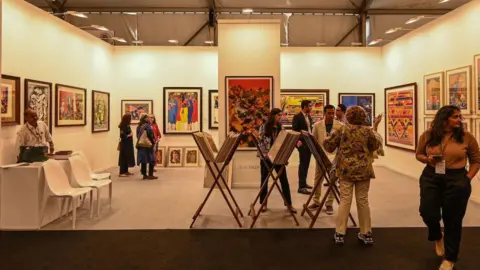
AFP via Getty Images Visitors look at exhibits at the India Art Fair in New Delhi on February 9, 2023AFP via Getty Images

The India Art Fair in Delhi is a popular event that receives thousands of visitors annually

Delhi-based non-profit Khoj, founded in 1997, tries to fill this gap by supporting emerging artists through programs and residencies. Director Pooja Sood notes growing participation from smaller towns often overlooked by the art world.

“They’re trying to build their own thing,” she said. “It’s fantastic”.

Rising interest in South Asian art boosts the ecosystem, but record-breaking sales of established artists don’t directly aid newcomers – ground-up support remains essential.

Ms Sood stresses that Khoj operates outside the commercial art world, offering young and mid-career artists a space to explore, experiment, and “even fail if they have to”.

“I feel the more mad, crazy, experimental art happens in very small pockets, and that’s what we’re always trying to build.”

Source link
#record #auctions #fuelling #Indias #art #boom

#Video #Latest #news #bulletin #April #18th #Midday{id:11940,slug:news,urlSafeValue:news,title:news},{id:12984,slug:world-news,urlSafeValue:world-news,title:World News},{id:25926,slug:top-stories,urlSafeValue:top-stories,title:Latest News},{id:26778,slug:euronews-live,urlSafeValue:euronews-live,title:euronews live}">Video. Latest news bulletin | April 18th, 2026 – Midday
      
                  
              Updated: 18/04/2026 – 12:00 GMT+2
          
              
                    Catch up with the most important stories from around Europe and beyond this April 18th, 2026 – latest news, breaking news, World, Business, Entertainment, Politics, Culture, Travel.
              
                … More


    #Video #Latest #news #bulletin #April #18th #Midday{id:11940,slug:news,urlSafeValue:news,title:news},{id:12984,slug:world-news,urlSafeValue:world-news,title:World News},{id:25926,slug:top-stories,urlSafeValue:top-stories,title:Latest News},{id:26778,slug:euronews-live,urlSafeValue:euronews-live,title:euronews live}

It was the shelling that drove Syrian man Imad Omar Qashit from his home again. Fourteen years ago, he fled from Syria to Lebanon. This time, it was the other way round.

“When Israeli missiles destroyed entire homes in my neighborhood in southern Lebanon’s city of Tyre, we decided it was time to save our lives again,” the 52-year-old told DW.

In early March, Lebanon was drawn into the wider Middle East war after local group Hezbollah, which is backed by Iran, fired rockets into Israel, ostensibly in retaliation for the Israeli killing of Iran’s leader.

On Thursday, a 10-day ceasefire between Israel and Lebanon was brokered by the US but before that, more than 227,549 people had crossed the three official border points from Lebanon into Syria, according to the latest numbers from the United Nation’s International Organization for Migration (IOM). The vast majority, 95%, were Syrians, while 5% were Lebanese nationals.

Lebanon’s health authorities say the death toll from Israel’s attacks on the Hezbollah militia is around 2,196. The ministry does not provide a breakdown by nationality and estimates of how many Syrians are among the killed and injured range widely, from 39 to 315. According to the UN refugee agency UNHCR, more than 1 million Syrian refugees are still registered in Lebanon, with hundreds of thousands more believed to be in the country without registration.

Syrians wait at a border crossing as refugees
More than 270,000 Syrians returned from Lebanon since March even though observers warn the country is not ready to host them Image: Izz Aldien Alqasem/Anadolu Agency/IMAGO

Protracted crisis

Once Qashit and his family arrived back in their home town Maarat al-Numan near Aleppo, they found their house completely destroyed as a result of Syria’s civil war, which only ended in December 2024 after a coalition of rebel groups ousted Syria’s longtime dictator, Bashar Assad.

“There are no houses for rent as the whole city is destroyed,” Qashit told DW. For the time being, they are staying with his sister. 

Another Syrian, Mohammad Jassem al-Brouk, fled Israeli strikes in Lebanon two weeks ago. “It was extremely crowded at the border crossing and it took an entire day to get through,” he told DW.

When he eventually arrived at his family home in the city of Qusair near Homs, he only found remnants of the house. With no other option, he unpacked his tent from the refugee camp in Lebanon, set it up, and is now living in it. Despite his lack of housing, he has no intention of returning to Lebanon. 

Earlier in April, a survey by the UN’s refugee agency, the UNHCR, found that around half of the Syrians they had interviewed also said that they intend to remain permanently in Syria despite economic challenges and limited state services.

“Syrians are returning because Lebanon has become unlivable, rather than Syria being ready to receive them,” Nanar Hawach, senior Syria analyst at the International Crisis Group, confirms. “The government can manage the border but it has no answer for what happens after that,” he said. In his view, the hundreds of thousands of returnees should not be read as a sign that conditions inside Syria have improved.

A boy jumps off the back of the rusted and charred remains of abandoned military vehicles
Areas that were contested during the Syrian civil war are often contaminated with unexploded devices that pose a danger to returning SyriansImage: Arif Hudaverdi Yaman/Anadolu/picture alliance

Legacy of war

Syria continues to struggle with the legacy of more than a decade of conflict. Despite sanctions being lifted and Syria’s return to the international fold, sectarian clashes and political instability still compound the country’s problems.

The World Bank’s damage assessment estimates total reconstruction costs at about $216 billion (€200 billion). Basic services, including education, health care and infrastructure, remain limited and the humanitarian situation for the around 26 million people is  dire.

According to the UN, around 15.6 million Syrians require humanitarian assistance and 13.3 million Syrians are food-insecure. A severe drought in 2025 devastated 95% of rainfed crops, the UN 2025 food security assessment report notes.

“Syria was already in a protracted humanitarian crisis before this new wave of returns,” Hiba Zayadin, senior researcher in the Middle East and North Africa division at Human Rights Watch, told DW. “The infrastructure simply isn’t there to absorb large numbers of people, many of whom left with nothing and are returning to the same.” 

A woman walks next to an ambulance
Before the US-brokered ceasefire, Israel demolished large parts of southern Lebanon and Tyre, prompting Syrian refugees to pack up and leaveImage: Louisa Gouliamaki/REUTERS

Risk of unexploded devices

These are not the only issues. Syria is also one of the most contaminated countries in the world when it comes to explosive remnants. “Years of aerial bombardment, ground fighting and the use of cluster munitions across multiple governorates have left vast areas littered with unexploded ordnance, or UXO, landmines and improvised explosive devices,” Zayadin continued.

“The danger is very real,” Iain Overton confirmed. He’s the executive director of the UK-based organization, Action on Armed Violence (AOAV) which records evidence of armed violence against civilians worldwide.

He also warned that UXO contamination remains particularly acute in areas that have seen sustained fighting and shifting frontlines, including parts of Raqqa, Deir el-Zour, Aleppo, Idlib and rural Homs and Hama. “These are precisely the areas to which many refugees are returning,” he told DW, adding that children and returnees unfamiliar with contaminated environments are especially vulnerable.

“Even in the absence of active hostilities, the legacy of explosive violence continues to kill and injure,” Overton said, adding that the trend is worsening. In 2024, AOAV recorded 238 UXO incidents causing 508 casualties. Of these, 479 were civilians. By 2025, this had risen sharply to 794 incidents and 1,537 casualties, including 1,424 civilians.

For Qashit and his family, recently returned from Lebanon, these is just one more thing to worry about. “My children would not recognize unexploded mines when they are playing outside,” he said, concerned. 

Back to Yarmouk: A Syrian family rebuilds and seeks justice

Edited by: C. Schaer

#Displaced #Iran #war #Lebanon #Syrian #crisis">Displaced by Iran war: out of Lebanon, into Syrian crisisIt was the shelling that drove Syrian man Imad Omar Qashit from his home again. Fourteen years ago, he fled from Syria to Lebanon. This time, it was the other way round.

“When Israeli missiles destroyed entire homes in my neighborhood in southern Lebanon’s city of Tyre, we decided it was time to save our lives again,” the 52-year-old told DW.

In early March, Lebanon was drawn into the wider Middle East war after local group Hezbollah, which is backed by Iran, fired rockets into Israel, ostensibly in retaliation for the Israeli killing of Iran’s leader.

On Thursday, a 10-day ceasefire between Israel and Lebanon was brokered by the US but before that, more than 227,549 people had crossed the three official border points from Lebanon into Syria, according to the latest numbers from the United Nation’s International Organization for Migration (IOM). The vast majority, 95%, were Syrians, while 5% were Lebanese nationals.

Lebanon’s health authorities say the death toll from Israel’s attacks on the Hezbollah militia is around 2,196. The ministry does not provide a breakdown by nationality and estimates of how many Syrians are among the killed and injured range widely, from 39 to 315. According to the UN refugee agency UNHCR, more than 1 million Syrian refugees are still registered in Lebanon, with hundreds of thousands more believed to be in the country without registration.More than 270,000 Syrians returned from Lebanon since March even though observers warn the country is not ready to host them Image: Izz Aldien Alqasem/Anadolu Agency/IMAGO

Protracted crisis

Once Qashit and his family arrived back in their home town Maarat al-Numan near Aleppo, they found their house completely destroyed as a result of Syria’s civil war, which only ended in December 2024 after a coalition of rebel groups ousted Syria’s longtime dictator, Bashar Assad.

“There are no houses for rent as the whole city is destroyed,” Qashit told DW. For the time being, they are staying with his sister. 

Another Syrian, Mohammad Jassem al-Brouk, fled Israeli strikes in Lebanon two weeks ago. “It was extremely crowded at the border crossing and it took an entire day to get through,” he told DW.

When he eventually arrived at his family home in the city of Qusair near Homs, he only found remnants of the house. With no other option, he unpacked his tent from the refugee camp in Lebanon, set it up, and is now living in it. Despite his lack of housing, he has no intention of returning to Lebanon. 

Earlier in April, a survey by the UN’s refugee agency, the UNHCR, found that around half of the Syrians they had interviewed also said that they intend to remain permanently in Syria despite economic challenges and limited state services.

“Syrians are returning because Lebanon has become unlivable, rather than Syria being ready to receive them,” Nanar Hawach, senior Syria analyst at the International Crisis Group, confirms. “The government can manage the border but it has no answer for what happens after that,” he said. In his view, the hundreds of thousands of returnees should not be read as a sign that conditions inside Syria have improved.Areas that were contested during the Syrian civil war are often contaminated with unexploded devices that pose a danger to returning SyriansImage: Arif Hudaverdi Yaman/Anadolu/picture alliance

Legacy of war

Syria continues to struggle with the legacy of more than a decade of conflict. Despite sanctions being lifted and Syria’s return to the international fold, sectarian clashes and political instability still compound the country’s problems.

The World Bank’s damage assessment estimates total reconstruction costs at about 6 billion (€200 billion). Basic services, including education, health care and infrastructure, remain limited and the humanitarian situation for the around 26 million people is  dire.

According to the UN, around 15.6 million Syrians require humanitarian assistance and 13.3 million Syrians are food-insecure. A severe drought in 2025 devastated 95% of rainfed crops, the UN 2025 food security assessment report notes.

“Syria was already in a protracted humanitarian crisis before this new wave of returns,” Hiba Zayadin, senior researcher in the Middle East and North Africa division at Human Rights Watch, told DW. “The infrastructure simply isn’t there to absorb large numbers of people, many of whom left with nothing and are returning to the same.”  Before the US-brokered ceasefire, Israel demolished large parts of southern Lebanon and Tyre, prompting Syrian refugees to pack up and leaveImage: Louisa Gouliamaki/REUTERS

Risk of unexploded devices

These are not the only issues. Syria is also one of the most contaminated countries in the world when it comes to explosive remnants. “Years of aerial bombardment, ground fighting and the use of cluster munitions across multiple governorates have left vast areas littered with unexploded ordnance, or UXO, landmines and improvised explosive devices,” Zayadin continued.

“The danger is very real,” Iain Overton confirmed. He’s the executive director of the UK-based organization, Action on Armed Violence (AOAV) which records evidence of armed violence against civilians worldwide.

He also warned that UXO contamination remains particularly acute in areas that have seen sustained fighting and shifting frontlines, including parts of Raqqa, Deir el-Zour, Aleppo, Idlib and rural Homs and Hama. “These are precisely the areas to which many refugees are returning,” he told DW, adding that children and returnees unfamiliar with contaminated environments are especially vulnerable.

“Even in the absence of active hostilities, the legacy of explosive violence continues to kill and injure,” Overton said, adding that the trend is worsening. In 2024, AOAV recorded 238 UXO incidents causing 508 casualties. Of these, 479 were civilians. By 2025, this had risen sharply to 794 incidents and 1,537 casualties, including 1,424 civilians.

For Qashit and his family, recently returned from Lebanon, these is just one more thing to worry about. “My children would not recognize unexploded mines when they are playing outside,” he said, concerned. 

Back to Yarmouk: A Syrian family rebuilds and seeks justice To view this video please enable JavaScript, and consider upgrading to a web browser that supports HTML5 video

Edited by: C. Schaer
#Displaced #Iran #war #Lebanon #Syrian #crisis

Syria to Lebanon. This time, it was the other way round.

“When Israeli missiles destroyed entire homes in my neighborhood in southern Lebanon’s city of Tyre, we decided it was time to save our lives again,” the 52-year-old told DW.

In early March, Lebanon was drawn into the wider Middle East war after local group Hezbollah, which is backed by Iran, fired rockets into Israel, ostensibly in retaliation for the Israeli killing of Iran’s leader.

On Thursday, a 10-day ceasefire between Israel and Lebanon was brokered by the US but before that, more than 227,549 people had crossed the three official border points from Lebanon into Syria, according to the latest numbers from the United Nation’s International Organization for Migration (IOM). The vast majority, 95%, were Syrians, while 5% were Lebanese nationals.

Lebanon’s health authorities say the death toll from Israel’s attacks on the Hezbollah militia is around 2,196. The ministry does not provide a breakdown by nationality and estimates of how many Syrians are among the killed and injured range widely, from 39 to 315. According to the UN refugee agency UNHCR, more than 1 million Syrian refugees are still registered in Lebanon, with hundreds of thousands more believed to be in the country without registration.

Syrians wait at a border crossing as refugees
More than 270,000 Syrians returned from Lebanon since March even though observers warn the country is not ready to host them Image: Izz Aldien Alqasem/Anadolu Agency/IMAGO

Protracted crisis

Once Qashit and his family arrived back in their home town Maarat al-Numan near Aleppo, they found their house completely destroyed as a result of Syria’s civil war, which only ended in December 2024 after a coalition of rebel groups ousted Syria’s longtime dictator, Bashar Assad.

“There are no houses for rent as the whole city is destroyed,” Qashit told DW. For the time being, they are staying with his sister. 

Another Syrian, Mohammad Jassem al-Brouk, fled Israeli strikes in Lebanon two weeks ago. “It was extremely crowded at the border crossing and it took an entire day to get through,” he told DW.

When he eventually arrived at his family home in the city of Qusair near Homs, he only found remnants of the house. With no other option, he unpacked his tent from the refugee camp in Lebanon, set it up, and is now living in it. Despite his lack of housing, he has no intention of returning to Lebanon. 

Earlier in April, a survey by the UN’s refugee agency, the UNHCR, found that around half of the Syrians they had interviewed also said that they intend to remain permanently in Syria despite economic challenges and limited state services.

“Syrians are returning because Lebanon has become unlivable, rather than Syria being ready to receive them,” Nanar Hawach, senior Syria analyst at the International Crisis Group, confirms. “The government can manage the border but it has no answer for what happens after that,” he said. In his view, the hundreds of thousands of returnees should not be read as a sign that conditions inside Syria have improved.

A boy jumps off the back of the rusted and charred remains of abandoned military vehicles
Areas that were contested during the Syrian civil war are often contaminated with unexploded devices that pose a danger to returning SyriansImage: Arif Hudaverdi Yaman/Anadolu/picture alliance

Legacy of war

Syria continues to struggle with the legacy of more than a decade of conflict. Despite sanctions being lifted and Syria’s return to the international fold, sectarian clashes and political instability still compound the country’s problems.

The World Bank’s damage assessment estimates total reconstruction costs at about $216 billion (€200 billion). Basic services, including education, health care and infrastructure, remain limited and the humanitarian situation for the around 26 million people is  dire.

According to the UN, around 15.6 million Syrians require humanitarian assistance and 13.3 million Syrians are food-insecure. A severe drought in 2025 devastated 95% of rainfed crops, the UN 2025 food security assessment report notes.

“Syria was already in a protracted humanitarian crisis before this new wave of returns,” Hiba Zayadin, senior researcher in the Middle East and North Africa division at Human Rights Watch, told DW. “The infrastructure simply isn’t there to absorb large numbers of people, many of whom left with nothing and are returning to the same.” 

A woman walks next to an ambulance
Before the US-brokered ceasefire, Israel demolished large parts of southern Lebanon and Tyre, prompting Syrian refugees to pack up and leaveImage: Louisa Gouliamaki/REUTERS

Risk of unexploded devices

These are not the only issues. Syria is also one of the most contaminated countries in the world when it comes to explosive remnants. “Years of aerial bombardment, ground fighting and the use of cluster munitions across multiple governorates have left vast areas littered with unexploded ordnance, or UXO, landmines and improvised explosive devices,” Zayadin continued.

“The danger is very real,” Iain Overton confirmed. He’s the executive director of the UK-based organization, Action on Armed Violence (AOAV) which records evidence of armed violence against civilians worldwide.

He also warned that UXO contamination remains particularly acute in areas that have seen sustained fighting and shifting frontlines, including parts of Raqqa, Deir el-Zour, Aleppo, Idlib and rural Homs and Hama. “These are precisely the areas to which many refugees are returning,” he told DW, adding that children and returnees unfamiliar with contaminated environments are especially vulnerable.

“Even in the absence of active hostilities, the legacy of explosive violence continues to kill and injure,” Overton said, adding that the trend is worsening. In 2024, AOAV recorded 238 UXO incidents causing 508 casualties. Of these, 479 were civilians. By 2025, this had risen sharply to 794 incidents and 1,537 casualties, including 1,424 civilians.

For Qashit and his family, recently returned from Lebanon, these is just one more thing to worry about. “My children would not recognize unexploded mines when they are playing outside,” he said, concerned. 

Back to Yarmouk: A Syrian family rebuilds and seeks justice

Edited by: C. Schaer

#Displaced #Iran #war #Lebanon #Syrian #crisis">Displaced by Iran war: out of Lebanon, into Syrian crisis

It was the shelling that drove Syrian man Imad Omar Qashit from his home again. Fourteen years ago, he fled from Syria to Lebanon. This time, it was the other way round.

“When Israeli missiles destroyed entire homes in my neighborhood in southern Lebanon’s city of Tyre, we decided it was time to save our lives again,” the 52-year-old told DW.

In early March, Lebanon was drawn into the wider Middle East war after local group Hezbollah, which is backed by Iran, fired rockets into Israel, ostensibly in retaliation for the Israeli killing of Iran’s leader.

On Thursday, a 10-day ceasefire between Israel and Lebanon was brokered by the US but before that, more than 227,549 people had crossed the three official border points from Lebanon into Syria, according to the latest numbers from the United Nation’s International Organization for Migration (IOM). The vast majority, 95%, were Syrians, while 5% were Lebanese nationals.

Lebanon’s health authorities say the death toll from Israel’s attacks on the Hezbollah militia is around 2,196. The ministry does not provide a breakdown by nationality and estimates of how many Syrians are among the killed and injured range widely, from 39 to 315. According to the UN refugee agency UNHCR, more than 1 million Syrian refugees are still registered in Lebanon, with hundreds of thousands more believed to be in the country without registration.

Syrians wait at a border crossing as refugees
More than 270,000 Syrians returned from Lebanon since March even though observers warn the country is not ready to host them Image: Izz Aldien Alqasem/Anadolu Agency/IMAGO

Protracted crisis

Once Qashit and his family arrived back in their home town Maarat al-Numan near Aleppo, they found their house completely destroyed as a result of Syria’s civil war, which only ended in December 2024 after a coalition of rebel groups ousted Syria’s longtime dictator, Bashar Assad.

“There are no houses for rent as the whole city is destroyed,” Qashit told DW. For the time being, they are staying with his sister. 

Another Syrian, Mohammad Jassem al-Brouk, fled Israeli strikes in Lebanon two weeks ago. “It was extremely crowded at the border crossing and it took an entire day to get through,” he told DW.

When he eventually arrived at his family home in the city of Qusair near Homs, he only found remnants of the house. With no other option, he unpacked his tent from the refugee camp in Lebanon, set it up, and is now living in it. Despite his lack of housing, he has no intention of returning to Lebanon. 

Earlier in April, a survey by the UN’s refugee agency, the UNHCR, found that around half of the Syrians they had interviewed also said that they intend to remain permanently in Syria despite economic challenges and limited state services.

“Syrians are returning because Lebanon has become unlivable, rather than Syria being ready to receive them,” Nanar Hawach, senior Syria analyst at the International Crisis Group, confirms. “The government can manage the border but it has no answer for what happens after that,” he said. In his view, the hundreds of thousands of returnees should not be read as a sign that conditions inside Syria have improved.

A boy jumps off the back of the rusted and charred remains of abandoned military vehicles
Areas that were contested during the Syrian civil war are often contaminated with unexploded devices that pose a danger to returning SyriansImage: Arif Hudaverdi Yaman/Anadolu/picture alliance

Legacy of war

Syria continues to struggle with the legacy of more than a decade of conflict. Despite sanctions being lifted and Syria’s return to the international fold, sectarian clashes and political instability still compound the country’s problems.

The World Bank’s damage assessment estimates total reconstruction costs at about $216 billion (€200 billion). Basic services, including education, health care and infrastructure, remain limited and the humanitarian situation for the around 26 million people is  dire.

According to the UN, around 15.6 million Syrians require humanitarian assistance and 13.3 million Syrians are food-insecure. A severe drought in 2025 devastated 95% of rainfed crops, the UN 2025 food security assessment report notes.

“Syria was already in a protracted humanitarian crisis before this new wave of returns,” Hiba Zayadin, senior researcher in the Middle East and North Africa division at Human Rights Watch, told DW. “The infrastructure simply isn’t there to absorb large numbers of people, many of whom left with nothing and are returning to the same.” 

A woman walks next to an ambulance
Before the US-brokered ceasefire, Israel demolished large parts of southern Lebanon and Tyre, prompting Syrian refugees to pack up and leaveImage: Louisa Gouliamaki/REUTERS

Risk of unexploded devices

These are not the only issues. Syria is also one of the most contaminated countries in the world when it comes to explosive remnants. “Years of aerial bombardment, ground fighting and the use of cluster munitions across multiple governorates have left vast areas littered with unexploded ordnance, or UXO, landmines and improvised explosive devices,” Zayadin continued.

“The danger is very real,” Iain Overton confirmed. He’s the executive director of the UK-based organization, Action on Armed Violence (AOAV) which records evidence of armed violence against civilians worldwide.

He also warned that UXO contamination remains particularly acute in areas that have seen sustained fighting and shifting frontlines, including parts of Raqqa, Deir el-Zour, Aleppo, Idlib and rural Homs and Hama. “These are precisely the areas to which many refugees are returning,” he told DW, adding that children and returnees unfamiliar with contaminated environments are especially vulnerable.

“Even in the absence of active hostilities, the legacy of explosive violence continues to kill and injure,” Overton said, adding that the trend is worsening. In 2024, AOAV recorded 238 UXO incidents causing 508 casualties. Of these, 479 were civilians. By 2025, this had risen sharply to 794 incidents and 1,537 casualties, including 1,424 civilians.

For Qashit and his family, recently returned from Lebanon, these is just one more thing to worry about. “My children would not recognize unexploded mines when they are playing outside,” he said, concerned. 

Back to Yarmouk: A Syrian family rebuilds and seeks justice

Edited by: C. Schaer

#Displaced #Iran #war #Lebanon #Syrian #crisis
Live Updates: Trump says U.S. will continue blockade after Iran says Strait of Hormuz 
                World shares were mixed Friday even after Wall Street set another record, as investors watched for signs of more U.S.-Iran talks and an extension of the ceasefire of the Iran war that is expiring next week.Oil prices fell Friday, while U.S. futures edged up.President Trump suggested Thursday that he’s open to extending the two-week ceasefire in the Iran war, and Iran’s U.N. envoy said Tehran remained “cautiously optimistic” over negotiations with the U.S.As optimism over an extended ceasefire grew, oil prices fell early Friday after climbing a day earlier. Brent crude, the international standard, was 3.2% lower at .25 per barrel. It had surged roughly 40% since the beginning of the Iran war in late February. Benchmark U.S. crude was down 3.6% to .86 a barrel.Global energy shocks are growing over impacts of the Iran war, with the Strait of Hormuz remaining largely closed while the U.S. imposed a sea blockade on Iranian ports. The head of the International Energy Agency told The Associated Press on Thursday that Europe has “maybe six weeks or so” of jet fuel supplies remaining and warned of flight cancellations “soon.” In stocks, U.S. futures for the Dow Jones Industrial Average rose 0.5%, while futures for the S&P 500 and Nasdaq both ticked up 0.3% Friday.Early European trading saw Britain’s FTSE 100 index down 0.2% to 10,567.17. France’s CAC 40 was 0.4% higher at 8,293.21, while Germany’s DAX gained 0.6% to 24,308.82.Asian stocks were mostly lower. Tokyo’s Nikkei 225 fell 1.8% to 58,475.90 after reaching an all-time high on Thursday. South Korea’s Kospi was 0.6% lower at 6,191.92. Hong Kong’s Hang Seng dropped 0.9% to 26,160.33. The Shanghai Composite index edged down 0.1% to 4,051.43.Australia’s S&P/ASX 200 lost 0.1%. Taiwan’s Taiex traded 0.9% lower, while India’s Sensex gained 0.7%.
              #Live #Updates #Trump #U.S #continue #blockade #Iran #Strait #HormuzWar, Iran, Israel, Ceasefire, Donald Trump, Hezbollah, Lebanon, Middle East, Oil and Gas, Strait of Hormuz

Post Comment