×
Iran faces unprecedented drought as water crisis hits Tehran

Iran faces unprecedented drought as water crisis hits Tehran

Parham GhobadiBBC Persian
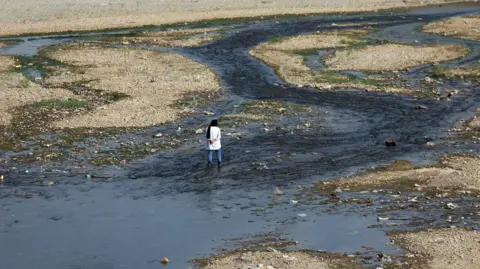
EPA A woman stands by an almost entirely dried out river in Tehran that was once full EPA

Iran – especially its capital, Tehran – is facing an unprecedented drought this autumn, with rainfall at record lows and reservoirs nearly empty. Officials are pleading with citizens to conserve water as the crisis deepens.

President Masoud Pezeshkian has warned that if there is not enough rainfall soon, Tehran’s water supply could be rationed. But he said that even rationing might not be enough to prevent a disaster.

“If rationing doesn’t work,” Pezeshkian said, “we may have to evacuate Tehran.”

His comments have prompted criticism in Iranian newspapers and on social media. Former Tehran mayor Gholamhossein Karbaschi called the idea “a joke” and said “evacuating Tehran makes no sense at all”.

Iran’s meteorological officials say no rainfall is expected over the next 10 days.

Meanwhile, the water crisis is already affecting daily life in the capital.

“I’m planning to buy water tankers to use for toilets and other necessities,” a woman in Tehran told BBC Persian.

In the summer, Iranian rapper Vafa Ahmadpoor posted a video on social media showing a kitchen tap with no running water.

“It’s been four or five hours,” he said. “I’ve bought bottled water just to be able to go to the toilet.”

Dams nearly empty

The manager of the Latian Dam, one of Tehran’s main water sources, says it now holds less than 10% of its capacity. The nearby Karaj Dam — which supplies water to both Tehran and Alborz provinces — is in a similarly dire condition.

“I have never seen this dam so empty since I was born,” an elderly local resident told Iranian state TV.

According to Mohammad-Ali Moallem, the manager of the Karaj Dam, rainfall has plummeted dramatically.

“We had a 92% decrease in rain compared to last year,” he said. “We have only eight per cent water in our reservoir — and most of it is unusable and considered ‘dead water.'”

Fears of water cuts

The government is now pinning its hopes on late autumn rain, but forecasts are bleak. Iran’s Minister of Energy, Abbas Ali Abadi, has warned the situation could soon force authorities to cut water supplies.

“Some nights we might decrease the water flow to zero,” he said.

Officials have also announced plans to penalise households and businesses that consume excessive amounts of water.

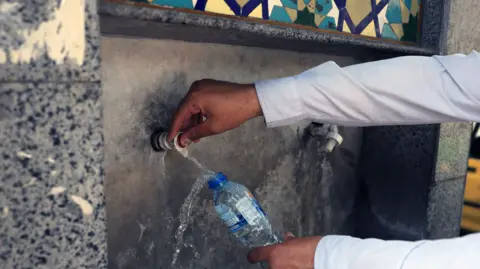
ABEDIN TAHERKENREH/EPA/Shutterstock Someone filling up a water bottle from a water fountain in TehranABEDIN TAHERKENREH/EPA/Shutterstock

The government has warned that it may have to restrict water supplies if the weather remains dry

Pipes, war damage – and a widening crisis

Iran’s energy minister Ali Abadi has said Tehran’s water crisis is not only due to a lack of rainfall. He blamed water leakage caused by the capital’s century-old water infrastructure and even pointed to the recent 12-day war with Israel.

During that conflict, Israel targeted the northern Tehran neighbourhood of Tajrish on 15 June. Afterwards videos showed heavy flooding in the area.

The day after the strike, the Israel Defence Forces said it had targeted Iranian military “command centres”.

But the crisis extends far beyond the capital.

The head of Iran’s National Centre for Climate and Drought Crisis Management, Ahmad Vazifeh, has warned that, apart from Tehran, dams in many other provinces — including West Azerbaijan, East Azerbaijan and Markazi — are also in a “worrying state”, with water levels in the single-digit percentages.

In Mashhad, Iran’s second-largest city, officials are sounding the alarm as well.

The Governor of Khorasan Razavi Province in north-east Iran, said the water reserves in Mashhad’s dams have dropped to “less than eight percent,” warning that the province faces a “mega-challenge of drought.”

CEO of Mashhad’s Water and Wastewater Company put the figure even lower.

“The storage level of the city’s main dam is below three percent,” Hossein Esmaeilian said.

“Only three percent of the combined capacity of Mashhad’s four water-supplying dams — Torogh, Kardeh, Doosti, and Ardak — remains. Apart from Doosti Dam, the other three are out of operation.”

A crisis long foreseen

Iran’s water crisis has been decades in the making.

Even Iran’s Supreme Leader, Ayatollah Ali Khamenei, has repeatedly acknowledged the looming threat — speaking about water shortages in his Nowruz addresses in 2011 and on other occasions in the following years.

Yet little has changed.

Today, Tehran, Karaj and Mashhad — home to more than 16 million people combined — are facing the real possibility of their taps running dry.

Source link
#Iran #faces #unprecedented #drought #water #crisis #hits #Tehran

The late Argentinian football legend’s childhood home has been converted into a soup kitchen serving those affected by President Javier Milei’s austerity measures.

At 523 Amazor street in Fiorito, a Buenos Aires suburb where the “Golden Boy” experienced extreme poverty growing up, locals can now receive meals and clothing assistance.

This neighbourhood of about 50,000 residents living in modest brick homes features numerous murals commemorating the career of the iconic number 10, who passed away in 2020 at the age of 60.

As a criminal negligence trial begins on Tuesday against the seven-member medical team responsible for Maradona’s final care following brain surgery, his childhood community continues his legacy of compassion.

Neighbours visit “Diego’s house” carrying containers that volunteers fill with chicken stew and other meals prepared in large cauldrons in the yard, while cumbia music – Maradona’s preferred genre – plays in the background.

“Diego would say there is a lot of hunger and we have to help, because the need is so great,” explained Diego Gavilan, who benefits from the kitchen’s services.

Gavilan, who collects cardboard and scrap metal, began visiting the soup kitchen after Milei implemented radical free-market reforms following his December 2023 election.

“You can’t make ends meet,” Gavilan noted.

Despite statistics showing poverty reduction under Milei, primarily due to decreasing inflation, family finances remain in crisis, according to Central Bank reports. Increased imports and plummeting consumption have resulted in more than 20,000 business closures.

Gavilan appreciates receiving assistance from Maradona’s former home: “He suffered so much hunger here as a child. For the people of the neighbourhood to receive a plate of food is special.”

The facility operates without dining accommodations. Volunteers prepare food over open fires in the yard, distributing it in bags to those waiting at the entrance.

Maradona frequently referenced his humble origins in an area without running water or paved streets. Sixty-six years after his birth, hardship remains visible on the faces of those queueing for food.

“People are going hungry,” said Maria Torres, one of the centre’s cooks, who believes Maradona would approve of his childhood home’s charitable repurposing.

#Photos #Maradonas #childhood #home #soup #kitchenGallery, News, Sport, Food, Football, Human Rights, Poverty and Development, Argentina, Latin America">Photos: Maradona’s childhood home becomes soup kitchen for those in needPublished On 14 Apr 202614 Apr 2026The late Argentinian football legend’s childhood home has been converted into a soup kitchen serving those affected by President Javier Milei’s austerity measures.At 523 Amazor street in Fiorito, a Buenos Aires suburb where the “Golden Boy” experienced extreme poverty growing up, locals can now receive meals and clothing assistance.This neighbourhood of about 50,000 residents living in modest brick homes features numerous murals commemorating the career of the iconic number 10, who passed away in 2020 at the age of 60.As a criminal negligence trial begins on Tuesday against the seven-member medical team responsible for Maradona’s final care following brain surgery, his childhood community continues his legacy of compassion.Neighbours visit “Diego’s house” carrying containers that volunteers fill with chicken stew and other meals prepared in large cauldrons in the yard, while cumbia music – Maradona’s preferred genre – plays in the background.“Diego would say there is a lot of hunger and we have to help, because the need is so great,” explained Diego Gavilan, who benefits from the kitchen’s services.Gavilan, who collects cardboard and scrap metal, began visiting the soup kitchen after Milei implemented radical free-market reforms following his December 2023 election.“You can’t make ends meet,” Gavilan noted.Despite statistics showing poverty reduction under Milei, primarily due to decreasing inflation, family finances remain in crisis, according to Central Bank reports. Increased imports and plummeting consumption have resulted in more than 20,000 business closures.Gavilan appreciates receiving assistance from Maradona’s former home: “He suffered so much hunger here as a child. For the people of the neighbourhood to receive a plate of food is special.”The facility operates without dining accommodations. Volunteers prepare food over open fires in the yard, distributing it in bags to those waiting at the entrance.Maradona frequently referenced his humble origins in an area without running water or paved streets. Sixty-six years after his birth, hardship remains visible on the faces of those queueing for food.“People are going hungry,” said Maria Torres, one of the centre’s cooks, who believes Maradona would approve of his childhood home’s charitable repurposing.#Photos #Maradonas #childhood #home #soup #kitchenGallery, News, Sport, Food, Football, Human Rights, Poverty and Development, Argentina, Latin America

Philippine President Ferdinand “Bongbong” Marcos Jr fought rumours of his ill-health with a set of impromptu star jumps on 13 April.

He challenged naysayers to “come and exercise with me” if they doubted his fitness.

The president was diagnosed with diverticulitis, an abdominal ailment, in late January and briefly put on a strict soup-based diet, causing significant weight-loss at that time.

#Bongbong #Marcos #fights #illhealth #rumours #star #jumps">Bongbong Marcos fights ill-health rumours with star jumpsPhilippine President Ferdinand “Bongbong” Marcos Jr fought rumours of his ill-health with a set of impromptu star jumps on 13 April. He challenged naysayers to “come and exercise with me” if they doubted his fitness.The president was diagnosed with diverticulitis, an abdominal ailment, in late January and briefly put on a strict soup-based diet, causing significant weight-loss at that time.#Bongbong #Marcos #fights #illhealth #rumours #star #jumps

Post Comment