Louisville lands transfer portal’s top overall player and elite point guard in massive haul
TEMPE, AZ – MARCH 3: Kansas Jayhawks forward Flory Bidunga (40) looks on during the college basketball game between the Kansas Jayhawks and the Arizona State Sun Devils on March 3, 2026 at Desert Financial Arena in Tempe, Arizona. (Photo by Kevin Abele/Icon Sportswire via Getty Images) | Icon Sportswire via Getty Images
The Louisville Cardinals became the biggest winner of the transfer portal in men’s college basketball with a 1-2 punch that could immediate vault them into position as one of the top teams in the country for the 2026-2027 season.
Flory Bidunga was by far the top player available in the transfer portal, and he chose Louisville over Duke, Michigan, and St. John’s on Sunday. Bidunga also declared for the 2026 NBA Draft, so it’s possible he never steps foot on campus, but it feels more likely than not that he ends up with the Cardinals. The bouncy 6’10 big man is coming off a terrific sophomore year at Kansas where he emerged as one of the country’s best rim protectors as well a terrifying lob threat and dominant presence on the offensive glass. Bidunga is considered a fringe first-round pick in the 2026 NBA Draft, but he would likely get significantly more money from Louisville than at his draft slot.
Louisville also landed a commitment from former Oregon point guard Jackson Shelstad on Sunday. Shelstad only played 12 games last season with a hand injury, but he looked like one of the better lead guards in the country last time he played a full season as a sophomore. The 6-foot guard ripped 38 percent of his threes in his last full season in 2024-25, and he seemed to be making a big leap as a playmaker before the injury. Shelstad is reportedly applying for a medical redshirt, so it’s possible he’ll have two years of college elibility left.
Bidunga and Shelstad’s commitments were framed as a packaged deal by ESPN. The Cardinals were also one of the biggest winners of last year’s transfer portal, but still couldn’t win a game in the NCAA tournament as star freshman point guard Mikel Brown Jr. was limited with a back injury. Louisville is expected to return Adrian Wooley, who could also be in for a breakout junior season.
Cards head coach Pat Kelsey hit a grand slam in the transfer portal. With Duke lacking a star on the level of Cooper Flagg or Cameron Boozer next season, and North Carolina just starting to rebuild with new coach Mike Malone, it’s possible Louisville just became the preseason favorites in the ACC as long as Bidunga doesn’t jump to the draft.
TEMPE, AZ – MARCH 3: Kansas Jayhawks forward Flory Bidunga (40) looks on during the college basketball game between the Kansas Jayhawks and the Arizona State Sun Devils on March 3, 2026 at Desert Financial Arena in Tempe, Arizona. (Photo by Kevin Abele/Icon Sportswire via Getty Images) | Icon Sportswire via Getty Images
The Louisville Cardinals became the biggest winner of the transfer portal in men’s college basketball with a 1-2 punch that could immediate vault them into position as one of the top teams in the country for the 2026-2027 season.
Flory Bidunga was by far the top player available in the transfer portal, and he chose Louisville over Duke, Michigan, and St. John’s on Sunday. Bidunga also declared for the 2026 NBA Draft, so it’s possible he never steps foot on campus, but it feels more likely than not that he ends up with the Cardinals. The bouncy 6’10 big man is coming off a terrific sophomore year at Kansas where he emerged as one of the country’s best rim protectors as well a terrifying lob threat and dominant presence on the offensive glass. Bidunga is considered a fringe first-round pick in the 2026 NBA Draft, but he would likely get significantly more money from Louisville than at his draft slot.
Louisville also landed a commitment from former Oregon point guard Jackson Shelstad on Sunday. Shelstad only played 12 games last season with a hand injury, but he looked like one of the better lead guards in the country last time he played a full season as a sophomore. The 6-foot guard ripped 38 percent of his threes in his last full season in 2024-25, and he seemed to be making a big leap as a playmaker before the injury. Shelstad is reportedly applying for a medical redshirt, so it’s possible he’ll have two years of college elibility left.
Bidunga and Shelstad’s commitments were framed as a packaged deal by ESPN. The Cardinals were also one of the biggest winners of last year’s transfer portal, but still couldn’t win a game in the NCAA tournament as star freshman point guard Mikel Brown Jr. was limited with a back injury. Louisville is expected to return Adrian Wooley, who could also be in for a breakout junior season.
Cards head coach Pat Kelsey hit a grand slam in the transfer portal. With Duke lacking a star on the level of Cooper Flagg or Cameron Boozer next season, and North Carolina just starting to rebuild with new coach Mike Malone, it’s possible Louisville just became the preseason favorites in the ACC as long as Bidunga doesn’t jump to the draft.
#France #defender #Lacroix #moves #Chelsea #Crystal #Palace #FIFA #World #Cup">France defender Lacroix moves to Chelsea from Crystal Palace after FIFA World Cup 2026
Chelsea has signed defender Maxence Lacroix from Crystal Palace on a deal until 2032, the Premier League club said on Thursday.
British media reported that Chelsea paid £52 million ($69.6 million) for the France international.
“Lacroix arrives at Chelsea with the reputation of being among European football’s most commanding centre-backs, as well as one of the fastest and best aerial defenders in the Premier League,” the club said in a statement.
The 26-year-old French international made 55 appearances in all competitions last season recording three goals and three assists as Palace won the UEFA Conference League.
A product of Sochaux’s academy, Lacroix made 28 senior appearances for the French club before joining Bundesliga side VfL Wolfsburg in 2020.
Palace signed Lacroix from Wolfsburg in 2024 for a reported fee of £18 million ($24.09 million). He made 98 appearances in all competitions during his two seasons in English football.
Lacroix made three appearances for France at this year’s World Cup as it finished fourth.
#Deadspin #Chargers #great #college #Hall #Famer #Billy #Ray #Smith #dies">Deadspin | Chargers great, college Hall of Famer Billy Ray Smith Jr. dies at 64
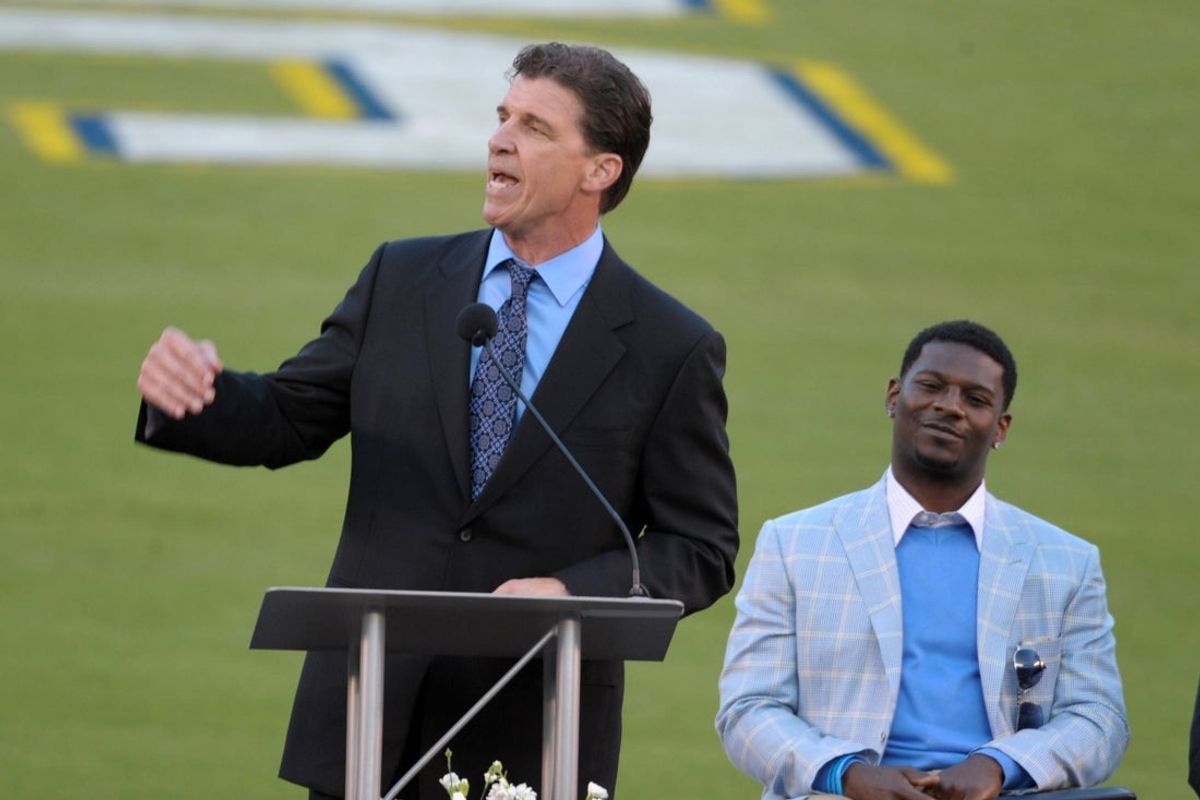
May 10, 2012; San Diego, CA, USA; San Diego Chargers former linebacker Billy Ray Smith speaks as LaDainian Tomlinson listens at the Celebration of Life for Junior Seau at Qualcomm Stadium. Mandatory Credit: Kirby Lee/Image of Sport-Imagn Images
Former San Diego Chargers linebacker and College Football Hall of Famer Billy Ray Smith Jr. died on Wednesday at age 64, his family announced.
“It is with profound sadness that we share the loss of our beloved Billy Ray Smith Jr., who passed away peacefully surrounded by family,” the family statement read. “Billy Ray faced his long journey with dementia caused by CTE with unmatched bravery, dignity, and strength.
“Billy Ray brought so much joy, light, and laughter to the world as a devoted father, husband, son, and loyal friend. On the NFL gridiron for a decade with the Chargers, and decades that followed in sports broadcasting, Billy Ray earned deep respect from teammates, colleagues, and fans, who he cherished in return.”
The son of Super Bowl champion defensive end Billy Ray Smith Sr., Smith Jr. followed in his father’s footsteps at Arkansas, where he was a two-time All-American for the Razorbacks before San Diego drafted him fifth overall in the 1983 NFL Draft.
He played his entire 10-year pro career for the Chargers, amassing 26.5 sacks, 15 interceptions and 13 forced fumbles in 126 games and earning a spot on the franchise’s 50th anniversary team in 2009.
“To know Billy Ray was to love Billy Ray,” Chargers owner Dean Spanos said in a statement. “Yes, he was a member of our 50th Anniversary team. Yes, he was a Charger for life, playing his entire 10-year career here. But he wasn’t merely a great football player. He was, truly, larger than life. Always smiling. Lighting up every room he walked into, infectious laughter. The kind of friend a friend should be. That was Billy Ray.
“When someone who brought so much positivity into the world leaves us, it’s hard to process. Hard to accept. That’s how I feel right now, and I know I’m not alone. Billy Ray loved his family, loved the Chargers, loved his teammates, loved his community and loved helping those in needs. And we all loved him back.”
After his playing career, Smith spent time as the sports director at San Diego’s ABC10 News, as a radio host in the area and as a broadcaster on college and professional football games.
He is survived by his wife, Kimberly Hunt, and their daughter, Savannah.
Now it might be slightly less metal to then say, “so make me the highest paid player in baseball or I’m gonna be distracted on the field, $81 million is not enough for me I have expensive taste.” But I’m not a heavy metal expert! Band t-shirts are probably expensive, officially licensed ones at least, maybe you have to be rich to be a metalhead?
Either way, In a bitter contract dispute in 1998, Los Angeles saw Piazza as greedy and disloyal, and Piazza saw the Dodgers organization as calculating and disloyal, and the fans fickle. He also blamed Vin Scully for his “Greedy Mike” label and that right there turned this beef from soft supple meat that could in theory be easily squashed, to an everlasting gobstopper, flamin’ beef flavor.
Wait… that sounds kind of good.. Or at least interesting, in a weird 7-11-spiciest-chip sort of way? Not my intent with the metaphor, but Willy Wonka, hit me up.
Now it might be slightly less metal to then say, “so make me the highest paid player in baseball or I’m gonna be distracted on the field, $81 million is not enough for me I have expensive taste.” But I’m not a heavy metal expert! Band t-shirts are probably expensive, officially licensed ones at least, maybe you have to be rich to be a metalhead?
Either way, In a bitter contract dispute in 1998, Los Angeles saw Piazza as greedy and disloyal, and Piazza saw the Dodgers organization as calculating and disloyal, and the fans fickle. He also blamed Vin Scully for his “Greedy Mike” label and that right there turned this beef from soft supple meat that could in theory be easily squashed, to an everlasting gobstopper, flamin’ beef flavor.
Wait… that sounds kind of good.. Or at least interesting, in a weird 7-11-spiciest-chip sort of way? Not my intent with the metaphor, but Willy Wonka, hit me up.
#Dodgers #discovered #Mike #Piazza #despise">The Dodgers discovered Mike Piazza, then came to despise him
The fact that Mike Piazza is a metalhead really fits with this beef. I believe it’s quite metal to shake out your mullet and be like, “The Dodgers drafted me when no one else would, but f-you corporate ownership, I don’t owe you no debt of gratitude!”
Now it might be slightly less metal to then say, “so make me the highest paid player in baseball or I’m gonna be distracted on the field, $81 million is not enough for me I have expensive taste.” But I’m not a heavy metal expert! Band t-shirts are probably expensive, officially licensed ones at least, maybe you have to be rich to be a metalhead?
Either way, In a bitter contract dispute in 1998, Los Angeles saw Piazza as greedy and disloyal, and Piazza saw the Dodgers organization as calculating and disloyal, and the fans fickle. He also blamed Vin Scully for his “Greedy Mike” label and that right there turned this beef from soft supple meat that could in theory be easily squashed, to an everlasting gobstopper, flamin’ beef flavor.
Wait… that sounds kind of good.. Or at least interesting, in a weird 7-11-spiciest-chip sort of way? Not my intent with the metaphor, but Willy Wonka, hit me up.




Post Comment