
One of Our Favorite 360 Cams Is 35 Percent OffTired of taking your action camera on an adventure, only to get home and find out you missed the action with a bad angle? One option is to switch to a 360-degree action cam, so you can capture all of the action and then edit down to just the good stuff later. One of our favorite options, the DJI Osmo 360, is currently available for just $390 on Amazon, a $209 discount from its usual price, and it comes with a selfie stick and an extra battery.
The DJI Osmo 360 achieves its impressive all-around video quality by leveraging a pair of 1/1.1-inch sensors, larger than some other offerings, and by supporting 10-bit color. You can really see that in the camera’s output, with colors that are vivid and bold, to the point that you may need to dial them back a bit in post if you want something more natural. With support for up to 50 frames per second at 8K when recording in 360 degrees, or 120 fps at 4K when shooting with only one sensor, you’ll have plenty of material to work with. In our testing, it ran for just shy of two hours at 30 fps, which is also around the time the internal storage had filled up anyway.
If you plan on catching any serious discussions with your Osmo 360, you’ll be pleased to know it connects directly to DJI’s line of wireless lavalier microphones, including the excellent and frequently discounted DJI Mic 2 and Mic Mini. If you want to mount it to something other than the included 1.2-meter selfie stick, it has both DJI’s magnetic attachment system and a more traditional ¼”-20 tripod mount. The DJI Mimo app lets you control the camera and adjust any settings, and there’s even a simple editor for on-the-fly production. For desktop users, DJI Studio has even more in-depth settings and editing options, in case you don’t want to pay for Premiere.
The DJI Osmo 360 is one of our favorite action cameras, and is particularly appealing at the discounted price point, but make sure to check out our full review for more info, or head over to our full roundup to see what else is available.
#Favorite #Cams #Percentcameras,shopping,deals,action cameras
Tired of taking your action camera on an adventure, only to get home and find out you missed the action with a bad angle? One option is to switch to a 360-degree action cam, so you can capture all of the action and then edit down to just the good stuff later. One of our favorite options, the DJI Osmo 360, is currently available for just $390 on Amazon, a $209 discount from its usual price, and it comes with a selfie stick and an extra battery.
The DJI Osmo 360 achieves its impressive all-around video quality by leveraging a pair of 1/1.1-inch sensors, larger than some other offerings, and by supporting 10-bit color. You can really see that in the camera’s output, with colors that are vivid and bold, to the point that you may need to dial them back a bit in post if you want something more natural. With support for up to 50 frames per second at 8K when recording in 360 degrees, or 120 fps at 4K when shooting with only one sensor, you’ll have plenty of material to work with. In our testing, it ran for just shy of two hours at 30 fps, which is also around the time the internal storage had filled up anyway.
If you plan on catching any serious discussions with your Osmo 360, you’ll be pleased to know it connects directly to DJI’s line of wireless lavalier microphones, including the excellent and frequently discounted DJI Mic 2 and Mic Mini. If you want to mount it to something other than the included 1.2-meter selfie stick, it has both DJI’s magnetic attachment system and a more traditional ¼”-20 tripod mount. The DJI Mimo app lets you control the camera and adjust any settings, and there’s even a simple editor for on-the-fly production. For desktop users, DJI Studio has even more in-depth settings and editing options, in case you don’t want to pay for Premiere.
The DJI Osmo 360 is one of our favorite action cameras, and is particularly appealing at the discounted price point, but make sure to check out our full review for more info, or head over to our full roundup to see what else is available.
![Ford’s new electric truck, ‘Fathom’, starts at ,350 | TechCrunch
Ford’s next-generation electric truck will be called Fathom, and it will start at ,350 when it goes on sale in 2027, the company said on Thursday.
A “destination and delivery” fee will bring that price up to ,945, putting the Fathom just below the ,000 mark that Ford has targeted since it first started talking more openly about the project in 2025.
The truck, when it arrives next year, represents a major bet for Ford. It’s the automaker’s second all-electric truck after the F-150 Lightning (third, if you count the limited-run Ranger EV from the late 1990s). But like many of its peers, the company has dramatically pulled back on its once-ambitious plans to build electric vehicles.
The Fathom is the first vehicle Ford is building on its new “Universal EV Platform,” or UEV, which will power a number of different EVs and involves a brand-new assembly line process meant to cut costs. It’s an attempt by CEO Jim Farley to try and catch up to category leader Tesla, as well as the many Chinese EVs that he’s argued against allowing into the U.S. market — all while building the truck in Louisville, Kentucky.
Deliveries begin in “fall 2027,” and Ford said on Thursday that it won’t reveal the truck until “early 2027,” which is when it will start taking pre-orders.
We do have some details, though. Ford has already said the Fathom will have Apple Maps built into its operating system, and on Thursday, the company said the truck will support Android Auto and Apple CarPlay. Notably, it will not support Apple’s next-generation CarPlay Ultra.
The Fathom will have five seats, which is more interior space than a Toyota Rav4; a “large, high-resolution touch screen,” and a “digital car key.” It will be capable of bidirectional power, much like the Lightning and the hybrid F-150.
Every Fathom will also be “BlueCruise-capable,” meaning it will come with the tech integrated, but buyers will likely have to pay extra to enable Ford’s hands-free advanced driver assistance system. The truck is supposed to have a newer, more powerful version of BlueCruise that Ford says will eventually be capable of handling supervised driving from starting point to destination. Eyes-off driving is expected in 2028.
The Fathom’s starting price also only includes the “standard range” lithium iron phosphate battery pack. Ford hasn’t yet said how many miles the truck can drive on a single charge.
Ford said the name represents “a deep understanding of the person who would drive” the truck, and how their “motivations look a little different from the traditional truck customer’s.”
“[T]he name had to do more than sound good. It had to capture a mindset, shifting the focus from specs to a spirit of adaptability,” the company wrote.
Electric trucks have not done terribly well in the U.S.. The Lightning only moved a little more than 10,000 units in its best quarter, and though Tesla’s Cybertruck had a higher peak, it has since crashed out.
Ford is gambling by choosing the truck form factor for its first UEV platform vehicle. But there are some inherent upsides: The Fathom and other vehicles built on the platform will be the first that Ford has designed from the ground up to use electric powertrains. That should mean fewer tradeoffs on range, efficiency, and overall packaging of the vehicle.
Both the Fathom and UEV have been in the works for a few years. It started as a skunkworks project that Farley tasked former Tesla exec Alan Clarke with leading, as TechCrunch first reported in 2024. The team is flush with talent from Rivian, Tesla and Apple’s now-defunct car project, and has purportedly been working in isolation in Los Angeles, separated from the bureaucracy of the rest of the company.
All of this likely contributed to getting the Fathom’s starting price to just under ,000, a major accomplishment in a market where the average new car costs ,000. The truck won’t have a lot of competition in that range — it’s essentially going up against just the spartan, Jeff Bezos-backed Slate pickup, and a few non-truck EVs like the Chevy Bolt.
Ford has found a ton of success with its small, low-cost Maverick pickup, which comes in both internal combustion and hybrid powertrain variants. The Fathom is an attempt to bottle that lightning, without going the way of the Lightning.
When you purchase through links in our articles, we may earn a small commission. This doesn’t affect our editorial independence.#Fords #electric #truck #Fathom #starts #TechCrunchelectric trucks,EVs,Ford](https://i0.wp.com/techcrunch.com/wp-content/uploads/2026/08/Ford-Fathom-Hero-Still-16x9_v2.jpg?resize=1200%2C675&ssl=1 "Ford’s new electric truck, ‘Fathom’, starts at ,350 | TechCrunch
Ford’s next-generation electric truck will be called Fathom, and it will start at ,350 when it goes on sale in 2027, the company said on Thursday.
A “destination and delivery” fee will bring that price up to ,945, putting the Fathom just below the ,000 mark that Ford has targeted since it first started talking more openly about the project in 2025.
The truck, when it arrives next year, represents a major bet for Ford. It’s the automaker’s second all-electric truck after the F-150 Lightning (third, if you count the limited-run Ranger EV from the late 1990s). But like many of its peers, the company has dramatically pulled back on its once-ambitious plans to build electric vehicles.
The Fathom is the first vehicle Ford is building on its new “Universal EV Platform,” or UEV, which will power a number of different EVs and involves a brand-new assembly line process meant to cut costs. It’s an attempt by CEO Jim Farley to try and catch up to category leader Tesla, as well as the many Chinese EVs that he’s argued against allowing into the U.S. market — all while building the truck in Louisville, Kentucky.
Deliveries begin in “fall 2027,” and Ford said on Thursday that it won’t reveal the truck until “early 2027,” which is when it will start taking pre-orders.
We do have some details, though. Ford has already said the Fathom will have Apple Maps built into its operating system, and on Thursday, the company said the truck will support Android Auto and Apple CarPlay. Notably, it will not support Apple’s next-generation CarPlay Ultra.
The Fathom will have five seats, which is more interior space than a Toyota Rav4; a “large, high-resolution touch screen,” and a “digital car key.” It will be capable of bidirectional power, much like the Lightning and the hybrid F-150.
Every Fathom will also be “BlueCruise-capable,” meaning it will come with the tech integrated, but buyers will likely have to pay extra to enable Ford’s hands-free advanced driver assistance system. The truck is supposed to have a newer, more powerful version of BlueCruise that Ford says will eventually be capable of handling supervised driving from starting point to destination. Eyes-off driving is expected in 2028.
The Fathom’s starting price also only includes the “standard range” lithium iron phosphate battery pack. Ford hasn’t yet said how many miles the truck can drive on a single charge.
Ford said the name represents “a deep understanding of the person who would drive” the truck, and how their “motivations look a little different from the traditional truck customer’s.”
“[T]he name had to do more than sound good. It had to capture a mindset, shifting the focus from specs to a spirit of adaptability,” the company wrote.
Electric trucks have not done terribly well in the U.S.. The Lightning only moved a little more than 10,000 units in its best quarter, and though Tesla’s Cybertruck had a higher peak, it has since crashed out.
Ford is gambling by choosing the truck form factor for its first UEV platform vehicle. But there are some inherent upsides: The Fathom and other vehicles built on the platform will be the first that Ford has designed from the ground up to use electric powertrains. That should mean fewer tradeoffs on range, efficiency, and overall packaging of the vehicle.
Both the Fathom and UEV have been in the works for a few years. It started as a skunkworks project that Farley tasked former Tesla exec Alan Clarke with leading, as TechCrunch first reported in 2024. The team is flush with talent from Rivian, Tesla and Apple’s now-defunct car project, and has purportedly been working in isolation in Los Angeles, separated from the bureaucracy of the rest of the company.
All of this likely contributed to getting the Fathom’s starting price to just under ,000, a major accomplishment in a market where the average new car costs ,000. The truck won’t have a lot of competition in that range — it’s essentially going up against just the spartan, Jeff Bezos-backed Slate pickup, and a few non-truck EVs like the Chevy Bolt.
Ford has found a ton of success with its small, low-cost Maverick pickup, which comes in both internal combustion and hybrid powertrain variants. The Fathom is an attempt to bottle that lightning, without going the way of the Lightning.
When you purchase through links in our articles, we may earn a small commission. This doesn’t affect our editorial independence.#Fords #electric #truck #Fathom #starts #TechCrunchelectric trucks,EVs,Ford")


![‘Cyberpunk: Edgerunners’ Creator’s New Manga Series Is a Love Letter to ‘Inception’ and Soulsborne Games
In the time before Cyberpunk: Edgerunners 2‘s imminent arrival on Netflix this fall, I’ve been living it up, rewatching the anime and re-reading manga from the folks responsible for its first season being Crunchyroll’s 2023 Anime of the Year.
While I’ve already waxed poetic about writer Bartosz Sztybor‘s Rebecca-centric prequel manga showcasing Night City as having plenty more stories to tell, season one creator Rafał Jaki has spun the block off the momentum of being one of Manga Plus’ first Western manga creators post-Edgerunners with an inventive new manga series that’s giving Inception meets Elden Ring. Coming off the heels of his refreshingly imaginative sci-fi series No\Name, in which folks’ powers were derived from the meanings of their given names, Jaki and artist Machine Gamu‘s newest series, Brain Alive—which he announced on his official X/Twitter account with a Google Drive link to read its first chapter for free—looks poised to carry that energy forward with a dark fantasy premise geared toward cinephiles and gamers alike. [embed]https://www.youtube.com/watch?v=01qvd0J-6Fc[/embed] In patented Edgerunners heart-shattering fashion, Brain Alive opens with a father named Daniel awakening from a car crash to the news that his wife didn’t survive and his son is in a coma. To keep his son company, Daniel reads him new volumes of the dark fantasy novel that inspired the Soulsborne video games they used to play together as a family. After falling asleep by his son’s bedside, Daniel finds himself stark naked inside a dungeon. Turns out, his dreams run on a kind of Kamen Rider ZETZ rule where he enters his son’s dreamscape influenced by his mind’s imaginings of their favorite video game series. But things are far from fun and games.
© Rafał Jaki/Machine Gamu Fortunately, if Daniel dies in the dream, he doesn’t die in real life. Any progress he makes in the dream follows a roguelike-meets-Soulsborne rule, with bonfire checkpoints featuring the dream-eating yokai, Baku, as a save state statue, and he returns a bit stronger as he retraces his steps in his son’s dreams. Unfortunately, Daniel can’t honk shoo-mimimi into his son’s dreams willy-nilly. He’s got a limited number of times he can go into his son’s dreams to make as much progress as he can and inch closer to saving his son’s life. Meaning, runs can’t be redone by closing his eyes and diving into his dreams multiple times a night. Think Persona 3 dungeon runs where, instead of planning dates and going to school in the interim of making doubly sure if you want to get your shit rocked in Tartarus, Daniel dedicates every waking moment to “git gud” at Soulsborne games to save his son’s life. Buddy can’t catch a break.
© Rafał Jaki/Machine Gamu As Soulsborne enemies are wont to do, everything from skeleton warriors and giant yokai to poisonous snakes wants to run the dozens with Daniel for keeps, leaving the weary father with nothing but his Soulsbourne techniques, like perfect dodges, attacking enemy weak points, and real-life sword lessons, to keep himself alive. It also doesn’t hurt that Daniel’s got the boon of a fire sabre with the spirit of his dead wife guiding him through his son’s lucid dark fantasy dreams. If the dead wife of it all isn’t the most Christopher Nolan-ism of all time, I don’t know what is. © Rafał Jaki/Machine Gamu © Rafał Jaki/Machine Gamu As is evident from its first chapter, Jaki owes a lot to both anime and the video games he’s played and helped bring into fruition in the stories he crafts. “I create in order to give back even a small fraction of what I have received from loving the work of other creators,” Jaki told IGN. “My hope is to provide someone else with that same moment of awe that I have experienced myself, offering a glimpse into another person’s mind and sharing thoughts and feelings.”
© Rafał Jaki/Machine Gamu As a wary fan of the diminishing returns of isekai-adjacent storytelling, what Jaki and Machine Gamu have put forward in Brain Alive‘s first chapter feels far from the derogatory sameness I’ve encountered from manga and anime that take gamified RPG rules for the sake of power fantasy wish-fulfillment while handwaving their many icky implications. It probably helps that Jaki is no stranger to expansive video game scripts, as the writer of Dark Horse’s The Witcher 3: Ronin comic and The Witcher: Old World board game. Like Former Destiny writer Frank Barbiere and Swamp Thing: Twin Branches artist Morgan Beem’s Image Comics series The Author Immortal (which I also strongly recommend folks check out), Brain Alive is a story with stakes and teeth I can’t wait to see pan out. You can read the first chapter of Brain Alive here ahead of its English release coming later this year, and Jaki’s first-ever manga series, No\Name, on MANGA Plus. Want more io9 news? Check out when to expect the latest Marvel, Star Wars, and Star Trek releases, what’s next for the DC Universe on film and TV, and everything you need to know about the future of Doctor Who. #Cyberpunk #Edgerunners #Creators #Manga #Series #Love #Letter #Inception #Soulsborne #GamesCyberpunk: Edgerunners,Manga,Rafal Jaki](https://gizmodo.com/app/uploads/2026/08/Brain-Alive-4.jpg "‘Cyberpunk: Edgerunners’ Creator’s New Manga Series Is a Love Letter to ‘Inception’ and Soulsborne Games
In the time before Cyberpunk: Edgerunners 2‘s imminent arrival on Netflix this fall, I’ve been living it up, rewatching the anime and re-reading manga from the folks responsible for its first season being Crunchyroll’s 2023 Anime of the Year.
While I’ve already waxed poetic about writer Bartosz Sztybor‘s Rebecca-centric prequel manga showcasing Night City as having plenty more stories to tell, season one creator Rafał Jaki has spun the block off the momentum of being one of Manga Plus’ first Western manga creators post-Edgerunners with an inventive new manga series that’s giving Inception meets Elden Ring. Coming off the heels of his refreshingly imaginative sci-fi series No\Name, in which folks’ powers were derived from the meanings of their given names, Jaki and artist Machine Gamu‘s newest series, Brain Alive—which he announced on his official X/Twitter account with a Google Drive link to read its first chapter for free—looks poised to carry that energy forward with a dark fantasy premise geared toward cinephiles and gamers alike. [embed]https://www.youtube.com/watch?v=01qvd0J-6Fc[/embed] In patented Edgerunners heart-shattering fashion, Brain Alive opens with a father named Daniel awakening from a car crash to the news that his wife didn’t survive and his son is in a coma. To keep his son company, Daniel reads him new volumes of the dark fantasy novel that inspired the Soulsborne video games they used to play together as a family. After falling asleep by his son’s bedside, Daniel finds himself stark naked inside a dungeon. Turns out, his dreams run on a kind of Kamen Rider ZETZ rule where he enters his son’s dreamscape influenced by his mind’s imaginings of their favorite video game series. But things are far from fun and games.
© Rafał Jaki/Machine Gamu Fortunately, if Daniel dies in the dream, he doesn’t die in real life. Any progress he makes in the dream follows a roguelike-meets-Soulsborne rule, with bonfire checkpoints featuring the dream-eating yokai, Baku, as a save state statue, and he returns a bit stronger as he retraces his steps in his son’s dreams. Unfortunately, Daniel can’t honk shoo-mimimi into his son’s dreams willy-nilly. He’s got a limited number of times he can go into his son’s dreams to make as much progress as he can and inch closer to saving his son’s life. Meaning, runs can’t be redone by closing his eyes and diving into his dreams multiple times a night. Think Persona 3 dungeon runs where, instead of planning dates and going to school in the interim of making doubly sure if you want to get your shit rocked in Tartarus, Daniel dedicates every waking moment to “git gud” at Soulsborne games to save his son’s life. Buddy can’t catch a break.
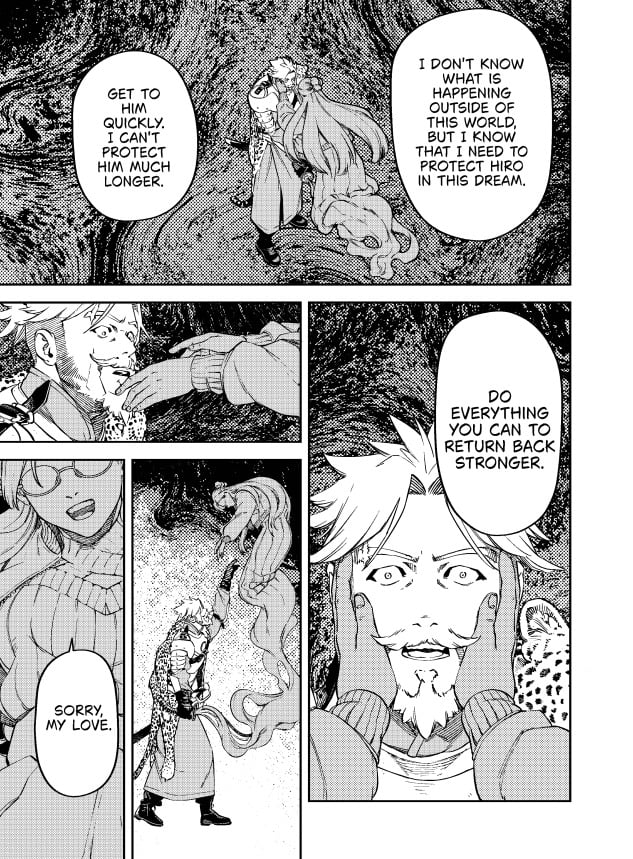
© Rafał Jaki/Machine Gamu As Soulsborne enemies are wont to do, everything from skeleton warriors and giant yokai to poisonous snakes wants to run the dozens with Daniel for keeps, leaving the weary father with nothing but his Soulsbourne techniques, like perfect dodges, attacking enemy weak points, and real-life sword lessons, to keep himself alive. It also doesn’t hurt that Daniel’s got the boon of a fire sabre with the spirit of his dead wife guiding him through his son’s lucid dark fantasy dreams. If the dead wife of it all isn’t the most Christopher Nolan-ism of all time, I don’t know what is. © Rafał Jaki/Machine Gamu © Rafał Jaki/Machine Gamu As is evident from its first chapter, Jaki owes a lot to both anime and the video games he’s played and helped bring into fruition in the stories he crafts. “I create in order to give back even a small fraction of what I have received from loving the work of other creators,” Jaki told IGN. “My hope is to provide someone else with that same moment of awe that I have experienced myself, offering a glimpse into another person’s mind and sharing thoughts and feelings.”
© Rafał Jaki/Machine Gamu As a wary fan of the diminishing returns of isekai-adjacent storytelling, what Jaki and Machine Gamu have put forward in Brain Alive‘s first chapter feels far from the derogatory sameness I’ve encountered from manga and anime that take gamified RPG rules for the sake of power fantasy wish-fulfillment while handwaving their many icky implications. It probably helps that Jaki is no stranger to expansive video game scripts, as the writer of Dark Horse’s The Witcher 3: Ronin comic and The Witcher: Old World board game. Like Former Destiny writer Frank Barbiere and Swamp Thing: Twin Branches artist Morgan Beem’s Image Comics series The Author Immortal (which I also strongly recommend folks check out), Brain Alive is a story with stakes and teeth I can’t wait to see pan out. You can read the first chapter of Brain Alive here ahead of its English release coming later this year, and Jaki’s first-ever manga series, No\Name, on MANGA Plus. Want more io9 news? Check out when to expect the latest Marvel, Star Wars, and Star Trek releases, what’s next for the DC Universe on film and TV, and everything you need to know about the future of Doctor Who. #Cyberpunk #Edgerunners #Creators #Manga #Series #Love #Letter #Inception #Soulsborne #GamesCyberpunk: Edgerunners,Manga,Rafal Jaki")



![‘Cyberpunk: Edgerunners’ Creator’s New Manga Series Is a Love Letter to ‘Inception’ and Soulsborne Games
In the time before Cyberpunk: Edgerunners 2‘s imminent arrival on Netflix this fall, I’ve been living it up, rewatching the anime and re-reading manga from the folks responsible for its first season being Crunchyroll’s 2023 Anime of the Year.
While I’ve already waxed poetic about writer Bartosz Sztybor‘s Rebecca-centric prequel manga showcasing Night City as having plenty more stories to tell, season one creator Rafał Jaki has spun the block off the momentum of being one of Manga Plus’ first Western manga creators post-Edgerunners with an inventive new manga series that’s giving Inception meets Elden Ring. Coming off the heels of his refreshingly imaginative sci-fi series No\Name, in which folks’ powers were derived from the meanings of their given names, Jaki and artist Machine Gamu‘s newest series, Brain Alive—which he announced on his official X/Twitter account with a Google Drive link to read its first chapter for free—looks poised to carry that energy forward with a dark fantasy premise geared toward cinephiles and gamers alike. [embed]https://www.youtube.com/watch?v=01qvd0J-6Fc[/embed] In patented Edgerunners heart-shattering fashion, Brain Alive opens with a father named Daniel awakening from a car crash to the news that his wife didn’t survive and his son is in a coma. To keep his son company, Daniel reads him new volumes of the dark fantasy novel that inspired the Soulsborne video games they used to play together as a family. After falling asleep by his son’s bedside, Daniel finds himself stark naked inside a dungeon. Turns out, his dreams run on a kind of Kamen Rider ZETZ rule where he enters his son’s dreamscape influenced by his mind’s imaginings of their favorite video game series. But things are far from fun and games.
© Rafał Jaki/Machine Gamu Fortunately, if Daniel dies in the dream, he doesn’t die in real life. Any progress he makes in the dream follows a roguelike-meets-Soulsborne rule, with bonfire checkpoints featuring the dream-eating yokai, Baku, as a save state statue, and he returns a bit stronger as he retraces his steps in his son’s dreams. Unfortunately, Daniel can’t honk shoo-mimimi into his son’s dreams willy-nilly. He’s got a limited number of times he can go into his son’s dreams to make as much progress as he can and inch closer to saving his son’s life. Meaning, runs can’t be redone by closing his eyes and diving into his dreams multiple times a night. Think Persona 3 dungeon runs where, instead of planning dates and going to school in the interim of making doubly sure if you want to get your shit rocked in Tartarus, Daniel dedicates every waking moment to “git gud” at Soulsborne games to save his son’s life. Buddy can’t catch a break.
© Rafał Jaki/Machine Gamu As Soulsborne enemies are wont to do, everything from skeleton warriors and giant yokai to poisonous snakes wants to run the dozens with Daniel for keeps, leaving the weary father with nothing but his Soulsbourne techniques, like perfect dodges, attacking enemy weak points, and real-life sword lessons, to keep himself alive. It also doesn’t hurt that Daniel’s got the boon of a fire sabre with the spirit of his dead wife guiding him through his son’s lucid dark fantasy dreams. If the dead wife of it all isn’t the most Christopher Nolan-ism of all time, I don’t know what is. © Rafał Jaki/Machine Gamu © Rafał Jaki/Machine Gamu As is evident from its first chapter, Jaki owes a lot to both anime and the video games he’s played and helped bring into fruition in the stories he crafts. “I create in order to give back even a small fraction of what I have received from loving the work of other creators,” Jaki told IGN. “My hope is to provide someone else with that same moment of awe that I have experienced myself, offering a glimpse into another person’s mind and sharing thoughts and feelings.”
© Rafał Jaki/Machine Gamu As a wary fan of the diminishing returns of isekai-adjacent storytelling, what Jaki and Machine Gamu have put forward in Brain Alive‘s first chapter feels far from the derogatory sameness I’ve encountered from manga and anime that take gamified RPG rules for the sake of power fantasy wish-fulfillment while handwaving their many icky implications. It probably helps that Jaki is no stranger to expansive video game scripts, as the writer of Dark Horse’s The Witcher 3: Ronin comic and The Witcher: Old World board game. Like Former Destiny writer Frank Barbiere and Swamp Thing: Twin Branches artist Morgan Beem’s Image Comics series The Author Immortal (which I also strongly recommend folks check out), Brain Alive is a story with stakes and teeth I can’t wait to see pan out. You can read the first chapter of Brain Alive here ahead of its English release coming later this year, and Jaki’s first-ever manga series, No\Name, on MANGA Plus. Want more io9 news? Check out when to expect the latest Marvel, Star Wars, and Star Trek releases, what’s next for the DC Universe on film and TV, and everything you need to know about the future of Doctor Who. #Cyberpunk #Edgerunners #Creators #Manga #Series #Love #Letter #Inception #Soulsborne #GamesCyberpunk: Edgerunners,Manga,Rafal Jaki](https://i0.wp.com/gizmodo.com/app/uploads/2026/08/Brain-Alive-4.jpg?ssl=1 "‘Cyberpunk: Edgerunners’ Creator’s New Manga Series Is a Love Letter to ‘Inception’ and Soulsborne Games
In the time before Cyberpunk: Edgerunners 2‘s imminent arrival on Netflix this fall, I’ve been living it up, rewatching the anime and re-reading manga from the folks responsible for its first season being Crunchyroll’s 2023 Anime of the Year.
While I’ve already waxed poetic about writer Bartosz Sztybor‘s Rebecca-centric prequel manga showcasing Night City as having plenty more stories to tell, season one creator Rafał Jaki has spun the block off the momentum of being one of Manga Plus’ first Western manga creators post-Edgerunners with an inventive new manga series that’s giving Inception meets Elden Ring. Coming off the heels of his refreshingly imaginative sci-fi series No\Name, in which folks’ powers were derived from the meanings of their given names, Jaki and artist Machine Gamu‘s newest series, Brain Alive—which he announced on his official X/Twitter account with a Google Drive link to read its first chapter for free—looks poised to carry that energy forward with a dark fantasy premise geared toward cinephiles and gamers alike. [embed]https://www.youtube.com/watch?v=01qvd0J-6Fc[/embed] In patented Edgerunners heart-shattering fashion, Brain Alive opens with a father named Daniel awakening from a car crash to the news that his wife didn’t survive and his son is in a coma. To keep his son company, Daniel reads him new volumes of the dark fantasy novel that inspired the Soulsborne video games they used to play together as a family. After falling asleep by his son’s bedside, Daniel finds himself stark naked inside a dungeon. Turns out, his dreams run on a kind of Kamen Rider ZETZ rule where he enters his son’s dreamscape influenced by his mind’s imaginings of their favorite video game series. But things are far from fun and games.
© Rafał Jaki/Machine Gamu Fortunately, if Daniel dies in the dream, he doesn’t die in real life. Any progress he makes in the dream follows a roguelike-meets-Soulsborne rule, with bonfire checkpoints featuring the dream-eating yokai, Baku, as a save state statue, and he returns a bit stronger as he retraces his steps in his son’s dreams. Unfortunately, Daniel can’t honk shoo-mimimi into his son’s dreams willy-nilly. He’s got a limited number of times he can go into his son’s dreams to make as much progress as he can and inch closer to saving his son’s life. Meaning, runs can’t be redone by closing his eyes and diving into his dreams multiple times a night. Think Persona 3 dungeon runs where, instead of planning dates and going to school in the interim of making doubly sure if you want to get your shit rocked in Tartarus, Daniel dedicates every waking moment to “git gud” at Soulsborne games to save his son’s life. Buddy can’t catch a break.
© Rafał Jaki/Machine Gamu As Soulsborne enemies are wont to do, everything from skeleton warriors and giant yokai to poisonous snakes wants to run the dozens with Daniel for keeps, leaving the weary father with nothing but his Soulsbourne techniques, like perfect dodges, attacking enemy weak points, and real-life sword lessons, to keep himself alive. It also doesn’t hurt that Daniel’s got the boon of a fire sabre with the spirit of his dead wife guiding him through his son’s lucid dark fantasy dreams. If the dead wife of it all isn’t the most Christopher Nolan-ism of all time, I don’t know what is. © Rafał Jaki/Machine Gamu © Rafał Jaki/Machine Gamu As is evident from its first chapter, Jaki owes a lot to both anime and the video games he’s played and helped bring into fruition in the stories he crafts. “I create in order to give back even a small fraction of what I have received from loving the work of other creators,” Jaki told IGN. “My hope is to provide someone else with that same moment of awe that I have experienced myself, offering a glimpse into another person’s mind and sharing thoughts and feelings.”
© Rafał Jaki/Machine Gamu As a wary fan of the diminishing returns of isekai-adjacent storytelling, what Jaki and Machine Gamu have put forward in Brain Alive‘s first chapter feels far from the derogatory sameness I’ve encountered from manga and anime that take gamified RPG rules for the sake of power fantasy wish-fulfillment while handwaving their many icky implications. It probably helps that Jaki is no stranger to expansive video game scripts, as the writer of Dark Horse’s The Witcher 3: Ronin comic and The Witcher: Old World board game. Like Former Destiny writer Frank Barbiere and Swamp Thing: Twin Branches artist Morgan Beem’s Image Comics series The Author Immortal (which I also strongly recommend folks check out), Brain Alive is a story with stakes and teeth I can’t wait to see pan out. You can read the first chapter of Brain Alive here ahead of its English release coming later this year, and Jaki’s first-ever manga series, No\Name, on MANGA Plus. Want more io9 news? Check out when to expect the latest Marvel, Star Wars, and Star Trek releases, what’s next for the DC Universe on film and TV, and everything you need to know about the future of Doctor Who. #Cyberpunk #Edgerunners #Creators #Manga #Series #Love #Letter #Inception #Soulsborne #GamesCyberpunk: Edgerunners,Manga,Rafal Jaki")
Post Comment