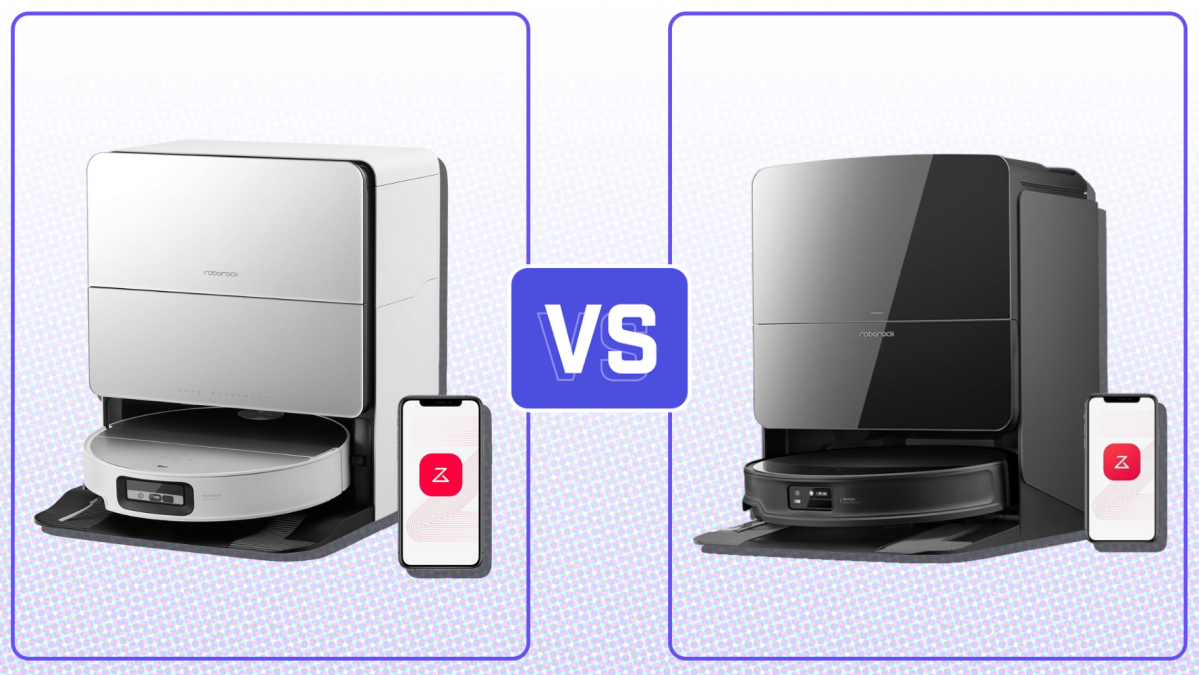
One Roborock Saros robot vacuum, the Saros Z70 that has a mechanical arm, has gone slightly viral on the internet. But it’s not even the Saros model that most people should be considering.
The real Roborock showdown of 2025 is actually between the Roborock Saros 10 and Saros 10R — the two more practical CES 2025 releases that have robot vacuum threads on Reddit in a chokehold.
After testing both of them in my apartment for three months, I’ll say this: Roborock made two of the best robot vacuums of the year here, but absolutely fumbled naming them. The addition of a single letter to an otherwise identical title almost insinuates that one is the diet version of the other, and that’s far from the case. If you’re confused about the difference between them, that’s valid. They have the exact same $1,599.99 price, after all.
After testing both in my apartment on a near-daily basis for three months, here are my thoughts on the Roborock Saros 10 vs. Saros 10R debate.
Saros 10 vs. 10R: Design
Roborock was impressively able to squeeze a whole lot of brains into these super-slim robot vacuums. Both the Saros 10 and Saros 10R are barely more than three inches tall, and can fit under low-hanging appliances like the refrigerator and more low-clearance furniture than thicker robot vacuums I’ve tested.
Underneath, though, the Saros 10 and 10R have one huge difference: the mopping pad situation. And this ended up being my deciding factor between the two.
Winner: Saros 10R
The underside of the Saros 10.
Credit: Leah Stodart / Mashable

The underside of the Saros 10R.
Credit: Leah Stodart / Mashable
Saros 10 vs. 10R: Vacuuming skills
The Roborock Saros 10 and 10R are two of the most powerful robot vacuums in 2025. The Saros 10R hits 20,000 Pa, while the Saros 10 cranks it up to 22,000 Pa. To be real, both of those figures are wicked — only a few other robot vacuums on the market match 20,000 Pa. So you’re getting a pretty top-notch clean with either model.
I personally don’t think the Saros 10’s extra 2,000 Pa of suction power makes that much of a difference. It did offer slightly better pet hair pick-up on a few rugs, as proven by a self-emptying Shark stick vacuum that starts every cleaning session with an empty dust bin. Once a robot vacuum has finished cleaning a rug, I run the super-strong Shark over it to see how much cat hair the vacuum missed. The Saros 10 fared slightly better in this test than the Saros 10R did.

The Saros 10 creating crisp vacuum lines that only stop for the mouse toy in the way.
Credit: Leah Stodart / Mashable
Other debris on rugs, like crumbs in the living room or spilled rice on the kitchen runner, was rarely left behind by either vacuum.
The Saros 10 and 10R share the same divided brush roll system, and it’s an absolutely stellar design for preventing tangling. Instead of one long brush roll across the bottom of the vacuum, an opening in the middle of two smaller brush rolls gives pet hair and long human hairs somewhere to go before they can get tangled around the brush. I haven’t ever had to take scissors to a nest of hair built up under either vacuum.
SEE ALSO:
The 3 best Shark robot vacuums do more than similarly-priced Roombas
On hard floors, both the Saros 10 and 10R pick up between 90 and 95 percent of the debris, including the mess in front of two litter boxes, loose kibble by the food bowls, crumbs from different snacks, dirt, and dust bunnies. Roborock’s FlexiArm is also present on both Saros models, which extends out from under each vacuum to push hidden edge debris into the cleaning path more intentionally than a traditional stationary side brush.

I’m always looking for a robot vacuum that can keep up with tracking outside the litter boxes.
Credit: Leah Stodart / Mashable

And the area by our Leo’s Loo Too is virtually spotless after the Saros 10R comes through.
Credit: Leah Stodart / Mashable
But the Saros 10R’s edge precision consistently boosts its overall debris pickup rate on hard floors. In an unfair way, the Saros 10R’s mopping pad design makes it a better vacuumer. Its hinged spinning side mop slides out to lap up dust and fine debris (like salt pushed off the counter) that the Saros 10’s pure force alone can’t suck up, especially against a wall.
On several occasions, I sent the Saros 10R into a room that the Saros 10 had just been in — the Saros 10R reliably scooped up almost all of the rogue crumbs or pieces of kitty litter that the Saros 10 left in the edges of the room. If you have fully carpeted rooms, this will obviously not be as helpful.
Winner: On paper? The Saros 10. In my experience? Saros 10 on pet hair, Saros 10R on dry debris
Saros 10 vs. 10 R: Mopping skills
The Saros 10R is inarguably better at mopping than the Saros 10.
The Saros 10’s one large, pressurized mopping pad just doesn’t provide the same intensity of physical agitation as the Saros 10R’s dual spinning mopping pads. In my testing, the rotating design was less likely to leave streaks of spills like wine or ranch dressing behind — it kind of mimics the movement of a hand scrubbing with a sponge rather than the singular wipe that only magically works in paper towel commercials.

The Saros 10’s mopping pad presses down and vibrates while dragging under the vacuum.
Credit: Leah Stodart / Mashable

The Saros 10R’s mopping pads spin and can swing out to mop along edges.
Credit: Leah Stodart / Mashable
Though the Saros 10’s vibrating pad isn’t exactly stationary, the scrubbing diameter is still limited to the circumference of the robot vacuum. That makes the Saros 10 (frustratingly) miss a lot of dust and droplets close to wall edges or in corners. The tiny circular pad that Roborock added as a supplement to the large pad is comically small — like the size of a quarter — and borderline worthless.
Meanwhile, the Saros 10R has completely mastered corner mopping and edge mopping. When a corner or hard edge is sensed, one of those spinning mopping pads flexes out on a hinge to scrub past where the round edge of the vacuum can reach. I’m talking nearly two inches of extra coverage compared to the quarter-sized spinning pad on the Saros 10.

Watching the 10R wipe up splatters under the lip of the kitchen counter or mystery sticky dust along my bathroom walls is never not delicious.
Credit: Leah Stodart / Mashable
Winner: Saros 10R
Saros 10 vs. 10R: Smart mapping and navigation
The type of small obstacle avoidance technology is another main difference between the Roborock Saros 10 and 10R. The Saros 10 uses Roborock’s established Reactive AI technology, which recognizes and steers clear of objects in real time. The Saros 10R gets a little fancier using StarSight 2.0, which uses technology that collects more data points from around the room and allows for more predictive obstacle avoidance.
The level of detail the Saros 10 and 10R achieved in the map of my home is wild. They know that a shoe is a shoe and a cord is a cord — they could even differentiate between a litter box, a cat tree, and other assorted pieces of furniture, and automatically label everything as such in the app.

Both the 10 and 10R knew the difference between a litter box and a credenza.
Credit: Screenshot: Roborock

Both the 10 and 10R spotted the cat tree in the corner.
Credit: Screenshot: Roborock
I don’t think the Saros 10R’s system is any better at avoiding obstacles than the Saros 10’s. Socks and hand towels were safe 100 percent of the time around these two vacuums, with pet toys like stuffed mice and crinkle balls coming in around 85 percent. Thin white cords, like iPhone or laptop chargers, were eaten more often than not, unfortunately.
But both are light years ahead of any robot vacuums that get stuck in table legs or under a bed. The Saros 10 and 10R are super nimble around furniture and simply know where they’re going, making the chances of coming home to a lost or stuck botvac slim to none.

The Saros 10 eyeing up (but not eating) a sock.
Credit: Leah Stodart / Mashable
My bigger gripe navigationally stems from the room limit that the Saros 10R randomly imposes on the home map. Contrary to everything Mean Girls taught me, the limit does exist, and it’s annoying.
Sure, this would be a non-issue in small spaces with just a handful of rooms. But in larger one-story homes or multi-bedroom and bathroom apartments like mine, it’s so clutch to be able to split up and label rooms according to your preferred cleaning schedule — it’s kind of the whole point of smart mapping and specific room cleaning.
At any rate, the Saros and the Saros 10R both have an impeccable sense of direction. Neither got lost at all during my testing and always made it to the room or zone I selected in the app.
The Saros 10 and 10R both have a camera that can livestream everything the robot vacuum sees in the Roborock app — a feature that sounds comically extra until you’re away from home and wondering what your pets are doing. (No, literally, the Saros robot vacuums have a “Search for the pet” feature.) You can also “call” someone at home from the Roborock app.

Hi, Sansa!
Credit: Screenshot: Roborock
Winner: Saros 10 (narrowly)
Saros 10 vs. 10R: Dock
The Saros 10 and 10R charging docks are, functionally, nearly identical. Both auto-empty the dust bins, wash and dry the mops, and automatically dispense detergent. Both have a clean water tank for refilling the onboard tank, and a dirty water tank to hold the gross water rinsed out of the dirty mopping pad. Compared to some other eardrum bursters I’ve tested, the auto-emptying noise of both Saros models is pretty tolerable.
But aesthetically, I’d rather have the Saros 10 out in the open in my home. I appreciate that its water tanks are covered by a lid — this makes the Saros 10 dock flat on top in case you want to decorate it a bit. I don’t even care that you have to move that vase or stack of books for a second when the tanks need to be filled or refilled.

The Roborock Saros 10.
Credit: Leah Stodart / Mashable

The Roborock Saros 10R.
Credit: Leah Stodart / Mashable
On the other hand, the exposed water tanks of the Saros 10R are just rounded enough for decor to potentially slide off. Though the mirrored exterior of the Saros 10R has a ton of curb appeal, the visible tank situation just loses chic points.
SEE ALSO:
As a Dyson stan, I wouldn’t tell anyone to buy the Dyson 360 Vis Nav robot vacuum
Roborock also made an odd decision with color variety here. The Saros 10 is available in black and white, but the Saros 10R is only available in black. That ultimately didn’t sway my decision, but I can’t say that the lack of a white Saros 10R option doesn’t sour my pick a bit. When you rent an apartment that fully plays into the whole “minimalist all white everything” design, a robot vacuum in the middle of the room is much less abrasive when it blends in with the walls.
Winner: Saros 10
Saros 10 vs. 10R: Cost
The Roborock Saros 10 and 10R both cost $1,599.99 — not sure if that makes your decision easier or harder. The scales could tip if one gets its first big discount before the other.
Winner: Tie
Our winner: Roborock Saros 10R

If you’re really going to make me pick between them, I would pick the Saros 10R over the Saros 10. At the end of the day, if I needed a vacuum to reliably clean up the litter box area or deal with a wet or dry spill near the kitchen counter, I’d send the Saros 10R every time.
The slight edge that the Saros 10 has in suction power isn’t nearly as game-changing as the edge that the Saros 10R has in mopping. If you’re a finicky clean freak like I am, the Saros 10R is going to get your floors to a more comforting level of barefoot-ready, including the nasty edges and corners that keep you awake at night.
You’re in good hands either way — the Saros 10 and Saros 10R are two of the best robot vacuums I’ve ever tested. They’re keeping some respect on the Saros legacy amid the Saros Z70’s flop of a release. If Roborock wisely combines the best features of the Saros 10 and 10R next year, that beast will be hard to beat. But as of mid-2025, either is a fantastic choice — and a better value than the Saros Z70 by a long shot.
Source link
#Roborock #Saros #10R #pick #athome #testing

![This former notorious red-light district is now one of the world’s top AI hubs | TechCrunch
What every U.K. AI startup wants to know these days is, how can I get office space in King’s Cross?
The area is so hot that a VC firm allegedly recently won a deal by promising a founder office space in the neighborhood. “We stop at nothing to win deals [for] and to support” founders, “including helping them source office space when needed,” the firm told me when asked about the rumor, declining to confirm or deny any details.
The neighborhood’s popularity began back in 2016 when DeepMind — then newly acquired by Google — moved in. Soon after, a flood of AI startups followed, wanting to be around the Google DeepMind magic. Today, they hope to take advantage of the cluster of AI talent there.
This has transformed King’s Cross into one of the world’s top AI hubs, rivaled only by San Francisco and Beijing. Around London, it’s known by the sobriquet “Knowledge Quarter,” as it’s home to names like OpenAI, Meta, Isomorphic Labs, Cusp AI, Wayne, Recursive, and, a little farther down the road, Synthesia and Anthropic. The European Technology Network (ETN) just moved into a glossy new office nearby, while University College London sits around the corner.
Mixed in with the new developments are trendy food spots like Hoppers and BAO. Hop a train from King’s Cross, and founders can be in Cambridge in 45 minutes to source talent or can be in Paris in two hours to strike a deal.
Who would have guessed that a little more than 20 years ago, this was one of the seediest areas in London?
“In the ’80s, crack and heroin made the area a major narcotics market,” Hussein Kanji, an investor at Hoxton Ventures, said, recalling syringes in tree trunks and gangs patrolling the streets. “In 1982, the local church was occupied by the English Collective of Prostitutes for 12 straight days.” Then, in the early 2000s, a real estate developer had a dream and, well, “now it is the AI hotbed of the United Kingdom,” Kanji said. “What a change.” Around 18 months ago, his portfolio company BioCorteX moved from the neighborhood Holborn to the Jellicoe building in King’s Cross, hoping to be near the action. “Lots going on in London right now,” Nik Sharma, co-founder of BioCorteX, told me. “Lots of hyperscalers moving in.” That includes, reportedly, Jeff Bezos’ AI company Prometheus, which is also said to be in talks to move into the Jellicoe.
There are around 3,600 AI startups in London, which, together, have raised around .1 billion out of the .8 billion raised in the city since late July, according to Dealroom. Since the start of June, AI-related startups have leased more than 1 million square feet of office space in London, according to the real estate firm Knight Frank. With that, prime rents in King’s Cross have risen 18% over the past three years, Chris Dunn, a commercial insight associate at the firm, told me. That percentage represents only the largest leases encompassing at least 10,000 square feet, like the ones OpenAI and Prometheus are signing. The shorter deals go for even more, he said, and now the vacancy rate for conventional office space is just 0.9%. “Demand has outstripped supply,” he continued.
Today, one of the big topics of the area is sovereignty. It was a wake-up call for many when Anthropic shut off access to Mythos and Fable this summer, leaving some in the ecosystem to conclude: “We’d better look after ourselves,” Saul Klein, co-founder of the VC firm Phoenix Court, told me.
Phoenix Court is located in the King’s Cross area and has three portfolio companies in the vicinity, including Olix (which just announced a .3 billion valuation), Early Health and CoMind. Robin Klein, co-founder of the firm, said the shutdown of Fable and Mythos access was a “small but sharp reminder that Europe can’t simply rent its AI capabilities and capacity; it needs to build and hold some of its own.” King’s Cross, he said, is where much of this building is actually happening.
“The bigger question,” he continued, “is whether the U.K. builds the infrastructure, compute, energy, capital, to make this self-reliance durable, rather than just hosting outposts of U.S. labs.”
Image Credits:Phoenix Court
Top founders want to stay
Simon Kohl, founder of Latent Labs, has offices in King’s Cross and San Francisco. The London office, at the moment, is growing faster, and he’s more bullish than ever on the ecosystem, he said. “The mood right now feels less like London trying to catch up and more like London becoming one of the default places to start a serious AI company,” he said. Look around and you are likely to see Wayve testing its autonomous cars. Founded in 2017 by co-founder Alex Kendall, the unicorn is one of London’s biggest success stories.
“Ten years ago, building a frontier AI company from London felt like an unusual choice,” Kendall told me. “Now it feels like an obvious one.” Wayve moved into King’s Cross in 2018 looking for a space that could double as a garage — “a rare combination in Central London,” Kendall said. He has watched the ecosystem mature around him — and it’s now evident that a startup can stay in London, raise serious capital, hire world-class AI talent, and remain globally competitive, he said. Down the street from Anthropic’s new 158,000-square-foot office is the AI agent builder Sierra and the AI video platform Synthesia.
Laura Gonzalez Florez, Synthesia’s chief of staff and head of people, says the company moved into its glossy new office building a year ago to accommodate its growing team. They were drawn to the area for the same reason as everyone else: “It’s very close to the airport … very close to where a lot of investors are,” she said.
Image Credits:Synthesia
Around two-thirds of Synthesia’s engineers are remote, Gonzalez Florez said, letting the company tap into an affordable, international, and diverse talent pool and helping it scale faster. “From London, we can hire and work, without any problem, people from anywhere, from Slovenia to Portugal,” she said.
Unsurprisingly, London’s AI boom is also causing a talent war.U.K. AI job postings have skyrocketed in the past few years, per data from PwC. When Anthropic announced it moved into town earlier this year, it listed, for example, a salary range of £260,000 to £630,000 for a machine learning research engineer when the average salary in London for the same role is around £102,000. Some founders in the U.K., like those in Silicon Valley, are being forced to raise more and bigger rounds to keep up.
“The real test is whether more globally significant AI companies are founded, funded, and scaled from the U.K., while continuing to attract the world’s best talent to build them here,” Zain Ali, founder of the King’s Cross-based AI legal firm Centuro, told me. “If that continues to happen, King’s Cross won’t just be an AI hub. It’ll become one of the U.K.’s most important strategic assets.”
When you purchase through links in our articles, we may earn a small commission. This doesn’t affect our editorial independence.#Thisformernotorious #redlight #districtis #nowone #worlds #top #hubs #TechCrunchUK](https://techcrunch.com/wp-content/uploads/2026/08/DM9A2852.jpg?w=680 "This former notorious red-light district is now one of the world’s top AI hubs | TechCrunch
What every U.K. AI startup wants to know these days is, how can I get office space in King’s Cross?
The area is so hot that a VC firm allegedly recently won a deal by promising a founder office space in the neighborhood. “We stop at nothing to win deals [for] and to support” founders, “including helping them source office space when needed,” the firm told me when asked about the rumor, declining to confirm or deny any details.
The neighborhood’s popularity began back in 2016 when DeepMind — then newly acquired by Google — moved in. Soon after, a flood of AI startups followed, wanting to be around the Google DeepMind magic. Today, they hope to take advantage of the cluster of AI talent there.
This has transformed King’s Cross into one of the world’s top AI hubs, rivaled only by San Francisco and Beijing. Around London, it’s known by the sobriquet “Knowledge Quarter,” as it’s home to names like OpenAI, Meta, Isomorphic Labs, Cusp AI, Wayne, Recursive, and, a little farther down the road, Synthesia and Anthropic. The European Technology Network (ETN) just moved into a glossy new office nearby, while University College London sits around the corner.
Mixed in with the new developments are trendy food spots like Hoppers and BAO. Hop a train from King’s Cross, and founders can be in Cambridge in 45 minutes to source talent or can be in Paris in two hours to strike a deal.
Who would have guessed that a little more than 20 years ago, this was one of the seediest areas in London?
“In the ’80s, crack and heroin made the area a major narcotics market,” Hussein Kanji, an investor at Hoxton Ventures, said, recalling syringes in tree trunks and gangs patrolling the streets. “In 1982, the local church was occupied by the English Collective of Prostitutes for 12 straight days.” Then, in the early 2000s, a real estate developer had a dream and, well, “now it is the AI hotbed of the United Kingdom,” Kanji said. “What a change.” Around 18 months ago, his portfolio company BioCorteX moved from the neighborhood Holborn to the Jellicoe building in King’s Cross, hoping to be near the action. “Lots going on in London right now,” Nik Sharma, co-founder of BioCorteX, told me. “Lots of hyperscalers moving in.” That includes, reportedly, Jeff Bezos’ AI company Prometheus, which is also said to be in talks to move into the Jellicoe.
There are around 3,600 AI startups in London, which, together, have raised around .1 billion out of the .8 billion raised in the city since late July, according to Dealroom. Since the start of June, AI-related startups have leased more than 1 million square feet of office space in London, according to the real estate firm Knight Frank. With that, prime rents in King’s Cross have risen 18% over the past three years, Chris Dunn, a commercial insight associate at the firm, told me. That percentage represents only the largest leases encompassing at least 10,000 square feet, like the ones OpenAI and Prometheus are signing. The shorter deals go for even more, he said, and now the vacancy rate for conventional office space is just 0.9%. “Demand has outstripped supply,” he continued.
Today, one of the big topics of the area is sovereignty. It was a wake-up call for many when Anthropic shut off access to Mythos and Fable this summer, leaving some in the ecosystem to conclude: “We’d better look after ourselves,” Saul Klein, co-founder of the VC firm Phoenix Court, told me.
Phoenix Court is located in the King’s Cross area and has three portfolio companies in the vicinity, including Olix (which just announced a .3 billion valuation), Early Health and CoMind. Robin Klein, co-founder of the firm, said the shutdown of Fable and Mythos access was a “small but sharp reminder that Europe can’t simply rent its AI capabilities and capacity; it needs to build and hold some of its own.” King’s Cross, he said, is where much of this building is actually happening.
“The bigger question,” he continued, “is whether the U.K. builds the infrastructure, compute, energy, capital, to make this self-reliance durable, rather than just hosting outposts of U.S. labs.”
Image Credits:Phoenix Court
Top founders want to stay
Simon Kohl, founder of Latent Labs, has offices in King’s Cross and San Francisco. The London office, at the moment, is growing faster, and he’s more bullish than ever on the ecosystem, he said. “The mood right now feels less like London trying to catch up and more like London becoming one of the default places to start a serious AI company,” he said. Look around and you are likely to see Wayve testing its autonomous cars. Founded in 2017 by co-founder Alex Kendall, the unicorn is one of London’s biggest success stories.
“Ten years ago, building a frontier AI company from London felt like an unusual choice,” Kendall told me. “Now it feels like an obvious one.” Wayve moved into King’s Cross in 2018 looking for a space that could double as a garage — “a rare combination in Central London,” Kendall said. He has watched the ecosystem mature around him — and it’s now evident that a startup can stay in London, raise serious capital, hire world-class AI talent, and remain globally competitive, he said. Down the street from Anthropic’s new 158,000-square-foot office is the AI agent builder Sierra and the AI video platform Synthesia.
Laura Gonzalez Florez, Synthesia’s chief of staff and head of people, says the company moved into its glossy new office building a year ago to accommodate its growing team. They were drawn to the area for the same reason as everyone else: “It’s very close to the airport … very close to where a lot of investors are,” she said.
Image Credits:Synthesia
Around two-thirds of Synthesia’s engineers are remote, Gonzalez Florez said, letting the company tap into an affordable, international, and diverse talent pool and helping it scale faster. “From London, we can hire and work, without any problem, people from anywhere, from Slovenia to Portugal,” she said.
Unsurprisingly, London’s AI boom is also causing a talent war.U.K. AI job postings have skyrocketed in the past few years, per data from PwC. When Anthropic announced it moved into town earlier this year, it listed, for example, a salary range of £260,000 to £630,000 for a machine learning research engineer when the average salary in London for the same role is around £102,000. Some founders in the U.K., like those in Silicon Valley, are being forced to raise more and bigger rounds to keep up.
“The real test is whether more globally significant AI companies are founded, funded, and scaled from the U.K., while continuing to attract the world’s best talent to build them here,” Zain Ali, founder of the King’s Cross-based AI legal firm Centuro, told me. “If that continues to happen, King’s Cross won’t just be an AI hub. It’ll become one of the U.K.’s most important strategic assets.”
When you purchase through links in our articles, we may earn a small commission. This doesn’t affect our editorial independence.#Thisformernotorious #redlight #districtis #nowone #worlds #top #hubs #TechCrunchUK")

![This former notorious red-light district is now one of the world’s top AI hubs | TechCrunch
What every U.K. AI startup wants to know these days is, how can I get office space in King’s Cross?
The area is so hot that a VC firm allegedly recently won a deal by promising a founder office space in the neighborhood. “We stop at nothing to win deals [for] and to support” founders, “including helping them source office space when needed,” the firm told me when asked about the rumor, declining to confirm or deny any details.
The neighborhood’s popularity began back in 2016 when DeepMind — then newly acquired by Google — moved in. Soon after, a flood of AI startups followed, wanting to be around the Google DeepMind magic. Today, they hope to take advantage of the cluster of AI talent there.
This has transformed King’s Cross into one of the world’s top AI hubs, rivaled only by San Francisco and Beijing. Around London, it’s known by the sobriquet “Knowledge Quarter,” as it’s home to names like OpenAI, Meta, Isomorphic Labs, Cusp AI, Wayne, Recursive, and, a little farther down the road, Synthesia and Anthropic. The European Technology Network (ETN) just moved into a glossy new office nearby, while University College London sits around the corner.
Mixed in with the new developments are trendy food spots like Hoppers and BAO. Hop a train from King’s Cross, and founders can be in Cambridge in 45 minutes to source talent or can be in Paris in two hours to strike a deal.
Who would have guessed that a little more than 20 years ago, this was one of the seediest areas in London?
“In the ’80s, crack and heroin made the area a major narcotics market,” Hussein Kanji, an investor at Hoxton Ventures, said, recalling syringes in tree trunks and gangs patrolling the streets. “In 1982, the local church was occupied by the English Collective of Prostitutes for 12 straight days.” Then, in the early 2000s, a real estate developer had a dream and, well, “now it is the AI hotbed of the United Kingdom,” Kanji said. “What a change.” Around 18 months ago, his portfolio company BioCorteX moved from the neighborhood Holborn to the Jellicoe building in King’s Cross, hoping to be near the action. “Lots going on in London right now,” Nik Sharma, co-founder of BioCorteX, told me. “Lots of hyperscalers moving in.” That includes, reportedly, Jeff Bezos’ AI company Prometheus, which is also said to be in talks to move into the Jellicoe.
There are around 3,600 AI startups in London, which, together, have raised around .1 billion out of the .8 billion raised in the city since late July, according to Dealroom. Since the start of June, AI-related startups have leased more than 1 million square feet of office space in London, according to the real estate firm Knight Frank. With that, prime rents in King’s Cross have risen 18% over the past three years, Chris Dunn, a commercial insight associate at the firm, told me. That percentage represents only the largest leases encompassing at least 10,000 square feet, like the ones OpenAI and Prometheus are signing. The shorter deals go for even more, he said, and now the vacancy rate for conventional office space is just 0.9%. “Demand has outstripped supply,” he continued.
Today, one of the big topics of the area is sovereignty. It was a wake-up call for many when Anthropic shut off access to Mythos and Fable this summer, leaving some in the ecosystem to conclude: “We’d better look after ourselves,” Saul Klein, co-founder of the VC firm Phoenix Court, told me.
Phoenix Court is located in the King’s Cross area and has three portfolio companies in the vicinity, including Olix (which just announced a .3 billion valuation), Early Health and CoMind. Robin Klein, co-founder of the firm, said the shutdown of Fable and Mythos access was a “small but sharp reminder that Europe can’t simply rent its AI capabilities and capacity; it needs to build and hold some of its own.” King’s Cross, he said, is where much of this building is actually happening.
“The bigger question,” he continued, “is whether the U.K. builds the infrastructure, compute, energy, capital, to make this self-reliance durable, rather than just hosting outposts of U.S. labs.”
Image Credits:Phoenix Court
Top founders want to stay
Simon Kohl, founder of Latent Labs, has offices in King’s Cross and San Francisco. The London office, at the moment, is growing faster, and he’s more bullish than ever on the ecosystem, he said. “The mood right now feels less like London trying to catch up and more like London becoming one of the default places to start a serious AI company,” he said. Look around and you are likely to see Wayve testing its autonomous cars. Founded in 2017 by co-founder Alex Kendall, the unicorn is one of London’s biggest success stories.
“Ten years ago, building a frontier AI company from London felt like an unusual choice,” Kendall told me. “Now it feels like an obvious one.” Wayve moved into King’s Cross in 2018 looking for a space that could double as a garage — “a rare combination in Central London,” Kendall said. He has watched the ecosystem mature around him — and it’s now evident that a startup can stay in London, raise serious capital, hire world-class AI talent, and remain globally competitive, he said. Down the street from Anthropic’s new 158,000-square-foot office is the AI agent builder Sierra and the AI video platform Synthesia.
Laura Gonzalez Florez, Synthesia’s chief of staff and head of people, says the company moved into its glossy new office building a year ago to accommodate its growing team. They were drawn to the area for the same reason as everyone else: “It’s very close to the airport … very close to where a lot of investors are,” she said.
Image Credits:Synthesia
Around two-thirds of Synthesia’s engineers are remote, Gonzalez Florez said, letting the company tap into an affordable, international, and diverse talent pool and helping it scale faster. “From London, we can hire and work, without any problem, people from anywhere, from Slovenia to Portugal,” she said.
Unsurprisingly, London’s AI boom is also causing a talent war.U.K. AI job postings have skyrocketed in the past few years, per data from PwC. When Anthropic announced it moved into town earlier this year, it listed, for example, a salary range of £260,000 to £630,000 for a machine learning research engineer when the average salary in London for the same role is around £102,000. Some founders in the U.K., like those in Silicon Valley, are being forced to raise more and bigger rounds to keep up.
“The real test is whether more globally significant AI companies are founded, funded, and scaled from the U.K., while continuing to attract the world’s best talent to build them here,” Zain Ali, founder of the King’s Cross-based AI legal firm Centuro, told me. “If that continues to happen, King’s Cross won’t just be an AI hub. It’ll become one of the U.K.’s most important strategic assets.”
When you purchase through links in our articles, we may earn a small commission. This doesn’t affect our editorial independence.#Thisformernotorious #redlight #districtis #nowone #worlds #top #hubs #TechCrunchUK](https://i0.wp.com/techcrunch.com/wp-content/uploads/2026/08/DM9A2852.jpg?w=680&ssl=1 "This former notorious red-light district is now one of the world’s top AI hubs | TechCrunch
What every U.K. AI startup wants to know these days is, how can I get office space in King’s Cross?
The area is so hot that a VC firm allegedly recently won a deal by promising a founder office space in the neighborhood. “We stop at nothing to win deals [for] and to support” founders, “including helping them source office space when needed,” the firm told me when asked about the rumor, declining to confirm or deny any details.
The neighborhood’s popularity began back in 2016 when DeepMind — then newly acquired by Google — moved in. Soon after, a flood of AI startups followed, wanting to be around the Google DeepMind magic. Today, they hope to take advantage of the cluster of AI talent there.
This has transformed King’s Cross into one of the world’s top AI hubs, rivaled only by San Francisco and Beijing. Around London, it’s known by the sobriquet “Knowledge Quarter,” as it’s home to names like OpenAI, Meta, Isomorphic Labs, Cusp AI, Wayne, Recursive, and, a little farther down the road, Synthesia and Anthropic. The European Technology Network (ETN) just moved into a glossy new office nearby, while University College London sits around the corner.
Mixed in with the new developments are trendy food spots like Hoppers and BAO. Hop a train from King’s Cross, and founders can be in Cambridge in 45 minutes to source talent or can be in Paris in two hours to strike a deal.
Who would have guessed that a little more than 20 years ago, this was one of the seediest areas in London?
“In the ’80s, crack and heroin made the area a major narcotics market,” Hussein Kanji, an investor at Hoxton Ventures, said, recalling syringes in tree trunks and gangs patrolling the streets. “In 1982, the local church was occupied by the English Collective of Prostitutes for 12 straight days.” Then, in the early 2000s, a real estate developer had a dream and, well, “now it is the AI hotbed of the United Kingdom,” Kanji said. “What a change.” Around 18 months ago, his portfolio company BioCorteX moved from the neighborhood Holborn to the Jellicoe building in King’s Cross, hoping to be near the action. “Lots going on in London right now,” Nik Sharma, co-founder of BioCorteX, told me. “Lots of hyperscalers moving in.” That includes, reportedly, Jeff Bezos’ AI company Prometheus, which is also said to be in talks to move into the Jellicoe.
There are around 3,600 AI startups in London, which, together, have raised around .1 billion out of the .8 billion raised in the city since late July, according to Dealroom. Since the start of June, AI-related startups have leased more than 1 million square feet of office space in London, according to the real estate firm Knight Frank. With that, prime rents in King’s Cross have risen 18% over the past three years, Chris Dunn, a commercial insight associate at the firm, told me. That percentage represents only the largest leases encompassing at least 10,000 square feet, like the ones OpenAI and Prometheus are signing. The shorter deals go for even more, he said, and now the vacancy rate for conventional office space is just 0.9%. “Demand has outstripped supply,” he continued.
Today, one of the big topics of the area is sovereignty. It was a wake-up call for many when Anthropic shut off access to Mythos and Fable this summer, leaving some in the ecosystem to conclude: “We’d better look after ourselves,” Saul Klein, co-founder of the VC firm Phoenix Court, told me.
Phoenix Court is located in the King’s Cross area and has three portfolio companies in the vicinity, including Olix (which just announced a .3 billion valuation), Early Health and CoMind. Robin Klein, co-founder of the firm, said the shutdown of Fable and Mythos access was a “small but sharp reminder that Europe can’t simply rent its AI capabilities and capacity; it needs to build and hold some of its own.” King’s Cross, he said, is where much of this building is actually happening.
“The bigger question,” he continued, “is whether the U.K. builds the infrastructure, compute, energy, capital, to make this self-reliance durable, rather than just hosting outposts of U.S. labs.”
Image Credits:Phoenix Court
Top founders want to stay
Simon Kohl, founder of Latent Labs, has offices in King’s Cross and San Francisco. The London office, at the moment, is growing faster, and he’s more bullish than ever on the ecosystem, he said. “The mood right now feels less like London trying to catch up and more like London becoming one of the default places to start a serious AI company,” he said. Look around and you are likely to see Wayve testing its autonomous cars. Founded in 2017 by co-founder Alex Kendall, the unicorn is one of London’s biggest success stories.
“Ten years ago, building a frontier AI company from London felt like an unusual choice,” Kendall told me. “Now it feels like an obvious one.” Wayve moved into King’s Cross in 2018 looking for a space that could double as a garage — “a rare combination in Central London,” Kendall said. He has watched the ecosystem mature around him — and it’s now evident that a startup can stay in London, raise serious capital, hire world-class AI talent, and remain globally competitive, he said. Down the street from Anthropic’s new 158,000-square-foot office is the AI agent builder Sierra and the AI video platform Synthesia.
Laura Gonzalez Florez, Synthesia’s chief of staff and head of people, says the company moved into its glossy new office building a year ago to accommodate its growing team. They were drawn to the area for the same reason as everyone else: “It’s very close to the airport … very close to where a lot of investors are,” she said.
Image Credits:Synthesia
Around two-thirds of Synthesia’s engineers are remote, Gonzalez Florez said, letting the company tap into an affordable, international, and diverse talent pool and helping it scale faster. “From London, we can hire and work, without any problem, people from anywhere, from Slovenia to Portugal,” she said.
Unsurprisingly, London’s AI boom is also causing a talent war.U.K. AI job postings have skyrocketed in the past few years, per data from PwC. When Anthropic announced it moved into town earlier this year, it listed, for example, a salary range of £260,000 to £630,000 for a machine learning research engineer when the average salary in London for the same role is around £102,000. Some founders in the U.K., like those in Silicon Valley, are being forced to raise more and bigger rounds to keep up.
“The real test is whether more globally significant AI companies are founded, funded, and scaled from the U.K., while continuing to attract the world’s best talent to build them here,” Zain Ali, founder of the King’s Cross-based AI legal firm Centuro, told me. “If that continues to happen, King’s Cross won’t just be an AI hub. It’ll become one of the U.K.’s most important strategic assets.”
When you purchase through links in our articles, we may earn a small commission. This doesn’t affect our editorial independence.#Thisformernotorious #redlight #districtis #nowone #worlds #top #hubs #TechCrunchUK")

Post Comment