Sanchar Saathi: India mandates state-owned cyber safety app on all smartphones

Sanchar Saathi: India mandates state-owned cyber safety app on all smartphones

Meryl Sebastian & Abhishek Dey
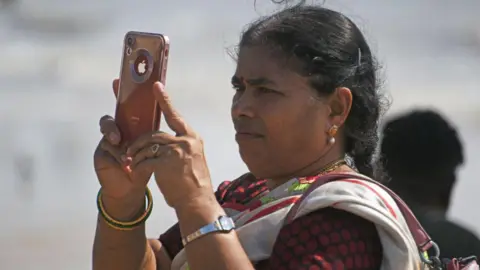
Getty Images A woman seen holding up a red smartphone with the apple logoGetty Images

India now has over 1.2 billion mobile subscribers

India has ordered all new smartphones to come pre-loaded with a state-run cybersecurity app, sparking privacy and surveillance concerns.

Under the order – passed last week but made public on Monday – smartphone makers have 90 days to ensure all new devices come with the government’s Sanchar Saathi app, whose “functionalities cannot be disabled or restricted”.

It says this is necessary to help citizens verify the authenticity of a handset and report the suspected misuse of telecom resources.

The move – which comes in one of the world’s largest phone markets, with more than 1.2 billion mobile users – has been criticised by cyber experts, who say it breaches citizens’ right to privacy.

Under the app’s privacy policy, it can make and manage phone calls, send messages, access call and message logs, photos and files as well as the phone’s camera.

“In plain terms, this converts every smartphone sold in India into a vessel for state mandated software that the user cannot meaningfully refuse, control, or remove,” advocacy group Internet Freedom Foundation said in a statement.

Amid the growing criticism, India’s Minister of Communications Jyotiradtiya Scindia has clarified that mobile phone users will have the option to delete this app if they don’t want to use it.

“This is a completely voluntary and democratic system – users may choose to activate the app and avail its benefits, or if they do not wish to, they can easily delete it from their phone at any time,” he wrote on X.

The minister did not, however, clarify how this would be done if the app’s functions cannot be disabled or restricted.

Launched in January, the Sanchar Saathi app allows users to check a device’s IMEI, report lost or stolen phones and flag suspected fraud communications.

An IMEI – the International Mobile Equipment Identity – is a unique 15-digit code that identifies and authenticates a mobile device on cellular networks. The code is essentially the phone’s serial number.

In a statement, India’s Department of Telecommunications said that mobile handsets with duplicate or spoofed IMEI numbers pose “serious endangerment” to telecom cyber security.

“India has big second-hand mobile device market. Cases have also been observed where stolen or blacklisted devices are being re-sold,” it said, adding that this makes the purchaser an “abetter in crime and causes financial loss to them”.

Under the new rules, the pre-installed app must be “readily visible and accessible” to users when they set up a device and its functionalities cannot be disabled or restricted.

Smartphone makers must also “make an endeavour” to provide the app through software updates for devices that are out of factories but haven’t been sold yet, the statement said.

All companies have been asked to give compliance reports on the order in 120 days.

Getty Images Four men see checking models of iPhone 17 series kept on display inside the Apple store at a mall in Mumbai. Two of them are wearing dark blue shirts while one wears a white and another wears a grey shirt.Getty Images

The order requires all phones manufactured or imported in India to pre-install the app within 90 days

The government says the move will bolster telecom cybersecurity. A Reuters report, citing official figures, says the app has helped recover more than 700,000 lost phones – including 50,000 in October alone.

But experts say the app’s broad permissions raise concerns about how much data it can collect, widening the scope for surveillance.

Technology analyst Prasanto K Roy says the bigger concern is about how much access an app might eventually be allowed on the handset.

“We can’t see exactly what it’s doing, but we can see that it’s asking for a great deal of permissions – potential access to just about everything from flashlight to camera. This is itself worrying,” he told the BBC.

On Google’s Play Store, the app says it doesn’t collect or share any user data. The BBC has reached out to the department of telecommunications with questions about the app and the privacy concerns related to it.

Mr Roy adds that compliance will be difficult, since the order runs counter to the policies of most handset-makers, including Apple.

“Most companies prohibit installation of any government or third-party app before the sale of a smartphone,” he says.

While India’s smartphone market is dominated by Android, Apple’s iOS powered an estimated 4.5% of the 735 million smartphones in the country by mid-2025, according to Counterpoint Research.

Apple has not commented publicly, but Reuters reports it does not intend to comply and “will convey its concerns to Delhi”.

India is not the only country to have tightened rules on device verification.

In August, Russia ordered all phones and tablets sold in the country to come pre-installed with the state-backed MAX messenger app, sparking similar privacy and surveillance concerns.

Follow BBC News India on Instagram, YouTube, Twitter and Facebook.


Source link
#Sanchar #Saathi #India #mandates #stateowned #cyber #safety #app #smartphones

Catch up with the most important stories from around Europe and beyond this April 18th, 2026 – latest news, breaking news, World, Business, Entertainment, Politics, Culture, Travel.

#Video #Latest #news #bulletin #April #18th #Midday{id:11940,slug:news,urlSafeValue:news,title:news},{id:12984,slug:world-news,urlSafeValue:world-news,title:World News},{id:25926,slug:top-stories,urlSafeValue:top-stories,title:Latest News},{id:26778,slug:euronews-live,urlSafeValue:euronews-live,title:euronews live}">Video. Latest news bulletin | April 18th, 2026 – Midday
      
                  
              Updated: 18/04/2026 – 12:00 GMT+2
          
              
                    Catch up with the most important stories from around Europe and beyond this April 18th, 2026 – latest news, breaking news, World, Business, Entertainment, Politics, Culture, Travel.
              
                … More


    #Video #Latest #news #bulletin #April #18th #Midday{id:11940,slug:news,urlSafeValue:news,title:news},{id:12984,slug:world-news,urlSafeValue:world-news,title:World News},{id:25926,slug:top-stories,urlSafeValue:top-stories,title:Latest News},{id:26778,slug:euronews-live,urlSafeValue:euronews-live,title:euronews live}

It was the shelling that drove Syrian man Imad Omar Qashit from his home again. Fourteen years ago, he fled from Syria to Lebanon. This time, it was the other way round.

“When Israeli missiles destroyed entire homes in my neighborhood in southern Lebanon’s city of Tyre, we decided it was time to save our lives again,” the 52-year-old told DW.

In early March, Lebanon was drawn into the wider Middle East war after local group Hezbollah, which is backed by Iran, fired rockets into Israel, ostensibly in retaliation for the Israeli killing of Iran’s leader.

On Thursday, a 10-day ceasefire between Israel and Lebanon was brokered by the US but before that, more than 227,549 people had crossed the three official border points from Lebanon into Syria, according to the latest numbers from the United Nation’s International Organization for Migration (IOM). The vast majority, 95%, were Syrians, while 5% were Lebanese nationals.

Lebanon’s health authorities say the death toll from Israel’s attacks on the Hezbollah militia is around 2,196. The ministry does not provide a breakdown by nationality and estimates of how many Syrians are among the killed and injured range widely, from 39 to 315. According to the UN refugee agency UNHCR, more than 1 million Syrian refugees are still registered in Lebanon, with hundreds of thousands more believed to be in the country without registration.

Syrians wait at a border crossing as refugees
More than 270,000 Syrians returned from Lebanon since March even though observers warn the country is not ready to host them Image: Izz Aldien Alqasem/Anadolu Agency/IMAGO

Protracted crisis

Once Qashit and his family arrived back in their home town Maarat al-Numan near Aleppo, they found their house completely destroyed as a result of Syria’s civil war, which only ended in December 2024 after a coalition of rebel groups ousted Syria’s longtime dictator, Bashar Assad.

“There are no houses for rent as the whole city is destroyed,” Qashit told DW. For the time being, they are staying with his sister. 

Another Syrian, Mohammad Jassem al-Brouk, fled Israeli strikes in Lebanon two weeks ago. “It was extremely crowded at the border crossing and it took an entire day to get through,” he told DW.

When he eventually arrived at his family home in the city of Qusair near Homs, he only found remnants of the house. With no other option, he unpacked his tent from the refugee camp in Lebanon, set it up, and is now living in it. Despite his lack of housing, he has no intention of returning to Lebanon. 

Earlier in April, a survey by the UN’s refugee agency, the UNHCR, found that around half of the Syrians they had interviewed also said that they intend to remain permanently in Syria despite economic challenges and limited state services.

“Syrians are returning because Lebanon has become unlivable, rather than Syria being ready to receive them,” Nanar Hawach, senior Syria analyst at the International Crisis Group, confirms. “The government can manage the border but it has no answer for what happens after that,” he said. In his view, the hundreds of thousands of returnees should not be read as a sign that conditions inside Syria have improved.

A boy jumps off the back of the rusted and charred remains of abandoned military vehicles
Areas that were contested during the Syrian civil war are often contaminated with unexploded devices that pose a danger to returning SyriansImage: Arif Hudaverdi Yaman/Anadolu/picture alliance

Legacy of war

Syria continues to struggle with the legacy of more than a decade of conflict. Despite sanctions being lifted and Syria’s return to the international fold, sectarian clashes and political instability still compound the country’s problems.

The World Bank’s damage assessment estimates total reconstruction costs at about $216 billion (€200 billion). Basic services, including education, health care and infrastructure, remain limited and the humanitarian situation for the around 26 million people is  dire.

According to the UN, around 15.6 million Syrians require humanitarian assistance and 13.3 million Syrians are food-insecure. A severe drought in 2025 devastated 95% of rainfed crops, the UN 2025 food security assessment report notes.

“Syria was already in a protracted humanitarian crisis before this new wave of returns,” Hiba Zayadin, senior researcher in the Middle East and North Africa division at Human Rights Watch, told DW. “The infrastructure simply isn’t there to absorb large numbers of people, many of whom left with nothing and are returning to the same.” 

A woman walks next to an ambulance
Before the US-brokered ceasefire, Israel demolished large parts of southern Lebanon and Tyre, prompting Syrian refugees to pack up and leaveImage: Louisa Gouliamaki/REUTERS

Risk of unexploded devices

These are not the only issues. Syria is also one of the most contaminated countries in the world when it comes to explosive remnants. “Years of aerial bombardment, ground fighting and the use of cluster munitions across multiple governorates have left vast areas littered with unexploded ordnance, or UXO, landmines and improvised explosive devices,” Zayadin continued.

“The danger is very real,” Iain Overton confirmed. He’s the executive director of the UK-based organization, Action on Armed Violence (AOAV) which records evidence of armed violence against civilians worldwide.

He also warned that UXO contamination remains particularly acute in areas that have seen sustained fighting and shifting frontlines, including parts of Raqqa, Deir el-Zour, Aleppo, Idlib and rural Homs and Hama. “These are precisely the areas to which many refugees are returning,” he told DW, adding that children and returnees unfamiliar with contaminated environments are especially vulnerable.

“Even in the absence of active hostilities, the legacy of explosive violence continues to kill and injure,” Overton said, adding that the trend is worsening. In 2024, AOAV recorded 238 UXO incidents causing 508 casualties. Of these, 479 were civilians. By 2025, this had risen sharply to 794 incidents and 1,537 casualties, including 1,424 civilians.

For Qashit and his family, recently returned from Lebanon, these is just one more thing to worry about. “My children would not recognize unexploded mines when they are playing outside,” he said, concerned. 

Back to Yarmouk: A Syrian family rebuilds and seeks justice

Edited by: C. Schaer

#Displaced #Iran #war #Lebanon #Syrian #crisis">Displaced by Iran war: out of Lebanon, into Syrian crisisIt was the shelling that drove Syrian man Imad Omar Qashit from his home again. Fourteen years ago, he fled from Syria to Lebanon. This time, it was the other way round.

“When Israeli missiles destroyed entire homes in my neighborhood in southern Lebanon’s city of Tyre, we decided it was time to save our lives again,” the 52-year-old told DW.

In early March, Lebanon was drawn into the wider Middle East war after local group Hezbollah, which is backed by Iran, fired rockets into Israel, ostensibly in retaliation for the Israeli killing of Iran’s leader.

On Thursday, a 10-day ceasefire between Israel and Lebanon was brokered by the US but before that, more than 227,549 people had crossed the three official border points from Lebanon into Syria, according to the latest numbers from the United Nation’s International Organization for Migration (IOM). The vast majority, 95%, were Syrians, while 5% were Lebanese nationals.

Lebanon’s health authorities say the death toll from Israel’s attacks on the Hezbollah militia is around 2,196. The ministry does not provide a breakdown by nationality and estimates of how many Syrians are among the killed and injured range widely, from 39 to 315. According to the UN refugee agency UNHCR, more than 1 million Syrian refugees are still registered in Lebanon, with hundreds of thousands more believed to be in the country without registration.More than 270,000 Syrians returned from Lebanon since March even though observers warn the country is not ready to host them Image: Izz Aldien Alqasem/Anadolu Agency/IMAGO

Protracted crisis

Once Qashit and his family arrived back in their home town Maarat al-Numan near Aleppo, they found their house completely destroyed as a result of Syria’s civil war, which only ended in December 2024 after a coalition of rebel groups ousted Syria’s longtime dictator, Bashar Assad.

“There are no houses for rent as the whole city is destroyed,” Qashit told DW. For the time being, they are staying with his sister. 

Another Syrian, Mohammad Jassem al-Brouk, fled Israeli strikes in Lebanon two weeks ago. “It was extremely crowded at the border crossing and it took an entire day to get through,” he told DW.

When he eventually arrived at his family home in the city of Qusair near Homs, he only found remnants of the house. With no other option, he unpacked his tent from the refugee camp in Lebanon, set it up, and is now living in it. Despite his lack of housing, he has no intention of returning to Lebanon. 

Earlier in April, a survey by the UN’s refugee agency, the UNHCR, found that around half of the Syrians they had interviewed also said that they intend to remain permanently in Syria despite economic challenges and limited state services.

“Syrians are returning because Lebanon has become unlivable, rather than Syria being ready to receive them,” Nanar Hawach, senior Syria analyst at the International Crisis Group, confirms. “The government can manage the border but it has no answer for what happens after that,” he said. In his view, the hundreds of thousands of returnees should not be read as a sign that conditions inside Syria have improved.Areas that were contested during the Syrian civil war are often contaminated with unexploded devices that pose a danger to returning SyriansImage: Arif Hudaverdi Yaman/Anadolu/picture alliance

Legacy of war

Syria continues to struggle with the legacy of more than a decade of conflict. Despite sanctions being lifted and Syria’s return to the international fold, sectarian clashes and political instability still compound the country’s problems.

The World Bank’s damage assessment estimates total reconstruction costs at about 6 billion (€200 billion). Basic services, including education, health care and infrastructure, remain limited and the humanitarian situation for the around 26 million people is  dire.

According to the UN, around 15.6 million Syrians require humanitarian assistance and 13.3 million Syrians are food-insecure. A severe drought in 2025 devastated 95% of rainfed crops, the UN 2025 food security assessment report notes.

“Syria was already in a protracted humanitarian crisis before this new wave of returns,” Hiba Zayadin, senior researcher in the Middle East and North Africa division at Human Rights Watch, told DW. “The infrastructure simply isn’t there to absorb large numbers of people, many of whom left with nothing and are returning to the same.”  Before the US-brokered ceasefire, Israel demolished large parts of southern Lebanon and Tyre, prompting Syrian refugees to pack up and leaveImage: Louisa Gouliamaki/REUTERS

Risk of unexploded devices

These are not the only issues. Syria is also one of the most contaminated countries in the world when it comes to explosive remnants. “Years of aerial bombardment, ground fighting and the use of cluster munitions across multiple governorates have left vast areas littered with unexploded ordnance, or UXO, landmines and improvised explosive devices,” Zayadin continued.

“The danger is very real,” Iain Overton confirmed. He’s the executive director of the UK-based organization, Action on Armed Violence (AOAV) which records evidence of armed violence against civilians worldwide.

He also warned that UXO contamination remains particularly acute in areas that have seen sustained fighting and shifting frontlines, including parts of Raqqa, Deir el-Zour, Aleppo, Idlib and rural Homs and Hama. “These are precisely the areas to which many refugees are returning,” he told DW, adding that children and returnees unfamiliar with contaminated environments are especially vulnerable.

“Even in the absence of active hostilities, the legacy of explosive violence continues to kill and injure,” Overton said, adding that the trend is worsening. In 2024, AOAV recorded 238 UXO incidents causing 508 casualties. Of these, 479 were civilians. By 2025, this had risen sharply to 794 incidents and 1,537 casualties, including 1,424 civilians.

For Qashit and his family, recently returned from Lebanon, these is just one more thing to worry about. “My children would not recognize unexploded mines when they are playing outside,” he said, concerned. 

Back to Yarmouk: A Syrian family rebuilds and seeks justice To view this video please enable JavaScript, and consider upgrading to a web browser that supports HTML5 video

Edited by: C. Schaer
#Displaced #Iran #war #Lebanon #Syrian #crisis

Syria to Lebanon. This time, it was the other way round.

“When Israeli missiles destroyed entire homes in my neighborhood in southern Lebanon’s city of Tyre, we decided it was time to save our lives again,” the 52-year-old told DW.

In early March, Lebanon was drawn into the wider Middle East war after local group Hezbollah, which is backed by Iran, fired rockets into Israel, ostensibly in retaliation for the Israeli killing of Iran’s leader.

On Thursday, a 10-day ceasefire between Israel and Lebanon was brokered by the US but before that, more than 227,549 people had crossed the three official border points from Lebanon into Syria, according to the latest numbers from the United Nation’s International Organization for Migration (IOM). The vast majority, 95%, were Syrians, while 5% were Lebanese nationals.

Lebanon’s health authorities say the death toll from Israel’s attacks on the Hezbollah militia is around 2,196. The ministry does not provide a breakdown by nationality and estimates of how many Syrians are among the killed and injured range widely, from 39 to 315. According to the UN refugee agency UNHCR, more than 1 million Syrian refugees are still registered in Lebanon, with hundreds of thousands more believed to be in the country without registration.

Syrians wait at a border crossing as refugees
More than 270,000 Syrians returned from Lebanon since March even though observers warn the country is not ready to host them Image: Izz Aldien Alqasem/Anadolu Agency/IMAGO

Protracted crisis

Once Qashit and his family arrived back in their home town Maarat al-Numan near Aleppo, they found their house completely destroyed as a result of Syria’s civil war, which only ended in December 2024 after a coalition of rebel groups ousted Syria’s longtime dictator, Bashar Assad.

“There are no houses for rent as the whole city is destroyed,” Qashit told DW. For the time being, they are staying with his sister. 

Another Syrian, Mohammad Jassem al-Brouk, fled Israeli strikes in Lebanon two weeks ago. “It was extremely crowded at the border crossing and it took an entire day to get through,” he told DW.

When he eventually arrived at his family home in the city of Qusair near Homs, he only found remnants of the house. With no other option, he unpacked his tent from the refugee camp in Lebanon, set it up, and is now living in it. Despite his lack of housing, he has no intention of returning to Lebanon. 

Earlier in April, a survey by the UN’s refugee agency, the UNHCR, found that around half of the Syrians they had interviewed also said that they intend to remain permanently in Syria despite economic challenges and limited state services.

“Syrians are returning because Lebanon has become unlivable, rather than Syria being ready to receive them,” Nanar Hawach, senior Syria analyst at the International Crisis Group, confirms. “The government can manage the border but it has no answer for what happens after that,” he said. In his view, the hundreds of thousands of returnees should not be read as a sign that conditions inside Syria have improved.

A boy jumps off the back of the rusted and charred remains of abandoned military vehicles
Areas that were contested during the Syrian civil war are often contaminated with unexploded devices that pose a danger to returning SyriansImage: Arif Hudaverdi Yaman/Anadolu/picture alliance

Legacy of war

Syria continues to struggle with the legacy of more than a decade of conflict. Despite sanctions being lifted and Syria’s return to the international fold, sectarian clashes and political instability still compound the country’s problems.

The World Bank’s damage assessment estimates total reconstruction costs at about $216 billion (€200 billion). Basic services, including education, health care and infrastructure, remain limited and the humanitarian situation for the around 26 million people is  dire.

According to the UN, around 15.6 million Syrians require humanitarian assistance and 13.3 million Syrians are food-insecure. A severe drought in 2025 devastated 95% of rainfed crops, the UN 2025 food security assessment report notes.

“Syria was already in a protracted humanitarian crisis before this new wave of returns,” Hiba Zayadin, senior researcher in the Middle East and North Africa division at Human Rights Watch, told DW. “The infrastructure simply isn’t there to absorb large numbers of people, many of whom left with nothing and are returning to the same.” 

A woman walks next to an ambulance
Before the US-brokered ceasefire, Israel demolished large parts of southern Lebanon and Tyre, prompting Syrian refugees to pack up and leaveImage: Louisa Gouliamaki/REUTERS

Risk of unexploded devices

These are not the only issues. Syria is also one of the most contaminated countries in the world when it comes to explosive remnants. “Years of aerial bombardment, ground fighting and the use of cluster munitions across multiple governorates have left vast areas littered with unexploded ordnance, or UXO, landmines and improvised explosive devices,” Zayadin continued.

“The danger is very real,” Iain Overton confirmed. He’s the executive director of the UK-based organization, Action on Armed Violence (AOAV) which records evidence of armed violence against civilians worldwide.

He also warned that UXO contamination remains particularly acute in areas that have seen sustained fighting and shifting frontlines, including parts of Raqqa, Deir el-Zour, Aleppo, Idlib and rural Homs and Hama. “These are precisely the areas to which many refugees are returning,” he told DW, adding that children and returnees unfamiliar with contaminated environments are especially vulnerable.

“Even in the absence of active hostilities, the legacy of explosive violence continues to kill and injure,” Overton said, adding that the trend is worsening. In 2024, AOAV recorded 238 UXO incidents causing 508 casualties. Of these, 479 were civilians. By 2025, this had risen sharply to 794 incidents and 1,537 casualties, including 1,424 civilians.

For Qashit and his family, recently returned from Lebanon, these is just one more thing to worry about. “My children would not recognize unexploded mines when they are playing outside,” he said, concerned. 

Back to Yarmouk: A Syrian family rebuilds and seeks justice

Edited by: C. Schaer

#Displaced #Iran #war #Lebanon #Syrian #crisis">Displaced by Iran war: out of Lebanon, into Syrian crisis

It was the shelling that drove Syrian man Imad Omar Qashit from his home again. Fourteen years ago, he fled from Syria to Lebanon. This time, it was the other way round.

“When Israeli missiles destroyed entire homes in my neighborhood in southern Lebanon’s city of Tyre, we decided it was time to save our lives again,” the 52-year-old told DW.

In early March, Lebanon was drawn into the wider Middle East war after local group Hezbollah, which is backed by Iran, fired rockets into Israel, ostensibly in retaliation for the Israeli killing of Iran’s leader.

On Thursday, a 10-day ceasefire between Israel and Lebanon was brokered by the US but before that, more than 227,549 people had crossed the three official border points from Lebanon into Syria, according to the latest numbers from the United Nation’s International Organization for Migration (IOM). The vast majority, 95%, were Syrians, while 5% were Lebanese nationals.

Lebanon’s health authorities say the death toll from Israel’s attacks on the Hezbollah militia is around 2,196. The ministry does not provide a breakdown by nationality and estimates of how many Syrians are among the killed and injured range widely, from 39 to 315. According to the UN refugee agency UNHCR, more than 1 million Syrian refugees are still registered in Lebanon, with hundreds of thousands more believed to be in the country without registration.

Syrians wait at a border crossing as refugees
More than 270,000 Syrians returned from Lebanon since March even though observers warn the country is not ready to host them Image: Izz Aldien Alqasem/Anadolu Agency/IMAGO

Protracted crisis

Once Qashit and his family arrived back in their home town Maarat al-Numan near Aleppo, they found their house completely destroyed as a result of Syria’s civil war, which only ended in December 2024 after a coalition of rebel groups ousted Syria’s longtime dictator, Bashar Assad.

“There are no houses for rent as the whole city is destroyed,” Qashit told DW. For the time being, they are staying with his sister. 

Another Syrian, Mohammad Jassem al-Brouk, fled Israeli strikes in Lebanon two weeks ago. “It was extremely crowded at the border crossing and it took an entire day to get through,” he told DW.

When he eventually arrived at his family home in the city of Qusair near Homs, he only found remnants of the house. With no other option, he unpacked his tent from the refugee camp in Lebanon, set it up, and is now living in it. Despite his lack of housing, he has no intention of returning to Lebanon. 

Earlier in April, a survey by the UN’s refugee agency, the UNHCR, found that around half of the Syrians they had interviewed also said that they intend to remain permanently in Syria despite economic challenges and limited state services.

“Syrians are returning because Lebanon has become unlivable, rather than Syria being ready to receive them,” Nanar Hawach, senior Syria analyst at the International Crisis Group, confirms. “The government can manage the border but it has no answer for what happens after that,” he said. In his view, the hundreds of thousands of returnees should not be read as a sign that conditions inside Syria have improved.

A boy jumps off the back of the rusted and charred remains of abandoned military vehicles
Areas that were contested during the Syrian civil war are often contaminated with unexploded devices that pose a danger to returning SyriansImage: Arif Hudaverdi Yaman/Anadolu/picture alliance

Legacy of war

Syria continues to struggle with the legacy of more than a decade of conflict. Despite sanctions being lifted and Syria’s return to the international fold, sectarian clashes and political instability still compound the country’s problems.

The World Bank’s damage assessment estimates total reconstruction costs at about $216 billion (€200 billion). Basic services, including education, health care and infrastructure, remain limited and the humanitarian situation for the around 26 million people is  dire.

According to the UN, around 15.6 million Syrians require humanitarian assistance and 13.3 million Syrians are food-insecure. A severe drought in 2025 devastated 95% of rainfed crops, the UN 2025 food security assessment report notes.

“Syria was already in a protracted humanitarian crisis before this new wave of returns,” Hiba Zayadin, senior researcher in the Middle East and North Africa division at Human Rights Watch, told DW. “The infrastructure simply isn’t there to absorb large numbers of people, many of whom left with nothing and are returning to the same.” 

A woman walks next to an ambulance
Before the US-brokered ceasefire, Israel demolished large parts of southern Lebanon and Tyre, prompting Syrian refugees to pack up and leaveImage: Louisa Gouliamaki/REUTERS

Risk of unexploded devices

These are not the only issues. Syria is also one of the most contaminated countries in the world when it comes to explosive remnants. “Years of aerial bombardment, ground fighting and the use of cluster munitions across multiple governorates have left vast areas littered with unexploded ordnance, or UXO, landmines and improvised explosive devices,” Zayadin continued.

“The danger is very real,” Iain Overton confirmed. He’s the executive director of the UK-based organization, Action on Armed Violence (AOAV) which records evidence of armed violence against civilians worldwide.

He also warned that UXO contamination remains particularly acute in areas that have seen sustained fighting and shifting frontlines, including parts of Raqqa, Deir el-Zour, Aleppo, Idlib and rural Homs and Hama. “These are precisely the areas to which many refugees are returning,” he told DW, adding that children and returnees unfamiliar with contaminated environments are especially vulnerable.

“Even in the absence of active hostilities, the legacy of explosive violence continues to kill and injure,” Overton said, adding that the trend is worsening. In 2024, AOAV recorded 238 UXO incidents causing 508 casualties. Of these, 479 were civilians. By 2025, this had risen sharply to 794 incidents and 1,537 casualties, including 1,424 civilians.

For Qashit and his family, recently returned from Lebanon, these is just one more thing to worry about. “My children would not recognize unexploded mines when they are playing outside,” he said, concerned. 

Back to Yarmouk: A Syrian family rebuilds and seeks justice

Edited by: C. Schaer

#Displaced #Iran #war #Lebanon #Syrian #crisis

Post Comment