×
Stop wasting world’s time, Ukraine tells Putin after US talks in Moscow

Stop wasting world’s time, Ukraine tells Putin after US talks in Moscow

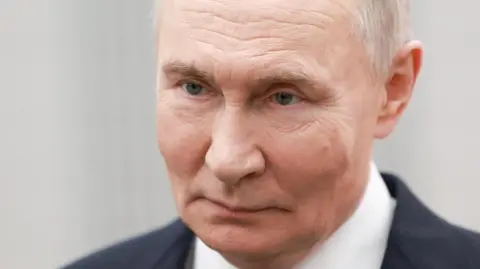
Reuters Russian President Vladimir Puitn. Photo: 3 December 2025
Reuters

Ukrainian Foreign Minister Andrii Sybiha‎ has accused Vladimir Putin of “wasting the world’s time”, a day after high-stakes talks between the US and Russia over ending the war in Ukraine failed to produce tangible results.

“Russia must end the bloodshed it has started. If this doesn’t happen and Putin just spits into the world’s face once again, there must be consequences,” Sybiha said.

Still, Sybiha added that the US delegation had told his colleagues that the talks had been of “positive significance for the peace process” and they had invited Ukrainian officials to continue talks in the US in the near future.

President Donald Trump’s special envoy Steve Witkoff and his son-in-law Jared Kushner spent almost five hours with Putin at the Kremlin on Tuesday and the White House said on Wednesday they had briefed Trump after a “thorough, productive meeting”.

The US-Russia talks followed days of US meetings with Ukrainian and European leaders, after concerns had been expressed that a deal was being hatched that was too slanted towards Russia’s demands.

Little concrete headway appears to have been made during the Kremlin talks in reconciling Moscow and Kyiv’s positions.

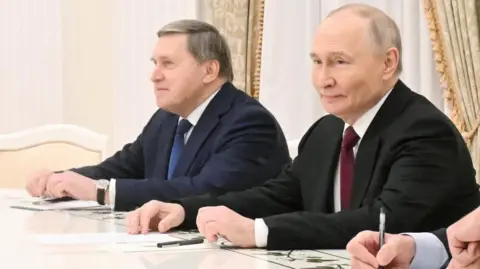
Reuters/Pool/Sputnik Russian President Vladimir Putin and foreign policy aide Yuri Ushakov attend a meeting with U.S. President Donald Trump's special envoy Steve Witkoff and son-in-law Jared Kushner at the Kremlin in Moscow, Russia, December 2, 202Reuters/Pool/Sputnik

Putin (R) and Yuri Ushakov took part in almost five hours of talks with the US envoys on Tuesday

Putin’s senior policy adviser Yuri Ushakov said “no compromise” on ending the war had been found. “Some of the US proposals look more or less acceptable, though they need to be discussed further”, he said, while adding that others had been openly criticised by Russia’s leader.

Although Ushakov did not elaborate further, at least two major points of contention remain between Moscow and Kyiv – the fate of Ukrainian territory seized by Russian forces and security guarantees for Ukraine.

Kyiv and its European partners believe that, even in the event of a peace deal, the most effective way to deter Russia from attacking again in the future would be to grant Ukraine membership of Nato.

Russia is vehemently opposed to such a proposal, and Trump too has repeatedly signalled he has no intention of letting Kyiv into the alliance.

The prospect of Ukraine joining Nato was a “key question” that was tackled in Moscow, the Kremlin said on Wednesday.

Ushakov implied that the Russian negotiating position had been strengthened thanks to recent successes on the battlefield.

Russian soldiers had “helped make the assessments of our foreign partners regarding the paths to a peace settlement more appropriate,” he said.

Ahead of the US visit to the Kremlin, Putin was filmed in army fatigues at a Russian command post, being briefed by commanders claiming the conquest of the key strategic city of Pokrovsk, in eastern Ukraine, as well as other nearby settlements.

Fighting in Pokrovsk is continuing and Russian forces do not control the whole city, but Russian officials clearly believe their message of military gains has been heard by the US.

Russian forces have made some incremental advances in the east and appear to have stepped up their campaign in recent weeks. They seized about 701 sq km (270 sq miles) of Ukrainian territory in November, according to AFP analysis of data from the US-based Institute for the Study of War (ISW), and they now control 19.3% of Ukrainian territory.

The Kremlin on Wednesday said Putin was ready to keep meeting with the Americans “as many times as needed”.

But as Russian-American relations appear to grow more cordial, the gulf between Moscow and Europe widens.

Putin has accused Europe of sabotaging Russia’s relations with the US, of putting forward demands Moscow could not accept and of blocking the peace process. Shortly before meeting Witkoff and Kushner, Putin told a forum in Moscow that while he did not want conflict with Europe, he was “ready for war”.
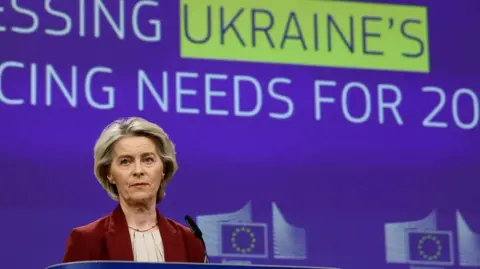
Reuters European Commission President Ursula von der Leyen attends a press conference with European Commissioner for Economy Valdis Dombrovskis, addressing Ukraine's financing needsReuters

European Commission chief Ursula von der Leyen has hailed a deal to end Russian imports of gas to the EU by 2027

UK government officials rejected Putin’s message as “yet more Kremlin claptrap from a president who isn’t serious about peace”.

Nato foreign ministers met in Brussels on Wednesday and Secretary-General Mark Rutte said that it was positive that peace talks were taking place but Ukraine had to be put in “the strongest position to keep the fight going”.

Meanwhile, EU member states have reached a deal with members of the European Parliament to make Europe fully independent of Russian gas before the end of 2027.

European Commission chief Ursula von der Leyen hailed “the dawn of a new era”, under a deal that means long-term gas pipeline contracts with Russia will be banned from September 2027 and long-term contracts for liquefied natural gas will be banned from January 2027.

“We’ve chosen energy security and independence for Europe. No more blackmail. No more market manipulation by Putin. We stand strong with Ukraine,” EU Energy Commissioner Dan Jorgensen said on Wednesday.

The Commission is also proposing to raise €90bn for Ukraine to fund its military and basic services while Russia’s war continues.

The plan would either require Belgium to agree to a “reparations loan” using frozen Russian assets held in a financial institution in Brussels, or the money would be funded by international borrowing.

Ukrainian Prime Minister Yulia Svyrydenko has welcomed the proposal, which would cover two-thirds of Ukraine’s financing needs for the next two years.

Belgium has resisted the plan to use frozen assets held on its territory, over concerns about legal repercussions from Moscow. The European Central Bank (ECB) has also opposed the idea, saying it would not act as a backstop for a reparations loan.

The proposed loan is smaller than the planned €140bn loan initially planned and German Foreign Minister Johann Wadephul said “we support this and, of course, take Belgium’s concerns seriously”.

Source link
#Stop #wasting #worlds #time #Ukraine #tells #Putin #talks #Moscow


<a href='https://news.sky.com/story/the-most-striking-pictures-of-the-week-13535986' target='_blank'>The most striking pictures of the week</a>#lta #href039httpsnews.sky.comstorythemoststrikingpicturesoftheweek13535986039 #target039_blank039gtThe #striking #pictures #weekltagt"><a href='https://news.sky.com/story/the-most-striking-pictures-of-the-week-13535986' target='_blank'>The most striking pictures of the week</a><a href='https://news.sky.com/story/the-most-striking-pictures-of-the-week-13535986' target='_blank'>The most striking pictures of the week</a>#lta #href039httpsnews.sky.comstorythemoststrikingpicturesoftheweek13535986039 #target039_blank039gtThe #striking #pictures #weekltagt
Britain should start talking about rejoining the EU, according to a former senior civil servant who ran the Brexit department.

Philip Rycroft, who was permanent secretary of the Department for Exiting the EU, said the “argument was there to be won” about going back into Europe, adding that a “clear-headed appraisal of what is in the country’s best interests” was needed. However, he said rejoining the bloc could be a “long and windy” road.

“Most economic analysis suggests that we have taken a significant hit to GDP as a result of leaving the single market,” he wrote in the Times. “The precise number, and the impact on our export performance to the EU and beyond, might be subject to debate, but no one can credibly claim that we have marched to the sunny uplands of sustained economic growth as a consequence of Brexit.”

Rycroft said the promises of the Brexit campaign on issues from economics to immigration had not lived up to expectations. “The great promise of a comprehensive trade deal with the USA now seems like an impossible dream,” he said.

Philip Rycroft answers questions in the House of Commons in 2018 on the UK’s negotiations on withdrawing from the EU. Photograph: PA Images/Alamy

“Chill winds don’t just blow through the international trading order. The postwar certainties that underpinned our security as a nation are visibly crumbling. With a hot war on the European mainland perpetrated by a revanchist Russia and an increasingly disengaged America, it is beyond peradventure that we must look to solidarity with our friends and neighbours in Europe to secure our defences.”

He concluded: “The argument is there to be won. It is time to talk about rejoining. It might be time to knock on the EU’s door.”

Rycroft’s comments chime with a growing mood within Labour that the party should be bolder on getting closer to the EU or rejoining in future. A number of cabinet ministers want Keir Starmer to push harder on trying to join a customs union or the single market, which are still red lines for the government as it seeks a stronger post-Brexit relationship with the EU.

In January, the prime minister said the UK should consider “even closer alignment” with the single market, which was preferable to a customs union. “If it’s in our national interest … then we should consider that, we should go that far,” he said.

Concerns were raised at the European parliament on Thursday over EU citizens in the UK and British citizens in Europe post Brexit. MEPs heard about worries over the rights of children born to EU citizens in the UK but who did not know they had to apply for settled status.

They could face charges from the NHS or questions about employability in future, the parliament heard. Michal Meduna, a senior official in the European Commission’s post-withdrawal agreement unit said: “The UK approach has significant consequences for newborn children, resulting in very high healthcare charges.”

The Home Office was also criticised at the European parliament hearing, which it attended, for ending funding for charities assisting vulnerable EU citizens making late applications for settlement.

Settled, one of the charities, will say in a report published next week that it is seeing “hundreds of requests for advice every week”, but it no longer receives funding from the Home Office.

British in Europe, a grassroots coalition that campaigned for the rights of about 1.2 million British people living in the EU in 27 countries, told the parliament it had no funding from the UK. Although it is one of the interlocutors with the European Commission on Brexit, its principals, Fiona Godfrey and Jane Golding, are now working on an unpaid basis.

“We are all here as volunteers,” they said. “We would call on the British government also to fund the work that is needed to be done, for the support of British citizens living in the EU, because that has not been forthcoming.”

The UK government defended its decision to stop funding, with £32m spent since 2019 to help charities. Aliza Dee, the deputy head of justice and home affairs at the EU relations secretariat in the Cabinet Office, told the parliament: “Now that we’re seeing significantly fewer applications being made, and with fewer organisations operating in that space, now is the right moment to to bring an end to that particular tranche of funding. But alternative forms of support do exist in the UK, for example, the settlement scheme resolution centre.”

#Britain #seek #rejoin #civil #servant #led #Brexit #department">Britain should seek to rejoin EU, says civil servant who led Brexit departmentBritain should start talking about rejoining the EU, according to a former senior civil servant who ran the Brexit department.Philip Rycroft, who was permanent secretary of the Department for Exiting the EU, said the “argument was there to be won” about going back into Europe, adding that a “clear-headed appraisal of what is in the country’s best interests” was needed. However, he said rejoining the bloc could be a “long and windy” road.“Most economic analysis suggests that we have taken a significant hit to GDP as a result of leaving the single market,” he wrote in the Times. “The precise number, and the impact on our export performance to the EU and beyond, might be subject to debate, but no one can credibly claim that we have marched to the sunny uplands of sustained economic growth as a consequence of Brexit.”Rycroft said the promises of the Brexit campaign on issues from economics to immigration had not lived up to expectations. “The great promise of a comprehensive trade deal with the USA now seems like an impossible dream,” he said.Philip Rycroft answers questions in the House of Commons in 2018 on the UK’s negotiations on withdrawing from the EU. Photograph: PA Images/Alamy“Chill winds don’t just blow through the international trading order. The postwar certainties that underpinned our security as a nation are visibly crumbling. With a hot war on the European mainland perpetrated by a revanchist Russia and an increasingly disengaged America, it is beyond peradventure that we must look to solidarity with our friends and neighbours in Europe to secure our defences.”He concluded: “The argument is there to be won. It is time to talk about rejoining. It might be time to knock on the EU’s door.”Rycroft’s comments chime with a growing mood within Labour that the party should be bolder on getting closer to the EU or rejoining in future. A number of cabinet ministers want Keir Starmer to push harder on trying to join a customs union or the single market, which are still red lines for the government as it seeks a stronger post-Brexit relationship with the EU.In January, the prime minister said the UK should consider “even closer alignment” with the single market, which was preferable to a customs union. “If it’s in our national interest … then we should consider that, we should go that far,” he said.Concerns were raised at the European parliament on Thursday over EU citizens in the UK and British citizens in Europe post Brexit. MEPs heard about worries over the rights of children born to EU citizens in the UK but who did not know they had to apply for settled status.They could face charges from the NHS or questions about employability in future, the parliament heard. Michal Meduna, a senior official in the European Commission’s post-withdrawal agreement unit said: “The UK approach has significant consequences for newborn children, resulting in very high healthcare charges.”The Home Office was also criticised at the European parliament hearing, which it attended, for ending funding for charities assisting vulnerable EU citizens making late applications for settlement.Settled, one of the charities, will say in a report published next week that it is seeing “hundreds of requests for advice every week”, but it no longer receives funding from the Home Office.British in Europe, a grassroots coalition that campaigned for the rights of about 1.2 million British people living in the EU in 27 countries, told the parliament it had no funding from the UK. Although it is one of the interlocutors with the European Commission on Brexit, its principals, Fiona Godfrey and Jane Golding, are now working on an unpaid basis.“We are all here as volunteers,” they said. “We would call on the British government also to fund the work that is needed to be done, for the support of British citizens living in the EU, because that has not been forthcoming.”The UK government defended its decision to stop funding, with £32m spent since 2019 to help charities. Aliza Dee, the deputy head of justice and home affairs at the EU relations secretariat in the Cabinet Office, told the parliament: “Now that we’re seeing significantly fewer applications being made, and with fewer organisations operating in that space, now is the right moment to to bring an end to that particular tranche of funding. But alternative forms of support do exist in the UK, for example, the settlement scheme resolution centre.”#Britain #seek #rejoin #civil #servant #led #Brexit #department

Brexit department.

Philip Rycroft, who was permanent secretary of the Department for Exiting the EU, said the “argument was there to be won” about going back into Europe, adding that a “clear-headed appraisal of what is in the country’s best interests” was needed. However, he said rejoining the bloc could be a “long and windy” road.

“Most economic analysis suggests that we have taken a significant hit to GDP as a result of leaving the single market,” he wrote in the Times. “The precise number, and the impact on our export performance to the EU and beyond, might be subject to debate, but no one can credibly claim that we have marched to the sunny uplands of sustained economic growth as a consequence of Brexit.”

Rycroft said the promises of the Brexit campaign on issues from economics to immigration had not lived up to expectations. “The great promise of a comprehensive trade deal with the USA now seems like an impossible dream,” he said.

Philip Rycroft answers questions in the House of Commons in 2018 on the UK’s negotiations on withdrawing from the EU. Photograph: PA Images/Alamy

“Chill winds don’t just blow through the international trading order. The postwar certainties that underpinned our security as a nation are visibly crumbling. With a hot war on the European mainland perpetrated by a revanchist Russia and an increasingly disengaged America, it is beyond peradventure that we must look to solidarity with our friends and neighbours in Europe to secure our defences.”

He concluded: “The argument is there to be won. It is time to talk about rejoining. It might be time to knock on the EU’s door.”

Rycroft’s comments chime with a growing mood within Labour that the party should be bolder on getting closer to the EU or rejoining in future. A number of cabinet ministers want Keir Starmer to push harder on trying to join a customs union or the single market, which are still red lines for the government as it seeks a stronger post-Brexit relationship with the EU.

In January, the prime minister said the UK should consider “even closer alignment” with the single market, which was preferable to a customs union. “If it’s in our national interest … then we should consider that, we should go that far,” he said.

Concerns were raised at the European parliament on Thursday over EU citizens in the UK and British citizens in Europe post Brexit. MEPs heard about worries over the rights of children born to EU citizens in the UK but who did not know they had to apply for settled status.

They could face charges from the NHS or questions about employability in future, the parliament heard. Michal Meduna, a senior official in the European Commission’s post-withdrawal agreement unit said: “The UK approach has significant consequences for newborn children, resulting in very high healthcare charges.”

The Home Office was also criticised at the European parliament hearing, which it attended, for ending funding for charities assisting vulnerable EU citizens making late applications for settlement.

Settled, one of the charities, will say in a report published next week that it is seeing “hundreds of requests for advice every week”, but it no longer receives funding from the Home Office.

British in Europe, a grassroots coalition that campaigned for the rights of about 1.2 million British people living in the EU in 27 countries, told the parliament it had no funding from the UK. Although it is one of the interlocutors with the European Commission on Brexit, its principals, Fiona Godfrey and Jane Golding, are now working on an unpaid basis.

“We are all here as volunteers,” they said. “We would call on the British government also to fund the work that is needed to be done, for the support of British citizens living in the EU, because that has not been forthcoming.”

The UK government defended its decision to stop funding, with £32m spent since 2019 to help charities. Aliza Dee, the deputy head of justice and home affairs at the EU relations secretariat in the Cabinet Office, told the parliament: “Now that we’re seeing significantly fewer applications being made, and with fewer organisations operating in that space, now is the right moment to to bring an end to that particular tranche of funding. But alternative forms of support do exist in the UK, for example, the settlement scheme resolution centre.”

#Britain #seek #rejoin #civil #servant #led #Brexit #department">Britain should seek to rejoin EU, says civil servant who led Brexit department

Britain should start talking about rejoining the EU, according to a former senior civil servant who ran the Brexit department.

Philip Rycroft, who was permanent secretary of the Department for Exiting the EU, said the “argument was there to be won” about going back into Europe, adding that a “clear-headed appraisal of what is in the country’s best interests” was needed. However, he said rejoining the bloc could be a “long and windy” road.

“Most economic analysis suggests that we have taken a significant hit to GDP as a result of leaving the single market,” he wrote in the Times. “The precise number, and the impact on our export performance to the EU and beyond, might be subject to debate, but no one can credibly claim that we have marched to the sunny uplands of sustained economic growth as a consequence of Brexit.”

Rycroft said the promises of the Brexit campaign on issues from economics to immigration had not lived up to expectations. “The great promise of a comprehensive trade deal with the USA now seems like an impossible dream,” he said.

Philip Rycroft answers questions in the House of Commons in 2018 on the UK’s negotiations on withdrawing from the EU. Photograph: PA Images/Alamy

“Chill winds don’t just blow through the international trading order. The postwar certainties that underpinned our security as a nation are visibly crumbling. With a hot war on the European mainland perpetrated by a revanchist Russia and an increasingly disengaged America, it is beyond peradventure that we must look to solidarity with our friends and neighbours in Europe to secure our defences.”

He concluded: “The argument is there to be won. It is time to talk about rejoining. It might be time to knock on the EU’s door.”

Rycroft’s comments chime with a growing mood within Labour that the party should be bolder on getting closer to the EU or rejoining in future. A number of cabinet ministers want Keir Starmer to push harder on trying to join a customs union or the single market, which are still red lines for the government as it seeks a stronger post-Brexit relationship with the EU.

In January, the prime minister said the UK should consider “even closer alignment” with the single market, which was preferable to a customs union. “If it’s in our national interest … then we should consider that, we should go that far,” he said.

Concerns were raised at the European parliament on Thursday over EU citizens in the UK and British citizens in Europe post Brexit. MEPs heard about worries over the rights of children born to EU citizens in the UK but who did not know they had to apply for settled status.

They could face charges from the NHS or questions about employability in future, the parliament heard. Michal Meduna, a senior official in the European Commission’s post-withdrawal agreement unit said: “The UK approach has significant consequences for newborn children, resulting in very high healthcare charges.”

The Home Office was also criticised at the European parliament hearing, which it attended, for ending funding for charities assisting vulnerable EU citizens making late applications for settlement.

Settled, one of the charities, will say in a report published next week that it is seeing “hundreds of requests for advice every week”, but it no longer receives funding from the Home Office.

British in Europe, a grassroots coalition that campaigned for the rights of about 1.2 million British people living in the EU in 27 countries, told the parliament it had no funding from the UK. Although it is one of the interlocutors with the European Commission on Brexit, its principals, Fiona Godfrey and Jane Golding, are now working on an unpaid basis.

“We are all here as volunteers,” they said. “We would call on the British government also to fund the work that is needed to be done, for the support of British citizens living in the EU, because that has not been forthcoming.”

The UK government defended its decision to stop funding, with £32m spent since 2019 to help charities. Aliza Dee, the deputy head of justice and home affairs at the EU relations secretariat in the Cabinet Office, told the parliament: “Now that we’re seeing significantly fewer applications being made, and with fewer organisations operating in that space, now is the right moment to to bring an end to that particular tranche of funding. But alternative forms of support do exist in the UK, for example, the settlement scheme resolution centre.”

#Britain #seek #rejoin #civil #servant #led #Brexit #department

Post Comment