×
Sudanese villagers dig with hands to reach landslide victims, group says

Sudanese villagers dig with hands to reach landslide victims, group says

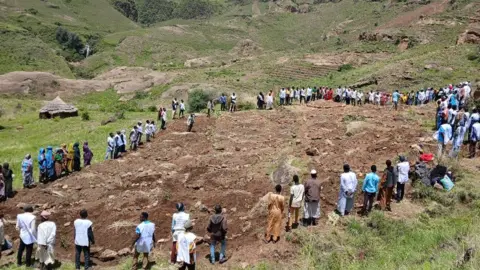
Sudan Liberation Movement/Army People standing outside in a circle around a large muddy area which looks like a burial site Sudan Liberation Movement/Army

This image is thought to show around 40 graves

Villagers in a remote area of Sudan’s western Darfur region are trying to reach buried victims by hand after a devastating landslide on Sunday, aid group Save the Children says.

“People are excavating by hand to rescue the bodies of their relatives since there are no tools or machinery”, Francesco Lanino, Save the Children’s deputy Sudan director for programmes and operations, said.

It is unclear how many people died. Figures range from as high as 1,000 from an armed group in charge of the area, to a figure from the national health ministry that says only two bodies have been recovered.

Save the Children said at least 373 bodies had been recovered, according to the head of the Civil Authority.

Mr Lanino said “1,000 lives may have been lost, including an estimated 200 children.”

Save the Children staff described scenes of “destruction and devastation” after the landslide caused by heavy rainfall. Mr Lanino said teams on location believe the landslide to be “one of the most tragic and large-scale disasters in the region’s history”.

He added that in the impacted Tarseen area, which is made up of five villages, there is only one known survivor in the worst-hit village.

Independently verifying the impact of the landslide has been difficult due to the remoteness of the area.

However, through analysis of satellite imagery, BBC Verify was able to identify nine buildings and structures that were washed away in the disaster.

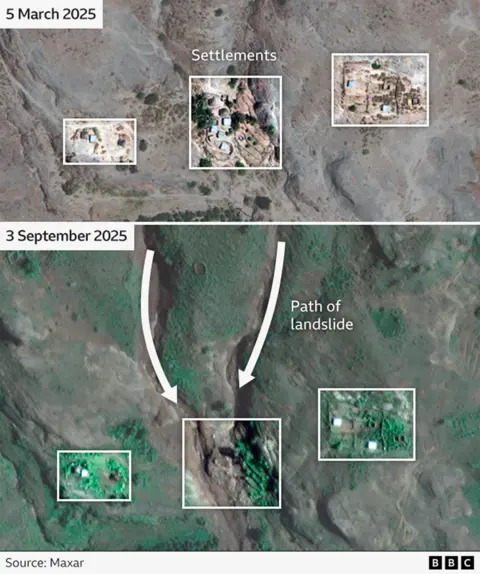
Two graphics of satellite images. One dated 5 March 2025 which shows three settlements which appear to be populated. The graphic below dated 3 September 2025 shows two arrows which depict the path of the landslide and shows the spaces where those settlements were sparsely populated.

It took Save the Children aid workers more than six hours to cross nearly 14 miles (22km) of rocky, muddy terrain from their office to the impacted area.

Aid workers had travelled on donkey to reach the Tarseen area in order to deliver the first batch of humanitarian supplies to survivors.

The ongoing civil war in Sudan has also made rescue efforts more challenging, another aid group World Vision stated.

Separately from the landslide, Sudan is currently facing a humanitarian crisis due to fighting between the paramilitary Rapid Support Forces (RSF) group and the army.

Estimates for the death toll from the civil war vary significantly, but a US official last year estimated up to 150,000 people had been killed since hostilities began in 2023.

Twelve million people have fled their homes.

More BBC stories about Sudan:

Getty Images/BBC A woman looking at her mobile phone and the graphic BBC News AfricaGetty Images/BBC

Source link
#Sudanese #villagers #dig #hands #reach #landslide #victims #group

Australia and Japan have signed contracts for the first three of 11 warships set to be delivered to the Australian navy under a landmark $7bn defence deal, as the two close US allies in the Asia Pacific region deepen defence cooperation.

Australia’s Defence Minister Richard Marles and Japanese Defence Minister Koizumi Shinjiro made the announcement in Melbourne on Saturday at the signing ceremony for the Mogami-class warships.

Recommended Stories

list of 4 itemsend of list

The “Mogami Memorandum” pledges to deepen military ties, including through “closer industrial cooperation” in defence.

Japan’s Mitsubishi Heavy Industries will build three of the stealth frigates in southern Nagasaki Prefecture, while Australia’s Austal will build eight in Western Australia.

The first of the Japanese-built warships is scheduled to be delivered in 2029 and enter service in 2030.

“Our surface fleet is more important than at any time in decades,” Marles said in a statement.

“These general-purpose frigates will help secure our maritime trade routes and northern approaches as part of a larger and more lethal surface combatant fleet.”

Shinjiro said closer defence coordination was becoming more important as Australia and Japan faced an “increasingly severe security environment”.

Australia’s government last year announced that it had chosen Mitsubishi Heavy Industries to build its fleet of next-generation warships, following a bidding war between the Tokyo-based firm and Germany’s Thyssenkrupp.

Australia has committed to a record $305bn in military spending over the next decade, as part of a widespread defence overhaul aimed at boosting the country’s naval power to levels not seen since World War II.

Under the plans, Canberra’s defence spending is set to rise to 3 percent of gross domestic product (GDP) by 3033, from about 2 percent now.

Australia and Japan, two of the United States’ closest allies, have ramped up military cooperation in recent years amid shared concerns about shifts in the regional security environment, particularly China’s rising influence. Tokyo and Canberra are also members of the Quad security bloc led by the US.

#Australia #Japan #sign #contracts #7bn #warships #dealEconomy, News, Business and Economy, Military, Asia Pacific, Australia">Australia and Japan sign contracts for bn warships dealDefence deal is latest example of deepening ties between Canberra and Tokyo amid shared concerns over China’s rise.Published On 19 Apr 202619 Apr 2026Australia and Japan have signed contracts for the first three of 11 warships set to be delivered to the Australian navy under a landmark bn defence deal, as the two close US allies in the Asia Pacific region deepen defence cooperation.Australia’s Defence Minister Richard Marles and Japanese Defence Minister Koizumi Shinjiro made the announcement in Melbourne on Saturday at the signing ceremony for the Mogami-class warships.Recommended Stories list of 4 itemsend of listThe “Mogami Memorandum” pledges to deepen military ties, including through “closer industrial cooperation” in defence.Japan’s Mitsubishi Heavy Industries will build three of the stealth frigates in southern Nagasaki Prefecture, while Australia’s Austal will build eight in Western Australia.The first of the Japanese-built warships is scheduled to be delivered in 2029 and enter service in 2030.“Our surface fleet is more important than at any time in decades,” Marles said in a statement.“These general-purpose frigates will help secure our maritime trade routes and northern approaches as part of a larger and more lethal surface combatant fleet.”Shinjiro said closer defence coordination was becoming more important as Australia and Japan faced an “increasingly severe security environment”.Australia’s government last year announced that it had chosen Mitsubishi Heavy Industries to build its fleet of next-generation warships, following a bidding war between the Tokyo-based firm and Germany’s Thyssenkrupp.Australia has committed to a record 5bn in military spending over the next decade, as part of a widespread defence overhaul aimed at boosting the country’s naval power to levels not seen since World War II.Under the plans, Canberra’s defence spending is set to rise to 3 percent of gross domestic product (GDP) by 3033, from about 2 percent now.Australia and Japan, two of the United States’ closest allies, have ramped up military cooperation in recent years amid shared concerns about shifts in the regional security environment, particularly China’s rising influence. Tokyo and Canberra are also members of the Quad security bloc led by the US.#Australia #Japan #sign #contracts #7bn #warships #dealEconomy, News, Business and Economy, Military, Asia Pacific, Australia

Australia and Japan have signed contracts for the first three of 11 warships set to be delivered to the Australian navy under a landmark $7bn defence deal, as the two close US allies in the Asia Pacific region deepen defence cooperation.

Australia’s Defence Minister Richard Marles and Japanese Defence Minister Koizumi Shinjiro made the announcement in Melbourne on Saturday at the signing ceremony for the Mogami-class warships.

Recommended Stories

list of 4 itemsend of list

The “Mogami Memorandum” pledges to deepen military ties, including through “closer industrial cooperation” in defence.

Japan’s Mitsubishi Heavy Industries will build three of the stealth frigates in southern Nagasaki Prefecture, while Australia’s Austal will build eight in Western Australia.

The first of the Japanese-built warships is scheduled to be delivered in 2029 and enter service in 2030.

“Our surface fleet is more important than at any time in decades,” Marles said in a statement.

“These general-purpose frigates will help secure our maritime trade routes and northern approaches as part of a larger and more lethal surface combatant fleet.”

Shinjiro said closer defence coordination was becoming more important as Australia and Japan faced an “increasingly severe security environment”.

Australia’s government last year announced that it had chosen Mitsubishi Heavy Industries to build its fleet of next-generation warships, following a bidding war between the Tokyo-based firm and Germany’s Thyssenkrupp.

Australia has committed to a record $305bn in military spending over the next decade, as part of a widespread defence overhaul aimed at boosting the country’s naval power to levels not seen since World War II.

Under the plans, Canberra’s defence spending is set to rise to 3 percent of gross domestic product (GDP) by 3033, from about 2 percent now.

Australia and Japan, two of the United States’ closest allies, have ramped up military cooperation in recent years amid shared concerns about shifts in the regional security environment, particularly China’s rising influence. Tokyo and Canberra are also members of the Quad security bloc led by the US.

#Australia #Japan #sign #contracts #7bn #warships #dealEconomy, News, Business and Economy, Military, Asia Pacific, Australia">Australia and Japan sign contracts for $7bn warships deal

Defence deal is latest example of deepening ties between Canberra and Tokyo amid shared concerns over China’s rise.

Australia and Japan have signed contracts for the first three of 11 warships set to be delivered to the Australian navy under a landmark $7bn defence deal, as the two close US allies in the Asia Pacific region deepen defence cooperation.

Australia’s Defence Minister Richard Marles and Japanese Defence Minister Koizumi Shinjiro made the announcement in Melbourne on Saturday at the signing ceremony for the Mogami-class warships.

Recommended Stories

list of 4 itemsend of list

The “Mogami Memorandum” pledges to deepen military ties, including through “closer industrial cooperation” in defence.

Japan’s Mitsubishi Heavy Industries will build three of the stealth frigates in southern Nagasaki Prefecture, while Australia’s Austal will build eight in Western Australia.

The first of the Japanese-built warships is scheduled to be delivered in 2029 and enter service in 2030.

“Our surface fleet is more important than at any time in decades,” Marles said in a statement.

“These general-purpose frigates will help secure our maritime trade routes and northern approaches as part of a larger and more lethal surface combatant fleet.”

Shinjiro said closer defence coordination was becoming more important as Australia and Japan faced an “increasingly severe security environment”.

Australia’s government last year announced that it had chosen Mitsubishi Heavy Industries to build its fleet of next-generation warships, following a bidding war between the Tokyo-based firm and Germany’s Thyssenkrupp.

Australia has committed to a record $305bn in military spending over the next decade, as part of a widespread defence overhaul aimed at boosting the country’s naval power to levels not seen since World War II.

Under the plans, Canberra’s defence spending is set to rise to 3 percent of gross domestic product (GDP) by 3033, from about 2 percent now.

Australia and Japan, two of the United States’ closest allies, have ramped up military cooperation in recent years amid shared concerns about shifts in the regional security environment, particularly China’s rising influence. Tokyo and Canberra are also members of the Quad security bloc led by the US.

#Australia #Japan #sign #contracts #7bn #warships #dealEconomy, News, Business and Economy, Military, Asia Pacific, Australia

Post Comment