“If there is an electric supercar to be built, then Ferrari will be the first,” Marchionne said. “People are amazed at what Tesla did with a supercar: I’m not trying to minimize what Elon, did but I think it’s doable by all of us.”
Well, Ferrari has not been the first. But it has certainly taken the award for most anticipated EV launch ever, what with the drip-feed strategy of an initial model “nickname” of Elettrica, then last October’s powertrain reveal, then, in February, the Apple-esque LoveFrom-designed interior spearheaded by Jony Ive and Marc Newson.
Today’s reveal of the exterior in Rome by Ferrari ends the secrecy and completes the process. This is the Luce (Italian for “light”), the most consequential thing Maranello has made in decades.
Courtesy of Ferrari
The numbers are suitably high-end. Four motors, one per wheel, have a combined output of over 1,000 horsepower in Boost mode. The rear axle puts out 832 hp and 7,750 Nm to the wheels. The front axle adds 282 hp and 3,400 Nm. Full power is available in less than a second. Zero to 62 mph is dealt with in 2.5 seconds, then on to a top speed of 192 mph. This is effectively a hypercar in a GT disguise with five seats (a first for Ferrari).
The 122 kWh battery—one of the largest in any production EV—charges at up to 350 kW on an 800-volt system. Ferrari is claiming this battery gives the Luce a range of more than 329 miles per charge. The all-wheel drive and steering are inspired by the Purosangue SUV. Ferrari has confirmed a curb weight of 4,982 pounds, or 2,260 kg, which is only around 200 pounds more than the Purosangue, despite that thumping great battery pack.
Courtesy of Ferrari
#Luce #Electric #Ferrari #Finallyferrari,electric vehicles,sports cars,design,evs and hybrids">
“If there is an electric supercar to be built, then Ferrari will be the first,” Marchionne said. “People are amazed at what Tesla did with a supercar: I’m not trying to minimize what Elon, did but I think it’s doable by all of us.”
Well, Ferrari has not been the first. But it has certainly taken the award for most anticipated EV launch ever, what with the drip-feed strategy of an initial model “nickname” of Elettrica, then last October’s powertrain reveal, then, in February, the Apple-esque LoveFrom-designed interior spearheaded by Jony Ive and Marc Newson.
Today’s reveal of the exterior in Rome by Ferrari ends the secrecy and completes the process. This is the Luce (Italian for “light”), the most consequential thing Maranello has made in decades.
Courtesy of Ferrari
The numbers are suitably high-end. Four motors, one per wheel, have a combined output of over 1,000 horsepower in Boost mode. The rear axle puts out 832 hp and 7,750 Nm to the wheels. The front axle adds 282 hp and 3,400 Nm. Full power is available in less than a second. Zero to 62 mph is dealt with in 2.5 seconds, then on to a top speed of 192 mph. This is effectively a hypercar in a GT disguise with five seats (a first for Ferrari).
The 122 kWh battery—one of the largest in any production EV—charges at up to 350 kW on an 800-volt system. Ferrari is claiming this battery gives the Luce a range of more than 329 miles per charge. The all-wheel drive and steering are inspired by the Purosangue SUV. Ferrari has confirmed a curb weight of 4,982 pounds, or 2,260 kg, which is only around 200 pounds more than the Purosangue, despite that thumping great battery pack.
Courtesy of Ferrari
#Luce #Electric #Ferrari #Finallyferrari,electric vehicles,sports cars,design,evs and hybrids">Let There Be Luce: The Electric Ferrari Is Finally Here
We have been waiting for the Ferrari Luce for eight years.
It was January 2018 when, at the North American International Auto Show in Detroit, former Ferrari chairman and CEO Sergio Marchionne first hinted at a “prancing horse” EV to compete with Tesla.
“If there is an electric supercar to be built, then Ferrari will be the first,” Marchionne said. “People are amazed at what Tesla did with a supercar: I’m not trying to minimize what Elon, did but I think it’s doable by all of us.”
Well, Ferrari has not been the first. But it has certainly taken the award for most anticipated EV launch ever, what with the drip-feed strategy of an initial model “nickname” of Elettrica, then last October’s powertrain reveal, then, in February, the Apple-esque LoveFrom-designed interior spearheaded by Jony Ive and Marc Newson.
Today’s reveal of the exterior in Rome by Ferrari ends the secrecy and completes the process. This is the Luce (Italian for “light”), the most consequential thing Maranello has made in decades.
Courtesy of Ferrari
The numbers are suitably high-end. Four motors, one per wheel, have a combined output of over 1,000 horsepower in Boost mode. The rear axle puts out 832 hp and 7,750 Nm to the wheels. The front axle adds 282 hp and 3,400 Nm. Full power is available in less than a second. Zero to 62 mph is dealt with in 2.5 seconds, then on to a top speed of 192 mph. This is effectively a hypercar in a GT disguise with five seats (a first for Ferrari).
The 122 kWh battery—one of the largest in any production EV—charges at up to 350 kW on an 800-volt system. Ferrari is claiming this battery gives the Luce a range of more than 329 miles per charge. The all-wheel drive and steering are inspired by the Purosangue SUV. Ferrari has confirmed a curb weight of 4,982 pounds, or 2,260 kg, which is only around 200 pounds more than the Purosangue, despite that thumping great battery pack.
Courtesy of Ferrari
#Luce #Electric #Ferrari #Finallyferrari,electric vehicles,sports cars,design,evs and hybrids
We have been waiting for the Ferrari Luce for eight years.It was January 2018 when,…
#Formula #Antonelli #wins #Japanese #Bearman #crash #exposes #dangerous #differential #issue">Formula One: Antonelli wins Japanese GP as Bearman crash exposes dangerous differential issue
If the race in Shanghai was a glimpse of Kimi Antonelli’s talent, the following Japanese Grand Prix was evidence that the prodigy will be a strong contender for the driver’s championship in the 2026 F1 season.
With more than a big slice of luck — a cheap pit stop during a Safety Car period propelling him to the top of the timesheet — the Italian recovered from a poor getaway at the start to take his second consecutive victory.
The records keep tumbling for Antonelli. He is now the first teenager to lead the championship standings since Lewis Hamilton in 2007 and the first Italian driver to win back-to-back races since Alberto Ascari in 1953.
Teammate George Russell endured a frustrating day out in Suzuka, failing to finish on the podium for the first time this season. Despite the pace advantage of the Mercedes, the Briton failed to get past the Ferrari of third-placed Charles Leclerc in the dying laps of the race, conceding the championship lead to his junior teammate.
McLaren’s Oscar Piastri, who had failed to start either of the first two races of the season, came home in second and could have even been on the top step if not for the untimely Safety Car.
The exciting three-team battle for the top six places is sure to have brought entertainment, but the Japanese Grand Prix highlighted a systemic fault line within the 2026 regulations, one that could have worse consequences than what played out on track. On lap 22, Haas’ Ollie Bearman was involved in a 50G crash (force fifty times the earth’s gravitational pull) when his car slammed into the barriers at the Spoon Curve (Turn 13). The incident occurred when the young English driver had to veer out of the way of a slow-moving Franco Colapinto, causing him to dip a tyre into the grass and lose control of the car.
Why the Alpine was moving slowly opened a Pandora’s box that F1 hoped to avoid with the new regulations. The crash was due to the high closing speed (the total speed at which two objects approach each other), which occurred due to Colapinto and Bearman’s opposing strategies. While the Argentinian was looking to harvest energy into the battery by going slower, Bearman had unlocked more speed by deploying battery power. While taking evasive action, the Haas car ran through a brake marker board before sliding into the barriers along the wall. Bearman was seen limping back to the service road after the high-impact crash.
Oliver Bearman’s mangled car after the crash.
| Photo Credit:
Getty Images
Oliver Bearman’s mangled car after the crash.
| Photo Credit:
Getty Images
Williams driver and director of the Grand Prix Drivers’ Association, Carlos Sainz, called it an accident waiting to happen, suggesting that F1 and the FIA had not heeded the drivers’ safety concerns. “We’ve been warning them about this happening. I’m not very happy with what we’ve had up until now.
Hopefully, we come up with a better solution that doesn’t create these massive closing speeds and [ensures] a safer way of going racing,” the Spaniard told reporters after the race. “Here, we were lucky there was an escape road. Now imagine going to Baku or going to Singapore or going to Vegas and having this kind of closing speeds and crashes next to the walls,” he added.
The crash and the subsequent complaints from the drivers forced the FIA to put out a statement regarding prospective changes to the energy management system. “A number of meetings are scheduled in April to assess the operation of the new regulations and to determine whether any refinements are required. Any potential adjustments require careful simulation and detailed analysis. At this stage, any speculation regarding the nature of potential changes would be premature,” the statement read.
With five weeks to go before the next Grand Prix in Miami, due to the cancellation of the races in Bahrain and Saudi Arabia, the FIA and F1 management will have to come up with a solution to tackle the issues of closing speeds, which are inherent in this generation of battery-powered racing. Safety should be priority number one, even if that entails taking a few steps back in the use of electrical energy.
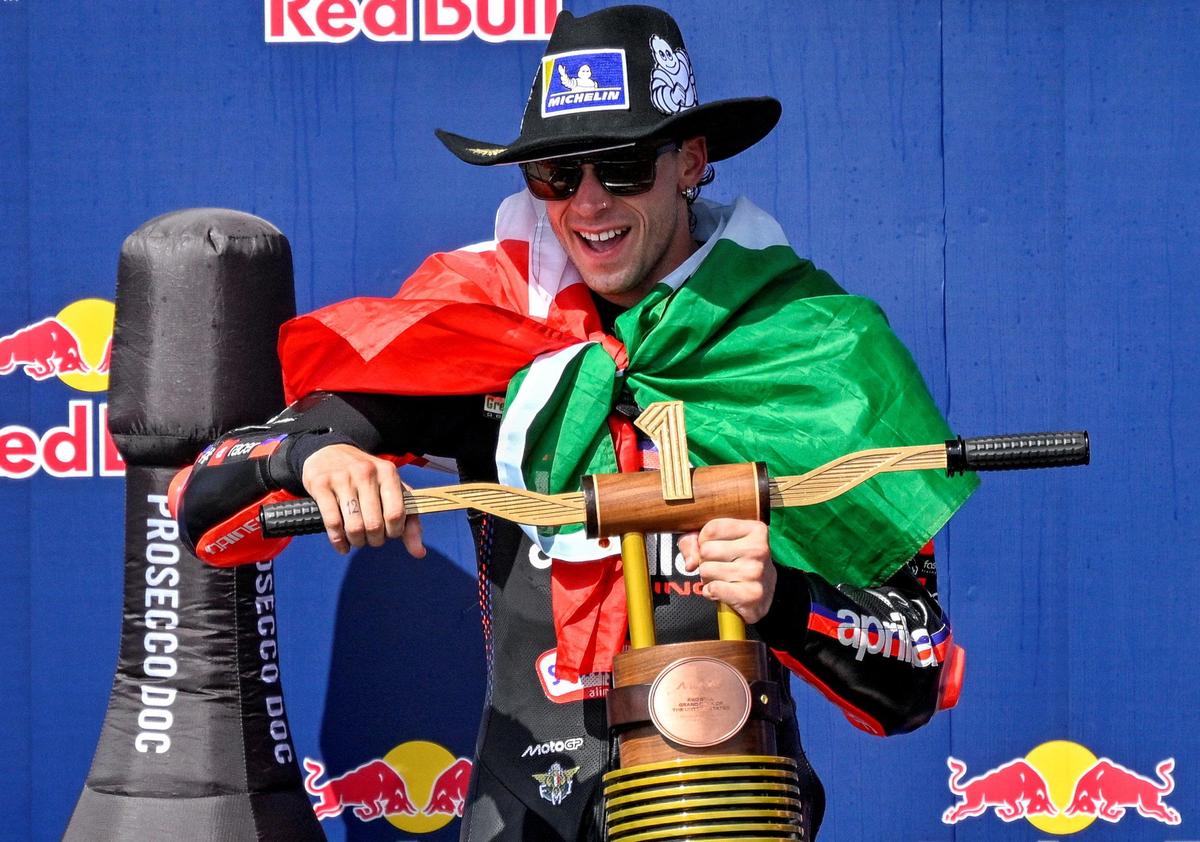
MotoGP
Marco Bezzecchi celebrates with his United States Grand Prix trophy.
| Photo Credit:
Reuters
Marco Bezzecchi celebrates with his United States Grand Prix trophy.
| Photo Credit:
Reuters
Marco Bezzecchi extended his winning streak to five races after victory at the United States Grand Prix at the Circuit of the Americas (COTA). He led an Aprilia 1-2 with teammate Jorge Martin, who had won the sprint race on Saturday but started seventh on the grid, ahead of KTM’s Pedro Acosta.
Despite only starting on the second row, Bezzecchi surged into second place before the first corner, then overtook leader Acosta after a slight argy-bargy, which resulted in his seat padding flying off the bike. When he crossed the start-finish straight at the end of lap one, he broke Jorge Lorenzo’s record for the most consecutive MotoGP laps led.
Pole-sitter Fabio Di Giannantonio finished fourth as the lead Ducati ahead of defending champion Marc Marquez, who responded after serving a long-lap penalty to round out the top five.


![Formula One: Antonelli wins Japanese GP as Bearman crash exposes dangerous differential issue If the race in Shanghai was a glimpse of Kimi Antonelli’s talent, the following Japanese Grand Prix was evidence that the prodigy will be a strong contender for the driver’s championship in the 2026 F1 season.With more than a big slice of luck — a cheap pit stop during a Safety Car period propelling him to the top of the timesheet — the Italian recovered from a poor getaway at the start to take his second consecutive victory.The records keep tumbling for Antonelli. He is now the first teenager to lead the championship standings since Lewis Hamilton in 2007 and the first Italian driver to win back-to-back races since Alberto Ascari in 1953.Teammate George Russell endured a frustrating day out in Suzuka, failing to finish on the podium for the first time this season. Despite the pace advantage of the Mercedes, the Briton failed to get past the Ferrari of third-placed Charles Leclerc in the dying laps of the race, conceding the championship lead to his junior teammate.McLaren’s Oscar Piastri, who had failed to start either of the first two races of the season, came home in second and could have even been on the top step if not for the untimely Safety Car.The exciting three-team battle for the top six places is sure to have brought entertainment, but the Japanese Grand Prix highlighted a systemic fault line within the 2026 regulations, one that could have worse consequences than what played out on track. On lap 22, Haas’ Ollie Bearman was involved in a 50G crash (force fifty times the earth’s gravitational pull) when his car slammed into the barriers at the Spoon Curve (Turn 13). The incident occurred when the young English driver had to veer out of the way of a slow-moving Franco Colapinto, causing him to dip a tyre into the grass and lose control of the car.Why the Alpine was moving slowly opened a Pandora’s box that F1 hoped to avoid with the new regulations. The crash was due to the high closing speed (the total speed at which two objects approach each other), which occurred due to Colapinto and Bearman’s opposing strategies. While the Argentinian was looking to harvest energy into the battery by going slower, Bearman had unlocked more speed by deploying battery power. While taking evasive action, the Haas car ran through a brake marker board before sliding into the barriers along the wall. Bearman was seen limping back to the service road after the high-impact crash. Oliver Bearman’s mangled car after the crash.
| Photo Credit:
Getty Images
Oliver Bearman’s mangled car after the crash.
| Photo Credit:
Getty Images
Williams driver and director of the Grand Prix Drivers’ Association, Carlos Sainz, called it an accident waiting to happen, suggesting that F1 and the FIA had not heeded the drivers’ safety concerns. “We’ve been warning them about this happening. I’m not very happy with what we’ve had up until now.Hopefully, we come up with a better solution that doesn’t create these massive closing speeds and [ensures] a safer way of going racing,” the Spaniard told reporters after the race. “Here, we were lucky there was an escape road. Now imagine going to Baku or going to Singapore or going to Vegas and having this kind of closing speeds and crashes next to the walls,” he added.The crash and the subsequent complaints from the drivers forced the FIA to put out a statement regarding prospective changes to the energy management system. “A number of meetings are scheduled in April to assess the operation of the new regulations and to determine whether any refinements are required. Any potential adjustments require careful simulation and detailed analysis. At this stage, any speculation regarding the nature of potential changes would be premature,” the statement read.With five weeks to go before the next Grand Prix in Miami, due to the cancellation of the races in Bahrain and Saudi Arabia, the FIA and F1 management will have to come up with a solution to tackle the issues of closing speeds, which are inherent in this generation of battery-powered racing. Safety should be priority number one, even if that entails taking a few steps back in the use of electrical energy.MotoGP Marco Bezzecchi celebrates with his United States Grand Prix trophy.
| Photo Credit:
Reuters
Marco Bezzecchi celebrates with his United States Grand Prix trophy.
| Photo Credit:
Reuters
Marco Bezzecchi extended his winning streak to five races after victory at the United States Grand Prix at the Circuit of the Americas (COTA). He led an Aprilia 1-2 with teammate Jorge Martin, who had won the sprint race on Saturday but started seventh on the grid, ahead of KTM’s Pedro Acosta.Despite only starting on the second row, Bezzecchi surged into second place before the first corner, then overtook leader Acosta after a slight argy-bargy, which resulted in his seat padding flying off the bike. When he crossed the start-finish straight at the end of lap one, he broke Jorge Lorenzo’s record for the most consecutive MotoGP laps led.Pole-sitter Fabio Di Giannantonio finished fourth as the lead Ducati ahead of defending champion Marc Marquez, who responded after serving a long-lap penalty to round out the top five.Published on Apr 08, 2026 #Formula #Antonelli #wins #Japanese #Bearman #crash #exposes #dangerous #differential #issue](https://ss-i.thgim.com/public/magazine/j7xy9x/article70838198.ece/alternates/FREE_1200/GettyImages-2268881319.jpg "Formula One: Antonelli wins Japanese GP as Bearman crash exposes dangerous differential issue If the race in Shanghai was a glimpse of Kimi Antonelli’s talent, the following Japanese Grand Prix was evidence that the prodigy will be a strong contender for the driver’s championship in the 2026 F1 season.With more than a big slice of luck — a cheap pit stop during a Safety Car period propelling him to the top of the timesheet — the Italian recovered from a poor getaway at the start to take his second consecutive victory.The records keep tumbling for Antonelli. He is now the first teenager to lead the championship standings since Lewis Hamilton in 2007 and the first Italian driver to win back-to-back races since Alberto Ascari in 1953.Teammate George Russell endured a frustrating day out in Suzuka, failing to finish on the podium for the first time this season. Despite the pace advantage of the Mercedes, the Briton failed to get past the Ferrari of third-placed Charles Leclerc in the dying laps of the race, conceding the championship lead to his junior teammate.McLaren’s Oscar Piastri, who had failed to start either of the first two races of the season, came home in second and could have even been on the top step if not for the untimely Safety Car.The exciting three-team battle for the top six places is sure to have brought entertainment, but the Japanese Grand Prix highlighted a systemic fault line within the 2026 regulations, one that could have worse consequences than what played out on track. On lap 22, Haas’ Ollie Bearman was involved in a 50G crash (force fifty times the earth’s gravitational pull) when his car slammed into the barriers at the Spoon Curve (Turn 13). The incident occurred when the young English driver had to veer out of the way of a slow-moving Franco Colapinto, causing him to dip a tyre into the grass and lose control of the car.Why the Alpine was moving slowly opened a Pandora’s box that F1 hoped to avoid with the new regulations. The crash was due to the high closing speed (the total speed at which two objects approach each other), which occurred due to Colapinto and Bearman’s opposing strategies. While the Argentinian was looking to harvest energy into the battery by going slower, Bearman had unlocked more speed by deploying battery power. While taking evasive action, the Haas car ran through a brake marker board before sliding into the barriers along the wall. Bearman was seen limping back to the service road after the high-impact crash. Oliver Bearman’s mangled car after the crash.
| Photo Credit:
Getty Images
Oliver Bearman’s mangled car after the crash.
| Photo Credit:
Getty Images
Williams driver and director of the Grand Prix Drivers’ Association, Carlos Sainz, called it an accident waiting to happen, suggesting that F1 and the FIA had not heeded the drivers’ safety concerns. “We’ve been warning them about this happening. I’m not very happy with what we’ve had up until now.Hopefully, we come up with a better solution that doesn’t create these massive closing speeds and [ensures] a safer way of going racing,” the Spaniard told reporters after the race. “Here, we were lucky there was an escape road. Now imagine going to Baku or going to Singapore or going to Vegas and having this kind of closing speeds and crashes next to the walls,” he added.The crash and the subsequent complaints from the drivers forced the FIA to put out a statement regarding prospective changes to the energy management system. “A number of meetings are scheduled in April to assess the operation of the new regulations and to determine whether any refinements are required. Any potential adjustments require careful simulation and detailed analysis. At this stage, any speculation regarding the nature of potential changes would be premature,” the statement read.With five weeks to go before the next Grand Prix in Miami, due to the cancellation of the races in Bahrain and Saudi Arabia, the FIA and F1 management will have to come up with a solution to tackle the issues of closing speeds, which are inherent in this generation of battery-powered racing. Safety should be priority number one, even if that entails taking a few steps back in the use of electrical energy.MotoGP Marco Bezzecchi celebrates with his United States Grand Prix trophy.
| Photo Credit:
Reuters
Marco Bezzecchi celebrates with his United States Grand Prix trophy.
| Photo Credit:
Reuters
Marco Bezzecchi extended his winning streak to five races after victory at the United States Grand Prix at the Circuit of the Americas (COTA). He led an Aprilia 1-2 with teammate Jorge Martin, who had won the sprint race on Saturday but started seventh on the grid, ahead of KTM’s Pedro Acosta.Despite only starting on the second row, Bezzecchi surged into second place before the first corner, then overtook leader Acosta after a slight argy-bargy, which resulted in his seat padding flying off the bike. When he crossed the start-finish straight at the end of lap one, he broke Jorge Lorenzo’s record for the most consecutive MotoGP laps led.Pole-sitter Fabio Di Giannantonio finished fourth as the lead Ducati ahead of defending champion Marc Marquez, who responded after serving a long-lap penalty to round out the top five.Published on Apr 08, 2026 #Formula #Antonelli #wins #Japanese #Bearman #crash #exposes #dangerous #differential #issue")

![Formula One: Antonelli wins Japanese GP as Bearman crash exposes dangerous differential issue If the race in Shanghai was a glimpse of Kimi Antonelli’s talent, the following Japanese Grand Prix was evidence that the prodigy will be a strong contender for the driver’s championship in the 2026 F1 season.With more than a big slice of luck — a cheap pit stop during a Safety Car period propelling him to the top of the timesheet — the Italian recovered from a poor getaway at the start to take his second consecutive victory.The records keep tumbling for Antonelli. He is now the first teenager to lead the championship standings since Lewis Hamilton in 2007 and the first Italian driver to win back-to-back races since Alberto Ascari in 1953.Teammate George Russell endured a frustrating day out in Suzuka, failing to finish on the podium for the first time this season. Despite the pace advantage of the Mercedes, the Briton failed to get past the Ferrari of third-placed Charles Leclerc in the dying laps of the race, conceding the championship lead to his junior teammate.McLaren’s Oscar Piastri, who had failed to start either of the first two races of the season, came home in second and could have even been on the top step if not for the untimely Safety Car.The exciting three-team battle for the top six places is sure to have brought entertainment, but the Japanese Grand Prix highlighted a systemic fault line within the 2026 regulations, one that could have worse consequences than what played out on track. On lap 22, Haas’ Ollie Bearman was involved in a 50G crash (force fifty times the earth’s gravitational pull) when his car slammed into the barriers at the Spoon Curve (Turn 13). The incident occurred when the young English driver had to veer out of the way of a slow-moving Franco Colapinto, causing him to dip a tyre into the grass and lose control of the car.Why the Alpine was moving slowly opened a Pandora’s box that F1 hoped to avoid with the new regulations. The crash was due to the high closing speed (the total speed at which two objects approach each other), which occurred due to Colapinto and Bearman’s opposing strategies. While the Argentinian was looking to harvest energy into the battery by going slower, Bearman had unlocked more speed by deploying battery power. While taking evasive action, the Haas car ran through a brake marker board before sliding into the barriers along the wall. Bearman was seen limping back to the service road after the high-impact crash. Oliver Bearman’s mangled car after the crash.
| Photo Credit:
Getty Images
Oliver Bearman’s mangled car after the crash.
| Photo Credit:
Getty Images
Williams driver and director of the Grand Prix Drivers’ Association, Carlos Sainz, called it an accident waiting to happen, suggesting that F1 and the FIA had not heeded the drivers’ safety concerns. “We’ve been warning them about this happening. I’m not very happy with what we’ve had up until now.Hopefully, we come up with a better solution that doesn’t create these massive closing speeds and [ensures] a safer way of going racing,” the Spaniard told reporters after the race. “Here, we were lucky there was an escape road. Now imagine going to Baku or going to Singapore or going to Vegas and having this kind of closing speeds and crashes next to the walls,” he added.The crash and the subsequent complaints from the drivers forced the FIA to put out a statement regarding prospective changes to the energy management system. “A number of meetings are scheduled in April to assess the operation of the new regulations and to determine whether any refinements are required. Any potential adjustments require careful simulation and detailed analysis. At this stage, any speculation regarding the nature of potential changes would be premature,” the statement read.With five weeks to go before the next Grand Prix in Miami, due to the cancellation of the races in Bahrain and Saudi Arabia, the FIA and F1 management will have to come up with a solution to tackle the issues of closing speeds, which are inherent in this generation of battery-powered racing. Safety should be priority number one, even if that entails taking a few steps back in the use of electrical energy.MotoGP Marco Bezzecchi celebrates with his United States Grand Prix trophy.
| Photo Credit:
Reuters
Marco Bezzecchi celebrates with his United States Grand Prix trophy.
| Photo Credit:
Reuters
Marco Bezzecchi extended his winning streak to five races after victory at the United States Grand Prix at the Circuit of the Americas (COTA). He led an Aprilia 1-2 with teammate Jorge Martin, who had won the sprint race on Saturday but started seventh on the grid, ahead of KTM’s Pedro Acosta.Despite only starting on the second row, Bezzecchi surged into second place before the first corner, then overtook leader Acosta after a slight argy-bargy, which resulted in his seat padding flying off the bike. When he crossed the start-finish straight at the end of lap one, he broke Jorge Lorenzo’s record for the most consecutive MotoGP laps led.Pole-sitter Fabio Di Giannantonio finished fourth as the lead Ducati ahead of defending champion Marc Marquez, who responded after serving a long-lap penalty to round out the top five.Published on Apr 08, 2026 #Formula #Antonelli #wins #Japanese #Bearman #crash #exposes #dangerous #differential #issue](https://i2.wp.com/ss-i.thgim.com/public/magazine/j7xy9x/article70838198.ece/alternates/FREE_1200/GettyImages-2268881319.jpg?ssl=1 "Formula One: Antonelli wins Japanese GP as Bearman crash exposes dangerous differential issue If the race in Shanghai was a glimpse of Kimi Antonelli’s talent, the following Japanese Grand Prix was evidence that the prodigy will be a strong contender for the driver’s championship in the 2026 F1 season.With more than a big slice of luck — a cheap pit stop during a Safety Car period propelling him to the top of the timesheet — the Italian recovered from a poor getaway at the start to take his second consecutive victory.The records keep tumbling for Antonelli. He is now the first teenager to lead the championship standings since Lewis Hamilton in 2007 and the first Italian driver to win back-to-back races since Alberto Ascari in 1953.Teammate George Russell endured a frustrating day out in Suzuka, failing to finish on the podium for the first time this season. Despite the pace advantage of the Mercedes, the Briton failed to get past the Ferrari of third-placed Charles Leclerc in the dying laps of the race, conceding the championship lead to his junior teammate.McLaren’s Oscar Piastri, who had failed to start either of the first two races of the season, came home in second and could have even been on the top step if not for the untimely Safety Car.The exciting three-team battle for the top six places is sure to have brought entertainment, but the Japanese Grand Prix highlighted a systemic fault line within the 2026 regulations, one that could have worse consequences than what played out on track. On lap 22, Haas’ Ollie Bearman was involved in a 50G crash (force fifty times the earth’s gravitational pull) when his car slammed into the barriers at the Spoon Curve (Turn 13). The incident occurred when the young English driver had to veer out of the way of a slow-moving Franco Colapinto, causing him to dip a tyre into the grass and lose control of the car.Why the Alpine was moving slowly opened a Pandora’s box that F1 hoped to avoid with the new regulations. The crash was due to the high closing speed (the total speed at which two objects approach each other), which occurred due to Colapinto and Bearman’s opposing strategies. While the Argentinian was looking to harvest energy into the battery by going slower, Bearman had unlocked more speed by deploying battery power. While taking evasive action, the Haas car ran through a brake marker board before sliding into the barriers along the wall. Bearman was seen limping back to the service road after the high-impact crash. Oliver Bearman’s mangled car after the crash.
| Photo Credit:
Getty Images
Oliver Bearman’s mangled car after the crash.
| Photo Credit:
Getty Images
Williams driver and director of the Grand Prix Drivers’ Association, Carlos Sainz, called it an accident waiting to happen, suggesting that F1 and the FIA had not heeded the drivers’ safety concerns. “We’ve been warning them about this happening. I’m not very happy with what we’ve had up until now.Hopefully, we come up with a better solution that doesn’t create these massive closing speeds and [ensures] a safer way of going racing,” the Spaniard told reporters after the race. “Here, we were lucky there was an escape road. Now imagine going to Baku or going to Singapore or going to Vegas and having this kind of closing speeds and crashes next to the walls,” he added.The crash and the subsequent complaints from the drivers forced the FIA to put out a statement regarding prospective changes to the energy management system. “A number of meetings are scheduled in April to assess the operation of the new regulations and to determine whether any refinements are required. Any potential adjustments require careful simulation and detailed analysis. At this stage, any speculation regarding the nature of potential changes would be premature,” the statement read.With five weeks to go before the next Grand Prix in Miami, due to the cancellation of the races in Bahrain and Saudi Arabia, the FIA and F1 management will have to come up with a solution to tackle the issues of closing speeds, which are inherent in this generation of battery-powered racing. Safety should be priority number one, even if that entails taking a few steps back in the use of electrical energy.MotoGP Marco Bezzecchi celebrates with his United States Grand Prix trophy.
| Photo Credit:
Reuters
Marco Bezzecchi celebrates with his United States Grand Prix trophy.
| Photo Credit:
Reuters
Marco Bezzecchi extended his winning streak to five races after victory at the United States Grand Prix at the Circuit of the Americas (COTA). He led an Aprilia 1-2 with teammate Jorge Martin, who had won the sprint race on Saturday but started seventh on the grid, ahead of KTM’s Pedro Acosta.Despite only starting on the second row, Bezzecchi surged into second place before the first corner, then overtook leader Acosta after a slight argy-bargy, which resulted in his seat padding flying off the bike. When he crossed the start-finish straight at the end of lap one, he broke Jorge Lorenzo’s record for the most consecutive MotoGP laps led.Pole-sitter Fabio Di Giannantonio finished fourth as the lead Ducati ahead of defending champion Marc Marquez, who responded after serving a long-lap penalty to round out the top five.Published on Apr 08, 2026 #Formula #Antonelli #wins #Japanese #Bearman #crash #exposes #dangerous #differential #issue")
.jpg?ssl=1 "Ferrari’s New Jony Ive–Designed EV Is Swathed in Glass and Aluminum")


