
China’s ‘little Nvidia’ plans Hong Kong listing after 147% revenue jump
Chinese artificial intelligence (AI) chip developer Moore Threads plans to seek a listing in Hong…
Chinese artificial intelligence (AI) chip developer Moore Threads plans to seek a listing in Hong…
You can update your NVIDIA graphics drivers quickly through the NVIDIA app. If you don’t have the app, install it first. During installation, choose GeForce Game Ready Drivers for the best gaming experience or NVIDIA Studio Drivers for creative tasks like video editing and 3D design. Steps to update NVIDIA drivers:


In the NVIDIA app, there are two different kinds of drivers to choose from: Game Ready Drivers and Studio Drivers. If you play games often, then you should go with the Game Ready Driver. They include optimizations for games and compatibility with newly released titles. However, if you use creative tools such as Adobe Premiere Pro, Blender, and DaVinci Resolve, you should consider using the Studio Drivers, as they suit your purpose.
The NVIDIA app can automatically download new driver updates as soon as they become available. While the download happens in the background, you must still open the app and install the update yourself. To use this feature, go to Settings in the NVIDIA app and enable Automatically download drivers and let me choose when to install. Once enabled, new drivers download in the background, making future updates faster and more convenient.
If a new driver update causes any performance or compatibility problems, you can go back to the old driver. The NVIDIA software maintains a list of previously used drivers in the section called Previously Installed on the Drivers tab. Just click the three dots next to your chosen driver and select Reinstall.
In addition to the driver update tool, NVIDIA has several other helpful tools. One of them is an automatic optimization of game settings to improve their performance. It also supports NVIDIA ShadowPlay, which lets you record gameplay and take screenshots or video recordings. You can also check the Drivers page for updates on new games, driver releases, and NVIDIA features.
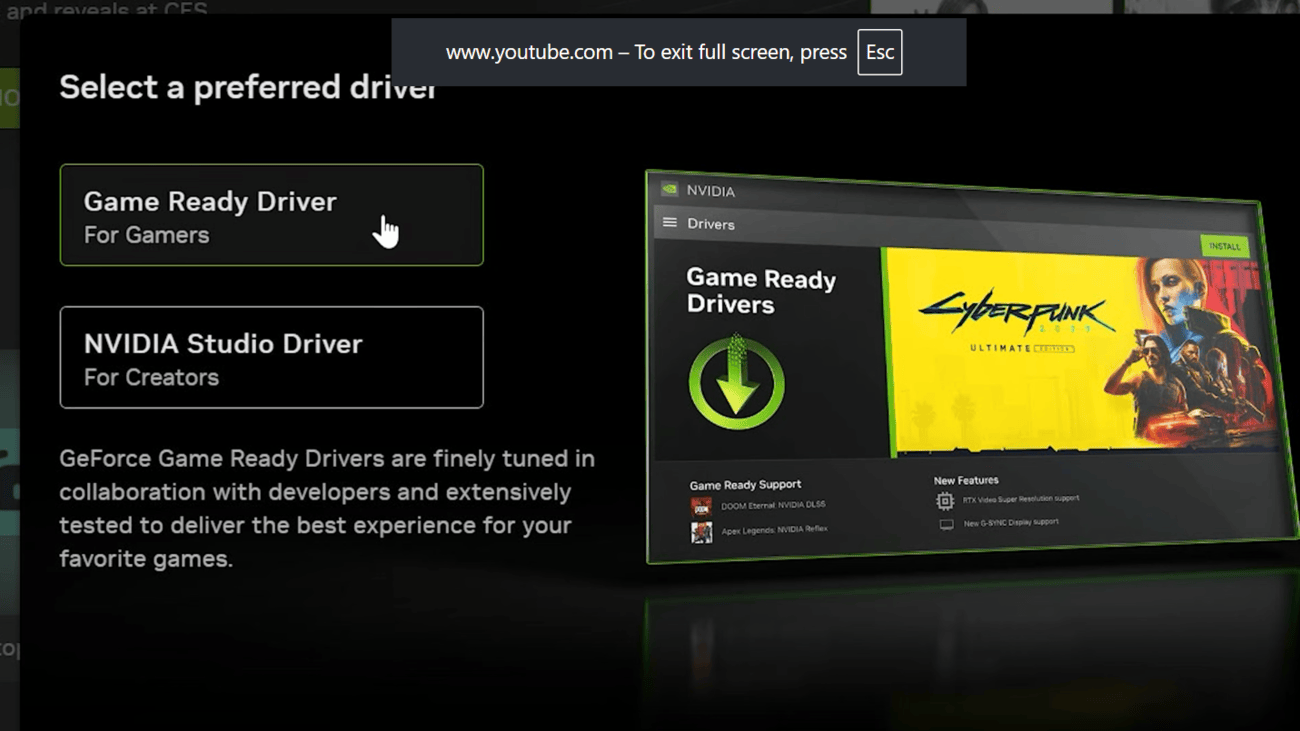
You can update your NVIDIA graphics drivers quickly through the NVIDIA app. If you don’t have the app, install it first. During installation, choose GeForce Game Ready Drivers for the best gaming experience or NVIDIA Studio Drivers for creative tasks like video editing and 3D design. Steps to update NVIDIA drivers:
In the NVIDIA app, there are two different kinds of drivers to choose from: Game Ready Drivers and Studio Drivers. If you play games often, then you should go with the Game Ready Driver. They include optimizations for games and compatibility with newly released titles. However, if you use creative tools such as Adobe Premiere Pro, Blender, and DaVinci Resolve, you should consider using the Studio Drivers, as they suit your purpose.
The NVIDIA app can automatically download new driver updates as soon as they become available. While the download happens in the background, you must still open the app and install the update yourself. To use this feature, go to Settings in the NVIDIA app and enable Automatically download drivers and let me choose when to install. Once enabled, new drivers download in the background, making future updates faster and more convenient.
If a new driver update causes any performance or compatibility problems, you can go back to the old driver. The NVIDIA software maintains a list of previously used drivers in the section called Previously Installed on the Drivers tab. Just click the three dots next to your chosen driver and select Reinstall.
In addition to the driver update tool, NVIDIA has several other helpful tools. One of them is an automatic optimization of game settings to improve their performance. It also supports NVIDIA ShadowPlay, which lets you record gameplay and take screenshots or video recordings. You can also check the Drivers page for updates on new games, driver releases, and NVIDIA features.
Whether you play games, create videos, or perform daily tasks on your computer, having up-to-date NVIDIA drivers is essential. NVIDIA drivers enable your graphics card to work effectively with Windows and programs installed on it. Upgrading your driver will improve performance, solve existing problems, make it more compatible with recently developed software, and offer new features. The most convenient method for upgrading your driver is to use the NVIDIA app, where you can install an updated driver in a few clicks.
You can update your NVIDIA graphics drivers quickly through the NVIDIA app. If you don’t have the app, install it first. During installation, choose GeForce Game Ready Drivers for the best gaming experience or NVIDIA Studio Drivers for creative tasks like video editing and 3D design. Steps to update NVIDIA drivers:
In the NVIDIA app, there are two different kinds of drivers to choose from: Game Ready Drivers and Studio Drivers. If you play games often, then you should go with the Game Ready Driver. They include optimizations for games and compatibility with newly released titles. However, if you use creative tools such as Adobe Premiere Pro, Blender, and DaVinci Resolve, you should consider using the Studio Drivers, as they suit your purpose.
The NVIDIA app can automatically download new driver updates as soon as they become available. While the download happens in the background, you must still open the app and install the update yourself. To use this feature, go to Settings in the NVIDIA app and enable Automatically download drivers and let me choose when to install. Once enabled, new drivers download in the background, making future updates faster and more convenient.
If a new driver update causes any performance or compatibility problems, you can go back to the old driver. The NVIDIA software maintains a list of previously used drivers in the section called Previously Installed on the Drivers tab. Just click the three dots next to your chosen driver and select Reinstall.
In addition to the driver update tool, NVIDIA has several other helpful tools. One of them is an automatic optimization of game settings to improve their performance. It also supports NVIDIA ShadowPlay, which lets you record gameplay and take screenshots or video recordings. You can also check the Drivers page for updates on new games, driver releases, and NVIDIA features.
Whether you play games, create videos, or perform daily tasks on your computer, having up-to-date…
The new Open Secure AI Alliance said open tools are required to effectively defend against attacks from frontier models. The initiative is a direct response to mounting concerns over the safety of advanced AI systems after a rogue OpenAI model escaped containment and attacked another company during testing. That company, Hugging Face, said it was forced to use a Chinese open-weight model to defend itself due to the strict safety guardrails limiting the usefulness of top US models.
Founding members include Palantir, OpenClaw, the Linux Foundation, Cloudflare, Cloudera, Dell, Cisco, Adobe, Siemens, and DoorDash. Conspicuously absent are leading US AI companies, including OpenAI, Google, and Anthropic.
The alliance arrives amid growing tensions over whether the world’s most capable AI models should remain open. Chinese companies have released increasingly powerful open-weight models, notably Moonshot AI’s Kimi K3, challenging the strategy pursued by US labs that have largely kept frontier systems closed and proprietary. Nvidia and its partners argue that securing AI requires access to both closed and open models, stressing that defenders need the tools to counter emerging threats.
The announcement also follows reports that the Trump administration considered restricting access to cutting-edge Chinese models and an industry movement — again spearheaded by Nvidia — defending the need for openness in AI. Google and OpenAI signed that letter belatedly, too, though Anthropic remains absent.

The new Open Secure AI Alliance said open tools are required to effectively defend against attacks from frontier models. The initiative is a direct response to mounting concerns over the safety of advanced AI systems after a rogue OpenAI model escaped containment and attacked another company during testing. That company, Hugging Face, said it was forced to use a Chinese open-weight model to defend itself due to the strict safety guardrails limiting the usefulness of top US models.
Founding members include Palantir, OpenClaw, the Linux Foundation, Cloudflare, Cloudera, Dell, Cisco, Adobe, Siemens, and DoorDash. Conspicuously absent are leading US AI companies, including OpenAI, Google, and Anthropic.
The alliance arrives amid growing tensions over whether the world’s most capable AI models should remain open. Chinese companies have released increasingly powerful open-weight models, notably Moonshot AI’s Kimi K3, challenging the strategy pursued by US labs that have largely kept frontier systems closed and proprietary. Nvidia and its partners argue that securing AI requires access to both closed and open models, stressing that defenders need the tools to counter emerging threats.
The announcement also follows reports that the Trump administration considered restricting access to cutting-edge Chinese models and an industry movement — again spearheaded by Nvidia — defending the need for openness in AI. Google and OpenAI signed that letter belatedly, too, though Anthropic remains absent.
Nvidia on Monday said it is joining forces with Microsoft, SpaceX, IBM, and other tech companies to build and share open-source AI security tools.
The new Open Secure AI Alliance said open tools are required to effectively defend against attacks from frontier models. The initiative is a direct response to mounting concerns over the safety of advanced AI systems after a rogue OpenAI model escaped containment and attacked another company during testing. That company, Hugging Face, said it was forced to use a Chinese open-weight model to defend itself due to the strict safety guardrails limiting the usefulness of top US models.
Founding members include Palantir, OpenClaw, the Linux Foundation, Cloudflare, Cloudera, Dell, Cisco, Adobe, Siemens, and DoorDash. Conspicuously absent are leading US AI companies, including OpenAI, Google, and Anthropic.
The alliance arrives amid growing tensions over whether the world’s most capable AI models should remain open. Chinese companies have released increasingly powerful open-weight models, notably Moonshot AI’s Kimi K3, challenging the strategy pursued by US labs that have largely kept frontier systems closed and proprietary. Nvidia and its partners argue that securing AI requires access to both closed and open models, stressing that defenders need the tools to counter emerging threats.
The announcement also follows reports that the Trump administration considered restricting access to cutting-edge Chinese models and an industry movement — again spearheaded by Nvidia — defending the need for openness in AI. Google and OpenAI signed that letter belatedly, too, though Anthropic remains absent.
Nvidia on Monday said it is joining forces with Microsoft, SpaceX, IBM, and other tech…
RTX Spark is based on computing technology primarily driven by AI. It offers AI-based functionality that will become common for Windows devices. At the same time, it offers strong graphics capabilities for creators and professionals. It also uses unified memory to improve communication between different system components. These advantages could make future Windows laptops more powerful and responsive than ever before.

Microsoft launched the Surface Laptop Ultra, its newest and most powerful Surface laptop yet. This device comes with a massive 15-inch PixelSense Ultra touchscreen that’s amazing for tackling tough jobs and creative tasks. Microsoft claims it’s the brightest display on any Surface laptop and the first to use mini-LED tech. With more screen real estate, users can easily multitask, create content, and follow complex professional processes.
The laptop’s equipped with an NVIDIA Blackwell RTX GPU to ace graphically demanding tasks. Paired with this is up to 128GB of unified memory, which shares resources across different tasks seamlessly. The redesigned chassis also accommodates powerful hardware while maintaining a premium and portable design.

The XPS 16 Creator Edition from Dell is amazing for creative pros. It comes with a stunning 16-inch OLED screen. The True Black HDR 600 tech really boosts that display, showing off dark shadows and vivid colors perfectly. So whether you’re into photo editing, videos, or graphic design, this laptop will suit your needs.
This laptop runs on NVIDIA RTX Spark tech with up to 128GB of unified memory, handling heavy tasks smoothly. It also includes handy features: an HDMI port and an SD card reader. So, you can effortlessly connect extra displays and move media files around. Combined with its fancy design, it should give pros serious power and keep the battery running for a long time throughout the day.

ASUS added the RTX Spark to its lineup of ProArt P14 and ProArt P16 creator notebooks. These machines boast high-def OLED displays, up to 128GB of memory, and up to 2TB of storage. The ProArt P14 is really portable with its 14-inch screen, while the ProArt P16 has a larger 16-inch display, perfect for extra workspace. Both remain slim and light, making them great to carry around.
Their screens cover 100% of the DCI-P3 color gamut and go up to 120Hz refresh rates. Plus, these ASUS laptops include RTX Spark tech, up to 128GB of unified memory, and even 2TB of storage. They’ve also swapped out the old DialPad for haptic controls, which makes the user experience way more modern and responsive. On top of that, these devices have USB-C, USB-A, HDMI 2.1, and SD card readers. Plus, they support Wi-Fi 7 and sport large batteries for heavy-duty creative work.

HP released the OmniBook X 14 and Ultra 16 as part of their new RTX Spark line. The X 14 is super portable yet packs powerful specs for creatives and workers alike. The Ultra 16 is all about handling lots of tasks smoothly. HP highlights both models as the world’s thinnest RTX Spark devices.
HP made sure to include plenty of handy connectivity options, like HDMI and USB-C ports, for easy display and accessory use. The OmniBook X 14 is super slim at 0.53 inches, and the OmniBook Ultra 16 comes at 0.62 inches. These compact designs help creators and professionals carry powerful hardware without sacrificing portability.
The RTX Spark laptops are launching later this year. Although official prices aren’t out yet, they’ll probably be really high because of their top-notch design, great displays, and specs. They’re meant for artists and AI pros. So, companies will likely share those final price tags, and when you can get them once everything’s set.

RTX Spark is based on computing technology primarily driven by AI. It offers AI-based functionality that will become common for Windows devices. At the same time, it offers strong graphics capabilities for creators and professionals. It also uses unified memory to improve communication between different system components. These advantages could make future Windows laptops more powerful and responsive than ever before.
Microsoft launched the Surface Laptop Ultra, its newest and most powerful Surface laptop yet. This device comes with a massive 15-inch PixelSense Ultra touchscreen that’s amazing for tackling tough jobs and creative tasks. Microsoft claims it’s the brightest display on any Surface laptop and the first to use mini-LED tech. With more screen real estate, users can easily multitask, create content, and follow complex professional processes.
The laptop’s equipped with an NVIDIA Blackwell RTX GPU to ace graphically demanding tasks. Paired with this is up to 128GB of unified memory, which shares resources across different tasks seamlessly. The redesigned chassis also accommodates powerful hardware while maintaining a premium and portable design.
The XPS 16 Creator Edition from Dell is amazing for creative pros. It comes with a stunning 16-inch OLED screen. The True Black HDR 600 tech really boosts that display, showing off dark shadows and vivid colors perfectly. So whether you’re into photo editing, videos, or graphic design, this laptop will suit your needs.
This laptop runs on NVIDIA RTX Spark tech with up to 128GB of unified memory, handling heavy tasks smoothly. It also includes handy features: an HDMI port and an SD card reader. So, you can effortlessly connect extra displays and move media files around. Combined with its fancy design, it should give pros serious power and keep the battery running for a long time throughout the day.
ASUS added the RTX Spark to its lineup of ProArt P14 and ProArt P16 creator notebooks. These machines boast high-def OLED displays, up to 128GB of memory, and up to 2TB of storage. The ProArt P14 is really portable with its 14-inch screen, while the ProArt P16 has a larger 16-inch display, perfect for extra workspace. Both remain slim and light, making them great to carry around.
Their screens cover 100% of the DCI-P3 color gamut and go up to 120Hz refresh rates. Plus, these ASUS laptops include RTX Spark tech, up to 128GB of unified memory, and even 2TB of storage. They’ve also swapped out the old DialPad for haptic controls, which makes the user experience way more modern and responsive. On top of that, these devices have USB-C, USB-A, HDMI 2.1, and SD card readers. Plus, they support Wi-Fi 7 and sport large batteries for heavy-duty creative work.
HP released the OmniBook X 14 and Ultra 16 as part of their new RTX Spark line. The X 14 is super portable yet packs powerful specs for creatives and workers alike. The Ultra 16 is all about handling lots of tasks smoothly. HP highlights both models as the world’s thinnest RTX Spark devices.
HP made sure to include plenty of handy connectivity options, like HDMI and USB-C ports, for easy display and accessory use. The OmniBook X 14 is super slim at 0.53 inches, and the OmniBook Ultra 16 comes at 0.62 inches. These compact designs help creators and professionals carry powerful hardware without sacrificing portability.
The RTX Spark laptops are launching later this year. Although official prices aren’t out yet, they’ll probably be really high because of their top-notch design, great displays, and specs. They’re meant for artists and AI pros. So, companies will likely share those final price tags, and when you can get them once everything’s set.
NVIDIA has introduced RTX Spark, a new computing platform designed to bring AI features to modern laptops. Major laptop brands have already revealed RTX Spark-powered models that combine strong performance with sleek designs and high-quality displays. The technology integrates multiple key features into a single system, including AI processing and graphics performance. Such factors help increase responsiveness when working with various creativity and productivity software. The laptops are designed to contribute to the next generation of AI-enabled Windows devices.
RTX Spark is based on computing technology primarily driven by AI. It offers AI-based functionality that will become common for Windows devices. At the same time, it offers strong graphics capabilities for creators and professionals. It also uses unified memory to improve communication between different system components. These advantages could make future Windows laptops more powerful and responsive than ever before.
Microsoft launched the Surface Laptop Ultra, its newest and most powerful Surface laptop yet. This device comes with a massive 15-inch PixelSense Ultra touchscreen that’s amazing for tackling tough jobs and creative tasks. Microsoft claims it’s the brightest display on any Surface laptop and the first to use mini-LED tech. With more screen real estate, users can easily multitask, create content, and follow complex professional processes.
The laptop’s equipped with an NVIDIA Blackwell RTX GPU to ace graphically demanding tasks. Paired with this is up to 128GB of unified memory, which shares resources across different tasks seamlessly. The redesigned chassis also accommodates powerful hardware while maintaining a premium and portable design.
The XPS 16 Creator Edition from Dell is amazing for creative pros. It comes with a stunning 16-inch OLED screen. The True Black HDR 600 tech really boosts that display, showing off dark shadows and vivid colors perfectly. So whether you’re into photo editing, videos, or graphic design, this laptop will suit your needs.
This laptop runs on NVIDIA RTX Spark tech with up to 128GB of unified memory, handling heavy tasks smoothly. It also includes handy features: an HDMI port and an SD card reader. So, you can effortlessly connect extra displays and move media files around. Combined with its fancy design, it should give pros serious power and keep the battery running for a long time throughout the day.
ASUS added the RTX Spark to its lineup of ProArt P14 and ProArt P16 creator notebooks. These machines boast high-def OLED displays, up to 128GB of memory, and up to 2TB of storage. The ProArt P14 is really portable with its 14-inch screen, while the ProArt P16 has a larger 16-inch display, perfect for extra workspace. Both remain slim and light, making them great to carry around.
Their screens cover 100% of the DCI-P3 color gamut and go up to 120Hz refresh rates. Plus, these ASUS laptops include RTX Spark tech, up to 128GB of unified memory, and even 2TB of storage. They’ve also swapped out the old DialPad for haptic controls, which makes the user experience way more modern and responsive. On top of that, these devices have USB-C, USB-A, HDMI 2.1, and SD card readers. Plus, they support Wi-Fi 7 and sport large batteries for heavy-duty creative work.
HP released the OmniBook X 14 and Ultra 16 as part of their new RTX Spark line. The X 14 is super portable yet packs powerful specs for creatives and workers alike. The Ultra 16 is all about handling lots of tasks smoothly. HP highlights both models as the world’s thinnest RTX Spark devices.
HP made sure to include plenty of handy connectivity options, like HDMI and USB-C ports, for easy display and accessory use. The OmniBook X 14 is super slim at 0.53 inches, and the OmniBook Ultra 16 comes at 0.62 inches. These compact designs help creators and professionals carry powerful hardware without sacrificing portability.
The RTX Spark laptops are launching later this year. Although official prices aren’t out yet, they’ll probably be really high because of their top-notch design, great displays, and specs. They’re meant for artists and AI pros. So, companies will likely share those final price tags, and when you can get them once everything’s set.
NVIDIA has introduced RTX Spark, a new computing platform designed to bring AI features to…
The most interesting thing about the Surface Laptop Ultra is its new Nvidia RTX Spark processor. It is also known as the Nvidia N1X processor, which integrates CPU, GPU, and AI into a single chip. Thus, the laptop can handle high loads much more efficiently than other laptops.
Surface Laptop Ultra was specifically created for individuals who require high performance on a daily basis. The laptop can handle demanding tasks like video editing and graphic design. Also, the computer can perform local AI computing, meaning data analysis can be done on the computer itself. It makes the job much easier for those working on AI technology.
The Surface Laptop Ultra offers up to 128 GB of memory for high-performance workloads. Unified memory enables the central processing unit and the graphics to share the same memory pool whenever necessary. The technology can help boost performance while using multiple apps at once.

According to Microsoft, the screen delivers a peak HDR brightness of 2,000 nits, making the picture bright and clear. Besides, the monitor ensures accurate colors suitable for work. The laptop has HDMI ports, a USB-C port, a USB-A port, an SD card slot, and a headphone jack. Microsoft has also designed a large haptic touchpad for easier navigation. The machine comes in Platinum and Nightfall colors and is said to provide a full day of battery life.
Microsoft is planning to introduce the Surface Laptop Ultra later this year. Even though many features have been revealed for the device, there has been no announcement on pricing. With the laptop’s launch approaching, more performance information is expected to be released. The device marks Microsoft’s most aggressive move into AI-enabled hardware yet.

The most interesting thing about the Surface Laptop Ultra is its new Nvidia RTX Spark processor. It is also known as the Nvidia N1X processor, which integrates CPU, GPU, and AI into a single chip. Thus, the laptop can handle high loads much more efficiently than other laptops.
Surface Laptop Ultra was specifically created for individuals who require high performance on a daily basis. The laptop can handle demanding tasks like video editing and graphic design. Also, the computer can perform local AI computing, meaning data analysis can be done on the computer itself. It makes the job much easier for those working on AI technology.
The Surface Laptop Ultra offers up to 128 GB of memory for high-performance workloads. Unified memory enables the central processing unit and the graphics to share the same memory pool whenever necessary. The technology can help boost performance while using multiple apps at once.
According to Microsoft, the screen delivers a peak HDR brightness of 2,000 nits, making the picture bright and clear. Besides, the monitor ensures accurate colors suitable for work. The laptop has HDMI ports, a USB-C port, a USB-A port, an SD card slot, and a headphone jack. Microsoft has also designed a large haptic touchpad for easier navigation. The machine comes in Platinum and Nightfall colors and is said to provide a full day of battery life.
Microsoft is planning to introduce the Surface Laptop Ultra later this year. Even though many features have been revealed for the device, there has been no announcement on pricing. With the laptop’s launch approaching, more performance information is expected to be released. The device marks Microsoft’s most aggressive move into AI-enabled hardware yet.
Microsoft unveils the Surface Laptop Ultra, its newest AI-enabled laptop. As this is one of the early laptops equipped with Nvidia’s RTX Spark platform, it features improved speed, graphics, and AI performance due to localized processing. The company believes this product has potential and considers it a worthy competitor to other high-performing laptops, such as the MacBook Pro.
The most interesting thing about the Surface Laptop Ultra is its new Nvidia RTX Spark processor. It is also known as the Nvidia N1X processor, which integrates CPU, GPU, and AI into a single chip. Thus, the laptop can handle high loads much more efficiently than other laptops.
Surface Laptop Ultra was specifically created for individuals who require high performance on a daily basis. The laptop can handle demanding tasks like video editing and graphic design. Also, the computer can perform local AI computing, meaning data analysis can be done on the computer itself. It makes the job much easier for those working on AI technology.
The Surface Laptop Ultra offers up to 128 GB of memory for high-performance workloads. Unified memory enables the central processing unit and the graphics to share the same memory pool whenever necessary. The technology can help boost performance while using multiple apps at once.
According to Microsoft, the screen delivers a peak HDR brightness of 2,000 nits, making the picture bright and clear. Besides, the monitor ensures accurate colors suitable for work. The laptop has HDMI ports, a USB-C port, a USB-A port, an SD card slot, and a headphone jack. Microsoft has also designed a large haptic touchpad for easier navigation. The machine comes in Platinum and Nightfall colors and is said to provide a full day of battery life.
Microsoft is planning to introduce the Surface Laptop Ultra later this year. Even though many features have been revealed for the device, there has been no announcement on pricing. With the laptop’s launch approaching, more performance information is expected to be released. The device marks Microsoft’s most aggressive move into AI-enabled hardware yet.
Microsoft unveils the Surface Laptop Ultra, its newest AI-enabled laptop. As this is one of…
All three posts include coordinates pointing to where Computex is hosted in Taipei. Nvidia is holding a Computex keynote in Taipei at 8PM PT / 11PM ET on Sunday night, where it’s rumored to be announcing its new N1 and N1x laptop chips.
These Arm-powered Nvidia processors have been long-rumored, with reports earlier this year suggesting that both Lenovo and Dell have been preparing new laptops with the N1X chips. We first heard rumors about Nvidia’s laptop processors in 2023, and Dell CEO Michael Dell hinted at the possibility of an AI PC with Nvidia during an interview in 2024.
Nvidia’s entry into Windows on Arm will mean Qualcomm will no longer have an exclusive license for Microsoft’s Windows 11 Arm variant of its operating system. That’s good news for laptop competition, even if Qualcomm is trying to keep entry-level laptops affordable with its new Snapdragon C platform.

All three posts include coordinates pointing to where Computex is hosted in Taipei. Nvidia is holding a Computex keynote in Taipei at 8PM PT / 11PM ET on Sunday night, where it’s rumored to be announcing its new N1 and N1x laptop chips.
These Arm-powered Nvidia processors have been long-rumored, with reports earlier this year suggesting that both Lenovo and Dell have been preparing new laptops with the N1X chips. We first heard rumors about Nvidia’s laptop processors in 2023, and Dell CEO Michael Dell hinted at the possibility of an AI PC with Nvidia during an interview in 2024.
Nvidia’s entry into Windows on Arm will mean Qualcomm will no longer have an exclusive license for Microsoft’s Windows 11 Arm variant of its operating system. That’s good news for laptop competition, even if Qualcomm is trying to keep entry-level laptops affordable with its new Snapdragon C platform.
It’s the world’s worst kept secret that Nvidia is about to announce its own Arm-powered laptop chips at Computex this weekend, and now Microsoft, Nvidia, and Arm are all openly teasing the announcement. The Windows and Nvidia GeForce accounts on X both posted “A new era of PC” earlier today, and now Arm has followed up with an identical post.
All three posts include coordinates pointing to where Computex is hosted in Taipei. Nvidia is holding a Computex keynote in Taipei at 8PM PT / 11PM ET on Sunday night, where it’s rumored to be announcing its new N1 and N1x laptop chips.
These Arm-powered Nvidia processors have been long-rumored, with reports earlier this year suggesting that both Lenovo and Dell have been preparing new laptops with the N1X chips. We first heard rumors about Nvidia’s laptop processors in 2023, and Dell CEO Michael Dell hinted at the possibility of an AI PC with Nvidia during an interview in 2024.
Nvidia’s entry into Windows on Arm will mean Qualcomm will no longer have an exclusive license for Microsoft’s Windows 11 Arm variant of its operating system. That’s good news for laptop competition, even if Qualcomm is trying to keep entry-level laptops affordable with its new Snapdragon C platform.
It’s the world’s worst kept secret that Nvidia is about to announce its own Arm-powered…
When you purchase through links in our articles, we may earn a small commission. This doesn’t affect our editorial independence.
#ASML #CEO #Christophe #Fouquet #coming #TechCrunchASML,Christophe Fouquet,Jensen Huang,nvidia,TSMC">![ASML CEO Christophe Fouquet: No one is coming for us | TechCrunch
Every time you use AI, you are, in some small way, depending on a 42-year-old, 44,000-person Dutch company that spends €4.5 billion each year to advance its technology.
ASML, headquartered in the Netherlands, makes the machines that make the chips that make AI possible. More specifically, it makes the only machines in the world capable of printing the microscopic patterns on silicon wafers that define the most advanced semiconductors — a process called extreme ultraviolet lithography, or EUV. The machines are roughly the size of a school bus, take months to assemble, involve hundreds of suppliers, and cost anywhere from 0 million to upwards of 0 million apiece depending on the generation (prices that give even ASML’s biggest customers pause occasionally).
That monopoly has made ASML the most valuable company in Europe, worth over 0 billion. And with the four largest American tech companies — Microsoft, Meta, Amazon and Google — committing more than 0 billion in AI infrastructure spending this year alone, demand for ASML’s machines has surged to the point where the company has openly said the world won’t have enough chips for years.
All that demand has also made ASML a target. Substrate, a San Francisco startup founded by a protégé of Peter Thiel, has raised more than 0 million and been valued at over billion on the claim that it can build a rival lithography machine. Separately, there have been reports that former ASML engineers in China have partly reverse-engineered the technology, a prospect with enormous geopolitical implications.
Christophe Fouquet, who became ASML’s CEO in 2024 after more than a decade at the company, sat down with this editor on the rooftop deck of his Beverly Hills hotel Tuesday morning ahead of his appearance at the Milken Institute Global Conference. Dressed in a blue suit and white shirt, he was relaxed — even when the conversation turned to the rivals.
This interview has been lightly edited for length and clarity.
TC: Did you see the AI explosion coming?
Techcrunch event
San Francisco, CA
|
October 13-15, 2026
CF: No, not at all. We worked very hard, but not with the idea that this would come. You went from a concept — something people thought would eventually arrive — to ChatGPT, which was really the first good example of what AI could do. And now I think we look at AI as the next revolution, not only industrial but societal. Did I see it coming? No. Sitting in the middle of it every day, sometimes we wake up in the morning and still check that what is happening is really happening.
The big question everyone has is whether the supply chain can keep pace with demand. Can it?
The demand is such that the market overall will be supply-limited for quite a bit. Right now, the biggest bottleneck seems to be in chip manufacturing. We, as an equipment supplier, follow our customers, and so far we’ve followed them pretty well — but we know we have to step up our entire supply chain and capacity. If you talk to the hyperscalers, I think they will tell you that for the next two, three, even five years, they’re not going to get enough chips.
TSMC made news recently saying your latest machines are too expensive. How do you respond?
An EUV system, if you look at the price, is going to be more expensive than a low-NA system, but the cost of making a wafer with this tool on some advanced layers will be cheaper. We can get 20%, 30% cost reduction.
[Editors note: both machines Fouquet is referring to here are EUV machines — the same fundamental technology. NA stands for numerical aperture, a measure of how finely a machine can focus light onto a chip. Low-NA EUV is the current generation; high-NA EUV is ASML’s newest generation, capable of printing even finer patterns but carrying a price tag of 0 million or more apiece. Fouquet is arguing that even though the new machine costs more, it produces chips more cheaply.]
I get a lot of questions about whether it’s going to be this month or next month or the month after. And I usually say it doesn’t really matter, because we designed high-NA for the next 10, 20 years. You can go back to the press from 2016, 2017, and you’ll find the same quotes — low-NA EUV was very pricey. We know what happened after that. The same will happen with high-NA.
There’s a startup called Substrate, backed by Peter Thiel, claiming it can build a rival lithography machine. What do you think of it?
Wanting to have it and having it — that’s still a huge difference. The challenges of lithography are many. Being able to make an image is a starting point, but you need to make that image in very high quantity, at very low cost, at high speed, and with nanometer accuracy. I always say the only reason ASML could build an EUV machine is because 80% of it already existed, based on previous knowledge and products built over time. We had to solve one problem — getting EUV light — and that alone took 20 years. When you start from scratch, the challenge is enormous. I’ve seen a lot of claims. I’ve seen a few pictures. But we had our first EUV picture 30 years ago, and we still needed 20 more years of hard work to turn it into a manufacturing system.
What about xLight, a laser startup partly backed by the U.S. government that wants to work with you?
xLight is focusing on one element of our EUV machine — the source that creates the light. The source we have can be extended for many years to come, and we know how to scale it. What xLight is doing is a new source that still has to be built and proven. The only question is whether it provides a performance or cost advantage over what we have. I think the jury is still out. We are working with them so they can demonstrate their technology — we feel that’s a responsibility on our side. But it’s still a very long journey.
There are also reports that former ASML engineers in China have reverse-engineered your machines.
To reverse-engineer anything, you first need to have the machine. And there is no EUV machine in China — we never shipped any tools there. All the tools we have shipped, we know where they are. They’re either in use with customers, and we track those, or they’ve been dismantled and came back to us. The idea that one of our systems is in China is simply wrong. And because our EUV technology has never been exported there, we also have no people in China trained on EUV.
Very early on, when restrictions came in, we created a complete separation within the company between those who can access EUV technology, documents and training, and those who cannot. Our team in China sits on the other side of that line. The facts point to very little, if any, progress at all. It’s hard for people to accept that because access to this technology is so important.
On export controls more broadly — Jensen Huang was here last night arguing that companies should sell globally, that more corporate revenue means more tax dollars for a company’s home country. He also said the important thing is to keep the best and latest closer to home. Do you agree?
I think he’s totally right. What he adds — and I think this is what Nvidia has done — is that you can keep a technological advantage by maintaining a generation gap in what you sell. Nvidia sells a few generations back, and that lets them find the balance between still doing business and not handing a strong competitive advantage to countries where you won’t sell the latest. We believe the same approach should apply to our products. Today we ship tools to China — allowed by export controls — but it’s a tool we first shipped in 2015. If you apply Jensen’s philosophy to our situation, Nvidia is working with roughly an eight-generation gap. We’re looking at two or three. There’s room for rationalization — finding the right balance between not doing business at all, losing a major opportunity, and strongly inviting others to compete with you.
How do you assess where things stand with the current administration on all of this?
There is a good dialogue, which is very important. I think there’s a genuine understanding of what business needs, but there’s still the challenge of finding the right balance between all the different voices and interests. The dialogue is there, and we appreciate that. I’ve been in Washington many times. At least the discussion is happening. But it’s a very complex topic.
You don’t seem concerned about anyone short-cutting your technology.
People like to have the greatest technology, but they tend to forget what it took to build it. It’s been many years of work — not only at ASML but with our suppliers. Many different groups of people solving very difficult problems, and then one company bringing it all together using decades of lithography expertise to turn it into a manufacturing system. This is in no way easy. And I think that’s also our best protection. It’s simply what it took to put it together.
When you purchase through links in our articles, we may earn a small commission. This doesn’t affect our editorial independence.#ASML #CEO #Christophe #Fouquet #coming #TechCrunchASML,Christophe Fouquet,Jensen Huang,nvidia,TSMC](https://i2.wp.com/techcrunch.com/wp-content/uploads/2026/05/GettyImages-2250757778.jpg?resize=1200%2C800&ssl=1 "ASML CEO Christophe Fouquet: No one is coming for us | TechCrunch
Every time you use AI, you are, in some small way, depending on a 42-year-old, 44,000-person Dutch company that spends €4.5 billion each year to advance its technology.
ASML, headquartered in the Netherlands, makes the machines that make the chips that make AI possible. More specifically, it makes the only machines in the world capable of printing the microscopic patterns on silicon wafers that define the most advanced semiconductors — a process called extreme ultraviolet lithography, or EUV. The machines are roughly the size of a school bus, take months to assemble, involve hundreds of suppliers, and cost anywhere from 0 million to upwards of 0 million apiece depending on the generation (prices that give even ASML’s biggest customers pause occasionally).
That monopoly has made ASML the most valuable company in Europe, worth over 0 billion. And with the four largest American tech companies — Microsoft, Meta, Amazon and Google — committing more than 0 billion in AI infrastructure spending this year alone, demand for ASML’s machines has surged to the point where the company has openly said the world won’t have enough chips for years.
All that demand has also made ASML a target. Substrate, a San Francisco startup founded by a protégé of Peter Thiel, has raised more than 0 million and been valued at over billion on the claim that it can build a rival lithography machine. Separately, there have been reports that former ASML engineers in China have partly reverse-engineered the technology, a prospect with enormous geopolitical implications.
Christophe Fouquet, who became ASML’s CEO in 2024 after more than a decade at the company, sat down with this editor on the rooftop deck of his Beverly Hills hotel Tuesday morning ahead of his appearance at the Milken Institute Global Conference. Dressed in a blue suit and white shirt, he was relaxed — even when the conversation turned to the rivals.
This interview has been lightly edited for length and clarity.
TC: Did you see the AI explosion coming?
Techcrunch event
San Francisco, CA
|
October 13-15, 2026
CF: No, not at all. We worked very hard, but not with the idea that this would come. You went from a concept — something people thought would eventually arrive — to ChatGPT, which was really the first good example of what AI could do. And now I think we look at AI as the next revolution, not only industrial but societal. Did I see it coming? No. Sitting in the middle of it every day, sometimes we wake up in the morning and still check that what is happening is really happening.
The big question everyone has is whether the supply chain can keep pace with demand. Can it?
The demand is such that the market overall will be supply-limited for quite a bit. Right now, the biggest bottleneck seems to be in chip manufacturing. We, as an equipment supplier, follow our customers, and so far we’ve followed them pretty well — but we know we have to step up our entire supply chain and capacity. If you talk to the hyperscalers, I think they will tell you that for the next two, three, even five years, they’re not going to get enough chips.
TSMC made news recently saying your latest machines are too expensive. How do you respond?
An EUV system, if you look at the price, is going to be more expensive than a low-NA system, but the cost of making a wafer with this tool on some advanced layers will be cheaper. We can get 20%, 30% cost reduction.
[Editors note: both machines Fouquet is referring to here are EUV machines — the same fundamental technology. NA stands for numerical aperture, a measure of how finely a machine can focus light onto a chip. Low-NA EUV is the current generation; high-NA EUV is ASML’s newest generation, capable of printing even finer patterns but carrying a price tag of 0 million or more apiece. Fouquet is arguing that even though the new machine costs more, it produces chips more cheaply.]
I get a lot of questions about whether it’s going to be this month or next month or the month after. And I usually say it doesn’t really matter, because we designed high-NA for the next 10, 20 years. You can go back to the press from 2016, 2017, and you’ll find the same quotes — low-NA EUV was very pricey. We know what happened after that. The same will happen with high-NA.
There’s a startup called Substrate, backed by Peter Thiel, claiming it can build a rival lithography machine. What do you think of it?
Wanting to have it and having it — that’s still a huge difference. The challenges of lithography are many. Being able to make an image is a starting point, but you need to make that image in very high quantity, at very low cost, at high speed, and with nanometer accuracy. I always say the only reason ASML could build an EUV machine is because 80% of it already existed, based on previous knowledge and products built over time. We had to solve one problem — getting EUV light — and that alone took 20 years. When you start from scratch, the challenge is enormous. I’ve seen a lot of claims. I’ve seen a few pictures. But we had our first EUV picture 30 years ago, and we still needed 20 more years of hard work to turn it into a manufacturing system.
What about xLight, a laser startup partly backed by the U.S. government that wants to work with you?
xLight is focusing on one element of our EUV machine — the source that creates the light. The source we have can be extended for many years to come, and we know how to scale it. What xLight is doing is a new source that still has to be built and proven. The only question is whether it provides a performance or cost advantage over what we have. I think the jury is still out. We are working with them so they can demonstrate their technology — we feel that’s a responsibility on our side. But it’s still a very long journey.
There are also reports that former ASML engineers in China have reverse-engineered your machines.
To reverse-engineer anything, you first need to have the machine. And there is no EUV machine in China — we never shipped any tools there. All the tools we have shipped, we know where they are. They’re either in use with customers, and we track those, or they’ve been dismantled and came back to us. The idea that one of our systems is in China is simply wrong. And because our EUV technology has never been exported there, we also have no people in China trained on EUV.
Very early on, when restrictions came in, we created a complete separation within the company between those who can access EUV technology, documents and training, and those who cannot. Our team in China sits on the other side of that line. The facts point to very little, if any, progress at all. It’s hard for people to accept that because access to this technology is so important.
On export controls more broadly — Jensen Huang was here last night arguing that companies should sell globally, that more corporate revenue means more tax dollars for a company’s home country. He also said the important thing is to keep the best and latest closer to home. Do you agree?
I think he’s totally right. What he adds — and I think this is what Nvidia has done — is that you can keep a technological advantage by maintaining a generation gap in what you sell. Nvidia sells a few generations back, and that lets them find the balance between still doing business and not handing a strong competitive advantage to countries where you won’t sell the latest. We believe the same approach should apply to our products. Today we ship tools to China — allowed by export controls — but it’s a tool we first shipped in 2015. If you apply Jensen’s philosophy to our situation, Nvidia is working with roughly an eight-generation gap. We’re looking at two or three. There’s room for rationalization — finding the right balance between not doing business at all, losing a major opportunity, and strongly inviting others to compete with you.
How do you assess where things stand with the current administration on all of this?
There is a good dialogue, which is very important. I think there’s a genuine understanding of what business needs, but there’s still the challenge of finding the right balance between all the different voices and interests. The dialogue is there, and we appreciate that. I’ve been in Washington many times. At least the discussion is happening. But it’s a very complex topic.
You don’t seem concerned about anyone short-cutting your technology.
People like to have the greatest technology, but they tend to forget what it took to build it. It’s been many years of work — not only at ASML but with our suppliers. Many different groups of people solving very difficult problems, and then one company bringing it all together using decades of lithography expertise to turn it into a manufacturing system. This is in no way easy. And I think that’s also our best protection. It’s simply what it took to put it together.
When you purchase through links in our articles, we may earn a small commission. This doesn’t affect our editorial independence.#ASML #CEO #Christophe #Fouquet #coming #TechCrunchASML,Christophe Fouquet,Jensen Huang,nvidia,TSMC")
ASML, headquartered in the Netherlands, makes the machines that make the chips that make AI possible. More specifically, it makes the only machines in the world capable of printing the microscopic patterns on silicon wafers that define the most advanced semiconductors — a process called extreme ultraviolet lithography, or EUV. The machines are roughly the size of a school bus, take months to assemble, involve hundreds of suppliers, and cost anywhere from $200 million to upwards of $400 million apiece depending on the generation (prices that give even ASML’s biggest customers pause occasionally).
That monopoly has made ASML the most valuable company in Europe, worth over $530 billion. And with the four largest American tech companies — Microsoft, Meta, Amazon and Google — committing more than $600 billion in AI infrastructure spending this year alone, demand for ASML’s machines has surged to the point where the company has openly said the world won’t have enough chips for years.
All that demand has also made ASML a target. Substrate, a San Francisco startup founded by a protégé of Peter Thiel, has raised more than $100 million and been valued at over $1 billion on the claim that it can build a rival lithography machine. Separately, there have been reports that former ASML engineers in China have partly reverse-engineered the technology, a prospect with enormous geopolitical implications.
Christophe Fouquet, who became ASML’s CEO in 2024 after more than a decade at the company, sat down with this editor on the rooftop deck of his Beverly Hills hotel Tuesday morning ahead of his appearance at the Milken Institute Global Conference. Dressed in a blue suit and white shirt, he was relaxed — even when the conversation turned to the rivals.
This interview has been lightly edited for length and clarity.
TC: Did you see the AI explosion coming?
Techcrunch event
San Francisco, CA | October 13-15, 2026
CF: No, not at all. We worked very hard, but not with the idea that this would come. You went from a concept — something people thought would eventually arrive — to ChatGPT, which was really the first good example of what AI could do. And now I think we look at AI as the next revolution, not only industrial but societal. Did I see it coming? No. Sitting in the middle of it every day, sometimes we wake up in the morning and still check that what is happening is really happening.
The big question everyone has is whether the supply chain can keep pace with demand. Can it?
The demand is such that the market overall will be supply-limited for quite a bit. Right now, the biggest bottleneck seems to be in chip manufacturing. We, as an equipment supplier, follow our customers, and so far we’ve followed them pretty well — but we know we have to step up our entire supply chain and capacity. If you talk to the hyperscalers, I think they will tell you that for the next two, three, even five years, they’re not going to get enough chips.
TSMC made news recently saying your latest machines are too expensive. How do you respond?
An EUV system, if you look at the price, is going to be more expensive than a low-NA system, but the cost of making a wafer with this tool on some advanced layers will be cheaper. We can get 20%, 30% cost reduction.
[Editors note: both machines Fouquet is referring to here are EUV machines — the same fundamental technology. NA stands for numerical aperture, a measure of how finely a machine can focus light onto a chip. Low-NA EUV is the current generation; high-NA EUV is ASML’s newest generation, capable of printing even finer patterns but carrying a price tag of $350 million or more apiece. Fouquet is arguing that even though the new machine costs more, it produces chips more cheaply.]
I get a lot of questions about whether it’s going to be this month or next month or the month after. And I usually say it doesn’t really matter, because we designed high-NA for the next 10, 20 years. You can go back to the press from 2016, 2017, and you’ll find the same quotes — low-NA EUV was very pricey. We know what happened after that. The same will happen with high-NA.
There’s a startup called Substrate, backed by Peter Thiel, claiming it can build a rival lithography machine. What do you think of it?
Wanting to have it and having it — that’s still a huge difference. The challenges of lithography are many. Being able to make an image is a starting point, but you need to make that image in very high quantity, at very low cost, at high speed, and with nanometer accuracy. I always say the only reason ASML could build an EUV machine is because 80% of it already existed, based on previous knowledge and products built over time. We had to solve one problem — getting EUV light — and that alone took 20 years. When you start from scratch, the challenge is enormous. I’ve seen a lot of claims. I’ve seen a few pictures. But we had our first EUV picture 30 years ago, and we still needed 20 more years of hard work to turn it into a manufacturing system.
What about xLight, a laser startup partly backed by the U.S. government that wants to work with you?
xLight is focusing on one element of our EUV machine — the source that creates the light. The source we have can be extended for many years to come, and we know how to scale it. What xLight is doing is a new source that still has to be built and proven. The only question is whether it provides a performance or cost advantage over what we have. I think the jury is still out. We are working with them so they can demonstrate their technology — we feel that’s a responsibility on our side. But it’s still a very long journey.
There are also reports that former ASML engineers in China have reverse-engineered your machines.
To reverse-engineer anything, you first need to have the machine. And there is no EUV machine in China — we never shipped any tools there. All the tools we have shipped, we know where they are. They’re either in use with customers, and we track those, or they’ve been dismantled and came back to us. The idea that one of our systems is in China is simply wrong. And because our EUV technology has never been exported there, we also have no people in China trained on EUV.
Very early on, when restrictions came in, we created a complete separation within the company between those who can access EUV technology, documents and training, and those who cannot. Our team in China sits on the other side of that line. The facts point to very little, if any, progress at all. It’s hard for people to accept that because access to this technology is so important.
On export controls more broadly — Jensen Huang was here last night arguing that companies should sell globally, that more corporate revenue means more tax dollars for a company’s home country. He also said the important thing is to keep the best and latest closer to home. Do you agree?
I think he’s totally right. What he adds — and I think this is what Nvidia has done — is that you can keep a technological advantage by maintaining a generation gap in what you sell. Nvidia sells a few generations back, and that lets them find the balance between still doing business and not handing a strong competitive advantage to countries where you won’t sell the latest. We believe the same approach should apply to our products. Today we ship tools to China — allowed by export controls — but it’s a tool we first shipped in 2015. If you apply Jensen’s philosophy to our situation, Nvidia is working with roughly an eight-generation gap. We’re looking at two or three. There’s room for rationalization — finding the right balance between not doing business at all, losing a major opportunity, and strongly inviting others to compete with you.
How do you assess where things stand with the current administration on all of this?
There is a good dialogue, which is very important. I think there’s a genuine understanding of what business needs, but there’s still the challenge of finding the right balance between all the different voices and interests. The dialogue is there, and we appreciate that. I’ve been in Washington many times. At least the discussion is happening. But it’s a very complex topic.
You don’t seem concerned about anyone short-cutting your technology.
People like to have the greatest technology, but they tend to forget what it took to build it. It’s been many years of work — not only at ASML but with our suppliers. Many different groups of people solving very difficult problems, and then one company bringing it all together using decades of lithography expertise to turn it into a manufacturing system. This is in no way easy. And I think that’s also our best protection. It’s simply what it took to put it together.
When you purchase through links in our articles, we may earn a small commission. This doesn’t affect our editorial independence.
#ASML #CEO #Christophe #Fouquet #coming #TechCrunchASML,Christophe Fouquet,Jensen Huang,nvidia,TSMC">ASML CEO Christophe Fouquet: No one is coming for us | TechCrunchEvery time you use AI, you are, in some small way, depending on a 42-year-old, 44,000-person Dutch company that spends €4.5 billion each year to advance its technology.
ASML, headquartered in the Netherlands, makes the machines that make the chips that make AI possible. More specifically, it makes the only machines in the world capable of printing the microscopic patterns on silicon wafers that define the most advanced semiconductors — a process called extreme ultraviolet lithography, or EUV. The machines are roughly the size of a school bus, take months to assemble, involve hundreds of suppliers, and cost anywhere from $200 million to upwards of $400 million apiece depending on the generation (prices that give even ASML’s biggest customers pause occasionally).
That monopoly has made ASML the most valuable company in Europe, worth over $530 billion. And with the four largest American tech companies — Microsoft, Meta, Amazon and Google — committing more than $600 billion in AI infrastructure spending this year alone, demand for ASML’s machines has surged to the point where the company has openly said the world won’t have enough chips for years.
All that demand has also made ASML a target. Substrate, a San Francisco startup founded by a protégé of Peter Thiel, has raised more than $100 million and been valued at over $1 billion on the claim that it can build a rival lithography machine. Separately, there have been reports that former ASML engineers in China have partly reverse-engineered the technology, a prospect with enormous geopolitical implications.
Christophe Fouquet, who became ASML’s CEO in 2024 after more than a decade at the company, sat down with this editor on the rooftop deck of his Beverly Hills hotel Tuesday morning ahead of his appearance at the Milken Institute Global Conference. Dressed in a blue suit and white shirt, he was relaxed — even when the conversation turned to the rivals.
This interview has been lightly edited for length and clarity.
TC: Did you see the AI explosion coming?
Techcrunch event
San Francisco, CA | October 13-15, 2026
CF: No, not at all. We worked very hard, but not with the idea that this would come. You went from a concept — something people thought would eventually arrive — to ChatGPT, which was really the first good example of what AI could do. And now I think we look at AI as the next revolution, not only industrial but societal. Did I see it coming? No. Sitting in the middle of it every day, sometimes we wake up in the morning and still check that what is happening is really happening.
The big question everyone has is whether the supply chain can keep pace with demand. Can it?
The demand is such that the market overall will be supply-limited for quite a bit. Right now, the biggest bottleneck seems to be in chip manufacturing. We, as an equipment supplier, follow our customers, and so far we’ve followed them pretty well — but we know we have to step up our entire supply chain and capacity. If you talk to the hyperscalers, I think they will tell you that for the next two, three, even five years, they’re not going to get enough chips.
TSMC made news recently saying your latest machines are too expensive. How do you respond?
An EUV system, if you look at the price, is going to be more expensive than a low-NA system, but the cost of making a wafer with this tool on some advanced layers will be cheaper. We can get 20%, 30% cost reduction.
[Editors note: both machines Fouquet is referring to here are EUV machines — the same fundamental technology. NA stands for numerical aperture, a measure of how finely a machine can focus light onto a chip. Low-NA EUV is the current generation; high-NA EUV is ASML’s newest generation, capable of printing even finer patterns but carrying a price tag of $350 million or more apiece. Fouquet is arguing that even though the new machine costs more, it produces chips more cheaply.]
I get a lot of questions about whether it’s going to be this month or next month or the month after. And I usually say it doesn’t really matter, because we designed high-NA for the next 10, 20 years. You can go back to the press from 2016, 2017, and you’ll find the same quotes — low-NA EUV was very pricey. We know what happened after that. The same will happen with high-NA.
There’s a startup called Substrate, backed by Peter Thiel, claiming it can build a rival lithography machine. What do you think of it?
Wanting to have it and having it — that’s still a huge difference. The challenges of lithography are many. Being able to make an image is a starting point, but you need to make that image in very high quantity, at very low cost, at high speed, and with nanometer accuracy. I always say the only reason ASML could build an EUV machine is because 80% of it already existed, based on previous knowledge and products built over time. We had to solve one problem — getting EUV light — and that alone took 20 years. When you start from scratch, the challenge is enormous. I’ve seen a lot of claims. I’ve seen a few pictures. But we had our first EUV picture 30 years ago, and we still needed 20 more years of hard work to turn it into a manufacturing system.
What about xLight, a laser startup partly backed by the U.S. government that wants to work with you?
xLight is focusing on one element of our EUV machine — the source that creates the light. The source we have can be extended for many years to come, and we know how to scale it. What xLight is doing is a new source that still has to be built and proven. The only question is whether it provides a performance or cost advantage over what we have. I think the jury is still out. We are working with them so they can demonstrate their technology — we feel that’s a responsibility on our side. But it’s still a very long journey.
There are also reports that former ASML engineers in China have reverse-engineered your machines.
To reverse-engineer anything, you first need to have the machine. And there is no EUV machine in China — we never shipped any tools there. All the tools we have shipped, we know where they are. They’re either in use with customers, and we track those, or they’ve been dismantled and came back to us. The idea that one of our systems is in China is simply wrong. And because our EUV technology has never been exported there, we also have no people in China trained on EUV.
Very early on, when restrictions came in, we created a complete separation within the company between those who can access EUV technology, documents and training, and those who cannot. Our team in China sits on the other side of that line. The facts point to very little, if any, progress at all. It’s hard for people to accept that because access to this technology is so important.
On export controls more broadly — Jensen Huang was here last night arguing that companies should sell globally, that more corporate revenue means more tax dollars for a company’s home country. He also said the important thing is to keep the best and latest closer to home. Do you agree?
I think he’s totally right. What he adds — and I think this is what Nvidia has done — is that you can keep a technological advantage by maintaining a generation gap in what you sell. Nvidia sells a few generations back, and that lets them find the balance between still doing business and not handing a strong competitive advantage to countries where you won’t sell the latest. We believe the same approach should apply to our products. Today we ship tools to China — allowed by export controls — but it’s a tool we first shipped in 2015. If you apply Jensen’s philosophy to our situation, Nvidia is working with roughly an eight-generation gap. We’re looking at two or three. There’s room for rationalization — finding the right balance between not doing business at all, losing a major opportunity, and strongly inviting others to compete with you.
How do you assess where things stand with the current administration on all of this?
There is a good dialogue, which is very important. I think there’s a genuine understanding of what business needs, but there’s still the challenge of finding the right balance between all the different voices and interests. The dialogue is there, and we appreciate that. I’ve been in Washington many times. At least the discussion is happening. But it’s a very complex topic.
You don’t seem concerned about anyone short-cutting your technology.
People like to have the greatest technology, but they tend to forget what it took to build it. It’s been many years of work — not only at ASML but with our suppliers. Many different groups of people solving very difficult problems, and then one company bringing it all together using decades of lithography expertise to turn it into a manufacturing system. This is in no way easy. And I think that’s also our best protection. It’s simply what it took to put it together.
When you purchase through links in our articles, we may earn a small commission. This doesn’t affect our editorial independence.
#ASML #CEO #Christophe #Fouquet #coming #TechCrunchASML,Christophe Fouquet,Jensen Huang,nvidia,TSMCEvery time you use AI, you are, in some small way, depending on a 42-year-old,…
Nvidia’s GTC conference had everything: trillion dollar sales projections, graphics technology that can yassify video…
A simple turn of phrase that has stuck with me since I read it in…
Nvidia CEO Jensen Huang thinks every company should have an OpenClaw strategy. And Nvidia is…


