
Luuk Bouwman’s The Propagandist is not a conventional historical documentary illuminating little-known moments of the Second World War. Instead, it’s a meditation on the use of Film during turbulent times, much like today. This Best Dutch Film award-winning film reconstructs the life and career of Jan Teunissen, a once-powerful filmmaker who rose to prominence during the Nazi occupation of the Netherlands. Through archival footage, propaganda films, home movies, and previously unpublished interviews, Bouwman gives the audience a portrait of a man who spent his life convincing himself that ambition could exist independently from ideology.
Teunissen is introduced almost immediately as a believer in the persuasive power of cinema, no longer replaced by social media for some. “Film was the most powerful means of propaganda there was,” declares Teunissen in audio recordings. Director Luuk Bouwman understands that propaganda is not merely about lies; it is about aesthetics, emotional seduction, and the manufacture of normality. In Teunissen, he finds a figure uniquely suited to expose how culture can become complicit in authoritarianism.
Nicknamed “the Dutch Leni Riefenstahl,” Jan Teunissen is not a propagandist, but more a socially ambitious opportunist. Born into wealth as the son of a prosperous antique dealer in The Hague, he had the financial freedom to indulge his obsession with filmmaking, beginning with home movies included in this production. Though only an amateur by temperament and talent, he nonetheless made the first Dutch sound film in 1931 and built a respectable reputation in the industry, trying to create what he called “Dutch Cinema.” Yet his ambitions exceeded his abilities. When German filmmakers from UFA and others fleeing Nazi persecution entered the Dutch film scene, Teunissen found himself increasingly marginalized. Bouwman subtly suggests that wounded pride and professional frustration helped shape the choices that followed.
The documentary’s most chilling revelation is how quickly Teunissen adapted to Nazi occupation. After the Dutch surrender in May 1940 when is denied permission to abide by the Germans, it reportedly took him only an hour to apply for a position within the “new order.” He joined the Dutch Nazi Party after a debate with his wife and was given control of the Film Department of both the NSB, Hitler Youth and the Dutch SS. Teunissen insists throughout the interviews that his motives were artistic rather than ideological. He simply wanted to revive Dutch filmmaking. Yet Bouwman wisely refuses to let such rationalizations stand unchallenged, particularly later on when dealing with antisemitic tones in the work.
The Propagandist is compelling in its refusal to portray Teunissen as a cartoon villain. Historian Rolf Schuursma, whose 1960s audio interviews form the documentary’s backbone, recalls being struck by how ordinary and even likable the man appeared. Like today, evil here does not emerge through fanaticism alone but through vanity, self-interest, and the comforting belief that moral compromise is temporary or necessary. I alone can save you, in this case, the Dutch film industry.
“… a meditation on the use of film during the turbulent times of WWII.”
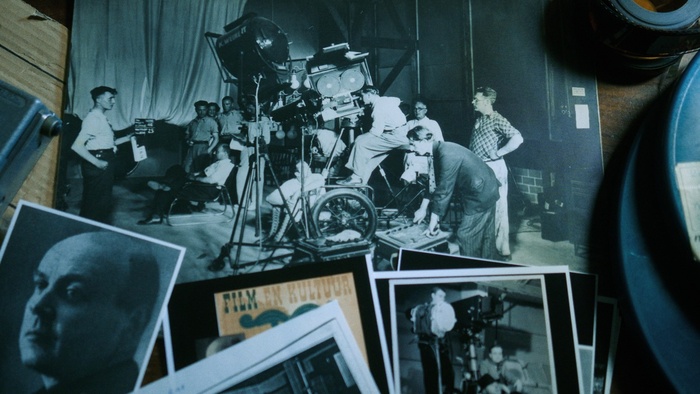
Teunissen’s own words are often more damning than any narration could be. Discussing the Holocaust, he dismisses it as “a German problem,” adding only that it “wasn’t done very elegantly.” The words land with force because of its casual detachment. Teunissen’s moral failure lies not simply in political collaboration but in his complete inability to comprehend the scale of human suffering surrounding him. Even after the war, he continued boasting about his connections to Goebbels, Himmler and others.
Visually, the film is meticulous in its evolving story that pulls you in with compelling footage, narration, clips and interviews. Mind-opening moments like segments from a “slapstick” film series called Terrible Times that enforced ideology with black humour. The footage of the stunning colour animated film Reynard the Fox drawn in what was then Disney style, demonstrates how seductive these images once were. Teunissen gave Dutch Nazi cinema a polished, romanticized look, constructing dreamlike visions designed to normalize occupation and encourage compliance.
One of the film’s most fascinating contradictions is Teunissen’s insistence on his own humanity. At one point, he claims, “Maybe I am too humane.” There is evidence that he occasionally helped individuals within the industry who were often complacent in producing, acting, and photographing these productions. Teunissen willingly ignored escalating atrocities, including the exclusion of Jews from Dutch cinemas in 1941, because acknowledging them might have threatened his ambitions. He also tries to make sure his sons are not deployed in the Waffen SS units that one of them joined, only to lose them both in Russia.
If The Propagandist occasionally risks overextending itself through repetition, the cumulative effect remains devastating. Filmmakers in Teunissen’s orbit whom he helped or employed often went on to post-war careers as studio heads, production executives in Dutch Cinema without punishments
In the end, The Propagandist with subtitles succeeds because it resists easy moral distancing. Jan Teunissen is something far more disturbing: a talented mediocrity who chose career over conscience and spent the rest of his life convincing himself those choices were reasonable. The documentary shows how propaganda rarely appears crude to its intended audience. Much like today’s rhetoric on social media, it wraps ideology inside familiarity, aspiration, idealized vision, and beauty.
Learn more at the official The Propagandist website.
Source link
#Propagandist #Film #Threat


Post Comment