×
Trump says he will ‘100%’ carry out Greenland tariffs threat, as EU vows to protect its interests

Trump says he will ‘100%’ carry out Greenland tariffs threat, as EU vows to protect its interests

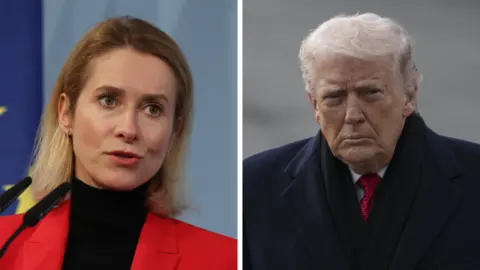
AFP via Getty Images Composit image of Donald Trump and Kaja Kallas. Both are looking towards the camera, Kallas has two microphones in front of her whereas Trump is outside wearing a navy coat and a red tie.AFP via Getty Images

Kaja Kallas, the EU’s foreign policy chief, said the bloc has “no interest to pick a fight, but we will hold our ground”.

Donald Trump has vowed to “100%” follow through on his threat to impose tariffs on European countries who oppose his demand to take control of Greenland.

European allies have rallied around Greenland’s sovereignty. Denmark’s foreign minister emphasised the US president cannot threaten his way to ownership of the semi-autonomous Danish territory.

UK Foreign Secretary Yvette Cooper reiterated the UK’s position that the future of Greenland is for “Greenlanders and for the Danes alone” to decide.

On Monday, Trump declined to rule out the use of force and insisted he would press ahead with the threatened tariffs on goods arriving in the US from the UK and seven other Nato-allied countries.

Asked by NBC News if he would use force to seize Greenland, Trump answered: “No comment”.

The US president said he would charge Britain a 10% tariff “on any and all goods” sent to the US from 1 February, increasing to 25% from 1 June, until a deal is reached for Washington to purchase Greenland from Denmark.

Trump said the same would apply to Denmark, Norway, Sweden, France, Germany, the Netherlands and Finland – all of whom are members of the defence alliance Nato which was founded in 1949.

Asked if he will follow through on the tariff threat, Mr Trump told NBC News: “I will, 100%.”

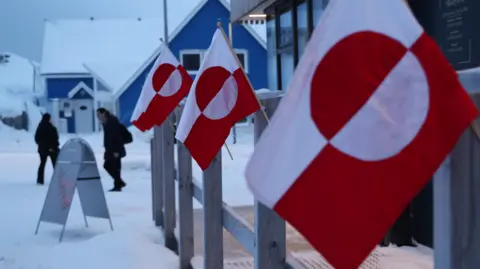
AFP via Getty Images  People walk past Greenlandic flags outside a shop in the city centreAFP via Getty Images

Trump added: “Europe ought to focus on the war with Russia and Ukraine because, frankly, you see what that’s gotten them… That’s what Europe should focus on – not Greenland.”

Denmark has warned that US military action in Greenland would spell the end of Nato. In recent days, Greenland has received support from European members of the alliance – some even sent a handful of troops to Greenland last week in a move seen as symbolic.

However, Trump followed that deployment with an announcement to impose tariffs on the eight Nato allies.

Danish foreign minister Lars Løkke Rasmussen said that Europe had to show President Trump tariff threats were “not the way forward”.

“We have red lines that can’t be crossed,” he told Sky News. “You can’t threaten your way to ownership of Greenland. I have no intention of escalating this situation.”

Nato secretary general Mark Rutte said the alliance will keep working with Denmark and Greenland on the security of the Arctic.

The European Union is to hold an emergency summit in Brussels for its leaders on Thursday where they will discuss how to respond to Trump’s latest threat to take over Greenland.

Kaja Kallas, the EU’s foreign policy chief, said the bloc has “no interest to pick a fight, but we will hold our ground”.

“But trades threats are not the way to go about this,” Kallas added. “Sovereignty is not for trade.”

It comes as text exchanges between Trump and the Norwegian prime minister were released – showing that on Sunday the US president blamed Norway for the fact he didn’t get the Nobel Peace Prize.

In his reply – seen by the BBC – Jonas Gahr Støre explained that an independent committee, not the government of Norway, awards the prize which last October went to Venezuela’s opposition leader María Corina Machado.

“Norway’s position on Greenland is clear. Greenland is a part of the Kingdom of Denmark, and Norway fully supports the Kingdom of Denmark on this matter,” Støre added.

Trump also addressed the text message exchange in Monday’s interview and said: “Norway totally controls it [the Nobel Prize] despite what they say.

“They like to say they have nothing to do with it, but they have everything to do with it.”

Meanwhile, the North American Aerospace Defense Command (Norad) on Monday announced that multiple aircraft are on their way to Pituffik Space Base in Greenland.

The joint US-Canada military defence organisation stressed they are part of a routine operation “to support various long-planned Norad activities”, and said they had been coordinated with Denmark and that the government of Greenland had been informed.

Similar Norad operations at the base took place in 2022, 2023, and last year.

Source link
#Trump #carry #Greenland #tariffs #threat #vows #protect #interests

The picturesque town of Gabala in northwest Azerbaijan hosted the fourth round of civil societies talks between Armenia and Azerbaijan representatives as the two countries continue to build on their process of peaceful future together after decades of tragic conflicts.

ADVERTISEMENT
ADVERTISEMENT

Amernia and Azerbaijan established together the so-called Peace Initiative Bridge format shortly after the two former foes signed their historic peace agreement in Washington DC. The Peace Initiative Bridge includes multiple participants from the two countries’ civil society who visit each other to conduct the ongoing peace dialogue by addressing all common issues openly and in an atmosphere of trust.

In an answer to Euronews, Armenia’s Areg Kochinyan, president of the Armenian Council and the Armenian coordinator of the Peace Initiative Bridge, said the two countries have to deal with a “gigantic amount of trauma,” as both nations are making significant efforts to move on as part of their historic peace agreement.

However, he added that “the normalistion and the peace in South Caucuses is well-needed in the West, in Europe, in the United States and that’s partially the reason why we have seen this level of interest of the United States in the region.”

On Azerbaijan’s side, Farhad Mammadov, director of the Center for Studies of the South Caucasus and Azerbaijan’s coordinator of the Peace Initiative Bridge, said that “the conflicts in the region did not have a negative effect on the peace-building process.”

“This is a two-way peace-building process and it is autonomous,” he added.

The focus of Saturday’s meeting in Gabala was on building momentum for the ongoing peace process between Armenia and Azerbaijan.

Armenia’s Lusine Kharatyan, writer and cultural anthropologist as well as member of the Peace Bridge Initiative, told Euronews that “it is extremely important to continue these talks in this world where violence and conflict grows around us, so it’s very important to keep the track of peace.”

“I think the talks went very well because we were able to discuss very important and sensitive issues for both societies and do it very deeply and very sensitively towards each other,” she added.

Eleonora Sargsyan from Armenia, a youth worker and member of the Peace Bridge Initiative said that “for 30 years, we’ve lived with closed borders and we haven’t had the chance of structured dialogue, which created a framework of mutual dehumanisation.”

“I believe that one of the primary objectives of peacebuilding initiatives and any civil society initiatives that untites Armenian and Azerbaijani experts is to start the process of rehumanisation.”

In its turn, Azerbaijan’s representatives underlined the importance to both countries to deepen the dialogue at civil society level.

Orkhan Amashov, Azerbaijan’s participant of the Peace Bridge Participant, described the discussions as being “incredibly comprehensive and wide-ranging.”

“The participants here are to prepare their respective societies for that ultimate eventuality – a peace agreement – and its consequences.” , he added.

Ramil Iskandarli, chairman of the Board of Azerbaijan’s National NGO Forum, and member of the Peace Bridge Initiative, described the symbolism of both sides crossing each other’s borders for peace talks.

“Both I and (the) other group members crossed the border between Azerbaijan and Armenia twice and our Armenian colleagues did the same to come to Gabala,” he said.

He added that “this particular meeting is important because it represents the fourth step actually. I am participating from the very first day of this process,” underlining that “there is also a certain symbolism in this process.”

Energy disruption has become a dominant challenge due to the global climate of instability also due to Iran’s Strait of Hormuz blockade crisis, which has shifted attention to the South Caucasus as a critical alternative route that Azerbaijan and Armenia are now working together to develop as a joint opportunity.

Hikmet Hajiyev, foreign policy advisor to the president of Azerbaijan, led Saturday’s peace talks and greeted each participant.

In a post on X after the talks, he announced that Azerbaijan is “fully committed to the Washington agenda” of the peace process and that “this commitment is not merely declarative or confined to paper; rather, concrete and pragmatic steps are being taken to strengthen the peace agenda,” in the context of both countries continuing the development of the major regional project of the Trump Route for International Peace and Prosperity, also known as the TRIPP corridor, which is a US-backed, 42-kilometre transit corridor through Armenia’s Syunik region which connects Azerbaijan to its Nakhchivan exclave.

Hajiyev underlined the fast developing economic cooperation between Azerbaijan and Armenia stating that “these include bilateral trade, transit shipments to Armenia via Azerbaijan, and people-to-people contacts, all of which reflect the concept of the economic dividends of peace.”

The participants concluded the Gabala talks agreeing that continued dialogue is an important step in maintaining communication between the two sides.

#Armenia #Azerbaijan #civil #societies #hold #talks #push #peace #plansPeace process,Armenia,Caucasus">Armenia and Azerbaijan civil societies hold talks to push peace plans 
  The picturesque town of Gabala in northwest Azerbaijan hosted the fourth round of civil societies talks between Armenia and Azerbaijan representatives as the two countries continue to build on their process of peaceful future together after decades of tragic conflicts.


          ADVERTISEMENT


          ADVERTISEMENT


Amernia and Azerbaijan established together the so-called Peace Initiative Bridge format shortly after the two former foes signed their historic peace agreement in Washington DC. The Peace Initiative Bridge includes multiple participants from the two countries’ civil society who visit each other to conduct the ongoing peace dialogue by addressing all common issues openly and in an atmosphere of trust.


In an answer to Euronews, Armenia’s Areg Kochinyan, president of the Armenian Council and the Armenian coordinator of the Peace Initiative Bridge, said the two countries have to deal with a “gigantic amount of trauma,” as both nations are making significant efforts to move on as part of their historic peace agreement.
However, he added that “the normalistion and the peace in South Caucuses is well-needed in the West, in Europe, in the United States and that’s partially the reason why we have seen this level of interest of the United States in the region.” 
On Azerbaijan’s side, Farhad Mammadov, director of the Center for Studies of the South Caucasus and Azerbaijan’s coordinator of the Peace Initiative Bridge, said that “the conflicts in the region did not have a negative effect on the peace-building process.” 
“This is a two-way peace-building process and it is autonomous,” he added. 
The focus of Saturday’s meeting in Gabala was on building momentum for the ongoing peace process between Armenia and Azerbaijan. 
Armenia’s Lusine Kharatyan, writer and cultural anthropologist as well as member of the Peace Bridge Initiative, told Euronews that “it is extremely important to continue these talks in this world where violence and conflict grows around us, so it’s very important to keep the track of peace.” 
“I think the talks went very well because we were able to discuss very important and sensitive issues for both societies and do it very deeply and very sensitively towards each other,” she added. 


Eleonora Sargsyan from Armenia, a youth worker and member of the Peace Bridge Initiative said that “for 30 years, we’ve lived with closed borders and we haven’t had the chance of structured dialogue, which created a framework of mutual dehumanisation.” 
“I believe that one of the primary objectives of peacebuilding initiatives and any civil society initiatives that untites Armenian and Azerbaijani experts is to start the process of rehumanisation.” 
In its turn, Azerbaijan’s representatives underlined the importance to both countries to deepen the dialogue at civil society level. 
Orkhan Amashov, Azerbaijan’s participant of the Peace Bridge Participant, described the discussions as being “incredibly comprehensive and wide-ranging.” 
“The participants here are to prepare their respective societies for that ultimate eventuality – a peace agreement – and its consequences.” , he added. 
Ramil Iskandarli, chairman of the Board of Azerbaijan’s National NGO Forum, and member of the Peace Bridge Initiative, described the symbolism of both sides crossing each other’s borders for peace talks. 
“Both I and (the) other group members crossed the border between Azerbaijan and Armenia twice and our Armenian colleagues did the same to come to Gabala,” he said. 
He added that “this particular meeting is important because it represents the fourth step actually. I am participating from the very first day of this process,” underlining that “there is also a certain symbolism in this process.” 
Energy disruption has become a dominant challenge due to the global climate of instability also due to Iran’s Strait of Hormuz blockade crisis, which has shifted attention to the South Caucasus as a critical alternative route that Azerbaijan and Armenia are now working together to develop as a joint opportunity. 
Hikmet Hajiyev, foreign policy advisor to the president of Azerbaijan, led Saturday’s peace talks and greeted each participant.
In a post on X after the talks, he announced that Azerbaijan is “fully committed to the Washington agenda” of the peace process and that “this commitment is not merely declarative or confined to paper; rather, concrete and pragmatic steps are being taken to strengthen the peace agenda,” in the context of both countries continuing the development of the major regional project of the Trump Route for International Peace and Prosperity, also known as the TRIPP corridor, which is a US-backed, 42-kilometre transit corridor through Armenia’s Syunik region which connects Azerbaijan to its Nakhchivan exclave. 


Hajiyev underlined the fast developing economic cooperation between Azerbaijan and Armenia stating that “these include bilateral trade, transit shipments to Armenia via Azerbaijan, and people-to-people contacts, all of which reflect the concept of the economic dividends of peace.” 
The participants concluded the Gabala talks agreeing that continued dialogue is an important step in maintaining communication between the two sides. 

  #Armenia #Azerbaijan #civil #societies #hold #talks #push #peace #plansPeace process,Armenia,Caucasus

Post Comment