×
Trump takes a break from world affairs to tee-up his Scottish golf courses

Trump takes a break from world affairs to tee-up his Scottish golf courses

James Cook

Scotland editor

As Donald Trump heads to Scotland, what to expect from his visit

Donald Trump flies into Scotland later to visit two golf resorts which he owns in the country where his mother was born.

He will travel to Turnberry in South Ayrshire, a world class venue he bought in 2014, and to Menie in Aberdeenshire to open a new 18-hole course.

The White House says Trump will also meet prime minister Sir Keir Starmer to discuss trade while he is in the UK.

The trip is exceptional as US presidents rarely promote their personal interests so publicly while in office.

It is not the first time that Trump has been accused of conflating his own affairs with the nation’s.

Even so, with Gaza and Ukraine in flames, the dollar on the slide, and questions mounting about his ties to convicted paedophile, Jeffrey Epstein, Trump’s decision to focus on golf has raised eyebrows.
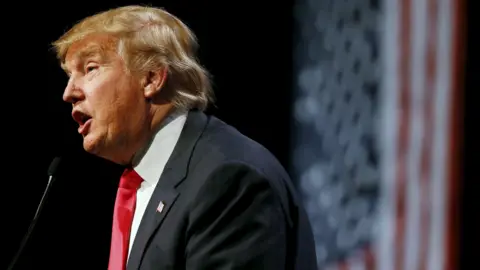
Reuters A photo of Donald trump on stage in Las Vegas in 2015. He is wearing a dark blue suit, white shirt and a red tie. In the background is an American flagReuters

In Las Vegas a decade ago Trump was keen to promote his Scottish golf courses

I witnessed Trump’s unconventional attitude first hand, right at the start of his political career, when I met him on the campaign trail in 2015 as the Republicans searched for a candidate who could win back the presidency after Barack Obama’s two terms in office.

Trump strode off the debate stage in a glitzy Las Vegas hotel and into a room packed with cameras.

Jostling for position, I asked the man with the long red tie a couple of questions and, after boasting about his status as frontrunner in the race, he told me he had a message for the UK.

This will make news, I thought. Maybe something about immigration, Trump’s signature campaign topic?

It was not. Instead Trump wanted BBC viewers to know that he had some fine golf courses on Scotland’s shores which they should visit.

The answer struck me as remarkable for a man aspiring to become the so-called leader of the free world.


Getty Images A sepia image of Mary An MacLeod from 1932. She is 20 years old and lounging on the steps of a house. Getty Images

Donald Trump’s mother, Mary Anne MacLeod, grew up on the Isle of Lewis before emigrating to America

Of course Trump does have a genuine link to Scotland.

His Gaelic-speaking mother, Mary Anne MacLeod, was born in 1912 on the island of Lewis in Scotland’s Outer Hebrides and left during the Great Depression for New York where she married property developer Fred Trump.

Their son’s return to Scotland for four days this summer comes ahead of an official state visit in September when the president and First Lady Melania Trump will be hosted by King Charles at Windsor Castle in Berkshire.

Trump is not scheduled to see the King on this visit but it is not entirely private either, as he will meet Scotland’s First Minister John Swinney as well as the prime minister.

Business leaders, including Scotch whisky producers, are urging Starmer and Swinney to use their meetings with Trump to lobby for a reduction in US taxes on imports, known as tariffs.
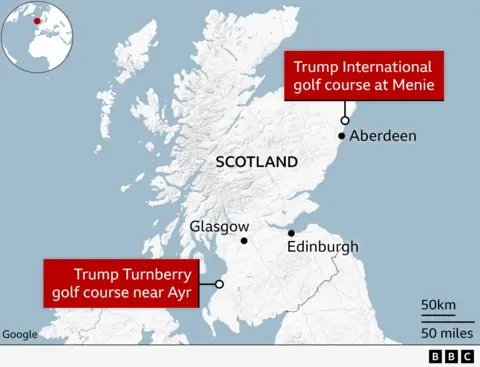
A map of Scotland showing Menie in the north east and Turnberry in the south

A huge security operation, which has been under way for weeks, has been scaled up in recent days.

Giant transport aircraft carrying military hardware, including the president’s helicopters, known when he is on board by the call sign Marine One, have been spotted at Aberdeen and Prestwick airports.

Roads and lanes in Aberdeenshire and Ayrshire have been secured and closed.

Airspace restrictions have been issued.

Police reinforcements have been heading north across the England-Scotland border.

Visits to Scotland by sitting US presidents are rare.

Queen Elizabeth hosted Dwight D Eisenhower at Balmoral in Aberdeenshire in 1957; George W Bush travelled to Gleneagles in Perthshire for a G8 summit in 2005; and Joe Biden attended a climate conference in Glasgow in 2021.

The only other serving president to visit this century is Trump himself in 2018 when he was met by protesters including one flying a paraglider low over Turnberry, breaching the air exclusion zone around the resort.

PA A photo of Trump at Turnberry in 2023. He is standing with his arms outstretched, holding a golf putter. He is wearing one white glove. He has a blue fleecy sweater on and a red MAGA hat. The background is the green of the golf course. PA

Trump’s trip to Scotland is not an official state visit

Even by the standards of Donald Trump the years since have been wild.

When he lost the 2020 election to Joe Biden, a mob of Trump supporters responded to their leader’s false claims of electoral fraud by mounting a violent assault on the US Capitol.

Four years later Trump staged a stunning political comeback and since returning to the White House he has survived at least one assassination attempt while a man has been charged with another.

Amid this turmoil, security surrounding Trump is supposedly tighter than ever.

The US Secret Service, much criticised for failures which nearly cost the president his life, remains primarily responsible for his safety but concerns have been raised about the impact of his visit on Police Scotland’s officers and budget, with one former senior officer estimating the policing cost at more than £5m.

Adding to the pressure which the police are under to secure his resorts, large anti-Trump demonstrations are expected to be held in Aberdeen and Edinburgh.

Police Scotland insists it has the resources it needs to deal with the visit.

Getty Images A photo of a protest in Edinburgh in 2018. There are hundreds of people milling around but the photo is dominated by a huge inflatable baby Donald Trump wearing a nappyGetty Images

Trump’s last visit as president sparked protests across the country

While polls suggest Trump is deeply unpopular in the UK, he may actually find some sympathy in Aberdeen, a city which he and many others call “the oil capital of Europe”.

He has stirred the heated debate about the nature and pace of the transition from fossil fuels to renewable energy, telling BBC News last week that Aberdeen, which has prospered for decades from North Sea drilling, “should get rid of the windmills and bring back the oil.”

The environmental campaign group Uplift says Trump’s claim that the North Sea can still provide the UK with a secure energy supply “runs counter to reality.”

Trump’s pro-oil message echoes the rhetoric of Reform UK, the right-wing party led by Trump fan Nigel Farage which made progress in a recent Scottish by-election and hopes to go one step further by winning seats for the first time in next year’s Scottish parliamentary election.

The Scottish Parliament, known as Holyrood after its location at the foot of Edinburgh’s Royal Mile, runs much of Scotland’s domestic affairs, such as health, education and some taxation and benefits, while the UK parliament in London retains control of defence, foreign affairs and wider economic policy.
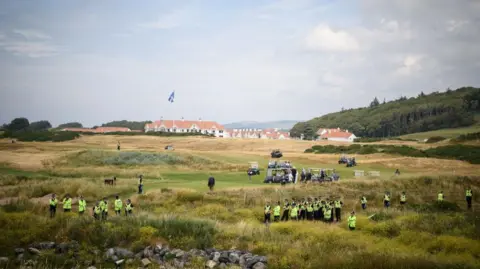
Getty Images A photo of Turnberry from 2018 when Trump visited as president. In the distance you can see the red roof of the famous hotel. In the middle distance are golf buggies. We assume Trump is in one of them. In the foreground dunes are dozens of police wearing yellow jackets.Getty Images

Security and police teams surrounded the perimeter of Turnberry as Donald Trump played golf on his last visit as president in July 2018

Trump’s support for the oil industry is well known but his hatred of wind turbines appears to run even deeper.

In 2012 he told me that building a wind farm off the coast of his golf course at Menie would be a “terrible error” that would “destroy Scotland.”

The encounter was a strange experience.

At first, Trump’s aides told us he was so affronted by the difficult questions he had been asked by Rona Dougall of STV News earlier that morning that he had changed his mind about speaking to the BBC.

We waited anyway in the rain, for hours. Eventually the man himself emerged. After some verbal sparring he offered us burgers from a barbecue before backing down and agreeing to be interviewed.

Later, asked by a committee of the Scottish Parliament in Edinburgh to provide evidence to back up his claim that Scottish tourism would be ruined by wind turbines, Trump famously replied: “I am the evidence.”

The wind farm was built anyway and is now clearly visible from the course.
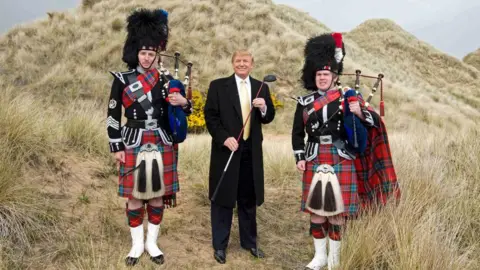
Getty Images A photo from 2010 of Donald Trump in the sand dune at Menie holding a golf club. He is flanked by two bagpipers in full Scottish regalia, kilt, sporran and feathered hatGetty Images

Donald Trump poses with Scottish pipers during a visit to the construction site of his golf course on the Menie Estate in 2010

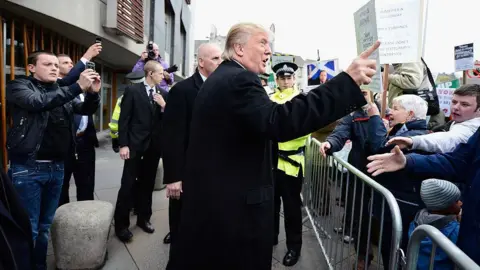
Getty Images A photo from 2012 of Donald Trump outside the Scottish Parliament at Holyrood in Edinburgh. Behind a barrier are protesters and some people who appear to want to shake his hand. Police and photographers are behind Trump as he talks at the crowd with his hand raised and his finger pointed. Getty Images

Trump appeared at the Scottish Parliament in 2012 to complain about wind turbines near his golf course

It is not the only battle Trump has fought against a backdrop of shifting sand dunes and whispering grasses at Menie where he has repeatedly clashed with local residents, politicians and environmentalists for a variety of reasons.

His other course at Turnberry is not controversial itself but it is the stage for a tussle with the golfing authorities because Trump appears to be infuriated by the refusal of the game’s governing body, the R&A, to stage the prestigious Open Championship there, citing logistical challenges.

Turnberry is home to three golf courses, said to be the most expensive to play in the UK, and the Open has been held there four times but never since Trump purchased it in 2014.

It is another striking example of how, a decade after mounting what was essentially a hostile takeover of the US Republican Party, the man who has been both the 45th and 47th president of the US has still not entirely swapped business for politics.

He is the most powerful man in the Western world and yet Donald Trump is still irked at being snubbed, still hankering for status, still angry about a golfing deal he has, so far at least, failed to close.

Source link
#Trump #takes #break #world #affairs #teeup #Scottish #golf #courses

The picturesque town of Gabala in northwest Azerbaijan hosted the fourth round of civil societies talks between Armenia and Azerbaijan representatives as the two countries continue to build on their process of peaceful future together after decades of tragic conflicts.

ADVERTISEMENT
ADVERTISEMENT

Amernia and Azerbaijan established together the so-called Peace Initiative Bridge format shortly after the two former foes signed their historic peace agreement in Washington DC. The Peace Initiative Bridge includes multiple participants from the two countries’ civil society who visit each other to conduct the ongoing peace dialogue by addressing all common issues openly and in an atmosphere of trust.

In an answer to Euronews, Armenia’s Areg Kochinyan, president of the Armenian Council and the Armenian coordinator of the Peace Initiative Bridge, said the two countries have to deal with a “gigantic amount of trauma,” as both nations are making significant efforts to move on as part of their historic peace agreement.

However, he added that “the normalistion and the peace in South Caucuses is well-needed in the West, in Europe, in the United States and that’s partially the reason why we have seen this level of interest of the United States in the region.”

On Azerbaijan’s side, Farhad Mammadov, director of the Center for Studies of the South Caucasus and Azerbaijan’s coordinator of the Peace Initiative Bridge, said that “the conflicts in the region did not have a negative effect on the peace-building process.”

“This is a two-way peace-building process and it is autonomous,” he added.

The focus of Saturday’s meeting in Gabala was on building momentum for the ongoing peace process between Armenia and Azerbaijan.

Armenia’s Lusine Kharatyan, writer and cultural anthropologist as well as member of the Peace Bridge Initiative, told Euronews that “it is extremely important to continue these talks in this world where violence and conflict grows around us, so it’s very important to keep the track of peace.”

“I think the talks went very well because we were able to discuss very important and sensitive issues for both societies and do it very deeply and very sensitively towards each other,” she added.

Eleonora Sargsyan from Armenia, a youth worker and member of the Peace Bridge Initiative said that “for 30 years, we’ve lived with closed borders and we haven’t had the chance of structured dialogue, which created a framework of mutual dehumanisation.”

“I believe that one of the primary objectives of peacebuilding initiatives and any civil society initiatives that untites Armenian and Azerbaijani experts is to start the process of rehumanisation.”

In its turn, Azerbaijan’s representatives underlined the importance to both countries to deepen the dialogue at civil society level.

Orkhan Amashov, Azerbaijan’s participant of the Peace Bridge Participant, described the discussions as being “incredibly comprehensive and wide-ranging.”

“The participants here are to prepare their respective societies for that ultimate eventuality – a peace agreement – and its consequences.” , he added.

Ramil Iskandarli, chairman of the Board of Azerbaijan’s National NGO Forum, and member of the Peace Bridge Initiative, described the symbolism of both sides crossing each other’s borders for peace talks.

“Both I and (the) other group members crossed the border between Azerbaijan and Armenia twice and our Armenian colleagues did the same to come to Gabala,” he said.

He added that “this particular meeting is important because it represents the fourth step actually. I am participating from the very first day of this process,” underlining that “there is also a certain symbolism in this process.”

Energy disruption has become a dominant challenge due to the global climate of instability also due to Iran’s Strait of Hormuz blockade crisis, which has shifted attention to the South Caucasus as a critical alternative route that Azerbaijan and Armenia are now working together to develop as a joint opportunity.

Hikmet Hajiyev, foreign policy advisor to the president of Azerbaijan, led Saturday’s peace talks and greeted each participant.

In a post on X after the talks, he announced that Azerbaijan is “fully committed to the Washington agenda” of the peace process and that “this commitment is not merely declarative or confined to paper; rather, concrete and pragmatic steps are being taken to strengthen the peace agenda,” in the context of both countries continuing the development of the major regional project of the Trump Route for International Peace and Prosperity, also known as the TRIPP corridor, which is a US-backed, 42-kilometre transit corridor through Armenia’s Syunik region which connects Azerbaijan to its Nakhchivan exclave.

Hajiyev underlined the fast developing economic cooperation between Azerbaijan and Armenia stating that “these include bilateral trade, transit shipments to Armenia via Azerbaijan, and people-to-people contacts, all of which reflect the concept of the economic dividends of peace.”

The participants concluded the Gabala talks agreeing that continued dialogue is an important step in maintaining communication between the two sides.

#Armenia #Azerbaijan #civil #societies #hold #talks #push #peace #plansPeace process,Armenia,Caucasus">Armenia and Azerbaijan civil societies hold talks to push peace plans 
  The picturesque town of Gabala in northwest Azerbaijan hosted the fourth round of civil societies talks between Armenia and Azerbaijan representatives as the two countries continue to build on their process of peaceful future together after decades of tragic conflicts.


          ADVERTISEMENT


          ADVERTISEMENT


Amernia and Azerbaijan established together the so-called Peace Initiative Bridge format shortly after the two former foes signed their historic peace agreement in Washington DC. The Peace Initiative Bridge includes multiple participants from the two countries’ civil society who visit each other to conduct the ongoing peace dialogue by addressing all common issues openly and in an atmosphere of trust.


In an answer to Euronews, Armenia’s Areg Kochinyan, president of the Armenian Council and the Armenian coordinator of the Peace Initiative Bridge, said the two countries have to deal with a “gigantic amount of trauma,” as both nations are making significant efforts to move on as part of their historic peace agreement.
However, he added that “the normalistion and the peace in South Caucuses is well-needed in the West, in Europe, in the United States and that’s partially the reason why we have seen this level of interest of the United States in the region.” 
On Azerbaijan’s side, Farhad Mammadov, director of the Center for Studies of the South Caucasus and Azerbaijan’s coordinator of the Peace Initiative Bridge, said that “the conflicts in the region did not have a negative effect on the peace-building process.” 
“This is a two-way peace-building process and it is autonomous,” he added. 
The focus of Saturday’s meeting in Gabala was on building momentum for the ongoing peace process between Armenia and Azerbaijan. 
Armenia’s Lusine Kharatyan, writer and cultural anthropologist as well as member of the Peace Bridge Initiative, told Euronews that “it is extremely important to continue these talks in this world where violence and conflict grows around us, so it’s very important to keep the track of peace.” 
“I think the talks went very well because we were able to discuss very important and sensitive issues for both societies and do it very deeply and very sensitively towards each other,” she added. 


Eleonora Sargsyan from Armenia, a youth worker and member of the Peace Bridge Initiative said that “for 30 years, we’ve lived with closed borders and we haven’t had the chance of structured dialogue, which created a framework of mutual dehumanisation.” 
“I believe that one of the primary objectives of peacebuilding initiatives and any civil society initiatives that untites Armenian and Azerbaijani experts is to start the process of rehumanisation.” 
In its turn, Azerbaijan’s representatives underlined the importance to both countries to deepen the dialogue at civil society level. 
Orkhan Amashov, Azerbaijan’s participant of the Peace Bridge Participant, described the discussions as being “incredibly comprehensive and wide-ranging.” 
“The participants here are to prepare their respective societies for that ultimate eventuality – a peace agreement – and its consequences.” , he added. 
Ramil Iskandarli, chairman of the Board of Azerbaijan’s National NGO Forum, and member of the Peace Bridge Initiative, described the symbolism of both sides crossing each other’s borders for peace talks. 
“Both I and (the) other group members crossed the border between Azerbaijan and Armenia twice and our Armenian colleagues did the same to come to Gabala,” he said. 
He added that “this particular meeting is important because it represents the fourth step actually. I am participating from the very first day of this process,” underlining that “there is also a certain symbolism in this process.” 
Energy disruption has become a dominant challenge due to the global climate of instability also due to Iran’s Strait of Hormuz blockade crisis, which has shifted attention to the South Caucasus as a critical alternative route that Azerbaijan and Armenia are now working together to develop as a joint opportunity. 
Hikmet Hajiyev, foreign policy advisor to the president of Azerbaijan, led Saturday’s peace talks and greeted each participant.
In a post on X after the talks, he announced that Azerbaijan is “fully committed to the Washington agenda” of the peace process and that “this commitment is not merely declarative or confined to paper; rather, concrete and pragmatic steps are being taken to strengthen the peace agenda,” in the context of both countries continuing the development of the major regional project of the Trump Route for International Peace and Prosperity, also known as the TRIPP corridor, which is a US-backed, 42-kilometre transit corridor through Armenia’s Syunik region which connects Azerbaijan to its Nakhchivan exclave. 


Hajiyev underlined the fast developing economic cooperation between Azerbaijan and Armenia stating that “these include bilateral trade, transit shipments to Armenia via Azerbaijan, and people-to-people contacts, all of which reflect the concept of the economic dividends of peace.” 
The participants concluded the Gabala talks agreeing that continued dialogue is an important step in maintaining communication between the two sides. 

  #Armenia #Azerbaijan #civil #societies #hold #talks #push #peace #plansPeace process,Armenia,Caucasus

Post Comment