×
Vaijnath Kale, the coach who gave Dilip Gavit a home — and a Commonwealth Games gold  When Dilip Mahadu Gavit stormed across the finish line to win gold in the men’s T47 100 metres at the Commonwealth Games, he didn’t run towards the photographers waiting beside the track. Instead, he turned around, scanned the stands at Scotstoun Stadium in Glasgow and sprinted towards one man in the crowd.Coach Vaijnath Kale caught him in a bear hug as both men struggled to hold back tears. “There were no words,” Kale tells        Sportstar. “Everything had already been said.”Speaking to this publication later, Gavit would tell what the win — India’s third gold at Glasgow and the first ever in para-athletics at the Commonwealth Games — meant to him. “Today was Guru Purnima,” he says, referring to the Hindu festival dedicated to honouring teachers. “I wanted to do something special for sir. This gold is for him.” Dilip Gavit wanted to do something special for his coach, Vaijnath Kale, on the occasion of Guru Purnima.
                                                            | Photo Credit: 
                                Special Arrangement
                            

                            Dilip Gavit wanted to do something special for his coach, Vaijnath Kale, on the occasion of Guru Purnima.
                                                            | Photo Credit: 
                                Special Arrangement
                                                    For most athletes, that would have been a heartfelt tribute to a coach. For Gavit, it barely scratched the surface. He admits their relationship goes beyond that of a coach and student. “He’s more than my guru (teacher). I live in his house. I eat at his table. Unhone mujhe adopt hi kiya hai. Mujhe bete jaise rakhte hain (He has adopted me. He has raised me as his son). He’s fed, trained and educated me. He’s my papa (father). Everything I have, I owe to him,” Gavit says.Kale agrees with that description. “I’ve adopted him in every way except giving him my surname. He is my son.”Chance meetingThere was a time when Gavit’s life could scarcely have been more different. As a child growing up in the village of Torandongri, a hamlet of less than a hundred families located in the hills of Maharashtra’s Nashik district, he had suffered a rough start to his life. One of six children of an impoverished tribal family, he had had his right arm amputated after suffering a fall that was treated improperly by an ayurvedic practitioner that he had been taken to in the absence of a medical facility.He was considered a burden growing up. “My family would work as labourers when there was not enough rain to farm our own land but I couldn’t even do that. I was seen as something useless,” he recalls.The one thing that gave him comfort was playing. It was while doing that that the then 11-year-old Gavit caught the eye of Kale.Kale had been a national level athlete but had given up his sport and started working a corporate job. After several years though, he had felt the urge to work in athletics once again and started working as a coach and technical official in Nashik. It was in that role that in the summer of 2014, he found himself in Gavit’s village. Vaijnath Kale made Dilip Gavit train with the able-bodied athletes from the beginning.
                                                            | Photo Credit: 
                                Special Arrangement
                            

                            Vaijnath Kale made Dilip Gavit train with the able-bodied athletes from the beginning.
                                                            | Photo Credit: 
                                Special Arrangement
                                                    “I remember seeing this tiny kid who was running around in the playground. He was clearly underweight and he was in a torn shirt and trousers and no shoes. He didn’t have a right arm, but it didn’t seem to hold him back. He had so much energy. I wanted to find out who he was,” Kale recalls.As he found out, Kale decided he had to do something for the boy. “When I asked Dilip what he would do later in life, he told me he would probably beg for a living. At that time, I didn’t think about sports or about the Commonwealth Games or anything. I just wanted to help this boy. I asked a village school teacher to help me talk to his parents,” he says.Gavit’s parents were uncertain. “They were a little suspicious when I said I wanted to adopt their son. They thought I wanted money, but I made it very clear that I just wanted to take care of him. They already had so many children to take care of that they agreed to let me take him to Nashik,” Kale recalls.His own family was equally concerned. “They thought I had gone mad. I had already given up a job where I was making nearly a lakh a month in order to work as a coach with young athletes. I had also recently got married. Now I was planning to raise a child who wasn’t even my own. I’m not wealthy. My family wanted to know where was I going to get the money from? What was I going to do when I had my own children?” he recalls.These were all legitimate questions, Kale admits. But he also remembers what he thought. “I was going to give this child a better life.” Dilip Gavit won bronze medal in the Delhi Grand Prix to qualify for the Commonwealth Games 2026.
                                                            | Photo Credit: 
                                Special Arrangement
                            

                            Dilip Gavit won bronze medal in the Delhi Grand Prix to qualify for the Commonwealth Games 2026.
                                                            | Photo Credit: 
                                Special Arrangement
                                                    In Nashik, Kale’s first intention was to educate Gavit. He realised though, that the child had a talent for running. He started letting him practice with the other young athletes that he was training at a local college ground.Despite the fact that he was missing his arm below the elbow left him with coordination and strength limitations compared to able bodied athletes, Kale encouraged Gavit to compete against them. “The biggest challenge that disabled children have is a lack of self-confidence. They feel inferior compared to able bodied people. I had to get that fear out of Dilip’s mind. So, for the first four or five years in which I trained him, I only made him compete with able bodied athletes. I didn’t want him to think he was a disabled runner,” he says.In all this while Kale never let Gavit believe he was only valued for his athletic ability. “Life is about more than athletics,” Kale says.His family, initially unwilling, would come on board. His wife, Jyothi, would leave her Human Resources job and work full time towards getting Gavit’s education, which had been languishing in his village, back on track.Gavit has now completed his graduation. Although the Kales have two children of their own, they’re supporting another four children similar to Gavit at their home. Kale now supports the academy and the athletes who live with him through charity and through a part-time property business.Rapid improvement With Vaijnath Kale on his side, Dilip Gavit wants to win gold in Para Asian Games and Paralympics as well.
                                                            | Photo Credit: 
                                Special Arrangement
                            

                            With Vaijnath Kale on his side, Dilip Gavit wants to win gold in Para Asian Games and Paralympics as well.
                                                            | Photo Credit: 
                                Special Arrangement
                                                    With the support of his adoptive family, Gavit was beating able bodied runners, and winning medals at the state and junior national level in the 200m and 400m. Eventually though, Kale started taking Gavit to compete amongst Para Athletes. The switch immediately paid dividends, with Gavit winning Para Asian gold in the 400m at Hangzhou in 2023.Last year Kale had Gavit make another switch. With there being no 400m event in his para disability category, Kale said he needed to compete in the 100m event, which was part of the Glasgow program. Although he had never run the 100m competitively, Gavit immediately agreed. “He can ask me to do anything and I would,” Gavit says.It was a plan that has played out perfectly. Gavit started running the 100m at the Grand Prix in Dubai and the won bronze in Grand Prix in India to qualify for the Commonwealth Games. At Glasgow, despite a slow start, Gavit steadily picked up speed and ran a personal best 10.71 to set a new Games record.While he’s proud of the gold medal, Gavit says his work is hardly done. “I will be competing in the 100m and 400m at the Para Asian Games this year and I want to win gold there also. Then at the Los Angeles Paralympics, I want to win another gold medal. Coach and I have the dream that one day India’s anthem plays at the Paralympics,” he says.It’s a lofty ambition. As Gavit pursues it, he’s glad he has Kale by his side. “He’s the most important person in my life. Everything I have achieved is because of him. We are a team,” he says.Kale is sure he can accomplish it. For his part, he’s just happy to be able to be alongside Gavit’s journey. “There are so many children in India who have talent. They simply don’t get the opportunity. It was God’s plan that he brought me to meet Dilip. I feel blessed that I have been able to help him fulfil his potential,” he says.Published on Jul 30, 2026  #Vaijnath #Kale #coach #gave #Dilip #Gavit #home #Commonwealth #Games #gold

Vaijnath Kale, the coach who gave Dilip Gavit a home — and a Commonwealth Games gold

When Dilip Mahadu Gavit stormed across the finish line to win gold in the men’s T47 100 metres at the Commonwealth Games, he didn’t run towards the photographers waiting beside the track. Instead, he turned around, scanned the stands at Scotstoun Stadium in Glasgow and sprinted towards one man in the crowd.

Coach Vaijnath Kale caught him in a bear hug as both men struggled to hold back tears. “There were no words,” Kale tells Sportstar. “Everything had already been said.”

Speaking to this publication later, Gavit would tell what the win — India’s third gold at Glasgow and the first ever in para-athletics at the Commonwealth Games — meant to him. “Today was Guru Purnima,” he says, referring to the Hindu festival dedicated to honouring teachers. “I wanted to do something special for sir. This gold is for him.”

Vaijnath Kale, the coach who gave Dilip Gavit a home — and a Commonwealth Games gold  When Dilip Mahadu Gavit stormed across the finish line to win gold in the men’s T47 100 metres at the Commonwealth Games, he didn’t run towards the photographers waiting beside the track. Instead, he turned around, scanned the stands at Scotstoun Stadium in Glasgow and sprinted towards one man in the crowd.Coach Vaijnath Kale caught him in a bear hug as both men struggled to hold back tears. “There were no words,” Kale tells        Sportstar. “Everything had already been said.”Speaking to this publication later, Gavit would tell what the win — India’s third gold at Glasgow and the first ever in para-athletics at the Commonwealth Games — meant to him. “Today was Guru Purnima,” he says, referring to the Hindu festival dedicated to honouring teachers. “I wanted to do something special for sir. This gold is for him.” Dilip Gavit wanted to do something special for his coach, Vaijnath Kale, on the occasion of Guru Purnima.
                                                            | Photo Credit: 
                                Special Arrangement
                            

                            Dilip Gavit wanted to do something special for his coach, Vaijnath Kale, on the occasion of Guru Purnima.
                                                            | Photo Credit: 
                                Special Arrangement
                                                    For most athletes, that would have been a heartfelt tribute to a coach. For Gavit, it barely scratched the surface. He admits their relationship goes beyond that of a coach and student. “He’s more than my guru (teacher). I live in his house. I eat at his table. Unhone mujhe adopt hi kiya hai. Mujhe bete jaise rakhte hain (He has adopted me. He has raised me as his son). He’s fed, trained and educated me. He’s my papa (father). Everything I have, I owe to him,” Gavit says.Kale agrees with that description. “I’ve adopted him in every way except giving him my surname. He is my son.”Chance meetingThere was a time when Gavit’s life could scarcely have been more different. As a child growing up in the village of Torandongri, a hamlet of less than a hundred families located in the hills of Maharashtra’s Nashik district, he had suffered a rough start to his life. One of six children of an impoverished tribal family, he had had his right arm amputated after suffering a fall that was treated improperly by an ayurvedic practitioner that he had been taken to in the absence of a medical facility.He was considered a burden growing up. “My family would work as labourers when there was not enough rain to farm our own land but I couldn’t even do that. I was seen as something useless,” he recalls.The one thing that gave him comfort was playing. It was while doing that that the then 11-year-old Gavit caught the eye of Kale.Kale had been a national level athlete but had given up his sport and started working a corporate job. After several years though, he had felt the urge to work in athletics once again and started working as a coach and technical official in Nashik. It was in that role that in the summer of 2014, he found himself in Gavit’s village. Vaijnath Kale made Dilip Gavit train with the able-bodied athletes from the beginning.
                                                            | Photo Credit: 
                                Special Arrangement
                            

                            Vaijnath Kale made Dilip Gavit train with the able-bodied athletes from the beginning.
                                                            | Photo Credit: 
                                Special Arrangement
                                                    “I remember seeing this tiny kid who was running around in the playground. He was clearly underweight and he was in a torn shirt and trousers and no shoes. He didn’t have a right arm, but it didn’t seem to hold him back. He had so much energy. I wanted to find out who he was,” Kale recalls.As he found out, Kale decided he had to do something for the boy. “When I asked Dilip what he would do later in life, he told me he would probably beg for a living. At that time, I didn’t think about sports or about the Commonwealth Games or anything. I just wanted to help this boy. I asked a village school teacher to help me talk to his parents,” he says.Gavit’s parents were uncertain. “They were a little suspicious when I said I wanted to adopt their son. They thought I wanted money, but I made it very clear that I just wanted to take care of him. They already had so many children to take care of that they agreed to let me take him to Nashik,” Kale recalls.His own family was equally concerned. “They thought I had gone mad. I had already given up a job where I was making nearly a lakh a month in order to work as a coach with young athletes. I had also recently got married. Now I was planning to raise a child who wasn’t even my own. I’m not wealthy. My family wanted to know where was I going to get the money from? What was I going to do when I had my own children?” he recalls.These were all legitimate questions, Kale admits. But he also remembers what he thought. “I was going to give this child a better life.” Dilip Gavit won bronze medal in the Delhi Grand Prix to qualify for the Commonwealth Games 2026.
                                                            | Photo Credit: 
                                Special Arrangement
                            

                            Dilip Gavit won bronze medal in the Delhi Grand Prix to qualify for the Commonwealth Games 2026.
                                                            | Photo Credit: 
                                Special Arrangement
                                                    In Nashik, Kale’s first intention was to educate Gavit. He realised though, that the child had a talent for running. He started letting him practice with the other young athletes that he was training at a local college ground.Despite the fact that he was missing his arm below the elbow left him with coordination and strength limitations compared to able bodied athletes, Kale encouraged Gavit to compete against them. “The biggest challenge that disabled children have is a lack of self-confidence. They feel inferior compared to able bodied people. I had to get that fear out of Dilip’s mind. So, for the first four or five years in which I trained him, I only made him compete with able bodied athletes. I didn’t want him to think he was a disabled runner,” he says.In all this while Kale never let Gavit believe he was only valued for his athletic ability. “Life is about more than athletics,” Kale says.His family, initially unwilling, would come on board. His wife, Jyothi, would leave her Human Resources job and work full time towards getting Gavit’s education, which had been languishing in his village, back on track.Gavit has now completed his graduation. Although the Kales have two children of their own, they’re supporting another four children similar to Gavit at their home. Kale now supports the academy and the athletes who live with him through charity and through a part-time property business.Rapid improvement With Vaijnath Kale on his side, Dilip Gavit wants to win gold in Para Asian Games and Paralympics as well.
                                                            | Photo Credit: 
                                Special Arrangement
                            

                            With Vaijnath Kale on his side, Dilip Gavit wants to win gold in Para Asian Games and Paralympics as well.
                                                            | Photo Credit: 
                                Special Arrangement
                                                    With the support of his adoptive family, Gavit was beating able bodied runners, and winning medals at the state and junior national level in the 200m and 400m. Eventually though, Kale started taking Gavit to compete amongst Para Athletes. The switch immediately paid dividends, with Gavit winning Para Asian gold in the 400m at Hangzhou in 2023.Last year Kale had Gavit make another switch. With there being no 400m event in his para disability category, Kale said he needed to compete in the 100m event, which was part of the Glasgow program. Although he had never run the 100m competitively, Gavit immediately agreed. “He can ask me to do anything and I would,” Gavit says.It was a plan that has played out perfectly. Gavit started running the 100m at the Grand Prix in Dubai and the won bronze in Grand Prix in India to qualify for the Commonwealth Games. At Glasgow, despite a slow start, Gavit steadily picked up speed and ran a personal best 10.71 to set a new Games record.While he’s proud of the gold medal, Gavit says his work is hardly done. “I will be competing in the 100m and 400m at the Para Asian Games this year and I want to win gold there also. Then at the Los Angeles Paralympics, I want to win another gold medal. Coach and I have the dream that one day India’s anthem plays at the Paralympics,” he says.It’s a lofty ambition. As Gavit pursues it, he’s glad he has Kale by his side. “He’s the most important person in my life. Everything I have achieved is because of him. We are a team,” he says.Kale is sure he can accomplish it. For his part, he’s just happy to be able to be alongside Gavit’s journey. “There are so many children in India who have talent. They simply don’t get the opportunity. It was God’s plan that he brought me to meet Dilip. I feel blessed that I have been able to help him fulfil his potential,” he says.Published on Jul 30, 2026  #Vaijnath #Kale #coach #gave #Dilip #Gavit #home #Commonwealth #Games #gold

Dilip Gavit wanted to do something special for his coach, Vaijnath Kale, on the occasion of Guru Purnima. | Photo Credit: Special Arrangement

lightbox-info

Dilip Gavit wanted to do something special for his coach, Vaijnath Kale, on the occasion of Guru Purnima. | Photo Credit: Special Arrangement

For most athletes, that would have been a heartfelt tribute to a coach. For Gavit, it barely scratched the surface. He admits their relationship goes beyond that of a coach and student. “He’s more than my guru (teacher). I live in his house. I eat at his table. Unhone mujhe adopt hi kiya hai. Mujhe bete jaise rakhte hain (He has adopted me. He has raised me as his son). He’s fed, trained and educated me. He’s my papa (father). Everything I have, I owe to him,” Gavit says.

Kale agrees with that description. “I’ve adopted him in every way except giving him my surname. He is my son.”

Chance meeting

There was a time when Gavit’s life could scarcely have been more different. As a child growing up in the village of Torandongri, a hamlet of less than a hundred families located in the hills of Maharashtra’s Nashik district, he had suffered a rough start to his life. One of six children of an impoverished tribal family, he had had his right arm amputated after suffering a fall that was treated improperly by an ayurvedic practitioner that he had been taken to in the absence of a medical facility.

He was considered a burden growing up. “My family would work as labourers when there was not enough rain to farm our own land but I couldn’t even do that. I was seen as something useless,” he recalls.

The one thing that gave him comfort was playing. It was while doing that that the then 11-year-old Gavit caught the eye of Kale.

Kale had been a national level athlete but had given up his sport and started working a corporate job. After several years though, he had felt the urge to work in athletics once again and started working as a coach and technical official in Nashik. It was in that role that in the summer of 2014, he found himself in Gavit’s village.

Vaijnath Kale made Dilip Gavit train with the able-bodied athletes from the beginning.

Vaijnath Kale made Dilip Gavit train with the able-bodied athletes from the beginning. | Photo Credit: Special Arrangement

lightbox-info

Vaijnath Kale made Dilip Gavit train with the able-bodied athletes from the beginning. | Photo Credit: Special Arrangement

“I remember seeing this tiny kid who was running around in the playground. He was clearly underweight and he was in a torn shirt and trousers and no shoes. He didn’t have a right arm, but it didn’t seem to hold him back. He had so much energy. I wanted to find out who he was,” Kale recalls.

As he found out, Kale decided he had to do something for the boy. “When I asked Dilip what he would do later in life, he told me he would probably beg for a living. At that time, I didn’t think about sports or about the Commonwealth Games or anything. I just wanted to help this boy. I asked a village school teacher to help me talk to his parents,” he says.

Gavit’s parents were uncertain. “They were a little suspicious when I said I wanted to adopt their son. They thought I wanted money, but I made it very clear that I just wanted to take care of him. They already had so many children to take care of that they agreed to let me take him to Nashik,” Kale recalls.

His own family was equally concerned. “They thought I had gone mad. I had already given up a job where I was making nearly a lakh a month in order to work as a coach with young athletes. I had also recently got married. Now I was planning to raise a child who wasn’t even my own. I’m not wealthy. My family wanted to know where was I going to get the money from? What was I going to do when I had my own children?” he recalls.

These were all legitimate questions, Kale admits. But he also remembers what he thought. “I was going to give this child a better life.”

Dilip Gavit won bronze medal in the Delhi Grand Prix to qualify for the Commonwealth Games 2026.

Dilip Gavit won bronze medal in the Delhi Grand Prix to qualify for the Commonwealth Games 2026. | Photo Credit: Special Arrangement

lightbox-info

Dilip Gavit won bronze medal in the Delhi Grand Prix to qualify for the Commonwealth Games 2026. | Photo Credit: Special Arrangement

In Nashik, Kale’s first intention was to educate Gavit. He realised though, that the child had a talent for running. He started letting him practice with the other young athletes that he was training at a local college ground.

Despite the fact that he was missing his arm below the elbow left him with coordination and strength limitations compared to able bodied athletes, Kale encouraged Gavit to compete against them. “The biggest challenge that disabled children have is a lack of self-confidence. They feel inferior compared to able bodied people. I had to get that fear out of Dilip’s mind. So, for the first four or five years in which I trained him, I only made him compete with able bodied athletes. I didn’t want him to think he was a disabled runner,” he says.

In all this while Kale never let Gavit believe he was only valued for his athletic ability. “Life is about more than athletics,” Kale says.

His family, initially unwilling, would come on board. His wife, Jyothi, would leave her Human Resources job and work full time towards getting Gavit’s education, which had been languishing in his village, back on track.

Gavit has now completed his graduation. Although the Kales have two children of their own, they’re supporting another four children similar to Gavit at their home. Kale now supports the academy and the athletes who live with him through charity and through a part-time property business.

Rapid improvement

With Vaijnath Kale on his side, Dilip Gavit wants to win gold in Para Asian Games and Paralympics as well.

With Vaijnath Kale on his side, Dilip Gavit wants to win gold in Para Asian Games and Paralympics as well. | Photo Credit: Special Arrangement

lightbox-info

With Vaijnath Kale on his side, Dilip Gavit wants to win gold in Para Asian Games and Paralympics as well. | Photo Credit: Special Arrangement

With the support of his adoptive family, Gavit was beating able bodied runners, and winning medals at the state and junior national level in the 200m and 400m. Eventually though, Kale started taking Gavit to compete amongst Para Athletes. The switch immediately paid dividends, with Gavit winning Para Asian gold in the 400m at Hangzhou in 2023.

Last year Kale had Gavit make another switch. With there being no 400m event in his para disability category, Kale said he needed to compete in the 100m event, which was part of the Glasgow program. Although he had never run the 100m competitively, Gavit immediately agreed. “He can ask me to do anything and I would,” Gavit says.

It was a plan that has played out perfectly. Gavit started running the 100m at the Grand Prix in Dubai and the won bronze in Grand Prix in India to qualify for the Commonwealth Games. At Glasgow, despite a slow start, Gavit steadily picked up speed and ran a personal best 10.71 to set a new Games record.

While he’s proud of the gold medal, Gavit says his work is hardly done. “I will be competing in the 100m and 400m at the Para Asian Games this year and I want to win gold there also. Then at the Los Angeles Paralympics, I want to win another gold medal. Coach and I have the dream that one day India’s anthem plays at the Paralympics,” he says.

It’s a lofty ambition. As Gavit pursues it, he’s glad he has Kale by his side. “He’s the most important person in my life. Everything I have achieved is because of him. We are a team,” he says.

Kale is sure he can accomplish it. For his part, he’s just happy to be able to be alongside Gavit’s journey. “There are so many children in India who have talent. They simply don’t get the opportunity. It was God’s plan that he brought me to meet Dilip. I feel blessed that I have been able to help him fulfil his potential,” he says.

Published on Jul 30, 2026

#Vaijnath #Kale #coach #gave #Dilip #Gavit #home #Commonwealth #Games #gold

When Dilip Mahadu Gavit stormed across the finish line to win gold in the men’s T47 100 metres at the Commonwealth Games, he didn’t run towards the photographers waiting beside the track. Instead, he turned around, scanned the stands at Scotstoun Stadium in Glasgow and sprinted towards one man in the crowd.

Coach Vaijnath Kale caught him in a bear hug as both men struggled to hold back tears. “There were no words,” Kale tells Sportstar. “Everything had already been said.”

Speaking to this publication later, Gavit would tell what the win — India’s third gold at Glasgow and the first ever in para-athletics at the Commonwealth Games — meant to him. “Today was Guru Purnima,” he says, referring to the Hindu festival dedicated to honouring teachers. “I wanted to do something special for sir. This gold is for him.”

Dilip Gavit wanted to do something special for his coach, Vaijnath Kale, on the occasion of Guru Purnima.
| Photo Credit:
Special Arrangement

lightbox-info

Dilip Gavit wanted to do something special for his coach, Vaijnath Kale, on the occasion of Guru Purnima.
| Photo Credit:
Special Arrangement

For most athletes, that would have been a heartfelt tribute to a coach. For Gavit, it barely scratched the surface. He admits their relationship goes beyond that of a coach and student. “He’s more than my guru (teacher). I live in his house. I eat at his table. Unhone mujhe adopt hi kiya hai. Mujhe bete jaise rakhte hain (He has adopted me. He has raised me as his son). He’s fed, trained and educated me. He’s my papa (father). Everything I have, I owe to him,” Gavit says.

Kale agrees with that description. “I’ve adopted him in every way except giving him my surname. He is my son.”

Chance meeting

There was a time when Gavit’s life could scarcely have been more different. As a child growing up in the village of Torandongri, a hamlet of less than a hundred families located in the hills of Maharashtra’s Nashik district, he had suffered a rough start to his life. One of six children of an impoverished tribal family, he had had his right arm amputated after suffering a fall that was treated improperly by an ayurvedic practitioner that he had been taken to in the absence of a medical facility.

He was considered a burden growing up. “My family would work as labourers when there was not enough rain to farm our own land but I couldn’t even do that. I was seen as something useless,” he recalls.

The one thing that gave him comfort was playing. It was while doing that that the then 11-year-old Gavit caught the eye of Kale.

Kale had been a national level athlete but had given up his sport and started working a corporate job. After several years though, he had felt the urge to work in athletics once again and started working as a coach and technical official in Nashik. It was in that role that in the summer of 2014, he found himself in Gavit’s village.

Vaijnath Kale made Dilip Gavit train with the able-bodied athletes from the beginning.

Vaijnath Kale made Dilip Gavit train with the able-bodied athletes from the beginning.
| Photo Credit:
Special Arrangement

lightbox-info

Vaijnath Kale made Dilip Gavit train with the able-bodied athletes from the beginning.
| Photo Credit:
Special Arrangement

“I remember seeing this tiny kid who was running around in the playground. He was clearly underweight and he was in a torn shirt and trousers and no shoes. He didn’t have a right arm, but it didn’t seem to hold him back. He had so much energy. I wanted to find out who he was,” Kale recalls.

As he found out, Kale decided he had to do something for the boy. “When I asked Dilip what he would do later in life, he told me he would probably beg for a living. At that time, I didn’t think about sports or about the Commonwealth Games or anything. I just wanted to help this boy. I asked a village school teacher to help me talk to his parents,” he says.

Gavit’s parents were uncertain. “They were a little suspicious when I said I wanted to adopt their son. They thought I wanted money, but I made it very clear that I just wanted to take care of him. They already had so many children to take care of that they agreed to let me take him to Nashik,” Kale recalls.

His own family was equally concerned. “They thought I had gone mad. I had already given up a job where I was making nearly a lakh a month in order to work as a coach with young athletes. I had also recently got married. Now I was planning to raise a child who wasn’t even my own. I’m not wealthy. My family wanted to know where was I going to get the money from? What was I going to do when I had my own children?” he recalls.

These were all legitimate questions, Kale admits. But he also remembers what he thought. “I was going to give this child a better life.”

Dilip Gavit won bronze medal in the Delhi Grand Prix to qualify for the Commonwealth Games 2026.

Dilip Gavit won bronze medal in the Delhi Grand Prix to qualify for the Commonwealth Games 2026.
| Photo Credit:
Special Arrangement

lightbox-info

Dilip Gavit won bronze medal in the Delhi Grand Prix to qualify for the Commonwealth Games 2026.
| Photo Credit:
Special Arrangement

In Nashik, Kale’s first intention was to educate Gavit. He realised though, that the child had a talent for running. He started letting him practice with the other young athletes that he was training at a local college ground.

Despite the fact that he was missing his arm below the elbow left him with coordination and strength limitations compared to able bodied athletes, Kale encouraged Gavit to compete against them. “The biggest challenge that disabled children have is a lack of self-confidence. They feel inferior compared to able bodied people. I had to get that fear out of Dilip’s mind. So, for the first four or five years in which I trained him, I only made him compete with able bodied athletes. I didn’t want him to think he was a disabled runner,” he says.

In all this while Kale never let Gavit believe he was only valued for his athletic ability. “Life is about more than athletics,” Kale says.

His family, initially unwilling, would come on board. His wife, Jyothi, would leave her Human Resources job and work full time towards getting Gavit’s education, which had been languishing in his village, back on track.

Gavit has now completed his graduation. Although the Kales have two children of their own, they’re supporting another four children similar to Gavit at their home. Kale now supports the academy and the athletes who live with him through charity and through a part-time property business.

Rapid improvement

With Vaijnath Kale on his side, Dilip Gavit wants to win gold in Para Asian Games and Paralympics as well.

With Vaijnath Kale on his side, Dilip Gavit wants to win gold in Para Asian Games and Paralympics as well.
| Photo Credit:
Special Arrangement

lightbox-info

With Vaijnath Kale on his side, Dilip Gavit wants to win gold in Para Asian Games and Paralympics as well.
| Photo Credit:
Special Arrangement

With the support of his adoptive family, Gavit was beating able bodied runners, and winning medals at the state and junior national level in the 200m and 400m. Eventually though, Kale started taking Gavit to compete amongst Para Athletes. The switch immediately paid dividends, with Gavit winning Para Asian gold in the 400m at Hangzhou in 2023.

Last year Kale had Gavit make another switch. With there being no 400m event in his para disability category, Kale said he needed to compete in the 100m event, which was part of the Glasgow program. Although he had never run the 100m competitively, Gavit immediately agreed. “He can ask me to do anything and I would,” Gavit says.

It was a plan that has played out perfectly. Gavit started running the 100m at the Grand Prix in Dubai and the won bronze in Grand Prix in India to qualify for the Commonwealth Games. At Glasgow, despite a slow start, Gavit steadily picked up speed and ran a personal best 10.71 to set a new Games record.

While he’s proud of the gold medal, Gavit says his work is hardly done. “I will be competing in the 100m and 400m at the Para Asian Games this year and I want to win gold there also. Then at the Los Angeles Paralympics, I want to win another gold medal. Coach and I have the dream that one day India’s anthem plays at the Paralympics,” he says.

It’s a lofty ambition. As Gavit pursues it, he’s glad he has Kale by his side. “He’s the most important person in my life. Everything I have achieved is because of him. We are a team,” he says.

Kale is sure he can accomplish it. For his part, he’s just happy to be able to be alongside Gavit’s journey. “There are so many children in India who have talent. They simply don’t get the opportunity. It was God’s plan that he brought me to meet Dilip. I feel blessed that I have been able to help him fulfil his potential,” he says.

Published on Jul 30, 2026
Source link
#Vaijnath #Kale #coach #gave #Dilip #Gavit #home #Commonwealth #Games #gold

Previous post

Indore news: राजस्व विभाग में शुरु होगा ई-ऑफिस, ऑनलाइन होगा काम, रूकेगा फर्जीवाड़ा | E Office To Be Launched In The Revenue Department Work To Go Online Curbing Fraud

Next post

सलमान रुश्दी हमला मामला: अमेरिकी अदालत ने हादी मातार को आतंकवाद के आरोपों में दोषी ठहराया, क्या है पूरा केस?

When I arrived to cover the Minnesota Vikings for the St. Paul Pioneer Press in 2000, it was clear I was dealing with a star-studded roster.

The team boasted future Pro Football Hall of Famers; wide receivers Cris Carter and Randy Moss and defensive tackle John Randle. Plus, there were a ton of other stars including quarterback Daunte Culpepper, center Matt Birk and running back Robert Smith. The Vikings were loaded with star power.

The talent around the team wasn’t relegated simply to the roster, however.

That summer I first laid my eyes on a 16-year-old high school junior named Larry Fitzgerald Jr. The son of a local media member and close friend of Vikings’ head coach Dennis Green, Little Fitzy was a ball boy during training camp and on game days. It turns out, Larry Fitzgerald Jr. is very likely the most famous former NFL ball boy in history.

On reporting date, fellow reporter Kevin Seifert pointed out Fitzgerald to me and said “that’s a bad man.” Seifert didn’t say that about any of the actual Vikings that day.

Fitzgerald was already known as the best Minnesota high school prospect in years and he was considered one of the best high school players in the country. Seifert told me the buzz was that the kid was, no doubt, headed to the NFL in a half decade or so. Seifert was on the money. I’m not sure the Hall of Fame was mentioned or not.

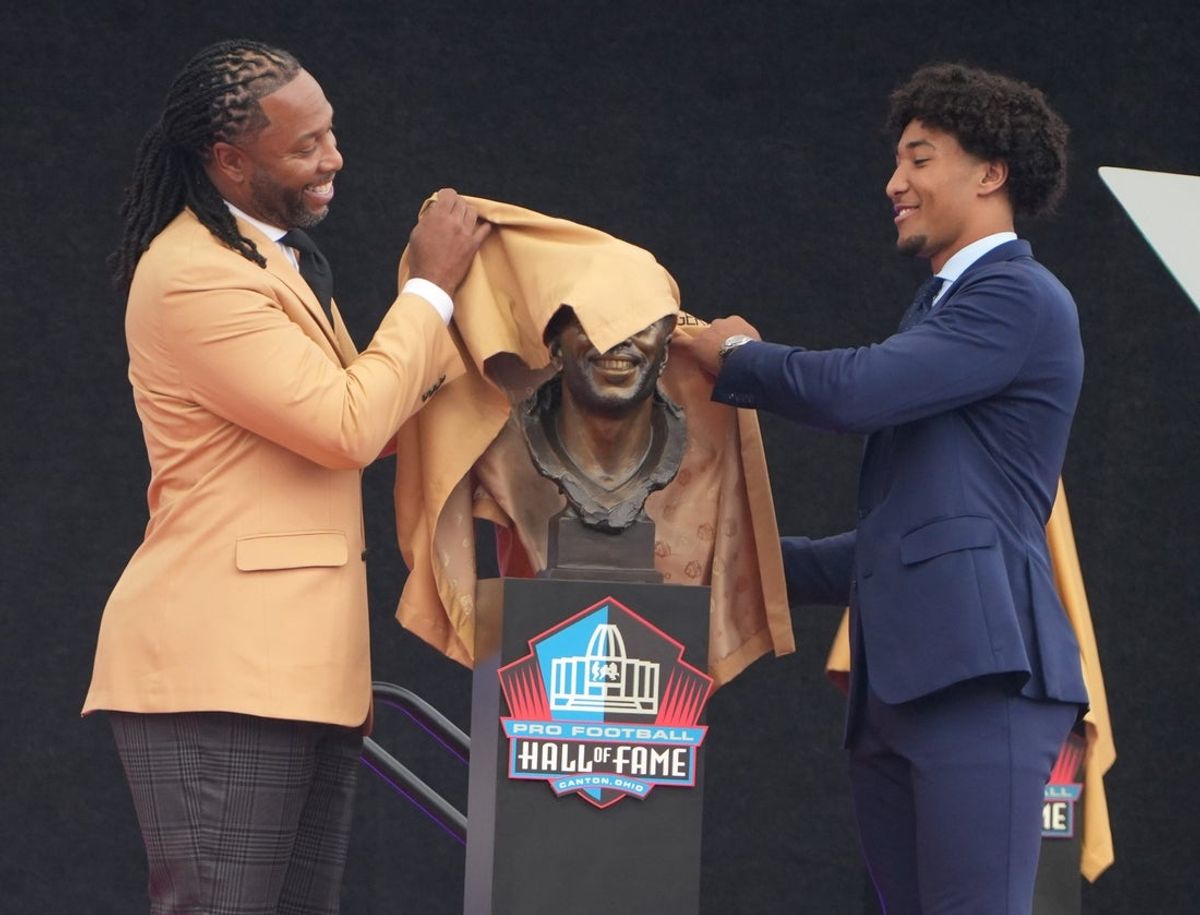
But this weekend of course, that’s exactly where Little Fitzy is headed. He will be enshrined into the Pro Football Hall of Fame in Canton, Ohio, on Saturday as a first-ballot Hall of Famer.

Fitzgerald will be remembered as one of the best and most productive wide receivers in league history after an incredible 17-season career with the Arizona Cardinals.

I have a ton of memories of being around Fitzgerald, but there’s one that stands out among them all.

One day after training camp, a nameless Vikings’ wide receiver camp body was getting extra work on a JUGS machine, catching balls. He was being tutored by Fitzgerald, who was showing this player how to properly approach the incoming ball. This was a child instructing a grown man an NFL team deemed good enough to attend training camp.

Larry Fitzgerald Jr. was special even back then.

In addition to his incredible natural football ability, Larry Fitzgerald Jr. stood out for his politeness and good nature. You could tell he was a good kid from the first time you met him.

There was no I’m-going-to-be-a-star attitude. He was genuine and he worked his tail off with the rest of the ball boys. There was no entitlement. It was as if he was using his time around an NFL camp as an internship for his future. He passed with flying colors.

I’ve always cherished following his career from his days at Pittsburgh in college to his days of dominating the NFL and I’ve enjoyed running into him over the years now and again.

Enjoy Canton, Little Fitzy, you’ve earned it.

#Larry #Fitzgeralds #Hall #Fame #induction #years #making">Larry Fitzgerald’s Hall of Fame induction is 25 years in the making  When I arrived to cover the Minnesota Vikings for the St. Paul Pioneer Press in 2000, it was clear I was dealing with a star-studded roster.The team boasted future Pro Football Hall of Famers; wide receivers Cris Carter and Randy Moss and defensive tackle John Randle. Plus, there were a ton of other stars including quarterback Daunte Culpepper, center Matt Birk and running back Robert Smith. The Vikings were loaded with star power.The talent around the team wasn’t relegated simply to the roster, however.That summer I first laid my eyes on a 16-year-old high school junior named Larry Fitzgerald Jr. The son of a local media member and close friend of Vikings’ head coach Dennis Green, Little Fitzy was a ball boy during training camp and on game days. It turns out, Larry Fitzgerald Jr. is very likely the most famous former NFL ball boy in history.On reporting date, fellow reporter Kevin Seifert pointed out Fitzgerald to me and said “that’s a bad man.” Seifert didn’t say that about any of the actual Vikings that day.Fitzgerald was already known as the best Minnesota high school prospect in years and he was considered one of the best high school players in the country. Seifert told me the buzz was that the kid was, no doubt, headed to the NFL in a half decade or so. Seifert was on the money. I’m not sure the Hall of Fame was mentioned or not.But this weekend of course, that’s exactly where Little Fitzy is headed. He will be enshrined into the Pro Football Hall of Fame in Canton, Ohio, on Saturday as a first-ballot Hall of Famer.Fitzgerald will be remembered as one of the best and most productive wide receivers in league history after an incredible 17-season career with the Arizona Cardinals.I have a ton of memories of being around Fitzgerald, but there’s one that stands out among them all.One day after training camp, a nameless Vikings’ wide receiver camp body was getting extra work on a JUGS machine, catching balls. He was being tutored by Fitzgerald, who was showing this player how to properly approach the incoming ball. This was a child instructing a grown man an NFL team deemed good enough to attend training camp.Larry Fitzgerald Jr. was special even back then.In addition to his incredible natural football ability, Larry Fitzgerald Jr. stood out for his politeness and good nature. You could tell he was a good kid from the first time you met him.There was no I’m-going-to-be-a-star attitude. He was genuine and he worked his tail off with the rest of the ball boys. There was no entitlement. It was as if he was using his time around an NFL camp as an internship for his future. He passed with flying colors.I’ve always cherished following his career from his days at Pittsburgh in college to his days of dominating the NFL and I’ve enjoyed running into him over the years now and again.Enjoy Canton, Little Fitzy, you’ve earned it.  #Larry #Fitzgeralds #Hall #Fame #induction #years #making

Follow Sportstar for extensive coverage of the tenth edition of the TNPL, from live scores and match reports to exclusive analysis and features.

TOSS

Tiruppur Tamizhans won the toss and chose to bowl first.

PLAYING XIs

Nellai Royal Kings: Athish SR(w), D Santhosh Kumar, Ajitesh Guruswamy, U Mukilesh, Rithik Easwaran, Sonu Yadav(c), Muhammed Adnan Khan, Ramalingam Rohit, Emmanuel Cherian, NS Harish, Rocky Bhasker

Tiruppur Tamizhans: Tushar Raheja(w), Amit Sathvik, Pradosh Ranjan Paul, Mohamed Ali, Uthirasamy Sasidev, Ravisrinivasan Sai Kishore(c), M Mathivannan, S Mohan Prasath, R Silambarasan, Esakkimuthu A, T Natarajan

Published on Aug 09, 2026

#TNPL #Live #Allround #batting #display #propels #Nellai #Royal #Kings">TNPL 2026 Live: All-round batting display propels Nellai Royal Kings to 206/8  Follow Sportstar for extensive coverage of the tenth edition of the TNPL, from live scores and match reports to exclusive analysis and features.TOSSTiruppur Tamizhans won the toss and chose to bowl first.PLAYING XIsNellai Royal Kings: Athish SR(w), D Santhosh Kumar, Ajitesh Guruswamy, U Mukilesh, Rithik Easwaran, Sonu Yadav(c), Muhammed Adnan Khan, Ramalingam Rohit, Emmanuel Cherian, NS Harish, Rocky BhaskerTiruppur Tamizhans: Tushar Raheja(w), Amit Sathvik, Pradosh Ranjan Paul, Mohamed Ali, Uthirasamy Sasidev, Ravisrinivasan Sai Kishore(c), M Mathivannan, S Mohan Prasath, R Silambarasan, Esakkimuthu A, T NatarajanPublished on Aug 09, 2026  #TNPL #Live #Allround #batting #display #propels #Nellai #Royal #Kings

Post Comment