×
Where to Find Job Security in Fashion

Where to Find Job Security in Fashion

The fashion job market is in a state of flux — and for those fortunate enough to be employed at all in 2026, workplace culture and dynamics are rapidly changing. After years of layoffs, restructuring and shifting consumer habits alongside economic volatility and the rise of AI, workers across the industry are navigating an uncertain landscape.

It’s against this backdrop that Fashionista surveyed more than 500 industry professionals across a range of fields, resulting in the 2026 Inside the Fashion Workplace Report.

Image: Fashionista

Beyond the current state of compensation, professional happiness and burnout rates in fashion jobs, the report also provides insights into the future of industry employment. For one, we learned that layoffs are becoming more common: 38%, or more than one-third, of survey takers said their company had layoffs in 2025 — a 6% increase from the year prior. Perhaps relatedly, a higher portion of respondents said they don’t feel confident in their job security going into 2026. There was also a small uptick in respondents who said they were actively looking for a new job: 56%, vs. 50% last year.

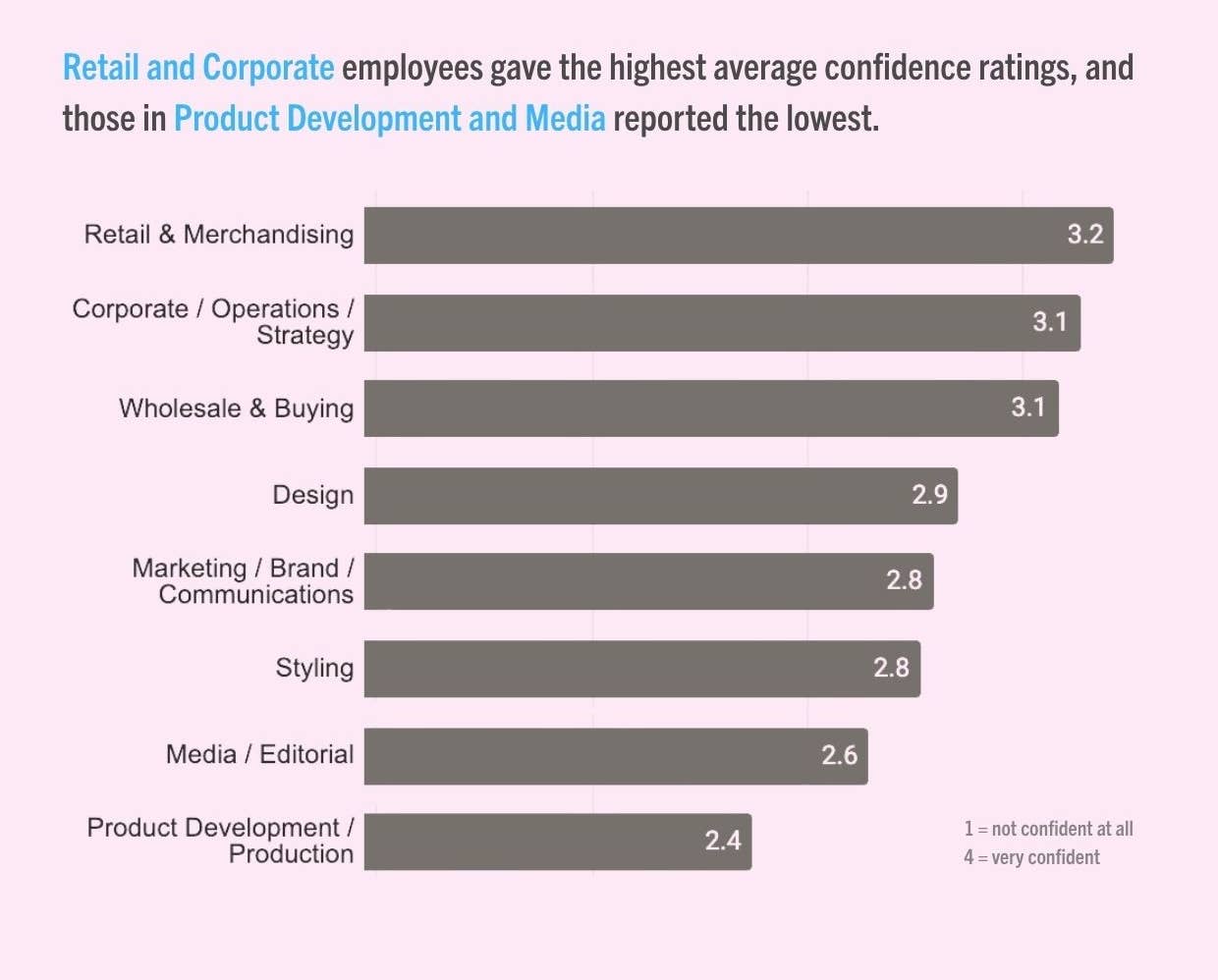
Of course, these metrics vary by sector: On average, those in retail, corporate and wholesale roles reported higher confidence in job security than those in product development, media and styling. Far more designers (55%) witnessed layoffs than sales professionals (33%).

Image: Fashionista
These results reflect macro conditions seen across the job market, beyond just fashion. Entry-level jobsare declining and, resultantly, unemployment among young college graduates is rising. Meanwhile, AI will undoubtedly continue have an impact on the job landscape by both reducing the need for some roles and creating demand for others.

In its State of Fashion 2026 report, McKinsey found that by 2030, across industries, 700,000 net new jobs will be created in the U.S. and 2 million in Europe. It also found that up to 40% of workers in developed countries will need to “reskill” or change roles by 2030 due to technology. Diving into specific fields, the report estimates that around 22% of marketing tasks can be automated by then, and that demand will rise for “product flow engineers, integrative marketing strategists and consumer experience designers” as well as expertise in “data quality, system integration, digital twins and marketing automation.”

Related: Which Fashion Jobs Pay the Most?

In the U.S., the Bureau of Labor Statistics also provides up-to-date statistics and projections for employment growth across sectors and positions. Between 2024 and 2034, total employment across all industries is expected to grow 3%. But among fashion retail businesses, it’s expected to decline 3%. Broken down further within this sector, it projects a 6% decline for PR specialists, a 10% decline for sales reps, a 2% decline for buyers and a 2% increase for retail salespeople. Those numbers are modest compared to employment in the apparel manufacturing industry, which overall is projected to decline a whopping 30% in the same period. Within that: -24% for fashion designers and -27% for patternmakers.

Much of this aligns with the results of our survey, where job security confidence was highest in retail and lowest in product development and production. For more, download the full report below.

Download Fashionista’s Inside the Fashion Workplace Report

View the original article to see embedded media.

Source link
#Find #Job #Security #Fashion

Previous post

ShipBob Wants AI to Run Retail Fulfillment

Next post

Ford’s new electric truck, ‘Fathom’, starts at $28,350 | TechCrunch<div> <p id="speakable-summary" class="wp-block-paragraph">Ford’s next-generation electric truck will be called Fathom, and it will start at $28,350 when it goes on sale in 2027, the company said on Thursday.</p> <p class="wp-block-paragraph">A “destination and delivery” fee will bring that price up to $29,945, putting the Fathom <em>just</em> below the $30,000 mark that Ford has targeted since it first started <a href="https://techcrunch.com/2025/08/11/ford-throws-out-henry-fords-assembly-line-to-make-low-cost-evs-in-america/" target="_blank" rel="noreferrer noopener">talking more openly</a> about the project in 2025.</p> <p class="wp-block-paragraph">The truck, when it arrives next year, represents a major bet for Ford. It’s the automaker’s second all-electric truck after the F-150 Lightning (third, if you count the limited-run Ranger EV from the late 1990s). But like many of its peers, the company has dramatically pulled back on its once-ambitious plans to build electric vehicles.</p> <p class="wp-block-paragraph">The Fathom is the first vehicle Ford is building on its new “Universal EV Platform,” or UEV, which will power a number of different EVs and involves <a href="https://techcrunch.com/2025/08/11/ford-throws-out-henry-fords-assembly-line-to-make-low-cost-evs-in-america/" target="_blank" rel="noreferrer noopener">a brand-new assembly line process</a> meant to cut costs. It’s an attempt by CEO Jim Farley to try and catch up to category leader Tesla, as well as the many Chinese EVs that he’s argued against allowing into the U.S. market — all while building the truck in Louisville, Kentucky.</p> <p class="wp-block-paragraph">Deliveries begin in “fall 2027,” and Ford said on Thursday that it won’t reveal the truck until “early 2027,” which is when it will start taking pre-orders.</p> <p class="wp-block-paragraph">We do have some details, though. Ford has already said the Fathom will <a href="https://techcrunch.com/2026/07/23/ford-bets-on-apple-for-its-next-generation-of-evs/" target="_blank" rel="noreferrer noopener">have Apple Maps</a> built into its operating system, and on Thursday, the company said the truck will support Android Auto and Apple CarPlay. Notably, it will <em>not </em>support Apple’s next-generation CarPlay Ultra. </p> <p class="wp-block-paragraph">The Fathom will have five seats, which is more interior space than a Toyota Rav4; a “large, high-resolution touch screen,” and a “digital car key.” It will be capable of bidirectional power, much like the Lightning and the hybrid F-150.</p> <p class="wp-block-paragraph">Every Fathom will also be “BlueCruise-capable,” meaning it will come with the tech integrated, but buyers will likely have to pay extra to enable Ford’s hands-free advanced driver assistance system. The truck is supposed to have a newer, more powerful version of BlueCruise that Ford says will eventually be capable of handling supervised driving from starting point to destination. Eyes-off driving is expected in 2028.</p> <p class="wp-block-paragraph">The Fathom’s starting price also only includes the “standard range” lithium iron phosphate battery pack. Ford hasn’t yet said how many miles the truck can drive on a single charge.</p> <p class="wp-block-paragraph">Ford said the name represents “a deep understanding of the person who would drive” the truck, and how their “motivations look a little different from the traditional truck customer’s.”</p> <p class="wp-block-paragraph">“[T]he name had to do more than sound good. It had to capture a mindset, shifting the focus from specs to a spirit of adaptability,” the company wrote.</p> <p class="wp-block-paragraph">Electric trucks have not done terribly well in the U.S.. The Lightning only moved a little more than 10,000 units in its <a href="https://techcrunch.com/2025/07/16/gmc-hummer-ev-outsold-the-tesla-cybertruck-last-quarter/" target="_blank" rel="noreferrer noopener">best quarter</a>, and though Tesla’s Cybertruck had a higher peak, it has since crashed out. </p> <p class="wp-block-paragraph">Ford is gambling by choosing the truck form factor for its first UEV platform vehicle. But there are some inherent upsides: The Fathom and other vehicles built on the platform will be the first that Ford has designed from the ground up to use electric powertrains. That should mean fewer tradeoffs on range, efficiency, and overall packaging of the vehicle.</p> <p class="wp-block-paragraph">Both the Fathom and UEV have been in the works for a few years. It started as a skunkworks project that Farley tasked former Tesla exec Alan Clarke with leading, as TechCrunch <a href="https://techcrunch.com/2024/02/06/ex-tesla-exec-leading-ford-skunkworks-project-to-develop-low-cost-ev/" target="_blank" rel="noreferrer noopener">first reported in 2024</a>. The team is <a href="https://techcrunch.com/2024/06/12/fords-secretive-low-cost-ev-team-is-growing-with-talent-from-rivian-tesla-and-apple/" target="_blank" rel="noreferrer noopener">flush with talent</a> from Rivian, Tesla and Apple’s now-defunct car project, and has purportedly been working in isolation in Los Angeles, <a href="https://techcrunch.com/2026/02/17/ford-turns-to-f1-and-bounties-to-build-a-30000-electric-truck/" target="_blank" rel="noreferrer noopener">separated from the bureaucracy</a> of the rest of the company.</p> <p class="wp-block-paragraph">All of this likely contributed to getting the Fathom’s starting price to just under $30,000, a major accomplishment in a market where the average new car costs $50,000. The truck won’t have a lot of competition in that range — it’s essentially going up against just the spartan, Jeff Bezos-backed Slate pickup, and a few non-truck EVs like the Chevy Bolt.</p> <p class="wp-block-paragraph">Ford has found a ton of success with its small, low-cost Maverick pickup, which comes in both internal combustion and hybrid powertrain variants. The Fathom is an attempt to bottle that lightning, without going the way of the Lightning.</p> </div><p><em>When you purchase through links in our articles, <a href="https://techcrunch.com/techcrunch-affiliate-monetization-standards/">we may earn a small commission</a>. This doesn’t affect our editorial independence.</em></p>#Fords #electric #truck #Fathom #starts #TechCrunchelectric trucks,EVs,Ford

Post Comment