
Tyler
When John Carpenter set out to make his 1988 cult classic They Live, did he intend to create one of the most scathing critiques of class disparity and consumerism ever put on screen? Or was he simply making a killer sci-fi action movie starring wrestling legend Roddy Piper? His answer might surprise you.
From its origins in a science fiction short story to one of the greatest fight scenes in movie history, They Live has endured for decades as both an endlessly entertaining cult movie and an eerily relevant social satire.
Here’s what happened to They Live.
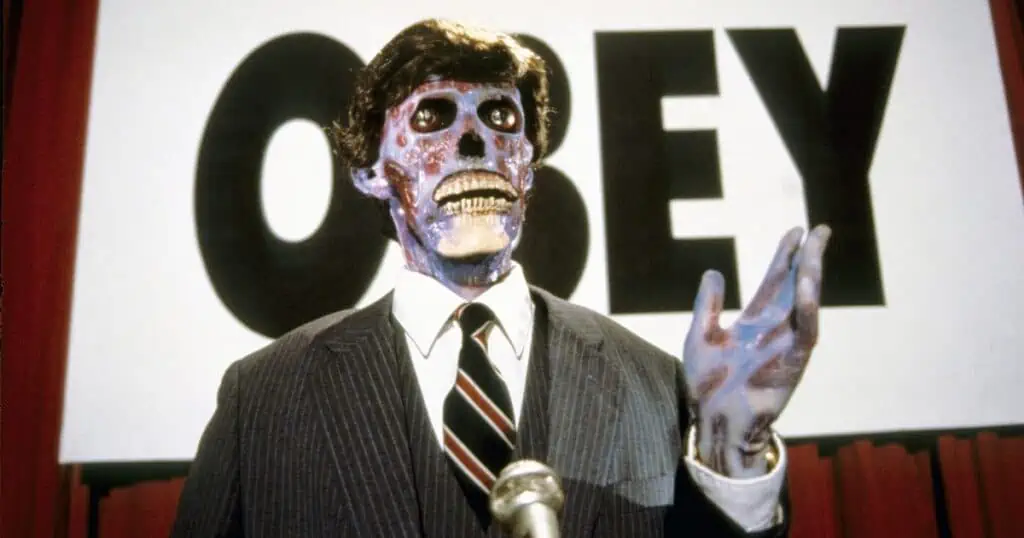
The roots of They Live go back to 1985, when Carpenter picked up a comic book called Alien Encounters from Eclipse Comics. Inside was a story called Nada by author Ray Nelson, adapted from his own short story Eight O’Clock in the Morning alongside artist Bill Wray. The story followed an ordinary man who attends a stage hypnotism show and suddenly “wakes up” to the horrifying truth: aliens have humanity trapped in a trance through subliminal messaging and media manipulation.
Messages like:
- Obey
- Consume
- Work
- Marry and reproduce
…were hidden all around society.
The protagonist, named Nada, literally meaning “nothing,” eventually storms a television station to expose the truth before dying exactly as his captors promised he would.
Even without the sunglasses, shotgun, or Roddy Piper, the DNA of They Live is unmistakable. Carpenter expanded those ideas by incorporating themes tied to the Reagan era, corporate greed, class disparity, and the loss of working-class values he felt America was abandoning during the 1980s.
The turning point for the movie came from an unexpected place: WrestleMania III. Carpenter, a longtime wrestling fan, attended the event and met Roddy Piper for the first time. Originally, Carpenter had envisioned actors like Kurt Russell or Jeff Bridges for the lead role. But Piper immediately stood out.
Carpenter later explained that Piper had the same quality those actors shared: he looked like someone who had actually lived a hard life. As Carpenter famously put it: “He has a rough face with scars from his fights, but it’s a kind face.”
That combination of toughness and humanity became the core of John Nada, the drifter hero at the center of They Live.
The timing could not have been better for Piper himself. At the time, the wrestling icon was frustrated with the direction of his career and with the world of professional wrestling under Vince McMahon. When Carpenter offered him the role, Piper decided to step away from wrestling and focus on acting.
Years later, Piper admitted the film ultimately made him even more popular than before. More importantly, They Live arrived during a dark period in his personal life. After years of nonstop wrestling, Piper was struggling physically and emotionally, and he credited the film and his relationship with Carpenter with helping him through that period.
The two formed a close creative partnership during production. Piper often praised Carpenter for helping him access emotional moments as an actor, particularly during scenes where Nada’s vulnerability needed to shine through the action-hero persona.
Some of the most memorable moments in They Live weren’t even scripted. Piper contributed heavily to the character of Nada, even keeping a notebook filled with potential dialogue and backstory ideas. That included one of the most iconic lines in movie history: “I have come here to chew bubblegum and kick ass… and I’m all out of bubblegum.”
The line has since appeared everywhere from Duke Nukem references to pop culture homages in films like Dazed and Confused.
Piper also improvised many of Nada’s best one-liners throughout the film, helping shape the character into one of the most memorable blue-collar heroes in sci-fi history.
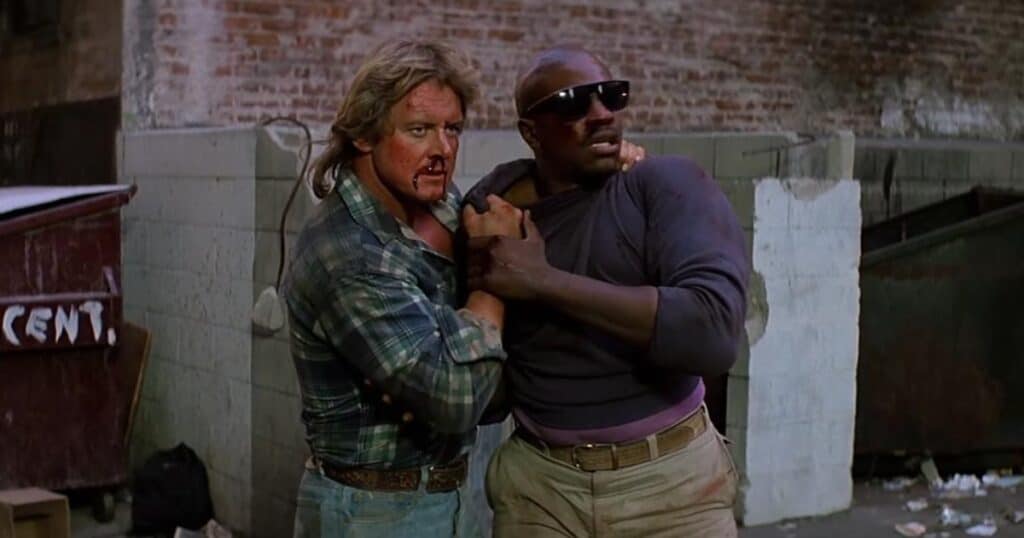
Alongside Piper was Keith David, fresh off another Carpenter classic, The Thing. David played Frank, the skeptical construction worker who becomes Nada’s reluctant ally. The chemistry between Piper and David became one of the film’s greatest strengths. Their relationship felt authentic because it wasn’t built around traditional Hollywood heroics. They were just two exhausted working-class guys trying to survive. That grounded energy gave They Live much of its emotional core.
The cast also featured:
- Meg Foster
- Peter Jason
- George Buck Flower
- Raymond St. Jacques
All staples of Carpenter’s gritty cinematic world.
No discussion of They Live is complete without the alley fight between Piper and Keith David. Originally written as a brief 20-second confrontation, the scene evolved into a brutal five-minute brawl that became one of the most beloved fistfights in cinema history.
The sequence was choreographed almost entirely by Piper and David themselves. Carpenter only requested a few wrestling-inspired moves to give the fight its own identity.
The two actors reportedly spent two months rehearsing the scene together in Piper’s backyard. When filming finally began, production spent four days shooting the fight using a Panaglide camera system. At times, Piper and David were genuinely hitting each other.
The result feels messy, painful, hilarious, and strangely realistic, with two stubborn men beating the hell out of each other over a pair of sunglasses. It remains one of the defining scenes of 1980s action cinema.
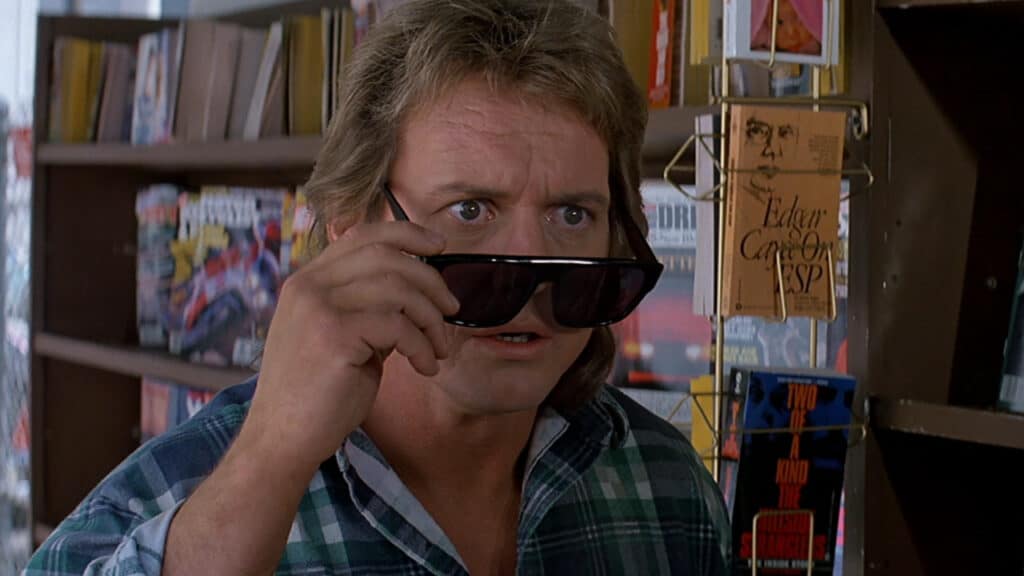
The sunglasses are arguably the defining visual gimmick of They Live. Once Nada puts them on, the hidden reality of the world is exposed in stark black and white imagery, revealing both the alien invaders and the subliminal commands hidden in advertising.
Interestingly, Piper had to imagine most of what he was seeing during filming. The alien sequences were shot separately due to the dramatic differences in cinematography and lighting. According to Piper, he drew inspiration from monsters he imagined as a child when reacting to the creatures on set.
As for the aliens themselves, Carpenter gave an incredibly simple explanation for their iconic appearance: His girlfriend at the time designed them. That was apparently enough for him.
They Live was filmed entirely in Los Angeles during an approximately eight-week shoot in 1988. In fact, the film’s French title was Invasion Los Angeles.
Carpenter intentionally used the city to emphasize the divide between the wealthy elite and the struggling working class. The locations gave the movie a gritty authenticity that perfectly matched its themes. According to Carpenter and the cast commentary, production even had to pay local gangs in certain neighborhoods to safely film there. Piper also claimed Carpenter hired homeless individuals from the surrounding areas as extras during production.
The result is a version of Los Angeles that feels raw, dangerous, and lived-in; a city where the film’s social commentary becomes inseparable from its setting.
Despite the film’s aggressive themes, Carpenter has repeatedly pushed back against the idea that They Live was meant to be an ultra-serious political statement. While he absolutely criticized greed and consumer culture, Carpenter has openly admitted he’s also a capitalist who made plenty of money working in Hollywood.
His real message was simpler: The world could use a little more humanity.
That balance between satire, cynicism, humor, and action is a major reason They Live continues to resonate decades later. Carpenter himself has even joked that the movie feels more like a documentary now than science fiction.
Originally planned for a Halloween-season release, They Live was delayed to avoid competing with another Carpenter-related release: Halloween 4: The Return of Michael Myers. The film finally arrived in theaters on November 4, 1988.
Made on a modest budget of roughly $4 million, They Live opened at number one at the domestic box office and ultimately grossed more than three times its production cost. Its 1989 VHS release further expanded its audience during the rise of the home video market.
Critically, reactions were mixed but passionate. Some critics dismissed the film’s social commentary and rough-edged filmmaking. Others immediately recognized its unique blend of satire, horror, science fiction, and action.
But fans didn’t fall in love with They Live because it was polished. They loved it because it was cool. And few things in movie history are cooler than Roddy Piper wearing sunglasses, carrying a shotgun, and delivering iconic lines.
Over the years, Carpenter has occasionally discussed the possibility of revisiting They Live. In the 1990s, he revealed he had ideas for a sequel but could never secure financing. A remake was also floated in 2010, with Matt Reeves attached to direct and write while Carpenter served as producer. However, Reeves reportedly wanted to stay closer to Ray Nelson’s original short story Eight O’Clock in the Morning, and the project eventually fell apart.
No sequel or remake has materialized since. Given how strongly the original film still resonates today, many fans believe it’s probably best left alone.
Nearly four decades later, They Live remains one of John Carpenter’s most beloved films. It works simultaneously as:
- A sci-fi conspiracy thriller
- A working-class action movie
- A satire of consumer culture
- A showcase for Roddy Piper’s charisma
- A celebration of anti-authority rebellion
Most importantly, it still feels relevant.
Whether you view it as a political statement, a cult action movie, or simply an excuse to watch Roddy Piper fight aliens in sunglasses, They Live continues to connect with audiences because it never loses sight of its humanity beneath all the chaos. And, of course, because it’s incredibly badass.
A couple of the previous episodes of the show can be seen below. To see more, head over to our JoBlo Horror Originals YouTube channel – and subscribe while you’re there!

Subscribe to our weekly newsletter
Source:
Arrow in the Head
Arrow in the Head
Source link
#Live #Hits #Hard #Today #Story #John #Carpenters #Cult #Classic


Post Comment