×
World Cup 2026: Team conduct score explained, standings  Group play is winding down at the 2026 FIFA World Cup, and teams have already booked spots in the Round of 32. Mexico was the first team to clinch a group win, followed by the United States.But with 30 other teams vying for spots in the knockout round, there are a lot of scenarios unfolding at the World Cup.And some involve the “team conduct score.”As the group stage draws to a close, today we are diving into the team conduct score: What it is, how it is calculated, what the current team conduct score standings are, and why those standings might matter at the World Cup.What is the team conduct score?The team conduct score is a calculation of the infractions a team has earned in a given tournament, in this case the World Cup. Specifically, it is a tally of the yellow and red cards each team has been given, for both players and team officials.How is the team conduct score calculated?Here is how the team conduct score is calculated.Yellow cards: -1 pointIndirect red card (resulting from a second yellow card): -3 pointsStraight red card: -4 pointsYellow card plus straight card: -5 pointsAs each team accumulates cards, the running total changes.Why might the team conduct score matter?Why might a team’s team conduct score matter at the World Cup?Because it can be used to break ties at the end of group play, to see how teams finish in a given group and/or advance to the knockout stage.To break ties within a group at the end of the group stage, a three-step process will be followed to determine tiebreakers.In the first step, the greatest number of points in the group matches between the tied teams will be applied. Then, the superior goal difference from the group matches between the tied teams will be applied, and finally, the greatest number of goals scored in all group matches between the tied teams will be applied.If that cannot determine a tiebreaker, then the teams that are still equal will advance to step two. In this stage, the first step is the goal difference in all group matches, then the greatest number of goals in all group matches, and finally the highest team conduct score (relating to yellow and red cards) will be applied.So while the team conduct score is one of the final tiebreakers, it could come into play here soon at the 2026 FIFA World Cup.If the team conduct score does not break the tie, then the teams still equal on points will be ranked according to the most recent FIFA World Rankings.Then there are the teams looking to advance to the knockout round as a third-place team in a group. With the field expanding to 48 teams, the top two teams in each group advance to the Round of 32, and then the eight best third-place teams fill out the final eight spots.When it comes to those standings, here is how FIFA will stack the third-place teams for potential tiebreakers:First, the greatest number of points in all group matchesSecond, the goal difference from all group matchesThird, the number of goals scored in all group matchesFourth, a team’s conduct score.If there are still ties after those four steps are applied, the teams still equal on points will be ranked according to the most recent FIFA World Rankings.What are the current team conduct scores at the World Cup?Here is the current team conduct score for each team at the FIFA World Cup.Note: This table was last updated following Egypt-New Zealand on Sunday, June 21TeamTeam Conduct ScoreGermany0Japan0Uruguay0Norway0France0Senegal0Argentina0Jordan0Algeria0England0Croatia0Czechia-1Morocco-1Tunisia-1Spain-1Iraq-1Austria-1Colombia-1DR Congo-1Uzbekistan-1Ghana-1Iran-2New Zealand-2Switzerland-2Ecuador-2Panama-2Saudi Arabia-3Cabo Verde-3South Korea-3Sweden-3Canada-3Brazil-3Türkiye-3Egypt-3Ivory Coast-3Netherlands-3Portugal-3Scotland-4Haiti-4United States-4Australia-4Curaçao-5Mexico-5Belgium-7Bosnia and Herzegovina-9Qatar-11Paraguay-11South Africa-12  #World #Cup #Team #conduct #score #explained #standings

World Cup 2026: Team conduct score explained, standings

Group play is winding down at the 2026 FIFA World Cup, and teams have already booked spots in the Round of 32. Mexico was the first team to clinch a group win, followed by the United States.

But with 30 other teams vying for spots in the knockout round, there are a lot of scenarios unfolding at the World Cup.

And some involve the “team conduct score.”

As the group stage draws to a close, today we are diving into the team conduct score: What it is, how it is calculated, what the current team conduct score standings are, and why those standings might matter at the World Cup.

What is the team conduct score?

The team conduct score is a calculation of the infractions a team has earned in a given tournament, in this case the World Cup. Specifically, it is a tally of the yellow and red cards each team has been given, for both players and team officials.

How is the team conduct score calculated?

Here is how the team conduct score is calculated.

  • Yellow cards: -1 point
  • Indirect red card (resulting from a second yellow card): -3 points
  • Straight red card: -4 points
  • Yellow card plus straight card: -5 points

As each team accumulates cards, the running total changes.

Why might the team conduct score matter?

Why might a team’s team conduct score matter at the World Cup?

Because it can be used to break ties at the end of group play, to see how teams finish in a given group and/or advance to the knockout stage.

To break ties within a group at the end of the group stage, a three-step process will be followed to determine tiebreakers.

In the first step, the greatest number of points in the group matches between the tied teams will be applied. Then, the superior goal difference from the group matches between the tied teams will be applied, and finally, the greatest number of goals scored in all group matches between the tied teams will be applied.

If that cannot determine a tiebreaker, then the teams that are still equal will advance to step two. In this stage, the first step is the goal difference in all group matches, then the greatest number of goals in all group matches, and finally the highest team conduct score (relating to yellow and red cards) will be applied.

So while the team conduct score is one of the final tiebreakers, it could come into play here soon at the 2026 FIFA World Cup.

If the team conduct score does not break the tie, then the teams still equal on points will be ranked according to the most recent FIFA World Rankings.

Then there are the teams looking to advance to the knockout round as a third-place team in a group. With the field expanding to 48 teams, the top two teams in each group advance to the Round of 32, and then the eight best third-place teams fill out the final eight spots.

When it comes to those standings, here is how FIFA will stack the third-place teams for potential tiebreakers:

  • First, the greatest number of points in all group matches
  • Second, the goal difference from all group matches
  • Third, the number of goals scored in all group matches
  • Fourth, a team’s conduct score.

If there are still ties after those four steps are applied, the teams still equal on points will be ranked according to the most recent FIFA World Rankings.

What are the current team conduct scores at the World Cup?

Here is the current team conduct score for each team at the FIFA World Cup.

Note: This table was last updated following Egypt-New Zealand on Sunday, June 21

Team

Team Conduct Score

Germany0
Japan0
Uruguay0
Norway0
France0
Senegal0
Argentina0
Jordan0
Algeria0
England0
Croatia0
Czechia-1
Morocco-1
Tunisia-1
Spain-1
Iraq-1
Austria-1
Colombia-1
DR Congo-1
Uzbekistan-1
Ghana-1
Iran-2
New Zealand-2
Switzerland-2
Ecuador-2
Panama-2
Saudi Arabia-3
Cabo Verde-3
South Korea-3
Sweden-3
Canada-3
Brazil-3
Türkiye-3
Egypt-3
Ivory Coast-3
Netherlands-3
Portugal-3
Scotland-4
Haiti-4
United States-4
Australia-4
Curaçao-5
Mexico-5
Belgium-7
Bosnia and Herzegovina-9
Qatar-11
Paraguay-11
South Africa-12
#World #Cup #Team #conduct #score #explained #standings

Group play is winding down at the 2026 FIFA World Cup, and teams have already booked spots in the Round of 32. Mexico was the first team to clinch a group win, followed by the United States.

But with 30 other teams vying for spots in the knockout round, there are a lot of scenarios unfolding at the World Cup.

And some involve the “team conduct score.”

As the group stage draws to a close, today we are diving into the team conduct score: What it is, how it is calculated, what the current team conduct score standings are, and why those standings might matter at the World Cup.

What is the team conduct score?

The team conduct score is a calculation of the infractions a team has earned in a given tournament, in this case the World Cup. Specifically, it is a tally of the yellow and red cards each team has been given, for both players and team officials.

How is the team conduct score calculated?

Here is how the team conduct score is calculated.

  • Yellow cards: -1 point
  • Indirect red card (resulting from a second yellow card): -3 points
  • Straight red card: -4 points
  • Yellow card plus straight card: -5 points

As each team accumulates cards, the running total changes.

Why might the team conduct score matter?

Why might a team’s team conduct score matter at the World Cup?

Because it can be used to break ties at the end of group play, to see how teams finish in a given group and/or advance to the knockout stage.

To break ties within a group at the end of the group stage, a three-step process will be followed to determine tiebreakers.

In the first step, the greatest number of points in the group matches between the tied teams will be applied. Then, the superior goal difference from the group matches between the tied teams will be applied, and finally, the greatest number of goals scored in all group matches between the tied teams will be applied.

If that cannot determine a tiebreaker, then the teams that are still equal will advance to step two. In this stage, the first step is the goal difference in all group matches, then the greatest number of goals in all group matches, and finally the highest team conduct score (relating to yellow and red cards) will be applied.

So while the team conduct score is one of the final tiebreakers, it could come into play here soon at the 2026 FIFA World Cup.

If the team conduct score does not break the tie, then the teams still equal on points will be ranked according to the most recent FIFA World Rankings.

Then there are the teams looking to advance to the knockout round as a third-place team in a group. With the field expanding to 48 teams, the top two teams in each group advance to the Round of 32, and then the eight best third-place teams fill out the final eight spots.

When it comes to those standings, here is how FIFA will stack the third-place teams for potential tiebreakers:

  • First, the greatest number of points in all group matches
  • Second, the goal difference from all group matches
  • Third, the number of goals scored in all group matches
  • Fourth, a team’s conduct score.

If there are still ties after those four steps are applied, the teams still equal on points will be ranked according to the most recent FIFA World Rankings.

What are the current team conduct scores at the World Cup?

Here is the current team conduct score for each team at the FIFA World Cup.

Note: This table was last updated following Egypt-New Zealand on Sunday, June 21

Team

Team Conduct Score

Germany 0
Japan 0
Uruguay 0
Norway 0
France 0
Senegal 0
Argentina 0
Jordan 0
Algeria 0
England 0
Croatia 0
Czechia -1
Morocco -1
Tunisia -1
Spain -1
Iraq -1
Austria -1
Colombia -1
DR Congo -1
Uzbekistan -1
Ghana -1
Iran -2
New Zealand -2
Switzerland -2
Ecuador -2
Panama -2
Saudi Arabia -3
Cabo Verde -3
South Korea -3
Sweden -3
Canada -3
Brazil -3
Türkiye -3
Egypt -3
Ivory Coast -3
Netherlands -3
Portugal -3
Scotland -4
Haiti -4
United States -4
Australia -4
Curaçao -5
Mexico -5
Belgium -7
Bosnia and Herzegovina -9
Qatar -11
Paraguay -11
South Africa -12

Source link
#World #Cup #Team #conduct #score #explained #standings

When I arrived to cover the Minnesota Vikings for the St. Paul Pioneer Press in 2000, it was clear I was dealing with a star-studded roster.

The team boasted future Pro Football Hall of Famers; wide receivers Cris Carter and Randy Moss and defensive tackle John Randle. Plus, there were a ton of other stars including quarterback Daunte Culpepper, center Matt Birk and running back Robert Smith. The Vikings were loaded with star power.

The talent around the team wasn’t relegated simply to the roster, however.

That summer I first laid my eyes on a 16-year-old high school junior named Larry Fitzgerald Jr. The son of a local media member and close friend of Vikings’ head coach Dennis Green, Little Fitzy was a ball boy during training camp and on game days. It turns out, Larry Fitzgerald Jr. is very likely the most famous former NFL ball boy in history.

On reporting date, fellow reporter Kevin Seifert pointed out Fitzgerald to me and said “that’s a bad man.” Seifert didn’t say that about any of the actual Vikings that day.

Fitzgerald was already known as the best Minnesota high school prospect in years and he was considered one of the best high school players in the country. Seifert told me the buzz was that the kid was, no doubt, headed to the NFL in a half decade or so. Seifert was on the money. I’m not sure the Hall of Fame was mentioned or not.

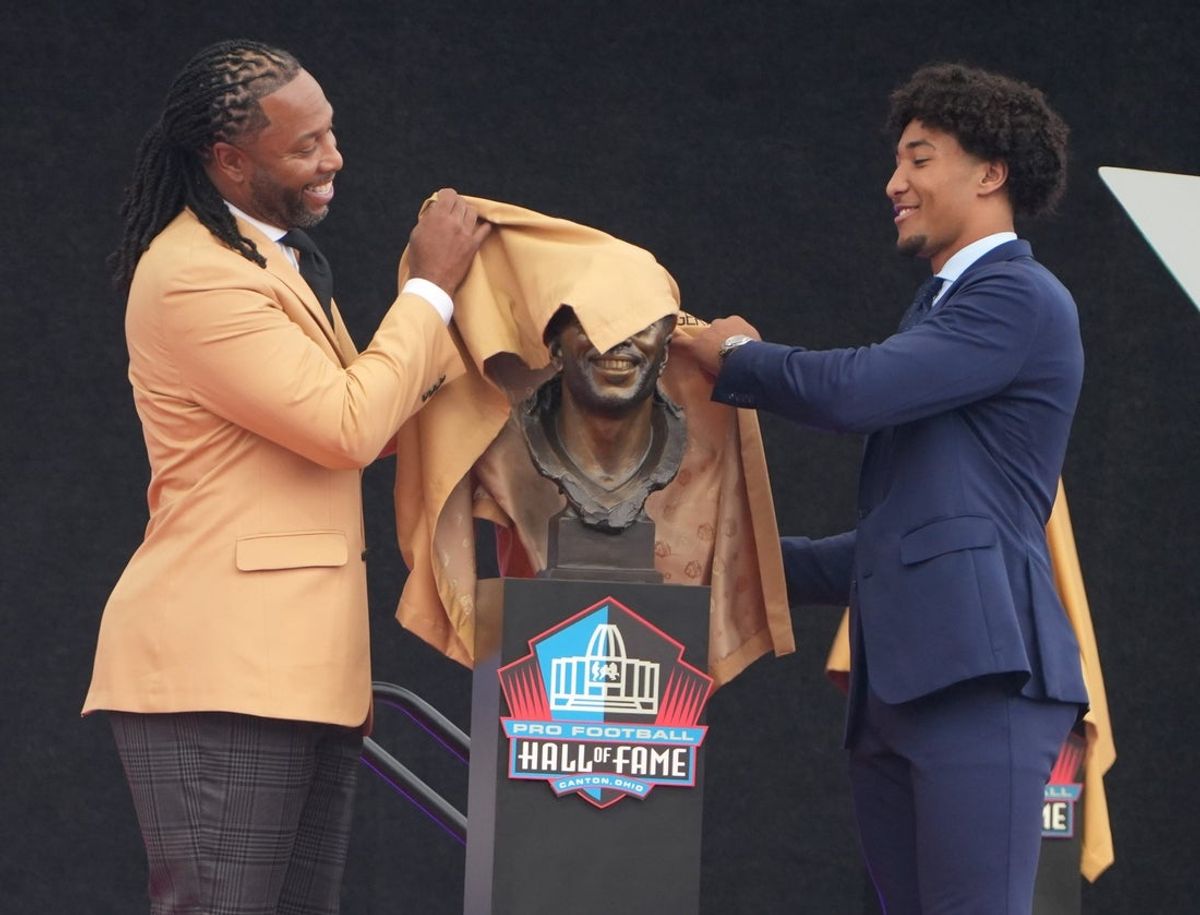
But this weekend of course, that’s exactly where Little Fitzy is headed. He will be enshrined into the Pro Football Hall of Fame in Canton, Ohio, on Saturday as a first-ballot Hall of Famer.

Fitzgerald will be remembered as one of the best and most productive wide receivers in league history after an incredible 17-season career with the Arizona Cardinals.

I have a ton of memories of being around Fitzgerald, but there’s one that stands out among them all.

One day after training camp, a nameless Vikings’ wide receiver camp body was getting extra work on a JUGS machine, catching balls. He was being tutored by Fitzgerald, who was showing this player how to properly approach the incoming ball. This was a child instructing a grown man an NFL team deemed good enough to attend training camp.

Larry Fitzgerald Jr. was special even back then.

In addition to his incredible natural football ability, Larry Fitzgerald Jr. stood out for his politeness and good nature. You could tell he was a good kid from the first time you met him.

There was no I’m-going-to-be-a-star attitude. He was genuine and he worked his tail off with the rest of the ball boys. There was no entitlement. It was as if he was using his time around an NFL camp as an internship for his future. He passed with flying colors.

I’ve always cherished following his career from his days at Pittsburgh in college to his days of dominating the NFL and I’ve enjoyed running into him over the years now and again.

Enjoy Canton, Little Fitzy, you’ve earned it.

#Larry #Fitzgeralds #Hall #Fame #induction #years #making">Larry Fitzgerald’s Hall of Fame induction is 25 years in the making  When I arrived to cover the Minnesota Vikings for the St. Paul Pioneer Press in 2000, it was clear I was dealing with a star-studded roster.The team boasted future Pro Football Hall of Famers; wide receivers Cris Carter and Randy Moss and defensive tackle John Randle. Plus, there were a ton of other stars including quarterback Daunte Culpepper, center Matt Birk and running back Robert Smith. The Vikings were loaded with star power.The talent around the team wasn’t relegated simply to the roster, however.That summer I first laid my eyes on a 16-year-old high school junior named Larry Fitzgerald Jr. The son of a local media member and close friend of Vikings’ head coach Dennis Green, Little Fitzy was a ball boy during training camp and on game days. It turns out, Larry Fitzgerald Jr. is very likely the most famous former NFL ball boy in history.On reporting date, fellow reporter Kevin Seifert pointed out Fitzgerald to me and said “that’s a bad man.” Seifert didn’t say that about any of the actual Vikings that day.Fitzgerald was already known as the best Minnesota high school prospect in years and he was considered one of the best high school players in the country. Seifert told me the buzz was that the kid was, no doubt, headed to the NFL in a half decade or so. Seifert was on the money. I’m not sure the Hall of Fame was mentioned or not.But this weekend of course, that’s exactly where Little Fitzy is headed. He will be enshrined into the Pro Football Hall of Fame in Canton, Ohio, on Saturday as a first-ballot Hall of Famer.Fitzgerald will be remembered as one of the best and most productive wide receivers in league history after an incredible 17-season career with the Arizona Cardinals.I have a ton of memories of being around Fitzgerald, but there’s one that stands out among them all.One day after training camp, a nameless Vikings’ wide receiver camp body was getting extra work on a JUGS machine, catching balls. He was being tutored by Fitzgerald, who was showing this player how to properly approach the incoming ball. This was a child instructing a grown man an NFL team deemed good enough to attend training camp.Larry Fitzgerald Jr. was special even back then.In addition to his incredible natural football ability, Larry Fitzgerald Jr. stood out for his politeness and good nature. You could tell he was a good kid from the first time you met him.There was no I’m-going-to-be-a-star attitude. He was genuine and he worked his tail off with the rest of the ball boys. There was no entitlement. It was as if he was using his time around an NFL camp as an internship for his future. He passed with flying colors.I’ve always cherished following his career from his days at Pittsburgh in college to his days of dominating the NFL and I’ve enjoyed running into him over the years now and again.Enjoy Canton, Little Fitzy, you’ve earned it.  #Larry #Fitzgeralds #Hall #Fame #induction #years #making

Follow Sportstar for extensive coverage of the tenth edition of the TNPL, from live scores and match reports to exclusive analysis and features.

TOSS

Tiruppur Tamizhans won the toss and chose to bowl first.

PLAYING XIs

Nellai Royal Kings: Athish SR(w), D Santhosh Kumar, Ajitesh Guruswamy, U Mukilesh, Rithik Easwaran, Sonu Yadav(c), Muhammed Adnan Khan, Ramalingam Rohit, Emmanuel Cherian, NS Harish, Rocky Bhasker

Tiruppur Tamizhans: Tushar Raheja(w), Amit Sathvik, Pradosh Ranjan Paul, Mohamed Ali, Uthirasamy Sasidev, Ravisrinivasan Sai Kishore(c), M Mathivannan, S Mohan Prasath, R Silambarasan, Esakkimuthu A, T Natarajan

Published on Aug 09, 2026

#TNPL #Live #Allround #batting #display #propels #Nellai #Royal #Kings">TNPL 2026 Live: All-round batting display propels Nellai Royal Kings to 206/8  Follow Sportstar for extensive coverage of the tenth edition of the TNPL, from live scores and match reports to exclusive analysis and features.TOSSTiruppur Tamizhans won the toss and chose to bowl first.PLAYING XIsNellai Royal Kings: Athish SR(w), D Santhosh Kumar, Ajitesh Guruswamy, U Mukilesh, Rithik Easwaran, Sonu Yadav(c), Muhammed Adnan Khan, Ramalingam Rohit, Emmanuel Cherian, NS Harish, Rocky BhaskerTiruppur Tamizhans: Tushar Raheja(w), Amit Sathvik, Pradosh Ranjan Paul, Mohamed Ali, Uthirasamy Sasidev, Ravisrinivasan Sai Kishore(c), M Mathivannan, S Mohan Prasath, R Silambarasan, Esakkimuthu A, T NatarajanPublished on Aug 09, 2026  #TNPL #Live #Allround #batting #display #propels #Nellai #Royal #Kings

Post Comment