×
Sports news

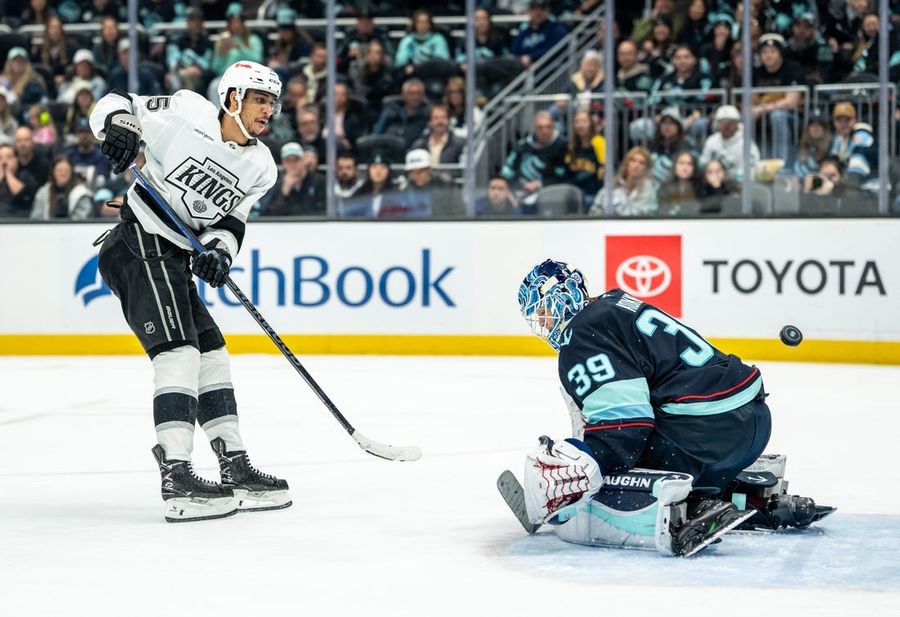
Apr 13, 2026; Seattle, Washington, USA; Los Angeles Kings forward Quinton Byfield (55) scores a goal…

Tommy Tuberville’s — there’s one thing for certain about college football’s changing landscape, and that’s the relative lack of smaller-school players in every draft class. Per ESPN’s Kalyn Kahler, the rate of prospects who transferred to bigger schools rose from 5.4% in 2018 to 38.2% in 2025. Better players are often moving to bigger schools for more money, yes, but also the opportunity to show their skills against a higher level of competition, in order to blot out that particular question mark in the eyes of NFL shot-callers.

In 2025, Las Vegas Raiders running back Ashton Jeanty (by way of Boise State) and Seattle left guard Grey Zabel (by way of North Dakota State) were the only first-round picks from non-major conferences, and that trend looks to continue in 2026. Toledo safety Emmanuel McNeil-Warren should be a lead-pipe lock as a first-round pick, but outside of that, it doesn’t look great for those guys outside of the bigger schools and conferences. Maybe San Diego State cornerback Chris Johnson sneaks into the back of the first round (which he should, based on performance; more on him later), and after that, we’re grasping at straws.

Still, there are smaller-school prospects whose tape reveals NFL starting potential in the right system, and here are my favorites in this particular draft class. Could these guys line up to be the next Joe Flacco (Delaware), Shannon Sharpe (Savannah State), Sam Mills (Montclair State), or Dave Krieg (Milton College — which no longer exists)? It’s entirely possible.

Here are five offensive prospects who I believe can start in the NFL sooner or later.

Cole Payton, QB, North Dakota State

Jan 31, 2026; Mobile, AL, USA; National quarterback Cole Payton (9) of North Dakota State throws the ball during the second half of the 2026 Senior Bowl at University of South Alabama, Hancock Whitney Stadium. Mandatory Credit: Vasha Hunt-Imagn Images

Jan 31, 2026; Mobile, AL, USA; National quarterback Cole Payton (9) of North Dakota State throws the ball during the second half of the 2026 Senior Bowl at University of South Alabama, Hancock Whitney Stadium. Mandatory Credit: Vasha Hunt-Imagn Images
Vasha Hunt-Imagn Images

Payton was a two-star recruit out of Westside High School in Omaha, Nebraska, and North Dakota State was the best of the smaller-school offers he got. There were no offers from bigger schools. He sat behind Trey Lance and Cam Miller until the 2025 season, when he was given the opportunity to be more than a package-play running quarterback (other people were interested in him as a potential tight end convert).

Given that chance, Payton went off. In 2025, he completed 161 of 226 passes (71.2%) for 2,719 yards (12.0 yards per attempt), 16 touchdowns, four interceptions, and a passer rating of 127.8. He completed 35 of 56 passes of 20 or more air yards for 1,247 yards, eight touchdowns, one interception, and a passer rating of 138.4. When under pressure, he completed 51 of 102 passes for 599 yards, two touchdowns, one interception, and a passer rating of 111.5, and when blitzed, he completed 63 of 89 passes for 1,399 yards, 10 touchdowns, no interceptions, and a passer rating of 150.6. Still, you’ll see opinions from alleged “experts” insisting that Payton doesn’t have a good deep arm, or that he falls apart under pressure. Nothing could be further from the truth.

The only real ding on Payton that makes sense, outside of strength of competition, is that he could be quicker and more consistent with his delivery. The one-year starter thing could be an issue for some NFL teams, as well. But if we’re going on NFL-transitive skills in a relatively weak quarterback class (Payton also ran the ball 120 times for 894 yards and 13 touchdowns last season), why wouldn’t Payton be able to hold a starting job in the NFL over time as he accentuates his development? The upside here could be Baker Mayfield-ish. Maybe the floor is Dillon Gabriel, but you could do a lot worse in the third day of the draft.

Robert Henry Jr., RB, UTSA

COLLEGE STATION, TEXAS - AUGUST 30: Robert Henry Jr #3 of the UTSA Roadrunners motions during the first quarter against the Texas A&M Aggies at Kyle Field on August 30, 2025 in College Station, Texas. (Photo by Maria Lysaker/Getty Images)

COLLEGE STATION, TEXAS – AUGUST 30: Robert Henry Jr #3 of the UTSA Roadrunners motions during the first quarter against the Texas A&M Aggies at Kyle Field on August 30, 2025 in College Station, Texas. (Photo by Maria Lysaker/Getty Images)
Getty Images

The 2026 running back class is somewhat similar to the quarterback class in that outside of the top guy (Notre Dame’s Jeremiyah Love), there isn’t a consensus No. 2 back. Which could leave the field open late in Day 2, or early in Day 3, for UTSA’s Robert Henry Jr. A no-star recruit from a very small high school, Henry spent his 2021 and 2022 seasons at Jones County Junior College in Ellisville, Mississippi before the Roadrunners snapped him up for the 2023 campaign, and he chose UTSA over Kentucky and South Carolina.

Henry’s first two seasons at his new school were pretty good, but 2025 was when he went off. He carried the rock 152 times for 1,051 yards (6.9 yards per carry), nine touchdowns, 33 forced missed tackles, and 16 runs of 15 or more yards. Add in his 17 catches on 24 targets for 112 yards and two touchdowns last season, and the fact that he’s not a complete disaster as a pass-blocker, and you can see an NFL path as a rotational back in either a gap-first or inside zone-heavy offense. And if you’re worried about strength of competition, go watch him against Texas A&M in the 2025 season opener, when he scalded the Aggies for 177 yards and two touchdowns on 16 carries.

Eli Heidenreich, RB/WR, Navy

BALTIMORE, MARYLAND - DECEMBER 13: Eli Heidenreich #22 of the Navy Midshipmen catches a pass for a touchdown during the second half of the 126th Army-Navy Game against the Army Black Knights at M&T Bank Stadium on December 13, 2025 in Baltimore, Maryland. (Photo by David Jensen/Getty Images)

BALTIMORE, MARYLAND – DECEMBER 13: Eli Heidenreich #22 of the Navy Midshipmen catches a pass for a touchdown during the second half of the 126th Army-Navy Game against the Army Black Knights at M&T Bank Stadium on December 13, 2025 in Baltimore, Maryland. (Photo by David Jensen/Getty Images)
Getty Images

When we talk about versatile players in football, we are generally focusing on defensive linemen who can win from multiple gaps, linebackers who can also rush the passer at the line of scrimmage, or defensive backs who can credibly play multiple positions without embarrassing themselves. In this case, we’re talking about a running back and a receiver in the person of Navy’s Eli Heidenreich, who is one of the more interesting prospects in this class, regardless of position.

Heidenreich was a lightly-recruited prospect out of Allegheny County near Pittsburgh, and committed to Navy when he was offered in 2021. He started to show his versatility in the 2023 season, led the Midshipmen in receiving in 2024, and put his best season together in 2025, when he totaled 1,440 yards from scrimmage and nine total touchdowns. 499 rushing yards and three touchdowns came on just 77 carries (6.9 yards per attempt), with 23 forced missed tackles, and nine runs of 15 or more yards. Then, as a receiver, he added 51 catches on 79 targets for 941 yards and six touchdowns, and he did all of that on a lot more than swings and screens. He’s got legitimate post, over, seam, and go routes in his palette from slot and wide deployments.

I’m not going to compare Heidenreich to the likes of Christian McCaffrey — he’s not that valuable as a runner. But if you think of how much Bill Belichick relied on James White when White played for the New England Patriots from 2014 to 2021, averaging 68 receptions per season over his career, that might be a good comp. Heidenreich won’t be for everybody; some will think of him more as a “homeless” tweener. But the right offensive coordinator could turn him into an every-down hybrid player with a ton of value.

Ted Hurst, WR, Georgia State

INDIANAPOLIS, IN - FEBRUARY 28: Ted Hurst #WO24 of Georgia State participates in a drill during the 2026 NFL Scouting Combine at Lucas Oil Stadium on February 28, 2026 in Indianapolis, Indiana. (Photo by Cooper Neill/Getty Images)

INDIANAPOLIS, IN – FEBRUARY 28: Ted Hurst #WO24 of Georgia State participates in a drill during the 2026 NFL Scouting Combine at Lucas Oil Stadium on February 28, 2026 in Indianapolis, Indiana. (Photo by Cooper Neill/Getty Images)
Getty Images

One of the first things I did when Dane Brugler of The Athletic released his mandatory “The Beast” draft guide this week was to look up Georgia State’s Ted Hurst for context as to why Hurst never saw action with bigger schools. Because the tape will tell you that this guy has a future as an NFL receiver. Somehow, even after a credible high-school stint at Sol C. Johnson High School in Savannah, Georgia, Hurst was a no-star recruit and played for Valdosta State for the 2022 and 2023 seasons before getting interest from one FBS school — Georgia State. I’m at a loss to explain why he didn’t end up at a major school (no offense to Georgia State!), but Hurst now has the opportunity to prove ‘em all wrong.

Last season, the 6’4”, 206-pound Hurst caught 71 passes on 124 targets for 999 yards (if only!) and six touchdowns. He had 11 catches on 27 targets of 20 or more air yards for 377 yards, and 14 explosive plays overall. Hurst also had 22 contested catches on 50 targets. And against Vanderbilt, Memphis, and Ole Miss — his most formidable opponents — Hurst caught 15 passes on 28 targets for 169 yards while his team was getting smushed more often than not.

I think he projects well as a “Z” receiver who you want to get open in space as opposed to someone who’s going to get dirty in traffic. Drops are an issue (13 over the last two seasons) and I’d like him to up hs play strength a bit. But if Hurst is a starting receiver in the NFL in two or three years, I will not be at all surprised.

Bryce Lance, WR, North Dakota State

FRISCO, TEXAS - JANUARY 6: Bryce Lance #5 of the North Dakota State Bison catches a pass against the Montana State Bobcats during the second half of the Division I FCS Football Championship held at Toyota Stadium on January 6, 2025 in Frisco, Texas. (Photo by Justin Tafoya/NCAA Photos via Getty Images)

FRISCO, TEXAS – JANUARY 6: Bryce Lance #5 of the North Dakota State Bison catches a pass against the Montana State Bobcats during the second half of the Division I FCS Football Championship held at Toyota Stadium on January 6, 2025 in Frisco, Texas. (Photo by Justin Tafoya/NCAA Photos via Getty Images)
NCAA Photos via Getty Images

Another speed receiver from a smaller school, though a juggernaut smaller school with a lot of NFL alumni, is Bryce Lance from North Dakota State. And yes, he is the younger brother of Trey Lance, who the San Francisco 49ers traded up to take with the third overall pick in the 2021 draft, and whose NFL career hasn’t exactly gone gangbusters.

Bryce Lance’s NFL transition looks a bit more solid. In 2025, the 6’3”, 204-pound Lance, who ran a 4.34-second 40-yard dash with a 1.49-second 10-yard split (ridiculous numbers for a man his size) caught 51 passes on 69 targets for 1,079 yards (an insane 21.2 yards per catch) and nine touchdowns. Lance was a big-play machine when given the opportunity — he caught 16 passes of 20 or more air yards on 21 targets for 641 yards and three touchdowns.

Lance turned down several NIL offers from bigger schools for the 2025 season after a 2024 season in which he caught 75 passes on 99 targets for 1,069 yards and 17 touchdowns, so he’s certainly not a one-year wonder. He’s got nice separation quickness off the line against press coverage, he has the physicality and body control to hold up well in contested-catch situation, and the track speed shows up on tape. Lance has all the attributes to be a WR2 or even a WR1 over time.

#smallschool #NFL #Draft #prospects #big #impact #offense"> 5 small-school NFL Draft prospects who can have a big impact on offense  No matter what you think of NIL and the transfer portal — and your opinion is probably valid as long as it isn’t, say, Tommy Tuberville’s — there’s one thing for certain about college football’s changing landscape, and that’s the relative lack of smaller-school players in every draft class. Per ESPN’s Kalyn Kahler, the rate of prospects who transferred to bigger schools rose from 5.4% in 2018 to 38.2% in 2025. Better players are often moving to bigger schools for more money, yes, but also the opportunity to show their skills against a higher level of competition, in order to blot out that particular question mark in the eyes of NFL shot-callers.In 2025, Las Vegas Raiders running back Ashton Jeanty (by way of Boise State) and Seattle left guard Grey Zabel (by way of North Dakota State) were the only first-round picks from non-major conferences, and that trend looks to continue in 2026. Toledo safety Emmanuel McNeil-Warren should be a lead-pipe lock as a first-round pick, but outside of that, it doesn’t look great for those guys outside of the bigger schools and conferences. Maybe San Diego State cornerback Chris Johnson sneaks into the back of the first round (which he should, based on performance; more on him later), and after that, we’re grasping at straws.Still, there are smaller-school prospects whose tape reveals NFL starting potential in the right system, and here are my favorites in this particular draft class. Could these guys line up to be the next Joe Flacco (Delaware), Shannon Sharpe (Savannah State), Sam Mills (Montclair State), or Dave Krieg (Milton College — which no longer exists)? It’s entirely possible.Here are five offensive prospects who I believe can start in the NFL sooner or later.Cole Payton, QB, North Dakota StateJan 31, 2026; Mobile, AL, USA; National quarterback Cole Payton (9) of North Dakota State throws the ball during the second half of the 2026 Senior Bowl at University of South Alabama, Hancock Whitney Stadium. Mandatory Credit: Vasha Hunt-Imagn Images Vasha Hunt-Imagn ImagesPayton was a two-star recruit out of Westside High School in Omaha, Nebraska, and North Dakota State was the best of the smaller-school offers he got. There were no offers from bigger schools. He sat behind Trey Lance and Cam Miller until the 2025 season, when he was given the opportunity to be more than a package-play running quarterback (other people were interested in him as a potential tight end convert).Given that chance, Payton went off. In 2025, he completed 161 of 226 passes (71.2%) for 2,719 yards (12.0 yards per attempt), 16 touchdowns, four interceptions, and a passer rating of 127.8. He completed 35 of 56 passes of 20 or more air yards for 1,247 yards, eight touchdowns, one interception, and a passer rating of 138.4. When under pressure, he completed 51 of 102 passes for 599 yards, two touchdowns, one interception, and a passer rating of 111.5, and when blitzed, he completed 63 of 89 passes for 1,399 yards, 10 touchdowns, no interceptions, and a passer rating of 150.6. Still, you’ll see opinions from alleged “experts” insisting that Payton doesn’t have a good deep arm, or that he falls apart under pressure. Nothing could be further from the truth.The only real ding on Payton that makes sense, outside of strength of competition, is that he could be quicker and more consistent with his delivery. The one-year starter thing could be an issue for some NFL teams, as well. But if we’re going on NFL-transitive skills in a relatively weak quarterback class (Payton also ran the ball 120 times for 894 yards and 13 touchdowns last season), why wouldn’t Payton be able to hold a starting job in the NFL over time as he accentuates his development? The upside here could be Baker Mayfield-ish. Maybe the floor is Dillon Gabriel, but you could do a lot worse in the third day of the draft.Robert Henry Jr., RB, UTSACOLLEGE STATION, TEXAS – AUGUST 30: Robert Henry Jr #3 of the UTSA Roadrunners motions during the first quarter against the Texas A&M Aggies at Kyle Field on August 30, 2025 in College Station, Texas. (Photo by Maria Lysaker/Getty Images) Getty ImagesThe 2026 running back class is somewhat similar to the quarterback class in that outside of the top guy (Notre Dame’s Jeremiyah Love), there isn’t a consensus No. 2 back. Which could leave the field open late in Day 2, or early in Day 3, for UTSA’s Robert Henry Jr. A no-star recruit from a very small high school, Henry spent his 2021 and 2022 seasons at Jones County Junior College in Ellisville, Mississippi before the Roadrunners snapped him up for the 2023 campaign, and he chose UTSA over Kentucky and South Carolina.Henry’s first two seasons at his new school were pretty good, but 2025 was when he went off. He carried the rock 152 times for 1,051 yards (6.9 yards per carry), nine touchdowns, 33 forced missed tackles, and 16 runs of 15 or more yards. Add in his 17 catches on 24 targets for 112 yards and two touchdowns last season, and the fact that he’s not a complete disaster as a pass-blocker, and you can see an NFL path as a rotational back in either a gap-first or inside zone-heavy offense. And if you’re worried about strength of competition, go watch him against Texas A&M in the 2025 season opener, when he scalded the Aggies for 177 yards and two touchdowns on 16 carries.Eli Heidenreich, RB/WR, NavyBALTIMORE, MARYLAND – DECEMBER 13: Eli Heidenreich #22 of the Navy Midshipmen catches a pass for a touchdown during the second half of the 126th Army-Navy Game against the Army Black Knights at M&T Bank Stadium on December 13, 2025 in Baltimore, Maryland. (Photo by David Jensen/Getty Images) Getty ImagesWhen we talk about versatile players in football, we are generally focusing on defensive linemen who can win from multiple gaps, linebackers who can also rush the passer at the line of scrimmage, or defensive backs who can credibly play multiple positions without embarrassing themselves. In this case, we’re talking about a running back and a receiver in the person of Navy’s Eli Heidenreich, who is one of the more interesting prospects in this class, regardless of position.Heidenreich was a lightly-recruited prospect out of Allegheny County near Pittsburgh, and committed to Navy when he was offered in 2021. He started to show his versatility in the 2023 season, led the Midshipmen in receiving in 2024, and put his best season together in 2025, when he totaled 1,440 yards from scrimmage and nine total touchdowns. 499 rushing yards and three touchdowns came on just 77 carries (6.9 yards per attempt), with 23 forced missed tackles, and nine runs of 15 or more yards. Then, as a receiver, he added 51 catches on 79 targets for 941 yards and six touchdowns, and he did all of that on a lot more than swings and screens. He’s got legitimate post, over, seam, and go routes in his palette from slot and wide deployments.I’m not going to compare Heidenreich to the likes of Christian McCaffrey — he’s not that valuable as a runner. But if you think of how much Bill Belichick relied on James White when White played for the New England Patriots from 2014 to 2021, averaging 68 receptions per season over his career, that might be a good comp. Heidenreich won’t be for everybody; some will think of him more as a “homeless” tweener. But the right offensive coordinator could turn him into an every-down hybrid player with a ton of value.Ted Hurst, WR, Georgia StateINDIANAPOLIS, IN – FEBRUARY 28: Ted Hurst #WO24 of Georgia State participates in a drill during the 2026 NFL Scouting Combine at Lucas Oil Stadium on February 28, 2026 in Indianapolis, Indiana. (Photo by Cooper Neill/Getty Images) Getty ImagesOne of the first things I did when Dane Brugler of The Athletic released his mandatory “The Beast” draft guide this week was to look up Georgia State’s Ted Hurst for context as to why Hurst never saw action with bigger schools. Because the tape will tell you that this guy has a future as an NFL receiver. Somehow, even after a credible high-school stint at Sol C. Johnson High School in Savannah, Georgia, Hurst was a no-star recruit and played for Valdosta State for the 2022 and 2023 seasons before getting interest from one FBS school — Georgia State. I’m at a loss to explain why he didn’t end up at a major school (no offense to Georgia State!), but Hurst now has the opportunity to prove ‘em all wrong.Last season, the 6’4”, 206-pound Hurst caught 71 passes on 124 targets for 999 yards (if only!) and six touchdowns. He had 11 catches on 27 targets of 20 or more air yards for 377 yards, and 14 explosive plays overall. Hurst also had 22 contested catches on 50 targets. And against Vanderbilt, Memphis, and Ole Miss — his most formidable opponents — Hurst caught 15 passes on 28 targets for 169 yards while his team was getting smushed more often than not.I think he projects well as a “Z” receiver who you want to get open in space as opposed to someone who’s going to get dirty in traffic. Drops are an issue (13 over the last two seasons) and I’d like him to up hs play strength a bit. But if Hurst is a starting receiver in the NFL in two or three years, I will not be at all surprised.Bryce Lance, WR, North Dakota StateFRISCO, TEXAS – JANUARY 6: Bryce Lance #5 of the North Dakota State Bison catches a pass against the Montana State Bobcats during the second half of the Division I FCS Football Championship held at Toyota Stadium on January 6, 2025 in Frisco, Texas. (Photo by Justin Tafoya/NCAA Photos via Getty Images) NCAA Photos via Getty ImagesAnother speed receiver from a smaller school, though a juggernaut smaller school with a lot of NFL alumni, is Bryce Lance from North Dakota State. And yes, he is the younger brother of Trey Lance, who the San Francisco 49ers traded up to take with the third overall pick in the 2021 draft, and whose NFL career hasn’t exactly gone gangbusters.Bryce Lance’s NFL transition looks a bit more solid. In 2025, the 6’3”, 204-pound Lance, who ran a 4.34-second 40-yard dash with a 1.49-second 10-yard split (ridiculous numbers for a man his size) caught 51 passes on 69 targets for 1,079 yards (an insane 21.2 yards per catch) and nine touchdowns. Lance was a big-play machine when given the opportunity — he caught 16 passes of 20 or more air yards on 21 targets for 641 yards and three touchdowns.Lance turned down several NIL offers from bigger schools for the 2025 season after a 2024 season in which he caught 75 passes on 99 targets for 1,069 yards and 17 touchdowns, so he’s certainly not a one-year wonder. He’s got nice separation quickness off the line against press coverage, he has the physicality and body control to hold up well in contested-catch situation, and the track speed shows up on tape. Lance has all the attributes to be a WR2 or even a WR1 over time.  #smallschool #NFL #Draft #prospects #big #impact #offense
Sports news

Tommy Tuberville’s — there’s one thing for certain about college football’s changing landscape, and that’s the relative lack of smaller-school players in every draft class. Per ESPN’s Kalyn Kahler, the rate of prospects who transferred to bigger schools rose from 5.4% in 2018 to 38.2% in 2025. Better players are often moving to bigger schools for more money, yes, but also the opportunity to show their skills against a higher level of competition, in order to blot out that particular question mark in the eyes of NFL shot-callers.

In 2025, Las Vegas Raiders running back Ashton Jeanty (by way of Boise State) and Seattle left guard Grey Zabel (by way of North Dakota State) were the only first-round picks from non-major conferences, and that trend looks to continue in 2026. Toledo safety Emmanuel McNeil-Warren should be a lead-pipe lock as a first-round pick, but outside of that, it doesn’t look great for those guys outside of the bigger schools and conferences. Maybe San Diego State cornerback Chris Johnson sneaks into the back of the first round (which he should, based on performance; more on him later), and after that, we’re grasping at straws.

Still, there are smaller-school prospects whose tape reveals NFL starting potential in the right system, and here are my favorites in this particular draft class. Could these guys line up to be the next Joe Flacco (Delaware), Shannon Sharpe (Savannah State), Sam Mills (Montclair State), or Dave Krieg (Milton College — which no longer exists)? It’s entirely possible.

Here are five offensive prospects who I believe can start in the NFL sooner or later.

Cole Payton, QB, North Dakota State

Jan 31, 2026; Mobile, AL, USA; National quarterback Cole Payton (9) of North Dakota State throws the ball during the second half of the 2026 Senior Bowl at University of South Alabama, Hancock Whitney Stadium. Mandatory Credit: Vasha Hunt-Imagn Images

Jan 31, 2026; Mobile, AL, USA; National quarterback Cole Payton (9) of North Dakota State throws the ball during the second half of the 2026 Senior Bowl at University of South Alabama, Hancock Whitney Stadium. Mandatory Credit: Vasha Hunt-Imagn Images
Vasha Hunt-Imagn Images

Payton was a two-star recruit out of Westside High School in Omaha, Nebraska, and North Dakota State was the best of the smaller-school offers he got. There were no offers from bigger schools. He sat behind Trey Lance and Cam Miller until the 2025 season, when he was given the opportunity to be more than a package-play running quarterback (other people were interested in him as a potential tight end convert).

Given that chance, Payton went off. In 2025, he completed 161 of 226 passes (71.2%) for 2,719 yards (12.0 yards per attempt), 16 touchdowns, four interceptions, and a passer rating of 127.8. He completed 35 of 56 passes of 20 or more air yards for 1,247 yards, eight touchdowns, one interception, and a passer rating of 138.4. When under pressure, he completed 51 of 102 passes for 599 yards, two touchdowns, one interception, and a passer rating of 111.5, and when blitzed, he completed 63 of 89 passes for 1,399 yards, 10 touchdowns, no interceptions, and a passer rating of 150.6. Still, you’ll see opinions from alleged “experts” insisting that Payton doesn’t have a good deep arm, or that he falls apart under pressure. Nothing could be further from the truth.

The only real ding on Payton that makes sense, outside of strength of competition, is that he could be quicker and more consistent with his delivery. The one-year starter thing could be an issue for some NFL teams, as well. But if we’re going on NFL-transitive skills in a relatively weak quarterback class (Payton also ran the ball 120 times for 894 yards and 13 touchdowns last season), why wouldn’t Payton be able to hold a starting job in the NFL over time as he accentuates his development? The upside here could be Baker Mayfield-ish. Maybe the floor is Dillon Gabriel, but you could do a lot worse in the third day of the draft.

Robert Henry Jr., RB, UTSA

COLLEGE STATION, TEXAS - AUGUST 30: Robert Henry Jr #3 of the UTSA Roadrunners motions during the first quarter against the Texas A&M Aggies at Kyle Field on August 30, 2025 in College Station, Texas. (Photo by Maria Lysaker/Getty Images)

COLLEGE STATION, TEXAS – AUGUST 30: Robert Henry Jr #3 of the UTSA Roadrunners motions during the first quarter against the Texas A&M Aggies at Kyle Field on August 30, 2025 in College Station, Texas. (Photo by Maria Lysaker/Getty Images)
Getty Images

The 2026 running back class is somewhat similar to the quarterback class in that outside of the top guy (Notre Dame’s Jeremiyah Love), there isn’t a consensus No. 2 back. Which could leave the field open late in Day 2, or early in Day 3, for UTSA’s Robert Henry Jr. A no-star recruit from a very small high school, Henry spent his 2021 and 2022 seasons at Jones County Junior College in Ellisville, Mississippi before the Roadrunners snapped him up for the 2023 campaign, and he chose UTSA over Kentucky and South Carolina.

Henry’s first two seasons at his new school were pretty good, but 2025 was when he went off. He carried the rock 152 times for 1,051 yards (6.9 yards per carry), nine touchdowns, 33 forced missed tackles, and 16 runs of 15 or more yards. Add in his 17 catches on 24 targets for 112 yards and two touchdowns last season, and the fact that he’s not a complete disaster as a pass-blocker, and you can see an NFL path as a rotational back in either a gap-first or inside zone-heavy offense. And if you’re worried about strength of competition, go watch him against Texas A&M in the 2025 season opener, when he scalded the Aggies for 177 yards and two touchdowns on 16 carries.

Eli Heidenreich, RB/WR, Navy

BALTIMORE, MARYLAND - DECEMBER 13: Eli Heidenreich #22 of the Navy Midshipmen catches a pass for a touchdown during the second half of the 126th Army-Navy Game against the Army Black Knights at M&T Bank Stadium on December 13, 2025 in Baltimore, Maryland. (Photo by David Jensen/Getty Images)

BALTIMORE, MARYLAND – DECEMBER 13: Eli Heidenreich #22 of the Navy Midshipmen catches a pass for a touchdown during the second half of the 126th Army-Navy Game against the Army Black Knights at M&T Bank Stadium on December 13, 2025 in Baltimore, Maryland. (Photo by David Jensen/Getty Images)
Getty Images

When we talk about versatile players in football, we are generally focusing on defensive linemen who can win from multiple gaps, linebackers who can also rush the passer at the line of scrimmage, or defensive backs who can credibly play multiple positions without embarrassing themselves. In this case, we’re talking about a running back and a receiver in the person of Navy’s Eli Heidenreich, who is one of the more interesting prospects in this class, regardless of position.

Heidenreich was a lightly-recruited prospect out of Allegheny County near Pittsburgh, and committed to Navy when he was offered in 2021. He started to show his versatility in the 2023 season, led the Midshipmen in receiving in 2024, and put his best season together in 2025, when he totaled 1,440 yards from scrimmage and nine total touchdowns. 499 rushing yards and three touchdowns came on just 77 carries (6.9 yards per attempt), with 23 forced missed tackles, and nine runs of 15 or more yards. Then, as a receiver, he added 51 catches on 79 targets for 941 yards and six touchdowns, and he did all of that on a lot more than swings and screens. He’s got legitimate post, over, seam, and go routes in his palette from slot and wide deployments.

I’m not going to compare Heidenreich to the likes of Christian McCaffrey — he’s not that valuable as a runner. But if you think of how much Bill Belichick relied on James White when White played for the New England Patriots from 2014 to 2021, averaging 68 receptions per season over his career, that might be a good comp. Heidenreich won’t be for everybody; some will think of him more as a “homeless” tweener. But the right offensive coordinator could turn him into an every-down hybrid player with a ton of value.

Ted Hurst, WR, Georgia State

INDIANAPOLIS, IN - FEBRUARY 28: Ted Hurst #WO24 of Georgia State participates in a drill during the 2026 NFL Scouting Combine at Lucas Oil Stadium on February 28, 2026 in Indianapolis, Indiana. (Photo by Cooper Neill/Getty Images)

INDIANAPOLIS, IN – FEBRUARY 28: Ted Hurst #WO24 of Georgia State participates in a drill during the 2026 NFL Scouting Combine at Lucas Oil Stadium on February 28, 2026 in Indianapolis, Indiana. (Photo by Cooper Neill/Getty Images)
Getty Images

One of the first things I did when Dane Brugler of The Athletic released his mandatory “The Beast” draft guide this week was to look up Georgia State’s Ted Hurst for context as to why Hurst never saw action with bigger schools. Because the tape will tell you that this guy has a future as an NFL receiver. Somehow, even after a credible high-school stint at Sol C. Johnson High School in Savannah, Georgia, Hurst was a no-star recruit and played for Valdosta State for the 2022 and 2023 seasons before getting interest from one FBS school — Georgia State. I’m at a loss to explain why he didn’t end up at a major school (no offense to Georgia State!), but Hurst now has the opportunity to prove ‘em all wrong.

Last season, the 6’4”, 206-pound Hurst caught 71 passes on 124 targets for 999 yards (if only!) and six touchdowns. He had 11 catches on 27 targets of 20 or more air yards for 377 yards, and 14 explosive plays overall. Hurst also had 22 contested catches on 50 targets. And against Vanderbilt, Memphis, and Ole Miss — his most formidable opponents — Hurst caught 15 passes on 28 targets for 169 yards while his team was getting smushed more often than not.

I think he projects well as a “Z” receiver who you want to get open in space as opposed to someone who’s going to get dirty in traffic. Drops are an issue (13 over the last two seasons) and I’d like him to up hs play strength a bit. But if Hurst is a starting receiver in the NFL in two or three years, I will not be at all surprised.

Bryce Lance, WR, North Dakota State

FRISCO, TEXAS - JANUARY 6: Bryce Lance #5 of the North Dakota State Bison catches a pass against the Montana State Bobcats during the second half of the Division I FCS Football Championship held at Toyota Stadium on January 6, 2025 in Frisco, Texas. (Photo by Justin Tafoya/NCAA Photos via Getty Images)

FRISCO, TEXAS – JANUARY 6: Bryce Lance #5 of the North Dakota State Bison catches a pass against the Montana State Bobcats during the second half of the Division I FCS Football Championship held at Toyota Stadium on January 6, 2025 in Frisco, Texas. (Photo by Justin Tafoya/NCAA Photos via Getty Images)
NCAA Photos via Getty Images

Another speed receiver from a smaller school, though a juggernaut smaller school with a lot of NFL alumni, is Bryce Lance from North Dakota State. And yes, he is the younger brother of Trey Lance, who the San Francisco 49ers traded up to take with the third overall pick in the 2021 draft, and whose NFL career hasn’t exactly gone gangbusters.

Bryce Lance’s NFL transition looks a bit more solid. In 2025, the 6’3”, 204-pound Lance, who ran a 4.34-second 40-yard dash with a 1.49-second 10-yard split (ridiculous numbers for a man his size) caught 51 passes on 69 targets for 1,079 yards (an insane 21.2 yards per catch) and nine touchdowns. Lance was a big-play machine when given the opportunity — he caught 16 passes of 20 or more air yards on 21 targets for 641 yards and three touchdowns.

Lance turned down several NIL offers from bigger schools for the 2025 season after a 2024 season in which he caught 75 passes on 99 targets for 1,069 yards and 17 touchdowns, so he’s certainly not a one-year wonder. He’s got nice separation quickness off the line against press coverage, he has the physicality and body control to hold up well in contested-catch situation, and the track speed shows up on tape. Lance has all the attributes to be a WR2 or even a WR1 over time.

#smallschool #NFL #Draft #prospects #big #impact #offense">5 small-school NFL Draft prospects who can have a big impact on offense

No matter what you think of NIL and the transfer portal — and your opinion is probably valid as long as it isn’t, say, Tommy Tuberville’s — there’s one thing for certain about college football’s changing landscape, and that’s the relative lack of smaller-school players in every draft class. Per ESPN’s Kalyn Kahler, the rate of prospects who transferred to bigger schools rose from 5.4% in 2018 to 38.2% in 2025. Better players are often moving to bigger schools for more money, yes, but also the opportunity to show their skills against a higher level of competition, in order to blot out that particular question mark in the eyes of NFL shot-callers.

In 2025, Las Vegas Raiders running back Ashton Jeanty (by way of Boise State) and Seattle left guard Grey Zabel (by way of North Dakota State) were the only first-round picks from non-major conferences, and that trend looks to continue in 2026. Toledo safety Emmanuel McNeil-Warren should be a lead-pipe lock as a first-round pick, but outside of that, it doesn’t look great for those guys outside of the bigger schools and conferences. Maybe San Diego State cornerback Chris Johnson sneaks into the back of the first round (which he should, based on performance; more on him later), and after that, we’re grasping at straws.

Still, there are smaller-school prospects whose tape reveals NFL starting potential in the right system, and here are my favorites in this particular draft class. Could these guys line up to be the next Joe Flacco (Delaware), Shannon Sharpe (Savannah State), Sam Mills (Montclair State), or Dave Krieg (Milton College — which no longer exists)? It’s entirely possible.

Here are five offensive prospects who I believe can start in the NFL sooner or later.

Cole Payton, QB, North Dakota State

Jan 31, 2026; Mobile, AL, USA; National quarterback Cole Payton (9) of North Dakota State throws the ball during the second half of the 2026 Senior Bowl at University of South Alabama, Hancock Whitney Stadium. Mandatory Credit: Vasha Hunt-Imagn Images

Jan 31, 2026; Mobile, AL, USA; National quarterback Cole Payton (9) of North Dakota State throws the ball during the second half of the 2026 Senior Bowl at University of South Alabama, Hancock Whitney Stadium. Mandatory Credit: Vasha Hunt-Imagn Images
Vasha Hunt-Imagn Images

Payton was a two-star recruit out of Westside High School in Omaha, Nebraska, and North Dakota State was the best of the smaller-school offers he got. There were no offers from bigger schools. He sat behind Trey Lance and Cam Miller until the 2025 season, when he was given the opportunity to be more than a package-play running quarterback (other people were interested in him as a potential tight end convert).

Given that chance, Payton went off. In 2025, he completed 161 of 226 passes (71.2%) for 2,719 yards (12.0 yards per attempt), 16 touchdowns, four interceptions, and a passer rating of 127.8. He completed 35 of 56 passes of 20 or more air yards for 1,247 yards, eight touchdowns, one interception, and a passer rating of 138.4. When under pressure, he completed 51 of 102 passes for 599 yards, two touchdowns, one interception, and a passer rating of 111.5, and when blitzed, he completed 63 of 89 passes for 1,399 yards, 10 touchdowns, no interceptions, and a passer rating of 150.6. Still, you’ll see opinions from alleged “experts” insisting that Payton doesn’t have a good deep arm, or that he falls apart under pressure. Nothing could be further from the truth.

The only real ding on Payton that makes sense, outside of strength of competition, is that he could be quicker and more consistent with his delivery. The one-year starter thing could be an issue for some NFL teams, as well. But if we’re going on NFL-transitive skills in a relatively weak quarterback class (Payton also ran the ball 120 times for 894 yards and 13 touchdowns last season), why wouldn’t Payton be able to hold a starting job in the NFL over time as he accentuates his development? The upside here could be Baker Mayfield-ish. Maybe the floor is Dillon Gabriel, but you could do a lot worse in the third day of the draft.

Robert Henry Jr., RB, UTSA

COLLEGE STATION, TEXAS - AUGUST 30: Robert Henry Jr #3 of the UTSA Roadrunners motions during the first quarter against the Texas A&M Aggies at Kyle Field on August 30, 2025 in College Station, Texas. (Photo by Maria Lysaker/Getty Images)

COLLEGE STATION, TEXAS – AUGUST 30: Robert Henry Jr #3 of the UTSA Roadrunners motions during the first quarter against the Texas A&M Aggies at Kyle Field on August 30, 2025 in College Station, Texas. (Photo by Maria Lysaker/Getty Images)
Getty Images

The 2026 running back class is somewhat similar to the quarterback class in that outside of the top guy (Notre Dame’s Jeremiyah Love), there isn’t a consensus No. 2 back. Which could leave the field open late in Day 2, or early in Day 3, for UTSA’s Robert Henry Jr. A no-star recruit from a very small high school, Henry spent his 2021 and 2022 seasons at Jones County Junior College in Ellisville, Mississippi before the Roadrunners snapped him up for the 2023 campaign, and he chose UTSA over Kentucky and South Carolina.

Henry’s first two seasons at his new school were pretty good, but 2025 was when he went off. He carried the rock 152 times for 1,051 yards (6.9 yards per carry), nine touchdowns, 33 forced missed tackles, and 16 runs of 15 or more yards. Add in his 17 catches on 24 targets for 112 yards and two touchdowns last season, and the fact that he’s not a complete disaster as a pass-blocker, and you can see an NFL path as a rotational back in either a gap-first or inside zone-heavy offense. And if you’re worried about strength of competition, go watch him against Texas A&M in the 2025 season opener, when he scalded the Aggies for 177 yards and two touchdowns on 16 carries.

Eli Heidenreich, RB/WR, Navy

BALTIMORE, MARYLAND - DECEMBER 13: Eli Heidenreich #22 of the Navy Midshipmen catches a pass for a touchdown during the second half of the 126th Army-Navy Game against the Army Black Knights at M&T Bank Stadium on December 13, 2025 in Baltimore, Maryland. (Photo by David Jensen/Getty Images)

BALTIMORE, MARYLAND – DECEMBER 13: Eli Heidenreich #22 of the Navy Midshipmen catches a pass for a touchdown during the second half of the 126th Army-Navy Game against the Army Black Knights at M&T Bank Stadium on December 13, 2025 in Baltimore, Maryland. (Photo by David Jensen/Getty Images)
Getty Images

When we talk about versatile players in football, we are generally focusing on defensive linemen who can win from multiple gaps, linebackers who can also rush the passer at the line of scrimmage, or defensive backs who can credibly play multiple positions without embarrassing themselves. In this case, we’re talking about a running back and a receiver in the person of Navy’s Eli Heidenreich, who is one of the more interesting prospects in this class, regardless of position.

Heidenreich was a lightly-recruited prospect out of Allegheny County near Pittsburgh, and committed to Navy when he was offered in 2021. He started to show his versatility in the 2023 season, led the Midshipmen in receiving in 2024, and put his best season together in 2025, when he totaled 1,440 yards from scrimmage and nine total touchdowns. 499 rushing yards and three touchdowns came on just 77 carries (6.9 yards per attempt), with 23 forced missed tackles, and nine runs of 15 or more yards. Then, as a receiver, he added 51 catches on 79 targets for 941 yards and six touchdowns, and he did all of that on a lot more than swings and screens. He’s got legitimate post, over, seam, and go routes in his palette from slot and wide deployments.

I’m not going to compare Heidenreich to the likes of Christian McCaffrey — he’s not that valuable as a runner. But if you think of how much Bill Belichick relied on James White when White played for the New England Patriots from 2014 to 2021, averaging 68 receptions per season over his career, that might be a good comp. Heidenreich won’t be for everybody; some will think of him more as a “homeless” tweener. But the right offensive coordinator could turn him into an every-down hybrid player with a ton of value.

Ted Hurst, WR, Georgia State

INDIANAPOLIS, IN - FEBRUARY 28: Ted Hurst #WO24 of Georgia State participates in a drill during the 2026 NFL Scouting Combine at Lucas Oil Stadium on February 28, 2026 in Indianapolis, Indiana. (Photo by Cooper Neill/Getty Images)

INDIANAPOLIS, IN – FEBRUARY 28: Ted Hurst #WO24 of Georgia State participates in a drill during the 2026 NFL Scouting Combine at Lucas Oil Stadium on February 28, 2026 in Indianapolis, Indiana. (Photo by Cooper Neill/Getty Images)
Getty Images

One of the first things I did when Dane Brugler of The Athletic released his mandatory “The Beast” draft guide this week was to look up Georgia State’s Ted Hurst for context as to why Hurst never saw action with bigger schools. Because the tape will tell you that this guy has a future as an NFL receiver. Somehow, even after a credible high-school stint at Sol C. Johnson High School in Savannah, Georgia, Hurst was a no-star recruit and played for Valdosta State for the 2022 and 2023 seasons before getting interest from one FBS school — Georgia State. I’m at a loss to explain why he didn’t end up at a major school (no offense to Georgia State!), but Hurst now has the opportunity to prove ‘em all wrong.

Last season, the 6’4”, 206-pound Hurst caught 71 passes on 124 targets for 999 yards (if only!) and six touchdowns. He had 11 catches on 27 targets of 20 or more air yards for 377 yards, and 14 explosive plays overall. Hurst also had 22 contested catches on 50 targets. And against Vanderbilt, Memphis, and Ole Miss — his most formidable opponents — Hurst caught 15 passes on 28 targets for 169 yards while his team was getting smushed more often than not.

I think he projects well as a “Z” receiver who you want to get open in space as opposed to someone who’s going to get dirty in traffic. Drops are an issue (13 over the last two seasons) and I’d like him to up hs play strength a bit. But if Hurst is a starting receiver in the NFL in two or three years, I will not be at all surprised.

Bryce Lance, WR, North Dakota State

FRISCO, TEXAS - JANUARY 6: Bryce Lance #5 of the North Dakota State Bison catches a pass against the Montana State Bobcats during the second half of the Division I FCS Football Championship held at Toyota Stadium on January 6, 2025 in Frisco, Texas. (Photo by Justin Tafoya/NCAA Photos via Getty Images)

FRISCO, TEXAS – JANUARY 6: Bryce Lance #5 of the North Dakota State Bison catches a pass against the Montana State Bobcats during the second half of the Division I FCS Football Championship held at Toyota Stadium on January 6, 2025 in Frisco, Texas. (Photo by Justin Tafoya/NCAA Photos via Getty Images)
NCAA Photos via Getty Images

Another speed receiver from a smaller school, though a juggernaut smaller school with a lot of NFL alumni, is Bryce Lance from North Dakota State. And yes, he is the younger brother of Trey Lance, who the San Francisco 49ers traded up to take with the third overall pick in the 2021 draft, and whose NFL career hasn’t exactly gone gangbusters.

Bryce Lance’s NFL transition looks a bit more solid. In 2025, the 6’3”, 204-pound Lance, who ran a 4.34-second 40-yard dash with a 1.49-second 10-yard split (ridiculous numbers for a man his size) caught 51 passes on 69 targets for 1,079 yards (an insane 21.2 yards per catch) and nine touchdowns. Lance was a big-play machine when given the opportunity — he caught 16 passes of 20 or more air yards on 21 targets for 641 yards and three touchdowns.

Lance turned down several NIL offers from bigger schools for the 2025 season after a 2024 season in which he caught 75 passes on 99 targets for 1,069 yards and 17 touchdowns, so he’s certainly not a one-year wonder. He’s got nice separation quickness off the line against press coverage, he has the physicality and body control to hold up well in contested-catch situation, and the track speed shows up on tape. Lance has all the attributes to be a WR2 or even a WR1 over time.

#smallschool #NFL #Draft #prospects #big #impact #offense

No matter what you think of NIL and the transfer portal — and your opinion…

ISL: Ashley Westwood, the wizard of Bengaluru FC, eyes similar magic at Kerala Blasters

The 27-year-old came on in the second half for Edmund Lalrindika and lasted just seven minutes on the pitch before sustaining the injury. He was replaced by Souvik Chakraborty.

Mahesh first joined East Bengal in 2021 on loan from Kerala Blasters before making the move permanent the following year. He has made 114 appearances across all competitions for the club, recording 16 goals and 18 assists in that period.

East Bengal is currently fourth in the standings with 14 points from seven games and takes on Bengaluru FC next on Thursday.

Published on Apr 14, 2026

#East #Bengals #Naorem #Mahesh #Singh #ruled #rest #ISL #season"> East Bengal’s Naorem Mahesh Singh ruled out for rest of ISL 2025-26 season  East Bengal forward Naorem Mahesh Singh has been ruled out for the rest of the Indian Super League (ISL) 2025-26 season after sustaining an injury during his side’s 3-1 win against Chennaiyin FC on April 11.In a statement on Tuesday, the club said, “Naorem Mahesh Singh, who sustained a knee injury during our recent ISL away match against Chennaiyin FC, is currently under the supervision of our club’s medical team, which is assessing the extent of his injury.”“Mahesh is expected to miss the remainder of the season,” it added.ALSO READ | ISL: Ashley Westwood, the wizard of Bengaluru FC, eyes similar magic at Kerala BlastersThe 27-year-old came on in the second half for Edmund Lalrindika and lasted just seven minutes on the pitch before sustaining the injury. He was replaced by Souvik Chakraborty.Mahesh first joined East Bengal in 2021 on loan from Kerala Blasters before making the move permanent the following year. He has made 114 appearances across all competitions for the club, recording 16 goals and 18 assists in that period.East Bengal is currently fourth in the standings with 14 points from seven games and takes on Bengaluru FC next on Thursday.Published on Apr 14, 2026  #East #Bengals #Naorem #Mahesh #Singh #ruled #rest #ISL #season
Sports news

ISL: Ashley Westwood, the wizard of Bengaluru FC, eyes similar magic at Kerala Blasters

The 27-year-old came on in the second half for Edmund Lalrindika and lasted just seven minutes on the pitch before sustaining the injury. He was replaced by Souvik Chakraborty.

Mahesh first joined East Bengal in 2021 on loan from Kerala Blasters before making the move permanent the following year. He has made 114 appearances across all competitions for the club, recording 16 goals and 18 assists in that period.

East Bengal is currently fourth in the standings with 14 points from seven games and takes on Bengaluru FC next on Thursday.

Published on Apr 14, 2026

#East #Bengals #Naorem #Mahesh #Singh #ruled #rest #ISL #season">East Bengal’s Naorem Mahesh Singh ruled out for rest of ISL 2025-26 season

East Bengal forward Naorem Mahesh Singh has been ruled out for the rest of the Indian Super League (ISL) 2025-26 season after sustaining an injury during his side’s 3-1 win against Chennaiyin FC on April 11.

In a statement on Tuesday, the club said, “Naorem Mahesh Singh, who sustained a knee injury during our recent ISL away match against Chennaiyin FC, is currently under the supervision of our club’s medical team, which is assessing the extent of his injury.”

“Mahesh is expected to miss the remainder of the season,” it added.

ALSO READ | ISL: Ashley Westwood, the wizard of Bengaluru FC, eyes similar magic at Kerala Blasters

The 27-year-old came on in the second half for Edmund Lalrindika and lasted just seven minutes on the pitch before sustaining the injury. He was replaced by Souvik Chakraborty.

Mahesh first joined East Bengal in 2021 on loan from Kerala Blasters before making the move permanent the following year. He has made 114 appearances across all competitions for the club, recording 16 goals and 18 assists in that period.

East Bengal is currently fourth in the standings with 14 points from seven games and takes on Bengaluru FC next on Thursday.

Published on Apr 14, 2026

#East #Bengals #Naorem #Mahesh #Singh #ruled #rest #ISL #season

East Bengal forward Naorem Mahesh Singh has been ruled out for the rest of the…

Sports news

Apr 3, 2026; Pittsburgh, Pennsylvania, USA; Pittsburgh Pirates starting pitcher Mitch Keller (23) delivers a…

Tommy Tuberville’s — there’s one thing for certain about college football’s changing landscape, and that’s the relative lack of smaller-school players in every draft class. Per ESPN’s Kalyn Kahler, the rate of prospects who transferred to bigger schools rose from 5.4% in 2018 to 38.2% in 2025. Better players are often moving to bigger schools for more money, yes, but also the opportunity to show their skills against a higher level of competition, in order to blot out that particular question mark in the eyes of NFL shot-callers.

In 2025, Las Vegas Raiders running back Ashton Jeanty (by way of Boise State) and Seattle left guard Grey Zabel (by way of North Dakota State) were the only first-round picks from non-major conferences, and that trend looks to continue in 2026. Toledo safety Emmanuel McNeil-Warren should be a lead-pipe lock as a first-round pick, but outside of that, it doesn’t look great for those guys outside of the bigger schools and conferences. Maybe San Diego State cornerback Chris Johnson sneaks into the back of the first round (which he should, based on performance; more on him later), and after that, we’re grasping at straws.

Still, there are smaller-school prospects whose tape reveals NFL starting potential in the right system, and here are my favorites in this particular draft class. Could these guys line up to be the next Joe Flacco (Delaware), Shannon Sharpe (Savannah State), Sam Mills (Montclair State), or Dave Krieg (Milton College — which no longer exists)? It’s entirely possible.

Here are five defensive prospects who I believe can start in the NFL sooner or later.

Malachi Lawrence, EDGE, UCF

UCF defensive end Malachi Lawrence (51) tackles ASU quarterback Sam Leavitt (10) as he scrambles during a game at Mountain America Stadium in Tempe on Nov. 9, 2024.

UCF defensive end Malachi Lawrence (51) tackles ASU quarterback Sam Leavitt (10) as he scrambles during a game at Mountain America Stadium in Tempe on Nov. 9, 2024.
Patrick Breen/The Republic / USA TODAY NETWORK via Imagn Images

The 2026 EDGE class is very deep, but also interesting in that there isn’t a consensus outside pass-rusher who has already shown it on the field. Ohio State’s Arvell Reese is EDGE1 in the minds of most, but only 58% of his snaps last season came on the edge (34% as an off-ball linebacker, and the rest as an inside blitzer/spinner), so there’s some projection there. Beyond David Bailey, Rueben Bain Jr., Keldric Faulk, Akheem Mesidor, and the rest of the top-tier disruptors, I could see NFL teams warming to UCF’s Malachi Lawrence sooner than later when the draft begins, and if he leapfrogs some of those guys when the picks are made, don’t be too surprised.

In 2025, the 6’4”, 253-pound Lawrence had seven sacks, 40 total pressures, 19 solo tackles, 18 stops, four tackles for loss, and two forced fumbles. He then amplified his profile with a scouting combine that gave him a spider chart for the ages, and the good thing is, all that athleticism shows up on tape. Lawrence is a relentless rusher who has the moves to deal with NFL tackles, he can kick inside in certain packages, and he can run and chase quarterbacks and running backs all the way to the boundary. You’re never really safe when Lawrence is out there, and I think that will transfer to the NFL.

Michael Heldman, EDGE, Central Michigan

Sep 6, 2025; Pittsburgh, Pennsylvania, USA; Pittsburgh Panthers quarterback Eli Holstein (10) runs the ball as Central Michigan Chippewas defensive lineman Michael Heldman (97) chases during the first quarter at Acrisure Stadium. Mandatory Credit: Charles LeClaire-Imagn Images

Sep 6, 2025; Pittsburgh, Pennsylvania, USA; Pittsburgh Panthers quarterback Eli Holstein (10) runs the ball as Central Michigan Chippewas defensive lineman Michael Heldman (97) chases during the first quarter at Acrisure Stadium. Mandatory Credit: Charles LeClaire-Imagn Images
Charles LeClaire-Imagn Images

The 6’4”, 268-pound Heldman, whose choice to wear No. 97 makes me think he wants people to see one of the Bosa brothers when they watch his tape, improved in each of his five seasons with the Chippewas, but 2025 was when he really put it all together. He had 12 sacks, 53 total pressures, 25 solo tackles, 29 stops, five tackles for loss, and two forced fumbles, and while he did all that mostly on the edge, he also kicked inside on 13% of his snaps, showing the requisite strength and leverage to blow up run fits.

I don’t see a Bosa brother when I watch Heldman’s tape, but from the size to the power/speed combination to the four-point stance, he brings to mind Ryan Kerrigan, who the then-Washington Redskins took with the 16th overall pick in the 2011 draft out of Purdue. Kerrigan developed into a great power-rocked pass rusher with more than credible run defense and the ability to line up over and inside the tackles. When you watch Heldman against Central Michigan’s toughest opponents in 2025, it’s not hard to see the NFL transition.

Kaleb Proctor, DI, Southeastern Louisiana

INDIANAPOLIS, INDIANA - FEBRUARY 26: Kaleb Proctor of the Southeastern Louisiana Lions participtates in a drill during the 2026 NFL Scouting Combine at Lucas Oil Stadium on February 26, 2026 in Indianapolis, Indiana. (Photo by Stacy Revere/Getty Images)

INDIANAPOLIS, INDIANA – FEBRUARY 26: Kaleb Proctor of the Southeastern Louisiana Lions participtates in a drill during the 2026 NFL Scouting Combine at Lucas Oil Stadium on February 26, 2026 in Indianapolis, Indiana. (Photo by Stacy Revere/Getty Images)
Getty Images

And now, the guy I just won’t shut up about. Of all the small-school prospects I’ve watched in this year’s process, Southeastern Louisiana’s Kaleb Proctor shot out of my laptop and got right in my face more than any other. In 2025, the 6’2”, 291-pound Proctor totaled nine sacks, 39 pressures, 18 solo tackles, 22 stops, and two tackles for loss. If you’re worried about strength of competition, hit the tape tweet below, and watch his two sacks against LSU.

Oh. And then, he completely killed it at the combine.

I’ve had a thing for smaller defensive tackles that goes all the way back to John Randle, and has served me well in evaluation from Grady Jarrett through to that Aaron Donald guy. Proctor could be the next in line. The gap quickness is off the charts, and that plays well in an NFL where stunts and line games are more important than ever, because defenses want more and better ways to mess with protections and create pressure without blitzing. Proctor has no real bad weight on his frame, and adding another 10 pounds of muscle might prevent him from getting washed out by the occasional double-team, but it’s not an epic problem — Proctor was double-teamed on 168 of his 564 snaps last season, and his ability to knife through doubles was evident.

If you get Proctor on the second day of the draft, and you turn him loose as a one-gap penetrator and move tackle with some spice on the edges as well, he’s going to be a force.

As always, tape don’t lie.

Domonique Orange, DI, Iowa State

Sep 6, 2025; Ames, Iowa, USA; Iowa State Cyclones defensive lineman Domonique Orange (95) celebrates after a play against the Iowa Hawkeyes during the second half at Jack Trice Stadium. Mandatory Credit: Reese Strickland-Imagn Images

Sep 6, 2025; Ames, Iowa, USA; Iowa State Cyclones defensive lineman Domonique Orange (95) celebrates after a play against the Iowa Hawkeyes during the second half at Jack Trice Stadium. Mandatory Credit: Reese Strickland-Imagn Images
Reese Strickland-Imagn Images

Well… okay. There are times when tape does lie.

There are some college defenses that are tough to watch when you’re trying to figure out NFL transitions, because there’s so much stuff you’re seeing on tape that you simply won’t see at the next level. In the case of Iowa State, it’s the constant use of three-man fronts that make you pause and wonder how it all works out. This happened to me when I was watching Will McDonald IV back in 2023 — I loved his skill set, but it was incredibly frustrating to see the 6’3”, 241-pound McDonald lined up inside the tackles so often, and then see people bashing his pressure production. The New York Jets took McDonald 15th overall in the 2023 draft regardless, and McDonald has become a very good edge-rusher, which he was born to be.

Now, onto the 6’2”, 322-pound Domonique Orange. Last season for the Cyclones, “Big Citrus” had no sacks, 13 pressures, 20 solo tackles, 16 stops, and a pass breakup against BYU tight end Carsen Ryan that bordered on homicide.

Beyond that, and as was the case with Will McDonald, you can’t box-score scout Orange and expect to come away with a clear picture. In 2025, Orange played 84% of his snaps as a nose tackle, and he didn’t have the help most other NCAA nose tackles had, because of all those three-man fronts. What we do know is that Orange’s movement skills for his size are exceptional, and he was also able to pressure on the edge in those three-man fronts, which is pretty neat to see.

Put Big Citrus in NFL four- and five-man fronts, and let the big man eat. You will be rewarded beyond popular expectation.

Chris Johnson, CB, San Diego State

Jan 29, 2026; Mobile, AL, USA; National cornerback Chris Johnson (2) of San Diego State practices during National Senior Bowl practice at Hancock Whitney Stadium. Mandatory Credit: Vasha Hunt-Imagn Images

Jan 29, 2026; Mobile, AL, USA; National cornerback Chris Johnson (2) of San Diego State practices during National Senior Bowl practice at Hancock Whitney Stadium. Mandatory Credit: Vasha Hunt-Imagn Images
Vasha Hunt-Imagn Images

I mentioned Emmanuel McNeil-Warren in the intro to this piece, and I didn’t include him on the list because he’s going to be a first-round pick, and an early NFL starter. We don’t really need to goose that up to any degree. If you want more on McNeil-Warren, you can check this out. But Chris Johnson, who I also mentioned? Maybe he hits the back of the first round based on his tape, and maybe he doesn’t. But he should. There’s an easy argument to be made that after LSU’s Mansoor Delane and Tennessee’s Jermod McCoy, he’s the best cornerback in this class, and he does everything well.

Last season, the 6’0”, 193-pound Johnson allowed 18 catches on 43 targets for 185 yards, 79 yards after the catch, no touchdowns, four interceptions, five pass breakups, and an opponent passer rating of 16.1 — by far the lowest among FBS cornerbacks last season who played at least 50% of their teams’ snaps last season. Delane ranked second at 31.3.

Johnson’s targets were about equally distributed between press and off coverage in 2025, and there were no issues with either. He comes out of low stance to turn and run well with receivers, he will fight for the ball in creating contested-catch situations, and he’s got some juice as a blitzer.

To bring up another Toledo defensive back, I could see Johnson making a similar immediate impact for his NFL team that Quinyon Mitchell did for the Philadelphia Eagles when they took Mitchell with the 22nd overall pick in the 2022 draft. Mitchell had a few rookie struggles, but he put it together very well down the stretch in 2024, and now, he’s one of the NFL’s better cornerbacks. Johnson could well be on the same path.

#smallschool #NFL #Draft #prospects #big #impact #defense"> 5 small-school NFL Draft prospects who can have a big impact on defense  No matter what you think of NIL and the transfer portal — and your opinion is probably valid as long as it isn’t, say, Tommy Tuberville’s — there’s one thing for certain about college football’s changing landscape, and that’s the relative lack of smaller-school players in every draft class. Per ESPN’s Kalyn Kahler, the rate of prospects who transferred to bigger schools rose from 5.4% in 2018 to 38.2% in 2025. Better players are often moving to bigger schools for more money, yes, but also the opportunity to show their skills against a higher level of competition, in order to blot out that particular question mark in the eyes of NFL shot-callers.In 2025, Las Vegas Raiders running back Ashton Jeanty (by way of Boise State) and Seattle left guard Grey Zabel (by way of North Dakota State) were the only first-round picks from non-major conferences, and that trend looks to continue in 2026. Toledo safety Emmanuel McNeil-Warren should be a lead-pipe lock as a first-round pick, but outside of that, it doesn’t look great for those guys outside of the bigger schools and conferences. Maybe San Diego State cornerback Chris Johnson sneaks into the back of the first round (which he should, based on performance; more on him later), and after that, we’re grasping at straws.Still, there are smaller-school prospects whose tape reveals NFL starting potential in the right system, and here are my favorites in this particular draft class. Could these guys line up to be the next Joe Flacco (Delaware), Shannon Sharpe (Savannah State), Sam Mills (Montclair State), or Dave Krieg (Milton College — which no longer exists)? It’s entirely possible.Here are five defensive prospects who I believe can start in the NFL sooner or later.Malachi Lawrence, EDGE, UCFUCF defensive end Malachi Lawrence (51) tackles ASU quarterback Sam Leavitt (10) as he scrambles during a game at Mountain America Stadium in Tempe on Nov. 9, 2024. Patrick Breen/The Republic / USA TODAY NETWORK via Imagn ImagesThe 2026 EDGE class is very deep, but also interesting in that there isn’t a consensus outside pass-rusher who has already shown it on the field. Ohio State’s Arvell Reese is EDGE1 in the minds of most, but only 58% of his snaps last season came on the edge (34% as an off-ball linebacker, and the rest as an inside blitzer/spinner), so there’s some projection there. Beyond David Bailey, Rueben Bain Jr., Keldric Faulk, Akheem Mesidor, and the rest of the top-tier disruptors, I could see NFL teams warming to UCF’s Malachi Lawrence sooner than later when the draft begins, and if he leapfrogs some of those guys when the picks are made, don’t be too surprised.In 2025, the 6’4”, 253-pound Lawrence had seven sacks, 40 total pressures, 19 solo tackles, 18 stops, four tackles for loss, and two forced fumbles. He then amplified his profile with a scouting combine that gave him a spider chart for the ages, and the good thing is, all that athleticism shows up on tape. Lawrence is a relentless rusher who has the moves to deal with NFL tackles, he can kick inside in certain packages, and he can run and chase quarterbacks and running backs all the way to the boundary. You’re never really safe when Lawrence is out there, and I think that will transfer to the NFL.Michael Heldman, EDGE, Central MichiganSep 6, 2025; Pittsburgh, Pennsylvania, USA; Pittsburgh Panthers quarterback Eli Holstein (10) runs the ball as Central Michigan Chippewas defensive lineman Michael Heldman (97) chases during the first quarter at Acrisure Stadium. Mandatory Credit: Charles LeClaire-Imagn Images Charles LeClaire-Imagn ImagesThe 6’4”, 268-pound Heldman, whose choice to wear No. 97 makes me think he wants people to see one of the Bosa brothers when they watch his tape, improved in each of his five seasons with the Chippewas, but 2025 was when he really put it all together. He had 12 sacks, 53 total pressures, 25 solo tackles, 29 stops, five tackles for loss, and two forced fumbles, and while he did all that mostly on the edge, he also kicked inside on 13% of his snaps, showing the requisite strength and leverage to blow up run fits.I don’t see a Bosa brother when I watch Heldman’s tape, but from the size to the power/speed combination to the four-point stance, he brings to mind Ryan Kerrigan, who the then-Washington Redskins took with the 16th overall pick in the 2011 draft out of Purdue. Kerrigan developed into a great power-rocked pass rusher with more than credible run defense and the ability to line up over and inside the tackles. When you watch Heldman against Central Michigan’s toughest opponents in 2025, it’s not hard to see the NFL transition.Kaleb Proctor, DI, Southeastern LouisianaINDIANAPOLIS, INDIANA – FEBRUARY 26: Kaleb Proctor of the Southeastern Louisiana Lions participtates in a drill during the 2026 NFL Scouting Combine at Lucas Oil Stadium on February 26, 2026 in Indianapolis, Indiana. (Photo by Stacy Revere/Getty Images) Getty ImagesAnd now, the guy I just won’t shut up about. Of all the small-school prospects I’ve watched in this year’s process, Southeastern Louisiana’s Kaleb Proctor shot out of my laptop and got right in my face more than any other. In 2025, the 6’2”, 291-pound Proctor totaled nine sacks, 39 pressures, 18 solo tackles, 22 stops, and two tackles for loss. If you’re worried about strength of competition, hit the tape tweet below, and watch his two sacks against LSU.Oh. And then, he completely killed it at the combine.I’ve had a thing for smaller defensive tackles that goes all the way back to John Randle, and has served me well in evaluation from Grady Jarrett through to that Aaron Donald guy. Proctor could be the next in line. The gap quickness is off the charts, and that plays well in an NFL where stunts and line games are more important than ever, because defenses want more and better ways to mess with protections and create pressure without blitzing. Proctor has no real bad weight on his frame, and adding another 10 pounds of muscle might prevent him from getting washed out by the occasional double-team, but it’s not an epic problem — Proctor was double-teamed on 168 of his 564 snaps last season, and his ability to knife through doubles was evident.If you get Proctor on the second day of the draft, and you turn him loose as a one-gap penetrator and move tackle with some spice on the edges as well, he’s going to be a force.As always, tape don’t lie.Domonique Orange, DI, Iowa StateSep 6, 2025; Ames, Iowa, USA; Iowa State Cyclones defensive lineman Domonique Orange (95) celebrates after a play against the Iowa Hawkeyes during the second half at Jack Trice Stadium. Mandatory Credit: Reese Strickland-Imagn Images Reese Strickland-Imagn ImagesWell… okay. There are times when tape does lie.There are some college defenses that are tough to watch when you’re trying to figure out NFL transitions, because there’s so much stuff you’re seeing on tape that you simply won’t see at the next level. In the case of Iowa State, it’s the constant use of three-man fronts that make you pause and wonder how it all works out. This happened to me when I was watching Will McDonald IV back in 2023 — I loved his skill set, but it was incredibly frustrating to see the 6’3”, 241-pound McDonald lined up inside the tackles so often, and then see people bashing his pressure production. The New York Jets took McDonald 15th overall in the 2023 draft regardless, and McDonald has become a very good edge-rusher, which he was born to be.Now, onto the 6’2”, 322-pound Domonique Orange. Last season for the Cyclones, “Big Citrus” had no sacks, 13 pressures, 20 solo tackles, 16 stops, and a pass breakup against BYU tight end Carsen Ryan that bordered on homicide.Beyond that, and as was the case with Will McDonald, you can’t box-score scout Orange and expect to come away with a clear picture. In 2025, Orange played 84% of his snaps as a nose tackle, and he didn’t have the help most other NCAA nose tackles had, because of all those three-man fronts. What we do know is that Orange’s movement skills for his size are exceptional, and he was also able to pressure on the edge in those three-man fronts, which is pretty neat to see.Put Big Citrus in NFL four- and five-man fronts, and let the big man eat. You will be rewarded beyond popular expectation.Chris Johnson, CB, San Diego StateJan 29, 2026; Mobile, AL, USA; National cornerback Chris Johnson (2) of San Diego State practices during National Senior Bowl practice at Hancock Whitney Stadium. Mandatory Credit: Vasha Hunt-Imagn Images Vasha Hunt-Imagn ImagesI mentioned Emmanuel McNeil-Warren in the intro to this piece, and I didn’t include him on the list because he’s going to be a first-round pick, and an early NFL starter. We don’t really need to goose that up to any degree. If you want more on McNeil-Warren, you can check this out. But Chris Johnson, who I also mentioned? Maybe he hits the back of the first round based on his tape, and maybe he doesn’t. But he should. There’s an easy argument to be made that after LSU’s Mansoor Delane and Tennessee’s Jermod McCoy, he’s the best cornerback in this class, and he does everything well.Last season, the 6’0”, 193-pound Johnson allowed 18 catches on 43 targets for 185 yards, 79 yards after the catch, no touchdowns, four interceptions, five pass breakups, and an opponent passer rating of 16.1 — by far the lowest among FBS cornerbacks last season who played at least 50% of their teams’ snaps last season. Delane ranked second at 31.3.Johnson’s targets were about equally distributed between press and off coverage in 2025, and there were no issues with either. He comes out of low stance to turn and run well with receivers, he will fight for the ball in creating contested-catch situations, and he’s got some juice as a blitzer.To bring up another Toledo defensive back, I could see Johnson making a similar immediate impact for his NFL team that Quinyon Mitchell did for the Philadelphia Eagles when they took Mitchell with the 22nd overall pick in the 2022 draft. Mitchell had a few rookie struggles, but he put it together very well down the stretch in 2024, and now, he’s one of the NFL’s better cornerbacks. Johnson could well be on the same path.  #smallschool #NFL #Draft #prospects #big #impact #defense
Sports news

Tommy Tuberville’s — there’s one thing for certain about college football’s changing landscape, and that’s the relative lack of smaller-school players in every draft class. Per ESPN’s Kalyn Kahler, the rate of prospects who transferred to bigger schools rose from 5.4% in 2018 to 38.2% in 2025. Better players are often moving to bigger schools for more money, yes, but also the opportunity to show their skills against a higher level of competition, in order to blot out that particular question mark in the eyes of NFL shot-callers.

In 2025, Las Vegas Raiders running back Ashton Jeanty (by way of Boise State) and Seattle left guard Grey Zabel (by way of North Dakota State) were the only first-round picks from non-major conferences, and that trend looks to continue in 2026. Toledo safety Emmanuel McNeil-Warren should be a lead-pipe lock as a first-round pick, but outside of that, it doesn’t look great for those guys outside of the bigger schools and conferences. Maybe San Diego State cornerback Chris Johnson sneaks into the back of the first round (which he should, based on performance; more on him later), and after that, we’re grasping at straws.

Still, there are smaller-school prospects whose tape reveals NFL starting potential in the right system, and here are my favorites in this particular draft class. Could these guys line up to be the next Joe Flacco (Delaware), Shannon Sharpe (Savannah State), Sam Mills (Montclair State), or Dave Krieg (Milton College — which no longer exists)? It’s entirely possible.

Here are five defensive prospects who I believe can start in the NFL sooner or later.

Malachi Lawrence, EDGE, UCF

UCF defensive end Malachi Lawrence (51) tackles ASU quarterback Sam Leavitt (10) as he scrambles during a game at Mountain America Stadium in Tempe on Nov. 9, 2024.

UCF defensive end Malachi Lawrence (51) tackles ASU quarterback Sam Leavitt (10) as he scrambles during a game at Mountain America Stadium in Tempe on Nov. 9, 2024.
Patrick Breen/The Republic / USA TODAY NETWORK via Imagn Images

The 2026 EDGE class is very deep, but also interesting in that there isn’t a consensus outside pass-rusher who has already shown it on the field. Ohio State’s Arvell Reese is EDGE1 in the minds of most, but only 58% of his snaps last season came on the edge (34% as an off-ball linebacker, and the rest as an inside blitzer/spinner), so there’s some projection there. Beyond David Bailey, Rueben Bain Jr., Keldric Faulk, Akheem Mesidor, and the rest of the top-tier disruptors, I could see NFL teams warming to UCF’s Malachi Lawrence sooner than later when the draft begins, and if he leapfrogs some of those guys when the picks are made, don’t be too surprised.

In 2025, the 6’4”, 253-pound Lawrence had seven sacks, 40 total pressures, 19 solo tackles, 18 stops, four tackles for loss, and two forced fumbles. He then amplified his profile with a scouting combine that gave him a spider chart for the ages, and the good thing is, all that athleticism shows up on tape. Lawrence is a relentless rusher who has the moves to deal with NFL tackles, he can kick inside in certain packages, and he can run and chase quarterbacks and running backs all the way to the boundary. You’re never really safe when Lawrence is out there, and I think that will transfer to the NFL.

Michael Heldman, EDGE, Central Michigan

Sep 6, 2025; Pittsburgh, Pennsylvania, USA; Pittsburgh Panthers quarterback Eli Holstein (10) runs the ball as Central Michigan Chippewas defensive lineman Michael Heldman (97) chases during the first quarter at Acrisure Stadium. Mandatory Credit: Charles LeClaire-Imagn Images

Sep 6, 2025; Pittsburgh, Pennsylvania, USA; Pittsburgh Panthers quarterback Eli Holstein (10) runs the ball as Central Michigan Chippewas defensive lineman Michael Heldman (97) chases during the first quarter at Acrisure Stadium. Mandatory Credit: Charles LeClaire-Imagn Images
Charles LeClaire-Imagn Images

The 6’4”, 268-pound Heldman, whose choice to wear No. 97 makes me think he wants people to see one of the Bosa brothers when they watch his tape, improved in each of his five seasons with the Chippewas, but 2025 was when he really put it all together. He had 12 sacks, 53 total pressures, 25 solo tackles, 29 stops, five tackles for loss, and two forced fumbles, and while he did all that mostly on the edge, he also kicked inside on 13% of his snaps, showing the requisite strength and leverage to blow up run fits.

I don’t see a Bosa brother when I watch Heldman’s tape, but from the size to the power/speed combination to the four-point stance, he brings to mind Ryan Kerrigan, who the then-Washington Redskins took with the 16th overall pick in the 2011 draft out of Purdue. Kerrigan developed into a great power-rocked pass rusher with more than credible run defense and the ability to line up over and inside the tackles. When you watch Heldman against Central Michigan’s toughest opponents in 2025, it’s not hard to see the NFL transition.

Kaleb Proctor, DI, Southeastern Louisiana

INDIANAPOLIS, INDIANA - FEBRUARY 26: Kaleb Proctor of the Southeastern Louisiana Lions participtates in a drill during the 2026 NFL Scouting Combine at Lucas Oil Stadium on February 26, 2026 in Indianapolis, Indiana. (Photo by Stacy Revere/Getty Images)

INDIANAPOLIS, INDIANA – FEBRUARY 26: Kaleb Proctor of the Southeastern Louisiana Lions participtates in a drill during the 2026 NFL Scouting Combine at Lucas Oil Stadium on February 26, 2026 in Indianapolis, Indiana. (Photo by Stacy Revere/Getty Images)
Getty Images

And now, the guy I just won’t shut up about. Of all the small-school prospects I’ve watched in this year’s process, Southeastern Louisiana’s Kaleb Proctor shot out of my laptop and got right in my face more than any other. In 2025, the 6’2”, 291-pound Proctor totaled nine sacks, 39 pressures, 18 solo tackles, 22 stops, and two tackles for loss. If you’re worried about strength of competition, hit the tape tweet below, and watch his two sacks against LSU.

Oh. And then, he completely killed it at the combine.

I’ve had a thing for smaller defensive tackles that goes all the way back to John Randle, and has served me well in evaluation from Grady Jarrett through to that Aaron Donald guy. Proctor could be the next in line. The gap quickness is off the charts, and that plays well in an NFL where stunts and line games are more important than ever, because defenses want more and better ways to mess with protections and create pressure without blitzing. Proctor has no real bad weight on his frame, and adding another 10 pounds of muscle might prevent him from getting washed out by the occasional double-team, but it’s not an epic problem — Proctor was double-teamed on 168 of his 564 snaps last season, and his ability to knife through doubles was evident.

If you get Proctor on the second day of the draft, and you turn him loose as a one-gap penetrator and move tackle with some spice on the edges as well, he’s going to be a force.

As always, tape don’t lie.

Domonique Orange, DI, Iowa State

Sep 6, 2025; Ames, Iowa, USA; Iowa State Cyclones defensive lineman Domonique Orange (95) celebrates after a play against the Iowa Hawkeyes during the second half at Jack Trice Stadium. Mandatory Credit: Reese Strickland-Imagn Images

Sep 6, 2025; Ames, Iowa, USA; Iowa State Cyclones defensive lineman Domonique Orange (95) celebrates after a play against the Iowa Hawkeyes during the second half at Jack Trice Stadium. Mandatory Credit: Reese Strickland-Imagn Images
Reese Strickland-Imagn Images

Well… okay. There are times when tape does lie.

There are some college defenses that are tough to watch when you’re trying to figure out NFL transitions, because there’s so much stuff you’re seeing on tape that you simply won’t see at the next level. In the case of Iowa State, it’s the constant use of three-man fronts that make you pause and wonder how it all works out. This happened to me when I was watching Will McDonald IV back in 2023 — I loved his skill set, but it was incredibly frustrating to see the 6’3”, 241-pound McDonald lined up inside the tackles so often, and then see people bashing his pressure production. The New York Jets took McDonald 15th overall in the 2023 draft regardless, and McDonald has become a very good edge-rusher, which he was born to be.

Now, onto the 6’2”, 322-pound Domonique Orange. Last season for the Cyclones, “Big Citrus” had no sacks, 13 pressures, 20 solo tackles, 16 stops, and a pass breakup against BYU tight end Carsen Ryan that bordered on homicide.

Beyond that, and as was the case with Will McDonald, you can’t box-score scout Orange and expect to come away with a clear picture. In 2025, Orange played 84% of his snaps as a nose tackle, and he didn’t have the help most other NCAA nose tackles had, because of all those three-man fronts. What we do know is that Orange’s movement skills for his size are exceptional, and he was also able to pressure on the edge in those three-man fronts, which is pretty neat to see.

Put Big Citrus in NFL four- and five-man fronts, and let the big man eat. You will be rewarded beyond popular expectation.

Chris Johnson, CB, San Diego State

Jan 29, 2026; Mobile, AL, USA; National cornerback Chris Johnson (2) of San Diego State practices during National Senior Bowl practice at Hancock Whitney Stadium. Mandatory Credit: Vasha Hunt-Imagn Images

Jan 29, 2026; Mobile, AL, USA; National cornerback Chris Johnson (2) of San Diego State practices during National Senior Bowl practice at Hancock Whitney Stadium. Mandatory Credit: Vasha Hunt-Imagn Images
Vasha Hunt-Imagn Images

I mentioned Emmanuel McNeil-Warren in the intro to this piece, and I didn’t include him on the list because he’s going to be a first-round pick, and an early NFL starter. We don’t really need to goose that up to any degree. If you want more on McNeil-Warren, you can check this out. But Chris Johnson, who I also mentioned? Maybe he hits the back of the first round based on his tape, and maybe he doesn’t. But he should. There’s an easy argument to be made that after LSU’s Mansoor Delane and Tennessee’s Jermod McCoy, he’s the best cornerback in this class, and he does everything well.

Last season, the 6’0”, 193-pound Johnson allowed 18 catches on 43 targets for 185 yards, 79 yards after the catch, no touchdowns, four interceptions, five pass breakups, and an opponent passer rating of 16.1 — by far the lowest among FBS cornerbacks last season who played at least 50% of their teams’ snaps last season. Delane ranked second at 31.3.

Johnson’s targets were about equally distributed between press and off coverage in 2025, and there were no issues with either. He comes out of low stance to turn and run well with receivers, he will fight for the ball in creating contested-catch situations, and he’s got some juice as a blitzer.

To bring up another Toledo defensive back, I could see Johnson making a similar immediate impact for his NFL team that Quinyon Mitchell did for the Philadelphia Eagles when they took Mitchell with the 22nd overall pick in the 2022 draft. Mitchell had a few rookie struggles, but he put it together very well down the stretch in 2024, and now, he’s one of the NFL’s better cornerbacks. Johnson could well be on the same path.

#smallschool #NFL #Draft #prospects #big #impact #defense">5 small-school NFL Draft prospects who can have a big impact on defense

No matter what you think of NIL and the transfer portal — and your opinion is probably valid as long as it isn’t, say, Tommy Tuberville’s — there’s one thing for certain about college football’s changing landscape, and that’s the relative lack of smaller-school players in every draft class. Per ESPN’s Kalyn Kahler, the rate of prospects who transferred to bigger schools rose from 5.4% in 2018 to 38.2% in 2025. Better players are often moving to bigger schools for more money, yes, but also the opportunity to show their skills against a higher level of competition, in order to blot out that particular question mark in the eyes of NFL shot-callers.

In 2025, Las Vegas Raiders running back Ashton Jeanty (by way of Boise State) and Seattle left guard Grey Zabel (by way of North Dakota State) were the only first-round picks from non-major conferences, and that trend looks to continue in 2026. Toledo safety Emmanuel McNeil-Warren should be a lead-pipe lock as a first-round pick, but outside of that, it doesn’t look great for those guys outside of the bigger schools and conferences. Maybe San Diego State cornerback Chris Johnson sneaks into the back of the first round (which he should, based on performance; more on him later), and after that, we’re grasping at straws.

Still, there are smaller-school prospects whose tape reveals NFL starting potential in the right system, and here are my favorites in this particular draft class. Could these guys line up to be the next Joe Flacco (Delaware), Shannon Sharpe (Savannah State), Sam Mills (Montclair State), or Dave Krieg (Milton College — which no longer exists)? It’s entirely possible.

Here are five defensive prospects who I believe can start in the NFL sooner or later.

Malachi Lawrence, EDGE, UCF

UCF defensive end Malachi Lawrence (51) tackles ASU quarterback Sam Leavitt (10) as he scrambles during a game at Mountain America Stadium in Tempe on Nov. 9, 2024.

UCF defensive end Malachi Lawrence (51) tackles ASU quarterback Sam Leavitt (10) as he scrambles during a game at Mountain America Stadium in Tempe on Nov. 9, 2024.
Patrick Breen/The Republic / USA TODAY NETWORK via Imagn Images

The 2026 EDGE class is very deep, but also interesting in that there isn’t a consensus outside pass-rusher who has already shown it on the field. Ohio State’s Arvell Reese is EDGE1 in the minds of most, but only 58% of his snaps last season came on the edge (34% as an off-ball linebacker, and the rest as an inside blitzer/spinner), so there’s some projection there. Beyond David Bailey, Rueben Bain Jr., Keldric Faulk, Akheem Mesidor, and the rest of the top-tier disruptors, I could see NFL teams warming to UCF’s Malachi Lawrence sooner than later when the draft begins, and if he leapfrogs some of those guys when the picks are made, don’t be too surprised.

In 2025, the 6’4”, 253-pound Lawrence had seven sacks, 40 total pressures, 19 solo tackles, 18 stops, four tackles for loss, and two forced fumbles. He then amplified his profile with a scouting combine that gave him a spider chart for the ages, and the good thing is, all that athleticism shows up on tape. Lawrence is a relentless rusher who has the moves to deal with NFL tackles, he can kick inside in certain packages, and he can run and chase quarterbacks and running backs all the way to the boundary. You’re never really safe when Lawrence is out there, and I think that will transfer to the NFL.

Michael Heldman, EDGE, Central Michigan

Sep 6, 2025; Pittsburgh, Pennsylvania, USA; Pittsburgh Panthers quarterback Eli Holstein (10) runs the ball as Central Michigan Chippewas defensive lineman Michael Heldman (97) chases during the first quarter at Acrisure Stadium. Mandatory Credit: Charles LeClaire-Imagn Images

Sep 6, 2025; Pittsburgh, Pennsylvania, USA; Pittsburgh Panthers quarterback Eli Holstein (10) runs the ball as Central Michigan Chippewas defensive lineman Michael Heldman (97) chases during the first quarter at Acrisure Stadium. Mandatory Credit: Charles LeClaire-Imagn Images
Charles LeClaire-Imagn Images

The 6’4”, 268-pound Heldman, whose choice to wear No. 97 makes me think he wants people to see one of the Bosa brothers when they watch his tape, improved in each of his five seasons with the Chippewas, but 2025 was when he really put it all together. He had 12 sacks, 53 total pressures, 25 solo tackles, 29 stops, five tackles for loss, and two forced fumbles, and while he did all that mostly on the edge, he also kicked inside on 13% of his snaps, showing the requisite strength and leverage to blow up run fits.

I don’t see a Bosa brother when I watch Heldman’s tape, but from the size to the power/speed combination to the four-point stance, he brings to mind Ryan Kerrigan, who the then-Washington Redskins took with the 16th overall pick in the 2011 draft out of Purdue. Kerrigan developed into a great power-rocked pass rusher with more than credible run defense and the ability to line up over and inside the tackles. When you watch Heldman against Central Michigan’s toughest opponents in 2025, it’s not hard to see the NFL transition.

Kaleb Proctor, DI, Southeastern Louisiana

INDIANAPOLIS, INDIANA - FEBRUARY 26: Kaleb Proctor of the Southeastern Louisiana Lions participtates in a drill during the 2026 NFL Scouting Combine at Lucas Oil Stadium on February 26, 2026 in Indianapolis, Indiana. (Photo by Stacy Revere/Getty Images)

INDIANAPOLIS, INDIANA – FEBRUARY 26: Kaleb Proctor of the Southeastern Louisiana Lions participtates in a drill during the 2026 NFL Scouting Combine at Lucas Oil Stadium on February 26, 2026 in Indianapolis, Indiana. (Photo by Stacy Revere/Getty Images)
Getty Images

And now, the guy I just won’t shut up about. Of all the small-school prospects I’ve watched in this year’s process, Southeastern Louisiana’s Kaleb Proctor shot out of my laptop and got right in my face more than any other. In 2025, the 6’2”, 291-pound Proctor totaled nine sacks, 39 pressures, 18 solo tackles, 22 stops, and two tackles for loss. If you’re worried about strength of competition, hit the tape tweet below, and watch his two sacks against LSU.

Oh. And then, he completely killed it at the combine.

I’ve had a thing for smaller defensive tackles that goes all the way back to John Randle, and has served me well in evaluation from Grady Jarrett through to that Aaron Donald guy. Proctor could be the next in line. The gap quickness is off the charts, and that plays well in an NFL where stunts and line games are more important than ever, because defenses want more and better ways to mess with protections and create pressure without blitzing. Proctor has no real bad weight on his frame, and adding another 10 pounds of muscle might prevent him from getting washed out by the occasional double-team, but it’s not an epic problem — Proctor was double-teamed on 168 of his 564 snaps last season, and his ability to knife through doubles was evident.

If you get Proctor on the second day of the draft, and you turn him loose as a one-gap penetrator and move tackle with some spice on the edges as well, he’s going to be a force.

As always, tape don’t lie.

Domonique Orange, DI, Iowa State

Sep 6, 2025; Ames, Iowa, USA; Iowa State Cyclones defensive lineman Domonique Orange (95) celebrates after a play against the Iowa Hawkeyes during the second half at Jack Trice Stadium. Mandatory Credit: Reese Strickland-Imagn Images

Sep 6, 2025; Ames, Iowa, USA; Iowa State Cyclones defensive lineman Domonique Orange (95) celebrates after a play against the Iowa Hawkeyes during the second half at Jack Trice Stadium. Mandatory Credit: Reese Strickland-Imagn Images
Reese Strickland-Imagn Images

Well… okay. There are times when tape does lie.

There are some college defenses that are tough to watch when you’re trying to figure out NFL transitions, because there’s so much stuff you’re seeing on tape that you simply won’t see at the next level. In the case of Iowa State, it’s the constant use of three-man fronts that make you pause and wonder how it all works out. This happened to me when I was watching Will McDonald IV back in 2023 — I loved his skill set, but it was incredibly frustrating to see the 6’3”, 241-pound McDonald lined up inside the tackles so often, and then see people bashing his pressure production. The New York Jets took McDonald 15th overall in the 2023 draft regardless, and McDonald has become a very good edge-rusher, which he was born to be.

Now, onto the 6’2”, 322-pound Domonique Orange. Last season for the Cyclones, “Big Citrus” had no sacks, 13 pressures, 20 solo tackles, 16 stops, and a pass breakup against BYU tight end Carsen Ryan that bordered on homicide.

Beyond that, and as was the case with Will McDonald, you can’t box-score scout Orange and expect to come away with a clear picture. In 2025, Orange played 84% of his snaps as a nose tackle, and he didn’t have the help most other NCAA nose tackles had, because of all those three-man fronts. What we do know is that Orange’s movement skills for his size are exceptional, and he was also able to pressure on the edge in those three-man fronts, which is pretty neat to see.

Put Big Citrus in NFL four- and five-man fronts, and let the big man eat. You will be rewarded beyond popular expectation.

Chris Johnson, CB, San Diego State

Jan 29, 2026; Mobile, AL, USA; National cornerback Chris Johnson (2) of San Diego State practices during National Senior Bowl practice at Hancock Whitney Stadium. Mandatory Credit: Vasha Hunt-Imagn Images

Jan 29, 2026; Mobile, AL, USA; National cornerback Chris Johnson (2) of San Diego State practices during National Senior Bowl practice at Hancock Whitney Stadium. Mandatory Credit: Vasha Hunt-Imagn Images
Vasha Hunt-Imagn Images

I mentioned Emmanuel McNeil-Warren in the intro to this piece, and I didn’t include him on the list because he’s going to be a first-round pick, and an early NFL starter. We don’t really need to goose that up to any degree. If you want more on McNeil-Warren, you can check this out. But Chris Johnson, who I also mentioned? Maybe he hits the back of the first round based on his tape, and maybe he doesn’t. But he should. There’s an easy argument to be made that after LSU’s Mansoor Delane and Tennessee’s Jermod McCoy, he’s the best cornerback in this class, and he does everything well.

Last season, the 6’0”, 193-pound Johnson allowed 18 catches on 43 targets for 185 yards, 79 yards after the catch, no touchdowns, four interceptions, five pass breakups, and an opponent passer rating of 16.1 — by far the lowest among FBS cornerbacks last season who played at least 50% of their teams’ snaps last season. Delane ranked second at 31.3.

Johnson’s targets were about equally distributed between press and off coverage in 2025, and there were no issues with either. He comes out of low stance to turn and run well with receivers, he will fight for the ball in creating contested-catch situations, and he’s got some juice as a blitzer.

To bring up another Toledo defensive back, I could see Johnson making a similar immediate impact for his NFL team that Quinyon Mitchell did for the Philadelphia Eagles when they took Mitchell with the 22nd overall pick in the 2022 draft. Mitchell had a few rookie struggles, but he put it together very well down the stretch in 2024, and now, he’s one of the NFL’s better cornerbacks. Johnson could well be on the same path.

#smallschool #NFL #Draft #prospects #big #impact #defense

No matter what you think of NIL and the transfer portal — and your opinion…

India news

मध्यप्रदेश के आसमान से बादलों की विदाई होते ही सूरज ने अपना रौद्र रूप दिखाना…

Sports news

Having made his mark at the Asian Boxing Championships in Ulaanbaatar, Vishvanath Suresh, the newly-crowned…

ADT Live Light, a light-up version of its logo yard sign that will—you guessed it—shine when your ADT alarm system has been tripped. 

Besides being a visual indicator for your neighbors that something is amiss, ADT says the Live Light could be useful in helping first responders identify which house is yours. It would also serve the same purpose as the stickers and yard signs that came before it: letting would-be intruders know that they risk triggering an alarm by messing with your stuff. And while it can activate automatically, you can also turn it on using the ADT+ app if you want.

The Live Light is wireless and powered by three included AAA lithium batteries. It’s IP65-rated, meaning it should be dust-proof and resistant to water jets from any direction, and should operate in temperatures ranging from 4 to 122 degrees Fahrenheit. Both good things if you’re expecting people to leave their light-up sign out in the elements year-round (although those of us in the Midwest might want to bring it in for a couple of months in the winter). The sign itself is 10 x 10 inches tall and 1.75 inches thick, and goes into the ground with a 21-inch stake, although it can also be wall-mounted. 

The Live Light requires a $25-per-month ADT Professional Monitoring subscription and costs $50, including professional installation. There’s no option to install it yourself; ADT requires that one of its own installers carry out what doesn’t strike me as a terribly complicated procedure. (But what do I know? I’m just a little ol’ country technology reporter.)

Images showing the ADT My Safety feature in the ADT+ app.
© ADT

ADT also announced a new ADT+ app feature called My Safety. My Safety extends ADT’s subscriber service beyond your house by letting you do things like set a check-in timer that, if missed, will prompt ADT to contact emergency services for you. It also offers the manual options of speaking or texting with ADT agents, or setting an “Emergency Phrase” that lets you speak a custom phrase to summon help—that is, ADT will again contact emergency services for you. The company says subscribers will be able to use that last feature even if their phone isn’t in their hand, and I’ve asked exactly how that works.

For the My Safety feature, there’s no call history, and for subscriptions with multiple people on them, only the person who initiates a call with ADT monitoring will be able to see status, activity, alerts, and notifications. It’s nice to see the company has thought of that—it can be important for victims of abuse to be able to discreetly seek help. An ADT representative told Gizmodo via email that the ADT+ app update with My Safety is available now for all subscribers in the U.S., except in Milwaukee, WI.

#ADTs #Big #Idea #LightUp #ADT #Sign #YardADT,apps,Home security,Smart Home"> ADT’s New Big Idea Is a Light-Up ADT Sign for Your Yard
                You know those little ADT security signs? You know, the ADT logo-emblazoned yard signs or stickers you find in front of houses or slapped on a window by the front door. Well, ADT is rethinking them: today, the home security company announced the ADT Live Light, a light-up version of its logo yard sign that will—you guessed it—shine when your ADT alarm system has been tripped. 

 Besides being a visual indicator for your neighbors that something is amiss, ADT says the Live Light could be useful in helping first responders identify which house is yours. It would also serve the same purpose as the stickers and yard signs that came before it: letting would-be intruders know that they risk triggering an alarm by messing with your stuff. And while it can activate automatically, you can also turn it on using the ADT+ app if you want.  			 				 			 				 				© ADT 				 			 				 			 				 				© ADT 				 		  The Live Light is wireless and powered by three included AAA lithium batteries. It’s IP65-rated, meaning it should be dust-proof and resistant to water jets from any direction, and should operate in temperatures ranging from 4 to 122 degrees Fahrenheit. Both good things if you’re expecting people to leave their light-up sign out in the elements year-round (although those of us in the Midwest might want to bring it in for a couple of months in the winter). The sign itself is 10 x 10 inches tall and 1.75 inches thick, and goes into the ground with a 21-inch stake, although it can also be wall-mounted.  The Live Light requires a -per-month ADT Professional Monitoring subscription and costs , including professional installation. There’s no option to install it yourself; ADT requires that one of its own installers carry out what doesn’t strike me as a terribly complicated procedure. (But what do I know? I’m just a little ol’ country technology reporter.) © ADT ADT also announced a new ADT+ app feature called My Safety. My Safety extends ADT’s subscriber service beyond your house by letting you do things like set a check-in timer that, if missed, will prompt ADT to contact emergency services for you. It also offers the manual options of speaking or texting with ADT agents, or setting an “Emergency Phrase” that lets you speak a custom phrase to summon help—that is, ADT will again contact emergency services for you. The company says subscribers will be able to use that last feature even if their phone isn’t in their hand, and I’ve asked exactly how that works.

 For the My Safety feature, there’s no call history, and for subscriptions with multiple people on them, only the person who initiates a call with ADT monitoring will be able to see status, activity, alerts, and notifications. It’s nice to see the company has thought of that—it can be important for victims of abuse to be able to discreetly seek help. An ADT representative told Gizmodo via email that the ADT+ app update with My Safety is available now for all subscribers in the U.S., except in Milwaukee, WI.      #ADTs #Big #Idea #LightUp #ADT #Sign #YardADT,apps,Home security,Smart Home
Tech-news

ADT Live Light, a light-up version of its logo yard sign that will—you guessed it—shine when your ADT alarm system has been tripped. 

Besides being a visual indicator for your neighbors that something is amiss, ADT says the Live Light could be useful in helping first responders identify which house is yours. It would also serve the same purpose as the stickers and yard signs that came before it: letting would-be intruders know that they risk triggering an alarm by messing with your stuff. And while it can activate automatically, you can also turn it on using the ADT+ app if you want.

The Live Light is wireless and powered by three included AAA lithium batteries. It’s IP65-rated, meaning it should be dust-proof and resistant to water jets from any direction, and should operate in temperatures ranging from 4 to 122 degrees Fahrenheit. Both good things if you’re expecting people to leave their light-up sign out in the elements year-round (although those of us in the Midwest might want to bring it in for a couple of months in the winter). The sign itself is 10 x 10 inches tall and 1.75 inches thick, and goes into the ground with a 21-inch stake, although it can also be wall-mounted. 

The Live Light requires a $25-per-month ADT Professional Monitoring subscription and costs $50, including professional installation. There’s no option to install it yourself; ADT requires that one of its own installers carry out what doesn’t strike me as a terribly complicated procedure. (But what do I know? I’m just a little ol’ country technology reporter.)

Images showing the ADT My Safety feature in the ADT+ app.
© ADT

ADT also announced a new ADT+ app feature called My Safety. My Safety extends ADT’s subscriber service beyond your house by letting you do things like set a check-in timer that, if missed, will prompt ADT to contact emergency services for you. It also offers the manual options of speaking or texting with ADT agents, or setting an “Emergency Phrase” that lets you speak a custom phrase to summon help—that is, ADT will again contact emergency services for you. The company says subscribers will be able to use that last feature even if their phone isn’t in their hand, and I’ve asked exactly how that works.

For the My Safety feature, there’s no call history, and for subscriptions with multiple people on them, only the person who initiates a call with ADT monitoring will be able to see status, activity, alerts, and notifications. It’s nice to see the company has thought of that—it can be important for victims of abuse to be able to discreetly seek help. An ADT representative told Gizmodo via email that the ADT+ app update with My Safety is available now for all subscribers in the U.S., except in Milwaukee, WI.

#ADTs #Big #Idea #LightUp #ADT #Sign #YardADT,apps,Home security,Smart Home">ADT’s New Big Idea Is a Light-Up ADT Sign for Your Yard

You know those little ADT security signs? You know, the ADT logo-emblazoned yard signs or stickers you find in front of houses or slapped on a window by the front door. Well, ADT is rethinking them: today, the home security company announced the ADT Live Light, a light-up version of its logo yard sign that will—you guessed it—shine when your ADT alarm system has been tripped. 

Besides being a visual indicator for your neighbors that something is amiss, ADT says the Live Light could be useful in helping first responders identify which house is yours. It would also serve the same purpose as the stickers and yard signs that came before it: letting would-be intruders know that they risk triggering an alarm by messing with your stuff. And while it can activate automatically, you can also turn it on using the ADT+ app if you want.

The Live Light is wireless and powered by three included AAA lithium batteries. It’s IP65-rated, meaning it should be dust-proof and resistant to water jets from any direction, and should operate in temperatures ranging from 4 to 122 degrees Fahrenheit. Both good things if you’re expecting people to leave their light-up sign out in the elements year-round (although those of us in the Midwest might want to bring it in for a couple of months in the winter). The sign itself is 10 x 10 inches tall and 1.75 inches thick, and goes into the ground with a 21-inch stake, although it can also be wall-mounted. 

The Live Light requires a $25-per-month ADT Professional Monitoring subscription and costs $50, including professional installation. There’s no option to install it yourself; ADT requires that one of its own installers carry out what doesn’t strike me as a terribly complicated procedure. (But what do I know? I’m just a little ol’ country technology reporter.)

Images showing the ADT My Safety feature in the ADT+ app.
© ADT

ADT also announced a new ADT+ app feature called My Safety. My Safety extends ADT’s subscriber service beyond your house by letting you do things like set a check-in timer that, if missed, will prompt ADT to contact emergency services for you. It also offers the manual options of speaking or texting with ADT agents, or setting an “Emergency Phrase” that lets you speak a custom phrase to summon help—that is, ADT will again contact emergency services for you. The company says subscribers will be able to use that last feature even if their phone isn’t in their hand, and I’ve asked exactly how that works.

For the My Safety feature, there’s no call history, and for subscriptions with multiple people on them, only the person who initiates a call with ADT monitoring will be able to see status, activity, alerts, and notifications. It’s nice to see the company has thought of that—it can be important for victims of abuse to be able to discreetly seek help. An ADT representative told Gizmodo via email that the ADT+ app update with My Safety is available now for all subscribers in the U.S., except in Milwaukee, WI.

#ADTs #Big #Idea #LightUp #ADT #Sign #YardADT,apps,Home security,Smart Home

You know those little ADT security signs? You know, the ADT logo-emblazoned yard signs or…

Hollywood news

Grace Glowicki’s provocative Dead Lover grabs you by the collar and drags you into its…

Sports news

Apr 13, 2026; Bronx, New York, USA; New York Yankees right fielder Aaron Judge (99)…