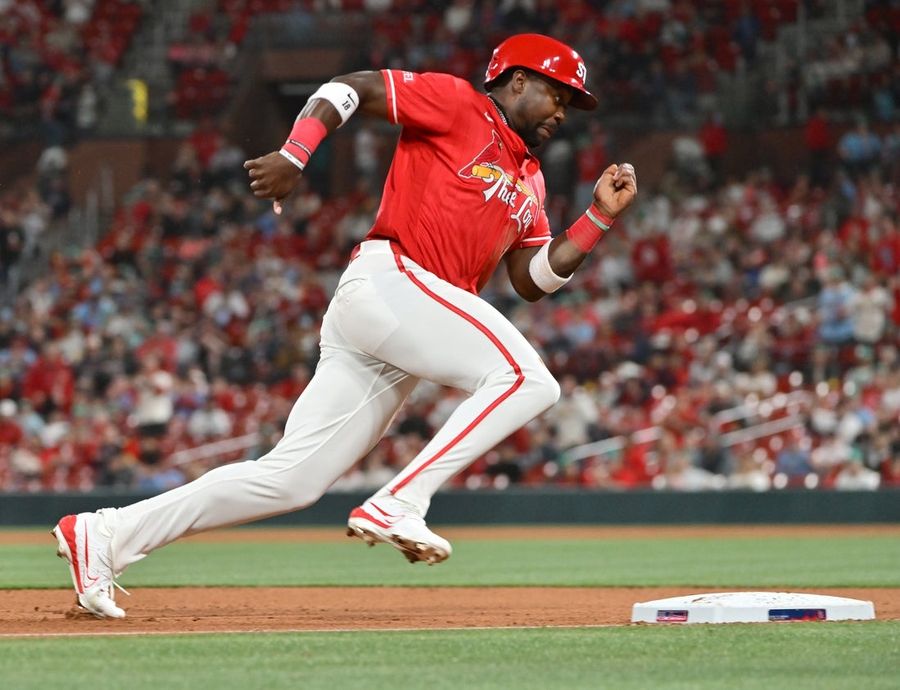
Deadspin | Dustin May’s best outing of season leads Cardinals past Red Sox  Apr 10, 2026; St. Louis, Missouri, USA;  St. Louis Cardinals right fielder Jordan Walker (18) heads to third base and then home in the fifth inning against the Boston Red Sox at Busch Stadium. Mandatory Credit: Tim Vizer-Imagn Images   Dustin May pitched six solid innings as the St. Louis Cardinals edged the visiting Boston Red Sox 3-2 on Friday in the opener of a three-game weekend series.  Jordan Walker went 2-for-4 with a run to help lead St. Louis, which had an 8-5 advantage in hits and won its third straight game. Ramon Urias crossed the plate twice, and Jose Fermin knocked in the decisive run in the fifth inning.  May (1-2), who entered the game with a 15.95 ERA through two starts, allowed two runs (one earned) on four hits and no walks. He struck out four.  Riley O’Brien pitched a 1-2-3 ninth to post his fourth save out of the Cardinals’ bullpen, which allowed just one hit across three scoreless innings.  Wilyer Abreu went 2-for-4 and Trevor Story drove in a run and stole home for the Red Sox, whose two-game winning streak ended.  In the St. Louis second inning, Ramon Urias ripped a leadoff double off Ceddanne Rafaela’s glove in deep center field, and the Cardinals loaded the bases with no outs. Boston starter Connelly Early limited the damage to just a single run, which scored on Victor Scott II’s sacrifice fly.  Early ended the inning with a strikeout, just as he did in each of his four full frames. The southpaw threw 86 pitches in his 4 1/3-inning stint, striking out five while allowing one run on five hits and two walks.   After May set the Red Sox down in order for his first 1-2-3 inning of the season in the third, the Red Sox moved in front with a two-run fourth.  Masataka Yoshida led off with a line single to right, and after Abreu’s one-out hit, Story plated the tying run on a fielder’s-choice grounder. Story advanced to second on a throwing error on the play, and he moved to third on Marcelo Mayer’s single before sliding home safely on a successful double steal.  Early departed after retiring the leadoff batter in the fifth, but the next three batters reached against Zack Kelly. St. Louis got a game-tying RBI single to left from Thomas Saggese, who entered the game after Masyn Winn got hit by a pitch. A wild pitch from Kelly moved put two runners into scoring position, and Fermin’s sacrifice fly made it a 3-2 lead.  Kelly (0-1) yielded two runs in two-thirds of an inning.  May retired the last seven hitters he faced before reliever Ryne Stanek continued that trend in the seventh. Rafaela opened the eighth with a double inside the right field line, and Boston had runners on the corners with one out, but JoJo Romero stranded them.  –Field Level Media   #Deadspin #Dustin #Mays #outing #season #leads #Cardinals #Red #Sox

Deadspin | Dustin May’s best outing of season leads Cardinals past Red Sox
Deadspin | Dustin May’s best outing of season leads Cardinals past Red Sox  Apr 10, 2026; St. Louis, Missouri, USA;  St. Louis Cardinals right fielder Jordan Walker (18) heads to third base and then home in the fifth inning against the Boston Red Sox at Busch Stadium. Mandatory Credit: Tim Vizer-Imagn Images   Dustin May pitched six solid innings as the St. Louis Cardinals edged the visiting Boston Red Sox 3-2 on Friday in the opener of a three-game weekend series.  Jordan Walker went 2-for-4 with a run to help lead St. Louis, which had an 8-5 advantage in hits and won its third straight game. Ramon Urias crossed the plate twice, and Jose Fermin knocked in the decisive run in the fifth inning.  May (1-2), who entered the game with a 15.95 ERA through two starts, allowed two runs (one earned) on four hits and no walks. He struck out four.  Riley O’Brien pitched a 1-2-3 ninth to post his fourth save out of the Cardinals’ bullpen, which allowed just one hit across three scoreless innings.  Wilyer Abreu went 2-for-4 and Trevor Story drove in a run and stole home for the Red Sox, whose two-game winning streak ended.  In the St. Louis second inning, Ramon Urias ripped a leadoff double off Ceddanne Rafaela’s glove in deep center field, and the Cardinals loaded the bases with no outs. Boston starter Connelly Early limited the damage to just a single run, which scored on Victor Scott II’s sacrifice fly.  Early ended the inning with a strikeout, just as he did in each of his four full frames. The southpaw threw 86 pitches in his 4 1/3-inning stint, striking out five while allowing one run on five hits and two walks.   After May set the Red Sox down in order for his first 1-2-3 inning of the season in the third, the Red Sox moved in front with a two-run fourth.  Masataka Yoshida led off with a line single to right, and after Abreu’s one-out hit, Story plated the tying run on a fielder’s-choice grounder. Story advanced to second on a throwing error on the play, and he moved to third on Marcelo Mayer’s single before sliding home safely on a successful double steal.  Early departed after retiring the leadoff batter in the fifth, but the next three batters reached against Zack Kelly. St. Louis got a game-tying RBI single to left from Thomas Saggese, who entered the game after Masyn Winn got hit by a pitch. A wild pitch from Kelly moved put two runners into scoring position, and Fermin’s sacrifice fly made it a 3-2 lead.  Kelly (0-1) yielded two runs in two-thirds of an inning.  May retired the last seven hitters he faced before reliever Ryne Stanek continued that trend in the seventh. Rafaela opened the eighth with a double inside the right field line, and Boston had runners on the corners with one out, but JoJo Romero stranded them.  –Field Level Media   #Deadspin #Dustin #Mays #outing #season #leads #Cardinals #Red #SoxApr 10, 2026; St. Louis, Missouri, USA; St. Louis Cardinals right fielder Jordan Walker (18) heads to third base and then home in the fifth inning against the Boston Red Sox at Busch Stadium. Mandatory Credit: Tim Vizer-Imagn Images
Dustin May pitched six solid innings as the St. Louis Cardinals edged the visiting Boston Red Sox 3-2 on Friday in the opener of a three-game weekend series.

Jordan Walker went 2-for-4 with a run to help lead St. Louis, which had an 8-5 advantage in hits and won its third straight game. Ramon Urias crossed the plate twice, and Jose Fermin knocked in the decisive run in the fifth inning.

May (1-2), who entered the game with a 15.95 ERA through two starts, allowed two runs (one earned) on four hits and no walks. He struck out four.

Riley O’Brien pitched a 1-2-3 ninth to post his fourth save out of the Cardinals’ bullpen, which allowed just one hit across three scoreless innings.

Wilyer Abreu went 2-for-4 and Trevor Story drove in a run and stole home for the Red Sox, whose two-game winning streak ended.

In the St. Louis second inning, Ramon Urias ripped a leadoff double off Ceddanne Rafaela’s glove in deep center field, and the Cardinals loaded the bases with no outs. Boston starter Connelly Early limited the damage to just a single run, which scored on Victor Scott II’s sacrifice fly.


Early ended the inning with a strikeout, just as he did in each of his four full frames. The southpaw threw 86 pitches in his 4 1/3-inning stint, striking out five while allowing one run on five hits and two walks.

After May set the Red Sox down in order for his first 1-2-3 inning of the season in the third, the Red Sox moved in front with a two-run fourth.

Masataka Yoshida led off with a line single to right, and after Abreu’s one-out hit, Story plated the tying run on a fielder’s-choice grounder. Story advanced to second on a throwing error on the play, and he moved to third on Marcelo Mayer’s single before sliding home safely on a successful double steal.

Early departed after retiring the leadoff batter in the fifth, but the next three batters reached against Zack Kelly. St. Louis got a game-tying RBI single to left from Thomas Saggese, who entered the game after Masyn Winn got hit by a pitch. A wild pitch from Kelly moved put two runners into scoring position, and Fermin’s sacrifice fly made it a 3-2 lead.

Kelly (0-1) yielded two runs in two-thirds of an inning.

May retired the last seven hitters he faced before reliever Ryne Stanek continued that trend in the seventh. Rafaela opened the eighth with a double inside the right field line, and Boston had runners on the corners with one out, but JoJo Romero stranded them.

–Field Level Media

#Deadspin #Dustin #Mays #outing #season #leads #Cardinals #Red #Sox

Apr 10, 2026; St. Louis, Missouri, USA; St. Louis Cardinals right fielder Jordan Walker (18) heads to third base and then home in the fifth inning against the Boston Red Sox at Busch Stadium. Mandatory Credit: Tim Vizer-Imagn Images

Dustin May pitched six solid innings as the St. Louis Cardinals edged the visiting Boston Red Sox 3-2 on Friday in the opener of a three-game weekend series.

Jordan Walker went 2-for-4 with a run to help lead St. Louis, which had an 8-5 advantage in hits and won its third straight game. Ramon Urias crossed the plate twice, and Jose Fermin knocked in the decisive run in the fifth inning.

May (1-2), who entered the game with a 15.95 ERA through two starts, allowed two runs (one earned) on four hits and no walks. He struck out four.

Riley O’Brien pitched a 1-2-3 ninth to post his fourth save out of the Cardinals’ bullpen, which allowed just one hit across three scoreless innings.

Wilyer Abreu went 2-for-4 and Trevor Story drove in a run and stole home for the Red Sox, whose two-game winning streak ended.

In the St. Louis second inning, Ramon Urias ripped a leadoff double off Ceddanne Rafaela’s glove in deep center field, and the Cardinals loaded the bases with no outs. Boston starter Connelly Early limited the damage to just a single run, which scored on Victor Scott II’s sacrifice fly.

Early ended the inning with a strikeout, just as he did in each of his four full frames. The southpaw threw 86 pitches in his 4 1/3-inning stint, striking out five while allowing one run on five hits and two walks.

After May set the Red Sox down in order for his first 1-2-3 inning of the season in the third, the Red Sox moved in front with a two-run fourth.

Masataka Yoshida led off with a line single to right, and after Abreu’s one-out hit, Story plated the tying run on a fielder’s-choice grounder. Story advanced to second on a throwing error on the play, and he moved to third on Marcelo Mayer’s single before sliding home safely on a successful double steal.

Early departed after retiring the leadoff batter in the fifth, but the next three batters reached against Zack Kelly. St. Louis got a game-tying RBI single to left from Thomas Saggese, who entered the game after Masyn Winn got hit by a pitch. A wild pitch from Kelly moved put two runners into scoring position, and Fermin’s sacrifice fly made it a 3-2 lead.

Kelly (0-1) yielded two runs in two-thirds of an inning.

May retired the last seven hitters he faced before reliever Ryne Stanek continued that trend in the seventh. Rafaela opened the eighth with a double inside the right field line, and Boston had runners on the corners with one out, but JoJo Romero stranded them.

–Field Level Media

Source link
#Deadspin #Dustin #Mays #outing #season #leads #Cardinals #Red #Sox

Previous post

PBKS vs SRH, IPL 2026: Punjab Kings’ batters overpower Sunrisers Hyderabad to continue unbeaten run <div id="content-body-70851327" itemprop="articleBody"><p>Just hours after the Artemis II crew splashed down from their historic journey around the moon, a few willow-wielders took guard at the Maharaja Yadavindra Singh Stadium as if they were determined to send some cricket balls back into the lunar orbit.</p><p>A mammoth 442 runs were plundered by the Punjab Kings and Sunrisers Hyderabad batters, at the end of which PBKS triumphed by six wickets.</p><p>While Abhishek Sharma’s 28-ball 74 (5×4, 8×6) proved the launchpad for SRH’s 219 for six, Priyansh Arya (57, 20b, 5×4, 5×6), Prabhsimran Singh (51, 25b, 4×4, 4×6) and Shreyas Iyer (69 n.o., 33b, 5×4, 5×6) ensured PBKS remained unbeaten in IPL 2026.</p><p>SRH left-arm wrist-spinner Shivang Kumar bowled with gumption (three for 33) and priced out the PBKS top-order, but the damage had been done before he was introduced in the seventh over.</p><p>While Abhishek’s half-century came off 18 balls, Priyansh’s came two deliveries faster. It took the SRH openers 3.4 overs to breach the 50-run mark; their counterparts did it in 3.3.</p><p>The blistering start made the rest of the run chase a formality as skipper Shreyas took the side home with seven deliveries to spare.</p><p><b>ALSO READ: <a href="https://sportstar.thehindu.com/cricket/ipl/lucknow-super-giants-vs-gujarat-titans-ipl-2026-lsg-v-gt-match-preview-ekana/article70850769.ece" target="_self">IPL 2026: Resurgent Lucknow Super Giants looks for a win at home against Gujarat Titans</a></b></p><p>Earlier, Arshdeep Singh’s 10-ball second over went for 24 runs, as Abhishek punished anything in his arc with elan.</p><p>Part-time bowler Shashank Singh proved to be the unlikely circuit-breaker after the 105-run PowerPlay.</p><p>The gentle medium-pacer repaid the faith shown by Shreyas by having Travis Head (38, 23b, 5×4, 1×6) and Abhishek caught in the deep.</p><p>After being 120 for no loss in eight overs, the SRH innings decelerated.</p><p>Arshdeep’s 14th over saw two contrasting fielding efforts. While Marcus Stoinis dropped Heinrich Klaasen at long-off, Marco Jansen ran to his right and plucked the ball out of thin air with his outstretched right hand to send back Ishan Kishan.</p><p>The nonchalance of the whole exercise saw Arshdeep cover his mouth and sit down in disbelief, though the crowd’s reaction was to stand up and applaud.</p><p>Later, Klaasen tossed his bat in the air out of frustration after his scratchy innings (39, 33b, 1×4, 1×6). Perhaps he knew that his knock would come back to haunt his team.</p><p>The PBKS willow-wielders made sure of it.</p><p class="publish-time" id="end-of-article">Published on Apr 11, 2026</p></div> #PBKS #SRH #IPL #Punjab #Kings #batters #overpower #Sunrisers #Hyderabad #continue #unbeaten #run

Next post

IPL 2026 — Sanju Samson hits first fifty for Chennai Super Kings <div id="content-body-70851488" itemprop="articleBody"><p>Sanju Samson on Saturday scored his maiden half century for five-time champion Chennai Super Kings during the side’s IPL 2026 match against Delhi Capitals at the M.A. Chidambaram Stadium.</p><p>The 31-year-old was traded in by CSK from Rajasthan Royals ahead of the season, in place of Ravindra Jadeja and Sam Curran.</p><p>Samson picked boundaries against Mukesh Kumar, Auqib Nabi, Lungi Ngidi, T. Natarajan and Axar Patel as he raced away to a 26-ball half century.</p><p>This was the 27th fifty for Samson in the IPL. He had scored 19 for RR and another seven for Delhi Capitals. Samson also has three centuries under his belt.</p><p class="publish-time" id="end-of-article">Published on Apr 11, 2026</p></div> #IPL #Sanju #Samson #hits #fifty #Chennai #Super #Kings

Los Angeles Lakers v Golden State Warriors

SAN FRANCISCO, CALIFORNIA – OCTOBER 18: Anthony Davis #3 and LeBron James #23 of the Los Angeles Lakers sit on the bench during their preseason game against the Golden State Warriors at Chase Center on October 18, 2024 in San Francisco, California. NOTE TO USER: User expressly acknowledges and agrees that, by downloading and/or using this photograph, user is consenting to the terms and conditions of the Getty Images License Agreement. (Photo by Ezra Shaw/Getty Images)
Getty Images

#Warriors #LeBron #James #sweepstakes #bailing #Anthony #Davis #trade #report">Warriors out of LeBron James sweepstakes after bailing on Anthony Davis trade, per report  SAN FRANCISCO, CALIFORNIA – OCTOBER 18: Anthony Davis #3 and LeBron James #23 of the Los Angeles Lakers sit on the bench during their preseason game against the Golden State Warriors at Chase Center on October 18, 2024 in San Francisco, California. NOTE TO USER: User expressly acknowledges and agrees that, by downloading and/or using this photograph, user is consenting to the terms and conditions of the Getty Images License Agreement. (Photo by Ezra Shaw/Getty Images) Getty Images  #Warriors #LeBron #James #sweepstakes #bailing #Anthony #Davis #trade #report

There is a particular kind of grief in sport that has little to do with defeat. It arrives not when a team loses, but when time finally catches up with the players who once seemed beyond its reach.

This FIFA World Cup has felt full of those moments. Luka Modric leaving with Croatia gone. Cristiano Ronaldo, who for so long bent matches to his will, walking away from another one. Manuel Neuer, for years football’s last great illusionist in goal, no longer carrying the same aura of permanence.

These were not just elite footballers; they were part of the architecture of the sport, figures so omnipresent for so long that they came to feel less like athletes and more like fixed points in our own lives.

Every major tournament had them somewhere in the frame. Modric gliding through the midfield with that strange combination of delicacy and defiance, Ronaldo summoning goals and drama with the force of habit, Neuer redrawing what a sweeper-goalkeeper could be. Their brilliance stretched across so many summers that it began to feel normal, and that was perhaps the greatest trick of all. Greatness, repeated often enough, starts to masquerade as permanence.

But sport, with its occasional cruelty, has a way of reminding us that permanence was never part of the bargain. This World Cup has exposed the mortality of men who once seemed immune to it. The legs do not always obey. The recovery takes a little longer. The moments still come, but not always on command. The body, eventually, begins to negotiate with the mind. And so, one by one, the stars who seemed to live outside time have begun to look what they always were underneath the myth: mere mortals.

Perhaps that is why Lionel Messi’s presence in this tournament feels so affecting. He is still here, still resisting and still playing as if he has found a private loophole in the laws of ageing. Around him, Argentina carries the urgency of men who know exactly what this moment means.

In Messi’s defiance, a generation watches its heroes grow old – FIFA World Cup 2026  There is a particular kind of grief in sport that has little to do with defeat. It arrives not when a team loses, but when time finally catches up with the players who once seemed beyond its reach.This FIFA World Cup has felt full of those moments. Luka Modric leaving with Croatia gone. Cristiano Ronaldo, who for so long bent matches to his will, walking away from another one. Manuel Neuer, for years football’s last great illusionist in goal, no longer carrying the same aura of permanence.These were not just elite footballers; they were part of the architecture of the sport, figures so omnipresent for so long that they came to feel less like athletes and more like fixed points in our own lives.Every major tournament had them somewhere in the frame. Modric gliding through the midfield with that strange combination of delicacy and defiance, Ronaldo summoning goals and drama with the force of habit, Neuer redrawing what a sweeper-goalkeeper could be. Their brilliance stretched across so many summers that it began to feel normal, and that was perhaps the greatest trick of all. Greatness, repeated often enough, starts to masquerade as permanence.But sport, with its occasional cruelty, has a way of reminding us that permanence was never part of the bargain. This World Cup has exposed the mortality of men who once seemed immune to it. The legs do not always obey. The recovery takes a little longer. The moments still come, but not always on command. The body, eventually, begins to negotiate with the mind. And so, one by one, the stars who seemed to live outside time have begun to look what they always were underneath the myth: mere mortals.Perhaps that is why Lionel Messi’s presence in this tournament feels so affecting. He is still here, still resisting and still playing as if he has found a private loophole in the laws of ageing. Around him, Argentina carries the urgency of men who know exactly what this moment means.Against time: Lionel Messi remains the old giant still holding back the inevitable with that familiar left foot and stubborn shrug of genius.
                                                            | Photo Credit: 
                                AFP
                            Against time: Lionel Messi remains the old giant still holding back the inevitable with that familiar left foot and stubborn shrug of genius.
                                                            | Photo Credit: 
                                AFP
                                                    There is something faintly familiar in the way his teammates seem to be fighting not only for a trophy but for the dignity of a farewell, for the chance to make sure that when their great man finally walks away, he does so with his head held high. It recalls, in its own way, those late-career years of Sachin Tendulkar, when Indian cricket seemed to understand that every innings, every tour, every knock might be one of the last chances to honour a figure who had towered over its imagination for a generation.The runs still mattered, but so did the ceremony of care around him, the collective desire to protect the ending of someone who had given so much. Maybe that is why these exits land differently as we get older. When we were younger, sporting heroes felt eternal. Tendulkar seemed as though he had always existed and somehow always would.ALSO READ: Europe holds firm grip over World Cup destiny with Messi’s Argentina offering resistanceThen came Roger Federer, making tennis look too graceful to be real; Rafael Nadal, with his fury, faith and wounded endurance; Novak Djokovic, the last great disruptor who has also now reached the stage where each tournament is shadowed by the thought of how many more are left.In cricket, Virat Kohli has moved from prodigy to elder statesman, playing just one format. And now football’s old gods, too, are being claimed by time. Their ageing has a way of confronting us with our own. You notice the greying beard in the mirror. The stiffness in your back after a long flight. The niggling pain in the knee after a walk up to the stadium media centre.Passing seasons: Virat Kohli, Roger Federer, and Rafael Nadal, who once felt eternal, now stand as reminders that even the brightest eras must eventually yield to time.
                                                            | Photo Credit: 
                                AFP, GETTY IMAGES, AP
                            Passing seasons: Virat Kohli, Roger Federer, and Rafael Nadal, who once felt eternal, now stand as reminders that even the brightest eras must eventually yield to time.
                                                            | Photo Credit: 
                                AFP, GETTY IMAGES, AP
                                                    You tell yourself these are manageable, that life is carrying on, that the body can be bargained with. But then you watch Modric labour where once he floated, or Ronaldo rage against the limits of legs that no longer answer every call, and that illusion breaks a little. If they can fade, then what chance do the rest of us have? These men were supposed to outlast ordinary rules. We were the mortals.That, perhaps, is why sport’s greatest stars matter beyond medals and numbers. They do not simply entertain us; they become markers of our own passage through life. We remember where we were when Tendulkar made that hundred, when Federer glided through another Wimbledon fortnight, when Nadal clawed through another five-set war, when Ronaldo leapt above defenders as though gravity could be compromised, when Messi finally won a World Cup.They become companions to our years. Their careers are the thread that stitches together school and work, first love and heartbreak, new cities and old friendships, parents growing older and children growing up. And so, when they begin to disappear, it is never only their ending we are mourning. It is the passing of our own seasons too.Maybe that is the ache running through this World Cup. Beneath the tactics and scorelines, beneath the noise of a new generation arriving, there is the unmistakable sense of an era loosening its grip. The old giants are not all gone yet. Messi remains, still defiant, holding back the inevitable with that familiar left foot and that stubborn little shrug of genius. But even his survival sharpens the feeling rather than easing it. It reminds us that the ending is near.And perhaps that is enough for now. One last run. One last attempt to hold the darkness off a little longer. One last tournament in which the old gods can still be glimpsed in the light, even if the light is beginning to fade.Published on Jul 08, 2026  #Messis #defiance #generation #watches #heroes #grow #FIFA #World #Cup

Against time: Lionel Messi remains the old giant still holding back the inevitable with that familiar left foot and stubborn shrug of genius. | Photo Credit: AFP

lightbox-info

Against time: Lionel Messi remains the old giant still holding back the inevitable with that familiar left foot and stubborn shrug of genius. | Photo Credit: AFP

There is something faintly familiar in the way his teammates seem to be fighting not only for a trophy but for the dignity of a farewell, for the chance to make sure that when their great man finally walks away, he does so with his head held high. It recalls, in its own way, those late-career years of Sachin Tendulkar, when Indian cricket seemed to understand that every innings, every tour, every knock might be one of the last chances to honour a figure who had towered over its imagination for a generation.

The runs still mattered, but so did the ceremony of care around him, the collective desire to protect the ending of someone who had given so much. Maybe that is why these exits land differently as we get older. When we were younger, sporting heroes felt eternal. Tendulkar seemed as though he had always existed and somehow always would.

ALSO READ: Europe holds firm grip over World Cup destiny with Messi’s Argentina offering resistance

Then came Roger Federer, making tennis look too graceful to be real; Rafael Nadal, with his fury, faith and wounded endurance; Novak Djokovic, the last great disruptor who has also now reached the stage where each tournament is shadowed by the thought of how many more are left.

In cricket, Virat Kohli has moved from prodigy to elder statesman, playing just one format. And now football’s old gods, too, are being claimed by time. Their ageing has a way of confronting us with our own. You notice the greying beard in the mirror. The stiffness in your back after a long flight. The niggling pain in the knee after a walk up to the stadium media centre.

Passing seasons: Virat Kohli, Roger Federer, and Rafael Nadal, who once felt eternal, now stand as reminders that even the brightest eras must eventually yield to time.

Passing seasons: Virat Kohli, Roger Federer, and Rafael Nadal, who once felt eternal, now stand as reminders that even the brightest eras must eventually yield to time. | Photo Credit: AFP, GETTY IMAGES, AP

lightbox-info

Passing seasons: Virat Kohli, Roger Federer, and Rafael Nadal, who once felt eternal, now stand as reminders that even the brightest eras must eventually yield to time. | Photo Credit: AFP, GETTY IMAGES, AP

You tell yourself these are manageable, that life is carrying on, that the body can be bargained with. But then you watch Modric labour where once he floated, or Ronaldo rage against the limits of legs that no longer answer every call, and that illusion breaks a little. If they can fade, then what chance do the rest of us have? These men were supposed to outlast ordinary rules. We were the mortals.

That, perhaps, is why sport’s greatest stars matter beyond medals and numbers. They do not simply entertain us; they become markers of our own passage through life. We remember where we were when Tendulkar made that hundred, when Federer glided through another Wimbledon fortnight, when Nadal clawed through another five-set war, when Ronaldo leapt above defenders as though gravity could be compromised, when Messi finally won a World Cup.

They become companions to our years. Their careers are the thread that stitches together school and work, first love and heartbreak, new cities and old friendships, parents growing older and children growing up. And so, when they begin to disappear, it is never only their ending we are mourning. It is the passing of our own seasons too.

Maybe that is the ache running through this World Cup. Beneath the tactics and scorelines, beneath the noise of a new generation arriving, there is the unmistakable sense of an era loosening its grip. The old giants are not all gone yet. Messi remains, still defiant, holding back the inevitable with that familiar left foot and that stubborn little shrug of genius. But even his survival sharpens the feeling rather than easing it. It reminds us that the ending is near.

And perhaps that is enough for now. One last run. One last attempt to hold the darkness off a little longer. One last tournament in which the old gods can still be glimpsed in the light, even if the light is beginning to fade.

Published on Jul 08, 2026

#Messis #defiance #generation #watches #heroes #grow #FIFA #World #Cup">In Messi’s defiance, a generation watches its heroes grow old – FIFA World Cup 2026  There is a particular kind of grief in sport that has little to do with defeat. It arrives not when a team loses, but when time finally catches up with the players who once seemed beyond its reach.This FIFA World Cup has felt full of those moments. Luka Modric leaving with Croatia gone. Cristiano Ronaldo, who for so long bent matches to his will, walking away from another one. Manuel Neuer, for years football’s last great illusionist in goal, no longer carrying the same aura of permanence.These were not just elite footballers; they were part of the architecture of the sport, figures so omnipresent for so long that they came to feel less like athletes and more like fixed points in our own lives.Every major tournament had them somewhere in the frame. Modric gliding through the midfield with that strange combination of delicacy and defiance, Ronaldo summoning goals and drama with the force of habit, Neuer redrawing what a sweeper-goalkeeper could be. Their brilliance stretched across so many summers that it began to feel normal, and that was perhaps the greatest trick of all. Greatness, repeated often enough, starts to masquerade as permanence.But sport, with its occasional cruelty, has a way of reminding us that permanence was never part of the bargain. This World Cup has exposed the mortality of men who once seemed immune to it. The legs do not always obey. The recovery takes a little longer. The moments still come, but not always on command. The body, eventually, begins to negotiate with the mind. And so, one by one, the stars who seemed to live outside time have begun to look what they always were underneath the myth: mere mortals.Perhaps that is why Lionel Messi’s presence in this tournament feels so affecting. He is still here, still resisting and still playing as if he has found a private loophole in the laws of ageing. Around him, Argentina carries the urgency of men who know exactly what this moment means.Against time: Lionel Messi remains the old giant still holding back the inevitable with that familiar left foot and stubborn shrug of genius.
                                                            | Photo Credit: 
                                AFP
                            Against time: Lionel Messi remains the old giant still holding back the inevitable with that familiar left foot and stubborn shrug of genius.
                                                            | Photo Credit: 
                                AFP
                                                    There is something faintly familiar in the way his teammates seem to be fighting not only for a trophy but for the dignity of a farewell, for the chance to make sure that when their great man finally walks away, he does so with his head held high. It recalls, in its own way, those late-career years of Sachin Tendulkar, when Indian cricket seemed to understand that every innings, every tour, every knock might be one of the last chances to honour a figure who had towered over its imagination for a generation.The runs still mattered, but so did the ceremony of care around him, the collective desire to protect the ending of someone who had given so much. Maybe that is why these exits land differently as we get older. When we were younger, sporting heroes felt eternal. Tendulkar seemed as though he had always existed and somehow always would.ALSO READ: Europe holds firm grip over World Cup destiny with Messi’s Argentina offering resistanceThen came Roger Federer, making tennis look too graceful to be real; Rafael Nadal, with his fury, faith and wounded endurance; Novak Djokovic, the last great disruptor who has also now reached the stage where each tournament is shadowed by the thought of how many more are left.In cricket, Virat Kohli has moved from prodigy to elder statesman, playing just one format. And now football’s old gods, too, are being claimed by time. Their ageing has a way of confronting us with our own. You notice the greying beard in the mirror. The stiffness in your back after a long flight. The niggling pain in the knee after a walk up to the stadium media centre.Passing seasons: Virat Kohli, Roger Federer, and Rafael Nadal, who once felt eternal, now stand as reminders that even the brightest eras must eventually yield to time.
                                                            | Photo Credit: 
                                AFP, GETTY IMAGES, AP
                            Passing seasons: Virat Kohli, Roger Federer, and Rafael Nadal, who once felt eternal, now stand as reminders that even the brightest eras must eventually yield to time.
                                                            | Photo Credit: 
                                AFP, GETTY IMAGES, AP
                                                    You tell yourself these are manageable, that life is carrying on, that the body can be bargained with. But then you watch Modric labour where once he floated, or Ronaldo rage against the limits of legs that no longer answer every call, and that illusion breaks a little. If they can fade, then what chance do the rest of us have? These men were supposed to outlast ordinary rules. We were the mortals.That, perhaps, is why sport’s greatest stars matter beyond medals and numbers. They do not simply entertain us; they become markers of our own passage through life. We remember where we were when Tendulkar made that hundred, when Federer glided through another Wimbledon fortnight, when Nadal clawed through another five-set war, when Ronaldo leapt above defenders as though gravity could be compromised, when Messi finally won a World Cup.They become companions to our years. Their careers are the thread that stitches together school and work, first love and heartbreak, new cities and old friendships, parents growing older and children growing up. And so, when they begin to disappear, it is never only their ending we are mourning. It is the passing of our own seasons too.Maybe that is the ache running through this World Cup. Beneath the tactics and scorelines, beneath the noise of a new generation arriving, there is the unmistakable sense of an era loosening its grip. The old giants are not all gone yet. Messi remains, still defiant, holding back the inevitable with that familiar left foot and that stubborn little shrug of genius. But even his survival sharpens the feeling rather than easing it. It reminds us that the ending is near.And perhaps that is enough for now. One last run. One last attempt to hold the darkness off a little longer. One last tournament in which the old gods can still be glimpsed in the light, even if the light is beginning to fade.Published on Jul 08, 2026  #Messis #defiance #generation #watches #heroes #grow #FIFA #World #Cup

Europe holds firm grip over World Cup destiny with Messi’s Argentina offering resistance

Then came Roger Federer, making tennis look too graceful to be real; Rafael Nadal, with his fury, faith and wounded endurance; Novak Djokovic, the last great disruptor who has also now reached the stage where each tournament is shadowed by the thought of how many more are left.

In cricket, Virat Kohli has moved from prodigy to elder statesman, playing just one format. And now football’s old gods, too, are being claimed by time. Their ageing has a way of confronting us with our own. You notice the greying beard in the mirror. The stiffness in your back after a long flight. The niggling pain in the knee after a walk up to the stadium media centre.

Passing seasons: Virat Kohli, Roger Federer, and Rafael Nadal, who once felt eternal, now stand as reminders that even the brightest eras must eventually yield to time.

Passing seasons: Virat Kohli, Roger Federer, and Rafael Nadal, who once felt eternal, now stand as reminders that even the brightest eras must eventually yield to time. | Photo Credit: AFP, GETTY IMAGES, AP

lightbox-info

Passing seasons: Virat Kohli, Roger Federer, and Rafael Nadal, who once felt eternal, now stand as reminders that even the brightest eras must eventually yield to time. | Photo Credit: AFP, GETTY IMAGES, AP

You tell yourself these are manageable, that life is carrying on, that the body can be bargained with. But then you watch Modric labour where once he floated, or Ronaldo rage against the limits of legs that no longer answer every call, and that illusion breaks a little. If they can fade, then what chance do the rest of us have? These men were supposed to outlast ordinary rules. We were the mortals.

That, perhaps, is why sport’s greatest stars matter beyond medals and numbers. They do not simply entertain us; they become markers of our own passage through life. We remember where we were when Tendulkar made that hundred, when Federer glided through another Wimbledon fortnight, when Nadal clawed through another five-set war, when Ronaldo leapt above defenders as though gravity could be compromised, when Messi finally won a World Cup.

They become companions to our years. Their careers are the thread that stitches together school and work, first love and heartbreak, new cities and old friendships, parents growing older and children growing up. And so, when they begin to disappear, it is never only their ending we are mourning. It is the passing of our own seasons too.

Maybe that is the ache running through this World Cup. Beneath the tactics and scorelines, beneath the noise of a new generation arriving, there is the unmistakable sense of an era loosening its grip. The old giants are not all gone yet. Messi remains, still defiant, holding back the inevitable with that familiar left foot and that stubborn little shrug of genius. But even his survival sharpens the feeling rather than easing it. It reminds us that the ending is near.

And perhaps that is enough for now. One last run. One last attempt to hold the darkness off a little longer. One last tournament in which the old gods can still be glimpsed in the light, even if the light is beginning to fade.

Published on Jul 08, 2026

#Messis #defiance #generation #watches #heroes #grow #FIFA #World #Cup">In Messi’s defiance, a generation watches its heroes grow old – FIFA World Cup 2026

There is a particular kind of grief in sport that has little to do with defeat. It arrives not when a team loses, but when time finally catches up with the players who once seemed beyond its reach.

This FIFA World Cup has felt full of those moments. Luka Modric leaving with Croatia gone. Cristiano Ronaldo, who for so long bent matches to his will, walking away from another one. Manuel Neuer, for years football’s last great illusionist in goal, no longer carrying the same aura of permanence.

These were not just elite footballers; they were part of the architecture of the sport, figures so omnipresent for so long that they came to feel less like athletes and more like fixed points in our own lives.

Every major tournament had them somewhere in the frame. Modric gliding through the midfield with that strange combination of delicacy and defiance, Ronaldo summoning goals and drama with the force of habit, Neuer redrawing what a sweeper-goalkeeper could be. Their brilliance stretched across so many summers that it began to feel normal, and that was perhaps the greatest trick of all. Greatness, repeated often enough, starts to masquerade as permanence.

But sport, with its occasional cruelty, has a way of reminding us that permanence was never part of the bargain. This World Cup has exposed the mortality of men who once seemed immune to it. The legs do not always obey. The recovery takes a little longer. The moments still come, but not always on command. The body, eventually, begins to negotiate with the mind. And so, one by one, the stars who seemed to live outside time have begun to look what they always were underneath the myth: mere mortals.

Perhaps that is why Lionel Messi’s presence in this tournament feels so affecting. He is still here, still resisting and still playing as if he has found a private loophole in the laws of ageing. Around him, Argentina carries the urgency of men who know exactly what this moment means.

In Messi’s defiance, a generation watches its heroes grow old – FIFA World Cup 2026  There is a particular kind of grief in sport that has little to do with defeat. It arrives not when a team loses, but when time finally catches up with the players who once seemed beyond its reach.This FIFA World Cup has felt full of those moments. Luka Modric leaving with Croatia gone. Cristiano Ronaldo, who for so long bent matches to his will, walking away from another one. Manuel Neuer, for years football’s last great illusionist in goal, no longer carrying the same aura of permanence.These were not just elite footballers; they were part of the architecture of the sport, figures so omnipresent for so long that they came to feel less like athletes and more like fixed points in our own lives.Every major tournament had them somewhere in the frame. Modric gliding through the midfield with that strange combination of delicacy and defiance, Ronaldo summoning goals and drama with the force of habit, Neuer redrawing what a sweeper-goalkeeper could be. Their brilliance stretched across so many summers that it began to feel normal, and that was perhaps the greatest trick of all. Greatness, repeated often enough, starts to masquerade as permanence.But sport, with its occasional cruelty, has a way of reminding us that permanence was never part of the bargain. This World Cup has exposed the mortality of men who once seemed immune to it. The legs do not always obey. The recovery takes a little longer. The moments still come, but not always on command. The body, eventually, begins to negotiate with the mind. And so, one by one, the stars who seemed to live outside time have begun to look what they always were underneath the myth: mere mortals.Perhaps that is why Lionel Messi’s presence in this tournament feels so affecting. He is still here, still resisting and still playing as if he has found a private loophole in the laws of ageing. Around him, Argentina carries the urgency of men who know exactly what this moment means.Against time: Lionel Messi remains the old giant still holding back the inevitable with that familiar left foot and stubborn shrug of genius.
                                                            | Photo Credit: 
                                AFP
                            Against time: Lionel Messi remains the old giant still holding back the inevitable with that familiar left foot and stubborn shrug of genius.
                                                            | Photo Credit: 
                                AFP
                                                    There is something faintly familiar in the way his teammates seem to be fighting not only for a trophy but for the dignity of a farewell, for the chance to make sure that when their great man finally walks away, he does so with his head held high. It recalls, in its own way, those late-career years of Sachin Tendulkar, when Indian cricket seemed to understand that every innings, every tour, every knock might be one of the last chances to honour a figure who had towered over its imagination for a generation.The runs still mattered, but so did the ceremony of care around him, the collective desire to protect the ending of someone who had given so much. Maybe that is why these exits land differently as we get older. When we were younger, sporting heroes felt eternal. Tendulkar seemed as though he had always existed and somehow always would.ALSO READ: Europe holds firm grip over World Cup destiny with Messi’s Argentina offering resistanceThen came Roger Federer, making tennis look too graceful to be real; Rafael Nadal, with his fury, faith and wounded endurance; Novak Djokovic, the last great disruptor who has also now reached the stage where each tournament is shadowed by the thought of how many more are left.In cricket, Virat Kohli has moved from prodigy to elder statesman, playing just one format. And now football’s old gods, too, are being claimed by time. Their ageing has a way of confronting us with our own. You notice the greying beard in the mirror. The stiffness in your back after a long flight. The niggling pain in the knee after a walk up to the stadium media centre.Passing seasons: Virat Kohli, Roger Federer, and Rafael Nadal, who once felt eternal, now stand as reminders that even the brightest eras must eventually yield to time.
                                                            | Photo Credit: 
                                AFP, GETTY IMAGES, AP
                            Passing seasons: Virat Kohli, Roger Federer, and Rafael Nadal, who once felt eternal, now stand as reminders that even the brightest eras must eventually yield to time.
                                                            | Photo Credit: 
                                AFP, GETTY IMAGES, AP
                                                    You tell yourself these are manageable, that life is carrying on, that the body can be bargained with. But then you watch Modric labour where once he floated, or Ronaldo rage against the limits of legs that no longer answer every call, and that illusion breaks a little. If they can fade, then what chance do the rest of us have? These men were supposed to outlast ordinary rules. We were the mortals.That, perhaps, is why sport’s greatest stars matter beyond medals and numbers. They do not simply entertain us; they become markers of our own passage through life. We remember where we were when Tendulkar made that hundred, when Federer glided through another Wimbledon fortnight, when Nadal clawed through another five-set war, when Ronaldo leapt above defenders as though gravity could be compromised, when Messi finally won a World Cup.They become companions to our years. Their careers are the thread that stitches together school and work, first love and heartbreak, new cities and old friendships, parents growing older and children growing up. And so, when they begin to disappear, it is never only their ending we are mourning. It is the passing of our own seasons too.Maybe that is the ache running through this World Cup. Beneath the tactics and scorelines, beneath the noise of a new generation arriving, there is the unmistakable sense of an era loosening its grip. The old giants are not all gone yet. Messi remains, still defiant, holding back the inevitable with that familiar left foot and that stubborn little shrug of genius. But even his survival sharpens the feeling rather than easing it. It reminds us that the ending is near.And perhaps that is enough for now. One last run. One last attempt to hold the darkness off a little longer. One last tournament in which the old gods can still be glimpsed in the light, even if the light is beginning to fade.Published on Jul 08, 2026  #Messis #defiance #generation #watches #heroes #grow #FIFA #World #Cup

Against time: Lionel Messi remains the old giant still holding back the inevitable with that familiar left foot and stubborn shrug of genius. | Photo Credit: AFP

lightbox-info

Against time: Lionel Messi remains the old giant still holding back the inevitable with that familiar left foot and stubborn shrug of genius. | Photo Credit: AFP

There is something faintly familiar in the way his teammates seem to be fighting not only for a trophy but for the dignity of a farewell, for the chance to make sure that when their great man finally walks away, he does so with his head held high. It recalls, in its own way, those late-career years of Sachin Tendulkar, when Indian cricket seemed to understand that every innings, every tour, every knock might be one of the last chances to honour a figure who had towered over its imagination for a generation.

The runs still mattered, but so did the ceremony of care around him, the collective desire to protect the ending of someone who had given so much. Maybe that is why these exits land differently as we get older. When we were younger, sporting heroes felt eternal. Tendulkar seemed as though he had always existed and somehow always would.

ALSO READ: Europe holds firm grip over World Cup destiny with Messi’s Argentina offering resistance

Then came Roger Federer, making tennis look too graceful to be real; Rafael Nadal, with his fury, faith and wounded endurance; Novak Djokovic, the last great disruptor who has also now reached the stage where each tournament is shadowed by the thought of how many more are left.

In cricket, Virat Kohli has moved from prodigy to elder statesman, playing just one format. And now football’s old gods, too, are being claimed by time. Their ageing has a way of confronting us with our own. You notice the greying beard in the mirror. The stiffness in your back after a long flight. The niggling pain in the knee after a walk up to the stadium media centre.

Passing seasons: Virat Kohli, Roger Federer, and Rafael Nadal, who once felt eternal, now stand as reminders that even the brightest eras must eventually yield to time.

Passing seasons: Virat Kohli, Roger Federer, and Rafael Nadal, who once felt eternal, now stand as reminders that even the brightest eras must eventually yield to time. | Photo Credit: AFP, GETTY IMAGES, AP

lightbox-info

Passing seasons: Virat Kohli, Roger Federer, and Rafael Nadal, who once felt eternal, now stand as reminders that even the brightest eras must eventually yield to time. | Photo Credit: AFP, GETTY IMAGES, AP

You tell yourself these are manageable, that life is carrying on, that the body can be bargained with. But then you watch Modric labour where once he floated, or Ronaldo rage against the limits of legs that no longer answer every call, and that illusion breaks a little. If they can fade, then what chance do the rest of us have? These men were supposed to outlast ordinary rules. We were the mortals.

That, perhaps, is why sport’s greatest stars matter beyond medals and numbers. They do not simply entertain us; they become markers of our own passage through life. We remember where we were when Tendulkar made that hundred, when Federer glided through another Wimbledon fortnight, when Nadal clawed through another five-set war, when Ronaldo leapt above defenders as though gravity could be compromised, when Messi finally won a World Cup.

They become companions to our years. Their careers are the thread that stitches together school and work, first love and heartbreak, new cities and old friendships, parents growing older and children growing up. And so, when they begin to disappear, it is never only their ending we are mourning. It is the passing of our own seasons too.

Maybe that is the ache running through this World Cup. Beneath the tactics and scorelines, beneath the noise of a new generation arriving, there is the unmistakable sense of an era loosening its grip. The old giants are not all gone yet. Messi remains, still defiant, holding back the inevitable with that familiar left foot and that stubborn little shrug of genius. But even his survival sharpens the feeling rather than easing it. It reminds us that the ending is near.

And perhaps that is enough for now. One last run. One last attempt to hold the darkness off a little longer. One last tournament in which the old gods can still be glimpsed in the light, even if the light is beginning to fade.

Published on Jul 08, 2026

#Messis #defiance #generation #watches #heroes #grow #FIFA #World #Cup

Post Comment