×
IPL 2026: Living on the edge—The risk and reward of the wide yorker  In Punjab Kings’ first match of the Indian Premier League (IPL) 2026 against Gujarat Titans, Arshdeep Singh was entrusted with the final over of the first innings. The left-arm pacer ended up bowling an 11-ball over—the joint-longest in IPL history. Across that over, Arshdeep largely tried to go short and wide to the left-handed Rahul Tewatia, which resulted in multiple wides; against Rashid Khan, he switched to yorkers, both at the stumps and outside off.Twenty-four matches into the season, the PBKS bowler has delivered the most wides so far—18, four more than Mumbai Indians’ Shardul Thakur, who has 14. Of Shardul’s 14 wides, 13 have come while bowling wide outside off. In Arshdeep’s case, 11 of his 18 wides have come while operating around the tramline outside off.What often shows up as poor execution is more often than not a calculated attempt to keep the ball away from the batter, with modern T20 batters favouring the leg side for their big shots. Even deliveries just outside off stump are now being whipped over the on-side with ease, thanks to the natural swing arc and high bat speeds.In response, the bowlers have moved further away from the stumps, forcing batters to manufacture shots square of the wicket, particularly in the point and square regions, where power is harder to generate.“If the batter is set and there’s a longer boundary on one side, you use that and keep the ball away from their strength. If the batter is new, you attack the stumps. When you feel the yorker is coming out well, you go for it. When the batter is set, you go wide. You just have to adapt before the batter knows what’s coming,” Arshdeep explained after the win over Mumbai Indians on Thursday, after picking three for 22, continuing to back his wide line tactic. That constant adjustment, though, often pushes bowlers closer to the wide line, where the margin for error is smaller.One such option is the wide yorker, aimed just inside the wide line outside off stump. It is one of the hardest deliveries to execute because of the precision required—more often than not, it ends up as a full toss or a slot ball. But when nailed, it is extremely difficult to put away.“That’s probably one of the hardest balls to bowl,” Delhi Capitals pacer Lungi Ngidi said. “You’ve got to land it on a yorker length, just inside the wide line – everything has to be perfect. If you land that ball, it’s a huge advantage in an over.”Since his IPL debut in 2019, Arshdeep has bowled 99 wide-line yorkers – joint second-most with Harshal Patel, with Avesh Khan leading the list with 104.Despite the risk, the tactic remains popular. In the 2021 season, there was a more than 46 per cent increase in attempts to bowl around the tramline, resulting in 114 wides—an 87 per cent jump from the previous season’s 61.The shift became even more pronounced in 2022, when wides across the season rose from 521 to 861—jump of 340 (65.26 per cent). While part of that increase was due to the addition of two teams—Gujarat Titans and Lucknow Super Giants—and therefore more matches, venue conditions also played a major role.That season was held across four venues in Maharashtra during the league stage—the Wankhede Stadium, DY Patil Stadium, Brabourne Stadium, and MCA International Stadium. Smaller boundaries, flatter pitches, and heavy dew made execution significantly harder for bowlers.Since that spike, the increase from 2023 onwards has appeared more gradual. The average number of wides per season, which stood at around 530 until 2021, has now risen to roughly 810. The ongoing 2026 season is not included in that average, but it has already seen 289 wides in 24 matches and is projected to finish close to 900 at the current rate of six wides per innings.What changed in 2023?That season introduced the option for teams to review wides and no-balls. With technology in play, the margin for error has reduced. As Ngidi pointed out: “The margins are very small. The review system helps now because earlier, you could bowl it correctly and still get called for a wide.”Ahead of the 2025 season, another tweak followed—the introduction of the moving wide guideline, where the line shifts with the batter’s position. This has made adjudication clearer for umpires and players alike. It made an immediate impact last season as the wides bowled while attempting the wide yorker dropped from 182 to 101.For bowlers like Arshdeep, operating around the wide tramline is a risky trade-off, where the margin for error is minimal. But in a format where batters dictate terms, it is a risk they are willing to take. Because on the days it comes off, the wide yorker can set up the game for the bowling side. Published on Apr 17, 2026  #IPL #Living #edgeThe #risk #reward #wide #yorker

IPL 2026: Living on the edge—The risk and reward of the wide yorker

In Punjab Kings’ first match of the Indian Premier League (IPL) 2026 against Gujarat Titans, Arshdeep Singh was entrusted with the final over of the first innings. The left-arm pacer ended up bowling an 11-ball over—the joint-longest in IPL history. Across that over, Arshdeep largely tried to go short and wide to the left-handed Rahul Tewatia, which resulted in multiple wides; against Rashid Khan, he switched to yorkers, both at the stumps and outside off.

Twenty-four matches into the season, the PBKS bowler has delivered the most wides so far—18, four more than Mumbai Indians’ Shardul Thakur, who has 14. Of Shardul’s 14 wides, 13 have come while bowling wide outside off. In Arshdeep’s case, 11 of his 18 wides have come while operating around the tramline outside off.

What often shows up as poor execution is more often than not a calculated attempt to keep the ball away from the batter, with modern T20 batters favouring the leg side for their big shots. Even deliveries just outside off stump are now being whipped over the on-side with ease, thanks to the natural swing arc and high bat speeds.

In response, the bowlers have moved further away from the stumps, forcing batters to manufacture shots square of the wicket, particularly in the point and square regions, where power is harder to generate.

“If the batter is set and there’s a longer boundary on one side, you use that and keep the ball away from their strength. If the batter is new, you attack the stumps. When you feel the yorker is coming out well, you go for it. When the batter is set, you go wide. You just have to adapt before the batter knows what’s coming,” Arshdeep explained after the win over Mumbai Indians on Thursday, after picking three for 22, continuing to back his wide line tactic. 

That constant adjustment, though, often pushes bowlers closer to the wide line, where the margin for error is smaller.

One such option is the wide yorker, aimed just inside the wide line outside off stump. It is one of the hardest deliveries to execute because of the precision required—more often than not, it ends up as a full toss or a slot ball. But when nailed, it is extremely difficult to put away.

“That’s probably one of the hardest balls to bowl,” Delhi Capitals pacer Lungi Ngidi said. “You’ve got to land it on a yorker length, just inside the wide line – everything has to be perfect. If you land that ball, it’s a huge advantage in an over.”

Since his IPL debut in 2019, Arshdeep has bowled 99 wide-line yorkers – joint second-most with Harshal Patel, with Avesh Khan leading the list with 104.

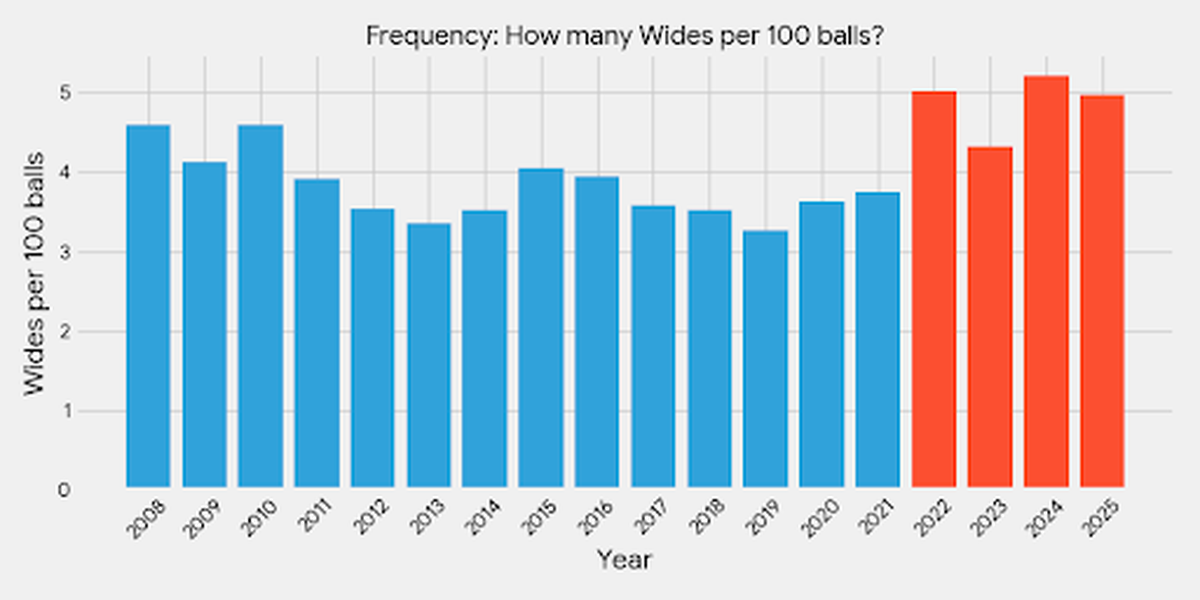
Despite the risk, the tactic remains popular. In the 2021 season, there was a more than 46 per cent increase in attempts to bowl around the tramline, resulting in 114 wides—an 87 per cent jump from the previous season’s 61.
IPL 2026: Living on the edge—The risk and reward of the wide yorker  In Punjab Kings’ first match of the Indian Premier League (IPL) 2026 against Gujarat Titans, Arshdeep Singh was entrusted with the final over of the first innings. The left-arm pacer ended up bowling an 11-ball over—the joint-longest in IPL history. Across that over, Arshdeep largely tried to go short and wide to the left-handed Rahul Tewatia, which resulted in multiple wides; against Rashid Khan, he switched to yorkers, both at the stumps and outside off.Twenty-four matches into the season, the PBKS bowler has delivered the most wides so far—18, four more than Mumbai Indians’ Shardul Thakur, who has 14. Of Shardul’s 14 wides, 13 have come while bowling wide outside off. In Arshdeep’s case, 11 of his 18 wides have come while operating around the tramline outside off.What often shows up as poor execution is more often than not a calculated attempt to keep the ball away from the batter, with modern T20 batters favouring the leg side for their big shots. Even deliveries just outside off stump are now being whipped over the on-side with ease, thanks to the natural swing arc and high bat speeds.In response, the bowlers have moved further away from the stumps, forcing batters to manufacture shots square of the wicket, particularly in the point and square regions, where power is harder to generate.“If the batter is set and there’s a longer boundary on one side, you use that and keep the ball away from their strength. If the batter is new, you attack the stumps. When you feel the yorker is coming out well, you go for it. When the batter is set, you go wide. You just have to adapt before the batter knows what’s coming,” Arshdeep explained after the win over Mumbai Indians on Thursday, after picking three for 22, continuing to back his wide line tactic. That constant adjustment, though, often pushes bowlers closer to the wide line, where the margin for error is smaller.One such option is the wide yorker, aimed just inside the wide line outside off stump. It is one of the hardest deliveries to execute because of the precision required—more often than not, it ends up as a full toss or a slot ball. But when nailed, it is extremely difficult to put away.“That’s probably one of the hardest balls to bowl,” Delhi Capitals pacer Lungi Ngidi said. “You’ve got to land it on a yorker length, just inside the wide line – everything has to be perfect. If you land that ball, it’s a huge advantage in an over.”Since his IPL debut in 2019, Arshdeep has bowled 99 wide-line yorkers – joint second-most with Harshal Patel, with Avesh Khan leading the list with 104.Despite the risk, the tactic remains popular. In the 2021 season, there was a more than 46 per cent increase in attempts to bowl around the tramline, resulting in 114 wides—an 87 per cent jump from the previous season’s 61.The shift became even more pronounced in 2022, when wides across the season rose from 521 to 861—jump of 340 (65.26 per cent). While part of that increase was due to the addition of two teams—Gujarat Titans and Lucknow Super Giants—and therefore more matches, venue conditions also played a major role.That season was held across four venues in Maharashtra during the league stage—the Wankhede Stadium, DY Patil Stadium, Brabourne Stadium, and MCA International Stadium. Smaller boundaries, flatter pitches, and heavy dew made execution significantly harder for bowlers.Since that spike, the increase from 2023 onwards has appeared more gradual. The average number of wides per season, which stood at around 530 until 2021, has now risen to roughly 810. The ongoing 2026 season is not included in that average, but it has already seen 289 wides in 24 matches and is projected to finish close to 900 at the current rate of six wides per innings.What changed in 2023?That season introduced the option for teams to review wides and no-balls. With technology in play, the margin for error has reduced. As Ngidi pointed out: “The margins are very small. The review system helps now because earlier, you could bowl it correctly and still get called for a wide.”Ahead of the 2025 season, another tweak followed—the introduction of the moving wide guideline, where the line shifts with the batter’s position. This has made adjudication clearer for umpires and players alike. It made an immediate impact last season as the wides bowled while attempting the wide yorker dropped from 182 to 101.For bowlers like Arshdeep, operating around the wide tramline is a risky trade-off, where the margin for error is minimal. But in a format where batters dictate terms, it is a risk they are willing to take. Because on the days it comes off, the wide yorker can set up the game for the bowling side. Published on Apr 17, 2026  #IPL #Living #edgeThe #risk #reward #wide #yorker
The shift became even more pronounced in 2022, when wides across the season rose from 521 to 861—jump of 340 (65.26 per cent). While part of that increase was due to the addition of two teams—Gujarat Titans and Lucknow Super Giants—and therefore more matches, venue conditions also played a major role.

That season was held across four venues in Maharashtra during the league stage—the Wankhede Stadium, DY Patil Stadium, Brabourne Stadium, and MCA International Stadium. Smaller boundaries, flatter pitches, and heavy dew made execution significantly harder for bowlers.

Since that spike, the increase from 2023 onwards has appeared more gradual. The average number of wides per season, which stood at around 530 until 2021, has now risen to roughly 810. The ongoing 2026 season is not included in that average, but it has already seen 289 wides in 24 matches and is projected to finish close to 900 at the current rate of six wides per innings.

What changed in 2023?

That season introduced the option for teams to review wides and no-balls. With technology in play, the margin for error has reduced. As Ngidi pointed out: “The margins are very small. The review system helps now because earlier, you could bowl it correctly and still get called for a wide.”

Ahead of the 2025 season, another tweak followed—the introduction of the moving wide guideline, where the line shifts with the batter’s position. This has made adjudication clearer for umpires and players alike. It made an immediate impact last season as the wides bowled while attempting the wide yorker dropped from 182 to 101.

For bowlers like Arshdeep, operating around the wide tramline is a risky trade-off, where the margin for error is minimal. But in a format where batters dictate terms, it is a risk they are willing to take. Because on the days it comes off, the wide yorker can set up the game for the bowling side. 

Published on Apr 17, 2026

#IPL #Living #edgeThe #risk #reward #wide #yorker

In Punjab Kings’ first match of the Indian Premier League (IPL) 2026 against Gujarat Titans, Arshdeep Singh was entrusted with the final over of the first innings. The left-arm pacer ended up bowling an 11-ball over—the joint-longest in IPL history. Across that over, Arshdeep largely tried to go short and wide to the left-handed Rahul Tewatia, which resulted in multiple wides; against Rashid Khan, he switched to yorkers, both at the stumps and outside off.

Twenty-four matches into the season, the PBKS bowler has delivered the most wides so far—18, four more than Mumbai Indians’ Shardul Thakur, who has 14. Of Shardul’s 14 wides, 13 have come while bowling wide outside off. In Arshdeep’s case, 11 of his 18 wides have come while operating around the tramline outside off.

What often shows up as poor execution is more often than not a calculated attempt to keep the ball away from the batter, with modern T20 batters favouring the leg side for their big shots. Even deliveries just outside off stump are now being whipped over the on-side with ease, thanks to the natural swing arc and high bat speeds.

In response, the bowlers have moved further away from the stumps, forcing batters to manufacture shots square of the wicket, particularly in the point and square regions, where power is harder to generate.

“If the batter is set and there’s a longer boundary on one side, you use that and keep the ball away from their strength. If the batter is new, you attack the stumps. When you feel the yorker is coming out well, you go for it. When the batter is set, you go wide. You just have to adapt before the batter knows what’s coming,” Arshdeep explained after the win over Mumbai Indians on Thursday, after picking three for 22, continuing to back his wide line tactic. 

That constant adjustment, though, often pushes bowlers closer to the wide line, where the margin for error is smaller.

One such option is the wide yorker, aimed just inside the wide line outside off stump. It is one of the hardest deliveries to execute because of the precision required—more often than not, it ends up as a full toss or a slot ball. But when nailed, it is extremely difficult to put away.

“That’s probably one of the hardest balls to bowl,” Delhi Capitals pacer Lungi Ngidi said. “You’ve got to land it on a yorker length, just inside the wide line – everything has to be perfect. If you land that ball, it’s a huge advantage in an over.”

Since his IPL debut in 2019, Arshdeep has bowled 99 wide-line yorkers – joint second-most with Harshal Patel, with Avesh Khan leading the list with 104.

Despite the risk, the tactic remains popular. In the 2021 season, there was a more than 46 per cent increase in attempts to bowl around the tramline, resulting in 114 wides—an 87 per cent jump from the previous season’s 61.

The shift became even more pronounced in 2022, when wides across the season rose from 521 to 861—jump of 340 (65.26 per cent). While part of that increase was due to the addition of two teams—Gujarat Titans and Lucknow Super Giants—and therefore more matches, venue conditions also played a major role.

That season was held across four venues in Maharashtra during the league stage—the Wankhede Stadium, DY Patil Stadium, Brabourne Stadium, and MCA International Stadium. Smaller boundaries, flatter pitches, and heavy dew made execution significantly harder for bowlers.

Since that spike, the increase from 2023 onwards has appeared more gradual. The average number of wides per season, which stood at around 530 until 2021, has now risen to roughly 810. The ongoing 2026 season is not included in that average, but it has already seen 289 wides in 24 matches and is projected to finish close to 900 at the current rate of six wides per innings.

What changed in 2023?

That season introduced the option for teams to review wides and no-balls. With technology in play, the margin for error has reduced. As Ngidi pointed out: “The margins are very small. The review system helps now because earlier, you could bowl it correctly and still get called for a wide.”

Ahead of the 2025 season, another tweak followed—the introduction of the moving wide guideline, where the line shifts with the batter’s position. This has made adjudication clearer for umpires and players alike. It made an immediate impact last season as the wides bowled while attempting the wide yorker dropped from 182 to 101.

For bowlers like Arshdeep, operating around the wide tramline is a risky trade-off, where the margin for error is minimal. But in a format where batters dictate terms, it is a risk they are willing to take. Because on the days it comes off, the wide yorker can set up the game for the bowling side. 

Published on Apr 17, 2026

Source link
#IPL #Living #edgeThe #risk #reward #wide #yorker

USA v Australia: Group D - FIFA World Cup 2026

SEATTLE, WASHINGTON – JUNE 19: Alex Freeman of United States celebrates with his teammates after scoring his team’s second goal during the FIFA World Cup 2026 Group D match between USA and Australia at Seattle Stadium on June 19, 2026 in Seattle, Washington. (Photo by MB Media/Getty Images)
Getty Images

#USMNT #history #World #Cup #victory #Australia">USMNT makes history in World Cup victory over Australia  SEATTLE, WASHINGTON – JUNE 19: Alex Freeman of United States celebrates with his teammates after scoring his team’s second goal during the FIFA World Cup 2026 Group D match between USA and Australia at Seattle Stadium on June 19, 2026 in Seattle, Washington. (Photo by MB Media/Getty Images) Getty Images  #USMNT #history #World #Cup #victory #Australia

The road to the Tri-Nation Series final has been anything but straightforward for India-A and Sri Lanka-A. Having already shared two fiercely contested encounters, the teams now face off one last time with the silverware on the line.

Sri Lanka-A pushed India-A hard in both meetings, with the most recent clash going all the way to a Super Over. Now India will hope its top order, particularly teenage sensation Vaibhav Sooryavanshi, finally delivers.

READ: Tilak Varma: ‘It only matters how good I am today and how good I can be tomorrow’

Fresh from a stunning IPL 2026 campaign that earned him the Orange Cap, Sooryavanshi has endured a lean run in the tournament so far, scoring 117 runs in four innings. Yet the team management remains firmly behind him. On the eve of the final, despite it being an optional training session, captain Tilak Varma, Prabhsimran Singh and Sooryavanshi spent considerable time in the nets at the Rangiri International Stadium, fine-tuning their preparations for the biggest game of the tournament.

While India’s batters will need to be more consistent, the team could consider bringing in hit-the-deck pacer Ashok Sharma. However, much will depend on the spin attack making the most of the conditions that have increasingly favoured slow bowlers throughout the competition.

For Sri Lanka-A, the challenge has been closing out games. Having let winning positions slip more than once during the tournament, the host will be keen to avoid a repeat in the final. Avishka Fernando arrives with confidence after his century against Afghanistan-A, while Niroshan Dickwella’s experience at the top will be crucial. The middle order, too, will need to hold its nerve under pressure.

The last time these teams met, tempers flared, emotions spilt over, and the result was decided only after a dramatic Super Over. On Sunday, though, both sides will look to leave the noise behind and focus on the bigger prize — lifting the trophy in front of what is expected to be another lively Dambulla crowd.

(The match starts at 10 am local time and IST)

Published on Jun 20, 2026

#TriNation #Series #India #hopes #top #order #fire #summit #clash #Sri #Lanka">Tri-Nation Series: India A hopes for top order to fire in summit clash against Sri Lanka A  The road to the Tri-Nation Series final has been anything but straightforward for India-A and Sri Lanka-A. Having already shared two fiercely contested encounters, the teams now face off one last time with the silverware on the line.Sri Lanka-A pushed India-A hard in both meetings, with the most recent clash going all the way to a Super Over. Now India will hope its top order, particularly teenage sensation Vaibhav Sooryavanshi, finally delivers.READ: Tilak Varma: ‘It only matters how good I am today and how good I can be tomorrow’Fresh from a stunning IPL 2026 campaign that earned him the Orange Cap, Sooryavanshi has endured a lean run in the tournament so far, scoring 117 runs in four innings. Yet the team management remains firmly behind him. On the eve of the final, despite it being an optional training session, captain Tilak Varma, Prabhsimran Singh and Sooryavanshi spent considerable time in the nets at the Rangiri International Stadium, fine-tuning their preparations for the biggest game of the tournament.While India’s batters will need to be more consistent, the team could consider bringing in hit-the-deck pacer Ashok Sharma. However, much will depend on the spin attack making the most of the conditions that have increasingly favoured slow bowlers throughout the competition.For Sri Lanka-A, the challenge has been closing out games. Having let winning positions slip more than once during the tournament, the host will be keen to avoid a repeat in the final. Avishka Fernando arrives with confidence after his century against Afghanistan-A, while Niroshan Dickwella’s experience at the top will be crucial. The middle order, too, will need to hold its nerve under pressure.The last time these teams met, tempers flared, emotions spilt over, and the result was decided only after a dramatic Super Over. On Sunday, though, both sides will look to leave the noise behind and focus on the bigger prize — lifting the trophy in front of what is expected to be another lively Dambulla crowd.(The match starts at 10 am local time and IST)Published on Jun 20, 2026  #TriNation #Series #India #hopes #top #order #fire #summit #clash #Sri #Lanka

Tilak Varma: ‘It only matters how good I am today and how good I can be tomorrow’

Fresh from a stunning IPL 2026 campaign that earned him the Orange Cap, Sooryavanshi has endured a lean run in the tournament so far, scoring 117 runs in four innings. Yet the team management remains firmly behind him. On the eve of the final, despite it being an optional training session, captain Tilak Varma, Prabhsimran Singh and Sooryavanshi spent considerable time in the nets at the Rangiri International Stadium, fine-tuning their preparations for the biggest game of the tournament.

While India’s batters will need to be more consistent, the team could consider bringing in hit-the-deck pacer Ashok Sharma. However, much will depend on the spin attack making the most of the conditions that have increasingly favoured slow bowlers throughout the competition.

For Sri Lanka-A, the challenge has been closing out games. Having let winning positions slip more than once during the tournament, the host will be keen to avoid a repeat in the final. Avishka Fernando arrives with confidence after his century against Afghanistan-A, while Niroshan Dickwella’s experience at the top will be crucial. The middle order, too, will need to hold its nerve under pressure.

The last time these teams met, tempers flared, emotions spilt over, and the result was decided only after a dramatic Super Over. On Sunday, though, both sides will look to leave the noise behind and focus on the bigger prize — lifting the trophy in front of what is expected to be another lively Dambulla crowd.

(The match starts at 10 am local time and IST)

Published on Jun 20, 2026

#TriNation #Series #India #hopes #top #order #fire #summit #clash #Sri #Lanka">Tri-Nation Series: India A hopes for top order to fire in summit clash against Sri Lanka A

The road to the Tri-Nation Series final has been anything but straightforward for India-A and Sri Lanka-A. Having already shared two fiercely contested encounters, the teams now face off one last time with the silverware on the line.

Sri Lanka-A pushed India-A hard in both meetings, with the most recent clash going all the way to a Super Over. Now India will hope its top order, particularly teenage sensation Vaibhav Sooryavanshi, finally delivers.

READ: Tilak Varma: ‘It only matters how good I am today and how good I can be tomorrow’

Fresh from a stunning IPL 2026 campaign that earned him the Orange Cap, Sooryavanshi has endured a lean run in the tournament so far, scoring 117 runs in four innings. Yet the team management remains firmly behind him. On the eve of the final, despite it being an optional training session, captain Tilak Varma, Prabhsimran Singh and Sooryavanshi spent considerable time in the nets at the Rangiri International Stadium, fine-tuning their preparations for the biggest game of the tournament.

While India’s batters will need to be more consistent, the team could consider bringing in hit-the-deck pacer Ashok Sharma. However, much will depend on the spin attack making the most of the conditions that have increasingly favoured slow bowlers throughout the competition.

For Sri Lanka-A, the challenge has been closing out games. Having let winning positions slip more than once during the tournament, the host will be keen to avoid a repeat in the final. Avishka Fernando arrives with confidence after his century against Afghanistan-A, while Niroshan Dickwella’s experience at the top will be crucial. The middle order, too, will need to hold its nerve under pressure.

The last time these teams met, tempers flared, emotions spilt over, and the result was decided only after a dramatic Super Over. On Sunday, though, both sides will look to leave the noise behind and focus on the bigger prize — lifting the trophy in front of what is expected to be another lively Dambulla crowd.

(The match starts at 10 am local time and IST)

Published on Jun 20, 2026

#TriNation #Series #India #hopes #top #order #fire #summit #clash #Sri #Lanka

Post Comment