×
IPL 2026: Living on the edge—The risk and reward of the wide yorker  In Punjab Kings’ first match of the Indian Premier League (IPL) 2026 against Gujarat Titans, Arshdeep Singh was entrusted with the final over of the first innings. The left-arm pacer ended up bowling an 11-ball over—the joint-longest in IPL history. Across that over, Arshdeep largely tried to go short and wide to the left-handed Rahul Tewatia, which resulted in multiple wides; against Rashid Khan, he switched to yorkers, both at the stumps and outside off.Twenty-four matches into the season, the PBKS bowler has delivered the most wides so far—18, four more than Mumbai Indians’ Shardul Thakur, who has 14. Of Shardul’s 14 wides, 13 have come while bowling wide outside off. In Arshdeep’s case, 11 of his 18 wides have come while operating around the tramline outside off.What often shows up as poor execution is more often than not a calculated attempt to keep the ball away from the batter, with modern T20 batters favouring the leg side for their big shots. Even deliveries just outside off stump are now being whipped over the on-side with ease, thanks to the natural swing arc and high bat speeds.In response, the bowlers have moved further away from the stumps, forcing batters to manufacture shots square of the wicket, particularly in the point and square regions, where power is harder to generate.“If the batter is set and there’s a longer boundary on one side, you use that and keep the ball away from their strength. If the batter is new, you attack the stumps. When you feel the yorker is coming out well, you go for it. When the batter is set, you go wide. You just have to adapt before the batter knows what’s coming,” Arshdeep explained after the win over Mumbai Indians on Thursday, after picking three for 22, continuing to back his wide line tactic. That constant adjustment, though, often pushes bowlers closer to the wide line, where the margin for error is smaller.One such option is the wide yorker, aimed just inside the wide line outside off stump. It is one of the hardest deliveries to execute because of the precision required—more often than not, it ends up as a full toss or a slot ball. But when nailed, it is extremely difficult to put away.“That’s probably one of the hardest balls to bowl,” Delhi Capitals pacer Lungi Ngidi said. “You’ve got to land it on a yorker length, just inside the wide line – everything has to be perfect. If you land that ball, it’s a huge advantage in an over.”Since his IPL debut in 2019, Arshdeep has bowled 99 wide-line yorkers – joint second-most with Harshal Patel, with Avesh Khan leading the list with 104.Despite the risk, the tactic remains popular. In the 2021 season, there was a more than 46 per cent increase in attempts to bowl around the tramline, resulting in 114 wides—an 87 per cent jump from the previous season’s 61.The shift became even more pronounced in 2022, when wides across the season rose from 521 to 861—jump of 340 (65.26 per cent). While part of that increase was due to the addition of two teams—Gujarat Titans and Lucknow Super Giants—and therefore more matches, venue conditions also played a major role.That season was held across four venues in Maharashtra during the league stage—the Wankhede Stadium, DY Patil Stadium, Brabourne Stadium, and MCA International Stadium. Smaller boundaries, flatter pitches, and heavy dew made execution significantly harder for bowlers.Since that spike, the increase from 2023 onwards has appeared more gradual. The average number of wides per season, which stood at around 530 until 2021, has now risen to roughly 810. The ongoing 2026 season is not included in that average, but it has already seen 289 wides in 24 matches and is projected to finish close to 900 at the current rate of six wides per innings.What changed in 2023?That season introduced the option for teams to review wides and no-balls. With technology in play, the margin for error has reduced. As Ngidi pointed out: “The margins are very small. The review system helps now because earlier, you could bowl it correctly and still get called for a wide.”Ahead of the 2025 season, another tweak followed—the introduction of the moving wide guideline, where the line shifts with the batter’s position. This has made adjudication clearer for umpires and players alike. It made an immediate impact last season as the wides bowled while attempting the wide yorker dropped from 182 to 101.For bowlers like Arshdeep, operating around the wide tramline is a risky trade-off, where the margin for error is minimal. But in a format where batters dictate terms, it is a risk they are willing to take. Because on the days it comes off, the wide yorker can set up the game for the bowling side. Published on Apr 17, 2026  #IPL #Living #edgeThe #risk #reward #wide #yorker

IPL 2026: Living on the edge—The risk and reward of the wide yorker

In Punjab Kings’ first match of the Indian Premier League (IPL) 2026 against Gujarat Titans, Arshdeep Singh was entrusted with the final over of the first innings. The left-arm pacer ended up bowling an 11-ball over—the joint-longest in IPL history. Across that over, Arshdeep largely tried to go short and wide to the left-handed Rahul Tewatia, which resulted in multiple wides; against Rashid Khan, he switched to yorkers, both at the stumps and outside off.

Twenty-four matches into the season, the PBKS bowler has delivered the most wides so far—18, four more than Mumbai Indians’ Shardul Thakur, who has 14. Of Shardul’s 14 wides, 13 have come while bowling wide outside off. In Arshdeep’s case, 11 of his 18 wides have come while operating around the tramline outside off.

What often shows up as poor execution is more often than not a calculated attempt to keep the ball away from the batter, with modern T20 batters favouring the leg side for their big shots. Even deliveries just outside off stump are now being whipped over the on-side with ease, thanks to the natural swing arc and high bat speeds.

In response, the bowlers have moved further away from the stumps, forcing batters to manufacture shots square of the wicket, particularly in the point and square regions, where power is harder to generate.

“If the batter is set and there’s a longer boundary on one side, you use that and keep the ball away from their strength. If the batter is new, you attack the stumps. When you feel the yorker is coming out well, you go for it. When the batter is set, you go wide. You just have to adapt before the batter knows what’s coming,” Arshdeep explained after the win over Mumbai Indians on Thursday, after picking three for 22, continuing to back his wide line tactic. 

That constant adjustment, though, often pushes bowlers closer to the wide line, where the margin for error is smaller.

One such option is the wide yorker, aimed just inside the wide line outside off stump. It is one of the hardest deliveries to execute because of the precision required—more often than not, it ends up as a full toss or a slot ball. But when nailed, it is extremely difficult to put away.

“That’s probably one of the hardest balls to bowl,” Delhi Capitals pacer Lungi Ngidi said. “You’ve got to land it on a yorker length, just inside the wide line – everything has to be perfect. If you land that ball, it’s a huge advantage in an over.”

Since his IPL debut in 2019, Arshdeep has bowled 99 wide-line yorkers – joint second-most with Harshal Patel, with Avesh Khan leading the list with 104.

Despite the risk, the tactic remains popular. In the 2021 season, there was a more than 46 per cent increase in attempts to bowl around the tramline, resulting in 114 wides—an 87 per cent jump from the previous season’s 61.
IPL 2026: Living on the edge—The risk and reward of the wide yorker  In Punjab Kings’ first match of the Indian Premier League (IPL) 2026 against Gujarat Titans, Arshdeep Singh was entrusted with the final over of the first innings. The left-arm pacer ended up bowling an 11-ball over—the joint-longest in IPL history. Across that over, Arshdeep largely tried to go short and wide to the left-handed Rahul Tewatia, which resulted in multiple wides; against Rashid Khan, he switched to yorkers, both at the stumps and outside off.Twenty-four matches into the season, the PBKS bowler has delivered the most wides so far—18, four more than Mumbai Indians’ Shardul Thakur, who has 14. Of Shardul’s 14 wides, 13 have come while bowling wide outside off. In Arshdeep’s case, 11 of his 18 wides have come while operating around the tramline outside off.What often shows up as poor execution is more often than not a calculated attempt to keep the ball away from the batter, with modern T20 batters favouring the leg side for their big shots. Even deliveries just outside off stump are now being whipped over the on-side with ease, thanks to the natural swing arc and high bat speeds.In response, the bowlers have moved further away from the stumps, forcing batters to manufacture shots square of the wicket, particularly in the point and square regions, where power is harder to generate.“If the batter is set and there’s a longer boundary on one side, you use that and keep the ball away from their strength. If the batter is new, you attack the stumps. When you feel the yorker is coming out well, you go for it. When the batter is set, you go wide. You just have to adapt before the batter knows what’s coming,” Arshdeep explained after the win over Mumbai Indians on Thursday, after picking three for 22, continuing to back his wide line tactic. That constant adjustment, though, often pushes bowlers closer to the wide line, where the margin for error is smaller.One such option is the wide yorker, aimed just inside the wide line outside off stump. It is one of the hardest deliveries to execute because of the precision required—more often than not, it ends up as a full toss or a slot ball. But when nailed, it is extremely difficult to put away.“That’s probably one of the hardest balls to bowl,” Delhi Capitals pacer Lungi Ngidi said. “You’ve got to land it on a yorker length, just inside the wide line – everything has to be perfect. If you land that ball, it’s a huge advantage in an over.”Since his IPL debut in 2019, Arshdeep has bowled 99 wide-line yorkers – joint second-most with Harshal Patel, with Avesh Khan leading the list with 104.Despite the risk, the tactic remains popular. In the 2021 season, there was a more than 46 per cent increase in attempts to bowl around the tramline, resulting in 114 wides—an 87 per cent jump from the previous season’s 61.The shift became even more pronounced in 2022, when wides across the season rose from 521 to 861—jump of 340 (65.26 per cent). While part of that increase was due to the addition of two teams—Gujarat Titans and Lucknow Super Giants—and therefore more matches, venue conditions also played a major role.That season was held across four venues in Maharashtra during the league stage—the Wankhede Stadium, DY Patil Stadium, Brabourne Stadium, and MCA International Stadium. Smaller boundaries, flatter pitches, and heavy dew made execution significantly harder for bowlers.Since that spike, the increase from 2023 onwards has appeared more gradual. The average number of wides per season, which stood at around 530 until 2021, has now risen to roughly 810. The ongoing 2026 season is not included in that average, but it has already seen 289 wides in 24 matches and is projected to finish close to 900 at the current rate of six wides per innings.What changed in 2023?That season introduced the option for teams to review wides and no-balls. With technology in play, the margin for error has reduced. As Ngidi pointed out: “The margins are very small. The review system helps now because earlier, you could bowl it correctly and still get called for a wide.”Ahead of the 2025 season, another tweak followed—the introduction of the moving wide guideline, where the line shifts with the batter’s position. This has made adjudication clearer for umpires and players alike. It made an immediate impact last season as the wides bowled while attempting the wide yorker dropped from 182 to 101.For bowlers like Arshdeep, operating around the wide tramline is a risky trade-off, where the margin for error is minimal. But in a format where batters dictate terms, it is a risk they are willing to take. Because on the days it comes off, the wide yorker can set up the game for the bowling side. Published on Apr 17, 2026  #IPL #Living #edgeThe #risk #reward #wide #yorker

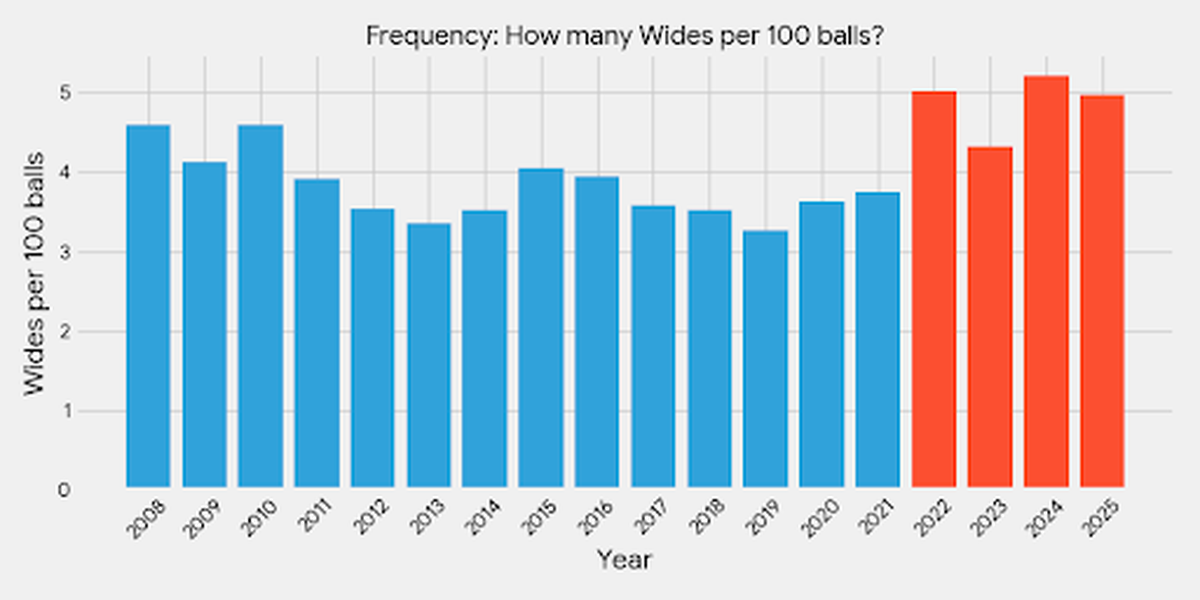
The shift became even more pronounced in 2022, when wides across the season rose from 521 to 861—jump of 340 (65.26 per cent). While part of that increase was due to the addition of two teams—Gujarat Titans and Lucknow Super Giants—and therefore more matches, venue conditions also played a major role.

That season was held across four venues in Maharashtra during the league stage—the Wankhede Stadium, DY Patil Stadium, Brabourne Stadium, and MCA International Stadium. Smaller boundaries, flatter pitches, and heavy dew made execution significantly harder for bowlers.

Since that spike, the increase from 2023 onwards has appeared more gradual. The average number of wides per season, which stood at around 530 until 2021, has now risen to roughly 810. The ongoing 2026 season is not included in that average, but it has already seen 289 wides in 24 matches and is projected to finish close to 900 at the current rate of six wides per innings.

What changed in 2023?

That season introduced the option for teams to review wides and no-balls. With technology in play, the margin for error has reduced. As Ngidi pointed out: “The margins are very small. The review system helps now because earlier, you could bowl it correctly and still get called for a wide.”

Ahead of the 2025 season, another tweak followed—the introduction of the moving wide guideline, where the line shifts with the batter’s position. This has made adjudication clearer for umpires and players alike. It made an immediate impact last season as the wides bowled while attempting the wide yorker dropped from 182 to 101.

For bowlers like Arshdeep, operating around the wide tramline is a risky trade-off, where the margin for error is minimal. But in a format where batters dictate terms, it is a risk they are willing to take. Because on the days it comes off, the wide yorker can set up the game for the bowling side. 

Published on Apr 17, 2026

#IPL #Living #edgeThe #risk #reward #wide #yorker

In Punjab Kings’ first match of the Indian Premier League (IPL) 2026 against Gujarat Titans, Arshdeep Singh was entrusted with the final over of the first innings. The left-arm pacer ended up bowling an 11-ball over—the joint-longest in IPL history. Across that over, Arshdeep largely tried to go short and wide to the left-handed Rahul Tewatia, which resulted in multiple wides; against Rashid Khan, he switched to yorkers, both at the stumps and outside off.

Twenty-four matches into the season, the PBKS bowler has delivered the most wides so far—18, four more than Mumbai Indians’ Shardul Thakur, who has 14. Of Shardul’s 14 wides, 13 have come while bowling wide outside off. In Arshdeep’s case, 11 of his 18 wides have come while operating around the tramline outside off.

What often shows up as poor execution is more often than not a calculated attempt to keep the ball away from the batter, with modern T20 batters favouring the leg side for their big shots. Even deliveries just outside off stump are now being whipped over the on-side with ease, thanks to the natural swing arc and high bat speeds.

In response, the bowlers have moved further away from the stumps, forcing batters to manufacture shots square of the wicket, particularly in the point and square regions, where power is harder to generate.

“If the batter is set and there’s a longer boundary on one side, you use that and keep the ball away from their strength. If the batter is new, you attack the stumps. When you feel the yorker is coming out well, you go for it. When the batter is set, you go wide. You just have to adapt before the batter knows what’s coming,” Arshdeep explained after the win over Mumbai Indians on Thursday, after picking three for 22, continuing to back his wide line tactic. 

That constant adjustment, though, often pushes bowlers closer to the wide line, where the margin for error is smaller.

One such option is the wide yorker, aimed just inside the wide line outside off stump. It is one of the hardest deliveries to execute because of the precision required—more often than not, it ends up as a full toss or a slot ball. But when nailed, it is extremely difficult to put away.

“That’s probably one of the hardest balls to bowl,” Delhi Capitals pacer Lungi Ngidi said. “You’ve got to land it on a yorker length, just inside the wide line – everything has to be perfect. If you land that ball, it’s a huge advantage in an over.”

Since his IPL debut in 2019, Arshdeep has bowled 99 wide-line yorkers – joint second-most with Harshal Patel, with Avesh Khan leading the list with 104.

Despite the risk, the tactic remains popular. In the 2021 season, there was a more than 46 per cent increase in attempts to bowl around the tramline, resulting in 114 wides—an 87 per cent jump from the previous season’s 61.

The shift became even more pronounced in 2022, when wides across the season rose from 521 to 861—jump of 340 (65.26 per cent). While part of that increase was due to the addition of two teams—Gujarat Titans and Lucknow Super Giants—and therefore more matches, venue conditions also played a major role.

That season was held across four venues in Maharashtra during the league stage—the Wankhede Stadium, DY Patil Stadium, Brabourne Stadium, and MCA International Stadium. Smaller boundaries, flatter pitches, and heavy dew made execution significantly harder for bowlers.

Since that spike, the increase from 2023 onwards has appeared more gradual. The average number of wides per season, which stood at around 530 until 2021, has now risen to roughly 810. The ongoing 2026 season is not included in that average, but it has already seen 289 wides in 24 matches and is projected to finish close to 900 at the current rate of six wides per innings.

What changed in 2023?

That season introduced the option for teams to review wides and no-balls. With technology in play, the margin for error has reduced. As Ngidi pointed out: “The margins are very small. The review system helps now because earlier, you could bowl it correctly and still get called for a wide.”

Ahead of the 2025 season, another tweak followed—the introduction of the moving wide guideline, where the line shifts with the batter’s position. This has made adjudication clearer for umpires and players alike. It made an immediate impact last season as the wides bowled while attempting the wide yorker dropped from 182 to 101.

For bowlers like Arshdeep, operating around the wide tramline is a risky trade-off, where the margin for error is minimal. But in a format where batters dictate terms, it is a risk they are willing to take. Because on the days it comes off, the wide yorker can set up the game for the bowling side. 

Published on Apr 17, 2026

Source link
#IPL #Living #edgeThe #risk #reward #wide #yorker

Deadspin | Oddsmakers favor Presidents’ Trophy-winning Avs to win Stanley Cup  Apr 16, 2026; Denver, Colorado, USA; Colorado Avalanche goaltender Scott Wedgewood (41) and defenseman Brett Kulak (27) celebrate defeating the Seattle Kraken at Ball Arena. Mandatory Credit: Ron Chenoy-Imagn Images   The Colorado Avalanche, out to end the miserable postseason history for Presidents’ Trophy winners, are the unanimous favorite to lift the Stanley Cup with the playoffs about to start.  The regular season concluded Thursday night, and the final two first-round playoff matchups were confirmed.  The Edmonton Oilers routed the Vancouver Canucks 6-1 and claimed second place in the Pacific Division, setting up a best-of-seven series against the Pacific’s third-place team, the Anaheim Ducks. The Kings fell 3-1 to the Calgary Flames and slipped into the Western Conference’s second wild-card slot. Los Angeles will open against the NHL-leading Avalanche on Sunday in Denver.  The other six series were already confirmed before Thursday.  In the Western Conference, the Dallas Stars will have home-ice advantage on the Minnesota Wild, and the Pacific Division champion Vegas Golden Knights will oppose the wild-card Utah Mammoth.  The Eastern Conference matchups are headed by the Metropolitan Division champion Carolina Hurricanes facing the wild-card Ottawa Senators and the Atlanta Division champion Buffalo Sabres meeting the wild-card Boston Bruins.  In an Atlantic Division matchup, the second-place Tampa Bay Lightning will oppose the Montreal Canadiens, while the second-place Pittsburgh Penguins will skate against the third-place Philadelphia Flyers in a Metropolitan Division clash.   Oddsmakers like the Avalanche’s chances of going all the way, with Colorado listed at +300 by both DraftKings and BetMGM and at +320 by FanDuel.  The winner of the Presidents’ Trophy, given to the NHL team with the most regular-season points, hasn’t won the Stanley Cup since the Chicago Blackhawks accomplished the feat in 2012-13. Since then, 10 of the 12 Presidents’ Trophy recipients bombed out of the postseason in the first or second round, with just the New York Rangers (in 2014-15 and 2023-24) advancing to the conference finals.  The Hurricanes and Lightning are next among the Cup favorites. Carolina has +475 odds at DraftKings and +500 at both BetMGM and FanDuel. Tampa Bay is +390 at FanDuel and +500 at both DraftKings and BetMGM.  All other teams have odds of at least +1000, generally headed by the Stars, Golden Knights and Oilers.  The biggest longshots are the Kings, Flyers and Ducks, all at least +5000 at each book.  –Field Level Media   #Deadspin #Oddsmakers #favor #Presidents #Trophywinning #Avs #win #Stanley #CupApr 16, 2026; Denver, Colorado, USA; Colorado Avalanche goaltender Scott Wedgewood (41) and defenseman Brett Kulak (27) celebrate defeating the Seattle Kraken at Ball Arena. Mandatory Credit: Ron Chenoy-Imagn Images

The Colorado Avalanche, out to end the miserable postseason history for Presidents’ Trophy winners, are the unanimous favorite to lift the Stanley Cup with the playoffs about to start.

The regular season concluded Thursday night, and the final two first-round playoff matchups were confirmed.

The Edmonton Oilers routed the Vancouver Canucks 6-1 and claimed second place in the Pacific Division, setting up a best-of-seven series against the Pacific’s third-place team, the Anaheim Ducks. The Kings fell 3-1 to the Calgary Flames and slipped into the Western Conference’s second wild-card slot. Los Angeles will open against the NHL-leading Avalanche on Sunday in Denver.

The other six series were already confirmed before Thursday.

In the Western Conference, the Dallas Stars will have home-ice advantage on the Minnesota Wild, and the Pacific Division champion Vegas Golden Knights will oppose the wild-card Utah Mammoth.

The Eastern Conference matchups are headed by the Metropolitan Division champion Carolina Hurricanes facing the wild-card Ottawa Senators and the Atlanta Division champion Buffalo Sabres meeting the wild-card Boston Bruins.


In an Atlantic Division matchup, the second-place Tampa Bay Lightning will oppose the Montreal Canadiens, while the second-place Pittsburgh Penguins will skate against the third-place Philadelphia Flyers in a Metropolitan Division clash.

Oddsmakers like the Avalanche’s chances of going all the way, with Colorado listed at +300 by both DraftKings and BetMGM and at +320 by FanDuel.

The winner of the Presidents’ Trophy, given to the NHL team with the most regular-season points, hasn’t won the Stanley Cup since the Chicago Blackhawks accomplished the feat in 2012-13. Since then, 10 of the 12 Presidents’ Trophy recipients bombed out of the postseason in the first or second round, with just the New York Rangers (in 2014-15 and 2023-24) advancing to the conference finals.

The Hurricanes and Lightning are next among the Cup favorites. Carolina has +475 odds at DraftKings and +500 at both BetMGM and FanDuel. Tampa Bay is +390 at FanDuel and +500 at both DraftKings and BetMGM.

All other teams have odds of at least +1000, generally headed by the Stars, Golden Knights and Oilers.

The biggest longshots are the Kings, Flyers and Ducks, all at least +5000 at each book.

–Field Level Media

#Deadspin #Oddsmakers #favor #Presidents #Trophywinning #Avs #win #Stanley #Cup">Deadspin | Oddsmakers favor Presidents’ Trophy-winning Avs to win Stanley Cup  Apr 16, 2026; Denver, Colorado, USA; Colorado Avalanche goaltender Scott Wedgewood (41) and defenseman Brett Kulak (27) celebrate defeating the Seattle Kraken at Ball Arena. Mandatory Credit: Ron Chenoy-Imagn Images   The Colorado Avalanche, out to end the miserable postseason history for Presidents’ Trophy winners, are the unanimous favorite to lift the Stanley Cup with the playoffs about to start.  The regular season concluded Thursday night, and the final two first-round playoff matchups were confirmed.  The Edmonton Oilers routed the Vancouver Canucks 6-1 and claimed second place in the Pacific Division, setting up a best-of-seven series against the Pacific’s third-place team, the Anaheim Ducks. The Kings fell 3-1 to the Calgary Flames and slipped into the Western Conference’s second wild-card slot. Los Angeles will open against the NHL-leading Avalanche on Sunday in Denver.  The other six series were already confirmed before Thursday.  In the Western Conference, the Dallas Stars will have home-ice advantage on the Minnesota Wild, and the Pacific Division champion Vegas Golden Knights will oppose the wild-card Utah Mammoth.  The Eastern Conference matchups are headed by the Metropolitan Division champion Carolina Hurricanes facing the wild-card Ottawa Senators and the Atlanta Division champion Buffalo Sabres meeting the wild-card Boston Bruins.  In an Atlantic Division matchup, the second-place Tampa Bay Lightning will oppose the Montreal Canadiens, while the second-place Pittsburgh Penguins will skate against the third-place Philadelphia Flyers in a Metropolitan Division clash.   Oddsmakers like the Avalanche’s chances of going all the way, with Colorado listed at +300 by both DraftKings and BetMGM and at +320 by FanDuel.  The winner of the Presidents’ Trophy, given to the NHL team with the most regular-season points, hasn’t won the Stanley Cup since the Chicago Blackhawks accomplished the feat in 2012-13. Since then, 10 of the 12 Presidents’ Trophy recipients bombed out of the postseason in the first or second round, with just the New York Rangers (in 2014-15 and 2023-24) advancing to the conference finals.  The Hurricanes and Lightning are next among the Cup favorites. Carolina has +475 odds at DraftKings and +500 at both BetMGM and FanDuel. Tampa Bay is +390 at FanDuel and +500 at both DraftKings and BetMGM.  All other teams have odds of at least +1000, generally headed by the Stars, Golden Knights and Oilers.  The biggest longshots are the Kings, Flyers and Ducks, all at least +5000 at each book.  –Field Level Media   #Deadspin #Oddsmakers #favor #Presidents #Trophywinning #Avs #win #Stanley #Cup

The Indian women’s cricket team will begin its preparations for this year’s T20 World Cup with a five-match T20I series, starting at Kingsmead in Durban on Friday.

The Women in Blue, the reigning 50-over World Cup champions, beat Australia 2-1 in their last T20I series assignment in February, and they will hope to carry that momentum into the upcoming series and the global showpiece, to be held in England and Wales.

South Africa, on the other hand, is coming off a 1-4 series defeat in New Zealand last month, and the Laura Wolvaardt-led side will need to bounce back if it wants to challenge Harmanpreet Kaur & Co.

The Proteas Women, who have lost 10 of the 16 completed T20Is they have played against India, will also need to overcome an unfavourable head-to-head record.

The last time the Women’s ODI World Cup 2025 finalists faced off in T20Is was in Chennai in July 2024, when the series ended in a 1-1 tie.

SA-W vs IND-W 1st T20I – Match Details

When will the first T20I between South Africa Women and India Women take place?

The first T20I between South Africa Women and India Women will be played on Friday, April 17.

Where will the first T20I between South Africa Women and India Women be held?

The first T20I between South Africa Women and India Women will be played at Kingsmead in Durban.

At what time will the first T20I between South Africa Women and India Women start?

The first T20I between South Africa Women and India Women will begin at 9:30 PM IST.

At what time will the toss take place for the first T20I between South Africa Women and India Women?

The toss for the first T20I between South Africa Women and India Women will take place at 9 PM IST.

Where to watch the live telecast of the first T20I between South Africa Women and India Women in India?

The first T20I between South Africa Women and India Women will be televised live in India on the Star Sports Network TV channels.

Where to watch the live stream of the first T20I between South Africa Women and India Women in India?

The first T20I between South Africa Women and India Women will be streamed live in India on the JioHotstar app and website.

THE SQUADS

South Africa Women: Laura Wolvaardt (c), Tazmin Brits, Annerie Dercksen, Sune Luus, Sinalo Jafta (wk), Chloe Tryon, Nadine de Klerk, Kayla Reyneke, Ayabonga Khaka, Tumi Sekhukhune, Nonkululeko Mlaba, Anneke Bosch, Ayanda Hlubi, Tebogo Macheke, Eliz-mari Marx.

India Women: Smriti Mandhana, Shafali Verma, Jemimah Rodrigues, Harmanpreet Kaur (c), Deepti Sharma, Richa Ghosh (wk), Arundhati Reddy, Shree Charani, Kranti Gaud, Shreyanka Patil, Renuka Singh Thakur, Kashvee Gautam, Anushka Sharma, Uma Chetry, Bharti Fulmali.

Published on Apr 17, 2026

#INDW #Live #Streaming #Info #1st #T20I #watch #India #Women #tour #South #Africa #match #details #squads">SA-W vs IND-W Live Streaming Info, 1st T20I: When and where to watch India Women tour of South Africa 2026; match details, squads  The Indian women’s cricket team will begin its preparations for this year’s T20 World Cup with a five-match T20I series, starting at Kingsmead in Durban on Friday.The Women in Blue, the reigning 50-over World Cup champions, beat Australia 2-1 in their last T20I series assignment in February, and they will hope to carry that momentum into the upcoming series and the global showpiece, to be held in England and Wales.South Africa, on the other hand, is coming off a 1-4 series defeat in New Zealand last month, and the Laura Wolvaardt-led side will need to bounce back if it wants to challenge Harmanpreet Kaur & Co.The Proteas Women, who have lost 10 of the 16 completed T20Is they have played against India, will also need to overcome an unfavourable head-to-head record.The last time the Women’s ODI World Cup 2025 finalists faced off in T20Is was in Chennai in July 2024, when the series ended in a 1-1 tie.SA-W vs IND-W 1st T20I – Match DetailsWhen will the first T20I between South Africa Women and India Women take place?The first T20I between South Africa Women and India Women will be played on Friday, April 17.Where will the first T20I between South Africa Women and India Women be held?The first T20I between South Africa Women and India Women will be played at Kingsmead in Durban.At what time will the first T20I between South Africa Women and India Women start?The first T20I between South Africa Women and India Women will begin at 9:30 PM IST.At what time will the toss take place for the first T20I between South Africa Women and India Women?The toss for the first T20I between South Africa Women and India Women will take place at 9 PM IST.Where to watch the live telecast of the first T20I between South Africa Women and India Women in India?The first T20I between South Africa Women and India Women will be televised live in India on the        Star Sports Network TV channels.Where to watch the live stream of the first T20I between South Africa Women and India Women in India?The first T20I between South Africa Women and India Women will be streamed live in India on the        JioHotstar app and website.THE SQUADSSouth Africa Women: Laura Wolvaardt (c), Tazmin Brits, Annerie Dercksen, Sune Luus, Sinalo Jafta (wk), Chloe Tryon, Nadine de Klerk, Kayla Reyneke, Ayabonga Khaka, Tumi Sekhukhune, Nonkululeko Mlaba, Anneke Bosch, Ayanda Hlubi, Tebogo Macheke, Eliz-mari Marx.India Women: Smriti Mandhana, Shafali Verma, Jemimah Rodrigues, Harmanpreet Kaur (c), Deepti Sharma, Richa Ghosh (wk), Arundhati Reddy, Shree Charani, Kranti Gaud, Shreyanka Patil, Renuka Singh Thakur, Kashvee Gautam, Anushka Sharma, Uma Chetry, Bharti Fulmali.Published on Apr 17, 2026  #INDW #Live #Streaming #Info #1st #T20I #watch #India #Women #tour #South #Africa #match #details #squads

Post Comment