×
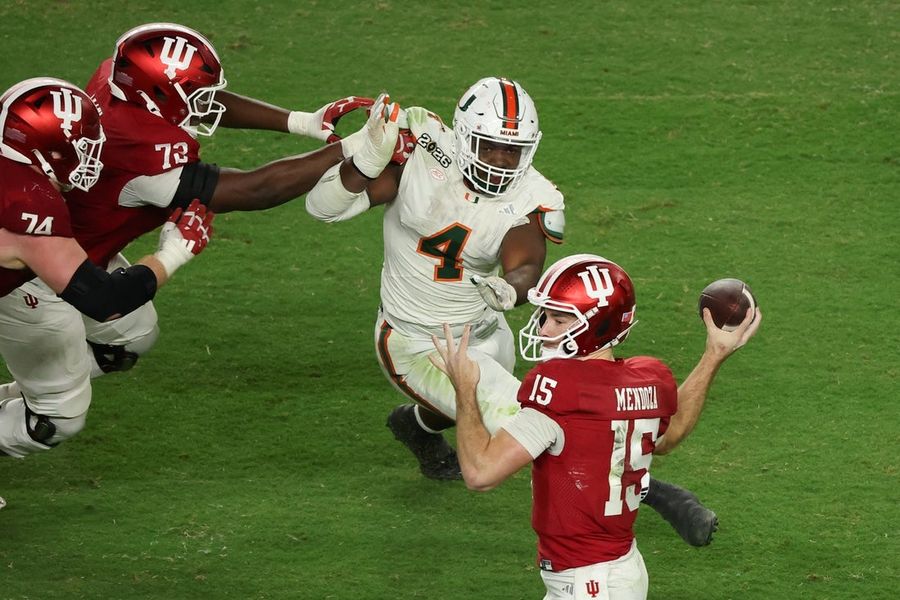
Deadspin | Projecting the top 32 picks in the 2026 NFL Draft  Indiana Hoosiers quarterback Fernando Mendoza (15) passes the ball under pressure by Miami Hurricanes defensive lineman Rueben Bain Jr. (4) in the third quarter during the College Football Playoff National Championship game at Hard Rock Stadium. Mandatory Credit: Kim Klement Neitzel-Imagn Images   For the third time in four years, a Heisman Trophy winner is going No. 1 in the NFL draft.   Indiana’s Fernando Mendoza, who led the Hoosiers to an undefeated season and national championship, is headed to the Las Vegas Raiders with the top overall pick. Traveling the route last taken by LSU’s Joe Burrow with the Heisman-natty-No. 1 pick trifecta, Mendoza is the only pro-ready quarterback in the 2026 NFL Draft.   Quarterbacks at the top are a virtual lock in the draft. This will be the 10th time it’s happened since Jameis Winston went No. 1 in 2015, and the eighth time in nine years a QB is the first player selected. Georgia defensive end Travon Walker went No. 1 in 2022.  But what happens after the Mendoza Family celebrates on Thursday night? Let’s connect some dots and project the top 32 picks in the 2026 draft. Zero anonymous general managers approved this exercise.   FIRST ROUND  1. Las Vegas Raiders  QB Fernando Mendoza, Indiana  Mendoza might be more big brain than big arm, but so was Peyton Manning. Mendoza has the makeup to stay the course for a franchise with no track record of developing a winning quarterback. He meshes well with new coach Klint Kubiak’s scheme but protection must be a bigger priority.  2. New York Jets  LB Arvell Reese, Ohio State  The QB the Jets want is headed to Las Vegas and they’re still smarting over Oregon QB Dante Moore’s decision to return for his senior season. It goes without saying, the franchise can ill-afford another Zach Wilson (No. 2 in 2021) or Blair Thomas (No. 2 in 1990) whiff. Reese is a projection because he doesn’t have a natural position, but his versatility makes him a safer bet to find a role. New York is weaponized for an overdue rebuild with five total first-round picks in 2026 and 2027.   3. Arizona Cardinals   OT Spencer Fano, Utah  Another franchise pining for a fix at QB, the Cardinals could be a bridesmaid in that pursuit and opt to reinforce the line with a position-versatile blocker or trade down.  4. Tennessee Titans  RB Jeremiyah Love, Notre Dame  Pairing Love with 2025 No. 1 pick Cam Ward puts Tennessee in a better position to compete in the sneaky solid AFC South division.  5. New York Giants  S Caleb Downs, Ohio State  As tempting as the top wide receivers in the class are in this spot, what with the specter of putting Jaxson Dart’s development on hyperdrive with Malik Nabers and a co-No. 1, new coach John Harbaugh knows a safety with Downs’ traits can become a linchpin for a defense with ample pressure providers.  6. Cleveland Browns  DE David Bailey, Texas Tech  Todd Monken will be twisting in knots if he has a pick of skill-position players but the top pass rusher in the draft is still on the board.  7. Washington Commanders  WR Carnell Tate, Ohio State  Some prefer Jordyn Tyson as their WR1 but the Commanders target Tate for his combination of size, durability and production.   8. New Orleans Saints   WR Jordyn Tyson, Arizona State  The Tyler Shough support seems genuine and the Saints were respectable in the final month of 2025. Tyson and WR1 Chris Olave, when healthy, would be a lethal 1-2 punch.  9. Kansas City Chiefs  LB Sonny Styles, Ohio State  A surprise if he’s still around. The Chiefs would have to weigh Styles’ value against the top offensive linemen left and LSU CB Mansoor Delane.  10. New York Giants  WR Makai Lemon, USC  A slot dynamo to step into the void created when Wan’Dale Robinson joined the Titans in free agency, the Giants are committed to adding weapons for Dart.  11. Miami Dolphins  DE Rueben Bain Jr., Miami   Bain plays with intensity and stays in his college stomping grounds to help re-establish dominance at the line of scrimmage as a more explosive version of Kenny Clark up front.  12. Dallas Cowboys  CB Mansoor Delane, LSU  Injuries and unpredictability at cornerback haunted the Cowboys even when the pass rush was lethal. Rumored to be a top candidate to move up for an edge, Delane is a sweet consolation prize.  13. Los Angeles Rams (via Atlanta Falcons)  OT Francis Mauigoa, Miami  A massive blocker who forwards the mission of owning the line of scrimmage and keeping Matthew Stafford from taking punishment.  14. Baltimore Ravens  OG Olaivavega Ioane, Penn State  One of the most competitive and physical players in the draft, Ioane puts defenders on their backs and restores the edge to the Ravens’ line.  15. Tampa Bay Buccaneers  OT Caleb Lomu, Utah  A put-me-in-coach option for the Bucs, Lomu helps preserve Baker Mayfield as he tries to rebound from a rough year of absorbing big blows.  16. New York Jets (via Indianapolis Colts)   TE Kenyon Sadiq, Oregon  A versatile big-play threat at tight end with slot versatility to take pressure off of WR Garrett Wilson.  17. Detroit Lions  S Emmanuel McNeil-Warren, Toledo  The tug to dive into the offensive line pool is there but if there was a defender built to be in Detroit with Dan Campbell, the Lions found him in McNeil-Warren. He’ll add even more versatility to the mix-and-match secondary and somehow match Campbell’s energy and intensity.  18. Minnesota Vikings  Edge Keldric Faulk, Auburn  Size and athletic ability are ample for Faulk to become a chess piece for Brian Flores, even if college production doesn’t imply elite rush skills.  19. Carolina Panthers  LB CJ Allen, Georgia  GM Dan Morgan is on a mission to add “dogs” to the Carolina defense. Allen qualifies, covering ground in every direction with a nose for the ball.   20. Dallas Cowboys (via Green Bay Packers)  DL Peter Woods, Clemson  A 4-3 defensive tackle at Clemson, Woods joins a line capable of creating a lot of headaches with Quinnen Williams inside and Kenny Clark at the other 5-technique spot.  21. Pittsburgh Steelers  CB Jermod McCoy, Tennessee  McCoy falls beyond the middle of the first round only because of the 2025 knee injury that kept him off the field. If he’s healthy and back to his pre-injury form, the Steelers move near the front of the line of defenses quarterbacks don’t want to face.  22. Los Angeles Chargers  CB Brandon Cisse, South Carolina  Speed for days, Cisse joins the Chargers’ secondary and Los Angeles keeps pace with the elite quarterbacks in the AFC West.  23. Philadelphia Eagles  WR Omar Cooper Jr., Indiana  A supremely talented and tools-rich receiver to team with De’Vonta Smith if the Patriots-A.J. Brown flirtations go any further.  24. Cleveland Browns (via Jacksonville Jaguars)  CB Avieon Terrell, Clemson  The Browns restock after last season’s trade which sent Greg Newsome II to the Jaguars.   25. Chicago Bears   Edge Cashius Howell, Texas A&M  Montez Sweat came on strong late in the season and the Bears are getting close as a defense. The one shortcoming remains a constant edge presence. Howell isn’t huge, but he’s sudden, dynamic and would add to Dennis Allen’s war chest along the front seven.  26. Buffalo Bills  S Dillon Thieneman, Oregon  All-around safeties with position flexibility are a must-have, and Thieneman carries many swords. He can line up over a slot receiver or take solo patrol of the deep middle of the field in coverage.  27. San Francisco 49ers  OT Kadyn Proctor, Alabama  Athletic and enormous, Proctor was not perfect at Alabama but he’s packing potential at a premium position and follows GM John Lynch’s track record of spending to restock quality linemen.  28. Houston Texans   LB Anthony Hill Jr., Texas  A tone-setter at the heart of Houston’s dogged defense.  29. Kansas City Chiefs (from L.A. Rams)  OT Max Iheanachor, Arizona State  A big winner at the Senior Bowl, he’s a pure right tackle for now but upside to be an option on the other side.   30. Miami Dolphins (from Denver Broncos)  WR Denzel Boston, Washington   Tall with a sturdy frame, Boston beats defenders off the line with physical play and uses his long stride to get behind cornerbacks.   31. New England Patriots   OT Monroe Freeling, Georgia  Upside pick for his combination of ability, agility and upside, Freeling could have been in the conversation in the top 10 in the 2027 draft.  32. Seattle Seahawks  DT Kayden McDonald, Ohio State  McDonald just turned 21 and remains raw with the frame and upside to become a disruptive force inside. If Seattle loves Jadarian Price — the ultra-talented Notre Dame backup to Jeremiyah Love — he could be the pick after Seattle lost Kenneth Walker III to the Chiefs.  –Field Level Media    #Deadspin #Projecting #top #picks #NFL #Draft
Deadspin | Projecting the top 32 picks in the 2026 NFL Draft
Deadspin | Projecting the top 32 picks in the 2026 NFL Draft  Indiana Hoosiers quarterback Fernando Mendoza (15) passes the ball under pressure by Miami Hurricanes defensive lineman Rueben Bain Jr. (4) in the third quarter during the College Football Playoff National Championship game at Hard Rock Stadium. Mandatory Credit: Kim Klement Neitzel-Imagn Images   For the third time in four years, a Heisman Trophy winner is going No. 1 in the NFL draft.   Indiana’s Fernando Mendoza, who led the Hoosiers to an undefeated season and national championship, is headed to the Las Vegas Raiders with the top overall pick. Traveling the route last taken by LSU’s Joe Burrow with the Heisman-natty-No. 1 pick trifecta, Mendoza is the only pro-ready quarterback in the 2026 NFL Draft.   Quarterbacks at the top are a virtual lock in the draft. This will be the 10th time it’s happened since Jameis Winston went No. 1 in 2015, and the eighth time in nine years a QB is the first player selected. Georgia defensive end Travon Walker went No. 1 in 2022.  But what happens after the Mendoza Family celebrates on Thursday night? Let’s connect some dots and project the top 32 picks in the 2026 draft. Zero anonymous general managers approved this exercise.   FIRST ROUND  1. Las Vegas Raiders  QB Fernando Mendoza, Indiana  Mendoza might be more big brain than big arm, but so was Peyton Manning. Mendoza has the makeup to stay the course for a franchise with no track record of developing a winning quarterback. He meshes well with new coach Klint Kubiak’s scheme but protection must be a bigger priority.  2. New York Jets  LB Arvell Reese, Ohio State  The QB the Jets want is headed to Las Vegas and they’re still smarting over Oregon QB Dante Moore’s decision to return for his senior season. It goes without saying, the franchise can ill-afford another Zach Wilson (No. 2 in 2021) or Blair Thomas (No. 2 in 1990) whiff. Reese is a projection because he doesn’t have a natural position, but his versatility makes him a safer bet to find a role. New York is weaponized for an overdue rebuild with five total first-round picks in 2026 and 2027.   3. Arizona Cardinals   OT Spencer Fano, Utah  Another franchise pining for a fix at QB, the Cardinals could be a bridesmaid in that pursuit and opt to reinforce the line with a position-versatile blocker or trade down.  4. Tennessee Titans  RB Jeremiyah Love, Notre Dame  Pairing Love with 2025 No. 1 pick Cam Ward puts Tennessee in a better position to compete in the sneaky solid AFC South division.  5. New York Giants  S Caleb Downs, Ohio State  As tempting as the top wide receivers in the class are in this spot, what with the specter of putting Jaxson Dart’s development on hyperdrive with Malik Nabers and a co-No. 1, new coach John Harbaugh knows a safety with Downs’ traits can become a linchpin for a defense with ample pressure providers.  6. Cleveland Browns  DE David Bailey, Texas Tech  Todd Monken will be twisting in knots if he has a pick of skill-position players but the top pass rusher in the draft is still on the board.  7. Washington Commanders  WR Carnell Tate, Ohio State  Some prefer Jordyn Tyson as their WR1 but the Commanders target Tate for his combination of size, durability and production.   8. New Orleans Saints   WR Jordyn Tyson, Arizona State  The Tyler Shough support seems genuine and the Saints were respectable in the final month of 2025. Tyson and WR1 Chris Olave, when healthy, would be a lethal 1-2 punch.  9. Kansas City Chiefs  LB Sonny Styles, Ohio State  A surprise if he’s still around. The Chiefs would have to weigh Styles’ value against the top offensive linemen left and LSU CB Mansoor Delane.  10. New York Giants  WR Makai Lemon, USC  A slot dynamo to step into the void created when Wan’Dale Robinson joined the Titans in free agency, the Giants are committed to adding weapons for Dart.  11. Miami Dolphins  DE Rueben Bain Jr., Miami   Bain plays with intensity and stays in his college stomping grounds to help re-establish dominance at the line of scrimmage as a more explosive version of Kenny Clark up front.  12. Dallas Cowboys  CB Mansoor Delane, LSU  Injuries and unpredictability at cornerback haunted the Cowboys even when the pass rush was lethal. Rumored to be a top candidate to move up for an edge, Delane is a sweet consolation prize.  13. Los Angeles Rams (via Atlanta Falcons)  OT Francis Mauigoa, Miami  A massive blocker who forwards the mission of owning the line of scrimmage and keeping Matthew Stafford from taking punishment.  14. Baltimore Ravens  OG Olaivavega Ioane, Penn State  One of the most competitive and physical players in the draft, Ioane puts defenders on their backs and restores the edge to the Ravens’ line.  15. Tampa Bay Buccaneers  OT Caleb Lomu, Utah  A put-me-in-coach option for the Bucs, Lomu helps preserve Baker Mayfield as he tries to rebound from a rough year of absorbing big blows.  16. New York Jets (via Indianapolis Colts)   TE Kenyon Sadiq, Oregon  A versatile big-play threat at tight end with slot versatility to take pressure off of WR Garrett Wilson.  17. Detroit Lions  S Emmanuel McNeil-Warren, Toledo  The tug to dive into the offensive line pool is there but if there was a defender built to be in Detroit with Dan Campbell, the Lions found him in McNeil-Warren. He’ll add even more versatility to the mix-and-match secondary and somehow match Campbell’s energy and intensity.  18. Minnesota Vikings  Edge Keldric Faulk, Auburn  Size and athletic ability are ample for Faulk to become a chess piece for Brian Flores, even if college production doesn’t imply elite rush skills.  19. Carolina Panthers  LB CJ Allen, Georgia  GM Dan Morgan is on a mission to add “dogs” to the Carolina defense. Allen qualifies, covering ground in every direction with a nose for the ball.   20. Dallas Cowboys (via Green Bay Packers)  DL Peter Woods, Clemson  A 4-3 defensive tackle at Clemson, Woods joins a line capable of creating a lot of headaches with Quinnen Williams inside and Kenny Clark at the other 5-technique spot.  21. Pittsburgh Steelers  CB Jermod McCoy, Tennessee  McCoy falls beyond the middle of the first round only because of the 2025 knee injury that kept him off the field. If he’s healthy and back to his pre-injury form, the Steelers move near the front of the line of defenses quarterbacks don’t want to face.  22. Los Angeles Chargers  CB Brandon Cisse, South Carolina  Speed for days, Cisse joins the Chargers’ secondary and Los Angeles keeps pace with the elite quarterbacks in the AFC West.  23. Philadelphia Eagles  WR Omar Cooper Jr., Indiana  A supremely talented and tools-rich receiver to team with De’Vonta Smith if the Patriots-A.J. Brown flirtations go any further.  24. Cleveland Browns (via Jacksonville Jaguars)  CB Avieon Terrell, Clemson  The Browns restock after last season’s trade which sent Greg Newsome II to the Jaguars.   25. Chicago Bears   Edge Cashius Howell, Texas A&M  Montez Sweat came on strong late in the season and the Bears are getting close as a defense. The one shortcoming remains a constant edge presence. Howell isn’t huge, but he’s sudden, dynamic and would add to Dennis Allen’s war chest along the front seven.  26. Buffalo Bills  S Dillon Thieneman, Oregon  All-around safeties with position flexibility are a must-have, and Thieneman carries many swords. He can line up over a slot receiver or take solo patrol of the deep middle of the field in coverage.  27. San Francisco 49ers  OT Kadyn Proctor, Alabama  Athletic and enormous, Proctor was not perfect at Alabama but he’s packing potential at a premium position and follows GM John Lynch’s track record of spending to restock quality linemen.  28. Houston Texans   LB Anthony Hill Jr., Texas  A tone-setter at the heart of Houston’s dogged defense.  29. Kansas City Chiefs (from L.A. Rams)  OT Max Iheanachor, Arizona State  A big winner at the Senior Bowl, he’s a pure right tackle for now but upside to be an option on the other side.   30. Miami Dolphins (from Denver Broncos)  WR Denzel Boston, Washington   Tall with a sturdy frame, Boston beats defenders off the line with physical play and uses his long stride to get behind cornerbacks.   31. New England Patriots   OT Monroe Freeling, Georgia  Upside pick for his combination of ability, agility and upside, Freeling could have been in the conversation in the top 10 in the 2027 draft.  32. Seattle Seahawks  DT Kayden McDonald, Ohio State  McDonald just turned 21 and remains raw with the frame and upside to become a disruptive force inside. If Seattle loves Jadarian Price — the ultra-talented Notre Dame backup to Jeremiyah Love — he could be the pick after Seattle lost Kenneth Walker III to the Chiefs.  –Field Level Media    #Deadspin #Projecting #top #picks #NFL #DraftIndiana Hoosiers quarterback Fernando Mendoza (15) passes the ball under pressure by Miami Hurricanes defensive lineman Rueben Bain Jr. (4) in the third quarter during the College Football Playoff National Championship game at Hard Rock Stadium. Mandatory Credit: Kim Klement Neitzel-Imagn Images

For the third time in four years, a Heisman Trophy winner is going No. 1 in the NFL draft.

Indiana’s Fernando Mendoza, who led the Hoosiers to an undefeated season and national championship, is headed to the Las Vegas Raiders with the top overall pick. Traveling the route last taken by LSU’s Joe Burrow with the Heisman-natty-No. 1 pick trifecta, Mendoza is the only pro-ready quarterback in the 2026 NFL Draft.

Quarterbacks at the top are a virtual lock in the draft. This will be the 10th time it’s happened since Jameis Winston went No. 1 in 2015, and the eighth time in nine years a QB is the first player selected. Georgia defensive end Travon Walker went No. 1 in 2022.

But what happens after the Mendoza Family celebrates on Thursday night? Let’s connect some dots and project the top 32 picks in the 2026 draft. Zero anonymous general managers approved this exercise.

FIRST ROUND

1. Las Vegas Raiders

QB Fernando Mendoza, Indiana

Mendoza might be more big brain than big arm, but so was Peyton Manning. Mendoza has the makeup to stay the course for a franchise with no track record of developing a winning quarterback. He meshes well with new coach Klint Kubiak’s scheme but protection must be a bigger priority.

2. New York Jets

LB Arvell Reese, Ohio State

The QB the Jets want is headed to Las Vegas and they’re still smarting over Oregon QB Dante Moore’s decision to return for his senior season. It goes without saying, the franchise can ill-afford another Zach Wilson (No. 2 in 2021) or Blair Thomas (No. 2 in 1990) whiff. Reese is a projection because he doesn’t have a natural position, but his versatility makes him a safer bet to find a role. New York is weaponized for an overdue rebuild with five total first-round picks in 2026 and 2027.

3. Arizona Cardinals

OT Spencer Fano, Utah

Another franchise pining for a fix at QB, the Cardinals could be a bridesmaid in that pursuit and opt to reinforce the line with a position-versatile blocker or trade down.

4. Tennessee Titans

RB Jeremiyah Love, Notre Dame

Pairing Love with 2025 No. 1 pick Cam Ward puts Tennessee in a better position to compete in the sneaky solid AFC South division.

5. New York Giants

S Caleb Downs, Ohio State

As tempting as the top wide receivers in the class are in this spot, what with the specter of putting Jaxson Dart’s development on hyperdrive with Malik Nabers and a co-No. 1, new coach John Harbaugh knows a safety with Downs’ traits can become a linchpin for a defense with ample pressure providers.

6. Cleveland Browns

DE David Bailey, Texas Tech

Todd Monken will be twisting in knots if he has a pick of skill-position players but the top pass rusher in the draft is still on the board.

7. Washington Commanders

WR Carnell Tate, Ohio State

Some prefer Jordyn Tyson as their WR1 but the Commanders target Tate for his combination of size, durability and production.

8. New Orleans Saints

WR Jordyn Tyson, Arizona State

The Tyler Shough support seems genuine and the Saints were respectable in the final month of 2025. Tyson and WR1 Chris Olave, when healthy, would be a lethal 1-2 punch.

9. Kansas City Chiefs

LB Sonny Styles, Ohio State

A surprise if he’s still around. The Chiefs would have to weigh Styles’ value against the top offensive linemen left and LSU CB Mansoor Delane.

10. New York Giants

WR Makai Lemon, USC

A slot dynamo to step into the void created when Wan’Dale Robinson joined the Titans in free agency, the Giants are committed to adding weapons for Dart.

11. Miami Dolphins

DE Rueben Bain Jr., Miami

Bain plays with intensity and stays in his college stomping grounds to help re-establish dominance at the line of scrimmage as a more explosive version of Kenny Clark up front.

12. Dallas Cowboys

CB Mansoor Delane, LSU

Injuries and unpredictability at cornerback haunted the Cowboys even when the pass rush was lethal. Rumored to be a top candidate to move up for an edge, Delane is a sweet consolation prize.

13. Los Angeles Rams (via Atlanta Falcons)

OT Francis Mauigoa, Miami

A massive blocker who forwards the mission of owning the line of scrimmage and keeping Matthew Stafford from taking punishment.

14. Baltimore Ravens

OG Olaivavega Ioane, Penn State

One of the most competitive and physical players in the draft, Ioane puts defenders on their backs and restores the edge to the Ravens’ line.

15. Tampa Bay Buccaneers

OT Caleb Lomu, Utah

A put-me-in-coach option for the Bucs, Lomu helps preserve Baker Mayfield as he tries to rebound from a rough year of absorbing big blows.


16. New York Jets (via Indianapolis Colts)

TE Kenyon Sadiq, Oregon

A versatile big-play threat at tight end with slot versatility to take pressure off of WR Garrett Wilson.

17. Detroit Lions

S Emmanuel McNeil-Warren, Toledo

The tug to dive into the offensive line pool is there but if there was a defender built to be in Detroit with Dan Campbell, the Lions found him in McNeil-Warren. He’ll add even more versatility to the mix-and-match secondary and somehow match Campbell’s energy and intensity.

18. Minnesota Vikings

Edge Keldric Faulk, Auburn

Size and athletic ability are ample for Faulk to become a chess piece for Brian Flores, even if college production doesn’t imply elite rush skills.

19. Carolina Panthers

LB CJ Allen, Georgia

GM Dan Morgan is on a mission to add “dogs” to the Carolina defense. Allen qualifies, covering ground in every direction with a nose for the ball.

20. Dallas Cowboys (via Green Bay Packers)

DL Peter Woods, Clemson

A 4-3 defensive tackle at Clemson, Woods joins a line capable of creating a lot of headaches with Quinnen Williams inside and Kenny Clark at the other 5-technique spot.

21. Pittsburgh Steelers

CB Jermod McCoy, Tennessee

McCoy falls beyond the middle of the first round only because of the 2025 knee injury that kept him off the field. If he’s healthy and back to his pre-injury form, the Steelers move near the front of the line of defenses quarterbacks don’t want to face.

22. Los Angeles Chargers

CB Brandon Cisse, South Carolina

Speed for days, Cisse joins the Chargers’ secondary and Los Angeles keeps pace with the elite quarterbacks in the AFC West.

23. Philadelphia Eagles

WR Omar Cooper Jr., Indiana

A supremely talented and tools-rich receiver to team with De’Vonta Smith if the Patriots-A.J. Brown flirtations go any further.

24. Cleveland Browns (via Jacksonville Jaguars)

CB Avieon Terrell, Clemson

The Browns restock after last season’s trade which sent Greg Newsome II to the Jaguars.

25. Chicago Bears

Edge Cashius Howell, Texas A&M

Montez Sweat came on strong late in the season and the Bears are getting close as a defense. The one shortcoming remains a constant edge presence. Howell isn’t huge, but he’s sudden, dynamic and would add to Dennis Allen’s war chest along the front seven.

26. Buffalo Bills

S Dillon Thieneman, Oregon

All-around safeties with position flexibility are a must-have, and Thieneman carries many swords. He can line up over a slot receiver or take solo patrol of the deep middle of the field in coverage.

27. San Francisco 49ers

OT Kadyn Proctor, Alabama

Athletic and enormous, Proctor was not perfect at Alabama but he’s packing potential at a premium position and follows GM John Lynch’s track record of spending to restock quality linemen.

28. Houston Texans

LB Anthony Hill Jr., Texas

A tone-setter at the heart of Houston’s dogged defense.

29. Kansas City Chiefs (from L.A. Rams)

OT Max Iheanachor, Arizona State

A big winner at the Senior Bowl, he’s a pure right tackle for now but upside to be an option on the other side.

30. Miami Dolphins (from Denver Broncos)

WR Denzel Boston, Washington

Tall with a sturdy frame, Boston beats defenders off the line with physical play and uses his long stride to get behind cornerbacks.

31. New England Patriots

OT Monroe Freeling, Georgia

Upside pick for his combination of ability, agility and upside, Freeling could have been in the conversation in the top 10 in the 2027 draft.

32. Seattle Seahawks

DT Kayden McDonald, Ohio State

McDonald just turned 21 and remains raw with the frame and upside to become a disruptive force inside. If Seattle loves Jadarian Price — the ultra-talented Notre Dame backup to Jeremiyah Love — he could be the pick after Seattle lost Kenneth Walker III to the Chiefs.


–Field Level Media

#Deadspin #Projecting #top #picks #NFL #Draft

Indiana Hoosiers quarterback Fernando Mendoza (15) passes the ball under pressure by Miami Hurricanes defensive lineman Rueben Bain Jr. (4) in the third quarter during the College Football Playoff National Championship game at Hard Rock Stadium. Mandatory Credit: Kim Klement Neitzel-Imagn Images

For the third time in four years, a Heisman Trophy winner is going No. 1 in the NFL draft.

Indiana’s Fernando Mendoza, who led the Hoosiers to an undefeated season and national championship, is headed to the Las Vegas Raiders with the top overall pick. Traveling the route last taken by LSU’s Joe Burrow with the Heisman-natty-No. 1 pick trifecta, Mendoza is the only pro-ready quarterback in the 2026 NFL Draft.

Quarterbacks at the top are a virtual lock in the draft. This will be the 10th time it’s happened since Jameis Winston went No. 1 in 2015, and the eighth time in nine years a QB is the first player selected. Georgia defensive end Travon Walker went No. 1 in 2022.

But what happens after the Mendoza Family celebrates on Thursday night? Let’s connect some dots and project the top 32 picks in the 2026 draft. Zero anonymous general managers approved this exercise.

FIRST ROUND

1. Las Vegas Raiders

QB Fernando Mendoza, Indiana

Mendoza might be more big brain than big arm, but so was Peyton Manning. Mendoza has the makeup to stay the course for a franchise with no track record of developing a winning quarterback. He meshes well with new coach Klint Kubiak’s scheme but protection must be a bigger priority.

2. New York Jets

LB Arvell Reese, Ohio State

The QB the Jets want is headed to Las Vegas and they’re still smarting over Oregon QB Dante Moore’s decision to return for his senior season. It goes without saying, the franchise can ill-afford another Zach Wilson (No. 2 in 2021) or Blair Thomas (No. 2 in 1990) whiff. Reese is a projection because he doesn’t have a natural position, but his versatility makes him a safer bet to find a role. New York is weaponized for an overdue rebuild with five total first-round picks in 2026 and 2027.

3. Arizona Cardinals

OT Spencer Fano, Utah

Another franchise pining for a fix at QB, the Cardinals could be a bridesmaid in that pursuit and opt to reinforce the line with a position-versatile blocker or trade down.

4. Tennessee Titans

RB Jeremiyah Love, Notre Dame

Pairing Love with 2025 No. 1 pick Cam Ward puts Tennessee in a better position to compete in the sneaky solid AFC South division.

5. New York Giants

S Caleb Downs, Ohio State

As tempting as the top wide receivers in the class are in this spot, what with the specter of putting Jaxson Dart’s development on hyperdrive with Malik Nabers and a co-No. 1, new coach John Harbaugh knows a safety with Downs’ traits can become a linchpin for a defense with ample pressure providers.

6. Cleveland Browns

DE David Bailey, Texas Tech

Todd Monken will be twisting in knots if he has a pick of skill-position players but the top pass rusher in the draft is still on the board.

7. Washington Commanders

WR Carnell Tate, Ohio State

Some prefer Jordyn Tyson as their WR1 but the Commanders target Tate for his combination of size, durability and production.

8. New Orleans Saints

WR Jordyn Tyson, Arizona State

The Tyler Shough support seems genuine and the Saints were respectable in the final month of 2025. Tyson and WR1 Chris Olave, when healthy, would be a lethal 1-2 punch.

9. Kansas City Chiefs

LB Sonny Styles, Ohio State

A surprise if he’s still around. The Chiefs would have to weigh Styles’ value against the top offensive linemen left and LSU CB Mansoor Delane.

10. New York Giants

WR Makai Lemon, USC

A slot dynamo to step into the void created when Wan’Dale Robinson joined the Titans in free agency, the Giants are committed to adding weapons for Dart.

11. Miami Dolphins

DE Rueben Bain Jr., Miami

Bain plays with intensity and stays in his college stomping grounds to help re-establish dominance at the line of scrimmage as a more explosive version of Kenny Clark up front.

12. Dallas Cowboys

CB Mansoor Delane, LSU

Injuries and unpredictability at cornerback haunted the Cowboys even when the pass rush was lethal. Rumored to be a top candidate to move up for an edge, Delane is a sweet consolation prize.

13. Los Angeles Rams (via Atlanta Falcons)

OT Francis Mauigoa, Miami

A massive blocker who forwards the mission of owning the line of scrimmage and keeping Matthew Stafford from taking punishment.

14. Baltimore Ravens

OG Olaivavega Ioane, Penn State

One of the most competitive and physical players in the draft, Ioane puts defenders on their backs and restores the edge to the Ravens’ line.

15. Tampa Bay Buccaneers

OT Caleb Lomu, Utah

A put-me-in-coach option for the Bucs, Lomu helps preserve Baker Mayfield as he tries to rebound from a rough year of absorbing big blows.

16. New York Jets (via Indianapolis Colts)

TE Kenyon Sadiq, Oregon

A versatile big-play threat at tight end with slot versatility to take pressure off of WR Garrett Wilson.

17. Detroit Lions

S Emmanuel McNeil-Warren, Toledo

The tug to dive into the offensive line pool is there but if there was a defender built to be in Detroit with Dan Campbell, the Lions found him in McNeil-Warren. He’ll add even more versatility to the mix-and-match secondary and somehow match Campbell’s energy and intensity.

18. Minnesota Vikings

Edge Keldric Faulk, Auburn

Size and athletic ability are ample for Faulk to become a chess piece for Brian Flores, even if college production doesn’t imply elite rush skills.

19. Carolina Panthers

LB CJ Allen, Georgia

GM Dan Morgan is on a mission to add “dogs” to the Carolina defense. Allen qualifies, covering ground in every direction with a nose for the ball.

20. Dallas Cowboys (via Green Bay Packers)

DL Peter Woods, Clemson

A 4-3 defensive tackle at Clemson, Woods joins a line capable of creating a lot of headaches with Quinnen Williams inside and Kenny Clark at the other 5-technique spot.

21. Pittsburgh Steelers

CB Jermod McCoy, Tennessee

McCoy falls beyond the middle of the first round only because of the 2025 knee injury that kept him off the field. If he’s healthy and back to his pre-injury form, the Steelers move near the front of the line of defenses quarterbacks don’t want to face.

22. Los Angeles Chargers

CB Brandon Cisse, South Carolina

Speed for days, Cisse joins the Chargers’ secondary and Los Angeles keeps pace with the elite quarterbacks in the AFC West.

23. Philadelphia Eagles

WR Omar Cooper Jr., Indiana

A supremely talented and tools-rich receiver to team with De’Vonta Smith if the Patriots-A.J. Brown flirtations go any further.

24. Cleveland Browns (via Jacksonville Jaguars)

CB Avieon Terrell, Clemson

The Browns restock after last season’s trade which sent Greg Newsome II to the Jaguars.

25. Chicago Bears

Edge Cashius Howell, Texas A&M

Montez Sweat came on strong late in the season and the Bears are getting close as a defense. The one shortcoming remains a constant edge presence. Howell isn’t huge, but he’s sudden, dynamic and would add to Dennis Allen’s war chest along the front seven.

26. Buffalo Bills

S Dillon Thieneman, Oregon

All-around safeties with position flexibility are a must-have, and Thieneman carries many swords. He can line up over a slot receiver or take solo patrol of the deep middle of the field in coverage.

27. San Francisco 49ers

OT Kadyn Proctor, Alabama

Athletic and enormous, Proctor was not perfect at Alabama but he’s packing potential at a premium position and follows GM John Lynch’s track record of spending to restock quality linemen.

28. Houston Texans

LB Anthony Hill Jr., Texas

A tone-setter at the heart of Houston’s dogged defense.

29. Kansas City Chiefs (from L.A. Rams)

OT Max Iheanachor, Arizona State

A big winner at the Senior Bowl, he’s a pure right tackle for now but upside to be an option on the other side.

30. Miami Dolphins (from Denver Broncos)

WR Denzel Boston, Washington

Tall with a sturdy frame, Boston beats defenders off the line with physical play and uses his long stride to get behind cornerbacks.

31. New England Patriots

OT Monroe Freeling, Georgia

Upside pick for his combination of ability, agility and upside, Freeling could have been in the conversation in the top 10 in the 2027 draft.

32. Seattle Seahawks

DT Kayden McDonald, Ohio State

McDonald just turned 21 and remains raw with the frame and upside to become a disruptive force inside. If Seattle loves Jadarian Price — the ultra-talented Notre Dame backup to Jeremiyah Love — he could be the pick after Seattle lost Kenneth Walker III to the Chiefs.

–Field Level Media

Source link
#Deadspin #Projecting #top #picks #NFL #Draft

Previous post

How Lana Del Rey’s Ex-Fiancé Clayton Johnson Feels About Her Marriage to Jeremy Dufrene

Next post

MCA Awards 2026: Mhatre, Jemimah among Mumbai cricketers honoured <div id="content-body-70894162" itemprop="articleBody"><p>Urging young cricketers to aim for the highest level, former India captain Dilip Vengsarkar on Wednesday said, Mumbai’s robust ecosystem continues to produce talent capable of representing the country.</p><p>As the Mumbai Cricket Association (MCA) honoured top performers from recent seasons in an award ceremony, Vengsarkar highlighted the strength of the city’s grassroots structure.</p><p>“Mumbai has a strong cricketing ecosystem — from the Harris Shield and Giles Shield to U-19 and inter-collegiate tournaments — which has long served as a supply line for talent,” Vengsarkar said. </p><p>“It continues to produce players who are the future of Mumbai and Indian cricket. I hope you all play for India. I am not saying that you shouldn’t play the IPL as it is also important, but you must contribute to Mumbai’s success.”</p><p>The ceremony, attended by Sunil Gavaskar, former MCA chief Ashish Shelar and Maharashtra minister Aditi Tatkare, saw Shardul Thakur and Siddhesh Lad named Best Cricketer for 2024-25 and 2025-26, respectively.</p><p>Vrushali Bhagat won the Best Senior Women’s Cricketer award (2024–25), while Sayali Satghare was honoured for the 2025–26 season. India U-19 World Cup-winning captain Ayush Mhatre and Abhigyan Kundu were also felicitated.</p><p>“Special thanks to MCA for backing me at a young age and supporting our U-19 World Cup win,” Mhatre said. Reflecting on his development as a player, he added, “Batting in the maidans of Mumbai is difficult. Practising in the maidans helped me perform at the higher levels. I love playing in Cross Maidan, Sivaji Park, and Oval Maidan — they’ve shaped my game.”</p><p>Jemimah Rodrigues was honoured for India’s Women’s ODI World Cup triumph, alongside coaches Amol Muzumdar and Aavishkar Salvi. Suryakumar Yadav and Shivam Dube also received special awards.</p><p>Lifetime Achievement Awards went to Chandrakant Patankar and Shobha Pandit, with both receiving Rs 10 lakh each.</p><p class="publish-time" id="end-of-article">Published on Apr 22, 2026</p></div> #MCA #Awards #Mhatre #Jemimah #among #Mumbai #cricketers #honoured

Eight teams have arrived in Omaha chasing one dream.

An NCAA baseball championship.

The Men’s College World Series begins today in Omaha, with a completely new set of teams from last year’s edition. Among the eight teams in the field are five SEC titans (Georgia, Ole Miss, Alabama, Oklahoma, and Texas), ACC mainstay North Carolina, West Virginia, and this year’s Cinderella, Troy.

Here is the full schedule. For key players, MLB Draft prospects, and how each team got here, we have you covered.

Men’s College World Series schedule and scores

Game 1: West Virginia 7, Troy 5
Game 2: North Carolina 6, Ole Miss 2

Game 3: Oklahoma 9, Alabama 0
Game 4: Georgia 7, Texas 1

Game 5: Troy vs. Ole Miss, 2:00 p.m., ESPN (Loser eliminated)
Game 6: West Virginia vs. North Carolina, 7:00 p.m., ESPN

Game 7: Alabama vs. Texas, 2:00 p.m., ESPN (Loser eliminated)
Game 8: Oklahoma vs. Georgia, 7:00 p.m., ESPN

Game 9: Game 5 winner vs. Game 6 loser, 2:00 p.m., ESPN (Loser eliminated)
Game 10: Game 7 winner vs. Game 8 loser, 8:00 p.m., ESPN (Loser eliminated)

Game 11: Game 6 winner vs. Game 9 winner, 2:00 p.m., ESPN*
Game 12: Game 8 winner vs. Game 10 winner, 7:00 p.m., ESPN**

* – Winner wins Bracket 1 if unbeaten
** – Winner wins Bracket 2 if unbeaten

Game 13: Game 11 winner vs. Game 11 loser, TBD – If Game 11 loser has one loss***
Game 14: Game 12 winner vs. Game 12 loser, TBD – If Game 12 loser has one loss****

*** – If necessary; winner wins Bracket 1
**** – If necessary; winner wins Bracket 2

MCWS scores and schedule by bracket

Game 1: West Virginia 7, Troy 5
Game 2: North Carolina 6, Ole Miss 2

Game 5: Troy vs. Ole Miss, 1:00 p.m., ESPN (Loser eliminated)
Game 6: West Virginia vs. North Carolina, 6:00 p.m., ESPN

Game 9: Game 5 winner vs. Game 6 loser, 1:00 p.m., ESPN (Loser eliminated)

Game 11: Game 6 winner vs. Game 9 winner, 1:00 p.m., ESPN*

* – Winner wins Bracket 1 if unbeaten

Game 13: Game 11 winner vs. Game 11 loser, TBD – If Game 11 loser has one loss**

** – If necessary; Winner wins Bracket 1

Game 3: Oklahoma 9, Alabama 0
Game 4: Georgia 7, Texas 1

Game 7: Alabama vs. Texas, 2:00 p.m., ESPN (Loser eliminated)
Game 8: Oklahoma vs. Georgia, 7:00 p.m., ESPN

Game 10: Game 7 winner vs. Game 8 loser, 7:00 p.m., ESPN (Loser eliminated)

Game 12: Game 8 winner vs. Game 10 winner, 6:00 p.m., ESPN*

* – Winner wins Bracket 2 if unbeaten

Game 14: Game 12 winner vs. Game 12 loser, TBD – If Game 12 loser has one loss**

** – If necessary; Winner wins Bracket 2

#Mens #College #World #Series #Schedule #scores #watch">Men’s College World Series 2026: Schedule, scores, and how to watch  Eight teams have arrived in Omaha chasing one dream.An NCAA baseball championship.The Men’s College World Series begins today in Omaha, with a completely new set of teams from last year’s edition. Among the eight teams in the field are five SEC titans (Georgia, Ole Miss, Alabama, Oklahoma, and Texas), ACC mainstay North Carolina, West Virginia, and this year’s Cinderella, Troy.Here is the full schedule. For key players, MLB Draft prospects, and how each team got here, we have you covered.Men’s College World Series schedule and scoresGame 1: West Virginia 7, Troy 5Game 2: North Carolina 6, Ole Miss 2Game 3: Oklahoma 9, Alabama 0Game 4: Georgia 7, Texas 1Game 5: Troy vs. Ole Miss, 2:00 p.m., ESPN (Loser eliminated)Game 6: West Virginia vs. North Carolina, 7:00 p.m., ESPNGame 7: Alabama vs. Texas, 2:00 p.m., ESPN (Loser eliminated)Game 8: Oklahoma vs. Georgia, 7:00 p.m., ESPNGame 9: Game 5 winner vs. Game 6 loser, 2:00 p.m., ESPN (Loser eliminated)Game 10: Game 7 winner vs. Game 8 loser, 8:00 p.m., ESPN (Loser eliminated)Game 11: Game 6 winner vs. Game 9 winner, 2:00 p.m., ESPN*Game 12: Game 8 winner vs. Game 10 winner, 7:00 p.m., ESPN*** – Winner wins Bracket 1 if unbeaten** – Winner wins Bracket 2 if unbeatenGame 13: Game 11 winner vs. Game 11 loser, TBD – If Game 11 loser has one loss***Game 14: Game 12 winner vs. Game 12 loser, TBD – If Game 12 loser has one loss******* – If necessary; winner wins Bracket 1**** – If necessary; winner wins Bracket 2MCWS scores and schedule by bracketGame 1: West Virginia 7, Troy 5Game 2: North Carolina 6, Ole Miss 2Game 5: Troy vs. Ole Miss, 1:00 p.m., ESPN (Loser eliminated)Game 6: West Virginia vs. North Carolina, 6:00 p.m., ESPNGame 9: Game 5 winner vs. Game 6 loser, 1:00 p.m., ESPN (Loser eliminated)Game 11: Game 6 winner vs. Game 9 winner, 1:00 p.m., ESPN** – Winner wins Bracket 1 if unbeatenGame 13: Game 11 winner vs. Game 11 loser, TBD – If Game 11 loser has one loss**** – If necessary; Winner wins Bracket 1Game 3: Oklahoma 9, Alabama 0Game 4: Georgia 7, Texas 1Game 7: Alabama vs. Texas, 2:00 p.m., ESPN (Loser eliminated)Game 8: Oklahoma vs. Georgia, 7:00 p.m., ESPNGame 10: Game 7 winner vs. Game 8 loser, 7:00 p.m., ESPN (Loser eliminated)Game 12: Game 8 winner vs. Game 10 winner, 6:00 p.m., ESPN** – Winner wins Bracket 2 if unbeatenGame 14: Game 12 winner vs. Game 12 loser, TBD – If Game 12 loser has one loss**** – If necessary; Winner wins Bracket 2  #Mens #College #World #Series #Schedule #scores #watch

key players, MLB Draft prospects, and how each team got here, we have you covered.

Men’s College World Series schedule and scores

Game 1: West Virginia 7, Troy 5
Game 2: North Carolina 6, Ole Miss 2

Game 3: Oklahoma 9, Alabama 0
Game 4: Georgia 7, Texas 1

Game 5: Troy vs. Ole Miss, 2:00 p.m., ESPN (Loser eliminated)
Game 6: West Virginia vs. North Carolina, 7:00 p.m., ESPN

Game 7: Alabama vs. Texas, 2:00 p.m., ESPN (Loser eliminated)
Game 8: Oklahoma vs. Georgia, 7:00 p.m., ESPN

Game 9: Game 5 winner vs. Game 6 loser, 2:00 p.m., ESPN (Loser eliminated)
Game 10: Game 7 winner vs. Game 8 loser, 8:00 p.m., ESPN (Loser eliminated)

Game 11: Game 6 winner vs. Game 9 winner, 2:00 p.m., ESPN*
Game 12: Game 8 winner vs. Game 10 winner, 7:00 p.m., ESPN**

* – Winner wins Bracket 1 if unbeaten
** – Winner wins Bracket 2 if unbeaten

Game 13: Game 11 winner vs. Game 11 loser, TBD – If Game 11 loser has one loss***
Game 14: Game 12 winner vs. Game 12 loser, TBD – If Game 12 loser has one loss****

*** – If necessary; winner wins Bracket 1
**** – If necessary; winner wins Bracket 2

MCWS scores and schedule by bracket

Game 1: West Virginia 7, Troy 5
Game 2: North Carolina 6, Ole Miss 2

Game 5: Troy vs. Ole Miss, 1:00 p.m., ESPN (Loser eliminated)
Game 6: West Virginia vs. North Carolina, 6:00 p.m., ESPN

Game 9: Game 5 winner vs. Game 6 loser, 1:00 p.m., ESPN (Loser eliminated)

Game 11: Game 6 winner vs. Game 9 winner, 1:00 p.m., ESPN*

* – Winner wins Bracket 1 if unbeaten

Game 13: Game 11 winner vs. Game 11 loser, TBD – If Game 11 loser has one loss**

** – If necessary; Winner wins Bracket 1

Game 3: Oklahoma 9, Alabama 0
Game 4: Georgia 7, Texas 1

Game 7: Alabama vs. Texas, 2:00 p.m., ESPN (Loser eliminated)
Game 8: Oklahoma vs. Georgia, 7:00 p.m., ESPN

Game 10: Game 7 winner vs. Game 8 loser, 7:00 p.m., ESPN (Loser eliminated)

Game 12: Game 8 winner vs. Game 10 winner, 6:00 p.m., ESPN*

* – Winner wins Bracket 2 if unbeaten

Game 14: Game 12 winner vs. Game 12 loser, TBD – If Game 12 loser has one loss**

** – If necessary; Winner wins Bracket 2

#Mens #College #World #Series #Schedule #scores #watch">Men’s College World Series 2026: Schedule, scores, and how to watch

Eight teams have arrived in Omaha chasing one dream.

An NCAA baseball championship.

The Men’s College World Series begins today in Omaha, with a completely new set of teams from last year’s edition. Among the eight teams in the field are five SEC titans (Georgia, Ole Miss, Alabama, Oklahoma, and Texas), ACC mainstay North Carolina, West Virginia, and this year’s Cinderella, Troy.

Here is the full schedule. For key players, MLB Draft prospects, and how each team got here, we have you covered.

Men’s College World Series schedule and scores

Game 1: West Virginia 7, Troy 5
Game 2: North Carolina 6, Ole Miss 2

Game 3: Oklahoma 9, Alabama 0
Game 4: Georgia 7, Texas 1

Game 5: Troy vs. Ole Miss, 2:00 p.m., ESPN (Loser eliminated)
Game 6: West Virginia vs. North Carolina, 7:00 p.m., ESPN

Game 7: Alabama vs. Texas, 2:00 p.m., ESPN (Loser eliminated)
Game 8: Oklahoma vs. Georgia, 7:00 p.m., ESPN

Game 9: Game 5 winner vs. Game 6 loser, 2:00 p.m., ESPN (Loser eliminated)
Game 10: Game 7 winner vs. Game 8 loser, 8:00 p.m., ESPN (Loser eliminated)

Game 11: Game 6 winner vs. Game 9 winner, 2:00 p.m., ESPN*
Game 12: Game 8 winner vs. Game 10 winner, 7:00 p.m., ESPN**

* – Winner wins Bracket 1 if unbeaten
** – Winner wins Bracket 2 if unbeaten

Game 13: Game 11 winner vs. Game 11 loser, TBD – If Game 11 loser has one loss***
Game 14: Game 12 winner vs. Game 12 loser, TBD – If Game 12 loser has one loss****

*** – If necessary; winner wins Bracket 1
**** – If necessary; winner wins Bracket 2

MCWS scores and schedule by bracket

Game 1: West Virginia 7, Troy 5
Game 2: North Carolina 6, Ole Miss 2

Game 5: Troy vs. Ole Miss, 1:00 p.m., ESPN (Loser eliminated)
Game 6: West Virginia vs. North Carolina, 6:00 p.m., ESPN

Game 9: Game 5 winner vs. Game 6 loser, 1:00 p.m., ESPN (Loser eliminated)

Game 11: Game 6 winner vs. Game 9 winner, 1:00 p.m., ESPN*

* – Winner wins Bracket 1 if unbeaten

Game 13: Game 11 winner vs. Game 11 loser, TBD – If Game 11 loser has one loss**

** – If necessary; Winner wins Bracket 1

Game 3: Oklahoma 9, Alabama 0
Game 4: Georgia 7, Texas 1

Game 7: Alabama vs. Texas, 2:00 p.m., ESPN (Loser eliminated)
Game 8: Oklahoma vs. Georgia, 7:00 p.m., ESPN

Game 10: Game 7 winner vs. Game 8 loser, 7:00 p.m., ESPN (Loser eliminated)

Game 12: Game 8 winner vs. Game 10 winner, 6:00 p.m., ESPN*

* – Winner wins Bracket 2 if unbeaten

Game 14: Game 12 winner vs. Game 12 loser, TBD – If Game 12 loser has one loss**

** – If necessary; Winner wins Bracket 2

#Mens #College #World #Series #Schedule #scores #watch

The past couple of weeks have been delightfully chaotic for the Netherlands women’s team captain Babette de Leede. Then again, that description fits much of the Dutch side’s year so far. Six months on, the euphoria of securing a maiden Women’s T20 World Cup berth through the Global Qualifiers still crackles through the camp, refusing to fade.

De Leede’s side walks into this 12-team World Cup as the only one without contracts of any kind. She is an exception, given she has a professional domestic contract in South Africa. Love for the game keeps this unit going. 

Before the Netherlands’ tournament opener against Bangladesh, de Leede quipped to reporters about how even those closest to her often got the sport she pursues wrong. 

“When I tell people from university that I play cricket, they think I play croquet because they just don’t know cricket. So they would ask me, why do you go to the gym so often when you play croquet? The rest of the country doesn’t really know what’s going on. My friends would say, ‘Good luck; I hope you hit home runs today.’” the 26-year-old said. 

Sportstar caught up with the Dutch skipper a day after the Netherlands pulled off an incredible win over Bangladesh during a tri-series involving Scotland, days ahead of the Women’s T20 World Cup. It was the side’s first win ever over an ICC full member. Losses followed in the Tri-Series thereafter and the warm-up fixtures after that, but this side holds on to that win over Nigar Sultana’s women to inspire it as it ventures into uncharted territory. 

Visibly a bit tired, de Leede’s calendar didn’t just feature preparation and practice games ahead of the World Cup. There were also media requests from different parts of the world pencilled into her schedule. Chats with her aren’t rushed. She is happy to talk about the system and the team. One imagines she has it all by heart now. A World Cup comes with extra eyeballs de Leede understands the value of. 

She reflected on why the victory over Bangladesh felt deeply vindicating, what life is like as a professional cricketer without the security of a contract, and what she hopes her country takes away from this World Cup adventure. Excerpts from the conversation: 

Q: You beat Bangladesh by eight runs in the tri-series and the celebrations were raucous. Why did that win mean so much to this group? 

A: When we played Bangladesh in the qualifier in January, we lost quite badly (Bangladesh won by six wickets). It wasn’t like a big loss as such, but we were not close to beating them at all. We sat down as a team after that qualifier and said, ‘Okay, we made it to the World Cup; we have qualified, but we do want to compete, and we do need to improve a lot to be able to compete at the highest level.’

We had a month off after returning to the Netherlands, and then we started training really hard. That’s why it’s so special now that we actually did beat them here because we worked really hard for this. We believed we could beat them, but we also want to show the world the talent we’ve got. 

READ: Women’s T20 World Cup 2026: Birmingham awaits another India vs Pakistan tussle

In the last few years, we have improved a lot as a team. That showed in how we beat Bangladesh. It gives us a lot of confidence ahead of the World Cup. Beating a full member is not something every associate country can do. 

It is good for our confidence because we also want to show the world that we’ve made it to the World Cup, but we’re not just here to participate. We actually are here to cause some upsets and beat some teams. 

Q: Is that moment where you sealed qualification still vivid for you and the team? Thoughts when you revisit the qualifiers? 

A: Excitement would be the right word. We’re going to the World Cup! We want to play the best teams in the world. Ours is the stronger group with India, Australia and South Africa there, too. We have a chance to show our talent and to measure ourselves against them. I’ve been to FairBreak (an invitational tournament sanctioned by the ICC which was primarily instituted to give full member and associate nation players a platform to play league-format cricket together), and I’ve been to South Africa and know their structure and programmes. Their professionalism too. You can’t even compare it to what we’ve got in the Netherlands. So it’s a huge opportunity and just as big of a challenge too. 

Q: Why did you personally choose cricket? You could have picked any other sport that may have potentially paid better? 

A: Sport in the Netherlands is never really about money. You don’t get the opportunity to make a professional career out of your sport of choice. Even with hockey, I would never have made the national team, or even if I had, you would still need a job on the side. So, we don’t really have a big sports culture in the Netherlands, unfortunately. This is why I had to pick one sport between cricket and hockey once I started studying. I didn’t have the time to do both anymore. 

Cricket got me to some really cool places like Thailand, Sri Lanka, England and Spain. I had already represented the Dutch team, so it was the logical choice for me to stick to cricket and give up hockey. I played hockey for fun, nothing serious. So, it was an easy decision. 

Q: Was cricket shown on TV growing up?

A: There’s no cricket on TV in the Netherlands. That changed this year when our men’s team played the World Cup. Our country’s main broadcaster streamed the games, which was huge. That had never happened before. They are going to do the same for our games at the T20 World Cup, which is historic. I don’t think it has ever happened before. 

No contracts, no stadium, one World Cup dream: Babette de Leede on Netherlands’ cricket journey  The past couple of weeks have been delightfully chaotic for the Netherlands women’s team captain Babette de Leede. Then again, that description fits much of the Dutch side’s year so far. Six months on, the euphoria of securing a maiden Women’s T20 World Cup berth through the Global Qualifiers still crackles through the camp, refusing to fade.De Leede’s side walks into this 12-team World Cup as the only one without contracts of any kind. She is an exception, given she has a professional domestic contract in South Africa. Love for the game keeps this unit going. Before the Netherlands’ tournament opener against Bangladesh, de Leede quipped to reporters about how even those closest to her often got the sport she pursues wrong. “When I tell people from university that I play cricket, they think I play croquet because they just don’t know cricket. So they would ask me, why do you go to the gym so often when you play croquet? The rest of the country doesn’t really know what’s going on. My friends would say, ‘Good luck; I hope you hit home runs today.’” the 26-year-old said. Sportstar caught up with the Dutch skipper a day after the Netherlands pulled off an incredible win over Bangladesh during a tri-series involving Scotland, days ahead of the Women’s T20 World Cup. It was the side’s first win ever over an ICC full member. Losses followed in the Tri-Series thereafter and the warm-up fixtures after that, but this side holds on to that win over Nigar Sultana’s women to inspire it as it ventures into uncharted territory. Visibly a bit tired, de Leede’s calendar didn’t just feature preparation and practice games ahead of the World Cup. There were also media requests from different parts of the world pencilled into her schedule. Chats with her aren’t rushed. She is happy to talk about the system and the team. One imagines she has it all by heart now. A World Cup comes with extra eyeballs de Leede understands the value of. She reflected on why the victory over Bangladesh felt deeply vindicating, what life is like as a professional cricketer without the security of a contract, and what she hopes her country takes away from this World Cup adventure. Excerpts from the conversation: Q: You beat Bangladesh by eight runs in the tri-series and the celebrations were raucous. Why did that win mean so much to this group? A: When we played Bangladesh in the qualifier in January, we lost quite badly (Bangladesh won by six wickets). It wasn’t like a big loss as such, but we were not close to beating them at all. We sat down as a team after that qualifier and said, ‘Okay, we made it to the World Cup; we have qualified, but we do want to compete, and we do need to improve a lot to be able to compete at the highest level.’We had a month off after returning to the Netherlands, and then we started training really hard. That’s why it’s so special now that we actually did beat them here because we worked really hard for this. We believed we could beat them, but we also want to show the world the talent we’ve got. READ: Women’s T20 World Cup 2026: Birmingham awaits another India vs Pakistan tussleIn the last few years, we have improved a lot as a team. That showed in how we beat Bangladesh. It gives us a lot of confidence ahead of the World Cup. Beating a full member is not something every associate country can do. It is good for our confidence because we also want to show the world that we’ve made it to the World Cup, but we’re not just here to participate. We actually are here to cause some upsets and beat some teams. Q: Is that moment where you sealed qualification still vivid for you and the team? Thoughts when you revisit the qualifiers? A: Excitement would be the right word. We’re going to the World Cup! We want to play the best teams in the world. Ours is the stronger group with India, Australia and South Africa there, too. We have a chance to show our talent and to measure ourselves against them. I’ve been to FairBreak (an invitational tournament sanctioned by the ICC which was primarily instituted to give full member and associate nation players a platform to play league-format cricket together), and I’ve been to South Africa and know their structure and programmes. Their professionalism too. You can’t even compare it to what we’ve got in the Netherlands. So it’s a huge opportunity and just as big of a challenge too. Q: Why did you personally choose cricket? You could have picked any other sport that may have potentially paid better? A: Sport in the Netherlands is never really about money. You don’t get the opportunity to make a professional career out of your sport of choice. Even with hockey, I would never have made the national team, or even if I had, you would still need a job on the side. So, we don’t really have a big sports culture in the Netherlands, unfortunately. This is why I had to pick one sport between cricket and hockey once I started studying. I didn’t have the time to do both anymore. Cricket got me to some really cool places like Thailand, Sri Lanka, England and Spain. I had already represented the Dutch team, so it was the logical choice for me to stick to cricket and give up hockey. I played hockey for fun, nothing serious. So, it was an easy decision. Q: Was cricket shown on TV growing up?A: There’s no cricket on TV in the Netherlands. That changed this year when our men’s team played the World Cup. Our country’s main broadcaster streamed the games, which was huge. That had never happened before. They are going to do the same for our games at the T20 World Cup, which is historic. I don’t think it has ever happened before.  A photo from The Captains’ Carnival, an activation event for the ICC Women’s T20 World Cup 2026. De Leede is fourth from left.
                                                            | Photo Credit: 
                                AFP
                            

                            A photo from The Captains’ Carnival, an activation event for the ICC Women’s T20 World Cup 2026. De Leede is fourth from left.
                                                            | Photo Credit: 
                                AFP
                                                    It’s what we need as a country. We need the exposure because people don’t know cricket at all. I hope we can get some exposure and inspire young girls in the Netherlands and show them what is possible. I never knew as a child growing up that I could potentially make a career out of my sport, my hobby.Unfortunately, it’s still not possible in the Netherlands, but with my contract in South Africa, I am a full-time cricketer. I am living a dream that I didn’t even realise was possible. Q: What convinced you that cricket was something you could do seriously as a long-term thing in your life?  A: For me, the turning point was in 2018 when the ICC selected a development team. So we played the Global T20 Qualifier in the Netherlands, after which the ICC selected a team of 14 girls who travelled to England to play the (now defunct) Kia Super League.We were split into teams like Loughborough Lightning, Western Storm and Surrey Stars. That was the first time ever that I played against some big names in the sport like Elyse Villani. Lizelle Lee was playing then for the Stars. Heather Knight was there too. That’s when I realised that a lot more is possible than I knew of in the Netherlands. I also understood that the gap between players from associate countries and the top players is actually not that big. I thought then that maybe if I dedicated my life a little bit more to cricket – until then it was just a hobby – then I could go further. I began training a bit more seriously. It was a huge turning point. Then FairBreak came along. It was a great initiative. Now, playing in South Africa, I realise the gap isn’t big at all. They are good players, but in a format like T20, we can beat others. Q: Did you ever get a chance to play club cricket in England? A: No. I did go to Essex once, but it was difficult because I was studying full time. After Brexit, we had to play as overseas players, not as locals anymore. That made it harder too. Q: What do you remember of that FairBreak experience?A: We didn’t talk about our games very much. It was more about getting to know the systems in other countries. I’m in touch with Sana (Mir). We just had a video call the other day where she still couldn’t believe that we don’t even have a cricket stadium in the Netherlands        (laughs)… It’s just one of those things people don’t realise about associate countries or things we don’t realise about full members either. Sana was a great captain, so it was also good to learn from her about how she went about things before. She keeps teaching me things here and there, helping a bit about this World Cup and how to prepare for it. FairBreak was valuable. The games were very good, but to have people from all around the world playing with and against you and the conversations and net sessions were great. I really hope they revive FairBreak in some form. It had immense value for players from associate nations.  Q: Why did you decide to head to South Africa for a long-term domestic contract? You’ve played for Western Province and Boland. A: I moved to another team for the coming season – the South Western District. Boland was a fantastic experience. We were hoping to earn a promotion but missed out.There are a lot of South Africans in the Netherlands who all told me to go to Cape Town. They raved about how beautiful the city is and how good the cricket is. I was then in touch with Western Province. I am happy it worked out because I love Cape Town. I kept going back. It is difficult (to play in a domestic league abroad) because there is politics and teams generally don’t like foreigners in their space. It is understandable, especially in teams like Western Province that have so much talent. It wasn’t always easy, but I am very happy I went there and got the opportunity to get a full-time contract after two or three years. It was a right-place-at-the-right-time situation for me. The level of cricket is really good; the league is now professionalised. Q: Did you ask a lot of questions and quietly make notes, or were you just happy to just do your own thing there? A: A little bit of both. For example, Dane van Niekerk was at Western Province. I loved picking her brain on things. She is so experienced, and she used to captain South Africa. I enjoy talking cricket to her. At the same time, I also prefer to focus on my game. I know every batter is different. I am not someone who talks to everyone and looks to learn everything others do. That’s what I liked about being at the Gary Kirsten Academy. They do one-on-one sessions with coaches who get to know you and your game very well. That works out better for me, I think. Q: What is your own cricketing process like?A: I like to write things down. I have a journal where I write down things I am working on, things I am telling myself when I am batting or what I want to work on in training. I do a lot of analysis before a game. I’ve studied econometrics, which is a lot of data and stats. I love numbers. That’s coming in handy during games too. Q: Why did you pick econometrics? A: Because it’s not an easy study. I think only one out of three actually finishes the degree. But I wanted to try. There was always the option to switch to economics from econometrics. But I really enjoyed it. There’s also the fact that there is a huge demand for econometricians. I never thought I could be a professional cricket player. I just thought I’d get my degree and start working in the marketing sector and maybe play some cricket on the side. I am happy it worked out differently. I like this life better. Q: When cricket became serious, what did the training infrastructure look like? A:  I used to train a lot with my uncle Tim (de Leede, former Dutch cricketer). De Leede’s uncle Tim seen celebrating after taking the last Indian wicket of Zaheer Khan during the 2003 World Cup.
                                                            | Photo Credit: 
                                AFP
                            

                            De Leede’s uncle Tim seen celebrating after taking the last Indian wicket of Zaheer Khan during the 2003 World Cup.
                                                            | Photo Credit: 
                                AFP
                                                    We would hit balls in some net somewhere or, if we were lucky, find a bowling machine. He helped me with my batting technique and things I wanted to work on. Early on, I did a few sessions with him every week. I later went to the Gary Kirsten Academy in Cape Town, and that helped me a lot. ALSO READ: What advice did India captain Harmanpreet Kaur give Netherlands skipper Babette de Leede?When I first started with the national side, we didn’t have a full-time coach. We had to pay for our own trips and such. Even when we got to the global qualifier, we had to fund ourselves. It is very different now. We have a full-time coach, and things are a lot better now and will only keep improving. Q: The COVID-19 pandemic was a huge career disruptor for athletes across the sporting ecosystem. How did it impact you? A: For me personally, it was great because my course leaders started to record lectures. In my first year of university, I had training from 10-12 in the morning, lectures from 1-5pm and then training again in the evening. I also wanted to explore student life a bit, but it all ended up being too much. I just suffered a burnout in my first year. So, I was very relieved when COVID happened that the lectures were recorded, and then eventually the university was a little easier with taking exams online because they didn’t want to really help me study more when I was doing my bachelor’s. Our competition did go ahead as usual, but we just had to test before every game. So, I’m not sure if numbers increased or decreased. Basically, it’s just been the same.Nothing too bad. It was just even better to leave the house for cricket, because there was nothing else. You were allowed to leave your house only for a few things; elite sports was one of those. I was very happy to be able to leave and play cricket or train. There was nothing else to do. Q: What does financial support from the board look like now? A: We get paid on tour. While travelling, we get a daily allowance. All the girls either study or work on the side. It is not a full-time gig yet, basically. Q: What does this conversation then look like at home? Are people supporting you by advocating for contracts? Where are you as a team on the journey towards full-time contracts?A: Well, it all comes down to money. Unfortunately, as an associate member, you don’t get a lot of money from the ICC. That’s why I think this World Cup is so important for us. We need the world to see our talent, maybe have some of the girls get into franchise leagues, perhaps. A lot of these tournaments have allowances for associate players they don’t use. So, I hope some of us can break into the Women’s Premier League, the Women’s Big Bash League or The Hundred. We can then earn a living out of that. Or if rookie contracts come up, it will help us. Q: Would you have liked for there to be some sort of European championship or league that can generate more game time for nations in this region? A: Yeah. So, you know how Asia has the Asian Games and the Asia Cup? Sri Lanka is the Asia Cup defending champion. In this picture, Kavisha Dilhari (L) celebrates the side’s 2024 win over India with Harshitha Samarawickrama at Rangiri Dambulla International Cricket Stadium.
                                                            | Photo Credit: 
                                Getty Images
                            

                            Sri Lanka is the Asia Cup defending champion. In this picture, Kavisha Dilhari (L) celebrates the side’s 2024 win over India with Harshitha Samarawickrama at Rangiri Dambulla International Cricket Stadium.
                                                            | Photo Credit: 
                                Getty Images
                                                    We don’t have any of that in Europe. I think it would be great because you get more games. Look at the difference between the number of games we play and the number Australia or India play. We do have entities like the European Cricket Network… the T10 tournament they organise. Those numbers are developing.If there were something in Asia like Africa has, it would be quite cool to watch. Q: What is the high-performance scene like in the Netherlands?A: No, we’re dependent on clubs. We train at club grounds, a fair bit at my home club (Voorburg Cricket Club). They have invested in an indoor facility, bowling machines and now even turf practice wickets. So, we are dependent on what the clubs do and then rent the facilities from them. Q: How easy is it to break into the setup then? A: Oh, it’s very easy. We don’t have a lot of female players in the Netherlands. Especially as a young girl, you automatically make it to the Dutch Lionesses if you’re coming through the U-13 or U-15 teams because there will be eyes on you. Everyone knows everyone in this ecosystem, so if you do well in a few games, you get invited to the women’s team training. We have a Super League, which is basically intra-squad games, but filled with players from outside the national setup who are performing in club cricket. Q: South Asian communities have a huge role to play in the propagation of this sport. What has that impact been like in the Netherlands?A: We have a huge Indian community, especially, which plays cricket in the Netherlands. But I feel, with women players, the priority isn’t really cricket. We have a few talented young girls in the U-15 and U-17 setup, but as soon as they start studying, they quit cricket because they want to focus on studies. So, that’s very unfortunate. But there are still, again, a few very talented girls coming up. I hope they see us heading to the World Cup and feel, ‘Okay, this is something I want to keep going with; that’s somewhere I want to be.’Q: How many fixtures does the Dutch women’s team get a year?A: I would say 10 to 20. (They played 23 T20Is in 2025, 11 so far in 2026). ALSO READ: Women’s T20 World Cup 2026: Australia thumps South Africa by 65 runs campaign openerQ: How many 50-over games do you get? A: We haven’t played one in two years. We’re due a 50-over fixture before the end of the year. Hopefully, we manage to secure a good tour. Q: Is it exhausting for the narrative around associate nations to always be about survival?A: No, it’s very important that we get our story out. That’s why I love to make time for anyone, really, because I just think it’s very important people know the situation in the Netherlands and how far we’ve come in qualifying for this World Cup. Q: How heavy is the burden of leadership?A: Sometimes, it’s a lot because I am constantly thinking about cricket. I enjoy playing in this team. The ones coming in are genuinely not committed. Q: Did you have any idols growing up? A: I was always a huge fan of Sarah Taylor as a wicketkeeper. Former England wicketkeeper Sarah Taylor’s wicketkeeping skills have inspired de Leede.
                                                            | Photo Credit: 
                                REUTERS
                            

                            Former England wicketkeeper Sarah Taylor’s wicketkeeping skills have inspired de Leede.
                                                            | Photo Credit: 
                                REUTERS
                                                    She’s unbelievable. As captain, Meg Lanning… She’s playing in England, so I hope to meet them both before the end of the World Cup. Q: Do you have any personal goals for this World Cup? What do you have in terms of personal goals for this World Cup?  A: I would like to have a legside stumping. I have worked on my legside takes a lot. With my batting, I generally like pace on the ball, whereas in associate cricket, there’s usually a lot of lack of pace and turning wickets. In England, the wickets will be a lot flatter, and there will generally be more pace on the ball. That excites me. Beyond all this, the most important thing is just to enjoy the experience and take it all in. Q: You spoke of pace being usually off in the women’s game. Have you worked on the pace element? How did the bowlers prepare for this tournament? A: All of our bowlers went to England on a trip, and they bowled at the grounds we’ll play at. They worked a little bit with domestic England coaches. They were in the country for a few days and got to train with domestic teams. Q: Does it all get a bit too heavy for Babette de Leede to process? What mental support do you have in your environment? A: Oh, it is important to offload. We have a psychologist with the Netherlands who has been very helpful. Mental rest, or like a holiday, something to take your mind off cricket, is really important. Usually, when the season ends, I take one or two weeks where I don’t touch a cricket ball. I don’t want to see a cricket ball, not even on TV. So yeah, I think it’s very important just to charge and get your mind on other things and yeah, do the things that you like apart from cricket.I am aggressive, but it’s more internal. But I am chirpy behind the stumps and have quite a reputation. Just not used to the stump mic, which records everything! Maybe I should take it a bit easy every now and then. Published on Jun 14, 2026  #contracts #stadium #World #Cup #dream #Babette #Leede #Netherlands #cricket #journey

A photo from The Captains’ Carnival, an activation event for the ICC Women’s T20 World Cup 2026. De Leede is fourth from left. | Photo Credit: AFP

lightbox-info

A photo from The Captains’ Carnival, an activation event for the ICC Women’s T20 World Cup 2026. De Leede is fourth from left. | Photo Credit: AFP

It’s what we need as a country. We need the exposure because people don’t know cricket at all. I hope we can get some exposure and inspire young girls in the Netherlands and show them what is possible. I never knew as a child growing up that I could potentially make a career out of my sport, my hobby.

Unfortunately, it’s still not possible in the Netherlands, but with my contract in South Africa, I am a full-time cricketer. I am living a dream that I didn’t even realise was possible. 

Q: What convinced you that cricket was something you could do seriously as a long-term thing in your life?  

A: For me, the turning point was in 2018 when the ICC selected a development team. So we played the Global T20 Qualifier in the Netherlands, after which the ICC selected a team of 14 girls who travelled to England to play the (now defunct) Kia Super League.

We were split into teams like Loughborough Lightning, Western Storm and Surrey Stars. That was the first time ever that I played against some big names in the sport like Elyse Villani. Lizelle Lee was playing then for the Stars. Heather Knight was there too. That’s when I realised that a lot more is possible than I knew of in the Netherlands. 

I also understood that the gap between players from associate countries and the top players is actually not that big. I thought then that maybe if I dedicated my life a little bit more to cricket – until then it was just a hobby – then I could go further. I began training a bit more seriously. It was a huge turning point. 

Then FairBreak came along. It was a great initiative. Now, playing in South Africa, I realise the gap isn’t big at all. They are good players, but in a format like T20, we can beat others. 

Q: Did you ever get a chance to play club cricket in England? 

A: No. I did go to Essex once, but it was difficult because I was studying full time. After Brexit, we had to play as overseas players, not as locals anymore. That made it harder too. 

Q: What do you remember of that FairBreak experience?

A: We didn’t talk about our games very much. It was more about getting to know the systems in other countries. I’m in touch with Sana (Mir). We just had a video call the other day where she still couldn’t believe that we don’t even have a cricket stadium in the Netherlands (laughs)… It’s just one of those things people don’t realise about associate countries or things we don’t realise about full members either. 

Sana was a great captain, so it was also good to learn from her about how she went about things before. She keeps teaching me things here and there, helping a bit about this World Cup and how to prepare for it. FairBreak was valuable. The games were very good, but to have people from all around the world playing with and against you and the conversations and net sessions were great. 

I really hope they revive FairBreak in some form. It had immense value for players from associate nations.  

Q: Why did you decide to head to South Africa for a long-term domestic contract? You’ve played for Western Province and Boland. 

A: I moved to another team for the coming season – the South Western District. Boland was a fantastic experience. We were hoping to earn a promotion but missed out.

There are a lot of South Africans in the Netherlands who all told me to go to Cape Town. They raved about how beautiful the city is and how good the cricket is. I was then in touch with Western Province. I am happy it worked out because I love Cape Town. I kept going back. It is difficult (to play in a domestic league abroad) because there is politics and teams generally don’t like foreigners in their space. It is understandable, especially in teams like Western Province that have so much talent. It wasn’t always easy, but I am very happy I went there and got the opportunity to get a full-time contract after two or three years. It was a right-place-at-the-right-time situation for me. The level of cricket is really good; the league is now professionalised. 

Q: Did you ask a lot of questions and quietly make notes, or were you just happy to just do your own thing there? 

A: A little bit of both. For example, Dane van Niekerk was at Western Province. I loved picking her brain on things. She is so experienced, and she used to captain South Africa. I enjoy talking cricket to her. At the same time, I also prefer to focus on my game. I know every batter is different. I am not someone who talks to everyone and looks to learn everything others do. 

That’s what I liked about being at the Gary Kirsten Academy. They do one-on-one sessions with coaches who get to know you and your game very well. That works out better for me, I think. 

Q: What is your own cricketing process like?

A: I like to write things down. I have a journal where I write down things I am working on, things I am telling myself when I am batting or what I want to work on in training. I do a lot of analysis before a game. I’ve studied econometrics, which is a lot of data and stats. I love numbers. That’s coming in handy during games too. 

Q: Why did you pick econometrics? 

A: Because it’s not an easy study. I think only one out of three actually finishes the degree. But I wanted to try. There was always the option to switch to economics from econometrics. But I really enjoyed it. There’s also the fact that there is a huge demand for econometricians. I never thought I could be a professional cricket player. I just thought I’d get my degree and start working in the marketing sector and maybe play some cricket on the side. I am happy it worked out differently. I like this life better. 

Q: When cricket became serious, what did the training infrastructure look like? 

A:  I used to train a lot with my uncle Tim (de Leede, former Dutch cricketer).

De Leede’s uncle Tim seen celebrating after taking the last Indian wicket of Zaheer Khan during the 2003 World Cup.

De Leede’s uncle Tim seen celebrating after taking the last Indian wicket of Zaheer Khan during the 2003 World Cup. | Photo Credit: AFP

lightbox-info

De Leede’s uncle Tim seen celebrating after taking the last Indian wicket of Zaheer Khan during the 2003 World Cup. | Photo Credit: AFP

We would hit balls in some net somewhere or, if we were lucky, find a bowling machine. He helped me with my batting technique and things I wanted to work on. Early on, I did a few sessions with him every week. I later went to the Gary Kirsten Academy in Cape Town, and that helped me a lot. 

ALSO READ: What advice did India captain Harmanpreet Kaur give Netherlands skipper Babette de Leede?

When I first started with the national side, we didn’t have a full-time coach. We had to pay for our own trips and such. Even when we got to the global qualifier, we had to fund ourselves. It is very different now. We have a full-time coach, and things are a lot better now and will only keep improving. 

Q: The COVID-19 pandemic was a huge career disruptor for athletes across the sporting ecosystem. How did it impact you? 

A: For me personally, it was great because my course leaders started to record lectures. In my first year of university, I had training from 10-12 in the morning, lectures from 1-5pm and then training again in the evening. I also wanted to explore student life a bit, but it all ended up being too much. I just suffered a burnout in my first year. 

So, I was very relieved when COVID happened that the lectures were recorded, and then eventually the university was a little easier with taking exams online because they didn’t want to really help me study more when I was doing my bachelor’s. 

Our competition did go ahead as usual, but we just had to test before every game. So, I’m not sure if numbers increased or decreased. Basically, it’s just been the same.

Nothing too bad. It was just even better to leave the house for cricket, because there was nothing else. 

You were allowed to leave your house only for a few things; elite sports was one of those. I was very happy to be able to leave and play cricket or train. There was nothing else to do. 

Q: What does financial support from the board look like now? 

A: We get paid on tour. While travelling, we get a daily allowance. All the girls either study or work on the side. It is not a full-time gig yet, basically. 

Q: What does this conversation then look like at home? Are people supporting you by advocating for contracts? Where are you as a team on the journey towards full-time contracts?

A: Well, it all comes down to money. Unfortunately, as an associate member, you don’t get a lot of money from the ICC. That’s why I think this World Cup is so important for us. We need the world to see our talent, maybe have some of the girls get into franchise leagues, perhaps. A lot of these tournaments have allowances for associate players they don’t use. So, I hope some of us can break into the Women’s Premier League, the Women’s Big Bash League or The Hundred. We can then earn a living out of that. Or if rookie contracts come up, it will help us. 

Q: Would you have liked for there to be some sort of European championship or league that can generate more game time for nations in this region? 

A: Yeah. So, you know how Asia has the Asian Games and the Asia Cup?

Sri Lanka is the Asia Cup defending champion. In this picture, Kavisha Dilhari (L) celebrates the side’s 2024 win over India with Harshitha Samarawickrama at Rangiri Dambulla International Cricket Stadium.

Sri Lanka is the Asia Cup defending champion. In this picture, Kavisha Dilhari (L) celebrates the side’s 2024 win over India with Harshitha Samarawickrama at Rangiri Dambulla International Cricket Stadium. | Photo Credit: Getty Images

lightbox-info

Sri Lanka is the Asia Cup defending champion. In this picture, Kavisha Dilhari (L) celebrates the side’s 2024 win over India with Harshitha Samarawickrama at Rangiri Dambulla International Cricket Stadium. | Photo Credit: Getty Images

We don’t have any of that in Europe. I think it would be great because you get more games. Look at the difference between the number of games we play and the number Australia or India play. We do have entities like the European Cricket Network… the T10 tournament they organise. Those numbers are developing.

If there were something in Asia like Africa has, it would be quite cool to watch. 

Q: What is the high-performance scene like in the Netherlands?

A: No, we’re dependent on clubs. We train at club grounds, a fair bit at my home club (Voorburg Cricket Club). They have invested in an indoor facility, bowling machines and now even turf practice wickets. So, we are dependent on what the clubs do and then rent the facilities from them. 

Q: How easy is it to break into the setup then? 

A: Oh, it’s very easy. We don’t have a lot of female players in the Netherlands. Especially as a young girl, you automatically make it to the Dutch Lionesses if you’re coming through the U-13 or U-15 teams because there will be eyes on you. Everyone knows everyone in this ecosystem, so if you do well in a few games, you get invited to the women’s team training. We have a Super League, which is basically intra-squad games, but filled with players from outside the national setup who are performing in club cricket. 

Q: South Asian communities have a huge role to play in the propagation of this sport. What has that impact been like in the Netherlands?

A: We have a huge Indian community, especially, which plays cricket in the Netherlands. But I feel, with women players, the priority isn’t really cricket. We have a few talented young girls in the U-15 and U-17 setup, but as soon as they start studying, they quit cricket because they want to focus on studies. So, that’s very unfortunate. But there are still, again, a few very talented girls coming up. I hope they see us heading to the World Cup and feel, ‘Okay, this is something I want to keep going with; that’s somewhere I want to be.’

Q: How many fixtures does the Dutch women’s team get a year?

A: I would say 10 to 20. (They played 23 T20Is in 2025, 11 so far in 2026). 

ALSO READ: Women’s T20 World Cup 2026: Australia thumps South Africa by 65 runs campaign opener

Q: How many 50-over games do you get? 

A: We haven’t played one in two years. We’re due a 50-over fixture before the end of the year. Hopefully, we manage to secure a good tour. 

Q: Is it exhausting for the narrative around associate nations to always be about survival?

A: No, it’s very important that we get our story out. That’s why I love to make time for anyone, really, because I just think it’s very important people know the situation in the Netherlands and how far we’ve come in qualifying for this World Cup. 

Q: How heavy is the burden of leadership?

A: Sometimes, it’s a lot because I am constantly thinking about cricket. I enjoy playing in this team. The ones coming in are genuinely not committed. 

Q: Did you have any idols growing up? 

A: I was always a huge fan of Sarah Taylor as a wicketkeeper.

Former England wicketkeeper Sarah Taylor’s wicketkeeping skills have inspired de Leede.

Former England wicketkeeper Sarah Taylor’s wicketkeeping skills have inspired de Leede. | Photo Credit: REUTERS

lightbox-info

Former England wicketkeeper Sarah Taylor’s wicketkeeping skills have inspired de Leede. | Photo Credit: REUTERS

She’s unbelievable. As captain, Meg Lanning… She’s playing in England, so I hope to meet them both before the end of the World Cup. 

Q: Do you have any personal goals for this World Cup? What do you have in terms of personal goals for this World Cup?  

A: I would like to have a legside stumping. I have worked on my legside takes a lot. With my batting, I generally like pace on the ball, whereas in associate cricket, there’s usually a lot of lack of pace and turning wickets. In England, the wickets will be a lot flatter, and there will generally be more pace on the ball. That excites me. 

Beyond all this, the most important thing is just to enjoy the experience and take it all in. 

Q: You spoke of pace being usually off in the women’s game. Have you worked on the pace element? How did the bowlers prepare for this tournament? 

A: All of our bowlers went to England on a trip, and they bowled at the grounds we’ll play at. They worked a little bit with domestic England coaches. They were in the country for a few days and got to train with domestic teams. 

Q: Does it all get a bit too heavy for Babette de Leede to process? What mental support do you have in your environment? 

A: Oh, it is important to offload. We have a psychologist with the Netherlands who has been very helpful. Mental rest, or like a holiday, something to take your mind off cricket, is really important. 

Usually, when the season ends, I take one or two weeks where I don’t touch a cricket ball. I don’t want to see a cricket ball, not even on TV. So yeah, I think it’s very important just to charge and get your mind on other things and yeah, do the things that you like apart from cricket.

I am aggressive, but it’s more internal. But I am chirpy behind the stumps and have quite a reputation. Just not used to the stump mic, which records everything! Maybe I should take it a bit easy every now and then. 

Published on Jun 14, 2026

#contracts #stadium #World #Cup #dream #Babette #Leede #Netherlands #cricket #journey">No contracts, no stadium, one World Cup dream: Babette de Leede on Netherlands’ cricket journey  The past couple of weeks have been delightfully chaotic for the Netherlands women’s team captain Babette de Leede. Then again, that description fits much of the Dutch side’s year so far. Six months on, the euphoria of securing a maiden Women’s T20 World Cup berth through the Global Qualifiers still crackles through the camp, refusing to fade.De Leede’s side walks into this 12-team World Cup as the only one without contracts of any kind. She is an exception, given she has a professional domestic contract in South Africa. Love for the game keeps this unit going. Before the Netherlands’ tournament opener against Bangladesh, de Leede quipped to reporters about how even those closest to her often got the sport she pursues wrong. “When I tell people from university that I play cricket, they think I play croquet because they just don’t know cricket. So they would ask me, why do you go to the gym so often when you play croquet? The rest of the country doesn’t really know what’s going on. My friends would say, ‘Good luck; I hope you hit home runs today.’” the 26-year-old said. Sportstar caught up with the Dutch skipper a day after the Netherlands pulled off an incredible win over Bangladesh during a tri-series involving Scotland, days ahead of the Women’s T20 World Cup. It was the side’s first win ever over an ICC full member. Losses followed in the Tri-Series thereafter and the warm-up fixtures after that, but this side holds on to that win over Nigar Sultana’s women to inspire it as it ventures into uncharted territory. Visibly a bit tired, de Leede’s calendar didn’t just feature preparation and practice games ahead of the World Cup. There were also media requests from different parts of the world pencilled into her schedule. Chats with her aren’t rushed. She is happy to talk about the system and the team. One imagines she has it all by heart now. A World Cup comes with extra eyeballs de Leede understands the value of. She reflected on why the victory over Bangladesh felt deeply vindicating, what life is like as a professional cricketer without the security of a contract, and what she hopes her country takes away from this World Cup adventure. Excerpts from the conversation: Q: You beat Bangladesh by eight runs in the tri-series and the celebrations were raucous. Why did that win mean so much to this group? A: When we played Bangladesh in the qualifier in January, we lost quite badly (Bangladesh won by six wickets). It wasn’t like a big loss as such, but we were not close to beating them at all. We sat down as a team after that qualifier and said, ‘Okay, we made it to the World Cup; we have qualified, but we do want to compete, and we do need to improve a lot to be able to compete at the highest level.’We had a month off after returning to the Netherlands, and then we started training really hard. That’s why it’s so special now that we actually did beat them here because we worked really hard for this. We believed we could beat them, but we also want to show the world the talent we’ve got. READ: Women’s T20 World Cup 2026: Birmingham awaits another India vs Pakistan tussleIn the last few years, we have improved a lot as a team. That showed in how we beat Bangladesh. It gives us a lot of confidence ahead of the World Cup. Beating a full member is not something every associate country can do. It is good for our confidence because we also want to show the world that we’ve made it to the World Cup, but we’re not just here to participate. We actually are here to cause some upsets and beat some teams. Q: Is that moment where you sealed qualification still vivid for you and the team? Thoughts when you revisit the qualifiers? A: Excitement would be the right word. We’re going to the World Cup! We want to play the best teams in the world. Ours is the stronger group with India, Australia and South Africa there, too. We have a chance to show our talent and to measure ourselves against them. I’ve been to FairBreak (an invitational tournament sanctioned by the ICC which was primarily instituted to give full member and associate nation players a platform to play league-format cricket together), and I’ve been to South Africa and know their structure and programmes. Their professionalism too. You can’t even compare it to what we’ve got in the Netherlands. So it’s a huge opportunity and just as big of a challenge too. Q: Why did you personally choose cricket? You could have picked any other sport that may have potentially paid better? A: Sport in the Netherlands is never really about money. You don’t get the opportunity to make a professional career out of your sport of choice. Even with hockey, I would never have made the national team, or even if I had, you would still need a job on the side. So, we don’t really have a big sports culture in the Netherlands, unfortunately. This is why I had to pick one sport between cricket and hockey once I started studying. I didn’t have the time to do both anymore. Cricket got me to some really cool places like Thailand, Sri Lanka, England and Spain. I had already represented the Dutch team, so it was the logical choice for me to stick to cricket and give up hockey. I played hockey for fun, nothing serious. So, it was an easy decision. Q: Was cricket shown on TV growing up?A: There’s no cricket on TV in the Netherlands. That changed this year when our men’s team played the World Cup. Our country’s main broadcaster streamed the games, which was huge. That had never happened before. They are going to do the same for our games at the T20 World Cup, which is historic. I don’t think it has ever happened before.  A photo from The Captains’ Carnival, an activation event for the ICC Women’s T20 World Cup 2026. De Leede is fourth from left.
                                                            | Photo Credit: 
                                AFP
                            

                            A photo from The Captains’ Carnival, an activation event for the ICC Women’s T20 World Cup 2026. De Leede is fourth from left.
                                                            | Photo Credit: 
                                AFP
                                                    It’s what we need as a country. We need the exposure because people don’t know cricket at all. I hope we can get some exposure and inspire young girls in the Netherlands and show them what is possible. I never knew as a child growing up that I could potentially make a career out of my sport, my hobby.Unfortunately, it’s still not possible in the Netherlands, but with my contract in South Africa, I am a full-time cricketer. I am living a dream that I didn’t even realise was possible. Q: What convinced you that cricket was something you could do seriously as a long-term thing in your life?  A: For me, the turning point was in 2018 when the ICC selected a development team. So we played the Global T20 Qualifier in the Netherlands, after which the ICC selected a team of 14 girls who travelled to England to play the (now defunct) Kia Super League.We were split into teams like Loughborough Lightning, Western Storm and Surrey Stars. That was the first time ever that I played against some big names in the sport like Elyse Villani. Lizelle Lee was playing then for the Stars. Heather Knight was there too. That’s when I realised that a lot more is possible than I knew of in the Netherlands. I also understood that the gap between players from associate countries and the top players is actually not that big. I thought then that maybe if I dedicated my life a little bit more to cricket – until then it was just a hobby – then I could go further. I began training a bit more seriously. It was a huge turning point. Then FairBreak came along. It was a great initiative. Now, playing in South Africa, I realise the gap isn’t big at all. They are good players, but in a format like T20, we can beat others. Q: Did you ever get a chance to play club cricket in England? A: No. I did go to Essex once, but it was difficult because I was studying full time. After Brexit, we had to play as overseas players, not as locals anymore. That made it harder too. Q: What do you remember of that FairBreak experience?A: We didn’t talk about our games very much. It was more about getting to know the systems in other countries. I’m in touch with Sana (Mir). We just had a video call the other day where she still couldn’t believe that we don’t even have a cricket stadium in the Netherlands        (laughs)… It’s just one of those things people don’t realise about associate countries or things we don’t realise about full members either. Sana was a great captain, so it was also good to learn from her about how she went about things before. She keeps teaching me things here and there, helping a bit about this World Cup and how to prepare for it. FairBreak was valuable. The games were very good, but to have people from all around the world playing with and against you and the conversations and net sessions were great. I really hope they revive FairBreak in some form. It had immense value for players from associate nations.  Q: Why did you decide to head to South Africa for a long-term domestic contract? You’ve played for Western Province and Boland. A: I moved to another team for the coming season – the South Western District. Boland was a fantastic experience. We were hoping to earn a promotion but missed out.There are a lot of South Africans in the Netherlands who all told me to go to Cape Town. They raved about how beautiful the city is and how good the cricket is. I was then in touch with Western Province. I am happy it worked out because I love Cape Town. I kept going back. It is difficult (to play in a domestic league abroad) because there is politics and teams generally don’t like foreigners in their space. It is understandable, especially in teams like Western Province that have so much talent. It wasn’t always easy, but I am very happy I went there and got the opportunity to get a full-time contract after two or three years. It was a right-place-at-the-right-time situation for me. The level of cricket is really good; the league is now professionalised. Q: Did you ask a lot of questions and quietly make notes, or were you just happy to just do your own thing there? A: A little bit of both. For example, Dane van Niekerk was at Western Province. I loved picking her brain on things. She is so experienced, and she used to captain South Africa. I enjoy talking cricket to her. At the same time, I also prefer to focus on my game. I know every batter is different. I am not someone who talks to everyone and looks to learn everything others do. That’s what I liked about being at the Gary Kirsten Academy. They do one-on-one sessions with coaches who get to know you and your game very well. That works out better for me, I think. Q: What is your own cricketing process like?A: I like to write things down. I have a journal where I write down things I am working on, things I am telling myself when I am batting or what I want to work on in training. I do a lot of analysis before a game. I’ve studied econometrics, which is a lot of data and stats. I love numbers. That’s coming in handy during games too. Q: Why did you pick econometrics? A: Because it’s not an easy study. I think only one out of three actually finishes the degree. But I wanted to try. There was always the option to switch to economics from econometrics. But I really enjoyed it. There’s also the fact that there is a huge demand for econometricians. I never thought I could be a professional cricket player. I just thought I’d get my degree and start working in the marketing sector and maybe play some cricket on the side. I am happy it worked out differently. I like this life better. Q: When cricket became serious, what did the training infrastructure look like? A:  I used to train a lot with my uncle Tim (de Leede, former Dutch cricketer). De Leede’s uncle Tim seen celebrating after taking the last Indian wicket of Zaheer Khan during the 2003 World Cup.
                                                            | Photo Credit: 
                                AFP
                            

                            De Leede’s uncle Tim seen celebrating after taking the last Indian wicket of Zaheer Khan during the 2003 World Cup.
                                                            | Photo Credit: 
                                AFP
                                                    We would hit balls in some net somewhere or, if we were lucky, find a bowling machine. He helped me with my batting technique and things I wanted to work on. Early on, I did a few sessions with him every week. I later went to the Gary Kirsten Academy in Cape Town, and that helped me a lot. ALSO READ: What advice did India captain Harmanpreet Kaur give Netherlands skipper Babette de Leede?When I first started with the national side, we didn’t have a full-time coach. We had to pay for our own trips and such. Even when we got to the global qualifier, we had to fund ourselves. It is very different now. We have a full-time coach, and things are a lot better now and will only keep improving. Q: The COVID-19 pandemic was a huge career disruptor for athletes across the sporting ecosystem. How did it impact you? A: For me personally, it was great because my course leaders started to record lectures. In my first year of university, I had training from 10-12 in the morning, lectures from 1-5pm and then training again in the evening. I also wanted to explore student life a bit, but it all ended up being too much. I just suffered a burnout in my first year. So, I was very relieved when COVID happened that the lectures were recorded, and then eventually the university was a little easier with taking exams online because they didn’t want to really help me study more when I was doing my bachelor’s. Our competition did go ahead as usual, but we just had to test before every game. So, I’m not sure if numbers increased or decreased. Basically, it’s just been the same.Nothing too bad. It was just even better to leave the house for cricket, because there was nothing else. You were allowed to leave your house only for a few things; elite sports was one of those. I was very happy to be able to leave and play cricket or train. There was nothing else to do. Q: What does financial support from the board look like now? A: We get paid on tour. While travelling, we get a daily allowance. All the girls either study or work on the side. It is not a full-time gig yet, basically. Q: What does this conversation then look like at home? Are people supporting you by advocating for contracts? Where are you as a team on the journey towards full-time contracts?A: Well, it all comes down to money. Unfortunately, as an associate member, you don’t get a lot of money from the ICC. That’s why I think this World Cup is so important for us. We need the world to see our talent, maybe have some of the girls get into franchise leagues, perhaps. A lot of these tournaments have allowances for associate players they don’t use. So, I hope some of us can break into the Women’s Premier League, the Women’s Big Bash League or The Hundred. We can then earn a living out of that. Or if rookie contracts come up, it will help us. Q: Would you have liked for there to be some sort of European championship or league that can generate more game time for nations in this region? A: Yeah. So, you know how Asia has the Asian Games and the Asia Cup? Sri Lanka is the Asia Cup defending champion. In this picture, Kavisha Dilhari (L) celebrates the side’s 2024 win over India with Harshitha Samarawickrama at Rangiri Dambulla International Cricket Stadium.
                                                            | Photo Credit: 
                                Getty Images
                            

                            Sri Lanka is the Asia Cup defending champion. In this picture, Kavisha Dilhari (L) celebrates the side’s 2024 win over India with Harshitha Samarawickrama at Rangiri Dambulla International Cricket Stadium.
                                                            | Photo Credit: 
                                Getty Images
                                                    We don’t have any of that in Europe. I think it would be great because you get more games. Look at the difference between the number of games we play and the number Australia or India play. We do have entities like the European Cricket Network… the T10 tournament they organise. Those numbers are developing.If there were something in Asia like Africa has, it would be quite cool to watch. Q: What is the high-performance scene like in the Netherlands?A: No, we’re dependent on clubs. We train at club grounds, a fair bit at my home club (Voorburg Cricket Club). They have invested in an indoor facility, bowling machines and now even turf practice wickets. So, we are dependent on what the clubs do and then rent the facilities from them. Q: How easy is it to break into the setup then? A: Oh, it’s very easy. We don’t have a lot of female players in the Netherlands. Especially as a young girl, you automatically make it to the Dutch Lionesses if you’re coming through the U-13 or U-15 teams because there will be eyes on you. Everyone knows everyone in this ecosystem, so if you do well in a few games, you get invited to the women’s team training. We have a Super League, which is basically intra-squad games, but filled with players from outside the national setup who are performing in club cricket. Q: South Asian communities have a huge role to play in the propagation of this sport. What has that impact been like in the Netherlands?A: We have a huge Indian community, especially, which plays cricket in the Netherlands. But I feel, with women players, the priority isn’t really cricket. We have a few talented young girls in the U-15 and U-17 setup, but as soon as they start studying, they quit cricket because they want to focus on studies. So, that’s very unfortunate. But there are still, again, a few very talented girls coming up. I hope they see us heading to the World Cup and feel, ‘Okay, this is something I want to keep going with; that’s somewhere I want to be.’Q: How many fixtures does the Dutch women’s team get a year?A: I would say 10 to 20. (They played 23 T20Is in 2025, 11 so far in 2026). ALSO READ: Women’s T20 World Cup 2026: Australia thumps South Africa by 65 runs campaign openerQ: How many 50-over games do you get? A: We haven’t played one in two years. We’re due a 50-over fixture before the end of the year. Hopefully, we manage to secure a good tour. Q: Is it exhausting for the narrative around associate nations to always be about survival?A: No, it’s very important that we get our story out. That’s why I love to make time for anyone, really, because I just think it’s very important people know the situation in the Netherlands and how far we’ve come in qualifying for this World Cup. Q: How heavy is the burden of leadership?A: Sometimes, it’s a lot because I am constantly thinking about cricket. I enjoy playing in this team. The ones coming in are genuinely not committed. Q: Did you have any idols growing up? A: I was always a huge fan of Sarah Taylor as a wicketkeeper. Former England wicketkeeper Sarah Taylor’s wicketkeeping skills have inspired de Leede.
                                                            | Photo Credit: 
                                REUTERS
                            

                            Former England wicketkeeper Sarah Taylor’s wicketkeeping skills have inspired de Leede.
                                                            | Photo Credit: 
                                REUTERS
                                                    She’s unbelievable. As captain, Meg Lanning… She’s playing in England, so I hope to meet them both before the end of the World Cup. Q: Do you have any personal goals for this World Cup? What do you have in terms of personal goals for this World Cup?  A: I would like to have a legside stumping. I have worked on my legside takes a lot. With my batting, I generally like pace on the ball, whereas in associate cricket, there’s usually a lot of lack of pace and turning wickets. In England, the wickets will be a lot flatter, and there will generally be more pace on the ball. That excites me. Beyond all this, the most important thing is just to enjoy the experience and take it all in. Q: You spoke of pace being usually off in the women’s game. Have you worked on the pace element? How did the bowlers prepare for this tournament? A: All of our bowlers went to England on a trip, and they bowled at the grounds we’ll play at. They worked a little bit with domestic England coaches. They were in the country for a few days and got to train with domestic teams. Q: Does it all get a bit too heavy for Babette de Leede to process? What mental support do you have in your environment? A: Oh, it is important to offload. We have a psychologist with the Netherlands who has been very helpful. Mental rest, or like a holiday, something to take your mind off cricket, is really important. Usually, when the season ends, I take one or two weeks where I don’t touch a cricket ball. I don’t want to see a cricket ball, not even on TV. So yeah, I think it’s very important just to charge and get your mind on other things and yeah, do the things that you like apart from cricket.I am aggressive, but it’s more internal. But I am chirpy behind the stumps and have quite a reputation. Just not used to the stump mic, which records everything! Maybe I should take it a bit easy every now and then. Published on Jun 14, 2026  #contracts #stadium #World #Cup #dream #Babette #Leede #Netherlands #cricket #journey

Women’s T20 World Cup 2026: Birmingham awaits another India vs Pakistan tussle

In the last few years, we have improved a lot as a team. That showed in how we beat Bangladesh. It gives us a lot of confidence ahead of the World Cup. Beating a full member is not something every associate country can do. 

It is good for our confidence because we also want to show the world that we’ve made it to the World Cup, but we’re not just here to participate. We actually are here to cause some upsets and beat some teams. 

Q: Is that moment where you sealed qualification still vivid for you and the team? Thoughts when you revisit the qualifiers? 

A: Excitement would be the right word. We’re going to the World Cup! We want to play the best teams in the world. Ours is the stronger group with India, Australia and South Africa there, too. We have a chance to show our talent and to measure ourselves against them. I’ve been to FairBreak (an invitational tournament sanctioned by the ICC which was primarily instituted to give full member and associate nation players a platform to play league-format cricket together), and I’ve been to South Africa and know their structure and programmes. Their professionalism too. You can’t even compare it to what we’ve got in the Netherlands. So it’s a huge opportunity and just as big of a challenge too. 

Q: Why did you personally choose cricket? You could have picked any other sport that may have potentially paid better? 

A: Sport in the Netherlands is never really about money. You don’t get the opportunity to make a professional career out of your sport of choice. Even with hockey, I would never have made the national team, or even if I had, you would still need a job on the side. So, we don’t really have a big sports culture in the Netherlands, unfortunately. This is why I had to pick one sport between cricket and hockey once I started studying. I didn’t have the time to do both anymore. 

Cricket got me to some really cool places like Thailand, Sri Lanka, England and Spain. I had already represented the Dutch team, so it was the logical choice for me to stick to cricket and give up hockey. I played hockey for fun, nothing serious. So, it was an easy decision. 

Q: Was cricket shown on TV growing up?

A: There’s no cricket on TV in the Netherlands. That changed this year when our men’s team played the World Cup. Our country’s main broadcaster streamed the games, which was huge. That had never happened before. They are going to do the same for our games at the T20 World Cup, which is historic. I don’t think it has ever happened before. 

No contracts, no stadium, one World Cup dream: Babette de Leede on Netherlands’ cricket journey  The past couple of weeks have been delightfully chaotic for the Netherlands women’s team captain Babette de Leede. Then again, that description fits much of the Dutch side’s year so far. Six months on, the euphoria of securing a maiden Women’s T20 World Cup berth through the Global Qualifiers still crackles through the camp, refusing to fade.De Leede’s side walks into this 12-team World Cup as the only one without contracts of any kind. She is an exception, given she has a professional domestic contract in South Africa. Love for the game keeps this unit going. Before the Netherlands’ tournament opener against Bangladesh, de Leede quipped to reporters about how even those closest to her often got the sport she pursues wrong. “When I tell people from university that I play cricket, they think I play croquet because they just don’t know cricket. So they would ask me, why do you go to the gym so often when you play croquet? The rest of the country doesn’t really know what’s going on. My friends would say, ‘Good luck; I hope you hit home runs today.’” the 26-year-old said. Sportstar caught up with the Dutch skipper a day after the Netherlands pulled off an incredible win over Bangladesh during a tri-series involving Scotland, days ahead of the Women’s T20 World Cup. It was the side’s first win ever over an ICC full member. Losses followed in the Tri-Series thereafter and the warm-up fixtures after that, but this side holds on to that win over Nigar Sultana’s women to inspire it as it ventures into uncharted territory. Visibly a bit tired, de Leede’s calendar didn’t just feature preparation and practice games ahead of the World Cup. There were also media requests from different parts of the world pencilled into her schedule. Chats with her aren’t rushed. She is happy to talk about the system and the team. One imagines she has it all by heart now. A World Cup comes with extra eyeballs de Leede understands the value of. She reflected on why the victory over Bangladesh felt deeply vindicating, what life is like as a professional cricketer without the security of a contract, and what she hopes her country takes away from this World Cup adventure. Excerpts from the conversation: Q: You beat Bangladesh by eight runs in the tri-series and the celebrations were raucous. Why did that win mean so much to this group? A: When we played Bangladesh in the qualifier in January, we lost quite badly (Bangladesh won by six wickets). It wasn’t like a big loss as such, but we were not close to beating them at all. We sat down as a team after that qualifier and said, ‘Okay, we made it to the World Cup; we have qualified, but we do want to compete, and we do need to improve a lot to be able to compete at the highest level.’We had a month off after returning to the Netherlands, and then we started training really hard. That’s why it’s so special now that we actually did beat them here because we worked really hard for this. We believed we could beat them, but we also want to show the world the talent we’ve got. READ: Women’s T20 World Cup 2026: Birmingham awaits another India vs Pakistan tussleIn the last few years, we have improved a lot as a team. That showed in how we beat Bangladesh. It gives us a lot of confidence ahead of the World Cup. Beating a full member is not something every associate country can do. It is good for our confidence because we also want to show the world that we’ve made it to the World Cup, but we’re not just here to participate. We actually are here to cause some upsets and beat some teams. Q: Is that moment where you sealed qualification still vivid for you and the team? Thoughts when you revisit the qualifiers? A: Excitement would be the right word. We’re going to the World Cup! We want to play the best teams in the world. Ours is the stronger group with India, Australia and South Africa there, too. We have a chance to show our talent and to measure ourselves against them. I’ve been to FairBreak (an invitational tournament sanctioned by the ICC which was primarily instituted to give full member and associate nation players a platform to play league-format cricket together), and I’ve been to South Africa and know their structure and programmes. Their professionalism too. You can’t even compare it to what we’ve got in the Netherlands. So it’s a huge opportunity and just as big of a challenge too. Q: Why did you personally choose cricket? You could have picked any other sport that may have potentially paid better? A: Sport in the Netherlands is never really about money. You don’t get the opportunity to make a professional career out of your sport of choice. Even with hockey, I would never have made the national team, or even if I had, you would still need a job on the side. So, we don’t really have a big sports culture in the Netherlands, unfortunately. This is why I had to pick one sport between cricket and hockey once I started studying. I didn’t have the time to do both anymore. Cricket got me to some really cool places like Thailand, Sri Lanka, England and Spain. I had already represented the Dutch team, so it was the logical choice for me to stick to cricket and give up hockey. I played hockey for fun, nothing serious. So, it was an easy decision. Q: Was cricket shown on TV growing up?A: There’s no cricket on TV in the Netherlands. That changed this year when our men’s team played the World Cup. Our country’s main broadcaster streamed the games, which was huge. That had never happened before. They are going to do the same for our games at the T20 World Cup, which is historic. I don’t think it has ever happened before.  A photo from The Captains’ Carnival, an activation event for the ICC Women’s T20 World Cup 2026. De Leede is fourth from left.
                                                            | Photo Credit: 
                                AFP
                            

                            A photo from The Captains’ Carnival, an activation event for the ICC Women’s T20 World Cup 2026. De Leede is fourth from left.
                                                            | Photo Credit: 
                                AFP
                                                    It’s what we need as a country. We need the exposure because people don’t know cricket at all. I hope we can get some exposure and inspire young girls in the Netherlands and show them what is possible. I never knew as a child growing up that I could potentially make a career out of my sport, my hobby.Unfortunately, it’s still not possible in the Netherlands, but with my contract in South Africa, I am a full-time cricketer. I am living a dream that I didn’t even realise was possible. Q: What convinced you that cricket was something you could do seriously as a long-term thing in your life?  A: For me, the turning point was in 2018 when the ICC selected a development team. So we played the Global T20 Qualifier in the Netherlands, after which the ICC selected a team of 14 girls who travelled to England to play the (now defunct) Kia Super League.We were split into teams like Loughborough Lightning, Western Storm and Surrey Stars. That was the first time ever that I played against some big names in the sport like Elyse Villani. Lizelle Lee was playing then for the Stars. Heather Knight was there too. That’s when I realised that a lot more is possible than I knew of in the Netherlands. I also understood that the gap between players from associate countries and the top players is actually not that big. I thought then that maybe if I dedicated my life a little bit more to cricket – until then it was just a hobby – then I could go further. I began training a bit more seriously. It was a huge turning point. Then FairBreak came along. It was a great initiative. Now, playing in South Africa, I realise the gap isn’t big at all. They are good players, but in a format like T20, we can beat others. Q: Did you ever get a chance to play club cricket in England? A: No. I did go to Essex once, but it was difficult because I was studying full time. After Brexit, we had to play as overseas players, not as locals anymore. That made it harder too. Q: What do you remember of that FairBreak experience?A: We didn’t talk about our games very much. It was more about getting to know the systems in other countries. I’m in touch with Sana (Mir). We just had a video call the other day where she still couldn’t believe that we don’t even have a cricket stadium in the Netherlands        (laughs)… It’s just one of those things people don’t realise about associate countries or things we don’t realise about full members either. Sana was a great captain, so it was also good to learn from her about how she went about things before. She keeps teaching me things here and there, helping a bit about this World Cup and how to prepare for it. FairBreak was valuable. The games were very good, but to have people from all around the world playing with and against you and the conversations and net sessions were great. I really hope they revive FairBreak in some form. It had immense value for players from associate nations.  Q: Why did you decide to head to South Africa for a long-term domestic contract? You’ve played for Western Province and Boland. A: I moved to another team for the coming season – the South Western District. Boland was a fantastic experience. We were hoping to earn a promotion but missed out.There are a lot of South Africans in the Netherlands who all told me to go to Cape Town. They raved about how beautiful the city is and how good the cricket is. I was then in touch with Western Province. I am happy it worked out because I love Cape Town. I kept going back. It is difficult (to play in a domestic league abroad) because there is politics and teams generally don’t like foreigners in their space. It is understandable, especially in teams like Western Province that have so much talent. It wasn’t always easy, but I am very happy I went there and got the opportunity to get a full-time contract after two or three years. It was a right-place-at-the-right-time situation for me. The level of cricket is really good; the league is now professionalised. Q: Did you ask a lot of questions and quietly make notes, or were you just happy to just do your own thing there? A: A little bit of both. For example, Dane van Niekerk was at Western Province. I loved picking her brain on things. She is so experienced, and she used to captain South Africa. I enjoy talking cricket to her. At the same time, I also prefer to focus on my game. I know every batter is different. I am not someone who talks to everyone and looks to learn everything others do. That’s what I liked about being at the Gary Kirsten Academy. They do one-on-one sessions with coaches who get to know you and your game very well. That works out better for me, I think. Q: What is your own cricketing process like?A: I like to write things down. I have a journal where I write down things I am working on, things I am telling myself when I am batting or what I want to work on in training. I do a lot of analysis before a game. I’ve studied econometrics, which is a lot of data and stats. I love numbers. That’s coming in handy during games too. Q: Why did you pick econometrics? A: Because it’s not an easy study. I think only one out of three actually finishes the degree. But I wanted to try. There was always the option to switch to economics from econometrics. But I really enjoyed it. There’s also the fact that there is a huge demand for econometricians. I never thought I could be a professional cricket player. I just thought I’d get my degree and start working in the marketing sector and maybe play some cricket on the side. I am happy it worked out differently. I like this life better. Q: When cricket became serious, what did the training infrastructure look like? A:  I used to train a lot with my uncle Tim (de Leede, former Dutch cricketer). De Leede’s uncle Tim seen celebrating after taking the last Indian wicket of Zaheer Khan during the 2003 World Cup.
                                                            | Photo Credit: 
                                AFP
                            

                            De Leede’s uncle Tim seen celebrating after taking the last Indian wicket of Zaheer Khan during the 2003 World Cup.
                                                            | Photo Credit: 
                                AFP
                                                    We would hit balls in some net somewhere or, if we were lucky, find a bowling machine. He helped me with my batting technique and things I wanted to work on. Early on, I did a few sessions with him every week. I later went to the Gary Kirsten Academy in Cape Town, and that helped me a lot. ALSO READ: What advice did India captain Harmanpreet Kaur give Netherlands skipper Babette de Leede?When I first started with the national side, we didn’t have a full-time coach. We had to pay for our own trips and such. Even when we got to the global qualifier, we had to fund ourselves. It is very different now. We have a full-time coach, and things are a lot better now and will only keep improving. Q: The COVID-19 pandemic was a huge career disruptor for athletes across the sporting ecosystem. How did it impact you? A: For me personally, it was great because my course leaders started to record lectures. In my first year of university, I had training from 10-12 in the morning, lectures from 1-5pm and then training again in the evening. I also wanted to explore student life a bit, but it all ended up being too much. I just suffered a burnout in my first year. So, I was very relieved when COVID happened that the lectures were recorded, and then eventually the university was a little easier with taking exams online because they didn’t want to really help me study more when I was doing my bachelor’s. Our competition did go ahead as usual, but we just had to test before every game. So, I’m not sure if numbers increased or decreased. Basically, it’s just been the same.Nothing too bad. It was just even better to leave the house for cricket, because there was nothing else. You were allowed to leave your house only for a few things; elite sports was one of those. I was very happy to be able to leave and play cricket or train. There was nothing else to do. Q: What does financial support from the board look like now? A: We get paid on tour. While travelling, we get a daily allowance. All the girls either study or work on the side. It is not a full-time gig yet, basically. Q: What does this conversation then look like at home? Are people supporting you by advocating for contracts? Where are you as a team on the journey towards full-time contracts?A: Well, it all comes down to money. Unfortunately, as an associate member, you don’t get a lot of money from the ICC. That’s why I think this World Cup is so important for us. We need the world to see our talent, maybe have some of the girls get into franchise leagues, perhaps. A lot of these tournaments have allowances for associate players they don’t use. So, I hope some of us can break into the Women’s Premier League, the Women’s Big Bash League or The Hundred. We can then earn a living out of that. Or if rookie contracts come up, it will help us. Q: Would you have liked for there to be some sort of European championship or league that can generate more game time for nations in this region? A: Yeah. So, you know how Asia has the Asian Games and the Asia Cup? Sri Lanka is the Asia Cup defending champion. In this picture, Kavisha Dilhari (L) celebrates the side’s 2024 win over India with Harshitha Samarawickrama at Rangiri Dambulla International Cricket Stadium.
                                                            | Photo Credit: 
                                Getty Images
                            

                            Sri Lanka is the Asia Cup defending champion. In this picture, Kavisha Dilhari (L) celebrates the side’s 2024 win over India with Harshitha Samarawickrama at Rangiri Dambulla International Cricket Stadium.
                                                            | Photo Credit: 
                                Getty Images
                                                    We don’t have any of that in Europe. I think it would be great because you get more games. Look at the difference between the number of games we play and the number Australia or India play. We do have entities like the European Cricket Network… the T10 tournament they organise. Those numbers are developing.If there were something in Asia like Africa has, it would be quite cool to watch. Q: What is the high-performance scene like in the Netherlands?A: No, we’re dependent on clubs. We train at club grounds, a fair bit at my home club (Voorburg Cricket Club). They have invested in an indoor facility, bowling machines and now even turf practice wickets. So, we are dependent on what the clubs do and then rent the facilities from them. Q: How easy is it to break into the setup then? A: Oh, it’s very easy. We don’t have a lot of female players in the Netherlands. Especially as a young girl, you automatically make it to the Dutch Lionesses if you’re coming through the U-13 or U-15 teams because there will be eyes on you. Everyone knows everyone in this ecosystem, so if you do well in a few games, you get invited to the women’s team training. We have a Super League, which is basically intra-squad games, but filled with players from outside the national setup who are performing in club cricket. Q: South Asian communities have a huge role to play in the propagation of this sport. What has that impact been like in the Netherlands?A: We have a huge Indian community, especially, which plays cricket in the Netherlands. But I feel, with women players, the priority isn’t really cricket. We have a few talented young girls in the U-15 and U-17 setup, but as soon as they start studying, they quit cricket because they want to focus on studies. So, that’s very unfortunate. But there are still, again, a few very talented girls coming up. I hope they see us heading to the World Cup and feel, ‘Okay, this is something I want to keep going with; that’s somewhere I want to be.’Q: How many fixtures does the Dutch women’s team get a year?A: I would say 10 to 20. (They played 23 T20Is in 2025, 11 so far in 2026). ALSO READ: Women’s T20 World Cup 2026: Australia thumps South Africa by 65 runs campaign openerQ: How many 50-over games do you get? A: We haven’t played one in two years. We’re due a 50-over fixture before the end of the year. Hopefully, we manage to secure a good tour. Q: Is it exhausting for the narrative around associate nations to always be about survival?A: No, it’s very important that we get our story out. That’s why I love to make time for anyone, really, because I just think it’s very important people know the situation in the Netherlands and how far we’ve come in qualifying for this World Cup. Q: How heavy is the burden of leadership?A: Sometimes, it’s a lot because I am constantly thinking about cricket. I enjoy playing in this team. The ones coming in are genuinely not committed. Q: Did you have any idols growing up? A: I was always a huge fan of Sarah Taylor as a wicketkeeper. Former England wicketkeeper Sarah Taylor’s wicketkeeping skills have inspired de Leede.
                                                            | Photo Credit: 
                                REUTERS
                            

                            Former England wicketkeeper Sarah Taylor’s wicketkeeping skills have inspired de Leede.
                                                            | Photo Credit: 
                                REUTERS
                                                    She’s unbelievable. As captain, Meg Lanning… She’s playing in England, so I hope to meet them both before the end of the World Cup. Q: Do you have any personal goals for this World Cup? What do you have in terms of personal goals for this World Cup?  A: I would like to have a legside stumping. I have worked on my legside takes a lot. With my batting, I generally like pace on the ball, whereas in associate cricket, there’s usually a lot of lack of pace and turning wickets. In England, the wickets will be a lot flatter, and there will generally be more pace on the ball. That excites me. Beyond all this, the most important thing is just to enjoy the experience and take it all in. Q: You spoke of pace being usually off in the women’s game. Have you worked on the pace element? How did the bowlers prepare for this tournament? A: All of our bowlers went to England on a trip, and they bowled at the grounds we’ll play at. They worked a little bit with domestic England coaches. They were in the country for a few days and got to train with domestic teams. Q: Does it all get a bit too heavy for Babette de Leede to process? What mental support do you have in your environment? A: Oh, it is important to offload. We have a psychologist with the Netherlands who has been very helpful. Mental rest, or like a holiday, something to take your mind off cricket, is really important. Usually, when the season ends, I take one or two weeks where I don’t touch a cricket ball. I don’t want to see a cricket ball, not even on TV. So yeah, I think it’s very important just to charge and get your mind on other things and yeah, do the things that you like apart from cricket.I am aggressive, but it’s more internal. But I am chirpy behind the stumps and have quite a reputation. Just not used to the stump mic, which records everything! Maybe I should take it a bit easy every now and then. Published on Jun 14, 2026  #contracts #stadium #World #Cup #dream #Babette #Leede #Netherlands #cricket #journey

A photo from The Captains’ Carnival, an activation event for the ICC Women’s T20 World Cup 2026. De Leede is fourth from left. | Photo Credit: AFP

lightbox-info

A photo from The Captains’ Carnival, an activation event for the ICC Women’s T20 World Cup 2026. De Leede is fourth from left. | Photo Credit: AFP

It’s what we need as a country. We need the exposure because people don’t know cricket at all. I hope we can get some exposure and inspire young girls in the Netherlands and show them what is possible. I never knew as a child growing up that I could potentially make a career out of my sport, my hobby.

Unfortunately, it’s still not possible in the Netherlands, but with my contract in South Africa, I am a full-time cricketer. I am living a dream that I didn’t even realise was possible. 

Q: What convinced you that cricket was something you could do seriously as a long-term thing in your life?  

A: For me, the turning point was in 2018 when the ICC selected a development team. So we played the Global T20 Qualifier in the Netherlands, after which the ICC selected a team of 14 girls who travelled to England to play the (now defunct) Kia Super League.

We were split into teams like Loughborough Lightning, Western Storm and Surrey Stars. That was the first time ever that I played against some big names in the sport like Elyse Villani. Lizelle Lee was playing then for the Stars. Heather Knight was there too. That’s when I realised that a lot more is possible than I knew of in the Netherlands. 

I also understood that the gap between players from associate countries and the top players is actually not that big. I thought then that maybe if I dedicated my life a little bit more to cricket – until then it was just a hobby – then I could go further. I began training a bit more seriously. It was a huge turning point. 

Then FairBreak came along. It was a great initiative. Now, playing in South Africa, I realise the gap isn’t big at all. They are good players, but in a format like T20, we can beat others. 

Q: Did you ever get a chance to play club cricket in England? 

A: No. I did go to Essex once, but it was difficult because I was studying full time. After Brexit, we had to play as overseas players, not as locals anymore. That made it harder too. 

Q: What do you remember of that FairBreak experience?

A: We didn’t talk about our games very much. It was more about getting to know the systems in other countries. I’m in touch with Sana (Mir). We just had a video call the other day where she still couldn’t believe that we don’t even have a cricket stadium in the Netherlands (laughs)… It’s just one of those things people don’t realise about associate countries or things we don’t realise about full members either. 

Sana was a great captain, so it was also good to learn from her about how she went about things before. She keeps teaching me things here and there, helping a bit about this World Cup and how to prepare for it. FairBreak was valuable. The games were very good, but to have people from all around the world playing with and against you and the conversations and net sessions were great. 

I really hope they revive FairBreak in some form. It had immense value for players from associate nations.  

Q: Why did you decide to head to South Africa for a long-term domestic contract? You’ve played for Western Province and Boland. 

A: I moved to another team for the coming season – the South Western District. Boland was a fantastic experience. We were hoping to earn a promotion but missed out.

There are a lot of South Africans in the Netherlands who all told me to go to Cape Town. They raved about how beautiful the city is and how good the cricket is. I was then in touch with Western Province. I am happy it worked out because I love Cape Town. I kept going back. It is difficult (to play in a domestic league abroad) because there is politics and teams generally don’t like foreigners in their space. It is understandable, especially in teams like Western Province that have so much talent. It wasn’t always easy, but I am very happy I went there and got the opportunity to get a full-time contract after two or three years. It was a right-place-at-the-right-time situation for me. The level of cricket is really good; the league is now professionalised. 

Q: Did you ask a lot of questions and quietly make notes, or were you just happy to just do your own thing there? 

A: A little bit of both. For example, Dane van Niekerk was at Western Province. I loved picking her brain on things. She is so experienced, and she used to captain South Africa. I enjoy talking cricket to her. At the same time, I also prefer to focus on my game. I know every batter is different. I am not someone who talks to everyone and looks to learn everything others do. 

That’s what I liked about being at the Gary Kirsten Academy. They do one-on-one sessions with coaches who get to know you and your game very well. That works out better for me, I think. 

Q: What is your own cricketing process like?

A: I like to write things down. I have a journal where I write down things I am working on, things I am telling myself when I am batting or what I want to work on in training. I do a lot of analysis before a game. I’ve studied econometrics, which is a lot of data and stats. I love numbers. That’s coming in handy during games too. 

Q: Why did you pick econometrics? 

A: Because it’s not an easy study. I think only one out of three actually finishes the degree. But I wanted to try. There was always the option to switch to economics from econometrics. But I really enjoyed it. There’s also the fact that there is a huge demand for econometricians. I never thought I could be a professional cricket player. I just thought I’d get my degree and start working in the marketing sector and maybe play some cricket on the side. I am happy it worked out differently. I like this life better. 

Q: When cricket became serious, what did the training infrastructure look like? 

A:  I used to train a lot with my uncle Tim (de Leede, former Dutch cricketer).

De Leede’s uncle Tim seen celebrating after taking the last Indian wicket of Zaheer Khan during the 2003 World Cup.

De Leede’s uncle Tim seen celebrating after taking the last Indian wicket of Zaheer Khan during the 2003 World Cup. | Photo Credit: AFP

lightbox-info

De Leede’s uncle Tim seen celebrating after taking the last Indian wicket of Zaheer Khan during the 2003 World Cup. | Photo Credit: AFP

We would hit balls in some net somewhere or, if we were lucky, find a bowling machine. He helped me with my batting technique and things I wanted to work on. Early on, I did a few sessions with him every week. I later went to the Gary Kirsten Academy in Cape Town, and that helped me a lot. 

ALSO READ: What advice did India captain Harmanpreet Kaur give Netherlands skipper Babette de Leede?

When I first started with the national side, we didn’t have a full-time coach. We had to pay for our own trips and such. Even when we got to the global qualifier, we had to fund ourselves. It is very different now. We have a full-time coach, and things are a lot better now and will only keep improving. 

Q: The COVID-19 pandemic was a huge career disruptor for athletes across the sporting ecosystem. How did it impact you? 

A: For me personally, it was great because my course leaders started to record lectures. In my first year of university, I had training from 10-12 in the morning, lectures from 1-5pm and then training again in the evening. I also wanted to explore student life a bit, but it all ended up being too much. I just suffered a burnout in my first year. 

So, I was very relieved when COVID happened that the lectures were recorded, and then eventually the university was a little easier with taking exams online because they didn’t want to really help me study more when I was doing my bachelor’s. 

Our competition did go ahead as usual, but we just had to test before every game. So, I’m not sure if numbers increased or decreased. Basically, it’s just been the same.

Nothing too bad. It was just even better to leave the house for cricket, because there was nothing else. 

You were allowed to leave your house only for a few things; elite sports was one of those. I was very happy to be able to leave and play cricket or train. There was nothing else to do. 

Q: What does financial support from the board look like now? 

A: We get paid on tour. While travelling, we get a daily allowance. All the girls either study or work on the side. It is not a full-time gig yet, basically. 

Q: What does this conversation then look like at home? Are people supporting you by advocating for contracts? Where are you as a team on the journey towards full-time contracts?

A: Well, it all comes down to money. Unfortunately, as an associate member, you don’t get a lot of money from the ICC. That’s why I think this World Cup is so important for us. We need the world to see our talent, maybe have some of the girls get into franchise leagues, perhaps. A lot of these tournaments have allowances for associate players they don’t use. So, I hope some of us can break into the Women’s Premier League, the Women’s Big Bash League or The Hundred. We can then earn a living out of that. Or if rookie contracts come up, it will help us. 

Q: Would you have liked for there to be some sort of European championship or league that can generate more game time for nations in this region? 

A: Yeah. So, you know how Asia has the Asian Games and the Asia Cup?

Sri Lanka is the Asia Cup defending champion. In this picture, Kavisha Dilhari (L) celebrates the side’s 2024 win over India with Harshitha Samarawickrama at Rangiri Dambulla International Cricket Stadium.

Sri Lanka is the Asia Cup defending champion. In this picture, Kavisha Dilhari (L) celebrates the side’s 2024 win over India with Harshitha Samarawickrama at Rangiri Dambulla International Cricket Stadium. | Photo Credit: Getty Images

lightbox-info

Sri Lanka is the Asia Cup defending champion. In this picture, Kavisha Dilhari (L) celebrates the side’s 2024 win over India with Harshitha Samarawickrama at Rangiri Dambulla International Cricket Stadium. | Photo Credit: Getty Images

We don’t have any of that in Europe. I think it would be great because you get more games. Look at the difference between the number of games we play and the number Australia or India play. We do have entities like the European Cricket Network… the T10 tournament they organise. Those numbers are developing.

If there were something in Asia like Africa has, it would be quite cool to watch. 

Q: What is the high-performance scene like in the Netherlands?

A: No, we’re dependent on clubs. We train at club grounds, a fair bit at my home club (Voorburg Cricket Club). They have invested in an indoor facility, bowling machines and now even turf practice wickets. So, we are dependent on what the clubs do and then rent the facilities from them. 

Q: How easy is it to break into the setup then? 

A: Oh, it’s very easy. We don’t have a lot of female players in the Netherlands. Especially as a young girl, you automatically make it to the Dutch Lionesses if you’re coming through the U-13 or U-15 teams because there will be eyes on you. Everyone knows everyone in this ecosystem, so if you do well in a few games, you get invited to the women’s team training. We have a Super League, which is basically intra-squad games, but filled with players from outside the national setup who are performing in club cricket. 

Q: South Asian communities have a huge role to play in the propagation of this sport. What has that impact been like in the Netherlands?

A: We have a huge Indian community, especially, which plays cricket in the Netherlands. But I feel, with women players, the priority isn’t really cricket. We have a few talented young girls in the U-15 and U-17 setup, but as soon as they start studying, they quit cricket because they want to focus on studies. So, that’s very unfortunate. But there are still, again, a few very talented girls coming up. I hope they see us heading to the World Cup and feel, ‘Okay, this is something I want to keep going with; that’s somewhere I want to be.’

Q: How many fixtures does the Dutch women’s team get a year?

A: I would say 10 to 20. (They played 23 T20Is in 2025, 11 so far in 2026). 

ALSO READ: Women’s T20 World Cup 2026: Australia thumps South Africa by 65 runs campaign opener

Q: How many 50-over games do you get? 

A: We haven’t played one in two years. We’re due a 50-over fixture before the end of the year. Hopefully, we manage to secure a good tour. 

Q: Is it exhausting for the narrative around associate nations to always be about survival?

A: No, it’s very important that we get our story out. That’s why I love to make time for anyone, really, because I just think it’s very important people know the situation in the Netherlands and how far we’ve come in qualifying for this World Cup. 

Q: How heavy is the burden of leadership?

A: Sometimes, it’s a lot because I am constantly thinking about cricket. I enjoy playing in this team. The ones coming in are genuinely not committed. 

Q: Did you have any idols growing up? 

A: I was always a huge fan of Sarah Taylor as a wicketkeeper.

Former England wicketkeeper Sarah Taylor’s wicketkeeping skills have inspired de Leede.

Former England wicketkeeper Sarah Taylor’s wicketkeeping skills have inspired de Leede. | Photo Credit: REUTERS

lightbox-info

Former England wicketkeeper Sarah Taylor’s wicketkeeping skills have inspired de Leede. | Photo Credit: REUTERS

She’s unbelievable. As captain, Meg Lanning… She’s playing in England, so I hope to meet them both before the end of the World Cup. 

Q: Do you have any personal goals for this World Cup? What do you have in terms of personal goals for this World Cup?  

A: I would like to have a legside stumping. I have worked on my legside takes a lot. With my batting, I generally like pace on the ball, whereas in associate cricket, there’s usually a lot of lack of pace and turning wickets. In England, the wickets will be a lot flatter, and there will generally be more pace on the ball. That excites me. 

Beyond all this, the most important thing is just to enjoy the experience and take it all in. 

Q: You spoke of pace being usually off in the women’s game. Have you worked on the pace element? How did the bowlers prepare for this tournament? 

A: All of our bowlers went to England on a trip, and they bowled at the grounds we’ll play at. They worked a little bit with domestic England coaches. They were in the country for a few days and got to train with domestic teams. 

Q: Does it all get a bit too heavy for Babette de Leede to process? What mental support do you have in your environment? 

A: Oh, it is important to offload. We have a psychologist with the Netherlands who has been very helpful. Mental rest, or like a holiday, something to take your mind off cricket, is really important. 

Usually, when the season ends, I take one or two weeks where I don’t touch a cricket ball. I don’t want to see a cricket ball, not even on TV. So yeah, I think it’s very important just to charge and get your mind on other things and yeah, do the things that you like apart from cricket.

I am aggressive, but it’s more internal. But I am chirpy behind the stumps and have quite a reputation. Just not used to the stump mic, which records everything! Maybe I should take it a bit easy every now and then. 

Published on Jun 14, 2026

#contracts #stadium #World #Cup #dream #Babette #Leede #Netherlands #cricket #journey">No contracts, no stadium, one World Cup dream: Babette de Leede on Netherlands’ cricket journey

The past couple of weeks have been delightfully chaotic for the Netherlands women’s team captain Babette de Leede. Then again, that description fits much of the Dutch side’s year so far. Six months on, the euphoria of securing a maiden Women’s T20 World Cup berth through the Global Qualifiers still crackles through the camp, refusing to fade.

De Leede’s side walks into this 12-team World Cup as the only one without contracts of any kind. She is an exception, given she has a professional domestic contract in South Africa. Love for the game keeps this unit going. 

Before the Netherlands’ tournament opener against Bangladesh, de Leede quipped to reporters about how even those closest to her often got the sport she pursues wrong. 

“When I tell people from university that I play cricket, they think I play croquet because they just don’t know cricket. So they would ask me, why do you go to the gym so often when you play croquet? The rest of the country doesn’t really know what’s going on. My friends would say, ‘Good luck; I hope you hit home runs today.’” the 26-year-old said. 

Sportstar caught up with the Dutch skipper a day after the Netherlands pulled off an incredible win over Bangladesh during a tri-series involving Scotland, days ahead of the Women’s T20 World Cup. It was the side’s first win ever over an ICC full member. Losses followed in the Tri-Series thereafter and the warm-up fixtures after that, but this side holds on to that win over Nigar Sultana’s women to inspire it as it ventures into uncharted territory. 

Visibly a bit tired, de Leede’s calendar didn’t just feature preparation and practice games ahead of the World Cup. There were also media requests from different parts of the world pencilled into her schedule. Chats with her aren’t rushed. She is happy to talk about the system and the team. One imagines she has it all by heart now. A World Cup comes with extra eyeballs de Leede understands the value of. 

She reflected on why the victory over Bangladesh felt deeply vindicating, what life is like as a professional cricketer without the security of a contract, and what she hopes her country takes away from this World Cup adventure. Excerpts from the conversation: 

Q: You beat Bangladesh by eight runs in the tri-series and the celebrations were raucous. Why did that win mean so much to this group? 

A: When we played Bangladesh in the qualifier in January, we lost quite badly (Bangladesh won by six wickets). It wasn’t like a big loss as such, but we were not close to beating them at all. We sat down as a team after that qualifier and said, ‘Okay, we made it to the World Cup; we have qualified, but we do want to compete, and we do need to improve a lot to be able to compete at the highest level.’

We had a month off after returning to the Netherlands, and then we started training really hard. That’s why it’s so special now that we actually did beat them here because we worked really hard for this. We believed we could beat them, but we also want to show the world the talent we’ve got. 

READ: Women’s T20 World Cup 2026: Birmingham awaits another India vs Pakistan tussle

In the last few years, we have improved a lot as a team. That showed in how we beat Bangladesh. It gives us a lot of confidence ahead of the World Cup. Beating a full member is not something every associate country can do. 

It is good for our confidence because we also want to show the world that we’ve made it to the World Cup, but we’re not just here to participate. We actually are here to cause some upsets and beat some teams. 

Q: Is that moment where you sealed qualification still vivid for you and the team? Thoughts when you revisit the qualifiers? 

A: Excitement would be the right word. We’re going to the World Cup! We want to play the best teams in the world. Ours is the stronger group with India, Australia and South Africa there, too. We have a chance to show our talent and to measure ourselves against them. I’ve been to FairBreak (an invitational tournament sanctioned by the ICC which was primarily instituted to give full member and associate nation players a platform to play league-format cricket together), and I’ve been to South Africa and know their structure and programmes. Their professionalism too. You can’t even compare it to what we’ve got in the Netherlands. So it’s a huge opportunity and just as big of a challenge too. 

Q: Why did you personally choose cricket? You could have picked any other sport that may have potentially paid better? 

A: Sport in the Netherlands is never really about money. You don’t get the opportunity to make a professional career out of your sport of choice. Even with hockey, I would never have made the national team, or even if I had, you would still need a job on the side. So, we don’t really have a big sports culture in the Netherlands, unfortunately. This is why I had to pick one sport between cricket and hockey once I started studying. I didn’t have the time to do both anymore. 

Cricket got me to some really cool places like Thailand, Sri Lanka, England and Spain. I had already represented the Dutch team, so it was the logical choice for me to stick to cricket and give up hockey. I played hockey for fun, nothing serious. So, it was an easy decision. 

Q: Was cricket shown on TV growing up?

A: There’s no cricket on TV in the Netherlands. That changed this year when our men’s team played the World Cup. Our country’s main broadcaster streamed the games, which was huge. That had never happened before. They are going to do the same for our games at the T20 World Cup, which is historic. I don’t think it has ever happened before. 

No contracts, no stadium, one World Cup dream: Babette de Leede on Netherlands’ cricket journey  The past couple of weeks have been delightfully chaotic for the Netherlands women’s team captain Babette de Leede. Then again, that description fits much of the Dutch side’s year so far. Six months on, the euphoria of securing a maiden Women’s T20 World Cup berth through the Global Qualifiers still crackles through the camp, refusing to fade.De Leede’s side walks into this 12-team World Cup as the only one without contracts of any kind. She is an exception, given she has a professional domestic contract in South Africa. Love for the game keeps this unit going. Before the Netherlands’ tournament opener against Bangladesh, de Leede quipped to reporters about how even those closest to her often got the sport she pursues wrong. “When I tell people from university that I play cricket, they think I play croquet because they just don’t know cricket. So they would ask me, why do you go to the gym so often when you play croquet? The rest of the country doesn’t really know what’s going on. My friends would say, ‘Good luck; I hope you hit home runs today.’” the 26-year-old said. Sportstar caught up with the Dutch skipper a day after the Netherlands pulled off an incredible win over Bangladesh during a tri-series involving Scotland, days ahead of the Women’s T20 World Cup. It was the side’s first win ever over an ICC full member. Losses followed in the Tri-Series thereafter and the warm-up fixtures after that, but this side holds on to that win over Nigar Sultana’s women to inspire it as it ventures into uncharted territory. Visibly a bit tired, de Leede’s calendar didn’t just feature preparation and practice games ahead of the World Cup. There were also media requests from different parts of the world pencilled into her schedule. Chats with her aren’t rushed. She is happy to talk about the system and the team. One imagines she has it all by heart now. A World Cup comes with extra eyeballs de Leede understands the value of. She reflected on why the victory over Bangladesh felt deeply vindicating, what life is like as a professional cricketer without the security of a contract, and what she hopes her country takes away from this World Cup adventure. Excerpts from the conversation: Q: You beat Bangladesh by eight runs in the tri-series and the celebrations were raucous. Why did that win mean so much to this group? A: When we played Bangladesh in the qualifier in January, we lost quite badly (Bangladesh won by six wickets). It wasn’t like a big loss as such, but we were not close to beating them at all. We sat down as a team after that qualifier and said, ‘Okay, we made it to the World Cup; we have qualified, but we do want to compete, and we do need to improve a lot to be able to compete at the highest level.’We had a month off after returning to the Netherlands, and then we started training really hard. That’s why it’s so special now that we actually did beat them here because we worked really hard for this. We believed we could beat them, but we also want to show the world the talent we’ve got. READ: Women’s T20 World Cup 2026: Birmingham awaits another India vs Pakistan tussleIn the last few years, we have improved a lot as a team. That showed in how we beat Bangladesh. It gives us a lot of confidence ahead of the World Cup. Beating a full member is not something every associate country can do. It is good for our confidence because we also want to show the world that we’ve made it to the World Cup, but we’re not just here to participate. We actually are here to cause some upsets and beat some teams. Q: Is that moment where you sealed qualification still vivid for you and the team? Thoughts when you revisit the qualifiers? A: Excitement would be the right word. We’re going to the World Cup! We want to play the best teams in the world. Ours is the stronger group with India, Australia and South Africa there, too. We have a chance to show our talent and to measure ourselves against them. I’ve been to FairBreak (an invitational tournament sanctioned by the ICC which was primarily instituted to give full member and associate nation players a platform to play league-format cricket together), and I’ve been to South Africa and know their structure and programmes. Their professionalism too. You can’t even compare it to what we’ve got in the Netherlands. So it’s a huge opportunity and just as big of a challenge too. Q: Why did you personally choose cricket? You could have picked any other sport that may have potentially paid better? A: Sport in the Netherlands is never really about money. You don’t get the opportunity to make a professional career out of your sport of choice. Even with hockey, I would never have made the national team, or even if I had, you would still need a job on the side. So, we don’t really have a big sports culture in the Netherlands, unfortunately. This is why I had to pick one sport between cricket and hockey once I started studying. I didn’t have the time to do both anymore. Cricket got me to some really cool places like Thailand, Sri Lanka, England and Spain. I had already represented the Dutch team, so it was the logical choice for me to stick to cricket and give up hockey. I played hockey for fun, nothing serious. So, it was an easy decision. Q: Was cricket shown on TV growing up?A: There’s no cricket on TV in the Netherlands. That changed this year when our men’s team played the World Cup. Our country’s main broadcaster streamed the games, which was huge. That had never happened before. They are going to do the same for our games at the T20 World Cup, which is historic. I don’t think it has ever happened before.  A photo from The Captains’ Carnival, an activation event for the ICC Women’s T20 World Cup 2026. De Leede is fourth from left.
                                                            | Photo Credit: 
                                AFP
                            

                            A photo from The Captains’ Carnival, an activation event for the ICC Women’s T20 World Cup 2026. De Leede is fourth from left.
                                                            | Photo Credit: 
                                AFP
                                                    It’s what we need as a country. We need the exposure because people don’t know cricket at all. I hope we can get some exposure and inspire young girls in the Netherlands and show them what is possible. I never knew as a child growing up that I could potentially make a career out of my sport, my hobby.Unfortunately, it’s still not possible in the Netherlands, but with my contract in South Africa, I am a full-time cricketer. I am living a dream that I didn’t even realise was possible. Q: What convinced you that cricket was something you could do seriously as a long-term thing in your life?  A: For me, the turning point was in 2018 when the ICC selected a development team. So we played the Global T20 Qualifier in the Netherlands, after which the ICC selected a team of 14 girls who travelled to England to play the (now defunct) Kia Super League.We were split into teams like Loughborough Lightning, Western Storm and Surrey Stars. That was the first time ever that I played against some big names in the sport like Elyse Villani. Lizelle Lee was playing then for the Stars. Heather Knight was there too. That’s when I realised that a lot more is possible than I knew of in the Netherlands. I also understood that the gap between players from associate countries and the top players is actually not that big. I thought then that maybe if I dedicated my life a little bit more to cricket – until then it was just a hobby – then I could go further. I began training a bit more seriously. It was a huge turning point. Then FairBreak came along. It was a great initiative. Now, playing in South Africa, I realise the gap isn’t big at all. They are good players, but in a format like T20, we can beat others. Q: Did you ever get a chance to play club cricket in England? A: No. I did go to Essex once, but it was difficult because I was studying full time. After Brexit, we had to play as overseas players, not as locals anymore. That made it harder too. Q: What do you remember of that FairBreak experience?A: We didn’t talk about our games very much. It was more about getting to know the systems in other countries. I’m in touch with Sana (Mir). We just had a video call the other day where she still couldn’t believe that we don’t even have a cricket stadium in the Netherlands        (laughs)… It’s just one of those things people don’t realise about associate countries or things we don’t realise about full members either. Sana was a great captain, so it was also good to learn from her about how she went about things before. She keeps teaching me things here and there, helping a bit about this World Cup and how to prepare for it. FairBreak was valuable. The games were very good, but to have people from all around the world playing with and against you and the conversations and net sessions were great. I really hope they revive FairBreak in some form. It had immense value for players from associate nations.  Q: Why did you decide to head to South Africa for a long-term domestic contract? You’ve played for Western Province and Boland. A: I moved to another team for the coming season – the South Western District. Boland was a fantastic experience. We were hoping to earn a promotion but missed out.There are a lot of South Africans in the Netherlands who all told me to go to Cape Town. They raved about how beautiful the city is and how good the cricket is. I was then in touch with Western Province. I am happy it worked out because I love Cape Town. I kept going back. It is difficult (to play in a domestic league abroad) because there is politics and teams generally don’t like foreigners in their space. It is understandable, especially in teams like Western Province that have so much talent. It wasn’t always easy, but I am very happy I went there and got the opportunity to get a full-time contract after two or three years. It was a right-place-at-the-right-time situation for me. The level of cricket is really good; the league is now professionalised. Q: Did you ask a lot of questions and quietly make notes, or were you just happy to just do your own thing there? A: A little bit of both. For example, Dane van Niekerk was at Western Province. I loved picking her brain on things. She is so experienced, and she used to captain South Africa. I enjoy talking cricket to her. At the same time, I also prefer to focus on my game. I know every batter is different. I am not someone who talks to everyone and looks to learn everything others do. That’s what I liked about being at the Gary Kirsten Academy. They do one-on-one sessions with coaches who get to know you and your game very well. That works out better for me, I think. Q: What is your own cricketing process like?A: I like to write things down. I have a journal where I write down things I am working on, things I am telling myself when I am batting or what I want to work on in training. I do a lot of analysis before a game. I’ve studied econometrics, which is a lot of data and stats. I love numbers. That’s coming in handy during games too. Q: Why did you pick econometrics? A: Because it’s not an easy study. I think only one out of three actually finishes the degree. But I wanted to try. There was always the option to switch to economics from econometrics. But I really enjoyed it. There’s also the fact that there is a huge demand for econometricians. I never thought I could be a professional cricket player. I just thought I’d get my degree and start working in the marketing sector and maybe play some cricket on the side. I am happy it worked out differently. I like this life better. Q: When cricket became serious, what did the training infrastructure look like? A:  I used to train a lot with my uncle Tim (de Leede, former Dutch cricketer). De Leede’s uncle Tim seen celebrating after taking the last Indian wicket of Zaheer Khan during the 2003 World Cup.
                                                            | Photo Credit: 
                                AFP
                            

                            De Leede’s uncle Tim seen celebrating after taking the last Indian wicket of Zaheer Khan during the 2003 World Cup.
                                                            | Photo Credit: 
                                AFP
                                                    We would hit balls in some net somewhere or, if we were lucky, find a bowling machine. He helped me with my batting technique and things I wanted to work on. Early on, I did a few sessions with him every week. I later went to the Gary Kirsten Academy in Cape Town, and that helped me a lot. ALSO READ: What advice did India captain Harmanpreet Kaur give Netherlands skipper Babette de Leede?When I first started with the national side, we didn’t have a full-time coach. We had to pay for our own trips and such. Even when we got to the global qualifier, we had to fund ourselves. It is very different now. We have a full-time coach, and things are a lot better now and will only keep improving. Q: The COVID-19 pandemic was a huge career disruptor for athletes across the sporting ecosystem. How did it impact you? A: For me personally, it was great because my course leaders started to record lectures. In my first year of university, I had training from 10-12 in the morning, lectures from 1-5pm and then training again in the evening. I also wanted to explore student life a bit, but it all ended up being too much. I just suffered a burnout in my first year. So, I was very relieved when COVID happened that the lectures were recorded, and then eventually the university was a little easier with taking exams online because they didn’t want to really help me study more when I was doing my bachelor’s. Our competition did go ahead as usual, but we just had to test before every game. So, I’m not sure if numbers increased or decreased. Basically, it’s just been the same.Nothing too bad. It was just even better to leave the house for cricket, because there was nothing else. You were allowed to leave your house only for a few things; elite sports was one of those. I was very happy to be able to leave and play cricket or train. There was nothing else to do. Q: What does financial support from the board look like now? A: We get paid on tour. While travelling, we get a daily allowance. All the girls either study or work on the side. It is not a full-time gig yet, basically. Q: What does this conversation then look like at home? Are people supporting you by advocating for contracts? Where are you as a team on the journey towards full-time contracts?A: Well, it all comes down to money. Unfortunately, as an associate member, you don’t get a lot of money from the ICC. That’s why I think this World Cup is so important for us. We need the world to see our talent, maybe have some of the girls get into franchise leagues, perhaps. A lot of these tournaments have allowances for associate players they don’t use. So, I hope some of us can break into the Women’s Premier League, the Women’s Big Bash League or The Hundred. We can then earn a living out of that. Or if rookie contracts come up, it will help us. Q: Would you have liked for there to be some sort of European championship or league that can generate more game time for nations in this region? A: Yeah. So, you know how Asia has the Asian Games and the Asia Cup? Sri Lanka is the Asia Cup defending champion. In this picture, Kavisha Dilhari (L) celebrates the side’s 2024 win over India with Harshitha Samarawickrama at Rangiri Dambulla International Cricket Stadium.
                                                            | Photo Credit: 
                                Getty Images
                            

                            Sri Lanka is the Asia Cup defending champion. In this picture, Kavisha Dilhari (L) celebrates the side’s 2024 win over India with Harshitha Samarawickrama at Rangiri Dambulla International Cricket Stadium.
                                                            | Photo Credit: 
                                Getty Images
                                                    We don’t have any of that in Europe. I think it would be great because you get more games. Look at the difference between the number of games we play and the number Australia or India play. We do have entities like the European Cricket Network… the T10 tournament they organise. Those numbers are developing.If there were something in Asia like Africa has, it would be quite cool to watch. Q: What is the high-performance scene like in the Netherlands?A: No, we’re dependent on clubs. We train at club grounds, a fair bit at my home club (Voorburg Cricket Club). They have invested in an indoor facility, bowling machines and now even turf practice wickets. So, we are dependent on what the clubs do and then rent the facilities from them. Q: How easy is it to break into the setup then? A: Oh, it’s very easy. We don’t have a lot of female players in the Netherlands. Especially as a young girl, you automatically make it to the Dutch Lionesses if you’re coming through the U-13 or U-15 teams because there will be eyes on you. Everyone knows everyone in this ecosystem, so if you do well in a few games, you get invited to the women’s team training. We have a Super League, which is basically intra-squad games, but filled with players from outside the national setup who are performing in club cricket. Q: South Asian communities have a huge role to play in the propagation of this sport. What has that impact been like in the Netherlands?A: We have a huge Indian community, especially, which plays cricket in the Netherlands. But I feel, with women players, the priority isn’t really cricket. We have a few talented young girls in the U-15 and U-17 setup, but as soon as they start studying, they quit cricket because they want to focus on studies. So, that’s very unfortunate. But there are still, again, a few very talented girls coming up. I hope they see us heading to the World Cup and feel, ‘Okay, this is something I want to keep going with; that’s somewhere I want to be.’Q: How many fixtures does the Dutch women’s team get a year?A: I would say 10 to 20. (They played 23 T20Is in 2025, 11 so far in 2026). ALSO READ: Women’s T20 World Cup 2026: Australia thumps South Africa by 65 runs campaign openerQ: How many 50-over games do you get? A: We haven’t played one in two years. We’re due a 50-over fixture before the end of the year. Hopefully, we manage to secure a good tour. Q: Is it exhausting for the narrative around associate nations to always be about survival?A: No, it’s very important that we get our story out. That’s why I love to make time for anyone, really, because I just think it’s very important people know the situation in the Netherlands and how far we’ve come in qualifying for this World Cup. Q: How heavy is the burden of leadership?A: Sometimes, it’s a lot because I am constantly thinking about cricket. I enjoy playing in this team. The ones coming in are genuinely not committed. Q: Did you have any idols growing up? A: I was always a huge fan of Sarah Taylor as a wicketkeeper. Former England wicketkeeper Sarah Taylor’s wicketkeeping skills have inspired de Leede.
                                                            | Photo Credit: 
                                REUTERS
                            

                            Former England wicketkeeper Sarah Taylor’s wicketkeeping skills have inspired de Leede.
                                                            | Photo Credit: 
                                REUTERS
                                                    She’s unbelievable. As captain, Meg Lanning… She’s playing in England, so I hope to meet them both before the end of the World Cup. Q: Do you have any personal goals for this World Cup? What do you have in terms of personal goals for this World Cup?  A: I would like to have a legside stumping. I have worked on my legside takes a lot. With my batting, I generally like pace on the ball, whereas in associate cricket, there’s usually a lot of lack of pace and turning wickets. In England, the wickets will be a lot flatter, and there will generally be more pace on the ball. That excites me. Beyond all this, the most important thing is just to enjoy the experience and take it all in. Q: You spoke of pace being usually off in the women’s game. Have you worked on the pace element? How did the bowlers prepare for this tournament? A: All of our bowlers went to England on a trip, and they bowled at the grounds we’ll play at. They worked a little bit with domestic England coaches. They were in the country for a few days and got to train with domestic teams. Q: Does it all get a bit too heavy for Babette de Leede to process? What mental support do you have in your environment? A: Oh, it is important to offload. We have a psychologist with the Netherlands who has been very helpful. Mental rest, or like a holiday, something to take your mind off cricket, is really important. Usually, when the season ends, I take one or two weeks where I don’t touch a cricket ball. I don’t want to see a cricket ball, not even on TV. So yeah, I think it’s very important just to charge and get your mind on other things and yeah, do the things that you like apart from cricket.I am aggressive, but it’s more internal. But I am chirpy behind the stumps and have quite a reputation. Just not used to the stump mic, which records everything! Maybe I should take it a bit easy every now and then. Published on Jun 14, 2026  #contracts #stadium #World #Cup #dream #Babette #Leede #Netherlands #cricket #journey

A photo from The Captains’ Carnival, an activation event for the ICC Women’s T20 World Cup 2026. De Leede is fourth from left. | Photo Credit: AFP

lightbox-info

A photo from The Captains’ Carnival, an activation event for the ICC Women’s T20 World Cup 2026. De Leede is fourth from left. | Photo Credit: AFP

It’s what we need as a country. We need the exposure because people don’t know cricket at all. I hope we can get some exposure and inspire young girls in the Netherlands and show them what is possible. I never knew as a child growing up that I could potentially make a career out of my sport, my hobby.

Unfortunately, it’s still not possible in the Netherlands, but with my contract in South Africa, I am a full-time cricketer. I am living a dream that I didn’t even realise was possible. 

Q: What convinced you that cricket was something you could do seriously as a long-term thing in your life?  

A: For me, the turning point was in 2018 when the ICC selected a development team. So we played the Global T20 Qualifier in the Netherlands, after which the ICC selected a team of 14 girls who travelled to England to play the (now defunct) Kia Super League.

We were split into teams like Loughborough Lightning, Western Storm and Surrey Stars. That was the first time ever that I played against some big names in the sport like Elyse Villani. Lizelle Lee was playing then for the Stars. Heather Knight was there too. That’s when I realised that a lot more is possible than I knew of in the Netherlands. 

I also understood that the gap between players from associate countries and the top players is actually not that big. I thought then that maybe if I dedicated my life a little bit more to cricket – until then it was just a hobby – then I could go further. I began training a bit more seriously. It was a huge turning point. 

Then FairBreak came along. It was a great initiative. Now, playing in South Africa, I realise the gap isn’t big at all. They are good players, but in a format like T20, we can beat others. 

Q: Did you ever get a chance to play club cricket in England? 

A: No. I did go to Essex once, but it was difficult because I was studying full time. After Brexit, we had to play as overseas players, not as locals anymore. That made it harder too. 

Q: What do you remember of that FairBreak experience?

A: We didn’t talk about our games very much. It was more about getting to know the systems in other countries. I’m in touch with Sana (Mir). We just had a video call the other day where she still couldn’t believe that we don’t even have a cricket stadium in the Netherlands (laughs)… It’s just one of those things people don’t realise about associate countries or things we don’t realise about full members either. 

Sana was a great captain, so it was also good to learn from her about how she went about things before. She keeps teaching me things here and there, helping a bit about this World Cup and how to prepare for it. FairBreak was valuable. The games were very good, but to have people from all around the world playing with and against you and the conversations and net sessions were great. 

I really hope they revive FairBreak in some form. It had immense value for players from associate nations.  

Q: Why did you decide to head to South Africa for a long-term domestic contract? You’ve played for Western Province and Boland. 

A: I moved to another team for the coming season – the South Western District. Boland was a fantastic experience. We were hoping to earn a promotion but missed out.

There are a lot of South Africans in the Netherlands who all told me to go to Cape Town. They raved about how beautiful the city is and how good the cricket is. I was then in touch with Western Province. I am happy it worked out because I love Cape Town. I kept going back. It is difficult (to play in a domestic league abroad) because there is politics and teams generally don’t like foreigners in their space. It is understandable, especially in teams like Western Province that have so much talent. It wasn’t always easy, but I am very happy I went there and got the opportunity to get a full-time contract after two or three years. It was a right-place-at-the-right-time situation for me. The level of cricket is really good; the league is now professionalised. 

Q: Did you ask a lot of questions and quietly make notes, or were you just happy to just do your own thing there? 

A: A little bit of both. For example, Dane van Niekerk was at Western Province. I loved picking her brain on things. She is so experienced, and she used to captain South Africa. I enjoy talking cricket to her. At the same time, I also prefer to focus on my game. I know every batter is different. I am not someone who talks to everyone and looks to learn everything others do. 

That’s what I liked about being at the Gary Kirsten Academy. They do one-on-one sessions with coaches who get to know you and your game very well. That works out better for me, I think. 

Q: What is your own cricketing process like?

A: I like to write things down. I have a journal where I write down things I am working on, things I am telling myself when I am batting or what I want to work on in training. I do a lot of analysis before a game. I’ve studied econometrics, which is a lot of data and stats. I love numbers. That’s coming in handy during games too. 

Q: Why did you pick econometrics? 

A: Because it’s not an easy study. I think only one out of three actually finishes the degree. But I wanted to try. There was always the option to switch to economics from econometrics. But I really enjoyed it. There’s also the fact that there is a huge demand for econometricians. I never thought I could be a professional cricket player. I just thought I’d get my degree and start working in the marketing sector and maybe play some cricket on the side. I am happy it worked out differently. I like this life better. 

Q: When cricket became serious, what did the training infrastructure look like? 

A:  I used to train a lot with my uncle Tim (de Leede, former Dutch cricketer).

De Leede’s uncle Tim seen celebrating after taking the last Indian wicket of Zaheer Khan during the 2003 World Cup.

De Leede’s uncle Tim seen celebrating after taking the last Indian wicket of Zaheer Khan during the 2003 World Cup. | Photo Credit: AFP

lightbox-info

De Leede’s uncle Tim seen celebrating after taking the last Indian wicket of Zaheer Khan during the 2003 World Cup. | Photo Credit: AFP

We would hit balls in some net somewhere or, if we were lucky, find a bowling machine. He helped me with my batting technique and things I wanted to work on. Early on, I did a few sessions with him every week. I later went to the Gary Kirsten Academy in Cape Town, and that helped me a lot. 

ALSO READ: What advice did India captain Harmanpreet Kaur give Netherlands skipper Babette de Leede?

When I first started with the national side, we didn’t have a full-time coach. We had to pay for our own trips and such. Even when we got to the global qualifier, we had to fund ourselves. It is very different now. We have a full-time coach, and things are a lot better now and will only keep improving. 

Q: The COVID-19 pandemic was a huge career disruptor for athletes across the sporting ecosystem. How did it impact you? 

A: For me personally, it was great because my course leaders started to record lectures. In my first year of university, I had training from 10-12 in the morning, lectures from 1-5pm and then training again in the evening. I also wanted to explore student life a bit, but it all ended up being too much. I just suffered a burnout in my first year. 

So, I was very relieved when COVID happened that the lectures were recorded, and then eventually the university was a little easier with taking exams online because they didn’t want to really help me study more when I was doing my bachelor’s. 

Our competition did go ahead as usual, but we just had to test before every game. So, I’m not sure if numbers increased or decreased. Basically, it’s just been the same.

Nothing too bad. It was just even better to leave the house for cricket, because there was nothing else. 

You were allowed to leave your house only for a few things; elite sports was one of those. I was very happy to be able to leave and play cricket or train. There was nothing else to do. 

Q: What does financial support from the board look like now? 

A: We get paid on tour. While travelling, we get a daily allowance. All the girls either study or work on the side. It is not a full-time gig yet, basically. 

Q: What does this conversation then look like at home? Are people supporting you by advocating for contracts? Where are you as a team on the journey towards full-time contracts?

A: Well, it all comes down to money. Unfortunately, as an associate member, you don’t get a lot of money from the ICC. That’s why I think this World Cup is so important for us. We need the world to see our talent, maybe have some of the girls get into franchise leagues, perhaps. A lot of these tournaments have allowances for associate players they don’t use. So, I hope some of us can break into the Women’s Premier League, the Women’s Big Bash League or The Hundred. We can then earn a living out of that. Or if rookie contracts come up, it will help us. 

Q: Would you have liked for there to be some sort of European championship or league that can generate more game time for nations in this region? 

A: Yeah. So, you know how Asia has the Asian Games and the Asia Cup?

Sri Lanka is the Asia Cup defending champion. In this picture, Kavisha Dilhari (L) celebrates the side’s 2024 win over India with Harshitha Samarawickrama at Rangiri Dambulla International Cricket Stadium.

Sri Lanka is the Asia Cup defending champion. In this picture, Kavisha Dilhari (L) celebrates the side’s 2024 win over India with Harshitha Samarawickrama at Rangiri Dambulla International Cricket Stadium. | Photo Credit: Getty Images

lightbox-info

Sri Lanka is the Asia Cup defending champion. In this picture, Kavisha Dilhari (L) celebrates the side’s 2024 win over India with Harshitha Samarawickrama at Rangiri Dambulla International Cricket Stadium. | Photo Credit: Getty Images

We don’t have any of that in Europe. I think it would be great because you get more games. Look at the difference between the number of games we play and the number Australia or India play. We do have entities like the European Cricket Network… the T10 tournament they organise. Those numbers are developing.

If there were something in Asia like Africa has, it would be quite cool to watch. 

Q: What is the high-performance scene like in the Netherlands?

A: No, we’re dependent on clubs. We train at club grounds, a fair bit at my home club (Voorburg Cricket Club). They have invested in an indoor facility, bowling machines and now even turf practice wickets. So, we are dependent on what the clubs do and then rent the facilities from them. 

Q: How easy is it to break into the setup then? 

A: Oh, it’s very easy. We don’t have a lot of female players in the Netherlands. Especially as a young girl, you automatically make it to the Dutch Lionesses if you’re coming through the U-13 or U-15 teams because there will be eyes on you. Everyone knows everyone in this ecosystem, so if you do well in a few games, you get invited to the women’s team training. We have a Super League, which is basically intra-squad games, but filled with players from outside the national setup who are performing in club cricket. 

Q: South Asian communities have a huge role to play in the propagation of this sport. What has that impact been like in the Netherlands?

A: We have a huge Indian community, especially, which plays cricket in the Netherlands. But I feel, with women players, the priority isn’t really cricket. We have a few talented young girls in the U-15 and U-17 setup, but as soon as they start studying, they quit cricket because they want to focus on studies. So, that’s very unfortunate. But there are still, again, a few very talented girls coming up. I hope they see us heading to the World Cup and feel, ‘Okay, this is something I want to keep going with; that’s somewhere I want to be.’

Q: How many fixtures does the Dutch women’s team get a year?

A: I would say 10 to 20. (They played 23 T20Is in 2025, 11 so far in 2026). 

ALSO READ: Women’s T20 World Cup 2026: Australia thumps South Africa by 65 runs campaign opener

Q: How many 50-over games do you get? 

A: We haven’t played one in two years. We’re due a 50-over fixture before the end of the year. Hopefully, we manage to secure a good tour. 

Q: Is it exhausting for the narrative around associate nations to always be about survival?

A: No, it’s very important that we get our story out. That’s why I love to make time for anyone, really, because I just think it’s very important people know the situation in the Netherlands and how far we’ve come in qualifying for this World Cup. 

Q: How heavy is the burden of leadership?

A: Sometimes, it’s a lot because I am constantly thinking about cricket. I enjoy playing in this team. The ones coming in are genuinely not committed. 

Q: Did you have any idols growing up? 

A: I was always a huge fan of Sarah Taylor as a wicketkeeper.

Former England wicketkeeper Sarah Taylor’s wicketkeeping skills have inspired de Leede.

Former England wicketkeeper Sarah Taylor’s wicketkeeping skills have inspired de Leede. | Photo Credit: REUTERS

lightbox-info

Former England wicketkeeper Sarah Taylor’s wicketkeeping skills have inspired de Leede. | Photo Credit: REUTERS

She’s unbelievable. As captain, Meg Lanning… She’s playing in England, so I hope to meet them both before the end of the World Cup. 

Q: Do you have any personal goals for this World Cup? What do you have in terms of personal goals for this World Cup?  

A: I would like to have a legside stumping. I have worked on my legside takes a lot. With my batting, I generally like pace on the ball, whereas in associate cricket, there’s usually a lot of lack of pace and turning wickets. In England, the wickets will be a lot flatter, and there will generally be more pace on the ball. That excites me. 

Beyond all this, the most important thing is just to enjoy the experience and take it all in. 

Q: You spoke of pace being usually off in the women’s game. Have you worked on the pace element? How did the bowlers prepare for this tournament? 

A: All of our bowlers went to England on a trip, and they bowled at the grounds we’ll play at. They worked a little bit with domestic England coaches. They were in the country for a few days and got to train with domestic teams. 

Q: Does it all get a bit too heavy for Babette de Leede to process? What mental support do you have in your environment? 

A: Oh, it is important to offload. We have a psychologist with the Netherlands who has been very helpful. Mental rest, or like a holiday, something to take your mind off cricket, is really important. 

Usually, when the season ends, I take one or two weeks where I don’t touch a cricket ball. I don’t want to see a cricket ball, not even on TV. So yeah, I think it’s very important just to charge and get your mind on other things and yeah, do the things that you like apart from cricket.

I am aggressive, but it’s more internal. But I am chirpy behind the stumps and have quite a reputation. Just not used to the stump mic, which records everything! Maybe I should take it a bit easy every now and then. 

Published on Jun 14, 2026

#contracts #stadium #World #Cup #dream #Babette #Leede #Netherlands #cricket #journey

Post Comment