
Asus’s Zenbook lineup, as many of you might already know, is the flagship series, catering to the needs of premium consumers who are willing to drop the cash for better-quality-of-life additions. Honestly, I’ve been a fan. The Zenbook series has carried some of the sleekest Ultrabooks that deliver on every single metric. Keeping up with this trend, the company recently dropped a spec refresh of the Zenbook 14, which now comes with an AMD Ryzen option, coupled with a 3K OLED display, and a promise of all-day battery life.
These specs alone were enough for me to call up Asus and get the device for testing. It’s been over two weeks since that call. Since then, I’ve been using the Zenbook 14 OLED (AMD) as my primary laptop, ditching the workhorse MacBook Air M1, and getting to know why and how it justifies its INR 85,990 price tag. The short answer? It’s really, really good. To find out why, read along.
Asus Zenbook 14 OLED (AMD) Review
Summary
The Asus Zenbook 14 OLED is hard to fault. It gives you all the performance to handle any office work on a spectacular display, coupled with a really decent keyboard and trackpad experience, all while running a full day without recharge.
Design & Hardware
Asus’s Zenbook series is known for its sleek looks, and the same stays true for the new Zenbook 14 OLED. I received the matte black variant and, oh boy, I’m a fan of this color. It’s so eloquent and stylish without making much noise. This finish, coupled with Asus’s new logo that runs along the back, makes the Zenbook 14 scream premium. Like my daily MacBook, it also doesn’t weigh much at just 1.29 kg. This, coupled with the 14.9mm, allowed me to cafe hop while taking review images for the ZenBook 14 without breaking my spine.
Speaking of taking review photos, I do have a gripe with the design, and that’s fingerprints. Every single time you touch the laptop, it gets fingerprinty, and they are not easy to remove. I spent a lot of time trying to keep the device clean for the review shots, but they did not come off easily. So, if you’re obsessed with keeping your tech clean, carry a microfiber cloth.

In line with the MacBook-esque aesthetic, the Zenbook 14 chassis is made of metal, which not only feels cool to the touch but is also MIL-STD 810H certified. While I didn’t drop the laptop when taking it out of a bag, I’m confident it’ll survive if that accident does happen. Open up the machine, and you’re greeted with a similar-feeling keyboard deck that is really comfortable to type on. The hinge allows for 360-degree opening, and it’s one of the better Asus hinges I’ve tested. That’s because it holds the display firm and doesn’t wobble.
When it comes to ports, there’s just one USB 3.2 Gen 1 port on the left, which is kind of a bummer considering I like to have charging ports on both sides. On the right, there’s a USB-4 Type-C port, another USB-C 3.2 port, an HDMI 2.1 port, and a 3.5mm headphone jack. It’s important to note that since this is an AMD-powered device, there’s no Thunderbolt support.
Keyboard & Trackpad

A decent keyboard is what every Ultrabook needs to earn my recommendation, and the one on the Zenbook 14 is really good. It’s the classic Asus keyboard with really tactile feedback, not much sound, and a clicky feel. It makes typing a joy, and I had no trouble writing for long periods, even this review, on the deck. There are different levels of backlit available as well, which make typing in darker environments easy, and thankfully, the keyboard letters don’t match with the accent color (looking at you, the Vivobook S14).
The good news continues with the trackpad, which is generously sized. The surface is smooth and tracks really well, with no dead zones around the corner edges. While the clicks are physical, they require little activation energy and are easy to use.
Display

If there’s one thing that makes the Asus Zenbook 14 OLED one of my favourite laptops ever tested, it’s that gorgeous display. Holding my horses a bit, the Zenbook 14 houses a 14-inch 3K (2880×1800) OLED display, with a 120Hz refresh rate. And there’s no other word to describe it, except perfect. There’s nothing I’d have more from a display than what this laptop has. Texts look sharp, colors pop out of the screen, and the blacks are inky-deep. I was amazed to see how much more colorful Pluribus (great show if you haven’t watched already) is when compared to my IPS MacBook display.
The good doesn’t end there, as the panel is not only pretty but also color-accurate, covering 100% of the DCI-P3 color space. Beyond that, the Zenbook 14 is also VESA DisplayHDR True Black 600 certified, meaning HDR content looks crisp and bright, too. In normal working conditions, I measured a peak brightness of 400 nits, which is plenty for working just about anywhere, even in the shade of the summer sun.
Performance & Gaming

Under the hood, the Asus Zenbook 14 OLED is powered by AMD’s Ryzen AI 5 340 processor, which includes six cores and twelve threads, coupled with an integrated NPU and the Radeon 840M graphics. My unit came with 16GB of LPDDR5X RAM and 512GB of NVMe SSD. Keeping the specs out of the way, the everyday performance of the Zenbook 14 is really, really good. On work days, when I was searching Google for story ideas, editing spreadsheets, and writing articles, the laptop was no slouch. Apps opened super quickly, there was no lag when switching between tabs, and the memory is enough to handle 20-30 tabs easily.
While I admit that I’m no coder or video editor, I did try my hand at some for this review. When editing multiple 4K timelines, the Zenbook 14 easily handled it all, including some effects. For coding, I ran a website that I designed for personal use, and the experience was decent, with no waiting around for the code to compile. To truly push the AMD Ryzen 5 processor, I also ran a series of benchmarks. In performance mode and plugged in, the Zenbook 14 scored 2,744 in Geekbench’s single-core test and 10,626 in the multi-core test. For the Geekbench GPU test, the score was 10,335. Beyond that, in 3D Mark’s Time Spy, it reached a respectable 2,210 points.


Moving things over to gaming, it’s first important to adjust the expectations. The Zenbook 14 is not a gaming laptop, by any means, and if that’s a priority for you, the Strix or ROG line would serve you better. But can the Zenbook 14 play games? Yes, it can. For context, I ran eSports titles like Counter-Strike and Valorant, where the laptop easily hit over 150 FPS at medium to high settings. In F1 2025, frame rates hovered around 50 FPS on medium settings, which is not half bad.
Battery Life

The Asus Zenbook 14 OLED features a 75Wh cell, which is one of its biggest highlights. Thanks to the Ryzen 5 chip’s efficiency improvements and the OLED display, the Zenbook 14 easily lasted me a full day of use. For context, my typical workday was spent on Chrome writing articles, doing some research, and watching a ton of YouTube and new Pluribus episodes. All that culminated in roughly 8-9 hours of screen-on time, which is on par with what my MacBook gets. Unlike the MacBook, though, the laptop supports 65W fast charging, which takes it from 10% to 80% in just under an hour.
Webcam & Speakers
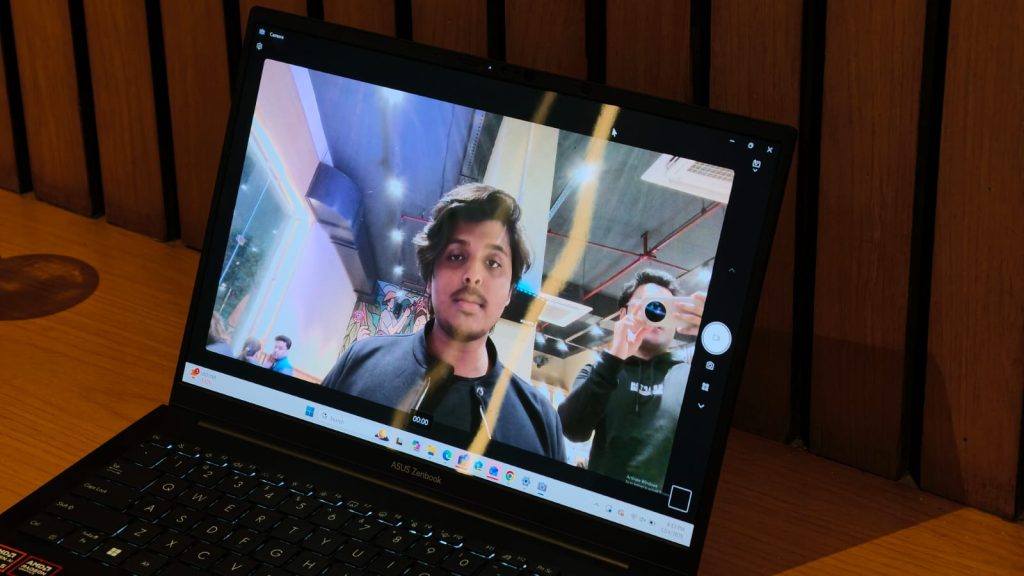
On top of the Asus Zenbook 14 is a 1080p webcam that works really well. Videos appear crisp in ample lighting and there’s some HDR as well. As expected, though, the quality drops in artificial and low-lighting scenarios. Still, I’d happily take the webcam over any 720p alternatives. Along the webcam, there are Windows Hello sensors that enable face unlocking. With my face registered, unlocking the laptop was super easy.
Unfortunately, the speakers are placed underneath the chassis, which inherently limits their output on soft surfaces like a bed. That being said, the quality on hard top surfaces was decent, with clear vocals and treble, along with a whiff of bass. They are plenty good to watch movies on.
Verdict
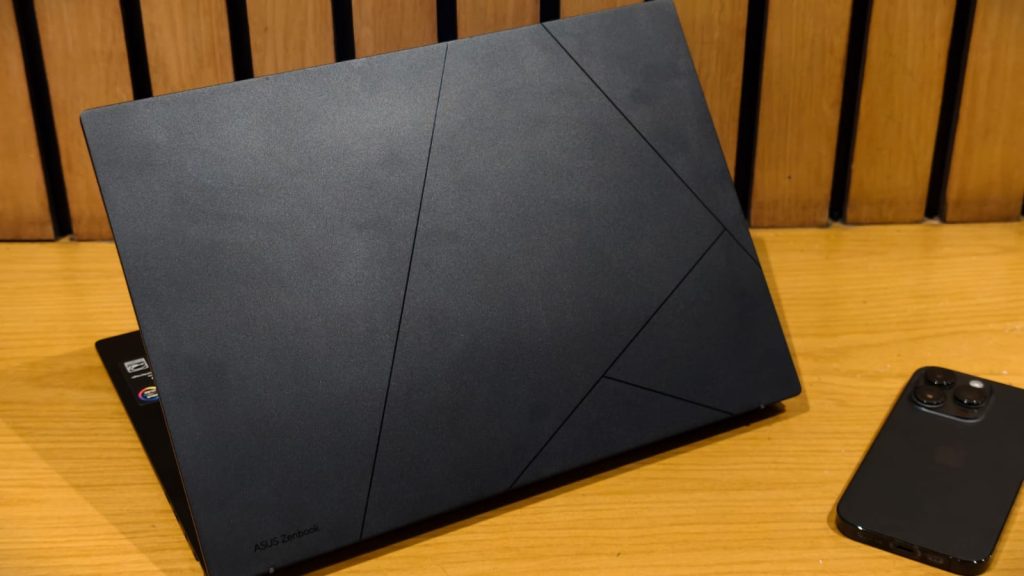
The Asus Zenbook 14 OLED, which starts at INR 85,990, is a laptop that’s hard to fault. It gives you all the performance to handle any office work on a spectacular display, coupled with a really decent keyboard and trackpad experience, all while running a full day without recharge. I mean, what else can you ask from an Ultrabook of this size? It even plays eSports titles well. Oh, don’t forget the premium build quality and the lightweight nature that make it portable as well. Sure, there are options with better GPUs, but the Zenbook 14 OLED is a really compelling option for just about anyone.
Source link
#Asus #Zenbook #OLED #AMD #Review #Gorgeous #Display #Meets #Ryzen #Power



![Scientists Built Amphibious Cyborg Cockroaches and We Regret to Inform You They Work
The humble cockroach: depending on where you live, they’re variously the bane of apartment dwellers, a tasty snacc, or a source of political inspiration. The cliché is that they’d be the only creatures to survive a nuclear apocalypse, and whether or not that’s true, you probably wouldn’t put them first in line for further enhancements to their already legendary ability to survive. However, it seems that no one’s told that to the folks at Nanyang Technological University in Singapore, because a group of researchers from the university’s School of Mechanical and Aerospace Engineering recently published a paper describing the process of fitting a cockroach with a diving suit. As the paper’s abstract explains, “The suit integrates a miniaturized oxygen generation module with a flexible waterproof shell, enabling continuous oxygen supply and isolation from surrounding water.” Or, in other words, the suit successfully allowed the insect to breathe underwater, turning it into a sort of nightmarish amphibious cyborg. If this sounds like a terrible idea at face value, console yourself with the knowledge that these cyber-roaches are designed to be used for benevolent purposes. As per the paper, said purposes include pipe inspections, “object transportation,” and, apparently, search-and-rescue missions. (Smash cut to 2031 and Elon Musk ranting about a “pedo roach”.)
Research into the creation of cyborg insects has been a thing for some time, both in academia and in the world of tech. On the latter point, readers may remember the RoboRoach, a 0 DIY kit for creating your own cyborg cockroach that was funded via Kickstarter in 2013. The kit is still available, and these days it seems to be marketed as a fun activity for kids—on the manufacturer’s website, it’s labelled as being for “Grade 9+” and “[Requiring] supervision.” If the idea of a bunch of 15-year-olds performing surgery on cockroaches makes you kinda queasy—supervision or not—well, you’re not alone.
Let’s get back to the Nanyang Technological University, where the experiments are presumably not being conducted by middle-schoolers. If you’ve ever wondered how a cockroach breathes, the paper explains that “like most terrestrial insects, [they] breathe through thoracic spiracles that take in oxygen directly from the air.” The “diving suit” is basically a flexible waterproof shell into which a miniature oxygen generator pumps oxygen, effectively creating a tiny breathing bubble around the insect’s air-intake thingamajigs. This allowed the insect to breathe underwater for up to three hours, although it seems there were some initial, um, design issues to sort out: “Dorsal mounting of the oxygen generator on the cockroach created significant water-resistance during underwater locomotion… causing postural instability and rollover.” Once this issue was resolved, it seems the roaches got on just fine underwater, exhibiting “stable and smooth underwater walking without rollover.” The researchers conclude that the idea is a winner, and that it could be “potentially extended to other terrestrial cyborg insect platforms, such as [other] cockroaches, locusts and beetles.” Amphibious locusts! What could possibly go wrong? #Scientists #Built #Amphibious #Cyborg #Cockroaches #Regret #Inform #Workcockroaches,cyborgs](https://i0.wp.com/gizmodo.com/app/uploads/2026/07/cyborg-cockroach-1280x853.png?ssl=1 "Scientists Built Amphibious Cyborg Cockroaches and We Regret to Inform You They Work
The humble cockroach: depending on where you live, they’re variously the bane of apartment dwellers, a tasty snacc, or a source of political inspiration. The cliché is that they’d be the only creatures to survive a nuclear apocalypse, and whether or not that’s true, you probably wouldn’t put them first in line for further enhancements to their already legendary ability to survive. However, it seems that no one’s told that to the folks at Nanyang Technological University in Singapore, because a group of researchers from the university’s School of Mechanical and Aerospace Engineering recently published a paper describing the process of fitting a cockroach with a diving suit. As the paper’s abstract explains, “The suit integrates a miniaturized oxygen generation module with a flexible waterproof shell, enabling continuous oxygen supply and isolation from surrounding water.” Or, in other words, the suit successfully allowed the insect to breathe underwater, turning it into a sort of nightmarish amphibious cyborg. If this sounds like a terrible idea at face value, console yourself with the knowledge that these cyber-roaches are designed to be used for benevolent purposes. As per the paper, said purposes include pipe inspections, “object transportation,” and, apparently, search-and-rescue missions. (Smash cut to 2031 and Elon Musk ranting about a “pedo roach”.)
Research into the creation of cyborg insects has been a thing for some time, both in academia and in the world of tech. On the latter point, readers may remember the RoboRoach, a 0 DIY kit for creating your own cyborg cockroach that was funded via Kickstarter in 2013. The kit is still available, and these days it seems to be marketed as a fun activity for kids—on the manufacturer’s website, it’s labelled as being for “Grade 9+” and “[Requiring] supervision.” If the idea of a bunch of 15-year-olds performing surgery on cockroaches makes you kinda queasy—supervision or not—well, you’re not alone.
Let’s get back to the Nanyang Technological University, where the experiments are presumably not being conducted by middle-schoolers. If you’ve ever wondered how a cockroach breathes, the paper explains that “like most terrestrial insects, [they] breathe through thoracic spiracles that take in oxygen directly from the air.” The “diving suit” is basically a flexible waterproof shell into which a miniature oxygen generator pumps oxygen, effectively creating a tiny breathing bubble around the insect’s air-intake thingamajigs. This allowed the insect to breathe underwater for up to three hours, although it seems there were some initial, um, design issues to sort out: “Dorsal mounting of the oxygen generator on the cockroach created significant water-resistance during underwater locomotion… causing postural instability and rollover.” Once this issue was resolved, it seems the roaches got on just fine underwater, exhibiting “stable and smooth underwater walking without rollover.” The researchers conclude that the idea is a winner, and that it could be “potentially extended to other terrestrial cyborg insect platforms, such as [other] cockroaches, locusts and beetles.” Amphibious locusts! What could possibly go wrong? #Scientists #Built #Amphibious #Cyborg #Cockroaches #Regret #Inform #Workcockroaches,cyborgs")
![Scientists Built Amphibious Cyborg Cockroaches and We Regret to Inform You They Work
The humble cockroach: depending on where you live, they’re variously the bane of apartment dwellers, a tasty snacc, or a source of political inspiration. The cliché is that they’d be the only creatures to survive a nuclear apocalypse, and whether or not that’s true, you probably wouldn’t put them first in line for further enhancements to their already legendary ability to survive. However, it seems that no one’s told that to the folks at Nanyang Technological University in Singapore, because a group of researchers from the university’s School of Mechanical and Aerospace Engineering recently published a paper describing the process of fitting a cockroach with a diving suit. As the paper’s abstract explains, “The suit integrates a miniaturized oxygen generation module with a flexible waterproof shell, enabling continuous oxygen supply and isolation from surrounding water.” Or, in other words, the suit successfully allowed the insect to breathe underwater, turning it into a sort of nightmarish amphibious cyborg. If this sounds like a terrible idea at face value, console yourself with the knowledge that these cyber-roaches are designed to be used for benevolent purposes. As per the paper, said purposes include pipe inspections, “object transportation,” and, apparently, search-and-rescue missions. (Smash cut to 2031 and Elon Musk ranting about a “pedo roach”.)
Research into the creation of cyborg insects has been a thing for some time, both in academia and in the world of tech. On the latter point, readers may remember the RoboRoach, a $200 DIY kit for creating your own cyborg cockroach that was funded via Kickstarter in 2013. The kit is still available, and these days it seems to be marketed as a fun activity for kids—on the manufacturer’s website, it’s labelled as being for “Grade 9+” and “[Requiring] supervision.” If the idea of a bunch of 15-year-olds performing surgery on cockroaches makes you kinda queasy—supervision or not—well, you’re not alone.
Let’s get back to the Nanyang Technological University, where the experiments are presumably not being conducted by middle-schoolers. If you’ve ever wondered how a cockroach breathes, the paper explains that “like most terrestrial insects, [they] breathe through thoracic spiracles that take in oxygen directly from the air.” The “diving suit” is basically a flexible waterproof shell into which a miniature oxygen generator pumps oxygen, effectively creating a tiny breathing bubble around the insect’s air-intake thingamajigs. This allowed the insect to breathe underwater for up to three hours, although it seems there were some initial, um, design issues to sort out: “Dorsal mounting of the oxygen generator on the cockroach created significant water-resistance during underwater locomotion… causing postural instability and rollover.” Once this issue was resolved, it seems the roaches got on just fine underwater, exhibiting “stable and smooth underwater walking without rollover.” The researchers conclude that the idea is a winner, and that it could be “potentially extended to other terrestrial cyborg insect platforms, such as [other] cockroaches, locusts and beetles.” Amphibious locusts! What could possibly go wrong? #Scientists #Built #Amphibious #Cyborg #Cockroaches #Regret #Inform #Workcockroaches,cyborgs](https://gizmodo.com/app/uploads/2026/07/cyborg-cockroach-1280x853.png "Scientists Built Amphibious Cyborg Cockroaches and We Regret to Inform You They Work
The humble cockroach: depending on where you live, they’re variously the bane of apartment dwellers, a tasty snacc, or a source of political inspiration. The cliché is that they’d be the only creatures to survive a nuclear apocalypse, and whether or not that’s true, you probably wouldn’t put them first in line for further enhancements to their already legendary ability to survive. However, it seems that no one’s told that to the folks at Nanyang Technological University in Singapore, because a group of researchers from the university’s School of Mechanical and Aerospace Engineering recently published a paper describing the process of fitting a cockroach with a diving suit. As the paper’s abstract explains, “The suit integrates a miniaturized oxygen generation module with a flexible waterproof shell, enabling continuous oxygen supply and isolation from surrounding water.” Or, in other words, the suit successfully allowed the insect to breathe underwater, turning it into a sort of nightmarish amphibious cyborg. If this sounds like a terrible idea at face value, console yourself with the knowledge that these cyber-roaches are designed to be used for benevolent purposes. As per the paper, said purposes include pipe inspections, “object transportation,” and, apparently, search-and-rescue missions. (Smash cut to 2031 and Elon Musk ranting about a “pedo roach”.)
Research into the creation of cyborg insects has been a thing for some time, both in academia and in the world of tech. On the latter point, readers may remember the RoboRoach, a $200 DIY kit for creating your own cyborg cockroach that was funded via Kickstarter in 2013. The kit is still available, and these days it seems to be marketed as a fun activity for kids—on the manufacturer’s website, it’s labelled as being for “Grade 9+” and “[Requiring] supervision.” If the idea of a bunch of 15-year-olds performing surgery on cockroaches makes you kinda queasy—supervision or not—well, you’re not alone.
Let’s get back to the Nanyang Technological University, where the experiments are presumably not being conducted by middle-schoolers. If you’ve ever wondered how a cockroach breathes, the paper explains that “like most terrestrial insects, [they] breathe through thoracic spiracles that take in oxygen directly from the air.” The “diving suit” is basically a flexible waterproof shell into which a miniature oxygen generator pumps oxygen, effectively creating a tiny breathing bubble around the insect’s air-intake thingamajigs. This allowed the insect to breathe underwater for up to three hours, although it seems there were some initial, um, design issues to sort out: “Dorsal mounting of the oxygen generator on the cockroach created significant water-resistance during underwater locomotion… causing postural instability and rollover.” Once this issue was resolved, it seems the roaches got on just fine underwater, exhibiting “stable and smooth underwater walking without rollover.” The researchers conclude that the idea is a winner, and that it could be “potentially extended to other terrestrial cyborg insect platforms, such as [other] cockroaches, locusts and beetles.” Amphibious locusts! What could possibly go wrong? #Scientists #Built #Amphibious #Cyborg #Cockroaches #Regret #Inform #Workcockroaches,cyborgs")
Post Comment