ASUS Launches Next Gen ZenBook S14, Duo, A-series & VivoBook Lineup In India
The Asus VivoBook and ZenBook laptops are quite the hotcakes in the Indian market, simply because they strike the right balance between portability and performance. Keeping up that momentum, the Taiwanese laptop maker has opened pre-orders for its latest premium Zenbook lineup in India, introducing a range of new laptops focused on design, portability, and AI-powered performance. The lineup includes the Zenbook S14, Zenbook DUO, Zenbook A14, and the upcoming Zenbook A16, alongside refreshed Vivobook models. Prices for the ZenBook series start at ₹1,79,990, while the Vivobook lineup begins at ₹98,990. Here’s everything you need to know about them.
What’s New with the ZenBooks & VivoBooks?
ASUS is doubling down on its “Design You Can Feel” philosophy with this launch. One of the key highlights is Ceraluminum, a proprietary material that aims to combine durability with a lightweight, premium finish. The flagship Zenbook S14, for instance, features an ultra-slim profile of around 1.1cm and weighs roughly 1.2kg, making it highly portable. It also gets a 14-inch 3K OLED display and a claimed battery life of up to 27 hours. Under the hood, the ZenBook S14 series packs Ultra Series 3 processors, with the highest tier going to the Ultra 9.
Meanwhile, the newest version of my favorite ZenBook Duo takes things to another level by packing dual 14-inch 3K 144Hz ASUS Lumina Pro OLED touch displays. It’s powered by Intel’s latest Core Ultra 7-series processors and offers 32 hours of claimed battery life. Lastly, there’s the Zenbook A Series (A14 & A16), which targets more casual, yet premium users. It’s made from the same Ceraluminum material and focuses primarily on portability, weighing under 1 kg. On the power side, the ZenBook A series uses the Snapdragon X2 series processors. While this should pay pretty big dividends in the battery life department, we have yet to test the laptops, so stay tuned for a full review.
The next-gen VivoBook classic series will be powered by the updated Intel Core Ultra 5 Series 3 processors, delivering 47 TOPS of NPU performance for all your AI tasks. On the other hand, the Vivobook S14 and S16 will feature sleeker metallic designs and Ultra 7 Series processors with up to 49 TOPS of NPU performance. Battery life for these is rated for 29 hours.
The Asus VivoBook and ZenBook laptops are quite the hotcakes in the Indian market, simply because they strike the right balance between portability and performance. Keeping up that momentum, the Taiwanese laptop maker has opened pre-orders for its latest premium Zenbook lineup in India, introducing a range of new laptops focused on design, portability, and AI-powered performance. The lineup includes the Zenbook S14, Zenbook DUO, Zenbook A14, and the upcoming Zenbook A16, alongside refreshed Vivobook models. Prices for the ZenBook series start at ₹1,79,990, while the Vivobook lineup begins at ₹98,990. Here’s everything you need to know about them.
What’s New with the ZenBooks & VivoBooks?
ASUS is doubling down on its “Design You Can Feel” philosophy with this launch. One of the key highlights is Ceraluminum, a proprietary material that aims to combine durability with a lightweight, premium finish. The flagship Zenbook S14, for instance, features an ultra-slim profile of around 1.1cm and weighs roughly 1.2kg, making it highly portable. It also gets a 14-inch 3K OLED display and a claimed battery life of up to 27 hours. Under the hood, the ZenBook S14 series packs Ultra Series 3 processors, with the highest tier going to the Ultra 9.
Meanwhile, the newest version of my favorite ZenBook Duo takes things to another level by packing dual 14-inch 3K 144Hz ASUS Lumina Pro OLED touch displays. It’s powered by Intel’s latest Core Ultra 7-series processors and offers 32 hours of claimed battery life. Lastly, there’s the Zenbook A Series (A14 & A16), which targets more casual, yet premium users. It’s made from the same Ceraluminum material and focuses primarily on portability, weighing under 1 kg. On the power side, the ZenBook A series uses the Snapdragon X2 series processors. While this should pay pretty big dividends in the battery life department, we have yet to test the laptops, so stay tuned for a full review.
The next-gen VivoBook classic series will be powered by the updated Intel Core Ultra 5 Series 3 processors, delivering 47 TOPS of NPU performance for all your AI tasks. On the other hand, the Vivobook S14 and S16 will feature sleeker metallic designs and Ultra 7 Series processors with up to 49 TOPS of NPU performance. Battery life for these is rated for 29 hours.
To start with Transkriptor, it does not take more than 1 minute. You can sign up with Google, Microsoft, Apple, or email. Transkriptor leans on a row of recognizable logos, from Pfizer and Tesla to Harvard and Microsoft, to build your trust before using it.
Transkriptor offers a clean, easy-to-navigate dashboard with 5 ways to create a transcript. You can record live audio, upload a file, pull a video from YouTube, join a meeting, and import audio-video files from the cloud. A left rail holds the heavier tools, including text-to-speech, AI content generation, and a calendar for scheduled meetings. The core action is never more than one click; you get transcription without any technical difficulties.
How Accurate is Transkriptor at Converting Speech to Text?
Accuracy is the most important thing, and an honest answer is better than a flawless one. On clean English audio, meaning a single speaker in a quiet room, Transkriptor landed in the high-80s to low-90s percent range in my tests, which matches what independent reviewers report. If you upload a clean 30-minute file, it will take you only a few minutes to check for grammar mistakes, mostly punctuation marks.
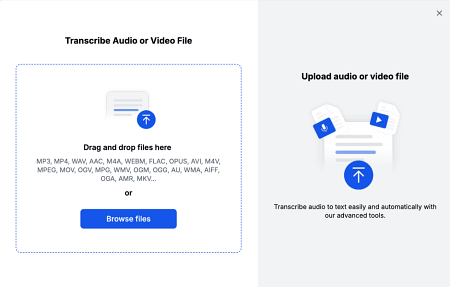
I started testing the tool by uploading different audio and video files, and Transkriptor supports a wide range of formats, so I never had to convert the file before uploading.
Audio with background noise and overlapping speakers leads to less accurate transcription. Also, non-native heavy accents reduced accuracy. Transkriptor supports 100+ languages and adds domain-specific vocabulary for medical, legal, and IT terms, which helped with a jargon-heavy recording, though non-English audio was less even than English.
Transkriptor’s editor did the real work. Every line of transcription carries a timestamp and speaker label. You can play back the audio while reading the transcription to ensure everything is up to the point. Additionally, AI chat and summary let you pull a quick recap of the whole conversation. You get richer insights, such as sentiment analysis and speaker talk time, but it is locked behind the Team plan.
Does Transkriptor Handle Zoom, Google Meet, and Teams Meetings?
Yes, Transkriptor handles Zoom, Google Meet, and Teams meetings with ease. You paste the link to add a recording bot to the live call. Or you can connect your Google or Outlook calendar so Transkriptor auto-joins scheduled meetings. I connected my Google Calendar in 2 clicks and set it to auto-detect the platform and record the meeting.
After each call, I got a transcript with speaker labels and an auto-generated summary with action items, which is exactly what a remote team wants from a note-taker. The bot-joins-the-call model is the same approach Otter uses, and Transkriptor matches it while supporting far more languages.
What Does Transkriptor Cost, and How Does It Compare to Otter and Sonix?
To get access to all features, you need to buy a Transkriptor subscription. It’s a limited free tier with a small daily allowance that lets you test it. Lite plan starts at $9.99 per month for 5 hours of transcription. Pro is $19.99 per month or $8.33 per month on annual billing ($99.99 a year) and unlocks 2,400 minutes per month with unlimited files.
Team runs $30 per seat monthly, or $20 per seat on annual billing ($240 a year per seat), adding 3,000 minutes per seat, shared workspaces, call analysis, and custom vocabulary. A custom-priced Business tier is available for larger orgs. Transkriptor is also ISO 27001, SOC 2, and GDPR compliant, which matters for regulated work.
Against the alternative transcription tools, Transkriptor lands in a useful middle ground. Otter is the polished meeting assistant with strong CRM sync, but it transcribes only 6 languages and caps your minutes. Sonix charges per hour and delivers the highest audio accuracy. Here is how the three line up.
Tool
Entry pricing
Languages
Best at
Watch out for
Transkriptor
$9.99/mo, free tier available
100+
Files plus live meeting recordings in one tool
Accuracy dips on noisy or accented audio
Otter
Free, then $8.33/mo annual
6 languages
Live meeting notes and CRM sync
Few languages, strict minute caps
Sonix
$10 per audio hour, pay as you go
50+
High accuracy on clean files
No live meeting recording
Who is Transkriptor Best For?
With Transkriptor, you get a practical mix of transcription, meeting recording, AI summaries, and multilingual support. During my testing, Transkriptor handled clean audio and video files well and integrated smoothly with Zoom, Google Meet, and Teams. It made it easy to turn speech into readable meeting notes and summaries.
While accuracy can vary with heavy background noise or challenging accents, the overall experience is reliable enough for most everyday transcription needs. The combination of 100+ language support, meeting integrations, and competitive pricing gives it a broader feature set than many alternatives.
For students, journalists, podcasters, and remote teams working across multiple languages, Transkriptor is a capable and cost-effective speech-to-text solution.
To start with Transkriptor, it does not take more than 1 minute. You can sign up with Google, Microsoft, Apple, or email. Transkriptor leans on a row of recognizable logos, from Pfizer and Tesla to Harvard and Microsoft, to build your trust before using it.
Transkriptor offers a clean, easy-to-navigate dashboard with 5 ways to create a transcript. You can record live audio, upload a file, pull a video from YouTube, join a meeting, and import audio-video files from the cloud. A left rail holds the heavier tools, including text-to-speech, AI content generation, and a calendar for scheduled meetings. The core action is never more than one click; you get transcription without any technical difficulties.
How Accurate is Transkriptor at Converting Speech to Text?
Accuracy is the most important thing, and an honest answer is better than a flawless one. On clean English audio, meaning a single speaker in a quiet room, Transkriptor landed in the high-80s to low-90s percent range in my tests, which matches what independent reviewers report. If you upload a clean 30-minute file, it will take you only a few minutes to check for grammar mistakes, mostly punctuation marks.
I started testing the tool by uploading different audio and video files, and Transkriptor supports a wide range of formats, so I never had to convert the file before uploading.
Audio with background noise and overlapping speakers leads to less accurate transcription. Also, non-native heavy accents reduced accuracy. Transkriptor supports 100+ languages and adds domain-specific vocabulary for medical, legal, and IT terms, which helped with a jargon-heavy recording, though non-English audio was less even than English.
Transkriptor’s editor did the real work. Every line of transcription carries a timestamp and speaker label. You can play back the audio while reading the transcription to ensure everything is up to the point. Additionally, AI chat and summary let you pull a quick recap of the whole conversation. You get richer insights, such as sentiment analysis and speaker talk time, but it is locked behind the Team plan.
Does Transkriptor Handle Zoom, Google Meet, and Teams Meetings?
Yes, Transkriptor handles Zoom, Google Meet, and Teams meetings with ease. You paste the link to add a recording bot to the live call. Or you can connect your Google or Outlook calendar so Transkriptor auto-joins scheduled meetings. I connected my Google Calendar in 2 clicks and set it to auto-detect the platform and record the meeting.
After each call, I got a transcript with speaker labels and an auto-generated summary with action items, which is exactly what a remote team wants from a note-taker. The bot-joins-the-call model is the same approach Otter uses, and Transkriptor matches it while supporting far more languages.
What Does Transkriptor Cost, and How Does It Compare to Otter and Sonix?
To get access to all features, you need to buy a Transkriptor subscription. It’s a limited free tier with a small daily allowance that lets you test it. Lite plan starts at $9.99 per month for 5 hours of transcription. Pro is $19.99 per month or $8.33 per month on annual billing ($99.99 a year) and unlocks 2,400 minutes per month with unlimited files.
Team runs $30 per seat monthly, or $20 per seat on annual billing ($240 a year per seat), adding 3,000 minutes per seat, shared workspaces, call analysis, and custom vocabulary. A custom-priced Business tier is available for larger orgs. Transkriptor is also ISO 27001, SOC 2, and GDPR compliant, which matters for regulated work.
Against the alternative transcription tools, Transkriptor lands in a useful middle ground. Otter is the polished meeting assistant with strong CRM sync, but it transcribes only 6 languages and caps your minutes. Sonix charges per hour and delivers the highest audio accuracy. Here is how the three line up.
Tool
Entry pricing
Languages
Best at
Watch out for
Transkriptor
$9.99/mo, free tier available
100+
Files plus live meeting recordings in one tool
Accuracy dips on noisy or accented audio
Otter
Free, then $8.33/mo annual
6 languages
Live meeting notes and CRM sync
Few languages, strict minute caps
Sonix
$10 per audio hour, pay as you go
50+
High accuracy on clean files
No live meeting recording
Who is Transkriptor Best For?
With Transkriptor, you get a practical mix of transcription, meeting recording, AI summaries, and multilingual support. During my testing, Transkriptor handled clean audio and video files well and integrated smoothly with Zoom, Google Meet, and Teams. It made it easy to turn speech into readable meeting notes and summaries.
While accuracy can vary with heavy background noise or challenging accents, the overall experience is reliable enough for most everyday transcription needs. The combination of 100+ language support, meeting integrations, and competitive pricing gives it a broader feature set than many alternatives.
For students, journalists, podcasters, and remote teams working across multiple languages, Transkriptor is a capable and cost-effective speech-to-text solution.
#Transkriptor #Review #SpeechtoText #AppAI">Transkriptor Review: Is It the Best Speech-to-Text App?
Manual transcription takes much time that most people do not have. I usually spend hours every week turning interviews and meetings into text, so I tried Transkriptor through a test to see if it could take notes and save me time. Transkriptor is an AI speech-to-text tool. It converts audio and video files into editable transcripts, and it supports 100+ languages. Over a week, I uploaded my clean and slightly messy recordings, ran them against accented audio, and also linked them to Zoom and Google Meet calls.
Here is how Transkriptor does well, where it goes wrong, and who should use it.
How Do You Get Started With Transkriptor?
To start with Transkriptor, it does not take more than 1 minute. You can sign up with Google, Microsoft, Apple, or email. Transkriptor leans on a row of recognizable logos, from Pfizer and Tesla to Harvard and Microsoft, to build your trust before using it.
Transkriptor offers a clean, easy-to-navigate dashboard with 5 ways to create a transcript. You can record live audio, upload a file, pull a video from YouTube, join a meeting, and import audio-video files from the cloud. A left rail holds the heavier tools, including text-to-speech, AI content generation, and a calendar for scheduled meetings. The core action is never more than one click; you get transcription without any technical difficulties.
How Accurate is Transkriptor at Converting Speech to Text?
Accuracy is the most important thing, and an honest answer is better than a flawless one. On clean English audio, meaning a single speaker in a quiet room, Transkriptor landed in the high-80s to low-90s percent range in my tests, which matches what independent reviewers report. If you upload a clean 30-minute file, it will take you only a few minutes to check for grammar mistakes, mostly punctuation marks.
I started testing the tool by uploading different audio and video files, and Transkriptor supports a wide range of formats, so I never had to convert the file before uploading.
Audio with background noise and overlapping speakers leads to less accurate transcription. Also, non-native heavy accents reduced accuracy. Transkriptor supports 100+ languages and adds domain-specific vocabulary for medical, legal, and IT terms, which helped with a jargon-heavy recording, though non-English audio was less even than English.
Transkriptor’s editor did the real work. Every line of transcription carries a timestamp and speaker label. You can play back the audio while reading the transcription to ensure everything is up to the point. Additionally, AI chat and summary let you pull a quick recap of the whole conversation. You get richer insights, such as sentiment analysis and speaker talk time, but it is locked behind the Team plan.
Does Transkriptor Handle Zoom, Google Meet, and Teams Meetings?
Yes, Transkriptor handles Zoom, Google Meet, and Teams meetings with ease. You paste the link to add a recording bot to the live call. Or you can connect your Google or Outlook calendar so Transkriptor auto-joins scheduled meetings. I connected my Google Calendar in 2 clicks and set it to auto-detect the platform and record the meeting.
After each call, I got a transcript with speaker labels and an auto-generated summary with action items, which is exactly what a remote team wants from a note-taker. The bot-joins-the-call model is the same approach Otter uses, and Transkriptor matches it while supporting far more languages.
What Does Transkriptor Cost, and How Does It Compare to Otter and Sonix?
To get access to all features, you need to buy a Transkriptor subscription. It’s a limited free tier with a small daily allowance that lets you test it. Lite plan starts at $9.99 per month for 5 hours of transcription. Pro is $19.99 per month or $8.33 per month on annual billing ($99.99 a year) and unlocks 2,400 minutes per month with unlimited files.
Team runs $30 per seat monthly, or $20 per seat on annual billing ($240 a year per seat), adding 3,000 minutes per seat, shared workspaces, call analysis, and custom vocabulary. A custom-priced Business tier is available for larger orgs. Transkriptor is also ISO 27001, SOC 2, and GDPR compliant, which matters for regulated work.
Against the alternative transcription tools, Transkriptor lands in a useful middle ground. Otter is the polished meeting assistant with strong CRM sync, but it transcribes only 6 languages and caps your minutes. Sonix charges per hour and delivers the highest audio accuracy. Here is how the three line up.
Tool
Entry pricing
Languages
Best at
Watch out for
Transkriptor
$9.99/mo, free tier available
100+
Files plus live meeting recordings in one tool
Accuracy dips on noisy or accented audio
Otter
Free, then $8.33/mo annual
6 languages
Live meeting notes and CRM sync
Few languages, strict minute caps
Sonix
$10 per audio hour, pay as you go
50+
High accuracy on clean files
No live meeting recording
Who is Transkriptor Best For?
With Transkriptor, you get a practical mix of transcription, meeting recording, AI summaries, and multilingual support. During my testing, Transkriptor handled clean audio and video files well and integrated smoothly with Zoom, Google Meet, and Teams. It made it easy to turn speech into readable meeting notes and summaries.
While accuracy can vary with heavy background noise or challenging accents, the overall experience is reliable enough for most everyday transcription needs. The combination of 100+ language support, meeting integrations, and competitive pricing gives it a broader feature set than many alternatives.
For students, journalists, podcasters, and remote teams working across multiple languages, Transkriptor is a capable and cost-effective speech-to-text solution.
#Transkriptor #Review #SpeechtoText #AppAI
If there was one word you wouldn’t want to hear in front of the word “diarrhea,” it’d be “explosive.” Unfortunately, it’s a combination that some Americans are personally experiencing right now, thanks to ongoing outbreaks of a parasitic foodborne disease called cyclosporiasis.
According to the Centers for the Disease Control and Prevention, there have been nearly 150 cases of cyclosporiasis reported across 17 states since early May, with close to two dozen people needing hospitalization as a result. The true toll of cases is almost certainly higher, though, and no clear food source behind these outbreaks has been identified as of yet.
Loud and explosive
Cyclosporiasis is caused by various species of the microscopic parasite Cyclospora, though it’s predominantly Cyclospora cayatenensis.
It usually takes about a week to feel sick after being infected, and the main symptom of cyclosporiasis, according to the Cleveland Clinic, is “loud, watery (explosive) diarrhea.” Joy. The infection can also cause fatigue, loss of appetite, and vomiting, though some people infected with the parasite are fortunate enough to avoid any symptoms at all. People generally feel better after a week or two without the need for treatment, though symptoms can last up to a month. While the infection is rarely fatal, people with weakened immune systems are more vulnerable to severe illness.
Cyclosporiasis is a nationally notifiable disease in 47 states, meaning doctors and testing labs are obligated to report any confirmed cases to their local or state health departments. According to the CDC, cases of cyclosporiasis in the U.S. tend to increase during the warmer months, and this year is no exception. Between May 1 and June 16, there have been 145 domestically acquired cases in 17 states reported to the CDC; of these, 20 people have been hospitalized, though no deaths have been recorded. There have also been 45 reported cases associated with travel (meaning they were likely infected outside of the U.S.).
As is often true for foodborne illness, however, there are probably a lot more hidden cases out there, since many infected people might not seek medical attention over their symptoms. Diagnosis is further complicated by the fact that routine stool testing for cyclosporiasis isn’t conducted in most labs, meaning doctors have to request specialized tests, and many people might not shed enough of the parasite in their poop to be detectable at first, often requiring multiple days of testing.
According to the CDC data, the biggest outbreak is currently in New York, which has reported somewhere between 31 and 80 cases, but it’s likely not the only state that needs to be worried.
“Local, state, and federal (CDC, FDA) public health authorities are investigating several clusters of cases in more than one state. Investigations to identify potential sources are ongoing,” the CDC reported in its latest update on June 18.
There already seem to be larger clusters of cyclosporiasis than currently documented by the CDC. On Tuesday, for instance, Michigan health officials reported that more than 150 cases have been seen in southeastern Michigan across several counties since June 22. A representative for Monroe County specifically told Gizmodo Wednesday that 90 cases have been documented in the county so far.
What to do
Cyclosporiasis is transmitted through eating food and water that’s been contaminated with infected poop, and outbreaks are often linked to produce. So far, no common sources of infection appear to have identified by the CDC or local heath departments for these latest clusters, but there are still steps you can take to lower your chances of contracting it.
The CDC recommends always washing your hands with soap and water before and after handling or preparing raw fruits and vegetables; washing all fruits and vegetables thoroughly under running water before eating, cutting, or cooking (if the produce is labeled prewashed, then you don’t need to do it again), and refrigerating cut, peeled, or cooked fruits and vegetables as soon as possible (within two hours if possible).
If there was one word you wouldn’t want to hear in front of the word “diarrhea,” it’d be “explosive.” Unfortunately, it’s a combination that some Americans are personally experiencing right now, thanks to ongoing outbreaks of a parasitic foodborne disease called cyclosporiasis.
According to the Centers for the Disease Control and Prevention, there have been nearly 150 cases of cyclosporiasis reported across 17 states since early May, with close to two dozen people needing hospitalization as a result. The true toll of cases is almost certainly higher, though, and no clear food source behind these outbreaks has been identified as of yet.
Loud and explosive
Cyclosporiasis is caused by various species of the microscopic parasite Cyclospora, though it’s predominantly Cyclospora cayatenensis.
It usually takes about a week to feel sick after being infected, and the main symptom of cyclosporiasis, according to the Cleveland Clinic, is “loud, watery (explosive) diarrhea.” Joy. The infection can also cause fatigue, loss of appetite, and vomiting, though some people infected with the parasite are fortunate enough to avoid any symptoms at all. People generally feel better after a week or two without the need for treatment, though symptoms can last up to a month. While the infection is rarely fatal, people with weakened immune systems are more vulnerable to severe illness.
Cyclosporiasis is a nationally notifiable disease in 47 states, meaning doctors and testing labs are obligated to report any confirmed cases to their local or state health departments. According to the CDC, cases of cyclosporiasis in the U.S. tend to increase during the warmer months, and this year is no exception. Between May 1 and June 16, there have been 145 domestically acquired cases in 17 states reported to the CDC; of these, 20 people have been hospitalized, though no deaths have been recorded. There have also been 45 reported cases associated with travel (meaning they were likely infected outside of the U.S.).
As is often true for foodborne illness, however, there are probably a lot more hidden cases out there, since many infected people might not seek medical attention over their symptoms. Diagnosis is further complicated by the fact that routine stool testing for cyclosporiasis isn’t conducted in most labs, meaning doctors have to request specialized tests, and many people might not shed enough of the parasite in their poop to be detectable at first, often requiring multiple days of testing.
According to the CDC data, the biggest outbreak is currently in New York, which has reported somewhere between 31 and 80 cases, but it’s likely not the only state that needs to be worried.
“Local, state, and federal (CDC, FDA) public health authorities are investigating several clusters of cases in more than one state. Investigations to identify potential sources are ongoing,” the CDC reported in its latest update on June 18.
There already seem to be larger clusters of cyclosporiasis than currently documented by the CDC. On Tuesday, for instance, Michigan health officials reported that more than 150 cases have been seen in southeastern Michigan across several counties since June 22. A representative for Monroe County specifically told Gizmodo Wednesday that 90 cases have been documented in the county so far.
What to do
Cyclosporiasis is transmitted through eating food and water that’s been contaminated with infected poop, and outbreaks are often linked to produce. So far, no common sources of infection appear to have identified by the CDC or local heath departments for these latest clusters, but there are still steps you can take to lower your chances of contracting it.
The CDC recommends always washing your hands with soap and water before and after handling or preparing raw fruits and vegetables; washing all fruits and vegetables thoroughly under running water before eating, cutting, or cooking (if the produce is labeled prewashed, then you don’t need to do it again), and refrigerating cut, peeled, or cooked fruits and vegetables as soon as possible (within two hours if possible).
#Great #Parasite #Explosive #Diarrhea #Spreadingfoodborne illnesses,infectious diseases,outbreaks">Oh Great, a Parasite That Causes Explosive Diarrhea Is Spreading Right Now
If there was one word you wouldn’t want to hear in front of the word “diarrhea,” it’d be “explosive.” Unfortunately, it’s a combination that some Americans are personally experiencing right now, thanks to ongoing outbreaks of a parasitic foodborne disease called cyclosporiasis.
According to the Centers for the Disease Control and Prevention, there have been nearly 150 cases of cyclosporiasis reported across 17 states since early May, with close to two dozen people needing hospitalization as a result. The true toll of cases is almost certainly higher, though, and no clear food source behind these outbreaks has been identified as of yet.
Loud and explosive
Cyclosporiasis is caused by various species of the microscopic parasite Cyclospora, though it’s predominantly Cyclospora cayatenensis.
It usually takes about a week to feel sick after being infected, and the main symptom of cyclosporiasis, according to the Cleveland Clinic, is “loud, watery (explosive) diarrhea.” Joy. The infection can also cause fatigue, loss of appetite, and vomiting, though some people infected with the parasite are fortunate enough to avoid any symptoms at all. People generally feel better after a week or two without the need for treatment, though symptoms can last up to a month. While the infection is rarely fatal, people with weakened immune systems are more vulnerable to severe illness.
Cyclosporiasis is a nationally notifiable disease in 47 states, meaning doctors and testing labs are obligated to report any confirmed cases to their local or state health departments. According to the CDC, cases of cyclosporiasis in the U.S. tend to increase during the warmer months, and this year is no exception. Between May 1 and June 16, there have been 145 domestically acquired cases in 17 states reported to the CDC; of these, 20 people have been hospitalized, though no deaths have been recorded. There have also been 45 reported cases associated with travel (meaning they were likely infected outside of the U.S.).
As is often true for foodborne illness, however, there are probably a lot more hidden cases out there, since many infected people might not seek medical attention over their symptoms. Diagnosis is further complicated by the fact that routine stool testing for cyclosporiasis isn’t conducted in most labs, meaning doctors have to request specialized tests, and many people might not shed enough of the parasite in their poop to be detectable at first, often requiring multiple days of testing.
According to the CDC data, the biggest outbreak is currently in New York, which has reported somewhere between 31 and 80 cases, but it’s likely not the only state that needs to be worried.
“Local, state, and federal (CDC, FDA) public health authorities are investigating several clusters of cases in more than one state. Investigations to identify potential sources are ongoing,” the CDC reported in its latest update on June 18.
There already seem to be larger clusters of cyclosporiasis than currently documented by the CDC. On Tuesday, for instance, Michigan health officials reported that more than 150 cases have been seen in southeastern Michigan across several counties since June 22. A representative for Monroe County specifically told Gizmodo Wednesday that 90 cases have been documented in the county so far.
What to do
Cyclosporiasis is transmitted through eating food and water that’s been contaminated with infected poop, and outbreaks are often linked to produce. So far, no common sources of infection appear to have identified by the CDC or local heath departments for these latest clusters, but there are still steps you can take to lower your chances of contracting it.
The CDC recommends always washing your hands with soap and water before and after handling or preparing raw fruits and vegetables; washing all fruits and vegetables thoroughly under running water before eating, cutting, or cooking (if the produce is labeled prewashed, then you don’t need to do it again), and refrigerating cut, peeled, or cooked fruits and vegetables as soon as possible (within two hours if possible).
But Motorola is now making it even more hassle-free by building a native travel eSIM experience into its smartphones.
The capability is initially available as an app customers will have to download from the Google Play Store, called Global Connect, but the app will be preinstalled on new Motorola devices in the future. It’s available for any Motorola phone with eSIM capabilities—including smartphones as cheap as the $180 2026 Moto G Play—though it’s currently only available for use in a handful of Latin American markets: Brazil, Mexico, Argentina, Peru, and Chile. Motorola says support for use in Germany, the UK, and Europe is coming in the next several weeks. The company didn’t have anything to share about US availability just yet.
Travel eSIMs give travelers an easy way to instantly access a data-only eSIM that works in their destination—even before hopping on a flight. It means you don’t have to stop by a SIM card kiosk at the airport and fuss with physical SIM cards to connect to the internet at your destination. You can top up your data allotment through an app and pay as you go. These eSIMs often don’t include the ability to make calls and send texts, and that’s the case here with Motorola’s solution. (Thankfully, WhatsApp is widely adopted in tourist destinations.)
The service is powered by Gigs, a San Francisco firm that helps companies sell mobile data plans without having to deal with complex telecom negotiations and contracts. It’s the same company behind the mobile plans from Klarna, the buy-now-and-pay-later service, and more recently, Cash App. Motorola says it worked closely with Gigs to make the experience feel like a “Motorola-branded experience” and not a third-party add-on.
While Motorola claims this is the first time a major smartphone manufacturer has embedded a travel eSIM function natively into its phones, Chinese phone maker Xiaomi offered a similar virtual travel SIM function as far back as 2015, though it has since discontinued the feature.
Sudhir Chadaga, vice president for Partnerships at Motorola, says customers have to install the Global Connect app, create a Gigs account, and they’ll get 1 GB for free with their first travel eSIM (available for a limited time), after which they can top up data as needed. Chadaga claims the rates are competitive—$3 for 1 GB for 30 days, up to $14 for 20 GB—and service is available in more than 160 countries. You can continue to use this same travel eSIM for all your travels.
“What we’re trying to do for our consumers is solve that friction point of getting that travel eSIM quickly on the device as they’re heading out to travel,” Chadaga tells WIRED. “With Global Connect, that’s exactly what we’re bringing to our users.”
Travel eSIMs are far cheaper than paying for data while roaming, which is what you’re doing when you rely on your primary carrier to connect you to networks in other countries. Siddhant Cally, a senior analyst on the Networks and Connectivity team at Counterpoint Research, says that in some regions, legacy network operators were offering roaming for half the data but at double the price of travel eSIMs.
The cheaper rates, paired with how easy it is to download and save a travel eSIM on your phone before your trip, have made them incredibly popular. And since you can still use data to make WhatsApp or FaceTime calls or send messages, the limitation of not being able to send or receive text messages or calls from your own number isn’t a big concern. It’s why US carriers like T-Mobile, Verizon, and AT&T have tried to counter the challenge of third-party travel eSIM apps to their roaming business with their own travel eSIM options for people entering the US during the World Cup.
But Motorola is now making it even more hassle-free by building a native travel eSIM experience into its smartphones.
The capability is initially available as an app customers will have to download from the Google Play Store, called Global Connect, but the app will be preinstalled on new Motorola devices in the future. It’s available for any Motorola phone with eSIM capabilities—including smartphones as cheap as the $180 2026 Moto G Play—though it’s currently only available for use in a handful of Latin American markets: Brazil, Mexico, Argentina, Peru, and Chile. Motorola says support for use in Germany, the UK, and Europe is coming in the next several weeks. The company didn’t have anything to share about US availability just yet.
Travel eSIMs give travelers an easy way to instantly access a data-only eSIM that works in their destination—even before hopping on a flight. It means you don’t have to stop by a SIM card kiosk at the airport and fuss with physical SIM cards to connect to the internet at your destination. You can top up your data allotment through an app and pay as you go. These eSIMs often don’t include the ability to make calls and send texts, and that’s the case here with Motorola’s solution. (Thankfully, WhatsApp is widely adopted in tourist destinations.)
The service is powered by Gigs, a San Francisco firm that helps companies sell mobile data plans without having to deal with complex telecom negotiations and contracts. It’s the same company behind the mobile plans from Klarna, the buy-now-and-pay-later service, and more recently, Cash App. Motorola says it worked closely with Gigs to make the experience feel like a “Motorola-branded experience” and not a third-party add-on.
While Motorola claims this is the first time a major smartphone manufacturer has embedded a travel eSIM function natively into its phones, Chinese phone maker Xiaomi offered a similar virtual travel SIM function as far back as 2015, though it has since discontinued the feature.
Sudhir Chadaga, vice president for Partnerships at Motorola, says customers have to install the Global Connect app, create a Gigs account, and they’ll get 1 GB for free with their first travel eSIM (available for a limited time), after which they can top up data as needed. Chadaga claims the rates are competitive—$3 for 1 GB for 30 days, up to $14 for 20 GB—and service is available in more than 160 countries. You can continue to use this same travel eSIM for all your travels.
“What we’re trying to do for our consumers is solve that friction point of getting that travel eSIM quickly on the device as they’re heading out to travel,” Chadaga tells WIRED. “With Global Connect, that’s exactly what we’re bringing to our users.”
Travel eSIMs are far cheaper than paying for data while roaming, which is what you’re doing when you rely on your primary carrier to connect you to networks in other countries. Siddhant Cally, a senior analyst on the Networks and Connectivity team at Counterpoint Research, says that in some regions, legacy network operators were offering roaming for half the data but at double the price of travel eSIMs.
The cheaper rates, paired with how easy it is to download and save a travel eSIM on your phone before your trip, have made them incredibly popular. And since you can still use data to make WhatsApp or FaceTime calls or send messages, the limitation of not being able to send or receive text messages or calls from your own number isn’t a big concern. It’s why US carriers like T-Mobile, Verizon, and AT&T have tried to counter the challenge of third-party travel eSIM apps to their roaming business with their own travel eSIM options for people entering the US during the World Cup.
#Motorola #Phones #BuiltIn #Travel #eSIM #Mobile #Datamotorola,smartphones,phones,android,sim,travel,data,mobile">Motorola Phones Now Have a Built-In Travel eSIM for Mobile Data Outside the US
There’s been an explosion in popularity in recent years for travel eSIMs. This is thanks to how easy eSIMs have become to set up on a phone, and how much more inexpensive their data plans can be when compared to what you’ll pay in international roaming fees.
But Motorola is now making it even more hassle-free by building a native travel eSIM experience into its smartphones.
The capability is initially available as an app customers will have to download from the Google Play Store, called Global Connect, but the app will be preinstalled on new Motorola devices in the future. It’s available for any Motorola phone with eSIM capabilities—including smartphones as cheap as the $180 2026 Moto G Play—though it’s currently only available for use in a handful of Latin American markets: Brazil, Mexico, Argentina, Peru, and Chile. Motorola says support for use in Germany, the UK, and Europe is coming in the next several weeks. The company didn’t have anything to share about US availability just yet.
Travel eSIMs give travelers an easy way to instantly access a data-only eSIM that works in their destination—even before hopping on a flight. It means you don’t have to stop by a SIM card kiosk at the airport and fuss with physical SIM cards to connect to the internet at your destination. You can top up your data allotment through an app and pay as you go. These eSIMs often don’t include the ability to make calls and send texts, and that’s the case here with Motorola’s solution. (Thankfully, WhatsApp is widely adopted in tourist destinations.)
The service is powered by Gigs, a San Francisco firm that helps companies sell mobile data plans without having to deal with complex telecom negotiations and contracts. It’s the same company behind the mobile plans from Klarna, the buy-now-and-pay-later service, and more recently, Cash App. Motorola says it worked closely with Gigs to make the experience feel like a “Motorola-branded experience” and not a third-party add-on.
While Motorola claims this is the first time a major smartphone manufacturer has embedded a travel eSIM function natively into its phones, Chinese phone maker Xiaomi offered a similar virtual travel SIM function as far back as 2015, though it has since discontinued the feature.
Sudhir Chadaga, vice president for Partnerships at Motorola, says customers have to install the Global Connect app, create a Gigs account, and they’ll get 1 GB for free with their first travel eSIM (available for a limited time), after which they can top up data as needed. Chadaga claims the rates are competitive—$3 for 1 GB for 30 days, up to $14 for 20 GB—and service is available in more than 160 countries. You can continue to use this same travel eSIM for all your travels.
“What we’re trying to do for our consumers is solve that friction point of getting that travel eSIM quickly on the device as they’re heading out to travel,” Chadaga tells WIRED. “With Global Connect, that’s exactly what we’re bringing to our users.”
Travel eSIMs are far cheaper than paying for data while roaming, which is what you’re doing when you rely on your primary carrier to connect you to networks in other countries. Siddhant Cally, a senior analyst on the Networks and Connectivity team at Counterpoint Research, says that in some regions, legacy network operators were offering roaming for half the data but at double the price of travel eSIMs.
The cheaper rates, paired with how easy it is to download and save a travel eSIM on your phone before your trip, have made them incredibly popular. And since you can still use data to make WhatsApp or FaceTime calls or send messages, the limitation of not being able to send or receive text messages or calls from your own number isn’t a big concern. It’s why US carriers like T-Mobile, Verizon, and AT&T have tried to counter the challenge of third-party travel eSIM apps to their roaming business with their own travel eSIM options for people entering the US during the World Cup.





Post Comment