×
Deadspin | Canucks pull out win over Sharks in shootout  Apr 11, 2026; San Jose, California, USA;  Vancouver Canucks right wing Brock Boeser (6) and San Jose Sharks defenseman Shakir Mukhamadullin (85) battle for control of the puck during the first period at SAP Center at San Jose. Mandatory Credit: Stan Szeto-Imagn Images   Macklin Celebrini tallied his 109th and 110th points of the season, but the San Jose Sharks couldn’t win their home finale of the season, falling 4-3 to the Vancouver Canucks in a shootout on Saturday night.  Teddy Blueger and Linus Karlsson found the back of the net for the Canucks in the shootout, which went to six rounds.  Blueger, Marco Rossi, and Jake DeBrusk scored in regulation, and Kevin Lankinen made 28 saves for the Canucks (23-48-8, 54 points), who had lost four straight games and nine of their last 10. Vancouver has been eliminated from playoff contention.  Igor Chernyshov scored twice, Celebrini had two assists, and Yaroslav Askarov made 38 saves for the Sharks (37-34-8, 82 points), who have lost three straight. Saturday’s loss keeps the Sharks five points behind the Los Angeles Kings, who are currently in the second wild-card spot in the Western Conference playoff standings.  Chernyshov put San Jose ahead 1-0 at 16:19 of the first period. Celebrini won a faceoff in Vancouver’s zone and fell as he fed the puck to Chernyshov, who scored on a backhanded shot in front of the net.   Rossi tied the game 1-1 at 5:56 of the second period. Askarov went to play the puck behind the net, then tried to adjust before Rossi’s shot caught him out of position. The netminder pulled the net down on the puck, but officials called the goal good for Vancouver.  Tyler Toffoli gave the Sharks the 2-1 lead at 9:02. Sam Dickinson broke up the ice and set Toffoli up with a drop pass. The veteran center scored on a wrist shot.  DeBrusk tied the score back up 2-2 on a power play at 17:37. Askarov stopped a shot by Filip Hronek, and DeBrusk successfully scored on the rebound. San Jose challenged the goal for goaltender interference, but the call stood. It was DeBrusk’s 20th goal of the season, and 17th on the man advantage.  Chernyshov’s second goal of the night put the Sharks up 3-2 at 12:44 as Celebrini set him up for a wrist shot. Blueger tied the game 3-3 with 3:00 left in regulation with a wrist shot of his own.  –Field Level Media    #Deadspin #Canucks #pull #win #Sharks #shootout
Deadspin | Canucks pull out win over Sharks in shootout
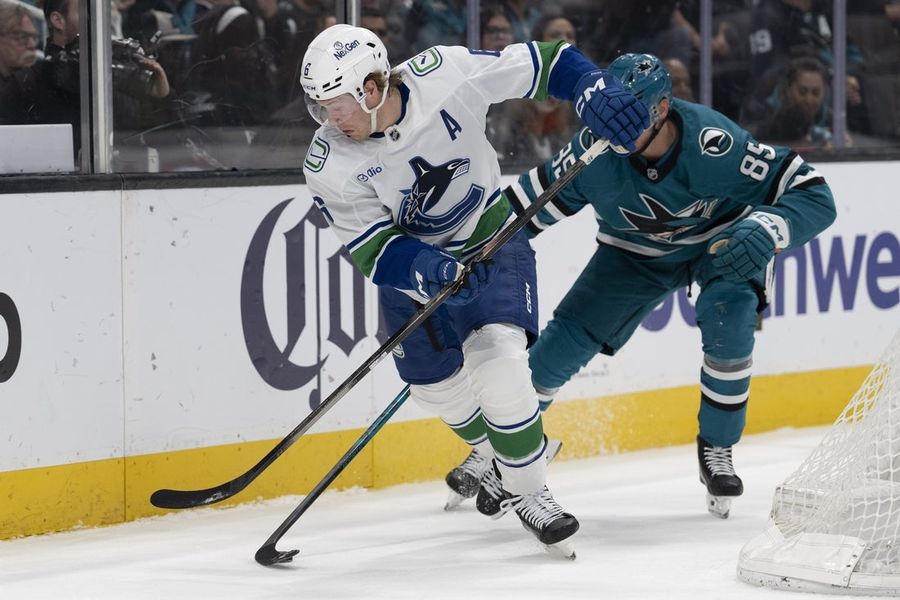
Deadspin | Canucks pull out win over Sharks in shootout  Apr 11, 2026; San Jose, California, USA;  Vancouver Canucks right wing Brock Boeser (6) and San Jose Sharks defenseman Shakir Mukhamadullin (85) battle for control of the puck during the first period at SAP Center at San Jose. Mandatory Credit: Stan Szeto-Imagn Images   Macklin Celebrini tallied his 109th and 110th points of the season, but the San Jose Sharks couldn’t win their home finale of the season, falling 4-3 to the Vancouver Canucks in a shootout on Saturday night.  Teddy Blueger and Linus Karlsson found the back of the net for the Canucks in the shootout, which went to six rounds.  Blueger, Marco Rossi, and Jake DeBrusk scored in regulation, and Kevin Lankinen made 28 saves for the Canucks (23-48-8, 54 points), who had lost four straight games and nine of their last 10. Vancouver has been eliminated from playoff contention.  Igor Chernyshov scored twice, Celebrini had two assists, and Yaroslav Askarov made 38 saves for the Sharks (37-34-8, 82 points), who have lost three straight. Saturday’s loss keeps the Sharks five points behind the Los Angeles Kings, who are currently in the second wild-card spot in the Western Conference playoff standings.  Chernyshov put San Jose ahead 1-0 at 16:19 of the first period. Celebrini won a faceoff in Vancouver’s zone and fell as he fed the puck to Chernyshov, who scored on a backhanded shot in front of the net.   Rossi tied the game 1-1 at 5:56 of the second period. Askarov went to play the puck behind the net, then tried to adjust before Rossi’s shot caught him out of position. The netminder pulled the net down on the puck, but officials called the goal good for Vancouver.  Tyler Toffoli gave the Sharks the 2-1 lead at 9:02. Sam Dickinson broke up the ice and set Toffoli up with a drop pass. The veteran center scored on a wrist shot.  DeBrusk tied the score back up 2-2 on a power play at 17:37. Askarov stopped a shot by Filip Hronek, and DeBrusk successfully scored on the rebound. San Jose challenged the goal for goaltender interference, but the call stood. It was DeBrusk’s 20th goal of the season, and 17th on the man advantage.  Chernyshov’s second goal of the night put the Sharks up 3-2 at 12:44 as Celebrini set him up for a wrist shot. Blueger tied the game 3-3 with 3:00 left in regulation with a wrist shot of his own.  –Field Level Media    #Deadspin #Canucks #pull #win #Sharks #shootoutApr 11, 2026; San Jose, California, USA; Vancouver Canucks right wing Brock Boeser (6) and San Jose Sharks defenseman Shakir Mukhamadullin (85) battle for control of the puck during the first period at SAP Center at San Jose. Mandatory Credit: Stan Szeto-Imagn Images

Macklin Celebrini tallied his 109th and 110th points of the season, but the San Jose Sharks couldn’t win their home finale of the season, falling 4-3 to the Vancouver Canucks in a shootout on Saturday night.

Teddy Blueger and Linus Karlsson found the back of the net for the Canucks in the shootout, which went to six rounds.

Blueger, Marco Rossi, and Jake DeBrusk scored in regulation, and Kevin Lankinen made 28 saves for the Canucks (23-48-8, 54 points), who had lost four straight games and nine of their last 10. Vancouver has been eliminated from playoff contention.

Igor Chernyshov scored twice, Celebrini had two assists, and Yaroslav Askarov made 38 saves for the Sharks (37-34-8, 82 points), who have lost three straight. Saturday’s loss keeps the Sharks five points behind the Los Angeles Kings, who are currently in the second wild-card spot in the Western Conference playoff standings.


Chernyshov put San Jose ahead 1-0 at 16:19 of the first period. Celebrini won a faceoff in Vancouver’s zone and fell as he fed the puck to Chernyshov, who scored on a backhanded shot in front of the net.

Rossi tied the game 1-1 at 5:56 of the second period. Askarov went to play the puck behind the net, then tried to adjust before Rossi’s shot caught him out of position. The netminder pulled the net down on the puck, but officials called the goal good for Vancouver.

Tyler Toffoli gave the Sharks the 2-1 lead at 9:02. Sam Dickinson broke up the ice and set Toffoli up with a drop pass. The veteran center scored on a wrist shot.

DeBrusk tied the score back up 2-2 on a power play at 17:37. Askarov stopped a shot by Filip Hronek, and DeBrusk successfully scored on the rebound. San Jose challenged the goal for goaltender interference, but the call stood. It was DeBrusk’s 20th goal of the season, and 17th on the man advantage.

Chernyshov’s second goal of the night put the Sharks up 3-2 at 12:44 as Celebrini set him up for a wrist shot. Blueger tied the game 3-3 with 3:00 left in regulation with a wrist shot of his own.


–Field Level Media

#Deadspin #Canucks #pull #win #Sharks #shootout

Apr 11, 2026; San Jose, California, USA; Vancouver Canucks right wing Brock Boeser (6) and San Jose Sharks defenseman Shakir Mukhamadullin (85) battle for control of the puck during the first period at SAP Center at San Jose. Mandatory Credit: Stan Szeto-Imagn Images

Macklin Celebrini tallied his 109th and 110th points of the season, but the San Jose Sharks couldn’t win their home finale of the season, falling 4-3 to the Vancouver Canucks in a shootout on Saturday night.

Teddy Blueger and Linus Karlsson found the back of the net for the Canucks in the shootout, which went to six rounds.

Blueger, Marco Rossi, and Jake DeBrusk scored in regulation, and Kevin Lankinen made 28 saves for the Canucks (23-48-8, 54 points), who had lost four straight games and nine of their last 10. Vancouver has been eliminated from playoff contention.

Igor Chernyshov scored twice, Celebrini had two assists, and Yaroslav Askarov made 38 saves for the Sharks (37-34-8, 82 points), who have lost three straight. Saturday’s loss keeps the Sharks five points behind the Los Angeles Kings, who are currently in the second wild-card spot in the Western Conference playoff standings.

Chernyshov put San Jose ahead 1-0 at 16:19 of the first period. Celebrini won a faceoff in Vancouver’s zone and fell as he fed the puck to Chernyshov, who scored on a backhanded shot in front of the net.

Rossi tied the game 1-1 at 5:56 of the second period. Askarov went to play the puck behind the net, then tried to adjust before Rossi’s shot caught him out of position. The netminder pulled the net down on the puck, but officials called the goal good for Vancouver.

Tyler Toffoli gave the Sharks the 2-1 lead at 9:02. Sam Dickinson broke up the ice and set Toffoli up with a drop pass. The veteran center scored on a wrist shot.

DeBrusk tied the score back up 2-2 on a power play at 17:37. Askarov stopped a shot by Filip Hronek, and DeBrusk successfully scored on the rebound. San Jose challenged the goal for goaltender interference, but the call stood. It was DeBrusk’s 20th goal of the season, and 17th on the man advantage.

Chernyshov’s second goal of the night put the Sharks up 3-2 at 12:44 as Celebrini set him up for a wrist shot. Blueger tied the game 3-3 with 3:00 left in regulation with a wrist shot of his own.

–Field Level Media

Source link
#Deadspin #Canucks #pull #win #Sharks #shootout

Previous post

Indore Nagar Nigam से उठे ‘वंदे मातरम’ विवाद पर Jitu Patwari का बड़ा बयान, CM Mohan को दिया चैलेंज!

Next post

How a simple exchange with Sheetal Devi put Payal Nag on course to become world’s first limbless archer <div id="content-body-70852085" itemprop="articleBody"><p>“ <i>Didi, mujhe bhi archery karni hai</i> (Sister, I too want to do archery),” the girl said. </p><p>“ <i>Theek hai. Aa jao</i> (Okay. Please, come here),” replied Sheetal Devi, the Asian Games gold medallist.</p><p>It was a simple exchange between two teenaged girls over a video call in 2023. </p><p>Last week, <a href="https://sportstar.thehindu.com/archery/payal-nag-quadruple-amputee-archer-beats-sheetal-devi-world-para-archery-series-2026-bangkok-indian-medallists/article70823056.ece" target="_blank">that girl, competing in only her second international event, beat World Champion Sheetal</a> in the compound women’s open final of the World Archery Para Series event in Bangkok.</p><p>Her name—Payal Nag.</p><p>But Payal’s story doesn’t start from that quick conversation with Sheetal. </p><p>In 2015, while Payal’s parents were busy working at a brick kiln in Raipur, Chhattisgarh, she was wandering around like any other seven-year-old when tragedy struck. She came into contact with a live wire. Consequently, the kid lost all four of her limbs.</p><p><b>ALSO READ | <a href="https://sportstar.thehindu.com/archery/world-archery-olympics-qualification-procedure-los-angeles-2028-quota-distribution-competitions/article70586821.ece" target="_blank">World Archery announces LA 2028 qualification process for recurve, compound events</a></b></p><p>The parents, despite societal taunts about the young daughter’s future, took care of her in their hometown of Balangir in Odisha. Barsha, her elder sister, became a major support. </p><p>Gradually, Payal took a liking to the world of painting and would draw sketches with her mouth. In 2022, for a better overall development, she was taken to Parbati Giri Bal Niketan—a government institute for childcare.</p><p>“Our District Collector Sir took me to the  <i>Ashram</i>. I used to draw even when I was at home and had even participated in one or two competitions. I used to sing as well. At the institute, competitions amongst the kids were held on a regular basis. There, a teacher named Prachi guided me,” recalls Payal. </p><p>“Then came a big drawing competition—Surbhi. I won the first prize. I even went on to compete at the State level. This is where someone tweeted about me.”</p><p>Call it the power of social media or pure destiny—Kuldeep Vedwan, Sheetal’s coach, saw Payal. </p><p>Vedwan, who Payal addresses as  <i>Guru Ji, </i>contacted the institute, got in touch with the District Collector, and made arrangements to bring Payal, along with her elder sister Barsha as her caretaker, to the Shri Mata Vaishno Devi Shrine Board Academy in Katra, Jammu and Kashmir.</p><p>Payal, who was also willing to learn archery during a video call with Vedwan and Sheetal, now had the chance to train.</p><p>The world had never witnessed a quadruple amputee in para archery. It was a journey into the unknown. But Vedwan had been here before with Sheetal. </p><p>Sheetal was born with phocomelia, a rare congenital condition due to which she had no arms. But Vedwan made a special equipment and trained her. Sheetal’s hard work bore fruit and her achievements turned her into an inspirational icon. </p><p>For Payal, Vedwan did the unthinkable again. By integrating a specialised mechanism into her prosthetic and securing it to her shoulder, he allowed her to anchor the bow via her mouth and trigger the release through a sharp shoulder movement.</p><p>Watching Sheetal practise in front of her gave Payal the necessary confidence to train, but she had to do so differently.</p><p>“In the initial stages, Payal used both prosthetic legs to shoot the arrows but it is against the international rules. Slowly, we switched to a single prosthetic limb,” says Abhilasha Chaudhary, who has also been coaching Payal at the academy and travels with the Indian para archery team.</p><p>“Once she became capable enough to shoot and hit 10s on a consistent basis, we had to customise the equipment so that she could perform using a single prosthetic leg. We also had to change the grip of her foot. Finally, we got the equipment approved by World Archery.”</p><p>After training for a year and a half, Payal took part in her first-ever event—the Para Archery Nationals in Jaipur in January. There, she grabbed two medals and also beat Sheetal for the first time. </p><p>That confidence of having beaten Sheetal earlier held Payal in good stead in Bangkok.</p><p>“ <i>Itna bhi darr nahin lag raha tha. Ma’am pichhe se samjha bhi rahe the.</i> (I wasn’t that scared. Ma’am was also guiding me from behind,” says the 18-year-old on facing her idol in the final at a global stage.)</p><p>After winning the women’s team gold together, it was time for an individual battle. Payal led Sheetal 27-25 after the first end of three arrows in the summit clash. But Sheetal, a year senior to Payal and much more experienced, equalised the score at 54-54. Another set of three arrows later, Payal was in front again at 82-80. With three more arrows to go, Payal led Sheetal by three—110-107.</p><p>Sheetal shot first and started the final end with a 10. Payal’s lead was down to two as she shot a 9. Then, Sheetal hit a 9 and shook her head slightly, realising that she had missed an opportunity. Payal responded with a 10. Sheetal came up with a 10 in her final shot. Payal needed only an 8 to secure the win but she matched Sheetal’s effort to put the icing on the cake. </p><p>Once the competition was over, Payal received a warm embrace from her senior. In a heartwarming gesture, Sheetal also helped in turning Payal’s wheelchair so that she could face the tricolour as the national anthem was to be played during the medal ceremony. </p><div class="inline_embed article-block-item"><blockquote class="twitter-tweet"><p lang="en" dir="ltr">𝗧𝗵𝗲 𝗠𝗲𝗱𝗮𝗹 𝗠𝗼𝗺𝗲𝗻𝘁 🎖️</p><p>Kudos to <a href="https://twitter.com/hashtag/Odisha?src=hash&ref_src=twsrc%5Etfw">#Odisha</a>‘s Payal Nag and Paralympian Sheetal Devi for etching history at the World Archery Para Series in Bangkok, securing <a href="https://twitter.com/hashtag/Gold?src=hash&ref_src=twsrc%5Etfw">#Gold</a> 🥇 and <a href="https://twitter.com/hashtag/Silver?src=hash&ref_src=twsrc%5Etfw">#Silver</a> 🥈 with a remarkable performance! 👏<a href="https://twitter.com/hashtag/OdishaForSports?src=hash&ref_src=twsrc%5Etfw">#OdishaForSports</a><a href="https://twitter.com/hashtag/ParaArchery?src=hash&ref_src=twsrc%5Etfw">#ParaArchery</a><a href="https://twitter.com/hashtag/PadiaToPodium?src=hash&ref_src=twsrc%5Etfw">#PadiaToPodium</a><a href="https://t.co/PNnafB4mNc">pic.twitter.com/PNnafB4mNc</a></p>— Odisha Sports (@sports_odisha) <a href="https://twitter.com/sports_odisha/status/2041168404791664869?ref_src=twsrc%5Etfw">April 6, 2026</a></blockquote></div><p>Payal’s success means a lot to her family. “My parents are really happy because earlier, people used to say, ‘ <i>Kuchh nahin kar payegi</i>’ (She won’t be able to do anything) about me. I have proved myself to those who didn’t have faith in me,” says the teenager. Her parents, along with her two younger siblings, also visit her in Katra sometimes and watch her train in person.</p><p>Payal’s victory is significant for Sheetal as well. “It was tough for her to do archery. I was worried about her. I could use my feet, but she had no limbs. How will she manage the grip? But Kuldeep Sir made a special device for her. Then, I felt that she could do it.  <i>Mujhe boht khushi huyi thi jab usne pehla teer chalaya tha </i>(I was really happy when she shot her first arrow) <i>. </i>I felt she would have to work harder, but she will manage,” recalls Sheetal, a Paralympic medallist, on watching Payal train at the academy.</p><p>In Payal, Sheetal has also found a strong teammate, “Winning and losing is part of the game. It’s good that she is here. I felt like I was alone, winning medals. With her, India will win more medals. The mixed team and women’s team have become better,” she says.</p><p>Payal is back to her daily routine at the academy, a place Sheetal left last year and shifted to Patiala to train under Gaurav Sharma to reinvent her technique after a major World Archery rule change made it illegal for the heel to touch the bow.</p><p>Payal, who is amongst the 10 per cent differently abled students at the academy, trains from 7:30 a.m. along with other able-bodied kids. The post-lunch training session begins at 2:30 p.m. and ends at 6 p.m. </p><p>“Training with able-bodied archers does have a positive effect on para archers’ performance,” says Abhilasha.</p><p>She believes that Payal can follow Sheetal, who made history last year by making it to the national able-bodied squad for the Asia Cup in Jeddah after finishing third among more than 60 compound women archers in the selection trials.</p><p>For now, Payal’s goal is to prepare for this year’s Asian Para Games and later, win gold at the Los Angeles Paralympics in 2028. </p><p>But what about drawing—the thing which started it all? “I still paint whenever I get time. My last painting was of  <i>Kanha Ji</i> (Lord Krishna) on my room’s wall,” she answers.</p><p>And singing? “ <i>Kabhi Kabhi</i> (sometimes),” she says with a huge smile on her face.</p><p class="publish-time" id="end-of-article">Published on Apr 12, 2026</p></div><script async src="https://platform.twitter.com/widgets.js" charset="utf-8"></script> #simple #exchange #Sheetal #Devi #put #Payal #Nag #worlds #limbless #archer

Soccer Meets America focuses around the meteoric rise in popularity, from the North American Soccer League days of the 1970s and 1980s to the 1984 Olympics, leading up to the 1994 World Cup. At the center of that history was Alan Rothenberg, who served as soccer commissioner for the 1984 Olympics, the president of the U.S. Soccer Federation from 1990 to 1998, and the CEO of the 1994 World Cup. He also had a hand in the start of Major League Soccer, adding women’s soccer to the Olympic program in 1996, and bringing the 1999 Women’s World Cup to the United States.

Rothenberg recently released a new book entitled The Big Bounce: The Surge that Shaped the Future of U.S. Soccer. In the book, Rothenberg gives an inside account at how American soccer went from the days where leagues were not organized and fizzled quickly to some of the success we have today with leagues like Major League Soccer, the National Women’s Soccer League, and the United Soccer Leagues. He details his firsthand knowledge of what it took for the United States to host a successful soccer tournament at the 1984 Olympics, how the nation won the bid to host the 1994 World Cup, and how he was able to organize the federation to get everything done and push the game forward. He recently sat down for an interview on the USA Soccercast, and in that interview, he mentioned that the rise in popularity of the game wasn’t based on one big moment, but a sustained buildup of momentum.

“[American soccer] sort of grew when I was starting in 1990,” Alan Rothenberg, former U.S. Soccer president and CEO of the 1994 World Cup, said in an interview for the USA Soccercast. “I had a glimpse of it back in the 70s when we had a team in Los Angeles ,and obviously the Cosmos set the world on fire at that time with Pelé and [Franz] Beckebauer…you had Giants Stadium. So there were those glimpses of what the future could hold. But as we started to build the soccer federation, our [1994] World cup team and the World cup organization, it just started to accelerate. So there wasn’t one ‘a ha!’ moment.”

Soccer Meets America takes the unique yet unexpected path of professional soccer in the United States andn gives the story some definition. Through people like Rothenberg, we see that the history is shaped by chance, persistence, and communities that kept the game alive long before it found mainstream recognition. Starting with the sport’s deep roots in immigrant communities in the 1920s, each episode of the docuseries explores soccer on a personal and professional level. Both nostalgic and forward-facing, the series features a variety of influential figures in American soccer and aims to resonate with new and old fans of the sport alike.

But there’s also the legacy of the 2026 World Cup, which will be different from what it was in 1994. “Well, obviously we’re starting from a different baseline,” Rothenberg said. “We started at virtually zero back in [1990], and now we’re starting from level 60 or 75…so the dramatic consequences will not be the same as they were after 94, but I think it’s going to be a huge spike in interest in the sport at all levels.”

To grow the history, you must learn from it. And Soccer Meets America gives you a review of America’s soccer history and strengthes the foundations from which the sport’s culture and passion were created. As we approach the World Cup, that knowledge will be essential to craft the legacy that will carry long after the tournament ends.

#Vox #Creative #Roku #debut #docuseries #history #American #soccer">Vox Creative, Roku debut new docuseries on history of American soccer  The history of American soccer has spanned well over 120 years, and to date there hasn’t been many opportunities to look back at that history. With the 2026 World Cup about a month away, we now have a chance to do just that. Yesterday, SB Nation collaborated with Vox Creative and Roku to release Soccer Meets America, a 3-part docuseries that focuses on the rise of soccer in the United States.Soccer Meets America focuses around the meteoric rise in popularity, from the North American Soccer League days of the 1970s and 1980s to the 1984 Olympics, leading up to the 1994 World Cup. At the center of that history was Alan Rothenberg, who served as soccer commissioner for the 1984 Olympics, the president of the U.S. Soccer Federation from 1990 to 1998, and the CEO of the 1994 World Cup. He also had a hand in the start of Major League Soccer, adding women’s soccer to the Olympic program in 1996, and bringing the 1999 Women’s World Cup to the United States.Rothenberg recently released a new book entitled The Big Bounce: The Surge that Shaped the Future of U.S. Soccer. In the book, Rothenberg gives an inside account at how American soccer went from the days where leagues were not organized and fizzled quickly to some of the success we have today with leagues like Major League Soccer, the National Women’s Soccer League, and the United Soccer Leagues. He details his firsthand knowledge of what it took for the United States to host a successful soccer tournament at the 1984 Olympics, how the nation won the bid to host the 1994 World Cup, and how he was able to organize the federation to get everything done and push the game forward. He recently sat down for an interview on the USA Soccercast, and in that interview, he mentioned that the rise in popularity of the game wasn’t based on one big moment, but a sustained buildup of momentum.“[American soccer] sort of grew when I was starting in 1990,” Alan Rothenberg, former U.S. Soccer president and CEO of the 1994 World Cup, said in an interview for the USA Soccercast. “I had a glimpse of it back in the 70s when we had a team in Los Angeles ,and obviously the Cosmos set the world on fire at that time with Pelé and [Franz] Beckebauer…you had Giants Stadium. So there were those glimpses of what the future could hold. But as we started to build the soccer federation, our [1994] World cup team and the World cup organization, it just started to accelerate. So there wasn’t one ‘a ha!’ moment.”Soccer Meets America takes the unique yet unexpected path of professional soccer in the United States andn gives the story some definition. Through people like Rothenberg, we see that the history is shaped by chance, persistence, and communities that kept the game alive long before it found mainstream recognition. Starting with the sport’s deep roots in immigrant communities in the 1920s, each episode of the docuseries explores soccer on a personal and professional level. Both nostalgic and forward-facing, the series features a variety of influential figures in American soccer and aims to resonate with new and old fans of the sport alike.But there’s also the legacy of the 2026 World Cup, which will be different from what it was in 1994. “Well, obviously we’re starting from a different baseline,” Rothenberg said. “We started at virtually zero back in [1990], and now we’re starting from level 60 or 75…so the dramatic consequences will not be the same as they were after 94, but I think it’s going to be a huge spike in interest in the sport at all levels.”To grow the history, you must learn from it. And Soccer Meets America gives you a review of America’s soccer history and strengthes the foundations from which the sport’s culture and passion were created. As we approach the World Cup, that knowledge will be essential to craft the legacy that will carry long after the tournament ends.  #Vox #Creative #Roku #debut #docuseries #history #American #soccer

Soccer Meets America, a 3-part docuseries that focuses on the rise of soccer in the United States.

Soccer Meets America focuses around the meteoric rise in popularity, from the North American Soccer League days of the 1970s and 1980s to the 1984 Olympics, leading up to the 1994 World Cup. At the center of that history was Alan Rothenberg, who served as soccer commissioner for the 1984 Olympics, the president of the U.S. Soccer Federation from 1990 to 1998, and the CEO of the 1994 World Cup. He also had a hand in the start of Major League Soccer, adding women’s soccer to the Olympic program in 1996, and bringing the 1999 Women’s World Cup to the United States.

Rothenberg recently released a new book entitled The Big Bounce: The Surge that Shaped the Future of U.S. Soccer. In the book, Rothenberg gives an inside account at how American soccer went from the days where leagues were not organized and fizzled quickly to some of the success we have today with leagues like Major League Soccer, the National Women’s Soccer League, and the United Soccer Leagues. He details his firsthand knowledge of what it took for the United States to host a successful soccer tournament at the 1984 Olympics, how the nation won the bid to host the 1994 World Cup, and how he was able to organize the federation to get everything done and push the game forward. He recently sat down for an interview on the USA Soccercast, and in that interview, he mentioned that the rise in popularity of the game wasn’t based on one big moment, but a sustained buildup of momentum.

“[American soccer] sort of grew when I was starting in 1990,” Alan Rothenberg, former U.S. Soccer president and CEO of the 1994 World Cup, said in an interview for the USA Soccercast. “I had a glimpse of it back in the 70s when we had a team in Los Angeles ,and obviously the Cosmos set the world on fire at that time with Pelé and [Franz] Beckebauer…you had Giants Stadium. So there were those glimpses of what the future could hold. But as we started to build the soccer federation, our [1994] World cup team and the World cup organization, it just started to accelerate. So there wasn’t one ‘a ha!’ moment.”

Soccer Meets America takes the unique yet unexpected path of professional soccer in the United States andn gives the story some definition. Through people like Rothenberg, we see that the history is shaped by chance, persistence, and communities that kept the game alive long before it found mainstream recognition. Starting with the sport’s deep roots in immigrant communities in the 1920s, each episode of the docuseries explores soccer on a personal and professional level. Both nostalgic and forward-facing, the series features a variety of influential figures in American soccer and aims to resonate with new and old fans of the sport alike.

But there’s also the legacy of the 2026 World Cup, which will be different from what it was in 1994. “Well, obviously we’re starting from a different baseline,” Rothenberg said. “We started at virtually zero back in [1990], and now we’re starting from level 60 or 75…so the dramatic consequences will not be the same as they were after 94, but I think it’s going to be a huge spike in interest in the sport at all levels.”

To grow the history, you must learn from it. And Soccer Meets America gives you a review of America’s soccer history and strengthes the foundations from which the sport’s culture and passion were created. As we approach the World Cup, that knowledge will be essential to craft the legacy that will carry long after the tournament ends.

#Vox #Creative #Roku #debut #docuseries #history #American #soccer">Vox Creative, Roku debut new docuseries on history of American soccer

The history of American soccer has spanned well over 120 years, and to date there hasn’t been many opportunities to look back at that history. With the 2026 World Cup about a month away, we now have a chance to do just that. Yesterday, SB Nation collaborated with Vox Creative and Roku to release Soccer Meets America, a 3-part docuseries that focuses on the rise of soccer in the United States.

Soccer Meets America focuses around the meteoric rise in popularity, from the North American Soccer League days of the 1970s and 1980s to the 1984 Olympics, leading up to the 1994 World Cup. At the center of that history was Alan Rothenberg, who served as soccer commissioner for the 1984 Olympics, the president of the U.S. Soccer Federation from 1990 to 1998, and the CEO of the 1994 World Cup. He also had a hand in the start of Major League Soccer, adding women’s soccer to the Olympic program in 1996, and bringing the 1999 Women’s World Cup to the United States.

Rothenberg recently released a new book entitled The Big Bounce: The Surge that Shaped the Future of U.S. Soccer. In the book, Rothenberg gives an inside account at how American soccer went from the days where leagues were not organized and fizzled quickly to some of the success we have today with leagues like Major League Soccer, the National Women’s Soccer League, and the United Soccer Leagues. He details his firsthand knowledge of what it took for the United States to host a successful soccer tournament at the 1984 Olympics, how the nation won the bid to host the 1994 World Cup, and how he was able to organize the federation to get everything done and push the game forward. He recently sat down for an interview on the USA Soccercast, and in that interview, he mentioned that the rise in popularity of the game wasn’t based on one big moment, but a sustained buildup of momentum.

“[American soccer] sort of grew when I was starting in 1990,” Alan Rothenberg, former U.S. Soccer president and CEO of the 1994 World Cup, said in an interview for the USA Soccercast. “I had a glimpse of it back in the 70s when we had a team in Los Angeles ,and obviously the Cosmos set the world on fire at that time with Pelé and [Franz] Beckebauer…you had Giants Stadium. So there were those glimpses of what the future could hold. But as we started to build the soccer federation, our [1994] World cup team and the World cup organization, it just started to accelerate. So there wasn’t one ‘a ha!’ moment.”

Soccer Meets America takes the unique yet unexpected path of professional soccer in the United States andn gives the story some definition. Through people like Rothenberg, we see that the history is shaped by chance, persistence, and communities that kept the game alive long before it found mainstream recognition. Starting with the sport’s deep roots in immigrant communities in the 1920s, each episode of the docuseries explores soccer on a personal and professional level. Both nostalgic and forward-facing, the series features a variety of influential figures in American soccer and aims to resonate with new and old fans of the sport alike.

But there’s also the legacy of the 2026 World Cup, which will be different from what it was in 1994. “Well, obviously we’re starting from a different baseline,” Rothenberg said. “We started at virtually zero back in [1990], and now we’re starting from level 60 or 75…so the dramatic consequences will not be the same as they were after 94, but I think it’s going to be a huge spike in interest in the sport at all levels.”

To grow the history, you must learn from it. And Soccer Meets America gives you a review of America’s soccer history and strengthes the foundations from which the sport’s culture and passion were created. As we approach the World Cup, that knowledge will be essential to craft the legacy that will carry long after the tournament ends.

#Vox #Creative #Roku #debut #docuseries #history #American #soccer

Delhi Capitals will host Chennai Super Kings at the Arun Jaitley Stadium in Delhi on Wednesday. Both teams have won four out of the nine games they have played.

In the reverse fixture, CSK beat DC by 23 runs in Chennai.

Here are the complete stats and head-to-head numbers you need to know before the teams face off:

DC vs CSK Head-to-Head Record in IPL

Matches Played: 32

Delhi Capitals: 12

Chennai Super Kings: 20

MOST RUNS IN DC vs CSK IPL MATCHES

Batter Innings Runs Average Strike Rate HS
MS Dhoni 29 696 38.66 142.04 63*
Suresh Raina 22 552 29.05 132.05 59
Shikhar Dhawan 10 433 54.12 136.16 101*
Rishabh Pant 11 375 46.87 156.9 79
Murali Vijay 12 346 34.6 136.22 113

MOST WICKETS IN DC vs CSK IPL MATCHES

Bowler Innings Wickets Economy Average BBI
Ravichandran Ashwin 17 19 6.52 21 3/23
Dwayne Bravo 17 19 8.06 22.42 3/33
Ravindra Jadeja 20 19 7.75 25.78 3/9
Deepak Chahar 12 13 8.06 26.69 3/22
Albie Morkel 14 13 8.29 29.76 3/32

Published on May 04, 2026

#CSK #headtohead #record #IPL #Delhi #Capitals #Chennai #Super #Kings #stats #runs #wickets">DC vs CSK head-to-head record, IPL 2026: Delhi Capitals vs Chennai Super Kings stats, runs, wickets  Delhi Capitals will host Chennai Super Kings at the Arun Jaitley Stadium in Delhi on Wednesday. Both teams have won four out of the nine games they have played.In the reverse fixture, CSK beat DC by 23 runs in Chennai.Here are the complete stats and head-to-head numbers you need to know before the teams face off:
DC vs CSK Head-to-Head Record in IPL

Matches Played: 32

Delhi Capitals: 12

Chennai Super Kings: 20
MOST RUNS IN DC vs CSK IPL MATCHES  Batter  Innings  Runs  Average  Strike Rate  HS   MS Dhoni  29  696  38.66  142.04  63*  Suresh Raina  22  552  29.05  132.05  59  Shikhar Dhawan  10  433  54.12  136.16  101*  Rishabh Pant  11  375  46.87  156.9  79  Murali Vijay  12  346  34.6  136.22  113MOST WICKETS IN DC vs CSK IPL MATCHES  Bowler  Innings  Wickets  Economy  Average  BBI  Ravichandran Ashwin  17  19  6.52  21  3/23  Dwayne Bravo  17  19  8.06  22.42  3/33  Ravindra Jadeja  20  19  7.75  25.78  3/9  Deepak Chahar  12  13  8.06  26.69  3/22  Albie Morkel  14  13  8.29  29.76  3/32Published on May 04, 2026  #CSK #headtohead #record #IPL #Delhi #Capitals #Chennai #Super #Kings #stats #runs #wickets

Post Comment