×
Deadspin | Oilers fall to Avs in shootout, slip 2 points back of Knights  Apr 13, 2026; Edmonton, Alberta, CAN; Edmonton Oilers goaltender Connor Ingram (39) makes a save on a deflection by Colorado Avalanche forward Zakhar Bardakov (93) during the second period at Rogers Place. Mandatory Credit: Perry Nelson-Imagn Images   Nathan MacKinnon scored the decisive goal in a shootout, Scott Wedgewood made 30 saves through regulation and overtime plus one more in the shootout, and the visiting Colorado Avalanche beat the Edmonton Oilers 2-1 on Monday night.  Sam Malinksi scored in regulation and Valeri Nichushkin and Martin Necas contributed shootout goals for the Central Division champion Avalanche (53-16-11, 117 points), who dealt Edmonton a tough loss in the Oilers’ quest for the Pacific Division title.  Edmonton (40-30-11, 91 points) fell two points behind Vegas for first place in the division after the Golden Knights beat the Winnipeg Jets 6-2 on Monday. The Oilers are one point ahead of the Anaheim Ducks, who have a game in hand on both Edmonton and Vegas.  Connor McDavid had a regulation goal and the first tally in the shootout for the Oilers. Ryan Nugent-Hopkins also had a shootout goal and Connor Ingram turned away 30 shots, though he was beaten on all three of Colorado’s shootout attempts.  The teams traded shootout goals until the third round. Wedgewood closed the pads on Jack Roslovic’s attempt, and then MacKinnon beat Ingram high to win it for the Avalanche.  The Edmonton goalie slammed his stick on the crossbar after allowing the goal.   Colorado coach Jared Bednar did not travel for the team’s final road trip of the season, which includes a Tuesday game at Calgary. Bednar sustained facial fractures and a corneal abrasion when he was struck by a puck on the bench during the Avalanche’s overtime loss to Vegas on Saturday.  Avalanche defenseman Josh Manson, who sustained an upper-body injury in the Saturday loss, did not play on Monday.  Malinski gave Colorado a 1-0 lead when he converted a turnover into his eighth goal at 9:05 of the second period. McDavid tied it at 15:49 of the second when his pass to Matt Savoie came right back to him and he beat Wedgewood before the goaltender could recover.  Edmonton had an opportunity to go ahead midway through the third period when Parker Kelly drew a minor penalty for closing his hand on the puck. It gave the Oilers a two-man advantage for 1:24, and they held the puck in the Avalanche zone for all of it but couldn’t cash in.  The Oilers killed off an overtime power play when Kasperi Kapanen was penalized for goalie interference.  –Field Level Media    #Deadspin #Oilers #fall #Avs #shootout #slip #points #Knights
Deadspin | Oilers fall to Avs in shootout, slip 2 points back of Knights
Deadspin | Oilers fall to Avs in shootout, slip 2 points back of Knights  Apr 13, 2026; Edmonton, Alberta, CAN; Edmonton Oilers goaltender Connor Ingram (39) makes a save on a deflection by Colorado Avalanche forward Zakhar Bardakov (93) during the second period at Rogers Place. Mandatory Credit: Perry Nelson-Imagn Images   Nathan MacKinnon scored the decisive goal in a shootout, Scott Wedgewood made 30 saves through regulation and overtime plus one more in the shootout, and the visiting Colorado Avalanche beat the Edmonton Oilers 2-1 on Monday night.  Sam Malinksi scored in regulation and Valeri Nichushkin and Martin Necas contributed shootout goals for the Central Division champion Avalanche (53-16-11, 117 points), who dealt Edmonton a tough loss in the Oilers’ quest for the Pacific Division title.  Edmonton (40-30-11, 91 points) fell two points behind Vegas for first place in the division after the Golden Knights beat the Winnipeg Jets 6-2 on Monday. The Oilers are one point ahead of the Anaheim Ducks, who have a game in hand on both Edmonton and Vegas.  Connor McDavid had a regulation goal and the first tally in the shootout for the Oilers. Ryan Nugent-Hopkins also had a shootout goal and Connor Ingram turned away 30 shots, though he was beaten on all three of Colorado’s shootout attempts.  The teams traded shootout goals until the third round. Wedgewood closed the pads on Jack Roslovic’s attempt, and then MacKinnon beat Ingram high to win it for the Avalanche.  The Edmonton goalie slammed his stick on the crossbar after allowing the goal.   Colorado coach Jared Bednar did not travel for the team’s final road trip of the season, which includes a Tuesday game at Calgary. Bednar sustained facial fractures and a corneal abrasion when he was struck by a puck on the bench during the Avalanche’s overtime loss to Vegas on Saturday.  Avalanche defenseman Josh Manson, who sustained an upper-body injury in the Saturday loss, did not play on Monday.  Malinski gave Colorado a 1-0 lead when he converted a turnover into his eighth goal at 9:05 of the second period. McDavid tied it at 15:49 of the second when his pass to Matt Savoie came right back to him and he beat Wedgewood before the goaltender could recover.  Edmonton had an opportunity to go ahead midway through the third period when Parker Kelly drew a minor penalty for closing his hand on the puck. It gave the Oilers a two-man advantage for 1:24, and they held the puck in the Avalanche zone for all of it but couldn’t cash in.  The Oilers killed off an overtime power play when Kasperi Kapanen was penalized for goalie interference.  –Field Level Media    #Deadspin #Oilers #fall #Avs #shootout #slip #points #KnightsApr 13, 2026; Edmonton, Alberta, CAN; Edmonton Oilers goaltender Connor Ingram (39) makes a save on a deflection by Colorado Avalanche forward Zakhar Bardakov (93) during the second period at Rogers Place. Mandatory Credit: Perry Nelson-Imagn Images

Nathan MacKinnon scored the decisive goal in a shootout, Scott Wedgewood made 30 saves through regulation and overtime plus one more in the shootout, and the visiting Colorado Avalanche beat the Edmonton Oilers 2-1 on Monday night.

Sam Malinksi scored in regulation and Valeri Nichushkin and Martin Necas contributed shootout goals for the Central Division champion Avalanche (53-16-11, 117 points), who dealt Edmonton a tough loss in the Oilers’ quest for the Pacific Division title.

Edmonton (40-30-11, 91 points) fell two points behind Vegas for first place in the division after the Golden Knights beat the Winnipeg Jets 6-2 on Monday. The Oilers are one point ahead of the Anaheim Ducks, who have a game in hand on both Edmonton and Vegas.

Connor McDavid had a regulation goal and the first tally in the shootout for the Oilers. Ryan Nugent-Hopkins also had a shootout goal and Connor Ingram turned away 30 shots, though he was beaten on all three of Colorado’s shootout attempts.

The teams traded shootout goals until the third round. Wedgewood closed the pads on Jack Roslovic’s attempt, and then MacKinnon beat Ingram high to win it for the Avalanche.


The Edmonton goalie slammed his stick on the crossbar after allowing the goal.

Colorado coach Jared Bednar did not travel for the team’s final road trip of the season, which includes a Tuesday game at Calgary. Bednar sustained facial fractures and a corneal abrasion when he was struck by a puck on the bench during the Avalanche’s overtime loss to Vegas on Saturday.

Avalanche defenseman Josh Manson, who sustained an upper-body injury in the Saturday loss, did not play on Monday.

Malinski gave Colorado a 1-0 lead when he converted a turnover into his eighth goal at 9:05 of the second period. McDavid tied it at 15:49 of the second when his pass to Matt Savoie came right back to him and he beat Wedgewood before the goaltender could recover.

Edmonton had an opportunity to go ahead midway through the third period when Parker Kelly drew a minor penalty for closing his hand on the puck. It gave the Oilers a two-man advantage for 1:24, and they held the puck in the Avalanche zone for all of it but couldn’t cash in.

The Oilers killed off an overtime power play when Kasperi Kapanen was penalized for goalie interference.


–Field Level Media

#Deadspin #Oilers #fall #Avs #shootout #slip #points #Knights

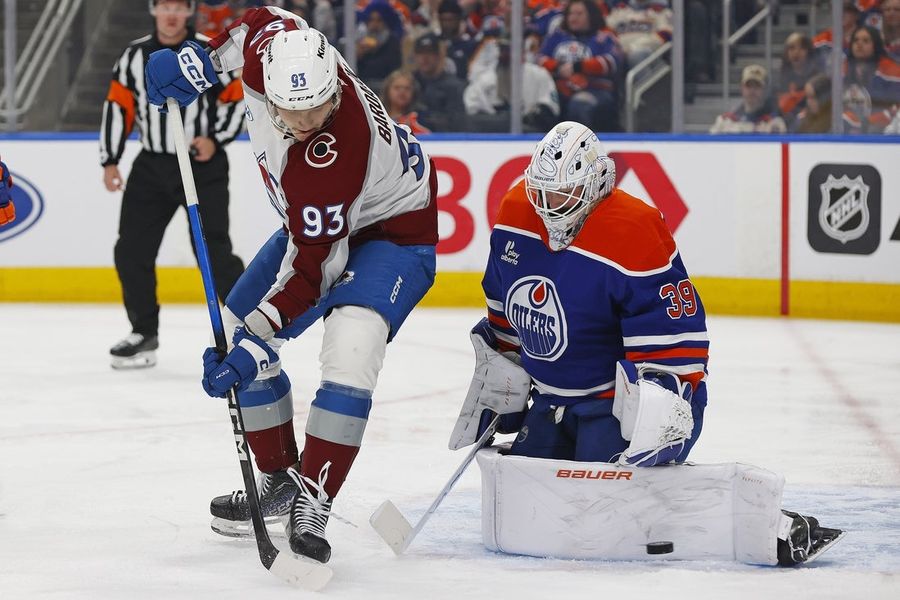
Apr 13, 2026; Edmonton, Alberta, CAN; Edmonton Oilers goaltender Connor Ingram (39) makes a save on a deflection by Colorado Avalanche forward Zakhar Bardakov (93) during the second period at Rogers Place. Mandatory Credit: Perry Nelson-Imagn Images

Nathan MacKinnon scored the decisive goal in a shootout, Scott Wedgewood made 30 saves through regulation and overtime plus one more in the shootout, and the visiting Colorado Avalanche beat the Edmonton Oilers 2-1 on Monday night.

Sam Malinksi scored in regulation and Valeri Nichushkin and Martin Necas contributed shootout goals for the Central Division champion Avalanche (53-16-11, 117 points), who dealt Edmonton a tough loss in the Oilers’ quest for the Pacific Division title.

Edmonton (40-30-11, 91 points) fell two points behind Vegas for first place in the division after the Golden Knights beat the Winnipeg Jets 6-2 on Monday. The Oilers are one point ahead of the Anaheim Ducks, who have a game in hand on both Edmonton and Vegas.

Connor McDavid had a regulation goal and the first tally in the shootout for the Oilers. Ryan Nugent-Hopkins also had a shootout goal and Connor Ingram turned away 30 shots, though he was beaten on all three of Colorado’s shootout attempts.

The teams traded shootout goals until the third round. Wedgewood closed the pads on Jack Roslovic’s attempt, and then MacKinnon beat Ingram high to win it for the Avalanche.

The Edmonton goalie slammed his stick on the crossbar after allowing the goal.

Colorado coach Jared Bednar did not travel for the team’s final road trip of the season, which includes a Tuesday game at Calgary. Bednar sustained facial fractures and a corneal abrasion when he was struck by a puck on the bench during the Avalanche’s overtime loss to Vegas on Saturday.

Avalanche defenseman Josh Manson, who sustained an upper-body injury in the Saturday loss, did not play on Monday.

Malinski gave Colorado a 1-0 lead when he converted a turnover into his eighth goal at 9:05 of the second period. McDavid tied it at 15:49 of the second when his pass to Matt Savoie came right back to him and he beat Wedgewood before the goaltender could recover.

Edmonton had an opportunity to go ahead midway through the third period when Parker Kelly drew a minor penalty for closing his hand on the puck. It gave the Oilers a two-man advantage for 1:24, and they held the puck in the Avalanche zone for all of it but couldn’t cash in.

The Oilers killed off an overtime power play when Kasperi Kapanen was penalized for goalie interference.

–Field Level Media

Source link
#Deadspin #Oilers #fall #Avs #shootout #slip #points #Knights

Previous post

AIFF responds to racial abuse complaints in Indian Super League <div id="content-body-70860429" itemprop="articleBody"><p>The All India Football Federation (AIFF) on Tuesday said that it has referred racial abuse complaints — during the Indian Super League — to the Disciplinary Committee for further investigation on the issue.</p><p>The development comes a day after Kerala Blasters sent a complaint of racism against its defender, Fallou Ndiaye, during the ISL match against Bengaluru FC at the Sree Kanteerava Stadium.</p><p>During the game, Ndiaye, who is from Senegal, was subject to racial slurs, videos of which have been widely circulated on social media.</p><p>“The AIFF maintains a zero-tolerance policy towards racism. The complaints have been referred to the Disciplinary Committee, an independent judicial body, for examination as per the AIFF Disciplinary Code. The AIFF will refrain from any further comments while the proceedings are ongoing,” the Federation said in a statement.</p><p>“The Indian Football family stands resolutely against racism. Those who bring hatred into our stadiums have no place in our game.”</p><p class="publish-time" id="end-of-article">Published on Apr 14, 2026</p></div> #AIFF #responds #racial #abuse #complaints #Indian #Super #League

Next post

CNN Shocker: Popular Correspondent To Leave After 20+ Years — Report

No matter what you think of NIL and the transfer portal — and your opinion is probably valid as long as it isn’t, say, Tommy Tuberville’s — there’s one thing for certain about college football’s changing landscape, and that’s the relative lack of smaller-school players in every draft class. Per ESPN’s Kalyn Kahler, the rate of prospects who transferred to bigger schools rose from 5.4% in 2018 to 38.2% in 2025. Better players are often moving to bigger schools for more money, yes, but also the opportunity to show their skills against a higher level of competition, in order to blot out that particular question mark in the eyes of NFL shot-callers.

In 2025, Las Vegas Raiders running back Ashton Jeanty (by way of Boise State) and Seattle left guard Grey Zabel (by way of North Dakota State) were the only first-round picks from non-major conferences, and that trend looks to continue in 2026. Toledo safety Emmanuel McNeil-Warren should be a lead-pipe lock as a first-round pick, but outside of that, it doesn’t look great for those guys outside of the bigger schools and conferences. Maybe San Diego State cornerback Chris Johnson sneaks into the back of the first round (which he should, based on performance; more on him later), and after that, we’re grasping at straws.

Still, there are smaller-school prospects whose tape reveals NFL starting potential in the right system, and here are my favorites in this particular draft class. Could these guys line up to be the next Joe Flacco (Delaware), Shannon Sharpe (Savannah State), Sam Mills (Montclair State), or Dave Krieg (Milton College — which no longer exists)? It’s entirely possible.

Here are five offensive prospects who I believe can start in the NFL sooner or later.

Cole Payton, QB, North Dakota State

Jan 31, 2026; Mobile, AL, USA; National quarterback Cole Payton (9) of North Dakota State throws the ball during the second half of the 2026 Senior Bowl at University of South Alabama, Hancock Whitney Stadium. Mandatory Credit: Vasha Hunt-Imagn Images

Jan 31, 2026; Mobile, AL, USA; National quarterback Cole Payton (9) of North Dakota State throws the ball during the second half of the 2026 Senior Bowl at University of South Alabama, Hancock Whitney Stadium. Mandatory Credit: Vasha Hunt-Imagn Images
Vasha Hunt-Imagn Images

Payton was a two-star recruit out of Westside High School in Omaha, Nebraska, and North Dakota State was the best of the smaller-school offers he got. There were no offers from bigger schools. He sat behind Trey Lance and Cam Miller until the 2025 season, when he was given the opportunity to be more than a package-play running quarterback (other people were interested in him as a potential tight end convert).

Given that chance, Payton went off. In 2025, he completed 161 of 226 passes (71.2%) for 2,719 yards (12.0 yards per attempt), 16 touchdowns, four interceptions, and a passer rating of 127.8. He completed 35 of 56 passes of 20 or more air yards for 1,247 yards, eight touchdowns, one interception, and a passer rating of 138.4. When under pressure, he completed 51 of 102 passes for 599 yards, two touchdowns, one interception, and a passer rating of 111.5, and when blitzed, he completed 63 of 89 passes for 1,399 yards, 10 touchdowns, no interceptions, and a passer rating of 150.6. Still, you’ll see opinions from alleged “experts” insisting that Payton doesn’t have a good deep arm, or that he falls apart under pressure. Nothing could be further from the truth.

The only real ding on Payton that makes sense, outside of strength of competition, is that he could be quicker and more consistent with his delivery. The one-year starter thing could be an issue for some NFL teams, as well. But if we’re going on NFL-transitive skills in a relatively weak quarterback class (Payton also ran the ball 120 times for 894 yards and 13 touchdowns last season), why wouldn’t Payton be able to hold a starting job in the NFL over time as he accentuates his development? The upside here could be Baker Mayfield-ish. Maybe the floor is Dillon Gabriel, but you could do a lot worse in the third day of the draft.

Robert Henry Jr., RB, UTSA

COLLEGE STATION, TEXAS - AUGUST 30: Robert Henry Jr #3 of the UTSA Roadrunners motions during the first quarter against the Texas A&M Aggies at Kyle Field on August 30, 2025 in College Station, Texas. (Photo by Maria Lysaker/Getty Images)

COLLEGE STATION, TEXAS – AUGUST 30: Robert Henry Jr #3 of the UTSA Roadrunners motions during the first quarter against the Texas A&M Aggies at Kyle Field on August 30, 2025 in College Station, Texas. (Photo by Maria Lysaker/Getty Images)
Getty Images

The 2026 running back class is somewhat similar to the quarterback class in that outside of the top guy (Notre Dame’s Jeremiyah Love), there isn’t a consensus No. 2 back. Which could leave the field open late in Day 2, or early in Day 3, for UTSA’s Robert Henry Jr. A no-star recruit from a very small high school, Henry spent his 2021 and 2022 seasons at Jones County Junior College in Ellisville, Mississippi before the Roadrunners snapped him up for the 2023 campaign, and he chose UTSA over Kentucky and South Carolina.

Henry’s first two seasons at his new school were pretty good, but 2025 was when he went off. He carried the rock 152 times for 1,051 yards (6.9 yards per carry), nine touchdowns, 33 forced missed tackles, and 16 runs of 15 or more yards. Add in his 17 catches on 24 targets for 112 yards and two touchdowns last season, and the fact that he’s not a complete disaster as a pass-blocker, and you can see an NFL path as a rotational back in either a gap-first or inside zone-heavy offense. And if you’re worried about strength of competition, go watch him against Texas A&M in the 2025 season opener, when he scalded the Aggies for 177 yards and two touchdowns on 16 carries.

Eli Heidenreich, RB/WR, Navy

BALTIMORE, MARYLAND - DECEMBER 13: Eli Heidenreich #22 of the Navy Midshipmen catches a pass for a touchdown during the second half of the 126th Army-Navy Game against the Army Black Knights at M&T Bank Stadium on December 13, 2025 in Baltimore, Maryland. (Photo by David Jensen/Getty Images)

BALTIMORE, MARYLAND – DECEMBER 13: Eli Heidenreich #22 of the Navy Midshipmen catches a pass for a touchdown during the second half of the 126th Army-Navy Game against the Army Black Knights at M&T Bank Stadium on December 13, 2025 in Baltimore, Maryland. (Photo by David Jensen/Getty Images)
Getty Images

When we talk about versatile players in football, we are generally focusing on defensive linemen who can win from multiple gaps, linebackers who can also rush the passer at the line of scrimmage, or defensive backs who can credibly play multiple positions without embarrassing themselves. In this case, we’re talking about a running back and a receiver in the person of Navy’s Eli Heidenreich, who is one of the more interesting prospects in this class, regardless of position.

Heidenreich was a lightly-recruited prospect out of Allegheny County near Pittsburgh, and committed to Navy when he was offered in 2021. He started to show his versatility in the 2023 season, led the Midshipmen in receiving in 2024, and put his best season together in 2025, when he totaled 1,440 yards from scrimmage and nine total touchdowns. 499 rushing yards and three touchdowns came on just 77 carries (6.9 yards per attempt), with 23 forced missed tackles, and nine runs of 15 or more yards. Then, as a receiver, he added 51 catches on 79 targets for 941 yards and six touchdowns, and he did all of that on a lot more than swings and screens. He’s got legitimate post, over, seam, and go routes in his palette from slot and wide deployments.

I’m not going to compare Heidenreich to the likes of Christian McCaffrey — he’s not that valuable as a runner. But if you think of how much Bill Belichick relied on James White when White played for the New England Patriots from 2014 to 2021, averaging 68 receptions per season over his career, that might be a good comp. Heidenreich won’t be for everybody; some will think of him more as a “homeless” tweener. But the right offensive coordinator could turn him into an every-down hybrid player with a ton of value.

Ted Hurst, WR, Georgia State

INDIANAPOLIS, IN - FEBRUARY 28: Ted Hurst #WO24 of Georgia State participates in a drill during the 2026 NFL Scouting Combine at Lucas Oil Stadium on February 28, 2026 in Indianapolis, Indiana. (Photo by Cooper Neill/Getty Images)

INDIANAPOLIS, IN – FEBRUARY 28: Ted Hurst #WO24 of Georgia State participates in a drill during the 2026 NFL Scouting Combine at Lucas Oil Stadium on February 28, 2026 in Indianapolis, Indiana. (Photo by Cooper Neill/Getty Images)
Getty Images

One of the first things I did when Dane Brugler of The Athletic released his mandatory “The Beast” draft guide this week was to look up Georgia State’s Ted Hurst for context as to why Hurst never saw action with bigger schools. Because the tape will tell you that this guy has a future as an NFL receiver. Somehow, even after a credible high-school stint at Sol C. Johnson High School in Savannah, Georgia, Hurst was a no-star recruit and played for Valdosta State for the 2022 and 2023 seasons before getting interest from one FBS school — Georgia State. I’m at a loss to explain why he didn’t end up at a major school (no offense to Georgia State!), but Hurst now has the opportunity to prove ‘em all wrong.

Last season, the 6’4”, 206-pound Hurst caught 71 passes on 124 targets for 999 yards (if only!) and six touchdowns. He had 11 catches on 27 targets of 20 or more air yards for 377 yards, and 14 explosive plays overall. Hurst also had 22 contested catches on 50 targets. And against Vanderbilt, Memphis, and Ole Miss — his most formidable opponents — Hurst caught 15 passes on 28 targets for 169 yards while his team was getting smushed more often than not.

I think he projects well as a “Z” receiver who you want to get open in space as opposed to someone who’s going to get dirty in traffic. Drops are an issue (13 over the last two seasons) and I’d like him to up hs play strength a bit. But if Hurst is a starting receiver in the NFL in two or three years, I will not be at all surprised.

Bryce Lance, WR, North Dakota State

FRISCO, TEXAS - JANUARY 6: Bryce Lance #5 of the North Dakota State Bison catches a pass against the Montana State Bobcats during the second half of the Division I FCS Football Championship held at Toyota Stadium on January 6, 2025 in Frisco, Texas. (Photo by Justin Tafoya/NCAA Photos via Getty Images)

FRISCO, TEXAS – JANUARY 6: Bryce Lance #5 of the North Dakota State Bison catches a pass against the Montana State Bobcats during the second half of the Division I FCS Football Championship held at Toyota Stadium on January 6, 2025 in Frisco, Texas. (Photo by Justin Tafoya/NCAA Photos via Getty Images)
NCAA Photos via Getty Images

Another speed receiver from a smaller school, though a juggernaut smaller school with a lot of NFL alumni, is Bryce Lance from North Dakota State. And yes, he is the younger brother of Trey Lance, who the San Francisco 49ers traded up to take with the third overall pick in the 2021 draft, and whose NFL career hasn’t exactly gone gangbusters.

Bryce Lance’s NFL transition looks a bit more solid. In 2025, the 6’3”, 204-pound Lance, who ran a 4.34-second 40-yard dash with a 1.49-second 10-yard split (ridiculous numbers for a man his size) caught 51 passes on 69 targets for 1,079 yards (an insane 21.2 yards per catch) and nine touchdowns. Lance was a big-play machine when given the opportunity — he caught 16 passes of 20 or more air yards on 21 targets for 641 yards and three touchdowns.

Lance turned down several NIL offers from bigger schools for the 2025 season after a 2024 season in which he caught 75 passes on 99 targets for 1,069 yards and 17 touchdowns, so he’s certainly not a one-year wonder. He’s got nice separation quickness off the line against press coverage, he has the physicality and body control to hold up well in contested-catch situation, and the track speed shows up on tape. Lance has all the attributes to be a WR2 or even a WR1 over time.

#smallschool #NFL #Draft #prospects #big #impact #offense">5 small-school NFL Draft prospects who can have a big impact on offense  No matter what you think of NIL and the transfer portal — and your opinion is probably valid as long as it isn’t, say, Tommy Tuberville’s — there’s one thing for certain about college football’s changing landscape, and that’s the relative lack of smaller-school players in every draft class. Per ESPN’s Kalyn Kahler, the rate of prospects who transferred to bigger schools rose from 5.4% in 2018 to 38.2% in 2025. Better players are often moving to bigger schools for more money, yes, but also the opportunity to show their skills against a higher level of competition, in order to blot out that particular question mark in the eyes of NFL shot-callers.In 2025, Las Vegas Raiders running back Ashton Jeanty (by way of Boise State) and Seattle left guard Grey Zabel (by way of North Dakota State) were the only first-round picks from non-major conferences, and that trend looks to continue in 2026. Toledo safety Emmanuel McNeil-Warren should be a lead-pipe lock as a first-round pick, but outside of that, it doesn’t look great for those guys outside of the bigger schools and conferences. Maybe San Diego State cornerback Chris Johnson sneaks into the back of the first round (which he should, based on performance; more on him later), and after that, we’re grasping at straws.Still, there are smaller-school prospects whose tape reveals NFL starting potential in the right system, and here are my favorites in this particular draft class. Could these guys line up to be the next Joe Flacco (Delaware), Shannon Sharpe (Savannah State), Sam Mills (Montclair State), or Dave Krieg (Milton College — which no longer exists)? It’s entirely possible.Here are five offensive prospects who I believe can start in the NFL sooner or later.Cole Payton, QB, North Dakota StateJan 31, 2026; Mobile, AL, USA; National quarterback Cole Payton (9) of North Dakota State throws the ball during the second half of the 2026 Senior Bowl at University of South Alabama, Hancock Whitney Stadium. Mandatory Credit: Vasha Hunt-Imagn Images Vasha Hunt-Imagn ImagesPayton was a two-star recruit out of Westside High School in Omaha, Nebraska, and North Dakota State was the best of the smaller-school offers he got. There were no offers from bigger schools. He sat behind Trey Lance and Cam Miller until the 2025 season, when he was given the opportunity to be more than a package-play running quarterback (other people were interested in him as a potential tight end convert).Given that chance, Payton went off. In 2025, he completed 161 of 226 passes (71.2%) for 2,719 yards (12.0 yards per attempt), 16 touchdowns, four interceptions, and a passer rating of 127.8. He completed 35 of 56 passes of 20 or more air yards for 1,247 yards, eight touchdowns, one interception, and a passer rating of 138.4. When under pressure, he completed 51 of 102 passes for 599 yards, two touchdowns, one interception, and a passer rating of 111.5, and when blitzed, he completed 63 of 89 passes for 1,399 yards, 10 touchdowns, no interceptions, and a passer rating of 150.6. Still, you’ll see opinions from alleged “experts” insisting that Payton doesn’t have a good deep arm, or that he falls apart under pressure. Nothing could be further from the truth.The only real ding on Payton that makes sense, outside of strength of competition, is that he could be quicker and more consistent with his delivery. The one-year starter thing could be an issue for some NFL teams, as well. But if we’re going on NFL-transitive skills in a relatively weak quarterback class (Payton also ran the ball 120 times for 894 yards and 13 touchdowns last season), why wouldn’t Payton be able to hold a starting job in the NFL over time as he accentuates his development? The upside here could be Baker Mayfield-ish. Maybe the floor is Dillon Gabriel, but you could do a lot worse in the third day of the draft.Robert Henry Jr., RB, UTSACOLLEGE STATION, TEXAS – AUGUST 30: Robert Henry Jr #3 of the UTSA Roadrunners motions during the first quarter against the Texas A&M Aggies at Kyle Field on August 30, 2025 in College Station, Texas. (Photo by Maria Lysaker/Getty Images) Getty ImagesThe 2026 running back class is somewhat similar to the quarterback class in that outside of the top guy (Notre Dame’s Jeremiyah Love), there isn’t a consensus No. 2 back. Which could leave the field open late in Day 2, or early in Day 3, for UTSA’s Robert Henry Jr. A no-star recruit from a very small high school, Henry spent his 2021 and 2022 seasons at Jones County Junior College in Ellisville, Mississippi before the Roadrunners snapped him up for the 2023 campaign, and he chose UTSA over Kentucky and South Carolina.Henry’s first two seasons at his new school were pretty good, but 2025 was when he went off. He carried the rock 152 times for 1,051 yards (6.9 yards per carry), nine touchdowns, 33 forced missed tackles, and 16 runs of 15 or more yards. Add in his 17 catches on 24 targets for 112 yards and two touchdowns last season, and the fact that he’s not a complete disaster as a pass-blocker, and you can see an NFL path as a rotational back in either a gap-first or inside zone-heavy offense. And if you’re worried about strength of competition, go watch him against Texas A&M in the 2025 season opener, when he scalded the Aggies for 177 yards and two touchdowns on 16 carries.Eli Heidenreich, RB/WR, NavyBALTIMORE, MARYLAND – DECEMBER 13: Eli Heidenreich #22 of the Navy Midshipmen catches a pass for a touchdown during the second half of the 126th Army-Navy Game against the Army Black Knights at M&T Bank Stadium on December 13, 2025 in Baltimore, Maryland. (Photo by David Jensen/Getty Images) Getty ImagesWhen we talk about versatile players in football, we are generally focusing on defensive linemen who can win from multiple gaps, linebackers who can also rush the passer at the line of scrimmage, or defensive backs who can credibly play multiple positions without embarrassing themselves. In this case, we’re talking about a running back and a receiver in the person of Navy’s Eli Heidenreich, who is one of the more interesting prospects in this class, regardless of position.Heidenreich was a lightly-recruited prospect out of Allegheny County near Pittsburgh, and committed to Navy when he was offered in 2021. He started to show his versatility in the 2023 season, led the Midshipmen in receiving in 2024, and put his best season together in 2025, when he totaled 1,440 yards from scrimmage and nine total touchdowns. 499 rushing yards and three touchdowns came on just 77 carries (6.9 yards per attempt), with 23 forced missed tackles, and nine runs of 15 or more yards. Then, as a receiver, he added 51 catches on 79 targets for 941 yards and six touchdowns, and he did all of that on a lot more than swings and screens. He’s got legitimate post, over, seam, and go routes in his palette from slot and wide deployments.I’m not going to compare Heidenreich to the likes of Christian McCaffrey — he’s not that valuable as a runner. But if you think of how much Bill Belichick relied on James White when White played for the New England Patriots from 2014 to 2021, averaging 68 receptions per season over his career, that might be a good comp. Heidenreich won’t be for everybody; some will think of him more as a “homeless” tweener. But the right offensive coordinator could turn him into an every-down hybrid player with a ton of value.Ted Hurst, WR, Georgia StateINDIANAPOLIS, IN – FEBRUARY 28: Ted Hurst #WO24 of Georgia State participates in a drill during the 2026 NFL Scouting Combine at Lucas Oil Stadium on February 28, 2026 in Indianapolis, Indiana. (Photo by Cooper Neill/Getty Images) Getty ImagesOne of the first things I did when Dane Brugler of The Athletic released his mandatory “The Beast” draft guide this week was to look up Georgia State’s Ted Hurst for context as to why Hurst never saw action with bigger schools. Because the tape will tell you that this guy has a future as an NFL receiver. Somehow, even after a credible high-school stint at Sol C. Johnson High School in Savannah, Georgia, Hurst was a no-star recruit and played for Valdosta State for the 2022 and 2023 seasons before getting interest from one FBS school — Georgia State. I’m at a loss to explain why he didn’t end up at a major school (no offense to Georgia State!), but Hurst now has the opportunity to prove ‘em all wrong.Last season, the 6’4”, 206-pound Hurst caught 71 passes on 124 targets for 999 yards (if only!) and six touchdowns. He had 11 catches on 27 targets of 20 or more air yards for 377 yards, and 14 explosive plays overall. Hurst also had 22 contested catches on 50 targets. And against Vanderbilt, Memphis, and Ole Miss — his most formidable opponents — Hurst caught 15 passes on 28 targets for 169 yards while his team was getting smushed more often than not.I think he projects well as a “Z” receiver who you want to get open in space as opposed to someone who’s going to get dirty in traffic. Drops are an issue (13 over the last two seasons) and I’d like him to up hs play strength a bit. But if Hurst is a starting receiver in the NFL in two or three years, I will not be at all surprised.Bryce Lance, WR, North Dakota StateFRISCO, TEXAS – JANUARY 6: Bryce Lance #5 of the North Dakota State Bison catches a pass against the Montana State Bobcats during the second half of the Division I FCS Football Championship held at Toyota Stadium on January 6, 2025 in Frisco, Texas. (Photo by Justin Tafoya/NCAA Photos via Getty Images) NCAA Photos via Getty ImagesAnother speed receiver from a smaller school, though a juggernaut smaller school with a lot of NFL alumni, is Bryce Lance from North Dakota State. And yes, he is the younger brother of Trey Lance, who the San Francisco 49ers traded up to take with the third overall pick in the 2021 draft, and whose NFL career hasn’t exactly gone gangbusters.Bryce Lance’s NFL transition looks a bit more solid. In 2025, the 6’3”, 204-pound Lance, who ran a 4.34-second 40-yard dash with a 1.49-second 10-yard split (ridiculous numbers for a man his size) caught 51 passes on 69 targets for 1,079 yards (an insane 21.2 yards per catch) and nine touchdowns. Lance was a big-play machine when given the opportunity — he caught 16 passes of 20 or more air yards on 21 targets for 641 yards and three touchdowns.Lance turned down several NIL offers from bigger schools for the 2025 season after a 2024 season in which he caught 75 passes on 99 targets for 1,069 yards and 17 touchdowns, so he’s certainly not a one-year wonder. He’s got nice separation quickness off the line against press coverage, he has the physicality and body control to hold up well in contested-catch situation, and the track speed shows up on tape. Lance has all the attributes to be a WR2 or even a WR1 over time.  #smallschool #NFL #Draft #prospects #big #impact #offense

Tommy Tuberville’s — there’s one thing for certain about college football’s changing landscape, and that’s the relative lack of smaller-school players in every draft class. Per ESPN’s Kalyn Kahler, the rate of prospects who transferred to bigger schools rose from 5.4% in 2018 to 38.2% in 2025. Better players are often moving to bigger schools for more money, yes, but also the opportunity to show their skills against a higher level of competition, in order to blot out that particular question mark in the eyes of NFL shot-callers.

In 2025, Las Vegas Raiders running back Ashton Jeanty (by way of Boise State) and Seattle left guard Grey Zabel (by way of North Dakota State) were the only first-round picks from non-major conferences, and that trend looks to continue in 2026. Toledo safety Emmanuel McNeil-Warren should be a lead-pipe lock as a first-round pick, but outside of that, it doesn’t look great for those guys outside of the bigger schools and conferences. Maybe San Diego State cornerback Chris Johnson sneaks into the back of the first round (which he should, based on performance; more on him later), and after that, we’re grasping at straws.

Still, there are smaller-school prospects whose tape reveals NFL starting potential in the right system, and here are my favorites in this particular draft class. Could these guys line up to be the next Joe Flacco (Delaware), Shannon Sharpe (Savannah State), Sam Mills (Montclair State), or Dave Krieg (Milton College — which no longer exists)? It’s entirely possible.

Here are five offensive prospects who I believe can start in the NFL sooner or later.

Cole Payton, QB, North Dakota State

Jan 31, 2026; Mobile, AL, USA; National quarterback Cole Payton (9) of North Dakota State throws the ball during the second half of the 2026 Senior Bowl at University of South Alabama, Hancock Whitney Stadium. Mandatory Credit: Vasha Hunt-Imagn Images

Jan 31, 2026; Mobile, AL, USA; National quarterback Cole Payton (9) of North Dakota State throws the ball during the second half of the 2026 Senior Bowl at University of South Alabama, Hancock Whitney Stadium. Mandatory Credit: Vasha Hunt-Imagn Images
Vasha Hunt-Imagn Images

Payton was a two-star recruit out of Westside High School in Omaha, Nebraska, and North Dakota State was the best of the smaller-school offers he got. There were no offers from bigger schools. He sat behind Trey Lance and Cam Miller until the 2025 season, when he was given the opportunity to be more than a package-play running quarterback (other people were interested in him as a potential tight end convert).

Given that chance, Payton went off. In 2025, he completed 161 of 226 passes (71.2%) for 2,719 yards (12.0 yards per attempt), 16 touchdowns, four interceptions, and a passer rating of 127.8. He completed 35 of 56 passes of 20 or more air yards for 1,247 yards, eight touchdowns, one interception, and a passer rating of 138.4. When under pressure, he completed 51 of 102 passes for 599 yards, two touchdowns, one interception, and a passer rating of 111.5, and when blitzed, he completed 63 of 89 passes for 1,399 yards, 10 touchdowns, no interceptions, and a passer rating of 150.6. Still, you’ll see opinions from alleged “experts” insisting that Payton doesn’t have a good deep arm, or that he falls apart under pressure. Nothing could be further from the truth.

The only real ding on Payton that makes sense, outside of strength of competition, is that he could be quicker and more consistent with his delivery. The one-year starter thing could be an issue for some NFL teams, as well. But if we’re going on NFL-transitive skills in a relatively weak quarterback class (Payton also ran the ball 120 times for 894 yards and 13 touchdowns last season), why wouldn’t Payton be able to hold a starting job in the NFL over time as he accentuates his development? The upside here could be Baker Mayfield-ish. Maybe the floor is Dillon Gabriel, but you could do a lot worse in the third day of the draft.

Robert Henry Jr., RB, UTSA

COLLEGE STATION, TEXAS - AUGUST 30: Robert Henry Jr #3 of the UTSA Roadrunners motions during the first quarter against the Texas A&M Aggies at Kyle Field on August 30, 2025 in College Station, Texas. (Photo by Maria Lysaker/Getty Images)

COLLEGE STATION, TEXAS – AUGUST 30: Robert Henry Jr #3 of the UTSA Roadrunners motions during the first quarter against the Texas A&M Aggies at Kyle Field on August 30, 2025 in College Station, Texas. (Photo by Maria Lysaker/Getty Images)
Getty Images

The 2026 running back class is somewhat similar to the quarterback class in that outside of the top guy (Notre Dame’s Jeremiyah Love), there isn’t a consensus No. 2 back. Which could leave the field open late in Day 2, or early in Day 3, for UTSA’s Robert Henry Jr. A no-star recruit from a very small high school, Henry spent his 2021 and 2022 seasons at Jones County Junior College in Ellisville, Mississippi before the Roadrunners snapped him up for the 2023 campaign, and he chose UTSA over Kentucky and South Carolina.

Henry’s first two seasons at his new school were pretty good, but 2025 was when he went off. He carried the rock 152 times for 1,051 yards (6.9 yards per carry), nine touchdowns, 33 forced missed tackles, and 16 runs of 15 or more yards. Add in his 17 catches on 24 targets for 112 yards and two touchdowns last season, and the fact that he’s not a complete disaster as a pass-blocker, and you can see an NFL path as a rotational back in either a gap-first or inside zone-heavy offense. And if you’re worried about strength of competition, go watch him against Texas A&M in the 2025 season opener, when he scalded the Aggies for 177 yards and two touchdowns on 16 carries.

Eli Heidenreich, RB/WR, Navy

BALTIMORE, MARYLAND - DECEMBER 13: Eli Heidenreich #22 of the Navy Midshipmen catches a pass for a touchdown during the second half of the 126th Army-Navy Game against the Army Black Knights at M&T Bank Stadium on December 13, 2025 in Baltimore, Maryland. (Photo by David Jensen/Getty Images)

BALTIMORE, MARYLAND – DECEMBER 13: Eli Heidenreich #22 of the Navy Midshipmen catches a pass for a touchdown during the second half of the 126th Army-Navy Game against the Army Black Knights at M&T Bank Stadium on December 13, 2025 in Baltimore, Maryland. (Photo by David Jensen/Getty Images)
Getty Images

When we talk about versatile players in football, we are generally focusing on defensive linemen who can win from multiple gaps, linebackers who can also rush the passer at the line of scrimmage, or defensive backs who can credibly play multiple positions without embarrassing themselves. In this case, we’re talking about a running back and a receiver in the person of Navy’s Eli Heidenreich, who is one of the more interesting prospects in this class, regardless of position.

Heidenreich was a lightly-recruited prospect out of Allegheny County near Pittsburgh, and committed to Navy when he was offered in 2021. He started to show his versatility in the 2023 season, led the Midshipmen in receiving in 2024, and put his best season together in 2025, when he totaled 1,440 yards from scrimmage and nine total touchdowns. 499 rushing yards and three touchdowns came on just 77 carries (6.9 yards per attempt), with 23 forced missed tackles, and nine runs of 15 or more yards. Then, as a receiver, he added 51 catches on 79 targets for 941 yards and six touchdowns, and he did all of that on a lot more than swings and screens. He’s got legitimate post, over, seam, and go routes in his palette from slot and wide deployments.

I’m not going to compare Heidenreich to the likes of Christian McCaffrey — he’s not that valuable as a runner. But if you think of how much Bill Belichick relied on James White when White played for the New England Patriots from 2014 to 2021, averaging 68 receptions per season over his career, that might be a good comp. Heidenreich won’t be for everybody; some will think of him more as a “homeless” tweener. But the right offensive coordinator could turn him into an every-down hybrid player with a ton of value.

Ted Hurst, WR, Georgia State

INDIANAPOLIS, IN - FEBRUARY 28: Ted Hurst #WO24 of Georgia State participates in a drill during the 2026 NFL Scouting Combine at Lucas Oil Stadium on February 28, 2026 in Indianapolis, Indiana. (Photo by Cooper Neill/Getty Images)

INDIANAPOLIS, IN – FEBRUARY 28: Ted Hurst #WO24 of Georgia State participates in a drill during the 2026 NFL Scouting Combine at Lucas Oil Stadium on February 28, 2026 in Indianapolis, Indiana. (Photo by Cooper Neill/Getty Images)
Getty Images

One of the first things I did when Dane Brugler of The Athletic released his mandatory “The Beast” draft guide this week was to look up Georgia State’s Ted Hurst for context as to why Hurst never saw action with bigger schools. Because the tape will tell you that this guy has a future as an NFL receiver. Somehow, even after a credible high-school stint at Sol C. Johnson High School in Savannah, Georgia, Hurst was a no-star recruit and played for Valdosta State for the 2022 and 2023 seasons before getting interest from one FBS school — Georgia State. I’m at a loss to explain why he didn’t end up at a major school (no offense to Georgia State!), but Hurst now has the opportunity to prove ‘em all wrong.

Last season, the 6’4”, 206-pound Hurst caught 71 passes on 124 targets for 999 yards (if only!) and six touchdowns. He had 11 catches on 27 targets of 20 or more air yards for 377 yards, and 14 explosive plays overall. Hurst also had 22 contested catches on 50 targets. And against Vanderbilt, Memphis, and Ole Miss — his most formidable opponents — Hurst caught 15 passes on 28 targets for 169 yards while his team was getting smushed more often than not.

I think he projects well as a “Z” receiver who you want to get open in space as opposed to someone who’s going to get dirty in traffic. Drops are an issue (13 over the last two seasons) and I’d like him to up hs play strength a bit. But if Hurst is a starting receiver in the NFL in two or three years, I will not be at all surprised.

Bryce Lance, WR, North Dakota State

FRISCO, TEXAS - JANUARY 6: Bryce Lance #5 of the North Dakota State Bison catches a pass against the Montana State Bobcats during the second half of the Division I FCS Football Championship held at Toyota Stadium on January 6, 2025 in Frisco, Texas. (Photo by Justin Tafoya/NCAA Photos via Getty Images)

FRISCO, TEXAS – JANUARY 6: Bryce Lance #5 of the North Dakota State Bison catches a pass against the Montana State Bobcats during the second half of the Division I FCS Football Championship held at Toyota Stadium on January 6, 2025 in Frisco, Texas. (Photo by Justin Tafoya/NCAA Photos via Getty Images)
NCAA Photos via Getty Images

Another speed receiver from a smaller school, though a juggernaut smaller school with a lot of NFL alumni, is Bryce Lance from North Dakota State. And yes, he is the younger brother of Trey Lance, who the San Francisco 49ers traded up to take with the third overall pick in the 2021 draft, and whose NFL career hasn’t exactly gone gangbusters.

Bryce Lance’s NFL transition looks a bit more solid. In 2025, the 6’3”, 204-pound Lance, who ran a 4.34-second 40-yard dash with a 1.49-second 10-yard split (ridiculous numbers for a man his size) caught 51 passes on 69 targets for 1,079 yards (an insane 21.2 yards per catch) and nine touchdowns. Lance was a big-play machine when given the opportunity — he caught 16 passes of 20 or more air yards on 21 targets for 641 yards and three touchdowns.

Lance turned down several NIL offers from bigger schools for the 2025 season after a 2024 season in which he caught 75 passes on 99 targets for 1,069 yards and 17 touchdowns, so he’s certainly not a one-year wonder. He’s got nice separation quickness off the line against press coverage, he has the physicality and body control to hold up well in contested-catch situation, and the track speed shows up on tape. Lance has all the attributes to be a WR2 or even a WR1 over time.

#smallschool #NFL #Draft #prospects #big #impact #offense">5 small-school NFL Draft prospects who can have a big impact on offense

No matter what you think of NIL and the transfer portal — and your opinion is probably valid as long as it isn’t, say, Tommy Tuberville’s — there’s one thing for certain about college football’s changing landscape, and that’s the relative lack of smaller-school players in every draft class. Per ESPN’s Kalyn Kahler, the rate of prospects who transferred to bigger schools rose from 5.4% in 2018 to 38.2% in 2025. Better players are often moving to bigger schools for more money, yes, but also the opportunity to show their skills against a higher level of competition, in order to blot out that particular question mark in the eyes of NFL shot-callers.

In 2025, Las Vegas Raiders running back Ashton Jeanty (by way of Boise State) and Seattle left guard Grey Zabel (by way of North Dakota State) were the only first-round picks from non-major conferences, and that trend looks to continue in 2026. Toledo safety Emmanuel McNeil-Warren should be a lead-pipe lock as a first-round pick, but outside of that, it doesn’t look great for those guys outside of the bigger schools and conferences. Maybe San Diego State cornerback Chris Johnson sneaks into the back of the first round (which he should, based on performance; more on him later), and after that, we’re grasping at straws.

Still, there are smaller-school prospects whose tape reveals NFL starting potential in the right system, and here are my favorites in this particular draft class. Could these guys line up to be the next Joe Flacco (Delaware), Shannon Sharpe (Savannah State), Sam Mills (Montclair State), or Dave Krieg (Milton College — which no longer exists)? It’s entirely possible.

Here are five offensive prospects who I believe can start in the NFL sooner or later.

Cole Payton, QB, North Dakota State

Jan 31, 2026; Mobile, AL, USA; National quarterback Cole Payton (9) of North Dakota State throws the ball during the second half of the 2026 Senior Bowl at University of South Alabama, Hancock Whitney Stadium. Mandatory Credit: Vasha Hunt-Imagn Images

Jan 31, 2026; Mobile, AL, USA; National quarterback Cole Payton (9) of North Dakota State throws the ball during the second half of the 2026 Senior Bowl at University of South Alabama, Hancock Whitney Stadium. Mandatory Credit: Vasha Hunt-Imagn Images
Vasha Hunt-Imagn Images

Payton was a two-star recruit out of Westside High School in Omaha, Nebraska, and North Dakota State was the best of the smaller-school offers he got. There were no offers from bigger schools. He sat behind Trey Lance and Cam Miller until the 2025 season, when he was given the opportunity to be more than a package-play running quarterback (other people were interested in him as a potential tight end convert).

Given that chance, Payton went off. In 2025, he completed 161 of 226 passes (71.2%) for 2,719 yards (12.0 yards per attempt), 16 touchdowns, four interceptions, and a passer rating of 127.8. He completed 35 of 56 passes of 20 or more air yards for 1,247 yards, eight touchdowns, one interception, and a passer rating of 138.4. When under pressure, he completed 51 of 102 passes for 599 yards, two touchdowns, one interception, and a passer rating of 111.5, and when blitzed, he completed 63 of 89 passes for 1,399 yards, 10 touchdowns, no interceptions, and a passer rating of 150.6. Still, you’ll see opinions from alleged “experts” insisting that Payton doesn’t have a good deep arm, or that he falls apart under pressure. Nothing could be further from the truth.

The only real ding on Payton that makes sense, outside of strength of competition, is that he could be quicker and more consistent with his delivery. The one-year starter thing could be an issue for some NFL teams, as well. But if we’re going on NFL-transitive skills in a relatively weak quarterback class (Payton also ran the ball 120 times for 894 yards and 13 touchdowns last season), why wouldn’t Payton be able to hold a starting job in the NFL over time as he accentuates his development? The upside here could be Baker Mayfield-ish. Maybe the floor is Dillon Gabriel, but you could do a lot worse in the third day of the draft.

Robert Henry Jr., RB, UTSA

COLLEGE STATION, TEXAS - AUGUST 30: Robert Henry Jr #3 of the UTSA Roadrunners motions during the first quarter against the Texas A&M Aggies at Kyle Field on August 30, 2025 in College Station, Texas. (Photo by Maria Lysaker/Getty Images)

COLLEGE STATION, TEXAS – AUGUST 30: Robert Henry Jr #3 of the UTSA Roadrunners motions during the first quarter against the Texas A&M Aggies at Kyle Field on August 30, 2025 in College Station, Texas. (Photo by Maria Lysaker/Getty Images)
Getty Images

The 2026 running back class is somewhat similar to the quarterback class in that outside of the top guy (Notre Dame’s Jeremiyah Love), there isn’t a consensus No. 2 back. Which could leave the field open late in Day 2, or early in Day 3, for UTSA’s Robert Henry Jr. A no-star recruit from a very small high school, Henry spent his 2021 and 2022 seasons at Jones County Junior College in Ellisville, Mississippi before the Roadrunners snapped him up for the 2023 campaign, and he chose UTSA over Kentucky and South Carolina.

Henry’s first two seasons at his new school were pretty good, but 2025 was when he went off. He carried the rock 152 times for 1,051 yards (6.9 yards per carry), nine touchdowns, 33 forced missed tackles, and 16 runs of 15 or more yards. Add in his 17 catches on 24 targets for 112 yards and two touchdowns last season, and the fact that he’s not a complete disaster as a pass-blocker, and you can see an NFL path as a rotational back in either a gap-first or inside zone-heavy offense. And if you’re worried about strength of competition, go watch him against Texas A&M in the 2025 season opener, when he scalded the Aggies for 177 yards and two touchdowns on 16 carries.

Eli Heidenreich, RB/WR, Navy

BALTIMORE, MARYLAND - DECEMBER 13: Eli Heidenreich #22 of the Navy Midshipmen catches a pass for a touchdown during the second half of the 126th Army-Navy Game against the Army Black Knights at M&T Bank Stadium on December 13, 2025 in Baltimore, Maryland. (Photo by David Jensen/Getty Images)

BALTIMORE, MARYLAND – DECEMBER 13: Eli Heidenreich #22 of the Navy Midshipmen catches a pass for a touchdown during the second half of the 126th Army-Navy Game against the Army Black Knights at M&T Bank Stadium on December 13, 2025 in Baltimore, Maryland. (Photo by David Jensen/Getty Images)
Getty Images

When we talk about versatile players in football, we are generally focusing on defensive linemen who can win from multiple gaps, linebackers who can also rush the passer at the line of scrimmage, or defensive backs who can credibly play multiple positions without embarrassing themselves. In this case, we’re talking about a running back and a receiver in the person of Navy’s Eli Heidenreich, who is one of the more interesting prospects in this class, regardless of position.

Heidenreich was a lightly-recruited prospect out of Allegheny County near Pittsburgh, and committed to Navy when he was offered in 2021. He started to show his versatility in the 2023 season, led the Midshipmen in receiving in 2024, and put his best season together in 2025, when he totaled 1,440 yards from scrimmage and nine total touchdowns. 499 rushing yards and three touchdowns came on just 77 carries (6.9 yards per attempt), with 23 forced missed tackles, and nine runs of 15 or more yards. Then, as a receiver, he added 51 catches on 79 targets for 941 yards and six touchdowns, and he did all of that on a lot more than swings and screens. He’s got legitimate post, over, seam, and go routes in his palette from slot and wide deployments.

I’m not going to compare Heidenreich to the likes of Christian McCaffrey — he’s not that valuable as a runner. But if you think of how much Bill Belichick relied on James White when White played for the New England Patriots from 2014 to 2021, averaging 68 receptions per season over his career, that might be a good comp. Heidenreich won’t be for everybody; some will think of him more as a “homeless” tweener. But the right offensive coordinator could turn him into an every-down hybrid player with a ton of value.

Ted Hurst, WR, Georgia State

INDIANAPOLIS, IN - FEBRUARY 28: Ted Hurst #WO24 of Georgia State participates in a drill during the 2026 NFL Scouting Combine at Lucas Oil Stadium on February 28, 2026 in Indianapolis, Indiana. (Photo by Cooper Neill/Getty Images)

INDIANAPOLIS, IN – FEBRUARY 28: Ted Hurst #WO24 of Georgia State participates in a drill during the 2026 NFL Scouting Combine at Lucas Oil Stadium on February 28, 2026 in Indianapolis, Indiana. (Photo by Cooper Neill/Getty Images)
Getty Images

One of the first things I did when Dane Brugler of The Athletic released his mandatory “The Beast” draft guide this week was to look up Georgia State’s Ted Hurst for context as to why Hurst never saw action with bigger schools. Because the tape will tell you that this guy has a future as an NFL receiver. Somehow, even after a credible high-school stint at Sol C. Johnson High School in Savannah, Georgia, Hurst was a no-star recruit and played for Valdosta State for the 2022 and 2023 seasons before getting interest from one FBS school — Georgia State. I’m at a loss to explain why he didn’t end up at a major school (no offense to Georgia State!), but Hurst now has the opportunity to prove ‘em all wrong.

Last season, the 6’4”, 206-pound Hurst caught 71 passes on 124 targets for 999 yards (if only!) and six touchdowns. He had 11 catches on 27 targets of 20 or more air yards for 377 yards, and 14 explosive plays overall. Hurst also had 22 contested catches on 50 targets. And against Vanderbilt, Memphis, and Ole Miss — his most formidable opponents — Hurst caught 15 passes on 28 targets for 169 yards while his team was getting smushed more often than not.

I think he projects well as a “Z” receiver who you want to get open in space as opposed to someone who’s going to get dirty in traffic. Drops are an issue (13 over the last two seasons) and I’d like him to up hs play strength a bit. But if Hurst is a starting receiver in the NFL in two or three years, I will not be at all surprised.

Bryce Lance, WR, North Dakota State

FRISCO, TEXAS - JANUARY 6: Bryce Lance #5 of the North Dakota State Bison catches a pass against the Montana State Bobcats during the second half of the Division I FCS Football Championship held at Toyota Stadium on January 6, 2025 in Frisco, Texas. (Photo by Justin Tafoya/NCAA Photos via Getty Images)

FRISCO, TEXAS – JANUARY 6: Bryce Lance #5 of the North Dakota State Bison catches a pass against the Montana State Bobcats during the second half of the Division I FCS Football Championship held at Toyota Stadium on January 6, 2025 in Frisco, Texas. (Photo by Justin Tafoya/NCAA Photos via Getty Images)
NCAA Photos via Getty Images

Another speed receiver from a smaller school, though a juggernaut smaller school with a lot of NFL alumni, is Bryce Lance from North Dakota State. And yes, he is the younger brother of Trey Lance, who the San Francisco 49ers traded up to take with the third overall pick in the 2021 draft, and whose NFL career hasn’t exactly gone gangbusters.

Bryce Lance’s NFL transition looks a bit more solid. In 2025, the 6’3”, 204-pound Lance, who ran a 4.34-second 40-yard dash with a 1.49-second 10-yard split (ridiculous numbers for a man his size) caught 51 passes on 69 targets for 1,079 yards (an insane 21.2 yards per catch) and nine touchdowns. Lance was a big-play machine when given the opportunity — he caught 16 passes of 20 or more air yards on 21 targets for 641 yards and three touchdowns.

Lance turned down several NIL offers from bigger schools for the 2025 season after a 2024 season in which he caught 75 passes on 99 targets for 1,069 yards and 17 touchdowns, so he’s certainly not a one-year wonder. He’s got nice separation quickness off the line against press coverage, he has the physicality and body control to hold up well in contested-catch situation, and the track speed shows up on tape. Lance has all the attributes to be a WR2 or even a WR1 over time.

#smallschool #NFL #Draft #prospects #big #impact #offense

East Bengal forward Naorem Mahesh Singh has been ruled out for the rest of the Indian Super League (ISL) 2025-26 season after sustaining an injury during his side’s 3-1 win against Chennaiyin FC on April 11.

In a statement on Tuesday, the club said, “Naorem Mahesh Singh, who sustained a knee injury during our recent ISL away match against Chennaiyin FC, is currently under the supervision of our club’s medical team, which is assessing the extent of his injury.”

“Mahesh is expected to miss the remainder of the season,” it added.

ALSO READ | ISL: Ashley Westwood, the wizard of Bengaluru FC, eyes similar magic at Kerala Blasters

The 27-year-old came on in the second half for Edmund Lalrindika and lasted just seven minutes on the pitch before sustaining the injury. He was replaced by Souvik Chakraborty.

Mahesh first joined East Bengal in 2021 on loan from Kerala Blasters before making the move permanent the following year. He has made 114 appearances across all competitions for the club, recording 16 goals and 18 assists in that period.

East Bengal is currently fourth in the standings with 14 points from seven games and takes on Bengaluru FC next on Thursday.

Published on Apr 14, 2026

#East #Bengals #Naorem #Mahesh #Singh #ruled #rest #ISL #season">East Bengal’s Naorem Mahesh Singh ruled out for rest of ISL 2025-26 season  East Bengal forward Naorem Mahesh Singh has been ruled out for the rest of the Indian Super League (ISL) 2025-26 season after sustaining an injury during his side’s 3-1 win against Chennaiyin FC on April 11.In a statement on Tuesday, the club said, “Naorem Mahesh Singh, who sustained a knee injury during our recent ISL away match against Chennaiyin FC, is currently under the supervision of our club’s medical team, which is assessing the extent of his injury.”“Mahesh is expected to miss the remainder of the season,” it added.ALSO READ | ISL: Ashley Westwood, the wizard of Bengaluru FC, eyes similar magic at Kerala BlastersThe 27-year-old came on in the second half for Edmund Lalrindika and lasted just seven minutes on the pitch before sustaining the injury. He was replaced by Souvik Chakraborty.Mahesh first joined East Bengal in 2021 on loan from Kerala Blasters before making the move permanent the following year. He has made 114 appearances across all competitions for the club, recording 16 goals and 18 assists in that period.East Bengal is currently fourth in the standings with 14 points from seven games and takes on Bengaluru FC next on Thursday.Published on Apr 14, 2026  #East #Bengals #Naorem #Mahesh #Singh #ruled #rest #ISL #season

ISL: Ashley Westwood, the wizard of Bengaluru FC, eyes similar magic at Kerala Blasters

The 27-year-old came on in the second half for Edmund Lalrindika and lasted just seven minutes on the pitch before sustaining the injury. He was replaced by Souvik Chakraborty.

Mahesh first joined East Bengal in 2021 on loan from Kerala Blasters before making the move permanent the following year. He has made 114 appearances across all competitions for the club, recording 16 goals and 18 assists in that period.

East Bengal is currently fourth in the standings with 14 points from seven games and takes on Bengaluru FC next on Thursday.

Published on Apr 14, 2026

#East #Bengals #Naorem #Mahesh #Singh #ruled #rest #ISL #season">East Bengal’s Naorem Mahesh Singh ruled out for rest of ISL 2025-26 season

East Bengal forward Naorem Mahesh Singh has been ruled out for the rest of the Indian Super League (ISL) 2025-26 season after sustaining an injury during his side’s 3-1 win against Chennaiyin FC on April 11.

In a statement on Tuesday, the club said, “Naorem Mahesh Singh, who sustained a knee injury during our recent ISL away match against Chennaiyin FC, is currently under the supervision of our club’s medical team, which is assessing the extent of his injury.”

“Mahesh is expected to miss the remainder of the season,” it added.

ALSO READ | ISL: Ashley Westwood, the wizard of Bengaluru FC, eyes similar magic at Kerala Blasters

The 27-year-old came on in the second half for Edmund Lalrindika and lasted just seven minutes on the pitch before sustaining the injury. He was replaced by Souvik Chakraborty.

Mahesh first joined East Bengal in 2021 on loan from Kerala Blasters before making the move permanent the following year. He has made 114 appearances across all competitions for the club, recording 16 goals and 18 assists in that period.

East Bengal is currently fourth in the standings with 14 points from seven games and takes on Bengaluru FC next on Thursday.

Published on Apr 14, 2026

#East #Bengals #Naorem #Mahesh #Singh #ruled #rest #ISL #season

Post Comment