×
Deadspin | Rory McIlroy’s Masters repeat scores CBS’ best ratings in 11 years  Apr 12, 2026; Augusta, Georgia, USA; Rory McIlroy holds the Masters championship trophy during the green jacket ceremony after the final round of the Masters Tournament at Augusta National Golf Club. Mandatory Credit: Kyle Terada-Imagn Images   Rory McIlroy’s sixth career major title — his second consecutive win at the Masters — earned a major ratings boost for CBS in the final round on Sunday afternoon.  The fourth round averaged nearly 14 million viewers — 13,995,000, more precisely — the most to watch CBS for the final day from Augusta National since the network averaged 14 million in 2015 when Jordan Spieth captured his first major, Front Office Sports reported.  Sunday’s final round was an 8% increase from April 2025 (12.71 million), when McIlroy completed a career grand slam. The Northern Irishman’s dramatic, emotional finish last year came in a playoff against England’s Justin Rose.  The 2026 edition also came with tension, as McIlroy shared the top of the leaderboard after the first round, surged to a record six-shot lead after 36 holes but saw that erased as he and Cameron Young were tied for the lead after three rounds.  Viewership numbers reflected that, as the third round averaged 8.1 million on CBS, a 14% increase from 7.6 million in 2025 and the largest number since Tiger Woods played the third round en route to his 2019 victory.   As McIlroy lost and regained his lead on Sunday, world No. 1 Scottie Scheffler charged from four strokes behind and finished one shot back of McIlroy, who joined Jack Nicklaus, Nick Faldo and Woods as the only consecutive champions in Masters history.  The ratings followed on Sunday, peaking at slightly more than 20 million viewers — the largest at the Masters since 2013, when Adam Scott earned the green jacket and Woods tied for fourth. The peak viewership in 2025 was 19.54 million.  The 2026 Masters was the first since Nielsen began compiling ratings figures exclusively through its Big Data+ Panel methodology. The expanded system, designed for a more holistic and accurate view of audience behaviors, generally results in higher overall ratings for live sports broadcasts compared to the old method, according to Front Office Sports.  –Field Level Media   #Deadspin #Rory #McIlroys #Masters #repeat #scores #CBS #ratings #years
Deadspin | Rory McIlroy’s Masters repeat scores CBS’ best ratings in 11 years
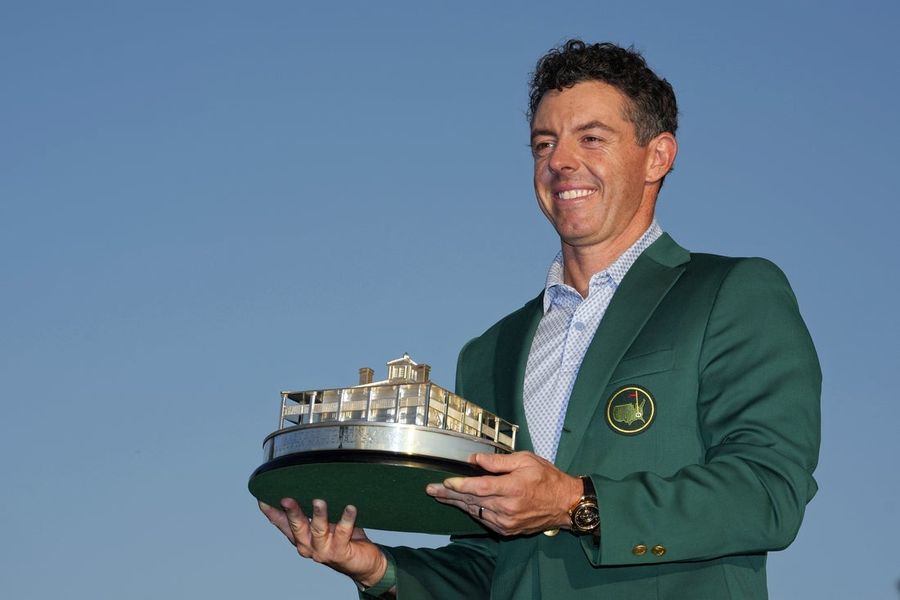
Deadspin | Rory McIlroy’s Masters repeat scores CBS’ best ratings in 11 years  Apr 12, 2026; Augusta, Georgia, USA; Rory McIlroy holds the Masters championship trophy during the green jacket ceremony after the final round of the Masters Tournament at Augusta National Golf Club. Mandatory Credit: Kyle Terada-Imagn Images   Rory McIlroy’s sixth career major title — his second consecutive win at the Masters — earned a major ratings boost for CBS in the final round on Sunday afternoon.  The fourth round averaged nearly 14 million viewers — 13,995,000, more precisely — the most to watch CBS for the final day from Augusta National since the network averaged 14 million in 2015 when Jordan Spieth captured his first major, Front Office Sports reported.  Sunday’s final round was an 8% increase from April 2025 (12.71 million), when McIlroy completed a career grand slam. The Northern Irishman’s dramatic, emotional finish last year came in a playoff against England’s Justin Rose.  The 2026 edition also came with tension, as McIlroy shared the top of the leaderboard after the first round, surged to a record six-shot lead after 36 holes but saw that erased as he and Cameron Young were tied for the lead after three rounds.  Viewership numbers reflected that, as the third round averaged 8.1 million on CBS, a 14% increase from 7.6 million in 2025 and the largest number since Tiger Woods played the third round en route to his 2019 victory.   As McIlroy lost and regained his lead on Sunday, world No. 1 Scottie Scheffler charged from four strokes behind and finished one shot back of McIlroy, who joined Jack Nicklaus, Nick Faldo and Woods as the only consecutive champions in Masters history.  The ratings followed on Sunday, peaking at slightly more than 20 million viewers — the largest at the Masters since 2013, when Adam Scott earned the green jacket and Woods tied for fourth. The peak viewership in 2025 was 19.54 million.  The 2026 Masters was the first since Nielsen began compiling ratings figures exclusively through its Big Data+ Panel methodology. The expanded system, designed for a more holistic and accurate view of audience behaviors, generally results in higher overall ratings for live sports broadcasts compared to the old method, according to Front Office Sports.  –Field Level Media   #Deadspin #Rory #McIlroys #Masters #repeat #scores #CBS #ratings #yearsApr 12, 2026; Augusta, Georgia, USA; Rory McIlroy holds the Masters championship trophy during the green jacket ceremony after the final round of the Masters Tournament at Augusta National Golf Club. Mandatory Credit: Kyle Terada-Imagn Images

Rory McIlroy’s sixth career major title — his second consecutive win at the Masters — earned a major ratings boost for CBS in the final round on Sunday afternoon.

The fourth round averaged nearly 14 million viewers — 13,995,000, more precisely — the most to watch CBS for the final day from Augusta National since the network averaged 14 million in 2015 when Jordan Spieth captured his first major, Front Office Sports reported.

Sunday’s final round was an 8% increase from April 2025 (12.71 million), when McIlroy completed a career grand slam. The Northern Irishman’s dramatic, emotional finish last year came in a playoff against England’s Justin Rose.

The 2026 edition also came with tension, as McIlroy shared the top of the leaderboard after the first round, surged to a record six-shot lead after 36 holes but saw that erased as he and Cameron Young were tied for the lead after three rounds.


Viewership numbers reflected that, as the third round averaged 8.1 million on CBS, a 14% increase from 7.6 million in 2025 and the largest number since Tiger Woods played the third round en route to his 2019 victory.

As McIlroy lost and regained his lead on Sunday, world No. 1 Scottie Scheffler charged from four strokes behind and finished one shot back of McIlroy, who joined Jack Nicklaus, Nick Faldo and Woods as the only consecutive champions in Masters history.

The ratings followed on Sunday, peaking at slightly more than 20 million viewers — the largest at the Masters since 2013, when Adam Scott earned the green jacket and Woods tied for fourth. The peak viewership in 2025 was 19.54 million.

The 2026 Masters was the first since Nielsen began compiling ratings figures exclusively through its Big Data+ Panel methodology. The expanded system, designed for a more holistic and accurate view of audience behaviors, generally results in higher overall ratings for live sports broadcasts compared to the old method, according to Front Office Sports.

–Field Level Media

#Deadspin #Rory #McIlroys #Masters #repeat #scores #CBS #ratings #years

Apr 12, 2026; Augusta, Georgia, USA; Rory McIlroy holds the Masters championship trophy during the green jacket ceremony after the final round of the Masters Tournament at Augusta National Golf Club. Mandatory Credit: Kyle Terada-Imagn Images

Rory McIlroy’s sixth career major title — his second consecutive win at the Masters — earned a major ratings boost for CBS in the final round on Sunday afternoon.

The fourth round averaged nearly 14 million viewers — 13,995,000, more precisely — the most to watch CBS for the final day from Augusta National since the network averaged 14 million in 2015 when Jordan Spieth captured his first major, Front Office Sports reported.

Sunday’s final round was an 8% increase from April 2025 (12.71 million), when McIlroy completed a career grand slam. The Northern Irishman’s dramatic, emotional finish last year came in a playoff against England’s Justin Rose.

The 2026 edition also came with tension, as McIlroy shared the top of the leaderboard after the first round, surged to a record six-shot lead after 36 holes but saw that erased as he and Cameron Young were tied for the lead after three rounds.

Viewership numbers reflected that, as the third round averaged 8.1 million on CBS, a 14% increase from 7.6 million in 2025 and the largest number since Tiger Woods played the third round en route to his 2019 victory.

As McIlroy lost and regained his lead on Sunday, world No. 1 Scottie Scheffler charged from four strokes behind and finished one shot back of McIlroy, who joined Jack Nicklaus, Nick Faldo and Woods as the only consecutive champions in Masters history.

The ratings followed on Sunday, peaking at slightly more than 20 million viewers — the largest at the Masters since 2013, when Adam Scott earned the green jacket and Woods tied for fourth. The peak viewership in 2025 was 19.54 million.

The 2026 Masters was the first since Nielsen began compiling ratings figures exclusively through its Big Data+ Panel methodology. The expanded system, designed for a more holistic and accurate view of audience behaviors, generally results in higher overall ratings for live sports broadcasts compared to the old method, according to Front Office Sports.

–Field Level Media

Source link
#Deadspin #Rory #McIlroys #Masters #repeat #scores #CBS #ratings #years

Previous post

FIFA World Cup 2026 — Infantino reassures Iran will play in the tournament <div id="content-body-70867577" itemprop="articleBody"><p>FIFA President Gianni Infantino said Wednesday that Iran will participate in the World Cup “for sure” despite its war with the United States of America (USA).</p><p>Speaking at <i>CNBC’s Invest in America Forum</i>, Infantino said it is important that Iran participates in the World Cup even though its participation has been in doubt since the USA and Israel launched airstrikes on the country.</p><p>“The Iranian team is coming for sure, yes,” Infantino said. “We hope that by then, of course, the situation will be a peaceful situation. As I said, that would definitely help. But Iran has to come. Of course, they represent their people. They have qualified. The players want to play.”</p><p>Infantino met with the Iranian national team in Antalya, Turkey, two weeks ago and said Wednesday he was impressed.</p><p>“I went to see them. They are actually quite a good team as well,” Infantino said. “And they really want to play and they should play. Sports should be outside of politics now.”</p><p>Infantino acknowledged it’s not always possible to achieve the separation of sports and politics.</p><p>“OK we don’t live on the moon, we live on planet Earth,” Infantino said. “But you know if there is nobody else that believes in building bridges and in keeping them, you know, intact and together, well we are doing that job.”</p><p>The USA will co-host the World Cup with Canada and Mexico.</p><p>Iran is scheduled to play two group-stage games in Inglewood, California, and one in Seattle.</p><p>The war has raised doubts about Iran’s participation in the World Cup. There have been conflicting public comments from Iranian government and football officials.</p><p>U.S. President Donald Trump discouraged the Iranian team from attending the tournament, citing safety concerns.</p><p class="publish-time" id="end-of-article">Published on Apr 16, 2026</p></div> #FIFA #World #Cup #Infantino #reassures #Iran #play #tournament

Next post

Bayern Munich vs Real Madrid — Kompany lauds ‘total togetherness’ of his boys after Champions League win <div id="content-body-70867622" itemprop="articleBody"><p>Bayern Munich showed ​mental strength and absolute belief to come from behind ⁠thrice before beating Real Madrid 4-3 to reach the Champions League semifinals on Wednesday, coach Vincent Kompany said.</p><p>Kompany, who was booked during the game ‌and will miss Bayern’s last-four first leg against holder Paris Saint-Germain, said the Bavarians, who are chasing ‌a treble of titles, had to dig deep to overcome ‌record ⁠15-time European champions Real 6-4 on aggregate in a ⁠classic tie.</p><p>“The boys were mentally strong today to recover from setbacks,” Kompany said. “The fans helped us as well. We stayed calm and always felt that our ​moment would come. The boys ‌deserved this win.</p><p>“What remains for me is the total togetherness that we showed. That’s what we take from the game. We showed absolute belief and will to fight our way ‌back into the game.”</p><p>“During the game our team has a ​lot of talent and experience to deal with these situations. After 35 seconds in this game to ⁠concede a goal, you then have to press the reset button. We stayed focused on our game,” Kompany said.</p><p>Host Bayern trailed 0-1 after 35 seconds when Arda Guler took advantage of a bad mistake by goalkeeper Manuel Neuer, and Real twice more took the lead to go into half-time 3-2 ahead.</p><p>Bayern, 2-1 winner of the first leg in Spain, kept its composure, however, and struck twice in the dying stages through Luis Diaz and Michael Olise ‌to snatch victory and advance to the last four.</p><p>The six-time European champion can ​potentially clinch the Bundesliga title this weekend, with a 12-point advantage and five matches remaining, before facing Bayer ⁠Leverkusen in the German Cup semifinals.</p><p>“It was a very emotional game,” ⁠said Kompany, in his second season at Bayern. “We had a lot of possession and always had the feeling we ‌could score. But Real Madrid remain Real Madrid. They have very quick players and are always a threat.”</p><p>Kompany became the ​11th coach to lead Bayern to the European Cup semifinals.</p><p class="publish-time" id="end-of-article">Published on Apr 16, 2026</p></div> #Bayern #Munich #Real #Madrid #Kompany #lauds #total #togetherness #boys #Champions #League #win

Australia booked its place in the knockout stage of the FIFA World Cup after playing out a goalless draw against Paraguay on Thursday.

The result was enough for the Socceroos to finish second behind the United States in the group, with Australia’s superior goal difference ensuring it stayed ahead of Paraguay despite both teams ending level on points.

The draw also lifted Paraguay to four points, leaving it well placed to qualify for the knockout stage as one of the best third-placed teams, although it must wait for the remaining group matches to confirm its progress.

Australia has now reached the World Cup knockout stage for the third time, having previously advanced in 2006 and 2022 before exiting in the Round of 16 on both occasions. The Socceroos will face the runner-up from Group G in the Round of 32 in Arlington, Texas, on July 3.

Paraguay, meanwhile, remains in contention to reach the knockout rounds for the fifth time in its history.

Player Ratings

Paraguay

Gill (8.2), Velázquez (7.1), Gómez (7.1), Alderete (7.3), Cáceres (6.7), Maidana (6.4), Gómez (7.3), Cubas (7.8), Galarza (8.1), Ávalos (6.3), Enciso (5.6) | Substitutes: Mauricio (6.7), Arce (6.0)

Australia

Beach (7.8), Souttar (7.3), Circati (7.6), Herrington (7.2), O’Neill (7.3), Irvine (6.7), Bos (7.9), Metcalfe (6.8), Volpato (6.2), Irankunda (6.4), Behich (6.8) | Substitutes: Hrustic (6.5), Okon-Engstler (6.6), Yengi (6.4)

Published on Jun 26, 2026

#FIFA #World #Cup #Australia #qualifies #knockouts #Paraguay #stalemate #Complete #player #ratings">FIFA World Cup 2026: Australia qualifies for knockouts after Paraguay stalemate – Complete player ratings  Australia booked its place in the knockout stage of the FIFA World Cup after playing out a goalless draw against Paraguay on Thursday.The result was enough for the Socceroos to finish second behind the United States in the group, with Australia’s superior goal difference ensuring it stayed ahead of Paraguay despite both teams ending level on points.The draw also lifted Paraguay to four points, leaving it well placed to qualify for the knockout stage as one of the best third-placed teams, although it must wait for the remaining group matches to confirm its progress.Australia has now reached the World Cup knockout stage for the third time, having previously advanced in 2006 and 2022 before exiting in the Round of 16 on both occasions. The Socceroos will face the runner-up from Group G in the Round of 32 in Arlington, Texas, on July 3.Paraguay, meanwhile, remains in contention to reach the knockout rounds for the fifth time in its history.
Player Ratings
Paraguay
Gill (8.2), Velázquez (7.1), Gómez (7.1), Alderete (7.3), Cáceres (6.7), Maidana (6.4), Gómez (7.3), Cubas (7.8), Galarza (8.1), Ávalos (6.3), Enciso (5.6) | Substitutes: Mauricio (6.7), Arce (6.0)
Australia
Beach (7.8), Souttar (7.3), Circati (7.6), Herrington (7.2), O’Neill (7.3), Irvine (6.7), Bos (7.9), Metcalfe (6.8), Volpato (6.2), Irankunda (6.4), Behich (6.8) | Substitutes: Hrustic (6.5), Okon-Engstler (6.6), Yengi (6.4)
Published on Jun 26, 2026  #FIFA #World #Cup #Australia #qualifies #knockouts #Paraguay #stalemate #Complete #player #ratings

Earlier this week, Argentina’s Lionel Messi added the new title of World Cup Goals King to his CV.

By the end of the tournament, it could be Kylian Mbappe holding that honor. Down the line, Erling Haaland and Vinicius Junior are young enough to get in the mix. And if everything goes right, the teenage Lamine Yamal has the time and talent to obliterate them all.

This is an amazing era for elite international goal-scorers. But maybe even more exciting, the convergence of those talents could be symbolic of a World Cup that is ushering in a new era of international competition, one that comes closer to the increasingly attack-oriented model that defines the modern club game.

Under the influence of rapidly improving data, modern soccer at the highest levels has become predicated on pressure and transition.

For sure, it’s not the aesthetic preference of every soccer critic.

Listen closely enough, and you’ll hear the cries of someone in Brazil whining that Carlo Ancelotti’s Selecao rejected the Jogo Bonito in favor of a modern devotion to backpressing that proved critical in their emphatic 3-0 win over Scotland on Wednesday night.

But for the average neutral, it’s hard to deny how much more compelling the club game has become as a result of data that shows the benefits of a higher octane approach.

You can see this in the UEFA Champions League, where goals per game have risen from 2.65 in 2015-16 to 3.45 in 2025-26.

Or you can see it in which teams are and aren’t succeeding at the international level.

Arguably, no side has fallen further than Italy, a nation whose footballing identity is most irrationally opposed to the ongoing tactical revolution.

Similarly, teams like Ecuador and Paraguay, who rode cynical tactics to success in South American qualifying, have so far been exposed by teams with more time to build attacking chemistry.

Yes, some teams have still succeeded out of a low block. But the Ghanas and Cape Verdes of the world have only done so when they could muster at least some threat of a vertical counterattack.

And now, with many of the same managers who orchestrated that rise in attacking play now coaching at this World Cup, goals are up here as well. If the rate of roughly 3.0 goals per game continues, it would be the highest scoring edition since 17-year-old Pele and Brazil dazzled their way to their first championship in Sweden in 1958.

The greatest attacking players are also staying great longer.

At 41, Ronaldo may come with baggage, but he’s still the best finisher on his Portugal team. At 32, Harry Kane’s career is only middle-aged when it would’ve been considered in its twilight era a generation ago.

And the engrossing all-time scoring chase is only possible because Messi is still playing at age 39, and arguably better at a World Cup than he ever has before.

There’s still a lot of time for this World Cup to go sideways. The knockout stages have a way of bringing out the worst conservative instincts in coaches. Oppressive summer weather could become more of a factor as June turns to July, and as more of the kickoffs fall before sunset to appease European TV audiences.

And there’s always the danger for off-the-field controversies to grow louder once the competitive field shrinks.

But on the evidence so far, this tournament has shown that the future of the game on the field is arguably the brightest it’s ever been. And whether it’s Messi or Mbappe who finishes on top of the all-time World Cup scoring chart this summer, you get the sense neither one will stay there for all that long.

#Lionel #Messi #Kylian #Mbappe #Headline #Era #World #Cup #Scoring #Deadspin.com">Lionel Messi and Kylian Mbappe Headline a New Era of World Cup Scoring | Deadspin.com   Earlier this week, Argentina’s Lionel Messi added the new title of World Cup Goals King to his CV.By the end of the tournament, it could be Kylian Mbappe holding that honor. Down the line, Erling Haaland and Vinicius Junior are young enough to get in the mix. And if everything goes right, the teenage Lamine Yamal has the time and talent to obliterate them all.This is an amazing era for elite international goal-scorers. But maybe even more exciting, the convergence of those talents could be symbolic of a World Cup that is ushering in a new era of international competition, one that comes closer to the increasingly attack-oriented model that defines the modern club game.Under the influence of rapidly improving data, modern soccer at the highest levels has become predicated on pressure and transition.For sure, it’s not the aesthetic preference of every soccer critic.Listen closely enough, and you’ll hear the cries of someone in Brazil whining that Carlo Ancelotti’s Selecao rejected the Jogo Bonito in favor of a modern devotion to backpressing that proved critical in their emphatic 3-0 win over Scotland on Wednesday night.But for the average neutral, it’s hard to deny how much more compelling the club game has become as a result of data that shows the benefits of a higher octane approach.You can see this in the UEFA Champions League, where goals per game have risen from 2.65 in 2015-16 to 3.45 in 2025-26.Or you can see it in which teams are and aren’t succeeding at the international level.Arguably, no side has fallen further than Italy, a nation whose footballing identity is most irrationally opposed to the ongoing tactical revolution.Similarly, teams like Ecuador and Paraguay, who rode cynical tactics to success in South American qualifying, have so far been exposed by teams with more time to build attacking chemistry.Yes, some teams have still succeeded out of a low block. But the Ghanas and Cape Verdes of the world have only done so when they could muster at least some threat of a vertical counterattack.And now, with many of the same managers who orchestrated that rise in attacking play now coaching at this World Cup, goals are up here as well. If the rate of roughly 3.0 goals per game continues, it would be the highest scoring edition since 17-year-old Pele and Brazil dazzled their way to their first championship in Sweden in 1958.The greatest attacking players are also staying great longer.At 41, Ronaldo may come with baggage, but he’s still the best finisher on his Portugal team. At 32, Harry Kane’s career is only middle-aged when it would’ve been considered in its twilight era a generation ago.And the engrossing all-time scoring chase is only possible because Messi is still playing at age 39, and arguably better at a World Cup than he ever has before.There’s still a lot of time for this World Cup to go sideways. The knockout stages have a way of bringing out the worst conservative instincts in coaches. Oppressive summer weather could become more of a factor as June turns to July, and as more of the kickoffs fall before sunset to appease European TV audiences.And there’s always the danger for off-the-field controversies to grow louder once the competitive field shrinks.But on the evidence so far, this tournament has shown that the future of the game on the field is arguably the brightest it’s ever been. And whether it’s Messi or Mbappe who finishes on top of the all-time World Cup scoring chart this summer, you get the sense neither one will stay there for all that long.   #Lionel #Messi #Kylian #Mbappe #Headline #Era #World #Cup #Scoring #Deadspin.com

symbolic of a World Cup that is ushering in a new era of international competition, one that comes closer to the increasingly attack-oriented model that defines the modern club game.

Under the influence of rapidly improving data, modern soccer at the highest levels has become predicated on pressure and transition.

For sure, it’s not the aesthetic preference of every soccer critic.

Listen closely enough, and you’ll hear the cries of someone in Brazil whining that Carlo Ancelotti’s Selecao rejected the Jogo Bonito in favor of a modern devotion to backpressing that proved critical in their emphatic 3-0 win over Scotland on Wednesday night.

But for the average neutral, it’s hard to deny how much more compelling the club game has become as a result of data that shows the benefits of a higher octane approach.

You can see this in the UEFA Champions League, where goals per game have risen from 2.65 in 2015-16 to 3.45 in 2025-26.

Or you can see it in which teams are and aren’t succeeding at the international level.

Arguably, no side has fallen further than Italy, a nation whose footballing identity is most irrationally opposed to the ongoing tactical revolution.

Similarly, teams like Ecuador and Paraguay, who rode cynical tactics to success in South American qualifying, have so far been exposed by teams with more time to build attacking chemistry.

Yes, some teams have still succeeded out of a low block. But the Ghanas and Cape Verdes of the world have only done so when they could muster at least some threat of a vertical counterattack.

And now, with many of the same managers who orchestrated that rise in attacking play now coaching at this World Cup, goals are up here as well. If the rate of roughly 3.0 goals per game continues, it would be the highest scoring edition since 17-year-old Pele and Brazil dazzled their way to their first championship in Sweden in 1958.

The greatest attacking players are also staying great longer.

At 41, Ronaldo may come with baggage, but he’s still the best finisher on his Portugal team. At 32, Harry Kane’s career is only middle-aged when it would’ve been considered in its twilight era a generation ago.

And the engrossing all-time scoring chase is only possible because Messi is still playing at age 39, and arguably better at a World Cup than he ever has before.

There’s still a lot of time for this World Cup to go sideways. The knockout stages have a way of bringing out the worst conservative instincts in coaches. Oppressive summer weather could become more of a factor as June turns to July, and as more of the kickoffs fall before sunset to appease European TV audiences.

And there’s always the danger for off-the-field controversies to grow louder once the competitive field shrinks.

But on the evidence so far, this tournament has shown that the future of the game on the field is arguably the brightest it’s ever been. And whether it’s Messi or Mbappe who finishes on top of the all-time World Cup scoring chart this summer, you get the sense neither one will stay there for all that long.

#Lionel #Messi #Kylian #Mbappe #Headline #Era #World #Cup #Scoring #Deadspin.com">Lionel Messi and Kylian Mbappe Headline a New Era of World Cup Scoring | Deadspin.com

Earlier this week, Argentina’s Lionel Messi added the new title of World Cup Goals King to his CV.

By the end of the tournament, it could be Kylian Mbappe holding that honor. Down the line, Erling Haaland and Vinicius Junior are young enough to get in the mix. And if everything goes right, the teenage Lamine Yamal has the time and talent to obliterate them all.

This is an amazing era for elite international goal-scorers. But maybe even more exciting, the convergence of those talents could be symbolic of a World Cup that is ushering in a new era of international competition, one that comes closer to the increasingly attack-oriented model that defines the modern club game.

Under the influence of rapidly improving data, modern soccer at the highest levels has become predicated on pressure and transition.

For sure, it’s not the aesthetic preference of every soccer critic.

Listen closely enough, and you’ll hear the cries of someone in Brazil whining that Carlo Ancelotti’s Selecao rejected the Jogo Bonito in favor of a modern devotion to backpressing that proved critical in their emphatic 3-0 win over Scotland on Wednesday night.

But for the average neutral, it’s hard to deny how much more compelling the club game has become as a result of data that shows the benefits of a higher octane approach.

You can see this in the UEFA Champions League, where goals per game have risen from 2.65 in 2015-16 to 3.45 in 2025-26.

Or you can see it in which teams are and aren’t succeeding at the international level.

Arguably, no side has fallen further than Italy, a nation whose footballing identity is most irrationally opposed to the ongoing tactical revolution.

Similarly, teams like Ecuador and Paraguay, who rode cynical tactics to success in South American qualifying, have so far been exposed by teams with more time to build attacking chemistry.

Yes, some teams have still succeeded out of a low block. But the Ghanas and Cape Verdes of the world have only done so when they could muster at least some threat of a vertical counterattack.

And now, with many of the same managers who orchestrated that rise in attacking play now coaching at this World Cup, goals are up here as well. If the rate of roughly 3.0 goals per game continues, it would be the highest scoring edition since 17-year-old Pele and Brazil dazzled their way to their first championship in Sweden in 1958.

The greatest attacking players are also staying great longer.

At 41, Ronaldo may come with baggage, but he’s still the best finisher on his Portugal team. At 32, Harry Kane’s career is only middle-aged when it would’ve been considered in its twilight era a generation ago.

And the engrossing all-time scoring chase is only possible because Messi is still playing at age 39, and arguably better at a World Cup than he ever has before.

There’s still a lot of time for this World Cup to go sideways. The knockout stages have a way of bringing out the worst conservative instincts in coaches. Oppressive summer weather could become more of a factor as June turns to July, and as more of the kickoffs fall before sunset to appease European TV audiences.

And there’s always the danger for off-the-field controversies to grow louder once the competitive field shrinks.

But on the evidence so far, this tournament has shown that the future of the game on the field is arguably the brightest it’s ever been. And whether it’s Messi or Mbappe who finishes on top of the all-time World Cup scoring chart this summer, you get the sense neither one will stay there for all that long.

#Lionel #Messi #Kylian #Mbappe #Headline #Era #World #Cup #Scoring #Deadspin.com

Post Comment