×
Gaza experiencing ‘real starvation’, Donald Trump says

Gaza experiencing ‘real starvation’, Donald Trump says

David Gritten

BBC News, Jerusalem
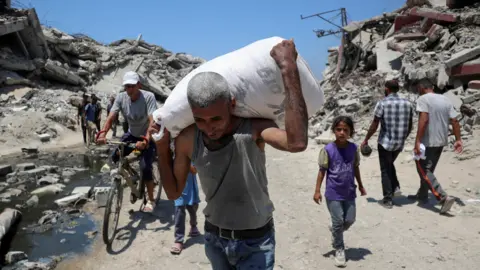
Reuters A Palestinian man carries a bag with aid supplies that entered Gaza, in Beit Lahia, northern Gaza (27 July 2025)Reuters

Tom Fletcher, UN humanitarian chief, said most of the UN’s food lorries were looted by desperately hungry Palestinians after entering Gaza on Sunday

There is “real starvation” in Gaza, Donald Trump has said, after Israeli Prime Minister Benjamin Netanyahu insisted there was no such thing.

Asked if he agreed with Netanyahu that it was a “bold-faced lie” to say Israel was fuelling hunger in Gaza, the US president replied: “I don’t know… those children look very hungry… that’s real starvation stuff.”

Speaking during a meeting with UK Prime Minister Keir Starmer in Scotland, Trump said: “Nobody’s done anything great over there. The whole place is a mess… I told Israel maybe they have to do it a different way.”

His comments came after the UN’s humanitarian chief said “vast amounts” of food were needed to stave off starvation.

Donald Trump says there “is real starvation” in Gaza

Tom Fletcher told the BBC he welcomed Israel’s measures over the weekend to allow more aid into Gaza in the form of airdrops, and military pauses to allow food convoys to reach people.

But he said what had been delivered so far was just “a drop in the ocean” of what was required.

“It’s the beginning, but the next few days are really make or break. We need to deliver at a much, much greater scale. We need vast amounts of aid going in, much faster,” he told BBC Radio 4’s Today programme.

Israel said 120 lorry loads were collected from crossings on Sunday during the first daily 10-hour “tactical pause” in military operations, and that Jordan and the United Arab Emirates airdropped 28 packages of food.

Hours after Mr Fletcher spoke, the territory’s Hamas-run health ministry said another 14 people had died as a result of malnutrition over the past 24 hours.

That brought the total number of malnutrition-related deaths since the war begin in October 2023 to 147, including 88 children, according to the ministry.

Israel, which controls the entry of all supplies to Gaza, has denied there is starvation in Gaza and rejected accusations of being responsible for food shortages.

On Sunday, the Israeli military began actions that it said would improve the “humanitarian response” in Gaza and disprove “the false claim of deliberate starvation”.

Israel announced there would be a “local tactical pause” in three areas of Gaza for 10 hours a day, as well the establishment of “designated secure routes” for aid convoys.

The military also allowed aid drops carried out by foreign countries to resume, despite humanitarian agencies warning that the method was ineffective and dangerous.

Israeli military body Cogat, which co-ordinates the entry of aid into Gaza, said more than 120 lorry loads of aid were collected from crossings by the UN and other international organisations on Sunday, and that hundreds more lorry loads were awaiting collection.

Mr Fletcher said the UN had collected fewer than 100 lorry loads in that time, and noted that 600 to 700 loads had entered Gaza daily on average during the two-month ceasefire between Israel and Hamas at the start of this year.

Asked to respond to Israel’s criticism of UN agencies for not collecting aid from crossings, he said: “We’re not going to leave on pallets if we can. But to get to it our drivers face bureaucratic constraints, they face massive security constraints.”

He also said that most of the UN’s food lorries were looted after entering Gaza on Sunday.

“Most of those lorries… were hit by desperate individual civilians, starving. The flour was taken off those lorries and its very, very dangerous for our drivers.”

Mr Fletcher also warned that UN teams on the ground believed the Israeli military’s pauses would only last a week or so, which he said would be “clearly insufficient when before our eyes we’re seeing this 21st Century atrocity on the ground”.

“We need a sustained period of delivery – weeks, months – to build up, to stop that starvation and build up the supplies again. Ultimately, we need a ceasefire. Pauses are a good step in the right direction, but stopping the conflict is the key.”

Netanyahu on Sunday savaged claims that Israel was deliberately starving civilians in Gaza, which would amount to a war crime.

“What a bold-faced lie. There is no policy of starvation in Gaza, and there is no starvation in Gaza.” he said.

“We enable humanitarian aid throughout the duration of the war to enter Gaza. Otherwise, there would be no Gazans. And what has interdicted the supply of humanitarian aid is one force, Hamas. Again, the reversal of truth,” he added.

Netanyahu said the Israeli military’s humanitarian pauses and corridors meant the UN had “no excuses left” not to collect and distribute all the aid from the crossings.

“Stop lying. Stop finding excuses. Do what you have to do.”

On Monday night, Netanyahu’s office said Israel would work with aid groups, the US and European nations to ensure “large amounts of humanitarian aid flows” into Gaza.

A statement said the “situation in Gaza is difficult” but that Hamas “benefits from attempting to fuel the perception of a humanitarian crisis”, by releasing “unverified numbers” and “circulating images that are carefully stage or manipulated”.

The Israeli government does not allow international news organisations, including the BBC, into Gaza to report freely on the situation there.

On Sunday, the World Health Organization warned that malnutrition was “on a dangerous trajectory in the Gaza Strip, marked by a spike in deaths in July”.

Of the 74 malnutrition-related deaths in Gaza in 2025, 63 had occurred this month, including 24 children under five and one child over five, the UN agency said.

“Most of these people were declared dead on arrival at health facilities or died shortly after, their bodies showing clear signs of severe wasting,” it added.

The WHO said the crisis was “entirely preventable” and condemned what it called the “deliberate blocking and delay of large-scale food, health, and humanitarian aid”.

Hamas has denied stealing aid, and on Sunday the New York Times cited senior Israeli military officials as saying that the military had never found proof that the armed group had systematically stolen aid from the UN. Reuters news agency also reported last week that US government analysis found no evidence of systematic theft by Hamas of US-funded aid.

On Monday, local hospital sources said Israeli attacks across Gaza had killed more than 30 people, including aid seekers.

The Israeli military launched a campaign in Gaza in response to the Hamas-led attack on southern Israel on 7 October 2023, in which about 1,200 people were killed and 251 others were taken hostage.

At least 59,821 people have been killed in Gaza since then, according to the territory’s Hamas-run health ministry.

Source link
#Gaza #experiencing #real #starvation #Donald #Trump

Australia and Japan have signed contracts for the first three of 11 warships set to be delivered to the Australian navy under a landmark $7bn defence deal, as the two close US allies in the Asia Pacific region deepen defence cooperation.

Australia’s Defence Minister Richard Marles and Japanese Defence Minister Koizumi Shinjiro made the announcement in Melbourne on Saturday at the signing ceremony for the Mogami-class warships.

Recommended Stories

list of 4 itemsend of list

The “Mogami Memorandum” pledges to deepen military ties, including through “closer industrial cooperation” in defence.

Japan’s Mitsubishi Heavy Industries will build three of the stealth frigates in southern Nagasaki Prefecture, while Australia’s Austal will build eight in Western Australia.

The first of the Japanese-built warships is scheduled to be delivered in 2029 and enter service in 2030.

“Our surface fleet is more important than at any time in decades,” Marles said in a statement.

“These general-purpose frigates will help secure our maritime trade routes and northern approaches as part of a larger and more lethal surface combatant fleet.”

Shinjiro said closer defence coordination was becoming more important as Australia and Japan faced an “increasingly severe security environment”.

Australia’s government last year announced that it had chosen Mitsubishi Heavy Industries to build its fleet of next-generation warships, following a bidding war between the Tokyo-based firm and Germany’s Thyssenkrupp.

Australia has committed to a record $305bn in military spending over the next decade, as part of a widespread defence overhaul aimed at boosting the country’s naval power to levels not seen since World War II.

Under the plans, Canberra’s defence spending is set to rise to 3 percent of gross domestic product (GDP) by 3033, from about 2 percent now.

Australia and Japan, two of the United States’ closest allies, have ramped up military cooperation in recent years amid shared concerns about shifts in the regional security environment, particularly China’s rising influence. Tokyo and Canberra are also members of the Quad security bloc led by the US.

#Australia #Japan #sign #contracts #7bn #warships #dealEconomy, News, Business and Economy, Military, Asia Pacific, Australia">Australia and Japan sign contracts for bn warships dealDefence deal is latest example of deepening ties between Canberra and Tokyo amid shared concerns over China’s rise.Published On 19 Apr 202619 Apr 2026Australia and Japan have signed contracts for the first three of 11 warships set to be delivered to the Australian navy under a landmark bn defence deal, as the two close US allies in the Asia Pacific region deepen defence cooperation.Australia’s Defence Minister Richard Marles and Japanese Defence Minister Koizumi Shinjiro made the announcement in Melbourne on Saturday at the signing ceremony for the Mogami-class warships.Recommended Stories list of 4 itemsend of listThe “Mogami Memorandum” pledges to deepen military ties, including through “closer industrial cooperation” in defence.Japan’s Mitsubishi Heavy Industries will build three of the stealth frigates in southern Nagasaki Prefecture, while Australia’s Austal will build eight in Western Australia.The first of the Japanese-built warships is scheduled to be delivered in 2029 and enter service in 2030.“Our surface fleet is more important than at any time in decades,” Marles said in a statement.“These general-purpose frigates will help secure our maritime trade routes and northern approaches as part of a larger and more lethal surface combatant fleet.”Shinjiro said closer defence coordination was becoming more important as Australia and Japan faced an “increasingly severe security environment”.Australia’s government last year announced that it had chosen Mitsubishi Heavy Industries to build its fleet of next-generation warships, following a bidding war between the Tokyo-based firm and Germany’s Thyssenkrupp.Australia has committed to a record 5bn in military spending over the next decade, as part of a widespread defence overhaul aimed at boosting the country’s naval power to levels not seen since World War II.Under the plans, Canberra’s defence spending is set to rise to 3 percent of gross domestic product (GDP) by 3033, from about 2 percent now.Australia and Japan, two of the United States’ closest allies, have ramped up military cooperation in recent years amid shared concerns about shifts in the regional security environment, particularly China’s rising influence. Tokyo and Canberra are also members of the Quad security bloc led by the US.#Australia #Japan #sign #contracts #7bn #warships #dealEconomy, News, Business and Economy, Military, Asia Pacific, Australia

Australia and Japan have signed contracts for the first three of 11 warships set to be delivered to the Australian navy under a landmark $7bn defence deal, as the two close US allies in the Asia Pacific region deepen defence cooperation.

Australia’s Defence Minister Richard Marles and Japanese Defence Minister Koizumi Shinjiro made the announcement in Melbourne on Saturday at the signing ceremony for the Mogami-class warships.

Recommended Stories

list of 4 itemsend of list

The “Mogami Memorandum” pledges to deepen military ties, including through “closer industrial cooperation” in defence.

Japan’s Mitsubishi Heavy Industries will build three of the stealth frigates in southern Nagasaki Prefecture, while Australia’s Austal will build eight in Western Australia.

The first of the Japanese-built warships is scheduled to be delivered in 2029 and enter service in 2030.

“Our surface fleet is more important than at any time in decades,” Marles said in a statement.

“These general-purpose frigates will help secure our maritime trade routes and northern approaches as part of a larger and more lethal surface combatant fleet.”

Shinjiro said closer defence coordination was becoming more important as Australia and Japan faced an “increasingly severe security environment”.

Australia’s government last year announced that it had chosen Mitsubishi Heavy Industries to build its fleet of next-generation warships, following a bidding war between the Tokyo-based firm and Germany’s Thyssenkrupp.

Australia has committed to a record $305bn in military spending over the next decade, as part of a widespread defence overhaul aimed at boosting the country’s naval power to levels not seen since World War II.

Under the plans, Canberra’s defence spending is set to rise to 3 percent of gross domestic product (GDP) by 3033, from about 2 percent now.

Australia and Japan, two of the United States’ closest allies, have ramped up military cooperation in recent years amid shared concerns about shifts in the regional security environment, particularly China’s rising influence. Tokyo and Canberra are also members of the Quad security bloc led by the US.

#Australia #Japan #sign #contracts #7bn #warships #dealEconomy, News, Business and Economy, Military, Asia Pacific, Australia">Australia and Japan sign contracts for $7bn warships deal

Defence deal is latest example of deepening ties between Canberra and Tokyo amid shared concerns over China’s rise.

Australia and Japan have signed contracts for the first three of 11 warships set to be delivered to the Australian navy under a landmark $7bn defence deal, as the two close US allies in the Asia Pacific region deepen defence cooperation.

Australia’s Defence Minister Richard Marles and Japanese Defence Minister Koizumi Shinjiro made the announcement in Melbourne on Saturday at the signing ceremony for the Mogami-class warships.

Recommended Stories

list of 4 itemsend of list

The “Mogami Memorandum” pledges to deepen military ties, including through “closer industrial cooperation” in defence.

Japan’s Mitsubishi Heavy Industries will build three of the stealth frigates in southern Nagasaki Prefecture, while Australia’s Austal will build eight in Western Australia.

The first of the Japanese-built warships is scheduled to be delivered in 2029 and enter service in 2030.

“Our surface fleet is more important than at any time in decades,” Marles said in a statement.

“These general-purpose frigates will help secure our maritime trade routes and northern approaches as part of a larger and more lethal surface combatant fleet.”

Shinjiro said closer defence coordination was becoming more important as Australia and Japan faced an “increasingly severe security environment”.

Australia’s government last year announced that it had chosen Mitsubishi Heavy Industries to build its fleet of next-generation warships, following a bidding war between the Tokyo-based firm and Germany’s Thyssenkrupp.

Australia has committed to a record $305bn in military spending over the next decade, as part of a widespread defence overhaul aimed at boosting the country’s naval power to levels not seen since World War II.

Under the plans, Canberra’s defence spending is set to rise to 3 percent of gross domestic product (GDP) by 3033, from about 2 percent now.

Australia and Japan, two of the United States’ closest allies, have ramped up military cooperation in recent years amid shared concerns about shifts in the regional security environment, particularly China’s rising influence. Tokyo and Canberra are also members of the Quad security bloc led by the US.

#Australia #Japan #sign #contracts #7bn #warships #dealEconomy, News, Business and Economy, Military, Asia Pacific, Australia

Post Comment