
Alfred Hitchcock was born in England in 1899 and he was … well, you know who he was. Hitchcock is one of the world’s best-known and most medium-altering filmmakers ever. His interest in the macabre influenced the entire business, and his reputation as the “Master of Suspense” remains unchallenged to this day. He directed over 50 movies from the 1920s through the 1970s, including “Rebecca,” “Spellbound,” “Rope,” “Dial M for Murder,” “Rear Window,” “Vertigo,” “Psycho,” “The Birds,” and so, so many others. No filmmaker has been written about more.
Hitchcock was also very visible and present in his suspense movies (he often gave himself cameo appearances), and he once hosted a TV series where he addressed the camera directly, so Hitch’s personality was well-known to the public. He was plummy, wry, mock-disinterested, and always gleefully grim.
Hitchcock told this story a lot in interviews, but he was fond of explaining his lifelong fear of policemen. It seems that when Hitch was five years old, young Alfred’s father sent him to a local police station to deliver a note. The policeman looked at the note, then ushered Alfred into a jail cell and locked him inside. “This is what we do to naughty boys,” the policeman said. He was released a few minutes later, but that unexpected time in the jail cell gave Hitchcock a lasting phobia of all law enforcement officers. One cannot fathom what Hitchcock’s father intended to teach with this little “lesson,” but what Hitchcock learned was that sudden and terrifying things can happen without warning.
It seems that Hitchcock formed a filmmaking career from exorcising that fear. In his movies, Hitchcock tried to share a specific sense of uneasiness as often as he could. He wasn’t happy until the audience suffered.
Quote of the Day by Alfred Hitchcock
“Always make the audience suffer as much as possible.”
Alfred Hitchcock, according to Time Magazine, gave the above piece of advice very early in his career, back in 1939. He was on his way from his native England to California to make his first American movie (“Rebecca,” a masterpiece of unease), and paused in Connecticut to give a lecture to the students at Yale. By then, Hitchcock had already made well-known classics like “The Man Who Knew Too Much,” “The 39 Steps,” “Sabotage,” and “The Lady Vanishes,” so he was certainly someone students would want to pay attention to.
The above quote, taken out of context, might have one believing that Hitchcock merely wanted to watch audiences squirm with ghastly horror and/or repellant material. In actuality, he was referring to a filmmaker’s duty to insert cinematic suspense wherever a narrative allows. A larger version of the quote reads: “Suspense can be introduced in a simple love story as well as the mystery or whodunnit picture. Make the audience suffer as much as possible.”
In other words, suspense should come as a surprise. Even the anticipation of suspense can cause suspense. A simple love story might suddenly reveal an untrustworthy or lying partner, and, hence, subsequent suspicion of their potentially murderous intentions. A murder mystery is ample time for suspense, as audiences will wonder if the detective will find the killer. Or, as was more common for Hitchcock, if the killer does get away with it (see: the 3D film “Dial M For Murder,” “Psycho,” etc.).
One can see how being locked in a jail cell at age five taught Alfred that suspense and fear can arrive suddenly and for no reason. And, once it arrives, we never know when the release will come.
The deeper meaning of Alfred Hitchcock’s quote – terror should be sudden and unexpected
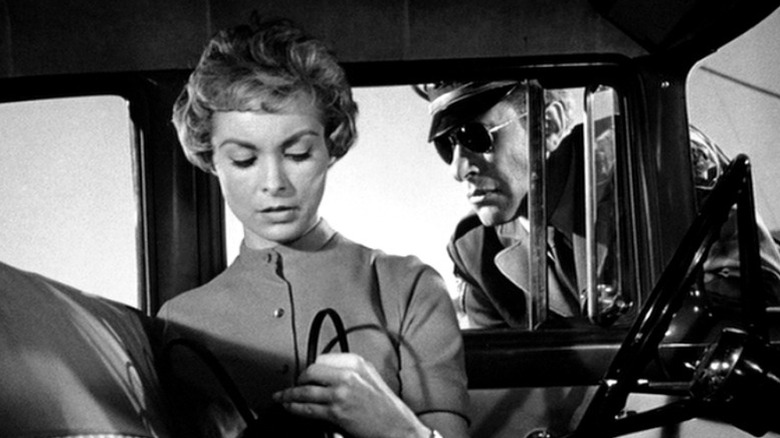
Naturally, cops are a great source of consternation for Hitchcock, and because they drive around town among the citizens, a sudden, random confrontation seems inevitable. One will definitely notice that none of Alfred Hitchcock’s movies feature heroic cops. Cops are intimidating figures. Recall the cop in “Psycho” who pulls over Marion Crane (Janet Leigh) as she attempts to skip town with $40,000 in cash. The cop (Mort Mills) is like a monster. Cops are there, Hitch knows, to make everyone uneasy.
It’s also very easy to find characters in Hitchcock’s filmography that have been falsely accused of a crime. In many of his movies, a character finds themselves on the lam for transgressions they did not commit. The suspense comes from them trying to clear their name, and having to traverse a world that is suddenly filled with people who want to apprehend them.
This trend might be best exemplified in Hitchcock’s 1956 film “The Wrong Man,” the only film he directed that was based on a true story. The film stars Henry Fonda as a boring everyman who, when visiting a life insurance office, is suddenly accused of being a man who tried to rob the place a few weeks earlier. As the film progresses, the Henry Fonda character finds that he more and more resembles a serial thief, and that he has less and less of a case. Even we in the audience begin to suspect that Henry Fonda may be the thief. And yet, we feel so terrible for him. So hopeless. Lost in a world that does nothing but randomly inflict persecution on hapless victims.
Incidentally, Henry Fonda didn’t think “The Wrong Man” was “Hitchcock” enough.
More quotes from Alfred Hitchcock
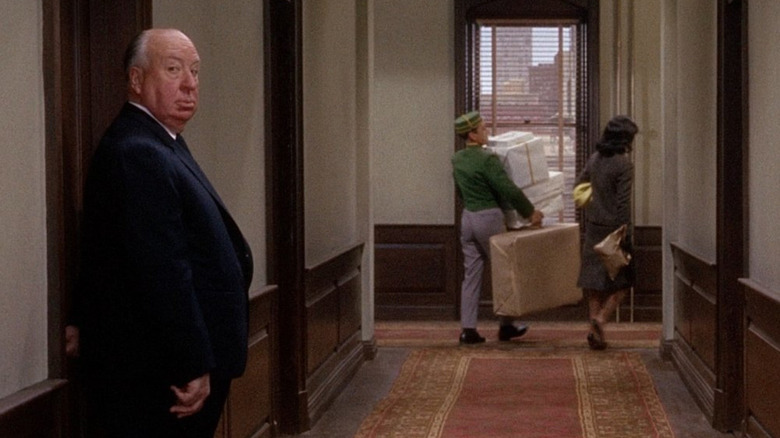
Hitchcock was eminently quotable, and some of his witty bon mots have luckily been captured in public, including:
- “There is no terror in the ‘bang.’ Only in the anticipation of it.”
- “It has been said that I called actors cattle. I would never say such a rude, insulting thing. What I probably said was that all actors should be treated like cattle.”
- “The ‘MacGuffin’ is the term we use to cover that sort of thing: to steal plans or documents, or discover a secret. It doesn’t matter what it is. And the logicians are wrong in trying to figure out the truth of a MacGuffin, since it’s besides the point. The only thing that matters is that in the picture, the plans, documents, or secrets must seem to be of vital importance to the characters.”
- “Man does not live by murder alone. He needs affection, approval, encouragement, and, occasionally, a hearty meal.”
- “I am pleased that television is showing murder stories because it is bringing murder back into its rightful setting: the home.”
- “Walt Disney, of course, has the best casting. If he doesn’t like an actor, he just tears him up.”
- “I apologize for the lack of bloodshed on tonight’s program. We shall try to do better next time.”
- “Bernard Shaw once tried to figure out how long an act of a play would be based on the endurance of the human bladder. And that is our fundamental problem when we devise a film.”
Source link
#Quote #Day #Alfred #Hitchcock #Audience #Suffer #SlashFilm



Post Comment