×
Secret Afghan relocation scheme set up after major data breach

Secret Afghan relocation scheme set up after major data breach

Joel Gunter & Sean Seddon

BBC News
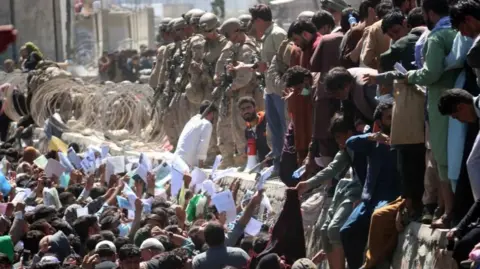
EPA A crowd of Afghans handing their papers to soldiers at Kabul AirportEPA

The leak dates back to the chaotic withdrawal of international forces from Afghanistan in 2021

Thousands of Afghans have moved to the UK under a secret scheme which was set up after a British official inadvertently leaked their data, it can be revealed.

In February 2022, the personal details of nearly 19,000 people who had applied to move to the UK after the Taliban seized power in Afghanistan were leaked.

The previous government learned of the breach in August 2023 when some of the details appeared on Facebook.

A new resettlement scheme for those on the leaked list was set up nine months later, and has seen 4,500 Afghans arrive in the UK so far.

But the existence of the leak and relocations were kept secret after the government obtained a super-injunction stopping it from becoming public.

Details of the major data breach, the response and the number of Afghans granted the right to live in the UK as a result only came to light on Tuesday after a High Court judge ruled the gagging order should be lifted.

The leak contained the names, contact details and some family information of people potentially at risk of harm from the Taliban.

The government also revealed on Tuesday:

  • The Ministry of Defence (MoD) believes 600 Afghan soldiers included in the leak, plus 1,800 of their family members, are still in Afghanistan
  • The scheme is being closed down, but relocation offers already made to those who remain in Afghanistan will be honoured
  • The secret scheme – officially called the Afghan Relocation Route – has cost £400m so far, and is expected to cost a further £400m to £450m
  • The breach was committed mistakenly by an unnamed official at the MoD
  • People whose details were leaked were only informed on Tuesday

Speaking in the House of Commons, Defence Secretary John Healey offered a “sincere apology” to those whose details had been included in the leak, which came to light when some appeared on Facebook.

He said it was as a result of a spreadsheet being emailed “outside of authorised government systems”, which he described as a “serious departmental error” – though the Metropolitan Police decided a police investigation was not necessary.

Healey said the leak was “one of many data losses” related to the Afghanistan evacuation during that period, and contained the names of senior military officials, government officials and MPs.

In a 2024 High Court judgement made public on Tuesday, Mr Justice Chamberlain said it was “quite possible” that some of those who saw parts of the leaked document in a Facebook group “were Taliban infiltrators or spoke about it to Taliban-aligned individuals”.

It had earlier been feared the number of people at “risk of death or serious harm” because they appeared on the list, or because their family member did, could be as high as 100,000.

However, a review of the incident carried out on behalf of the MoD found it was “highly unlikely” an individual would have been targeted solely because of the leaked data, which “may not have spread nearly as widely as initially feared”.

The MoD has declined to say how many people may have been arrested or killed as a result of the data breach.

The same review judged the secret scheme to be an “extremely significant intervention” given the “potentially limited” risk posed by the leak.

An email has been sent to those impacted by the breach, urging them to “exercise caution”, and take steps like protecting their online activities and not responding to messages from unknown contacts.

Healey said those who have been relocated to the UK have already been counted in immigration figures.

‘Unprecedented’

Tuesday’s disclosure dates back to the August 2021 withdrawal of US troops from Afghanistan, which saw the Taliban retake power and quickly surround the capital Kabul.

The leak involved the names of people who had applied for the Afghan Relocations and Assistance Policy (Arap) scheme, which the UK government set up to rapidly process applications by people who feared reprisals from the Taliban and move them to the UK.

The evacuation – which saw 36,000 Afghans moved to the UK – has already been heavily criticised in the years since it was launched, with a 2022 inquiry by the Foreign Affairs Committee finding it was a “disaster” and a “betrayal”.

When the government set up a new relocation scheme last year in response to the leak, members of the press quickly learned about the plans.

The government asked a judge to impose an injunction on the media. The court then imposed a type of order which prevented outlets from reporting any detail of the leak, or even that the injunction itself existed. Healey said he was not aware of any other similar injunctions being in place.

He told the House even he had been prevented from speaking about the breach because of the “unprecedented” injunction, after being informed while still shadow defence secretary.

Reading a summary of his judgment in court, Mr Justice Chamberlain said the gagging order had “given rise to serious free speech concerns”.

He continued: “The super-injunction had the effect of completely shutting down the ordinary mechanisms of accountability which operate in a democracy.

“This led to what I describe as a ‘scrutiny vacuum’.”

Court documents disclosed on Tuesday revealed then-Defence Secretary Ben Wallace “personally” applied for the stringent injunction in order to give the government time to do “everything it reasonably can to help those who might have been put at further risk by the data compromise”.

The injunction was extended in November 2023 on the basis the Taliban may not have been aware of the leaked data’s existence.

However, Mr Justice Chamberlain decided to lift it on the ground the MoD’s internal review found the Taliban “likely already possess the key information in the dataset” and confirmation of its existence was “unlikely” to “substantially” raise the risk” faced by those impacted.

Shadow defence secretary James Cartlidge, who was in government when the secret scheme was established, said “this data leak should never have happened and was an unacceptable breach of all relevant data protocols”.

Erin Alcock, a lawyer for the firm Leigh Day, which has assisted hundreds of Arap applicants and family members, called the breach a “catastrophic failure”.

Earlier this month, the government confirmed it had offered payouts to Afghans whose information had been compromised in a separate data breach.

Source link
#Secret #Afghan #relocation #scheme #set #major #data #breach

Australia and Japan have signed contracts for the first three of 11 warships set to be delivered to the Australian navy under a landmark $7bn defence deal, as the two close US allies in the Asia Pacific region deepen defence cooperation.

Australia’s Defence Minister Richard Marles and Japanese Defence Minister Koizumi Shinjiro made the announcement in Melbourne on Saturday at the signing ceremony for the Mogami-class warships.

Recommended Stories

list of 4 itemsend of list

The “Mogami Memorandum” pledges to deepen military ties, including through “closer industrial cooperation” in defence.

Japan’s Mitsubishi Heavy Industries will build three of the stealth frigates in southern Nagasaki Prefecture, while Australia’s Austal will build eight in Western Australia.

The first of the Japanese-built warships is scheduled to be delivered in 2029 and enter service in 2030.

“Our surface fleet is more important than at any time in decades,” Marles said in a statement.

“These general-purpose frigates will help secure our maritime trade routes and northern approaches as part of a larger and more lethal surface combatant fleet.”

Shinjiro said closer defence coordination was becoming more important as Australia and Japan faced an “increasingly severe security environment”.

Australia’s government last year announced that it had chosen Mitsubishi Heavy Industries to build its fleet of next-generation warships, following a bidding war between the Tokyo-based firm and Germany’s Thyssenkrupp.

Australia has committed to a record $305bn in military spending over the next decade, as part of a widespread defence overhaul aimed at boosting the country’s naval power to levels not seen since World War II.

Under the plans, Canberra’s defence spending is set to rise to 3 percent of gross domestic product (GDP) by 3033, from about 2 percent now.

Australia and Japan, two of the United States’ closest allies, have ramped up military cooperation in recent years amid shared concerns about shifts in the regional security environment, particularly China’s rising influence. Tokyo and Canberra are also members of the Quad security bloc led by the US.

#Australia #Japan #sign #contracts #7bn #warships #dealEconomy, News, Business and Economy, Military, Asia Pacific, Australia">Australia and Japan sign contracts for bn warships dealDefence deal is latest example of deepening ties between Canberra and Tokyo amid shared concerns over China’s rise.Published On 19 Apr 202619 Apr 2026Australia and Japan have signed contracts for the first three of 11 warships set to be delivered to the Australian navy under a landmark bn defence deal, as the two close US allies in the Asia Pacific region deepen defence cooperation.Australia’s Defence Minister Richard Marles and Japanese Defence Minister Koizumi Shinjiro made the announcement in Melbourne on Saturday at the signing ceremony for the Mogami-class warships.Recommended Stories list of 4 itemsend of listThe “Mogami Memorandum” pledges to deepen military ties, including through “closer industrial cooperation” in defence.Japan’s Mitsubishi Heavy Industries will build three of the stealth frigates in southern Nagasaki Prefecture, while Australia’s Austal will build eight in Western Australia.The first of the Japanese-built warships is scheduled to be delivered in 2029 and enter service in 2030.“Our surface fleet is more important than at any time in decades,” Marles said in a statement.“These general-purpose frigates will help secure our maritime trade routes and northern approaches as part of a larger and more lethal surface combatant fleet.”Shinjiro said closer defence coordination was becoming more important as Australia and Japan faced an “increasingly severe security environment”.Australia’s government last year announced that it had chosen Mitsubishi Heavy Industries to build its fleet of next-generation warships, following a bidding war between the Tokyo-based firm and Germany’s Thyssenkrupp.Australia has committed to a record 5bn in military spending over the next decade, as part of a widespread defence overhaul aimed at boosting the country’s naval power to levels not seen since World War II.Under the plans, Canberra’s defence spending is set to rise to 3 percent of gross domestic product (GDP) by 3033, from about 2 percent now.Australia and Japan, two of the United States’ closest allies, have ramped up military cooperation in recent years amid shared concerns about shifts in the regional security environment, particularly China’s rising influence. Tokyo and Canberra are also members of the Quad security bloc led by the US.#Australia #Japan #sign #contracts #7bn #warships #dealEconomy, News, Business and Economy, Military, Asia Pacific, Australia

Australia and Japan have signed contracts for the first three of 11 warships set to be delivered to the Australian navy under a landmark $7bn defence deal, as the two close US allies in the Asia Pacific region deepen defence cooperation.

Australia’s Defence Minister Richard Marles and Japanese Defence Minister Koizumi Shinjiro made the announcement in Melbourne on Saturday at the signing ceremony for the Mogami-class warships.

Recommended Stories

list of 4 itemsend of list

The “Mogami Memorandum” pledges to deepen military ties, including through “closer industrial cooperation” in defence.

Japan’s Mitsubishi Heavy Industries will build three of the stealth frigates in southern Nagasaki Prefecture, while Australia’s Austal will build eight in Western Australia.

The first of the Japanese-built warships is scheduled to be delivered in 2029 and enter service in 2030.

“Our surface fleet is more important than at any time in decades,” Marles said in a statement.

“These general-purpose frigates will help secure our maritime trade routes and northern approaches as part of a larger and more lethal surface combatant fleet.”

Shinjiro said closer defence coordination was becoming more important as Australia and Japan faced an “increasingly severe security environment”.

Australia’s government last year announced that it had chosen Mitsubishi Heavy Industries to build its fleet of next-generation warships, following a bidding war between the Tokyo-based firm and Germany’s Thyssenkrupp.

Australia has committed to a record $305bn in military spending over the next decade, as part of a widespread defence overhaul aimed at boosting the country’s naval power to levels not seen since World War II.

Under the plans, Canberra’s defence spending is set to rise to 3 percent of gross domestic product (GDP) by 3033, from about 2 percent now.

Australia and Japan, two of the United States’ closest allies, have ramped up military cooperation in recent years amid shared concerns about shifts in the regional security environment, particularly China’s rising influence. Tokyo and Canberra are also members of the Quad security bloc led by the US.

#Australia #Japan #sign #contracts #7bn #warships #dealEconomy, News, Business and Economy, Military, Asia Pacific, Australia">Australia and Japan sign contracts for $7bn warships deal

Defence deal is latest example of deepening ties between Canberra and Tokyo amid shared concerns over China’s rise.

Australia and Japan have signed contracts for the first three of 11 warships set to be delivered to the Australian navy under a landmark $7bn defence deal, as the two close US allies in the Asia Pacific region deepen defence cooperation.

Australia’s Defence Minister Richard Marles and Japanese Defence Minister Koizumi Shinjiro made the announcement in Melbourne on Saturday at the signing ceremony for the Mogami-class warships.

Recommended Stories

list of 4 itemsend of list

The “Mogami Memorandum” pledges to deepen military ties, including through “closer industrial cooperation” in defence.

Japan’s Mitsubishi Heavy Industries will build three of the stealth frigates in southern Nagasaki Prefecture, while Australia’s Austal will build eight in Western Australia.

The first of the Japanese-built warships is scheduled to be delivered in 2029 and enter service in 2030.

“Our surface fleet is more important than at any time in decades,” Marles said in a statement.

“These general-purpose frigates will help secure our maritime trade routes and northern approaches as part of a larger and more lethal surface combatant fleet.”

Shinjiro said closer defence coordination was becoming more important as Australia and Japan faced an “increasingly severe security environment”.

Australia’s government last year announced that it had chosen Mitsubishi Heavy Industries to build its fleet of next-generation warships, following a bidding war between the Tokyo-based firm and Germany’s Thyssenkrupp.

Australia has committed to a record $305bn in military spending over the next decade, as part of a widespread defence overhaul aimed at boosting the country’s naval power to levels not seen since World War II.

Under the plans, Canberra’s defence spending is set to rise to 3 percent of gross domestic product (GDP) by 3033, from about 2 percent now.

Australia and Japan, two of the United States’ closest allies, have ramped up military cooperation in recent years amid shared concerns about shifts in the regional security environment, particularly China’s rising influence. Tokyo and Canberra are also members of the Quad security bloc led by the US.

#Australia #Japan #sign #contracts #7bn #warships #dealEconomy, News, Business and Economy, Military, Asia Pacific, Australia

Post Comment