×
Splitgate 2 CEO apologies for deliberately courting controversy

Splitgate 2 CEO apologies for deliberately courting controversy

There’s a line in showbiz that goes, “There’s no such thing as bad publicity.” Ian Proulx, CEO of 1047 Games and creator of Splitgate 2 has recently learned the hard way that’s not entirely true.

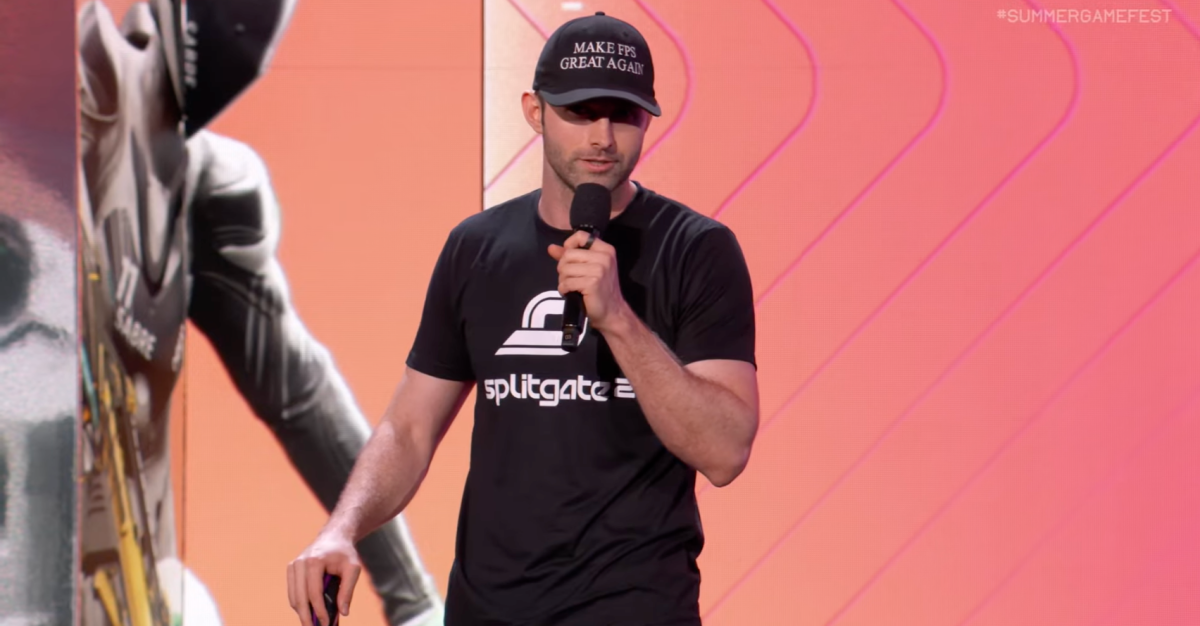
Last week, during the Summer Game Fest keynote livestream, Proulx came out to promote his game wearing a black hat that read, “Make FPS Great Again” — an obvious reference to Donald Trump’s Make American Great Again slogan. The Splitgate 2 community, journalists, and regular gamers seized on the hat (and not, you know, the game) immediately calling the statement gross and tone deaf statement. As questions from the Splitgate 2 community poured in, Proulx doubled down on social media saying that he would not apologize and that the hat wasn’t a political statement and should be taken at face value.

Today, however, he’s singing a different tune. He posted on X with the simple caption, “No excuses, I’m sorry,” accompanied by a nearly three-minute video explaining the decision to wear the hat and the intention behind it.

“We needed something to grab attention, and the honest truth is, we tried to think of something, and this is what we came up with,” Proulx said.

He acknowledged that he was aware the hat would raise controversy. His apology was not for the hat itself, but the discussion surrounding the hat within the Splitgate 2 community. Proulx claimed he did not want the division he himself sowed. “The reason I’m sorry is because of what this has done to the community,” he said.

He continued: “We knew there would be some level of controversy, but we really saw this as a meme that was kind of stating our truth.” As Proulx was making his statement, a few miles away in Los Angeles’ fashion district where the Summer Game Fest Play Days campus resides, US Immigration and Customs Enforcement (ICE) was conducting raids snatching up people just going about their lives; raids that led to city-wide clashes between people protecting their neighbors and defenders of a cruel regime.

But it is not just a hat. Aping a political statement that has been used to enact state violence isn’t “a meme,” it is a continuation of that violence. I think of the people in attendance at the show and those who work at the YouTube Theater who are immigrants or have immigrant family members. I think of the bartender at the City Market Social House, the venue where SGF holds its Play Days event, who told me about the protocol they have in case ICE shows up: how people can hide in a room in the basement and hand out cards so they don’t have to speak to ICE and potentially implicate themself.

Proulx’s statement, no matter its form, isn’t just in bad taste. It is a stark reminder to those people that their lives and families are at risk. And saying ‘I’m sorry, it was just a meme,’ isn’t enough.

Source link
#Splitgate #CEO #apologies #deliberately #courting #controversy
The Swift Observatory was launched in 2004, but recent solar storms have pushed its orbit lower, and it’s in danger of burning up in Earth’s atmosphere as soon as this year. To try and stave off its demise, NASA has enlisted Katalyst Space Technologies. The company’s Link spacecraft launched Friday with the goal of intercepting Swift, which has no propulsion system, and boosting its orbit back to its original position. Right now, Swift is circling at an altitude of 224 miles, and Link is aiming to raise that by about 150 miles.

Using a three-armed spacecraft to lift a satellite 150 miles higher into orbit is challenging enough, but the speed with which Katalyst pulled the mission together makes it even more impressive. NASA required the company to rush the job because Swift would be too low to save by October. $30 million and nine months later, help is on the way for the $500 million Swift.

#NASA #launched #emergency #mission #stop #Swift #Observatory #crashing #EarthNews,Science,Space">NASA launched an emergency mission to stop the Swift Observatory from crashing to EarthThe Swift Observatory was launched in 2004, but recent solar storms have pushed its orbit lower, and it’s in danger of burning up in Earth’s atmosphere as soon as this year. To try and stave off its demise, NASA has enlisted Katalyst Space Technologies. The company’s Link spacecraft launched Friday with the goal of intercepting Swift, which has no propulsion system, and boosting its orbit back to its original position. Right now, Swift is circling at an altitude of 224 miles, and Link is aiming to raise that by about 150 miles.Using a three-armed spacecraft to lift a satellite 150 miles higher into orbit is challenging enough, but the speed with which Katalyst pulled the mission together makes it even more impressive. NASA required the company to rush the job because Swift would be too low to save by October.  million and nine months later, help is on the way for the 0 million Swift.#NASA #launched #emergency #mission #stop #Swift #Observatory #crashing #EarthNews,Science,Space

stave off its demise, NASA has enlisted Katalyst Space Technologies. The company’s Link spacecraft launched Friday with the goal of intercepting Swift, which has no propulsion system, and boosting its orbit back to its original position. Right now, Swift is circling at an altitude of 224 miles, and Link is aiming to raise that by about 150 miles.

Using a three-armed spacecraft to lift a satellite 150 miles higher into orbit is challenging enough, but the speed with which Katalyst pulled the mission together makes it even more impressive. NASA required the company to rush the job because Swift would be too low to save by October. $30 million and nine months later, help is on the way for the $500 million Swift.

#NASA #launched #emergency #mission #stop #Swift #Observatory #crashing #EarthNews,Science,Space">NASA launched an emergency mission to stop the Swift Observatory from crashing to Earth

The Swift Observatory was launched in 2004, but recent solar storms have pushed its orbit lower, and it’s in danger of burning up in Earth’s atmosphere as soon as this year. To try and stave off its demise, NASA has enlisted Katalyst Space Technologies. The company’s Link spacecraft launched Friday with the goal of intercepting Swift, which has no propulsion system, and boosting its orbit back to its original position. Right now, Swift is circling at an altitude of 224 miles, and Link is aiming to raise that by about 150 miles.

Using a three-armed spacecraft to lift a satellite 150 miles higher into orbit is challenging enough, but the speed with which Katalyst pulled the mission together makes it even more impressive. NASA required the company to rush the job because Swift would be too low to save by October. $30 million and nine months later, help is on the way for the $500 million Swift.

#NASA #launched #emergency #mission #stop #Swift #Observatory #crashing #EarthNews,Science,Space
Two hundred and fifty years after the signing of the Declaration of Independence, a new commercial from Google asks: What if the Founding Fathers had access to Google Workspace?

With the tagline “Group project, but make it 1776,” the ad depicts a largely unseen Thomas Jefferson mid-draft when he gets a nagging text from Ben Franklin, leading to a very Google-centric collaboration process. Edits are suggested in Google Docs, a meeting gets scheduled in Google Calendar and conducted remotely via Google Meet (with every single attendee apparently turning their camera off?), then the whole thing is finalized with e-signatures; cue the fireworks.

Of course, since this is an ad from a tech company in the year 2026, AI has a role to play. The fictionalized founders use Google’s “help me visualize” AI tool to try out different animals on the national seal, Gemini takes notes on the meeting, and the founders also ask the chatbot for advice before declining King George III’s document access request.

The whole thing is very tongue-in-cheek (at one point, Sam Adams asks, “Can we settle this over beers?”), and the AI evangelism is relatively discreet when compared to many other recent ads. And unlike that infamous Google commercial in which a father uses Gemini to write a fan letter for his daughter, this one shies away from any suggestion that the actual text of the Declaration of Independence would be improved with AI. Perhaps the most AI-forward element of the ad is the footage itself, which to my eye has the uncanny glow of AI-generated video.

While viewer comments on YouTube and Instagram appear to be mostly positive, you may not be surprised to learn that the response on Bluesky has been far more critical. Posters declared the commercial “cringey” and “stunningly tone deaf,” and the AI angle was the biggest target — even as many users, including historian Angus Johnston, noted that it’s “amazing how little of this is actually AI.”

“Even in a corny fantasy joke, it’s impossible to make the case that AI is a useful tool for political organizing, writing, or human collaboration,” Johnston said.

[embed]https://www.youtube.com/watch?v=Q3RjZY-rSsc[/embed]

When you purchase through links in our articles, we may earn a small commission. This doesn’t affect our editorial independence.

#Google #commercial #imagines #Declaration #Independence #written #TechCrunchgemini,Google">New Google commercial imagines a Declaration of Independence written with help from AI | TechCrunch
Two hundred and fifty years after the signing of the Declaration of Independence, a new commercial from Google asks: What if the Founding Fathers had access to Google Workspace?

With the tagline “Group project, but make it 1776,” the ad depicts a largely unseen Thomas Jefferson mid-draft when he gets a nagging text from Ben Franklin, leading to a very Google-centric collaboration process. Edits are suggested in Google Docs, a meeting gets scheduled in Google Calendar and conducted remotely via Google Meet (with every single attendee apparently turning their camera off?), then the whole thing is finalized with e-signatures; cue the fireworks.


Of course, since this is an ad from a tech company in the year 2026, AI has a role to play. The fictionalized founders use Google’s “help me visualize” AI tool to try out different animals on the national seal, Gemini takes notes on the meeting, and the founders also ask the chatbot for advice before declining King George III’s document access request.

The whole thing is very tongue-in-cheek (at one point, Sam Adams asks, “Can we settle this over beers?”), and the AI evangelism is relatively discreet when compared to many other recent ads. And unlike that infamous Google commercial in which a father uses Gemini to write a fan letter for his daughter, this one shies away from any suggestion that the actual text of the Declaration of Independence would be improved with AI. Perhaps the most AI-forward element of the ad is the footage itself, which to my eye has the uncanny glow of AI-generated video.

While viewer comments on YouTube and Instagram appear to be mostly positive, you may not be surprised to learn that the response on Bluesky has been far more critical. Posters declared the commercial “cringey” and “stunningly tone deaf,” and the AI angle was the biggest target — even as many users, including historian Angus Johnston, noted that it’s “amazing how little of this is actually AI.”

“Even in a corny fantasy joke, it’s impossible to make the case that AI is a useful tool for political organizing, writing, or human collaboration,” Johnston said.


[embed]https://www.youtube.com/watch?v=Q3RjZY-rSsc[/embed]

When you purchase through links in our articles, we may earn a small commission. This doesn’t affect our editorial independence.#Google #commercial #imagines #Declaration #Independence #written #TechCrunchgemini,Google

a new commercial from Google asks: What if the Founding Fathers had access to Google Workspace?

With the tagline “Group project, but make it 1776,” the ad depicts a largely unseen Thomas Jefferson mid-draft when he gets a nagging text from Ben Franklin, leading to a very Google-centric collaboration process. Edits are suggested in Google Docs, a meeting gets scheduled in Google Calendar and conducted remotely via Google Meet (with every single attendee apparently turning their camera off?), then the whole thing is finalized with e-signatures; cue the fireworks.

Of course, since this is an ad from a tech company in the year 2026, AI has a role to play. The fictionalized founders use Google’s “help me visualize” AI tool to try out different animals on the national seal, Gemini takes notes on the meeting, and the founders also ask the chatbot for advice before declining King George III’s document access request.

The whole thing is very tongue-in-cheek (at one point, Sam Adams asks, “Can we settle this over beers?”), and the AI evangelism is relatively discreet when compared to many other recent ads. And unlike that infamous Google commercial in which a father uses Gemini to write a fan letter for his daughter, this one shies away from any suggestion that the actual text of the Declaration of Independence would be improved with AI. Perhaps the most AI-forward element of the ad is the footage itself, which to my eye has the uncanny glow of AI-generated video.

While viewer comments on YouTube and Instagram appear to be mostly positive, you may not be surprised to learn that the response on Bluesky has been far more critical. Posters declared the commercial “cringey” and “stunningly tone deaf,” and the AI angle was the biggest target — even as many users, including historian Angus Johnston, noted that it’s “amazing how little of this is actually AI.”

“Even in a corny fantasy joke, it’s impossible to make the case that AI is a useful tool for political organizing, writing, or human collaboration,” Johnston said.

[embed]https://www.youtube.com/watch?v=Q3RjZY-rSsc[/embed]

When you purchase through links in our articles, we may earn a small commission. This doesn’t affect our editorial independence.

#Google #commercial #imagines #Declaration #Independence #written #TechCrunchgemini,Google">New Google commercial imagines a Declaration of Independence written with help from AI | TechCrunch

Two hundred and fifty years after the signing of the Declaration of Independence, a new commercial from Google asks: What if the Founding Fathers had access to Google Workspace?

With the tagline “Group project, but make it 1776,” the ad depicts a largely unseen Thomas Jefferson mid-draft when he gets a nagging text from Ben Franklin, leading to a very Google-centric collaboration process. Edits are suggested in Google Docs, a meeting gets scheduled in Google Calendar and conducted remotely via Google Meet (with every single attendee apparently turning their camera off?), then the whole thing is finalized with e-signatures; cue the fireworks.

Of course, since this is an ad from a tech company in the year 2026, AI has a role to play. The fictionalized founders use Google’s “help me visualize” AI tool to try out different animals on the national seal, Gemini takes notes on the meeting, and the founders also ask the chatbot for advice before declining King George III’s document access request.

The whole thing is very tongue-in-cheek (at one point, Sam Adams asks, “Can we settle this over beers?”), and the AI evangelism is relatively discreet when compared to many other recent ads. And unlike that infamous Google commercial in which a father uses Gemini to write a fan letter for his daughter, this one shies away from any suggestion that the actual text of the Declaration of Independence would be improved with AI. Perhaps the most AI-forward element of the ad is the footage itself, which to my eye has the uncanny glow of AI-generated video.

While viewer comments on YouTube and Instagram appear to be mostly positive, you may not be surprised to learn that the response on Bluesky has been far more critical. Posters declared the commercial “cringey” and “stunningly tone deaf,” and the AI angle was the biggest target — even as many users, including historian Angus Johnston, noted that it’s “amazing how little of this is actually AI.”

“Even in a corny fantasy joke, it’s impossible to make the case that AI is a useful tool for political organizing, writing, or human collaboration,” Johnston said.

[embed]https://www.youtube.com/watch?v=Q3RjZY-rSsc[/embed]

When you purchase through links in our articles, we may earn a small commission. This doesn’t affect our editorial independence.

#Google #commercial #imagines #Declaration #Independence #written #TechCrunchgemini,Google

Post Comment