×
US-South Korea nuclear submarine deal: What does it mean?

US-South Korea nuclear submarine deal: What does it mean?

Jake Kwon,Seoul and

Gavin Butler,Singapore
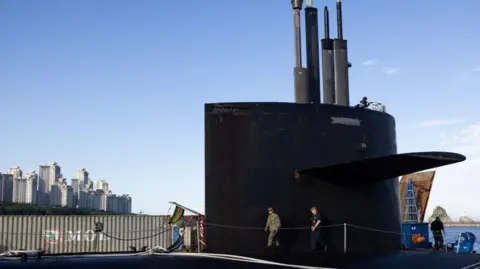
Getty Images The USS Kentucky ballistic missile submarine in Busan, South Korea, during a joint exercise with the South Korean Navy.Getty Images

A file photo of the USS Kentucky nuclear submarine during a visit to South Korea

South Korea’s government has announced that it has finalised an agreement to build nuclear-powered submarines in partnership with the United States.

The US has approved the “attack submarines” and agreed to cooperate in sourcing fuel, according to a fact sheet released by the White House on Thursday.

The agreement marks a significant step in South Korea’s relations with the US and comes amid a period of growing tensions on the Korean Peninsula: with the nuclear-armed North Korea, and an expansionist China to the west.

Here’s what you need to know about the agreement.

What’s in the agreement?

The agreement between the US and South Korea comes as leaders from both countries reached a broad trade deal earlier last month that would see reciprocal tariffs cut to 15% from 25%.

US President Donald Trump had slapped a tariff rate on Seoul of 25% earlier this year – which his counterpart Lee Jae Myung managed to negotiate down to 15%, after Seoul said it would invest $350bn (£265bn) in the US, including $200bn in cash investment and $150bn in shipbuilding.

In a White House readout released on Thursday, the US said it had “given approval for the Republic of Korea to build nuclear-powered attack submarines… [and would] work closely to advance requirements for this project, including avenues to source fuel”.

In an earlier post on his social media platform Truth Social, Trump had said the vessels would be constructed at a shipyard in Philadelphia run by South Korean conglomerate Hanwha.

Only six countries currently possess nuclear-powered strategic submarines: the US, China, Russia, the UK, France and India.

South Korea already possesses about 20 submarines, but they are all diesel propelled and therefore need to surface far more frequently. Nuclear submarines are also able to operate further and faster.

“I have given them approval to build a nuclear-powered submarine, rather than the old-fashioned, and far less nimble, diesel-powered submarines that they have now,” Trump wrote on Truth Social.

South Korea is a powerhouse when it comes to civilian nuclear energy. It had a nuclear weapons programme in the 1970s but gave it up following US pressure.

And so its ability to enrich or reprocess uranium is limited by the US as it is entirely dependent on imports.

Why does South Korea want nuclear submarines?

The latest vessel programme is aimed at countering North Korea, which recently revealed that it was pursuing its own nuclear submarine programme.

President Lee had told Trump at the APEC summit last month that South Korea needed them for that express purpose.

In a TV interview last week, Ahn Gyu-back, South Korea’s Minister of Defence, said that nuclear submarines would be a “proud achievement” for South Korea, and a major leap in strengthening the country’s defence against the North.

The stealth of nuclear submarines would keep North Korean leader Kim Jong Un “awake at night”, he added.

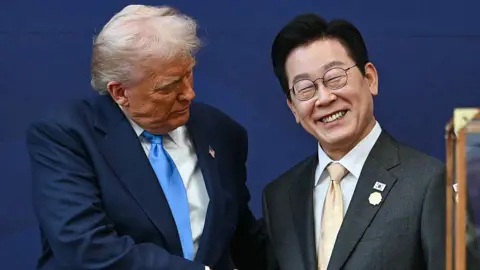
Getty Images US President Donald Trump shakes hands with South Korean President Lee Jae Myung Getty Images

US President Donald Trump met his Korean counterpart in South Korea last month

Does North Korea have nuclear submarines?

North Korea has also been pursuing a nuclear submarine programme – possibly with Russia’s help, according to South Korean officials.

In March 2025, North Korea unveiled pictures of what it claimed was a nuclear-powered submarine that was under construction, showing Kim visiting the shipyard.

Pyongyang is expected to have the submarines within the next few years.

North Korea is also estimated to have an arsenal of approximately 50 nuclear weapons, as part of its broader nuclear weapons programme.

Jo Bee-yun, a research fellow at the Sejong Institute, suggested that Seoul’s acquisition of nuclear submarines will help it stay apace in East Asia’s escalating arms race.

“North Korea’s nuclear weapon is an established fact,” she told the BBC. “[South Korea acquiring] nuclear submarines is only a step in the larger trend of rising tension.”

Will this inflame tensions on the Korean Peninsula?

It is unclear how much the nuclear-propelled submarines will contribute to South Korea’s defence capabilities – and though they are very expensive, they don’t quite change the balance of power on the Korean Peninsula, according to some experts.

Yang Uk, a research fellow at the Asan Institute for Policy Studies, told the BBC that the nuclear subs’ primary purpose is to assure South Korean voters that their government is responding to North Korea’s nuclear threat.

“South Korea cannot develop its own nuclear weapons to counter North Korea’s,” Dr Yang said. “What’s something that they can do? Fielding nuclear submarines.”

Dr Yang believes North Korea might revel in the change, however, because it reinforces their justification to hold on to nuclear weapons – meaning it will become more difficult to demand that Pyongyang give up its nuclear arsenal.

Jo nonetheless emphasised the strategic advantage that South Korea stands to gain from the new submarine deal, describing it as a “major change” which “means South Korea is now a regional player”.

“The best feature of a nuclear submarine is its speed,” she said. “It can now go fast and far and South Korea can operate together with more countries.”

What’s in it for the United States?

For Washington, support for South Korea’s nuclear-powered submarine programme likely aims to put pressure on both North Korea and China.

“Trump has put the burden of defence spending on the back of South Korea,” Dr Yang explained. “South Korea will greatly expand its defence budget. They will act as America’s proxy in putting pressure on China and North Korea.”
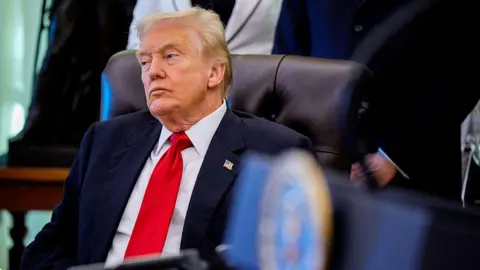
Getty Images Donald Trump sitting at a desk, wearing a suit and red tieGetty Images

Donald Trump is attempting to counter the influence of other nations in South Korea, according to experts

US and China have long competed for strategic influence in South Korea, leaving Seoul to walk a geopolitical tightrope. More recently, China has been increasing its naval activity near South Korea’s maritime border – a move akin to those seen in the South China Sea.

Beijing must be “furious” about South Korea’s nuclear submarine agreement with the US, Dr Yang said.

Following the deal’s announcement, the Chinese Ambassador to South Korea, Dai Bing, said he hoped South Korea would “deal with this issue prudently, taking into consideration the concerns of all sides”.

Dai also added that Beijing was engaging with Seoul on the matter through diplomatic channels, and emphasised that “the (security) situation on the Korean Peninsula and in the region is still complex and sensitive”.

What next?

Although President Trump said the submarines would be built in Philadelphia and bring jobs to the US, South Korean officials have maintained they must be built locally, where existing facilities can deliver them in a much shorter timeline.

South Korea’s Prime Minister Kim Min-seok had himself said during a parliamentary hearing that the South Korean owned shipyard in Philadelphia did “not have the capability” to build such vessels, according to reports.

Hanwha, who owns the shipyard, has yet to comment on the matter.

But now that an agreement has been reached, the next step is to adjust the nuclear agreement between the two countries, allowing for the US to provide nuclear fuel and to set the fence for its military use.

Source link
#USSouth #Korea #nuclear #submarine #deal

Australia and Japan have signed contracts for the first three of 11 warships set to be delivered to the Australian navy under a landmark $7bn defence deal, as the two close US allies in the Asia Pacific region deepen defence cooperation.

Australia’s Defence Minister Richard Marles and Japanese Defence Minister Koizumi Shinjiro made the announcement in Melbourne on Saturday at the signing ceremony for the Mogami-class warships.

Recommended Stories

list of 4 itemsend of list

The “Mogami Memorandum” pledges to deepen military ties, including through “closer industrial cooperation” in defence.

Japan’s Mitsubishi Heavy Industries will build three of the stealth frigates in southern Nagasaki Prefecture, while Australia’s Austal will build eight in Western Australia.

The first of the Japanese-built warships is scheduled to be delivered in 2029 and enter service in 2030.

“Our surface fleet is more important than at any time in decades,” Marles said in a statement.

“These general-purpose frigates will help secure our maritime trade routes and northern approaches as part of a larger and more lethal surface combatant fleet.”

Shinjiro said closer defence coordination was becoming more important as Australia and Japan faced an “increasingly severe security environment”.

Australia’s government last year announced that it had chosen Mitsubishi Heavy Industries to build its fleet of next-generation warships, following a bidding war between the Tokyo-based firm and Germany’s Thyssenkrupp.

Australia has committed to a record $305bn in military spending over the next decade, as part of a widespread defence overhaul aimed at boosting the country’s naval power to levels not seen since World War II.

Under the plans, Canberra’s defence spending is set to rise to 3 percent of gross domestic product (GDP) by 3033, from about 2 percent now.

Australia and Japan, two of the United States’ closest allies, have ramped up military cooperation in recent years amid shared concerns about shifts in the regional security environment, particularly China’s rising influence. Tokyo and Canberra are also members of the Quad security bloc led by the US.

#Australia #Japan #sign #contracts #7bn #warships #dealEconomy, News, Business and Economy, Military, Asia Pacific, Australia">Australia and Japan sign contracts for bn warships dealDefence deal is latest example of deepening ties between Canberra and Tokyo amid shared concerns over China’s rise.Published On 19 Apr 202619 Apr 2026Australia and Japan have signed contracts for the first three of 11 warships set to be delivered to the Australian navy under a landmark bn defence deal, as the two close US allies in the Asia Pacific region deepen defence cooperation.Australia’s Defence Minister Richard Marles and Japanese Defence Minister Koizumi Shinjiro made the announcement in Melbourne on Saturday at the signing ceremony for the Mogami-class warships.Recommended Stories list of 4 itemsend of listThe “Mogami Memorandum” pledges to deepen military ties, including through “closer industrial cooperation” in defence.Japan’s Mitsubishi Heavy Industries will build three of the stealth frigates in southern Nagasaki Prefecture, while Australia’s Austal will build eight in Western Australia.The first of the Japanese-built warships is scheduled to be delivered in 2029 and enter service in 2030.“Our surface fleet is more important than at any time in decades,” Marles said in a statement.“These general-purpose frigates will help secure our maritime trade routes and northern approaches as part of a larger and more lethal surface combatant fleet.”Shinjiro said closer defence coordination was becoming more important as Australia and Japan faced an “increasingly severe security environment”.Australia’s government last year announced that it had chosen Mitsubishi Heavy Industries to build its fleet of next-generation warships, following a bidding war between the Tokyo-based firm and Germany’s Thyssenkrupp.Australia has committed to a record 5bn in military spending over the next decade, as part of a widespread defence overhaul aimed at boosting the country’s naval power to levels not seen since World War II.Under the plans, Canberra’s defence spending is set to rise to 3 percent of gross domestic product (GDP) by 3033, from about 2 percent now.Australia and Japan, two of the United States’ closest allies, have ramped up military cooperation in recent years amid shared concerns about shifts in the regional security environment, particularly China’s rising influence. Tokyo and Canberra are also members of the Quad security bloc led by the US.#Australia #Japan #sign #contracts #7bn #warships #dealEconomy, News, Business and Economy, Military, Asia Pacific, Australia

Australia and Japan have signed contracts for the first three of 11 warships set to be delivered to the Australian navy under a landmark $7bn defence deal, as the two close US allies in the Asia Pacific region deepen defence cooperation.

Australia’s Defence Minister Richard Marles and Japanese Defence Minister Koizumi Shinjiro made the announcement in Melbourne on Saturday at the signing ceremony for the Mogami-class warships.

Recommended Stories

list of 4 itemsend of list

The “Mogami Memorandum” pledges to deepen military ties, including through “closer industrial cooperation” in defence.

Japan’s Mitsubishi Heavy Industries will build three of the stealth frigates in southern Nagasaki Prefecture, while Australia’s Austal will build eight in Western Australia.

The first of the Japanese-built warships is scheduled to be delivered in 2029 and enter service in 2030.

“Our surface fleet is more important than at any time in decades,” Marles said in a statement.

“These general-purpose frigates will help secure our maritime trade routes and northern approaches as part of a larger and more lethal surface combatant fleet.”

Shinjiro said closer defence coordination was becoming more important as Australia and Japan faced an “increasingly severe security environment”.

Australia’s government last year announced that it had chosen Mitsubishi Heavy Industries to build its fleet of next-generation warships, following a bidding war between the Tokyo-based firm and Germany’s Thyssenkrupp.

Australia has committed to a record $305bn in military spending over the next decade, as part of a widespread defence overhaul aimed at boosting the country’s naval power to levels not seen since World War II.

Under the plans, Canberra’s defence spending is set to rise to 3 percent of gross domestic product (GDP) by 3033, from about 2 percent now.

Australia and Japan, two of the United States’ closest allies, have ramped up military cooperation in recent years amid shared concerns about shifts in the regional security environment, particularly China’s rising influence. Tokyo and Canberra are also members of the Quad security bloc led by the US.

#Australia #Japan #sign #contracts #7bn #warships #dealEconomy, News, Business and Economy, Military, Asia Pacific, Australia">Australia and Japan sign contracts for $7bn warships deal

Defence deal is latest example of deepening ties between Canberra and Tokyo amid shared concerns over China’s rise.

Australia and Japan have signed contracts for the first three of 11 warships set to be delivered to the Australian navy under a landmark $7bn defence deal, as the two close US allies in the Asia Pacific region deepen defence cooperation.

Australia’s Defence Minister Richard Marles and Japanese Defence Minister Koizumi Shinjiro made the announcement in Melbourne on Saturday at the signing ceremony for the Mogami-class warships.

Recommended Stories

list of 4 itemsend of list

The “Mogami Memorandum” pledges to deepen military ties, including through “closer industrial cooperation” in defence.

Japan’s Mitsubishi Heavy Industries will build three of the stealth frigates in southern Nagasaki Prefecture, while Australia’s Austal will build eight in Western Australia.

The first of the Japanese-built warships is scheduled to be delivered in 2029 and enter service in 2030.

“Our surface fleet is more important than at any time in decades,” Marles said in a statement.

“These general-purpose frigates will help secure our maritime trade routes and northern approaches as part of a larger and more lethal surface combatant fleet.”

Shinjiro said closer defence coordination was becoming more important as Australia and Japan faced an “increasingly severe security environment”.

Australia’s government last year announced that it had chosen Mitsubishi Heavy Industries to build its fleet of next-generation warships, following a bidding war between the Tokyo-based firm and Germany’s Thyssenkrupp.

Australia has committed to a record $305bn in military spending over the next decade, as part of a widespread defence overhaul aimed at boosting the country’s naval power to levels not seen since World War II.

Under the plans, Canberra’s defence spending is set to rise to 3 percent of gross domestic product (GDP) by 3033, from about 2 percent now.

Australia and Japan, two of the United States’ closest allies, have ramped up military cooperation in recent years amid shared concerns about shifts in the regional security environment, particularly China’s rising influence. Tokyo and Canberra are also members of the Quad security bloc led by the US.

#Australia #Japan #sign #contracts #7bn #warships #dealEconomy, News, Business and Economy, Military, Asia Pacific, Australia

Post Comment