I tried out OpenAI’s new AI keypad — which will be fun for some coders and slightly mystifying to everyone else | TechCrunch
OpenAI launched its first piece of hardware last week — a fancy little keypad built to pair with ChatGPT. Micro, which was developed in collaboration with specialty keyboard designer Work Louder, is essentially an artisanal workplace novelty that many tech enthusiasts will love and that may leave everyone else a little puzzled.
OpenAI’s entrance into the hardware market hasn’t arrived without drama. Several weeks ago, Apple sued the AI lab and accused it of trade theft — kicking off what’s certain to be a long-simmering legal battle. Meanwhile, news of another smart home product in development at OpenAI has also raised eyebrows, as the supposed device — which is being built to pair with ChatGPT — was reportedly developed by former Apple engineers.
Until the legal battle works itself out and OpenAI’s broader hardware ambitions materialize, the most the startup has to offer is Micro — a funky little keypad clearly engineered to delight the tech industry’s code monkeys.
OpenAI sent TechCrunch a Micro test unit. The first big thing you notice when initially handling the keypad is that it’s a sturdy little device — enough so that if the AI accessory thing doesn’t end up working out, it could easily double as a paperweight. The other thing you might notice (and I am not the only one to point this out), is that the packaging — an immaculate white box with a sleek, clean aesthetic — is pretty Apple-coded. Make of that what you will.
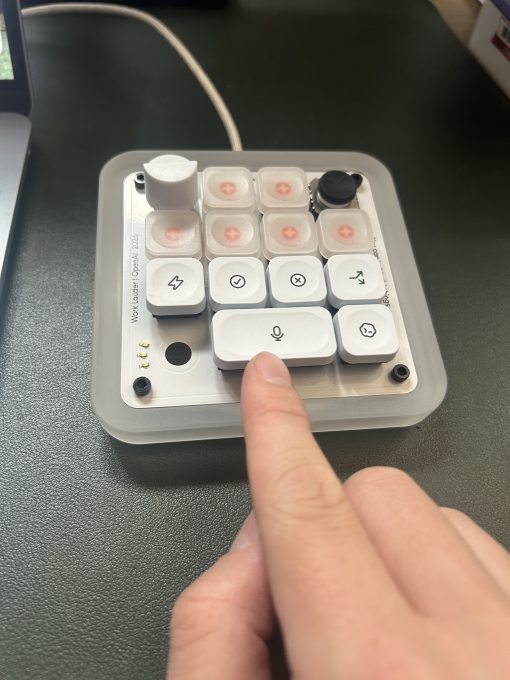
The keypad’s layout involves six frosted “agent” keys at the top of the pad, which can be customized to carry out specific tasks within ChatGPT or its agentic coding tool Codex. Below them are six command keys, which can be used to control those programs. You can pair your Micro with your computer either through a Bluetooth connection or a USB cable.
Image Credits:Lucas Ropek/TechCrunch
Perhaps the most convenient thing Micro offers is a button for voice dictation — meaning you simply tell the app what you want done and it will get busy working on your behalf. Just hold down the dictation button and start talking. When you’re done, tap the “send” button next to it to submit your request.
You can customize your Micro keypad within ChatGPT itself, where a Micro tab allows you to adjust everything from the brightness of the light from the keys to the specific commands and projects you want tied to those keys.
Hard-core coders — the device’s actual target audience — haven’t exactly embraced it. Reviews by Redditors have largely negative, with one Reddit user calling it “a prank and not a real product,” and others saying serious coders won’t touch it. A review by the smaller independent outlet Aftermath was even harsher, calling the $230 price tag hard to justify next to cheaper DIY and off-the-shelf alternatives. (The title of that review: “OpenAI’s expensive macropad feels engineered to piss me off specifically.”)
It’s definitely the case that new users may need some time to figure out how Micro works and what to do with it.
Once I figured out how to program the keypad to my liking, I found it was actually pretty fun. You can assign various ChatGPT sessions to specific keys, which then allows you to easily toggle back and forth between all of your various projects. When you combine that with the dictation button, it makes the whole experience considerably more efficient and enjoyable.
But there’s still a learning curve. Micro’s buttons are color-coded. White means an agent is idle, blue means its thinking, green means a task is complete, and red means there’s been an error. You’ll need to memorize that, along with memorizing which specific projects are coded to each key.
The big question is whether the Micro keypad is functionally easier to use than just continuing to work on your laptop. In short: Why would I spend a week learning how to program and operate this thing when I already know how to use my computer’s mouse and keyboard?
Ultimately, your experience with the Micro will depend heavily on how much you use ChatGPT. Since I don’t use AI much day to day, I’m probably not the target audience for it.
That said, if you’re a ChatGPT power user, have $230 to spare, and like vintage-looking hardware with clicky buttons, Micro probably isn’t the worst purchase you could make — it might even brighten your day a little.
When you purchase through links in our articles, we may earn a small commission. This doesn’t affect our editorial independence.
OpenAI launched its first piece of hardware last week — a fancy little keypad built to pair with ChatGPT. Micro, which was developed in collaboration with specialty keyboard designer Work Louder, is essentially an artisanal workplace novelty that many tech enthusiasts will love and that may leave everyone else a little puzzled.
OpenAI’s entrance into the hardware market hasn’t arrived without drama. Several weeks ago, Apple sued the AI lab and accused it of trade theft — kicking off what’s certain to be a long-simmering legal battle. Meanwhile, news of another smart home product in development at OpenAI has also raised eyebrows, as the supposed device — which is being built to pair with ChatGPT — was reportedly developed by former Apple engineers.
Until the legal battle works itself out and OpenAI’s broader hardware ambitions materialize, the most the startup has to offer is Micro — a funky little keypad clearly engineered to delight the tech industry’s code monkeys.
OpenAI sent TechCrunch a Micro test unit. The first big thing you notice when initially handling the keypad is that it’s a sturdy little device — enough so that if the AI accessory thing doesn’t end up working out, it could easily double as a paperweight. The other thing you might notice (and I am not the only one to point this out), is that the packaging — an immaculate white box with a sleek, clean aesthetic — is pretty Apple-coded. Make of that what you will.
The keypad’s layout involves six frosted “agent” keys at the top of the pad, which can be customized to carry out specific tasks within ChatGPT or its agentic coding tool Codex. Below them are six command keys, which can be used to control those programs. You can pair your Micro with your computer either through a Bluetooth connection or a USB cable.
Image Credits:Lucas Ropek/TechCrunch
Perhaps the most convenient thing Micro offers is a button for voice dictation — meaning you simply tell the app what you want done and it will get busy working on your behalf. Just hold down the dictation button and start talking. When you’re done, tap the “send” button next to it to submit your request.
You can customize your Micro keypad within ChatGPT itself, where a Micro tab allows you to adjust everything from the brightness of the light from the keys to the specific commands and projects you want tied to those keys.
Hard-core coders — the device’s actual target audience — haven’t exactly embraced it. Reviews by Redditors have largely negative, with one Reddit user calling it “a prank and not a real product,” and others saying serious coders won’t touch it. A review by the smaller independent outlet Aftermath was even harsher, calling the $230 price tag hard to justify next to cheaper DIY and off-the-shelf alternatives. (The title of that review: “OpenAI’s expensive macropad feels engineered to piss me off specifically.”)
It’s definitely the case that new users may need some time to figure out how Micro works and what to do with it.
Once I figured out how to program the keypad to my liking, I found it was actually pretty fun. You can assign various ChatGPT sessions to specific keys, which then allows you to easily toggle back and forth between all of your various projects. When you combine that with the dictation button, it makes the whole experience considerably more efficient and enjoyable.
But there’s still a learning curve. Micro’s buttons are color-coded. White means an agent is idle, blue means its thinking, green means a task is complete, and red means there’s been an error. You’ll need to memorize that, along with memorizing which specific projects are coded to each key.
The big question is whether the Micro keypad is functionally easier to use than just continuing to work on your laptop. In short: Why would I spend a week learning how to program and operate this thing when I already know how to use my computer’s mouse and keyboard?
Ultimately, your experience with the Micro will depend heavily on how much you use ChatGPT. Since I don’t use AI much day to day, I’m probably not the target audience for it.
That said, if you’re a ChatGPT power user, have $230 to spare, and like vintage-looking hardware with clicky buttons, Micro probably isn’t the worst purchase you could make — it might even brighten your day a little.
When you purchase through links in our articles, we may earn a small commission. This doesn’t affect our editorial independence.
Source link
#OpenAIs #keypad #fun #coders #slightly #mystifying #TechCrunch
launch of five new devices at its Galaxy Unpacked 2026 event in London. Three foldable handsets were unveiled, along with the Galaxy Watch 9 and Galaxy Watch Ultra 2, in addition to the Galaxy Z Fold 8 and Galaxy Z Fold 8 Ultra. The newest additions feature improved technology, slimmer form factors, Galaxy AI, and health monitoring capabilities. Preorders for the new products have already been opened in various markets, and they will be available starting from early August.
Samsung Galaxy Z Fold 8
The new Samsung Galaxy Z Fold 8 is built with people who prefer a larger foldable device in mind. For that reason, it comes with a passport-like design, which makes the device relatively shorter but gives a wider cover screen. This type of device enables easy completion of daily activities without unfolding it. The device has a 5.5-inch cover screen and a 7.6-inch foldable OLED screen. Both displays support an adaptive refresh rate from 1Hz to 120Hz.
The company uses a new Flex Titanium display structure to strengthen the folding screen. Samsung has redesigned the hinge for better performance and a less noticeable crease. It is powered by the Snapdragon 8 Elite Gen 5 chip. The device features up to 16 GB of RAM and 1 TB of internal memory. It includes a 50 MP primary sensor, a 50 MP ultra-wide lens, and a pair of 10 MP selfie shooters.
A 4,800mAh silicon-carbon battery keeps the phone running and supports 45W fast charging. The Galaxy Z Fold 8 ships with Android 17 and One UI 9. It also includes Galaxy AI tools such as Now Nudge, Gemini Intelligence, and Gemini Notebook. Buyers also get six months of Google AI Pro at no extra cost. The phone starts at $1,899.99 and is available in Lavender, Cream, Graphite, and an online-only Pistachio finish.
Samsung Galaxy Z Fold 8 Ultra
The latest addition to the line-up of the company’s top-selling foldable model is the Galaxy Z Fold 8 Ultra. The new smartphone replaces the Galaxy Z Fold 7 and offers a slimmer form factor. Its thickness measures 4.1 mm when unfolded, and 8.9 mm when folded. Samsung has also introduced a toughened Flex Titanium frame along with the improved hinge, which increases the strength of the display and minimizes the crease effect. The Fold 8 Ultra has a 6.5-inch outer screen and an 8-inch folding screen with a 120Hz adaptive refresh rate.
The Galaxy Z Fold 8 Ultra runs on the Snapdragon 8 Elite Gen 5 processor. It comes with up to 16GB of RAM and up to 1TB of storage. Samsung also upgrades the camera system. The phone includes a 200MP main camera, a 50MP ultra-wide camera, and a 10MP telephoto camera. It also has two 10MP selfie cameras, one on each display.
The Fold 8 Ultra includes a 5,000mAh silicon-carbon battery with 45W wired charging support. It runs Android 17 with One UI 9 and includes Galaxy AI features like Now Nudge, Gemini Intelligence, and Gemini Notebook. Samsung offers the phone in Violet Shadow, Cream, Graphite, and an online-only Green Shadow color. The device starts at $2,099.99, while preorder buyers can take advantage of Samsung credit and trade-in deals.
Samsung Galaxy Z Flip 8
The Galaxy Z Flip 8 is the latest folding clamshell from Samsung. The company retains its classic design, but now makes the device slimmer and even more advanced. The features of the new Galaxy Z Flip 8 include the 6.9-inch foldable display and the 4.1-inch FlexWindow cover display.
Galaxy Z Flip 8 comes with the Snapdragon 8 Elite Gen 5 processor in America. Overseas versions have the Samsung Exynos 2600 chipset. This model features 12GB RAM along with up to 512GB of internal memory. It has a camera system that comprises 50MP main, 12MP ultra-wide, and 10MP selfie cameras.
The phone runs Android 17 with One UI 9. Samsung includes Galaxy AI features that work directly on the FlexWindow display. Personalized Now Brief updates and Gemini Intelligence help users complete tasks more quickly. The Galaxy Z Flip 8 also packs a 4,300mAh battery with 25W wired charging. It is available in Pink, Cream, Graphite, and an online-only Mint finish. It starts at $1,199.99, and preorder buyers can take advantage of Samsung credit and trade-in deals.
Samsung Galaxy Watch Ultra 2
The Galaxy Watch Ultra 2 is Samsung’s newest premium smartwatch. The watch features LTE connectivity as standard across all models. Samsung also redesigned the titanium body to make it thinner than before. The wearable includes a 47mm display with a peak brightness of 5,000 nits. It is powered by the Snapdragon Wear Elite platform and includes 2GB RAM and 64GB storage. Samsung equips the watch with a larger 800mAh battery. The company says it can deliver up to 60 hours of battery life with the Always-On Display enabled.
Samsung adds several new health and fitness features to the watch. These include Heart Health Score, Daily Cardio Load, Trail Run mode, and Nutrition Alert. The watch also provides hydration guidance during workouts. Samsung plans to release a Diving app later this year. The Galaxy Watch Ultra 2 has an IP69K rating and comes in Titanium Gray and Titanium Silver. It starts at $699.99, while preorder buyers can receive Samsung credit and trade-in savings.
Samsung Galaxy Watch 9
Samsung has launched the Galaxy Watch 9 as its more affordable smartwatch. The watch comes in 40mm and 44mm sizes. Buyers can choose between Bluetooth and LTE models. The 40mm version is available in Cream and Graphite, and the 44mm model comes in Silver and Graphite. Samsung powers the watch with the Snapdragon Wear Elite processor. It includes 2GB RAM and 32GB storage. The display offers up to 3,000 nits of peak brightness. The 40mm model packs a 390mAh battery, while the 44mm version includes a 445mAh battery. Samsung claims up to 30 hours of battery life with the Always-On Display turned on.
The Galaxy Watch 9 introduces new health and fitness features. Users get Heart Health Score, Daily Cardio Load, Sleep Apnea detection, and Vitals tracking during sleep. The watch also warns users about unsafe environmental noise levels. Samsung gives the smartwatch MIL-STD-810H and IP68 ratings for durability. Pricing starts at $379.99, with LTE models priced $50 higher. Samsung also offers a 60-day Strava trial and a two-month iFIT membership for new buyers.
launch of five new devices at its Galaxy Unpacked 2026 event in London. Three foldable handsets were unveiled, along with the Galaxy Watch 9 and Galaxy Watch Ultra 2, in addition to the Galaxy Z Fold 8 and Galaxy Z Fold 8 Ultra. The newest additions feature improved technology, slimmer form factors, Galaxy AI, and health monitoring capabilities. Preorders for the new products have already been opened in various markets, and they will be available starting from early August.
Samsung Galaxy Z Fold 8
The new Samsung Galaxy Z Fold 8 is built with people who prefer a larger foldable device in mind. For that reason, it comes with a passport-like design, which makes the device relatively shorter but gives a wider cover screen. This type of device enables easy completion of daily activities without unfolding it. The device has a 5.5-inch cover screen and a 7.6-inch foldable OLED screen. Both displays support an adaptive refresh rate from 1Hz to 120Hz.
The company uses a new Flex Titanium display structure to strengthen the folding screen. Samsung has redesigned the hinge for better performance and a less noticeable crease. It is powered by the Snapdragon 8 Elite Gen 5 chip. The device features up to 16 GB of RAM and 1 TB of internal memory. It includes a 50 MP primary sensor, a 50 MP ultra-wide lens, and a pair of 10 MP selfie shooters.
A 4,800mAh silicon-carbon battery keeps the phone running and supports 45W fast charging. The Galaxy Z Fold 8 ships with Android 17 and One UI 9. It also includes Galaxy AI tools such as Now Nudge, Gemini Intelligence, and Gemini Notebook. Buyers also get six months of Google AI Pro at no extra cost. The phone starts at $1,899.99 and is available in Lavender, Cream, Graphite, and an online-only Pistachio finish.
Samsung Galaxy Z Fold 8 Ultra
The latest addition to the line-up of the company’s top-selling foldable model is the Galaxy Z Fold 8 Ultra. The new smartphone replaces the Galaxy Z Fold 7 and offers a slimmer form factor. Its thickness measures 4.1 mm when unfolded, and 8.9 mm when folded. Samsung has also introduced a toughened Flex Titanium frame along with the improved hinge, which increases the strength of the display and minimizes the crease effect. The Fold 8 Ultra has a 6.5-inch outer screen and an 8-inch folding screen with a 120Hz adaptive refresh rate.
The Galaxy Z Fold 8 Ultra runs on the Snapdragon 8 Elite Gen 5 processor. It comes with up to 16GB of RAM and up to 1TB of storage. Samsung also upgrades the camera system. The phone includes a 200MP main camera, a 50MP ultra-wide camera, and a 10MP telephoto camera. It also has two 10MP selfie cameras, one on each display.
The Fold 8 Ultra includes a 5,000mAh silicon-carbon battery with 45W wired charging support. It runs Android 17 with One UI 9 and includes Galaxy AI features like Now Nudge, Gemini Intelligence, and Gemini Notebook. Samsung offers the phone in Violet Shadow, Cream, Graphite, and an online-only Green Shadow color. The device starts at $2,099.99, while preorder buyers can take advantage of Samsung credit and trade-in deals.
Samsung Galaxy Z Flip 8
The Galaxy Z Flip 8 is the latest folding clamshell from Samsung. The company retains its classic design, but now makes the device slimmer and even more advanced. The features of the new Galaxy Z Flip 8 include the 6.9-inch foldable display and the 4.1-inch FlexWindow cover display.
Galaxy Z Flip 8 comes with the Snapdragon 8 Elite Gen 5 processor in America. Overseas versions have the Samsung Exynos 2600 chipset. This model features 12GB RAM along with up to 512GB of internal memory. It has a camera system that comprises 50MP main, 12MP ultra-wide, and 10MP selfie cameras.
The phone runs Android 17 with One UI 9. Samsung includes Galaxy AI features that work directly on the FlexWindow display. Personalized Now Brief updates and Gemini Intelligence help users complete tasks more quickly. The Galaxy Z Flip 8 also packs a 4,300mAh battery with 25W wired charging. It is available in Pink, Cream, Graphite, and an online-only Mint finish. It starts at $1,199.99, and preorder buyers can take advantage of Samsung credit and trade-in deals.
Samsung Galaxy Watch Ultra 2
The Galaxy Watch Ultra 2 is Samsung’s newest premium smartwatch. The watch features LTE connectivity as standard across all models. Samsung also redesigned the titanium body to make it thinner than before. The wearable includes a 47mm display with a peak brightness of 5,000 nits. It is powered by the Snapdragon Wear Elite platform and includes 2GB RAM and 64GB storage. Samsung equips the watch with a larger 800mAh battery. The company says it can deliver up to 60 hours of battery life with the Always-On Display enabled.
Samsung adds several new health and fitness features to the watch. These include Heart Health Score, Daily Cardio Load, Trail Run mode, and Nutrition Alert. The watch also provides hydration guidance during workouts. Samsung plans to release a Diving app later this year. The Galaxy Watch Ultra 2 has an IP69K rating and comes in Titanium Gray and Titanium Silver. It starts at $699.99, while preorder buyers can receive Samsung credit and trade-in savings.
Samsung Galaxy Watch 9
Samsung has launched the Galaxy Watch 9 as its more affordable smartwatch. The watch comes in 40mm and 44mm sizes. Buyers can choose between Bluetooth and LTE models. The 40mm version is available in Cream and Graphite, and the 44mm model comes in Silver and Graphite. Samsung powers the watch with the Snapdragon Wear Elite processor. It includes 2GB RAM and 32GB storage. The display offers up to 3,000 nits of peak brightness. The 40mm model packs a 390mAh battery, while the 44mm version includes a 445mAh battery. Samsung claims up to 30 hours of battery life with the Always-On Display turned on.
The Galaxy Watch 9 introduces new health and fitness features. Users get Heart Health Score, Daily Cardio Load, Sleep Apnea detection, and Vitals tracking during sleep. The watch also warns users about unsafe environmental noise levels. Samsung gives the smartwatch MIL-STD-810H and IP68 ratings for durability. Pricing starts at $379.99, with LTE models priced $50 higher. Samsung also offers a 60-day Strava trial and a two-month iFIT membership for new buyers.
#Biggest #Samsung #Launches #Galaxy #Unpacked #JulySamsung">5 Biggest Samsung Launches from Galaxy Unpacked July 2026
Samsung has expanded its Galaxy lineup with the launch of five new devices at its Galaxy Unpacked 2026 event in London. Three foldable handsets were unveiled, along with the Galaxy Watch 9 and Galaxy Watch Ultra 2, in addition to the Galaxy Z Fold 8 and Galaxy Z Fold 8 Ultra. The newest additions feature improved technology, slimmer form factors, Galaxy AI, and health monitoring capabilities. Preorders for the new products have already been opened in various markets, and they will be available starting from early August.
Samsung Galaxy Z Fold 8
The new Samsung Galaxy Z Fold 8 is built with people who prefer a larger foldable device in mind. For that reason, it comes with a passport-like design, which makes the device relatively shorter but gives a wider cover screen. This type of device enables easy completion of daily activities without unfolding it. The device has a 5.5-inch cover screen and a 7.6-inch foldable OLED screen. Both displays support an adaptive refresh rate from 1Hz to 120Hz.
The company uses a new Flex Titanium display structure to strengthen the folding screen. Samsung has redesigned the hinge for better performance and a less noticeable crease. It is powered by the Snapdragon 8 Elite Gen 5 chip. The device features up to 16 GB of RAM and 1 TB of internal memory. It includes a 50 MP primary sensor, a 50 MP ultra-wide lens, and a pair of 10 MP selfie shooters.
A 4,800mAh silicon-carbon battery keeps the phone running and supports 45W fast charging. The Galaxy Z Fold 8 ships with Android 17 and One UI 9. It also includes Galaxy AI tools such as Now Nudge, Gemini Intelligence, and Gemini Notebook. Buyers also get six months of Google AI Pro at no extra cost. The phone starts at $1,899.99 and is available in Lavender, Cream, Graphite, and an online-only Pistachio finish.
Samsung Galaxy Z Fold 8 Ultra
The latest addition to the line-up of the company’s top-selling foldable model is the Galaxy Z Fold 8 Ultra. The new smartphone replaces the Galaxy Z Fold 7 and offers a slimmer form factor. Its thickness measures 4.1 mm when unfolded, and 8.9 mm when folded. Samsung has also introduced a toughened Flex Titanium frame along with the improved hinge, which increases the strength of the display and minimizes the crease effect. The Fold 8 Ultra has a 6.5-inch outer screen and an 8-inch folding screen with a 120Hz adaptive refresh rate.
The Galaxy Z Fold 8 Ultra runs on the Snapdragon 8 Elite Gen 5 processor. It comes with up to 16GB of RAM and up to 1TB of storage. Samsung also upgrades the camera system. The phone includes a 200MP main camera, a 50MP ultra-wide camera, and a 10MP telephoto camera. It also has two 10MP selfie cameras, one on each display.
The Fold 8 Ultra includes a 5,000mAh silicon-carbon battery with 45W wired charging support. It runs Android 17 with One UI 9 and includes Galaxy AI features like Now Nudge, Gemini Intelligence, and Gemini Notebook. Samsung offers the phone in Violet Shadow, Cream, Graphite, and an online-only Green Shadow color. The device starts at $2,099.99, while preorder buyers can take advantage of Samsung credit and trade-in deals.
Samsung Galaxy Z Flip 8
The Galaxy Z Flip 8 is the latest folding clamshell from Samsung. The company retains its classic design, but now makes the device slimmer and even more advanced. The features of the new Galaxy Z Flip 8 include the 6.9-inch foldable display and the 4.1-inch FlexWindow cover display.
Galaxy Z Flip 8 comes with the Snapdragon 8 Elite Gen 5 processor in America. Overseas versions have the Samsung Exynos 2600 chipset. This model features 12GB RAM along with up to 512GB of internal memory. It has a camera system that comprises 50MP main, 12MP ultra-wide, and 10MP selfie cameras.
The phone runs Android 17 with One UI 9. Samsung includes Galaxy AI features that work directly on the FlexWindow display. Personalized Now Brief updates and Gemini Intelligence help users complete tasks more quickly. The Galaxy Z Flip 8 also packs a 4,300mAh battery with 25W wired charging. It is available in Pink, Cream, Graphite, and an online-only Mint finish. It starts at $1,199.99, and preorder buyers can take advantage of Samsung credit and trade-in deals.
Samsung Galaxy Watch Ultra 2
The Galaxy Watch Ultra 2 is Samsung’s newest premium smartwatch. The watch features LTE connectivity as standard across all models. Samsung also redesigned the titanium body to make it thinner than before. The wearable includes a 47mm display with a peak brightness of 5,000 nits. It is powered by the Snapdragon Wear Elite platform and includes 2GB RAM and 64GB storage. Samsung equips the watch with a larger 800mAh battery. The company says it can deliver up to 60 hours of battery life with the Always-On Display enabled.
Samsung adds several new health and fitness features to the watch. These include Heart Health Score, Daily Cardio Load, Trail Run mode, and Nutrition Alert. The watch also provides hydration guidance during workouts. Samsung plans to release a Diving app later this year. The Galaxy Watch Ultra 2 has an IP69K rating and comes in Titanium Gray and Titanium Silver. It starts at $699.99, while preorder buyers can receive Samsung credit and trade-in savings.
Samsung Galaxy Watch 9
Samsung has launched the Galaxy Watch 9 as its more affordable smartwatch. The watch comes in 40mm and 44mm sizes. Buyers can choose between Bluetooth and LTE models. The 40mm version is available in Cream and Graphite, and the 44mm model comes in Silver and Graphite. Samsung powers the watch with the Snapdragon Wear Elite processor. It includes 2GB RAM and 32GB storage. The display offers up to 3,000 nits of peak brightness. The 40mm model packs a 390mAh battery, while the 44mm version includes a 445mAh battery. Samsung claims up to 30 hours of battery life with the Always-On Display turned on.
The Galaxy Watch 9 introduces new health and fitness features. Users get Heart Health Score, Daily Cardio Load, Sleep Apnea detection, and Vitals tracking during sleep. The watch also warns users about unsafe environmental noise levels. Samsung gives the smartwatch MIL-STD-810H and IP68 ratings for durability. Pricing starts at $379.99, with LTE models priced $50 higher. Samsung also offers a 60-day Strava trial and a two-month iFIT membership for new buyers.
The Pixel Watch 4 proved Google could make a truly great Android smartwatch, so for this year’s Pixel Watch 5, the company apparently doesn’t plan to change much. According to a Google Play Console listing spotted by 9to5Google, the Pixel Watch 5 may end up using the exact same Qualcomm chip as the Pixel Watch 4, just with a smidge more RAM.
The listing specifically names a device called “google godric_btwifi” using a “Qualcomm SW5100” with a 4x ARM Cortex-A53 CPU and a Qualcomm Adreno 702. That suggests Google is using a chip in the same Snapdragon W5 family as it did on its smartwatches starting with the Pixel Watch 2. It may even be the exact same Snapdragon W5 Gen 2 chip as the Pixel Watch 4 if the yet-to-be-listed co-processor hasn’t been changed. That’s a notable difference from early leaks that suggested Google might introduce its own Tensor chip for the Pixel Watch 5.
One place the smartwatch could be different is memory: the listing shows the Pixel Watch 5 as having 3GB of RAM, a 1GB increase over the Pixel Watch 4. This might not change the day-to-day experience of using the smartwatch, but it could enable new Gemini Intelligence features Google has planned.
Combined with leaked renders of the Pixel Watch 5, which show the wearable as looking more or less like the Pixel Watch that came before it, Google’s new smartwatch seems like not much of an upgrade. It’ll reportedly be available in new “Dark Anthracite” (dark gray) and “Pyrite” (green) colors, and Google will likely introduce new bands, but nothing about what’s leaked so far suggests the watch will do anything different than it did before.
Google could still wow in the software department—for example, the company patented technology for measuring arterial stiffness that could show up on a future watch—but it’ll still have an uphill battle selling the smartwatch. Dealabs reported earlier this month that the Pixel Watch 5 will likely start at $400, $50 more than the Pixel Watch 4. That price might be harder to swallow if the watch also looks nearly identical to last year’s model.
Increasingly, it seems like the Pixel Watch story Google will be telling at its upcoming Made by Google event will be focused on software. That’s one of the company’s strengths, but it remains to be seen whether the Pixel Watch 5 will be worth the upgrade.
The Pixel Watch 4 proved Google could make a truly great Android smartwatch, so for this year’s Pixel Watch 5, the company apparently doesn’t plan to change much. According to a Google Play Console listing spotted by 9to5Google, the Pixel Watch 5 may end up using the exact same Qualcomm chip as the Pixel Watch 4, just with a smidge more RAM.
The listing specifically names a device called “google godric_btwifi” using a “Qualcomm SW5100” with a 4x ARM Cortex-A53 CPU and a Qualcomm Adreno 702. That suggests Google is using a chip in the same Snapdragon W5 family as it did on its smartwatches starting with the Pixel Watch 2. It may even be the exact same Snapdragon W5 Gen 2 chip as the Pixel Watch 4 if the yet-to-be-listed co-processor hasn’t been changed. That’s a notable difference from early leaks that suggested Google might introduce its own Tensor chip for the Pixel Watch 5.
One place the smartwatch could be different is memory: the listing shows the Pixel Watch 5 as having 3GB of RAM, a 1GB increase over the Pixel Watch 4. This might not change the day-to-day experience of using the smartwatch, but it could enable new Gemini Intelligence features Google has planned.
Combined with leaked renders of the Pixel Watch 5, which show the wearable as looking more or less like the Pixel Watch that came before it, Google’s new smartwatch seems like not much of an upgrade. It’ll reportedly be available in new “Dark Anthracite” (dark gray) and “Pyrite” (green) colors, and Google will likely introduce new bands, but nothing about what’s leaked so far suggests the watch will do anything different than it did before.
Google could still wow in the software department—for example, the company patented technology for measuring arterial stiffness that could show up on a future watch—but it’ll still have an uphill battle selling the smartwatch. Dealabs reported earlier this month that the Pixel Watch 5 will likely start at $400, $50 more than the Pixel Watch 4. That price might be harder to swallow if the watch also looks nearly identical to last year’s model.
Increasingly, it seems like the Pixel Watch story Google will be telling at its upcoming Made by Google event will be focused on software. That’s one of the company’s strengths, but it remains to be seen whether the Pixel Watch 5 will be worth the upgrade.
#Temper #Excitement #Pixel #WatchGoogle,Google Pixel,smart watch,Wearables">You Might Want to Temper Your Excitement for the Pixel Watch 5
The Pixel Watch 4 proved Google could make a truly great Android smartwatch, so for this year’s Pixel Watch 5, the company apparently doesn’t plan to change much. According to a Google Play Console listing spotted by 9to5Google, the Pixel Watch 5 may end up using the exact same Qualcomm chip as the Pixel Watch 4, just with a smidge more RAM.
The listing specifically names a device called “google godric_btwifi” using a “Qualcomm SW5100” with a 4x ARM Cortex-A53 CPU and a Qualcomm Adreno 702. That suggests Google is using a chip in the same Snapdragon W5 family as it did on its smartwatches starting with the Pixel Watch 2. It may even be the exact same Snapdragon W5 Gen 2 chip as the Pixel Watch 4 if the yet-to-be-listed co-processor hasn’t been changed. That’s a notable difference from early leaks that suggested Google might introduce its own Tensor chip for the Pixel Watch 5.
One place the smartwatch could be different is memory: the listing shows the Pixel Watch 5 as having 3GB of RAM, a 1GB increase over the Pixel Watch 4. This might not change the day-to-day experience of using the smartwatch, but it could enable new Gemini Intelligence features Google has planned.
Combined with leaked renders of the Pixel Watch 5, which show the wearable as looking more or less like the Pixel Watch that came before it, Google’s new smartwatch seems like not much of an upgrade. It’ll reportedly be available in new “Dark Anthracite” (dark gray) and “Pyrite” (green) colors, and Google will likely introduce new bands, but nothing about what’s leaked so far suggests the watch will do anything different than it did before.
Google could still wow in the software department—for example, the company patented technology for measuring arterial stiffness that could show up on a future watch—but it’ll still have an uphill battle selling the smartwatch. Dealabs reported earlier this month that the Pixel Watch 5 will likely start at $400, $50 more than the Pixel Watch 4. That price might be harder to swallow if the watch also looks nearly identical to last year’s model.
Increasingly, it seems like the Pixel Watch story Google will be telling at its upcoming Made by Google event will be focused on software. That’s one of the company’s strengths, but it remains to be seen whether the Pixel Watch 5 will be worth the upgrade.
The world could face the strongest El Niño since recordkeeping began, increasing the likelihood of extreme weather events and significant, long-term economic impacts globally.
A new analysis by Berkeley Earth climate scientist Zeke Hausfather paints a worrying picture of the climate phenomenon developing in the Pacific Ocean. Models have consistently forecast that this year’s El Niño—characterized by hotter than normal waters in the eastern tropical Pacific—could be among the strongest on records. Hausfather’s analysis using the El Niño forecast based on 14 climate models through July indicates that “this year’s El Niño is not only very likely to be the strongest event since reliable records began—it may end up the strongest by a truly mind-blowing margin.”
Climate researchers measure the strength of El Niño by looking at the temperatures in a region of the Pacific known as Niño 3.4, which covers the eastern and central part of the ocean basin. The new analysis relies on 667 simulations and compares them with historical records of the most intense El Niño events since 1877. It also disentangles El Niño’s intensity from the background warming driven by fossil fuels, making it easier to draw comparisons between super El Niños.
The model average shows that heat in the Niño 3.4 region could peak at 3.6 degrees Celsius (6.5 degrees Fahrenheit) above normal levels. This figure would exceed the previous record—set during the 2015-2016 El Niño episode—by approximately 0.8 degrees Celsius. It’s rare for records to fall by such a wide spread.
“For context, the gap between the strongest and the fifth strongest El Niño of the past 150 years is only about 0.5C. The models are forecasting something outside the envelope of anything we have ever observed,” Hausfather writes.
Of course, what happens in the tropical Pacific doesn’t stay in the tropical Pacific. El Niño rearranges the atmosphere, changing weather patterns around the world. The more intense the El Niño, the more intense the impacts (usually).
Record-breaking ocean heat in the Pacific combined with warming driven by carbon emissions could send the global temperature to new highs. But it takes a while for the extra heat released by El Niño to work its way through the vast climate system, meaning that next year is when we’ll see the full impact of this year’s Pacific heat wave on the global average temperature. According to his projections, global temperatures in 2027 could reach up to 1.7 degrees Celsius above the preindustrial average, well above the 1.5 degrees Celsius threshold that’s been dubbed a relatively safe level of global warming.
But the world won’t have to wait until 2027 to feel the heat of El Niño. A separate analysis by Carbon Brief shows that the odds are increasing for 2026 to set an annual heat record, with the likelihood up from 19 percent in April to 35 percent as of July. And the forecasters are expecting extreme weather associated with El Niño to impact various parts of the globe in the coming months. In fact, some impacts are already here: Fisheries in the eastern Pacific are seeing lower catches, with the Peruvian government setting up a ban for catching anchovies this spring.
Hausfather’s analysis also revealed that the phenomenon is developing faster than usual. According to the comparison, this year’s El Niño is intensifying more rapidly than the 1997-1998 event, another super El Niño. It also differs significantly from the 2015 event, which began when the ocean was already showing signs of prior warming—in other words, it had a running start. That’s particularly striking because this year began with La Niña, the cooler-than-normal cousin of El Niño, so it had a bit of work to do before it even got going.
The world could face the strongest El Niño since recordkeeping began, increasing the likelihood of extreme weather events and significant, long-term economic impacts globally.
A new analysis by Berkeley Earth climate scientist Zeke Hausfather paints a worrying picture of the climate phenomenon developing in the Pacific Ocean. Models have consistently forecast that this year’s El Niño—characterized by hotter than normal waters in the eastern tropical Pacific—could be among the strongest on records. Hausfather’s analysis using the El Niño forecast based on 14 climate models through July indicates that “this year’s El Niño is not only very likely to be the strongest event since reliable records began—it may end up the strongest by a truly mind-blowing margin.”
Climate researchers measure the strength of El Niño by looking at the temperatures in a region of the Pacific known as Niño 3.4, which covers the eastern and central part of the ocean basin. The new analysis relies on 667 simulations and compares them with historical records of the most intense El Niño events since 1877. It also disentangles El Niño’s intensity from the background warming driven by fossil fuels, making it easier to draw comparisons between super El Niños.
The model average shows that heat in the Niño 3.4 region could peak at 3.6 degrees Celsius (6.5 degrees Fahrenheit) above normal levels. This figure would exceed the previous record—set during the 2015-2016 El Niño episode—by approximately 0.8 degrees Celsius. It’s rare for records to fall by such a wide spread.
“For context, the gap between the strongest and the fifth strongest El Niño of the past 150 years is only about 0.5C. The models are forecasting something outside the envelope of anything we have ever observed,” Hausfather writes.
Of course, what happens in the tropical Pacific doesn’t stay in the tropical Pacific. El Niño rearranges the atmosphere, changing weather patterns around the world. The more intense the El Niño, the more intense the impacts (usually).
Record-breaking ocean heat in the Pacific combined with warming driven by carbon emissions could send the global temperature to new highs. But it takes a while for the extra heat released by El Niño to work its way through the vast climate system, meaning that next year is when we’ll see the full impact of this year’s Pacific heat wave on the global average temperature. According to his projections, global temperatures in 2027 could reach up to 1.7 degrees Celsius above the preindustrial average, well above the 1.5 degrees Celsius threshold that’s been dubbed a relatively safe level of global warming.
But the world won’t have to wait until 2027 to feel the heat of El Niño. A separate analysis by Carbon Brief shows that the odds are increasing for 2026 to set an annual heat record, with the likelihood up from 19 percent in April to 35 percent as of July. And the forecasters are expecting extreme weather associated with El Niño to impact various parts of the globe in the coming months. In fact, some impacts are already here: Fisheries in the eastern Pacific are seeing lower catches, with the Peruvian government setting up a ban for catching anchovies this spring.
Hausfather’s analysis also revealed that the phenomenon is developing faster than usual. According to the comparison, this year’s El Niño is intensifying more rapidly than the 1997-1998 event, another super El Niño. It also differs significantly from the 2015 event, which began when the ocean was already showing signs of prior warming—in other words, it had a running start. That’s particularly striking because this year began with La Niña, the cooler-than-normal cousin of El Niño, so it had a bit of work to do before it even got going.
#Niño #Track #Strongest #Recordclimate,environment,weather,el nino">The 2026 El Niño Is on Track to Be the Strongest on Record
The world could face the strongest El Niño since recordkeeping began, increasing the likelihood of extreme weather events and significant, long-term economic impacts globally.
A new analysis by Berkeley Earth climate scientist Zeke Hausfather paints a worrying picture of the climate phenomenon developing in the Pacific Ocean. Models have consistently forecast that this year’s El Niño—characterized by hotter than normal waters in the eastern tropical Pacific—could be among the strongest on records. Hausfather’s analysis using the El Niño forecast based on 14 climate models through July indicates that “this year’s El Niño is not only very likely to be the strongest event since reliable records began—it may end up the strongest by a truly mind-blowing margin.”
Climate researchers measure the strength of El Niño by looking at the temperatures in a region of the Pacific known as Niño 3.4, which covers the eastern and central part of the ocean basin. The new analysis relies on 667 simulations and compares them with historical records of the most intense El Niño events since 1877. It also disentangles El Niño’s intensity from the background warming driven by fossil fuels, making it easier to draw comparisons between super El Niños.
The model average shows that heat in the Niño 3.4 region could peak at 3.6 degrees Celsius (6.5 degrees Fahrenheit) above normal levels. This figure would exceed the previous record—set during the 2015-2016 El Niño episode—by approximately 0.8 degrees Celsius. It’s rare for records to fall by such a wide spread.
“For context, the gap between the strongest and the fifth strongest El Niño of the past 150 years is only about 0.5C. The models are forecasting something outside the envelope of anything we have ever observed,” Hausfather writes.
Of course, what happens in the tropical Pacific doesn’t stay in the tropical Pacific. El Niño rearranges the atmosphere, changing weather patterns around the world. The more intense the El Niño, the more intense the impacts (usually).
Record-breaking ocean heat in the Pacific combined with warming driven by carbon emissions could send the global temperature to new highs. But it takes a while for the extra heat released by El Niño to work its way through the vast climate system, meaning that next year is when we’ll see the full impact of this year’s Pacific heat wave on the global average temperature. According to his projections, global temperatures in 2027 could reach up to 1.7 degrees Celsius above the preindustrial average, well above the 1.5 degrees Celsius threshold that’s been dubbed a relatively safe level of global warming.
But the world won’t have to wait until 2027 to feel the heat of El Niño. A separate analysis by Carbon Brief shows that the odds are increasing for 2026 to set an annual heat record, with the likelihood up from 19 percent in April to 35 percent as of July. And the forecasters are expecting extreme weather associated with El Niño to impact various parts of the globe in the coming months. In fact, some impacts are already here: Fisheries in the eastern Pacific are seeing lower catches, with the Peruvian government setting up a ban for catching anchovies this spring.
Hausfather’s analysis also revealed that the phenomenon is developing faster than usual. According to the comparison, this year’s El Niño is intensifying more rapidly than the 1997-1998 event, another super El Niño. It also differs significantly from the 2015 event, which began when the ocean was already showing signs of prior warming—in other words, it had a running start. That’s particularly striking because this year began with La Niña, the cooler-than-normal cousin of El Niño, so it had a bit of work to do before it even got going.


Post Comment