×
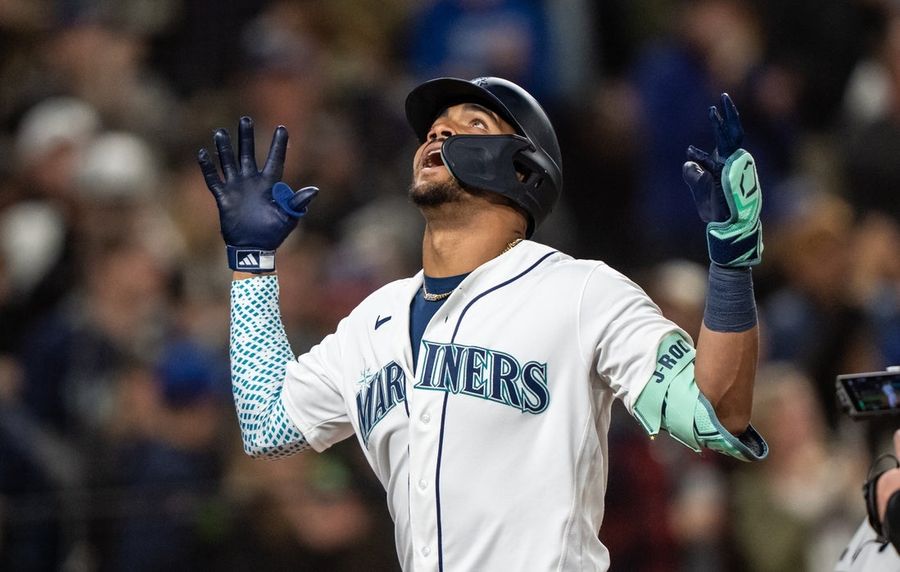
Deadspin | Julio Rodriguez, Mariners rally from 5-run deficit to walk off Astros  Apr 11, 2026; Seattle, Washington, USA; Seattle Mariners centerfielder Julio Rodríguez (44) celebrates after hitting a two-run home run during the fifth inning against the Houston Astros at T-Mobile Park. Mandatory Credit: Stephen Brashear-Imagn Images   J.P. Crawford’s walk-off single with one out and the bases loaded in the ninth inning capped the Seattle Mariners’ rally from a five-run deficit in an 8-7 victory against the visiting Houston Astros on Saturday night.  Julio Rodriguez doubled and homered, his first two extra-base hits of the season, and Cal Raleigh also went deep for the Mariners and drove in three runs.  Astros reliever Bryan Abreu (0-2) struck out Luke Raley leading off the ninth, then walked the bases loaded. Crawford, who went 2-for-3 with three RBIs, lined a 0-2 fastball to left field to plate the decisive run.  Mariners closer Andres Munoz (2-1) pitched a scoreless inning for the victory.  The Mariners jumped out to an early lead. Crawford, batting leadoff for a second straight night with Brendan Donovan out with an illness, drew a walk and Raleigh lined the next pitch into the right-field seats. Rodriguez followed by grounding a double down the third-base line.  With one out, Randy Arozarena hit a 102-mph liner back up the middle. Pitcher Lance McCullers Jr. raised his glove in a defensive motion and caught the ball, starting an inning-ending double play.  The Astros took the lead in the second, loading the bases on singles by Jose Altuve and Cam Smith sandwiched around a walk to Joey Loperfido.   Luis Castillo caught Yainer Diaz looking at a called third strike, courtesy of an ABS challenge, for the second out. Former Mariner Taylor Trammell came through with a bases-clearing double off the wall in left-center field in his first at-bat of the season to make it 3-2.  The Astros scored three more runs in the third. Yordan Alvarez led off with a homer to right-center. With two outs, Carlos Correa lined a single to center and Loperfido doubled down the right-field line before Smith capped a 13-pitch at-bat by lining a two-run single to center.   Houston tallied again in the fourth. Trammell and Jeremy Pena led off with singles and, an out later, Isaac Paredes grounded a run-scoring single to left, ending Castillo’s night.  Castillo lasted just 3 1/3 innings, giving up seven runs on 10 hits. The right-hander walked one and fanned three.  McCullers retired 12 consecutive batters starting with his first-inning escape before running into trouble in the fifth.   With one out, Cole Young singled, Dominic Canzone doubled and Leo Rivas walked, loading the bases. Crawford lined a two-run single to center, chasing McCullers.   Reliever Steven Okert got Raleigh to hit a broken-bat liner to left, deep enough for a sacrifice fly. Rodriguez then hammered a 1-2 fastball 426 feet over the wall in straightaway center field, tying the score at 7.  McCullers was charged with six runs on five hits in 4 1/3 innings. The righty walked two and struck out four.  Pena, the Astros’ shortstop, left in the middle of the fourth inning with what the team called right posterior knee tightness. He was replaced by Nick Allen.  –Field Level Media   #Deadspin #Julio #Rodriguez #Mariners #rally #5run #deficit #walk #Astros

Deadspin | Julio Rodriguez, Mariners rally from 5-run deficit to walk off Astros
Deadspin | Julio Rodriguez, Mariners rally from 5-run deficit to walk off Astros  Apr 11, 2026; Seattle, Washington, USA; Seattle Mariners centerfielder Julio Rodríguez (44) celebrates after hitting a two-run home run during the fifth inning against the Houston Astros at T-Mobile Park. Mandatory Credit: Stephen Brashear-Imagn Images   J.P. Crawford’s walk-off single with one out and the bases loaded in the ninth inning capped the Seattle Mariners’ rally from a five-run deficit in an 8-7 victory against the visiting Houston Astros on Saturday night.  Julio Rodriguez doubled and homered, his first two extra-base hits of the season, and Cal Raleigh also went deep for the Mariners and drove in three runs.  Astros reliever Bryan Abreu (0-2) struck out Luke Raley leading off the ninth, then walked the bases loaded. Crawford, who went 2-for-3 with three RBIs, lined a 0-2 fastball to left field to plate the decisive run.  Mariners closer Andres Munoz (2-1) pitched a scoreless inning for the victory.  The Mariners jumped out to an early lead. Crawford, batting leadoff for a second straight night with Brendan Donovan out with an illness, drew a walk and Raleigh lined the next pitch into the right-field seats. Rodriguez followed by grounding a double down the third-base line.  With one out, Randy Arozarena hit a 102-mph liner back up the middle. Pitcher Lance McCullers Jr. raised his glove in a defensive motion and caught the ball, starting an inning-ending double play.  The Astros took the lead in the second, loading the bases on singles by Jose Altuve and Cam Smith sandwiched around a walk to Joey Loperfido.   Luis Castillo caught Yainer Diaz looking at a called third strike, courtesy of an ABS challenge, for the second out. Former Mariner Taylor Trammell came through with a bases-clearing double off the wall in left-center field in his first at-bat of the season to make it 3-2.  The Astros scored three more runs in the third. Yordan Alvarez led off with a homer to right-center. With two outs, Carlos Correa lined a single to center and Loperfido doubled down the right-field line before Smith capped a 13-pitch at-bat by lining a two-run single to center.   Houston tallied again in the fourth. Trammell and Jeremy Pena led off with singles and, an out later, Isaac Paredes grounded a run-scoring single to left, ending Castillo’s night.  Castillo lasted just 3 1/3 innings, giving up seven runs on 10 hits. The right-hander walked one and fanned three.  McCullers retired 12 consecutive batters starting with his first-inning escape before running into trouble in the fifth.   With one out, Cole Young singled, Dominic Canzone doubled and Leo Rivas walked, loading the bases. Crawford lined a two-run single to center, chasing McCullers.   Reliever Steven Okert got Raleigh to hit a broken-bat liner to left, deep enough for a sacrifice fly. Rodriguez then hammered a 1-2 fastball 426 feet over the wall in straightaway center field, tying the score at 7.  McCullers was charged with six runs on five hits in 4 1/3 innings. The righty walked two and struck out four.  Pena, the Astros’ shortstop, left in the middle of the fourth inning with what the team called right posterior knee tightness. He was replaced by Nick Allen.  –Field Level Media   #Deadspin #Julio #Rodriguez #Mariners #rally #5run #deficit #walk #AstrosApr 11, 2026; Seattle, Washington, USA; Seattle Mariners centerfielder Julio Rodríguez (44) celebrates after hitting a two-run home run during the fifth inning against the Houston Astros at T-Mobile Park. Mandatory Credit: Stephen Brashear-Imagn Images

J.P. Crawford’s walk-off single with one out and the bases loaded in the ninth inning capped the Seattle Mariners’ rally from a five-run deficit in an 8-7 victory against the visiting Houston Astros on Saturday night.

Julio Rodriguez doubled and homered, his first two extra-base hits of the season, and Cal Raleigh also went deep for the Mariners and drove in three runs.

Astros reliever Bryan Abreu (0-2) struck out Luke Raley leading off the ninth, then walked the bases loaded. Crawford, who went 2-for-3 with three RBIs, lined a 0-2 fastball to left field to plate the decisive run.

Mariners closer Andres Munoz (2-1) pitched a scoreless inning for the victory.

The Mariners jumped out to an early lead. Crawford, batting leadoff for a second straight night with Brendan Donovan out with an illness, drew a walk and Raleigh lined the next pitch into the right-field seats. Rodriguez followed by grounding a double down the third-base line.

With one out, Randy Arozarena hit a 102-mph liner back up the middle. Pitcher Lance McCullers Jr. raised his glove in a defensive motion and caught the ball, starting an inning-ending double play.

The Astros took the lead in the second, loading the bases on singles by Jose Altuve and Cam Smith sandwiched around a walk to Joey Loperfido.

Luis Castillo caught Yainer Diaz looking at a called third strike, courtesy of an ABS challenge, for the second out. Former Mariner Taylor Trammell came through with a bases-clearing double off the wall in left-center field in his first at-bat of the season to make it 3-2.


The Astros scored three more runs in the third. Yordan Alvarez led off with a homer to right-center. With two outs, Carlos Correa lined a single to center and Loperfido doubled down the right-field line before Smith capped a 13-pitch at-bat by lining a two-run single to center.

Houston tallied again in the fourth. Trammell and Jeremy Pena led off with singles and, an out later, Isaac Paredes grounded a run-scoring single to left, ending Castillo’s night.

Castillo lasted just 3 1/3 innings, giving up seven runs on 10 hits. The right-hander walked one and fanned three.

McCullers retired 12 consecutive batters starting with his first-inning escape before running into trouble in the fifth.

With one out, Cole Young singled, Dominic Canzone doubled and Leo Rivas walked, loading the bases. Crawford lined a two-run single to center, chasing McCullers.

Reliever Steven Okert got Raleigh to hit a broken-bat liner to left, deep enough for a sacrifice fly. Rodriguez then hammered a 1-2 fastball 426 feet over the wall in straightaway center field, tying the score at 7.

McCullers was charged with six runs on five hits in 4 1/3 innings. The righty walked two and struck out four.

Pena, the Astros’ shortstop, left in the middle of the fourth inning with what the team called right posterior knee tightness. He was replaced by Nick Allen.

–Field Level Media

#Deadspin #Julio #Rodriguez #Mariners #rally #5run #deficit #walk #Astros

Apr 11, 2026; Seattle, Washington, USA; Seattle Mariners centerfielder Julio Rodríguez (44) celebrates after hitting a two-run home run during the fifth inning against the Houston Astros at T-Mobile Park. Mandatory Credit: Stephen Brashear-Imagn Images

J.P. Crawford’s walk-off single with one out and the bases loaded in the ninth inning capped the Seattle Mariners’ rally from a five-run deficit in an 8-7 victory against the visiting Houston Astros on Saturday night.

Julio Rodriguez doubled and homered, his first two extra-base hits of the season, and Cal Raleigh also went deep for the Mariners and drove in three runs.

Astros reliever Bryan Abreu (0-2) struck out Luke Raley leading off the ninth, then walked the bases loaded. Crawford, who went 2-for-3 with three RBIs, lined a 0-2 fastball to left field to plate the decisive run.

Mariners closer Andres Munoz (2-1) pitched a scoreless inning for the victory.

The Mariners jumped out to an early lead. Crawford, batting leadoff for a second straight night with Brendan Donovan out with an illness, drew a walk and Raleigh lined the next pitch into the right-field seats. Rodriguez followed by grounding a double down the third-base line.

With one out, Randy Arozarena hit a 102-mph liner back up the middle. Pitcher Lance McCullers Jr. raised his glove in a defensive motion and caught the ball, starting an inning-ending double play.

The Astros took the lead in the second, loading the bases on singles by Jose Altuve and Cam Smith sandwiched around a walk to Joey Loperfido.

Luis Castillo caught Yainer Diaz looking at a called third strike, courtesy of an ABS challenge, for the second out. Former Mariner Taylor Trammell came through with a bases-clearing double off the wall in left-center field in his first at-bat of the season to make it 3-2.

The Astros scored three more runs in the third. Yordan Alvarez led off with a homer to right-center. With two outs, Carlos Correa lined a single to center and Loperfido doubled down the right-field line before Smith capped a 13-pitch at-bat by lining a two-run single to center.

Houston tallied again in the fourth. Trammell and Jeremy Pena led off with singles and, an out later, Isaac Paredes grounded a run-scoring single to left, ending Castillo’s night.

Castillo lasted just 3 1/3 innings, giving up seven runs on 10 hits. The right-hander walked one and fanned three.

McCullers retired 12 consecutive batters starting with his first-inning escape before running into trouble in the fifth.

With one out, Cole Young singled, Dominic Canzone doubled and Leo Rivas walked, loading the bases. Crawford lined a two-run single to center, chasing McCullers.

Reliever Steven Okert got Raleigh to hit a broken-bat liner to left, deep enough for a sacrifice fly. Rodriguez then hammered a 1-2 fastball 426 feet over the wall in straightaway center field, tying the score at 7.

McCullers was charged with six runs on five hits in 4 1/3 innings. The righty walked two and struck out four.

Pena, the Astros’ shortstop, left in the middle of the fourth inning with what the team called right posterior knee tightness. He was replaced by Nick Allen.

–Field Level Media

Source link
#Deadspin #Julio #Rodriguez #Mariners #rally #5run #deficit #walk #Astros

Texas Tech quarterback Brendan Sorsby has won a temporary injunction in his fight with the NCAA, and under the terms of the order issued by Judge Ken Curry in the District Court of Texas for Lubbock County, he is eligible to play for the Red Raiders during the 2026 season. Sorsby sought the injunction after the NCAA stripped the quarterback of his remaining collegiate eligibility due to multiple violations of the governing body’s gambling policy.

However, there are some caveats to that statement. Several, in fact.

The decision comes in the wake of a hearing held in the District Court of Texas for Lubbock County at the start of June. As outlined in Judge Curry’s four-page order, finding that Sorsby would suffer “a probable, imminent, and irreparable injury” if his eligibility was not reinstated, Judge Curry held that Sorsby “demonstrated a probable right to the relief he seeks on his claims for breach of contract, declaratory judgment, breach of duty of good faith and fair dealing, and breach of fiduciary duty.”

Judge Curry further ruled that Sorsby “demonstrated that the balance of equities is in his favor because of the hardship he would face in the absence of a temporary injunction.”

In the ruling, Judge Curry declared that the NCAA is barred from:

  1. Prohibiting [Sorsby] from practicing, playing, or otherwise participating on Texas Tech’s football team for the 2026 football season.
  2. Enforcing its Bylaw 12.9.4.2 (Rule of Restitution) against [Sorsby], Texas Tech, any affiliate of Texas Tech, any university that competes against Texas Tech during the 2026 college football season, or any affiliate of any such university for complying with, and relying on this Order.

First, Sorsby — through his attorneys — sought a temporary injunction, which Judge Curry granted. As Judge Curry noted in the order, the temporary injunction will be in place until the final judgment in this matter, and “until a full trial on the merits of this matter” is conducted.

Second, Judge Curry imposed six conditions that Sorsby is required to meet during the period of time the temporary injunction is in place. These include: (1) Commencing and continuing clinical counseling with a credentialed provider, focusing on relapse prevention, (2) Commencing and participating in peer support through Gamblers Anonymous or a comparable aid community, (3) Commencing and continuing treatment for Adjustment Disorder with Anxiety, to address the “underlying anxiety that served as the primary driver of [Sorsby’s] gambling behavior,” (4) Commencing and participating in athlete-specific recovery resources, (5) Not participating in game-day activities for the first two games of the Texas Tech season, and (6) Serving on the NCAA a report detailing compliance with the five previous conditions, on or before the fifth of each month during the order, to cover the previous month of compliance.

Failure of Sorsby to comply with those conditions would allow the NCAA to “apply for emergency relief from this injunction.”

The NCAA does have the right to appeal this ruling (more on that in a moment), but for now, Sorsby is reinstated, with a two-game suspension. That would mean the transfer quarterback would miss the season opener against Abilene Christian, and the game against Oregon State on September 12.

In response to Judge Curry’s order, the NCAA released this brief statement:

“The NCAA strongly disagrees with the court’s ruling in Sorsby’s case and is deeply concerned about the damaging, far-reaching and broadly destabilizing ramifications of this outcome — which undermines and corrupts the integrity of sports. The NCAA is committed to supporting student-athlete mental health but must continue to aggressively defend against actions that defraud college athletics and threaten competitive integrity, such as betting on one’s own sport.”

As to whether the NCAA would appeal this temporary injunction, it is worth noting that the governing body would face a significant hurdle with such an appeal. Specifically, the standard of review from the appellate court. In 1919 the Texas Legislature codified the right to an appeal of a temporary injunction, declaring that a party “may appeal from an interlocutory order of a district court, county court at law, statutory probate court, or county court that … grants or refuses a temporary injunction or grants or overrules a motion to dissolve a temporary injunction.” See Texas Civil Practices and Remedies Code Section 51.014(a)(4).

So while the NCAA has the right to an appeal, the problem they will face is the standard of review. Appeals of these decisions are reviewed on one standard: Abuse of discretion. Judges in temporary injunction cases are given substantial deference in deciding those matters, and to overturn the order in this case, the NCAA must convince the appellate court that Judge Curry abused that discretion, and that the ruling was arbitrary, capricious, or failed to apply the law correctly in reaching the decision.

Texas courts have defined this standard as follows: A trial court abuses its discretion if its decision is “arbitrary, unreasonable, and without reference to [any] guiding [rules and] principles” or is “so arbitrary and unreasonable as to amount to a clear and prejudicial error of law.” See Mercedes-Benz Credit Corp. v. Rhyne, 925 S.W. 2d 664 (Texas 1996) and Walker v. Packer, 827 S.W.2d 833 (Texas 1992).

To find such an abuse, the reviewing court must “determine that the facts and circumstances presented [to the trial judge] ‘extinguish any discretion [or choice] in the matter.’” See F.A. Richard & Assoc. v. Millard, 856 S.W.3d 419 (Texas App. 1993). The appellate court cannot simply substitute its own judgment for that of the trial court.

When reviewing such a case, the appellate court asks two questions: Did the trial court have sufficient information to exercise such discretion, and did the trial court err in the application of that discretion?

Simply put, an appeal by the NCAA of this ruling, given the great deference appellate courts show trial courts in these matters, seems unlikely to succeed.

Still, the ruling has many wondering if the NCAA should still appeal, even given the difficult standard the governing body would face with such an appeal:

Plus, there is the matter of precedent. If the NCAA ultimately loses on this matter, it would essentially become the “first and only American sports league to allow an athlete to compete after betting on his own games,” a point the NCAA argued in front of Judge Curry.

Sorsby admitted to placing wagers of at least $90,000 on more than 9,000 bets during his time in college, including 40 bets of at least $850 on Indiana football while he was a member of the Hoosiers. Under NCAA rules, the penalty for a player gambling on their own team is permanent ineligibility.

The NCAA could appeal and argue that the fact Sorsby admitted to those bets, in clear violation of stated NCAA rules, and yet has been reinstated under Judge Curry’s order amounts to a decision that is “legally unreasonable in the factual-legal context in which it [was] made.” See Landon v. Jean-Paul Budinger, Inc., 724 S.W.2d 931. That language has been held in Texas to overturn a trial court’s decision under the abuse of discretion standard.

Given the precedent set by this decision, the NCAA likely appeals.

But whether they succeeded on that appeal is a different story.

And while the underlying case will ultimately go to trial, that might not occur until after the 2026 season is completed.

So, for now at least, Sorsby is back on the Red Raiders for the upcoming season.

#NCAA #appeal #Brendan #Sorsbys #shocking #reinstatement #Texas #law #isnt #side">The NCAA can appeal Brendan Sorsby’s shocking reinstatement, but Texas law isn’t on their side  Texas Tech quarterback Brendan Sorsby has won a temporary injunction in his fight with the NCAA, and under the terms of the order issued by Judge Ken Curry in the District Court of Texas for Lubbock County, he is eligible to play for the Red Raiders during the 2026 season. Sorsby sought the injunction after the NCAA stripped the quarterback of his remaining collegiate eligibility due to multiple violations of the governing body’s gambling policy.However, there are some caveats to that statement. Several, in fact.The decision comes in the wake of a hearing held in the District Court of Texas for Lubbock County at the start of June. As outlined in Judge Curry’s four-page order, finding that Sorsby would suffer “a probable, imminent, and irreparable injury” if his eligibility was not reinstated, Judge Curry held that Sorsby “demonstrated a probable right to the relief he seeks on his claims for breach of contract, declaratory judgment, breach of duty of good faith and fair dealing, and breach of fiduciary duty.”Judge Curry further ruled that Sorsby “demonstrated that the balance of equities is in his favor because of the hardship he would face in the absence of a temporary injunction.”In the ruling, Judge Curry declared that the NCAA is barred from:Prohibiting [Sorsby] from practicing, playing, or otherwise participating on Texas Tech’s football team for the 2026 football season.Enforcing its Bylaw 12.9.4.2 (Rule of Restitution) against [Sorsby], Texas Tech, any affiliate of Texas Tech, any university that competes against Texas Tech during the 2026 college football season, or any affiliate of any such university for complying with, and relying on this Order.First, Sorsby — through his attorneys — sought a temporary injunction, which Judge Curry granted. As Judge Curry noted in the order, the temporary injunction will be in place until the final judgment in this matter, and “until a full trial on the merits of this matter” is conducted.Second, Judge Curry imposed six conditions that Sorsby is required to meet during the period of time the temporary injunction is in place. These include: (1) Commencing and continuing clinical counseling with a credentialed provider, focusing on relapse prevention, (2) Commencing and participating in peer support through Gamblers Anonymous or a comparable aid community, (3) Commencing and continuing treatment for Adjustment Disorder with Anxiety, to address the “underlying anxiety that served as the primary driver of [Sorsby’s] gambling behavior,” (4) Commencing and participating in athlete-specific recovery resources, (5) Not participating in game-day activities for the first two games of the Texas Tech season, and (6) Serving on the NCAA a report detailing compliance with the five previous conditions, on or before the fifth of each month during the order, to cover the previous month of compliance.Failure of Sorsby to comply with those conditions would allow the NCAA to “apply for emergency relief from this injunction.”The NCAA does have the right to appeal this ruling (more on that in a moment), but for now, Sorsby is reinstated, with a two-game suspension. That would mean the transfer quarterback would miss the season opener against Abilene Christian, and the game against Oregon State on September 12.In response to Judge Curry’s order, the NCAA released this brief statement:“The NCAA strongly disagrees with the court’s ruling in Sorsby’s case and is deeply concerned about the damaging, far-reaching and broadly destabilizing ramifications of this outcome — which undermines and corrupts the integrity of sports. The NCAA is committed to supporting student-athlete mental health but must continue to aggressively defend against actions that defraud college athletics and threaten competitive integrity, such as betting on one’s own sport.”As to whether the NCAA would appeal this temporary injunction, it is worth noting that the governing body would face a significant hurdle with such an appeal. Specifically, the standard of review from the appellate court. In 1919 the Texas Legislature codified the right to an appeal of a temporary injunction, declaring that a party “may appeal from an interlocutory order of a district court, county court at law, statutory probate court, or county court that … grants or refuses a temporary injunction or grants or overrules a motion to dissolve a temporary injunction.” See Texas Civil Practices and Remedies Code Section 51.014(a)(4).So while the NCAA has the right to an appeal, the problem they will face is the standard of review. Appeals of these decisions are reviewed on one standard: Abuse of discretion. Judges in temporary injunction cases are given substantial deference in deciding those matters, and to overturn the order in this case, the NCAA must convince the appellate court that Judge Curry abused that discretion, and that the ruling was arbitrary, capricious, or failed to apply the law correctly in reaching the decision.Texas courts have defined this standard as follows: A trial court abuses its discretion if its decision is “arbitrary, unreasonable, and without reference to [any] guiding [rules and] principles” or is “so arbitrary and unreasonable as to amount to a clear and prejudicial error of law.” See Mercedes-Benz Credit Corp. v. Rhyne, 925 S.W. 2d 664 (Texas 1996) and Walker v. Packer, 827 S.W.2d 833 (Texas 1992).To find such an abuse, the reviewing court must “determine that the facts and circumstances presented [to the trial judge] ‘extinguish any discretion [or choice] in the matter.’” See F.A. Richard & Assoc. v. Millard, 856 S.W.3d 419 (Texas App. 1993). The appellate court cannot simply substitute its own judgment for that of the trial court.When reviewing such a case, the appellate court asks two questions: Did the trial court have sufficient information to exercise such discretion, and did the trial court err in the application of that discretion?Simply put, an appeal by the NCAA of this ruling, given the great deference appellate courts show trial courts in these matters, seems unlikely to succeed.Still, the ruling has many wondering if the NCAA should still appeal, even given the difficult standard the governing body would face with such an appeal:Plus, there is the matter of precedent. If the NCAA ultimately loses on this matter, it would essentially become the “first and only American sports league to allow an athlete to compete after betting on his own games,” a point the NCAA argued in front of Judge Curry.Sorsby admitted to placing wagers of at least $90,000 on more than 9,000 bets during his time in college, including 40 bets of at least $850 on Indiana football while he was a member of the Hoosiers. Under NCAA rules, the penalty for a player gambling on their own team is permanent ineligibility.The NCAA could appeal and argue that the fact Sorsby admitted to those bets, in clear violation of stated NCAA rules, and yet has been reinstated under Judge Curry’s order amounts to a decision that is “legally unreasonable in the factual-legal context in which it [was] made.” See Landon v. Jean-Paul Budinger, Inc., 724 S.W.2d 931. That language has been held in Texas to overturn a trial court’s decision under the abuse of discretion standard.Given the precedent set by this decision, the NCAA likely appeals.But whether they succeeded on that appeal is a different story.And while the underlying case will ultimately go to trial, that might not occur until after the 2026 season is completed.So, for now at least, Sorsby is back on the Red Raiders for the upcoming season.  #NCAA #appeal #Brendan #Sorsbys #shocking #reinstatement #Texas #law #isnt #side

Brendan Sorsby has won a temporary injunction in his fight with the NCAA, and under the terms of the order issued by Judge Ken Curry in the District Court of Texas for Lubbock County, he is eligible to play for the Red Raiders during the 2026 season. Sorsby sought the injunction after the NCAA stripped the quarterback of his remaining collegiate eligibility due to multiple violations of the governing body’s gambling policy.

However, there are some caveats to that statement. Several, in fact.

The decision comes in the wake of a hearing held in the District Court of Texas for Lubbock County at the start of June. As outlined in Judge Curry’s four-page order, finding that Sorsby would suffer “a probable, imminent, and irreparable injury” if his eligibility was not reinstated, Judge Curry held that Sorsby “demonstrated a probable right to the relief he seeks on his claims for breach of contract, declaratory judgment, breach of duty of good faith and fair dealing, and breach of fiduciary duty.”

Judge Curry further ruled that Sorsby “demonstrated that the balance of equities is in his favor because of the hardship he would face in the absence of a temporary injunction.”

In the ruling, Judge Curry declared that the NCAA is barred from:

  1. Prohibiting [Sorsby] from practicing, playing, or otherwise participating on Texas Tech’s football team for the 2026 football season.
  2. Enforcing its Bylaw 12.9.4.2 (Rule of Restitution) against [Sorsby], Texas Tech, any affiliate of Texas Tech, any university that competes against Texas Tech during the 2026 college football season, or any affiliate of any such university for complying with, and relying on this Order.

First, Sorsby — through his attorneys — sought a temporary injunction, which Judge Curry granted. As Judge Curry noted in the order, the temporary injunction will be in place until the final judgment in this matter, and “until a full trial on the merits of this matter” is conducted.

Second, Judge Curry imposed six conditions that Sorsby is required to meet during the period of time the temporary injunction is in place. These include: (1) Commencing and continuing clinical counseling with a credentialed provider, focusing on relapse prevention, (2) Commencing and participating in peer support through Gamblers Anonymous or a comparable aid community, (3) Commencing and continuing treatment for Adjustment Disorder with Anxiety, to address the “underlying anxiety that served as the primary driver of [Sorsby’s] gambling behavior,” (4) Commencing and participating in athlete-specific recovery resources, (5) Not participating in game-day activities for the first two games of the Texas Tech season, and (6) Serving on the NCAA a report detailing compliance with the five previous conditions, on or before the fifth of each month during the order, to cover the previous month of compliance.

Failure of Sorsby to comply with those conditions would allow the NCAA to “apply for emergency relief from this injunction.”

The NCAA does have the right to appeal this ruling (more on that in a moment), but for now, Sorsby is reinstated, with a two-game suspension. That would mean the transfer quarterback would miss the season opener against Abilene Christian, and the game against Oregon State on September 12.

In response to Judge Curry’s order, the NCAA released this brief statement:

“The NCAA strongly disagrees with the court’s ruling in Sorsby’s case and is deeply concerned about the damaging, far-reaching and broadly destabilizing ramifications of this outcome — which undermines and corrupts the integrity of sports. The NCAA is committed to supporting student-athlete mental health but must continue to aggressively defend against actions that defraud college athletics and threaten competitive integrity, such as betting on one’s own sport.”

As to whether the NCAA would appeal this temporary injunction, it is worth noting that the governing body would face a significant hurdle with such an appeal. Specifically, the standard of review from the appellate court. In 1919 the Texas Legislature codified the right to an appeal of a temporary injunction, declaring that a party “may appeal from an interlocutory order of a district court, county court at law, statutory probate court, or county court that … grants or refuses a temporary injunction or grants or overrules a motion to dissolve a temporary injunction.” See Texas Civil Practices and Remedies Code Section 51.014(a)(4).

So while the NCAA has the right to an appeal, the problem they will face is the standard of review. Appeals of these decisions are reviewed on one standard: Abuse of discretion. Judges in temporary injunction cases are given substantial deference in deciding those matters, and to overturn the order in this case, the NCAA must convince the appellate court that Judge Curry abused that discretion, and that the ruling was arbitrary, capricious, or failed to apply the law correctly in reaching the decision.

Texas courts have defined this standard as follows: A trial court abuses its discretion if its decision is “arbitrary, unreasonable, and without reference to [any] guiding [rules and] principles” or is “so arbitrary and unreasonable as to amount to a clear and prejudicial error of law.” See Mercedes-Benz Credit Corp. v. Rhyne, 925 S.W. 2d 664 (Texas 1996) and Walker v. Packer, 827 S.W.2d 833 (Texas 1992).

To find such an abuse, the reviewing court must “determine that the facts and circumstances presented [to the trial judge] ‘extinguish any discretion [or choice] in the matter.’” See F.A. Richard & Assoc. v. Millard, 856 S.W.3d 419 (Texas App. 1993). The appellate court cannot simply substitute its own judgment for that of the trial court.

When reviewing such a case, the appellate court asks two questions: Did the trial court have sufficient information to exercise such discretion, and did the trial court err in the application of that discretion?

Simply put, an appeal by the NCAA of this ruling, given the great deference appellate courts show trial courts in these matters, seems unlikely to succeed.

Still, the ruling has many wondering if the NCAA should still appeal, even given the difficult standard the governing body would face with such an appeal:

Plus, there is the matter of precedent. If the NCAA ultimately loses on this matter, it would essentially become the “first and only American sports league to allow an athlete to compete after betting on his own games,” a point the NCAA argued in front of Judge Curry.

Sorsby admitted to placing wagers of at least $90,000 on more than 9,000 bets during his time in college, including 40 bets of at least $850 on Indiana football while he was a member of the Hoosiers. Under NCAA rules, the penalty for a player gambling on their own team is permanent ineligibility.

The NCAA could appeal and argue that the fact Sorsby admitted to those bets, in clear violation of stated NCAA rules, and yet has been reinstated under Judge Curry’s order amounts to a decision that is “legally unreasonable in the factual-legal context in which it [was] made.” See Landon v. Jean-Paul Budinger, Inc., 724 S.W.2d 931. That language has been held in Texas to overturn a trial court’s decision under the abuse of discretion standard.

Given the precedent set by this decision, the NCAA likely appeals.

But whether they succeeded on that appeal is a different story.

And while the underlying case will ultimately go to trial, that might not occur until after the 2026 season is completed.

So, for now at least, Sorsby is back on the Red Raiders for the upcoming season.

#NCAA #appeal #Brendan #Sorsbys #shocking #reinstatement #Texas #law #isnt #side">The NCAA can appeal Brendan Sorsby’s shocking reinstatement, but Texas law isn’t on their side

Texas Tech quarterback Brendan Sorsby has won a temporary injunction in his fight with the NCAA, and under the terms of the order issued by Judge Ken Curry in the District Court of Texas for Lubbock County, he is eligible to play for the Red Raiders during the 2026 season. Sorsby sought the injunction after the NCAA stripped the quarterback of his remaining collegiate eligibility due to multiple violations of the governing body’s gambling policy.

However, there are some caveats to that statement. Several, in fact.

The decision comes in the wake of a hearing held in the District Court of Texas for Lubbock County at the start of June. As outlined in Judge Curry’s four-page order, finding that Sorsby would suffer “a probable, imminent, and irreparable injury” if his eligibility was not reinstated, Judge Curry held that Sorsby “demonstrated a probable right to the relief he seeks on his claims for breach of contract, declaratory judgment, breach of duty of good faith and fair dealing, and breach of fiduciary duty.”

Judge Curry further ruled that Sorsby “demonstrated that the balance of equities is in his favor because of the hardship he would face in the absence of a temporary injunction.”

In the ruling, Judge Curry declared that the NCAA is barred from:

  1. Prohibiting [Sorsby] from practicing, playing, or otherwise participating on Texas Tech’s football team for the 2026 football season.
  2. Enforcing its Bylaw 12.9.4.2 (Rule of Restitution) against [Sorsby], Texas Tech, any affiliate of Texas Tech, any university that competes against Texas Tech during the 2026 college football season, or any affiliate of any such university for complying with, and relying on this Order.

First, Sorsby — through his attorneys — sought a temporary injunction, which Judge Curry granted. As Judge Curry noted in the order, the temporary injunction will be in place until the final judgment in this matter, and “until a full trial on the merits of this matter” is conducted.

Second, Judge Curry imposed six conditions that Sorsby is required to meet during the period of time the temporary injunction is in place. These include: (1) Commencing and continuing clinical counseling with a credentialed provider, focusing on relapse prevention, (2) Commencing and participating in peer support through Gamblers Anonymous or a comparable aid community, (3) Commencing and continuing treatment for Adjustment Disorder with Anxiety, to address the “underlying anxiety that served as the primary driver of [Sorsby’s] gambling behavior,” (4) Commencing and participating in athlete-specific recovery resources, (5) Not participating in game-day activities for the first two games of the Texas Tech season, and (6) Serving on the NCAA a report detailing compliance with the five previous conditions, on or before the fifth of each month during the order, to cover the previous month of compliance.

Failure of Sorsby to comply with those conditions would allow the NCAA to “apply for emergency relief from this injunction.”

The NCAA does have the right to appeal this ruling (more on that in a moment), but for now, Sorsby is reinstated, with a two-game suspension. That would mean the transfer quarterback would miss the season opener against Abilene Christian, and the game against Oregon State on September 12.

In response to Judge Curry’s order, the NCAA released this brief statement:

“The NCAA strongly disagrees with the court’s ruling in Sorsby’s case and is deeply concerned about the damaging, far-reaching and broadly destabilizing ramifications of this outcome — which undermines and corrupts the integrity of sports. The NCAA is committed to supporting student-athlete mental health but must continue to aggressively defend against actions that defraud college athletics and threaten competitive integrity, such as betting on one’s own sport.”

As to whether the NCAA would appeal this temporary injunction, it is worth noting that the governing body would face a significant hurdle with such an appeal. Specifically, the standard of review from the appellate court. In 1919 the Texas Legislature codified the right to an appeal of a temporary injunction, declaring that a party “may appeal from an interlocutory order of a district court, county court at law, statutory probate court, or county court that … grants or refuses a temporary injunction or grants or overrules a motion to dissolve a temporary injunction.” See Texas Civil Practices and Remedies Code Section 51.014(a)(4).

So while the NCAA has the right to an appeal, the problem they will face is the standard of review. Appeals of these decisions are reviewed on one standard: Abuse of discretion. Judges in temporary injunction cases are given substantial deference in deciding those matters, and to overturn the order in this case, the NCAA must convince the appellate court that Judge Curry abused that discretion, and that the ruling was arbitrary, capricious, or failed to apply the law correctly in reaching the decision.

Texas courts have defined this standard as follows: A trial court abuses its discretion if its decision is “arbitrary, unreasonable, and without reference to [any] guiding [rules and] principles” or is “so arbitrary and unreasonable as to amount to a clear and prejudicial error of law.” See Mercedes-Benz Credit Corp. v. Rhyne, 925 S.W. 2d 664 (Texas 1996) and Walker v. Packer, 827 S.W.2d 833 (Texas 1992).

To find such an abuse, the reviewing court must “determine that the facts and circumstances presented [to the trial judge] ‘extinguish any discretion [or choice] in the matter.’” See F.A. Richard & Assoc. v. Millard, 856 S.W.3d 419 (Texas App. 1993). The appellate court cannot simply substitute its own judgment for that of the trial court.

When reviewing such a case, the appellate court asks two questions: Did the trial court have sufficient information to exercise such discretion, and did the trial court err in the application of that discretion?

Simply put, an appeal by the NCAA of this ruling, given the great deference appellate courts show trial courts in these matters, seems unlikely to succeed.

Still, the ruling has many wondering if the NCAA should still appeal, even given the difficult standard the governing body would face with such an appeal:

Plus, there is the matter of precedent. If the NCAA ultimately loses on this matter, it would essentially become the “first and only American sports league to allow an athlete to compete after betting on his own games,” a point the NCAA argued in front of Judge Curry.

Sorsby admitted to placing wagers of at least $90,000 on more than 9,000 bets during his time in college, including 40 bets of at least $850 on Indiana football while he was a member of the Hoosiers. Under NCAA rules, the penalty for a player gambling on their own team is permanent ineligibility.

The NCAA could appeal and argue that the fact Sorsby admitted to those bets, in clear violation of stated NCAA rules, and yet has been reinstated under Judge Curry’s order amounts to a decision that is “legally unreasonable in the factual-legal context in which it [was] made.” See Landon v. Jean-Paul Budinger, Inc., 724 S.W.2d 931. That language has been held in Texas to overturn a trial court’s decision under the abuse of discretion standard.

Given the precedent set by this decision, the NCAA likely appeals.

But whether they succeeded on that appeal is a different story.

And while the underlying case will ultimately go to trial, that might not occur until after the 2026 season is completed.

So, for now at least, Sorsby is back on the Red Raiders for the upcoming season.

#NCAA #appeal #Brendan #Sorsbys #shocking #reinstatement #Texas #law #isnt #side

Fiorentina has appointed former Italy defender Fabio Grosso ​as manager, the Serie A club ‌said on Monday, with the ​48-year-old signing a ⁠two-year contract.

Grosso, who scored the winning penalty for Italy in the shootout ‌win over France at the 2006 World Cup final, ‌began his managerial career ‌in ⁠Serie B with Bari and ⁠Hellas Verona before taking charge of Brescia, Sion, Frosinone and Olympique Lyonnais.

His ​last role came ‌at Sassuolo, where he won promotion in his first campaign, and after guiding it to ‌mid-table safety in Serie A ​last season, Grosso left the club by mutual ⁠agreement on Thursday.

ALSO READ | Denmark’s Eriksen in ‘good spirits’ after collapsing during friendly

“I never like to make promises,” Grosso said in ‌a Fiorentina statement, “but aware of the responsibilities that await me, I immediately feel I can guarantee seriousness, professionalism and involvement in building a team ‌that has courage and ambition.”

Fiorentina battled ​relegation in the most recent campaign, with Stefano Pioli ⁠sacked in November after a 10-game ⁠winless start. Paolo Vanoli took over and led it to a 15th-place finish before departing the club on ​Friday.

Published on Jun 08, 2026

#Fiorentina #appoints #World #Cup #winner #Fabio #Grosso #manager">Fiorentina appoints former World Cup winner Fabio Grosso as manager  Fiorentina has appointed former Italy defender Fabio Grosso ​as manager, the Serie A club ‌said on Monday, with the ​48-year-old signing a ⁠two-year contract.Grosso, who scored the winning penalty for Italy in the shootout ‌win over France at the 2006 World Cup final, ‌began his managerial career ‌in ⁠Serie B with Bari and ⁠Hellas Verona before taking charge of Brescia, Sion, Frosinone and Olympique Lyonnais.His ​last role came ‌at Sassuolo, where he won promotion in his first campaign, and after guiding it to ‌mid-table safety in Serie A ​last season, Grosso left the club by mutual ⁠agreement on Thursday.ALSO READ | Denmark’s Eriksen in ‘good spirits’ after collapsing during friendly“I never like to make promises,” Grosso said in ‌a Fiorentina statement, “but aware of the responsibilities that await me, I immediately feel I can guarantee seriousness, professionalism and involvement in building a team ‌that has courage and ambition.”Fiorentina battled ​relegation in the most recent campaign, with Stefano Pioli ⁠sacked in November after a 10-game ⁠winless start. Paolo Vanoli took over and led it to a 15th-place finish before departing the club on ​Friday.Published on Jun 08, 2026  #Fiorentina #appoints #World #Cup #winner #Fabio #Grosso #manager

Denmark’s Eriksen in ‘good spirits’ after collapsing during friendly

“I never like to make promises,” Grosso said in ‌a Fiorentina statement, “but aware of the responsibilities that await me, I immediately feel I can guarantee seriousness, professionalism and involvement in building a team ‌that has courage and ambition.”

Fiorentina battled ​relegation in the most recent campaign, with Stefano Pioli ⁠sacked in November after a 10-game ⁠winless start. Paolo Vanoli took over and led it to a 15th-place finish before departing the club on ​Friday.

Published on Jun 08, 2026

#Fiorentina #appoints #World #Cup #winner #Fabio #Grosso #manager">Fiorentina appoints former World Cup winner Fabio Grosso as manager

Fiorentina has appointed former Italy defender Fabio Grosso ​as manager, the Serie A club ‌said on Monday, with the ​48-year-old signing a ⁠two-year contract.

Grosso, who scored the winning penalty for Italy in the shootout ‌win over France at the 2006 World Cup final, ‌began his managerial career ‌in ⁠Serie B with Bari and ⁠Hellas Verona before taking charge of Brescia, Sion, Frosinone and Olympique Lyonnais.

His ​last role came ‌at Sassuolo, where he won promotion in his first campaign, and after guiding it to ‌mid-table safety in Serie A ​last season, Grosso left the club by mutual ⁠agreement on Thursday.

ALSO READ | Denmark’s Eriksen in ‘good spirits’ after collapsing during friendly

“I never like to make promises,” Grosso said in ‌a Fiorentina statement, “but aware of the responsibilities that await me, I immediately feel I can guarantee seriousness, professionalism and involvement in building a team ‌that has courage and ambition.”

Fiorentina battled ​relegation in the most recent campaign, with Stefano Pioli ⁠sacked in November after a 10-game ⁠winless start. Paolo Vanoli took over and led it to a 15th-place finish before departing the club on ​Friday.

Published on Jun 08, 2026

#Fiorentina #appoints #World #Cup #winner #Fabio #Grosso #manager

Post Comment