×
Deadspin | Kevin Durant takes spotlight as Rockets try to even series with Lakers  Apr 18, 2026; Los Angeles, California, USA; Houston Rockets center Alperen Sengun (28) and forward Kevin Durant (center) watch during the first half against the Los Angeles Lakers during game one of the first round of the 2026 NBA Playoffs at Crypto.com Arena. Mandatory Credit: Kirby Lee-Imagn Images   All eyes will be on the great Kevin Durant when his visiting Houston Rockets seek to square the ledger against the Los Angeles Lakers in Game 2 of their best-of-seven playoff series Tuesday.  Durant was unable to play Saturday’s first-round series opener after accidentally bumping knees with a teammate at practice three days earlier.  The 16-time All-Star attempted to warm up a few hours before tipoff, but he ultimately didn’t feel his right knee was good enough to play.  Durant led Houston with an average of 26 points per game this season and is No. 5 on the NBA’s all-time leading scorers list.  In his absence, the fifth-seeded Rockets struggled offensively in a 107-98 loss to the Lakers in Game 1.  Houston had 27 more shot attempts but misfired badly, connecting at 37.6% from the field, 33.3% from 3-point range and 68% from the free-throw line.  Rockets coach Ime Udoka didn’t hesitate when asked about the qualities that Durant brings to the table, which were sorely lacking Saturday.  “Efficiency and consistent scoring,” Udoka said. “On a nightly basis, he (Durant) shoots at a good, high clip. He doesn’t have too many nights like this (Houston in Game 1), struggling-wise. With all the young guys, he kind of calms you down … Regardless, if he’s back or not, if we’re shooting that poorly, it’s going to be tough to win.”  Alperen Sengun led the Durant-less Rockets with 19 points. Amen Thompson and Reed Sheppard added 17 apiece, and Jabari Smith Jr. and Tari Eason both had 16.   Durant is expected to be fit to take his place as the Rockets endeavor to overcome their 1-0 deficit, but the Lakers showed they are able to adapt whether or not Houston’s main man is on the court.  “I don’t think it (Durant not playing Game 1) affected our mentality,” Los Angeles coach JJ Redick said. “This is all we’ve talked about for two months, is our playoff mentality. You can’t worry about who’s in or out of a line-up. It’s our gameplan, it’s our standard, it’s how we play and we’ve built towards that.”  That standard saw the Lakers shoot a sizzling 60.6% from the floor, including 52.6% from deep. The star was Luke Kennard, who produced a playoff career-high 27 points and went 5-of-5 from three.  Thompson admits the Rockets should have been more dialed in on Kennard, a key reserve and the NBA’s most accurate 3-point shooter, who the Lakers acquired from the Atlanta Hawks in February.  “Just respect other players,” Thompson said when asked where his team can improve. “I knew what Kennard could do. But I’ve got to be more locked in for it — locked in for that match-up.”  LeBron James posted 19 points and 13 assists, while Deandre Ayton paired 19 points with 11 boards for Los Angeles.  The Lakers are without their two leading scorers — Luka Doncic (left hamstring strain) and Austin Reaves (left oblique strain) — which means greater production is required from more sources.  “We don’t have a choice,” said James, who is participating in his 19th postseason. “It has to be that way — it has to be the collective group. When you’re missing so much firepower like we are right now with AR and Luka being out, we all have to pitch in. We all have to do our job, and even do a little bit more.”  –Field Level Media    #Deadspin #Kevin #Durant #takes #spotlight #Rockets #series #Lakers
Deadspin | Kevin Durant takes spotlight as Rockets try to even series with Lakers
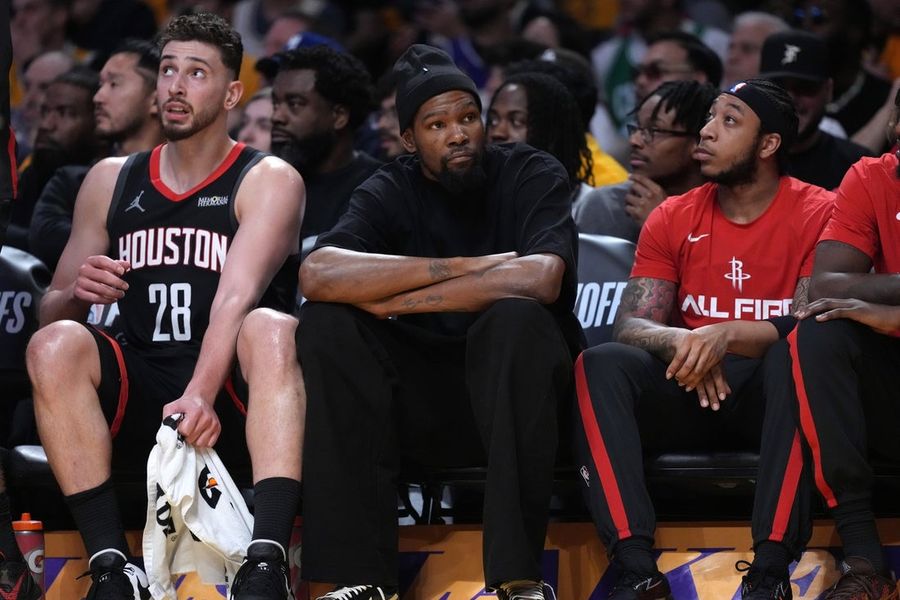
Deadspin | Kevin Durant takes spotlight as Rockets try to even series with Lakers  Apr 18, 2026; Los Angeles, California, USA; Houston Rockets center Alperen Sengun (28) and forward Kevin Durant (center) watch during the first half against the Los Angeles Lakers during game one of the first round of the 2026 NBA Playoffs at Crypto.com Arena. Mandatory Credit: Kirby Lee-Imagn Images   All eyes will be on the great Kevin Durant when his visiting Houston Rockets seek to square the ledger against the Los Angeles Lakers in Game 2 of their best-of-seven playoff series Tuesday.  Durant was unable to play Saturday’s first-round series opener after accidentally bumping knees with a teammate at practice three days earlier.  The 16-time All-Star attempted to warm up a few hours before tipoff, but he ultimately didn’t feel his right knee was good enough to play.  Durant led Houston with an average of 26 points per game this season and is No. 5 on the NBA’s all-time leading scorers list.  In his absence, the fifth-seeded Rockets struggled offensively in a 107-98 loss to the Lakers in Game 1.  Houston had 27 more shot attempts but misfired badly, connecting at 37.6% from the field, 33.3% from 3-point range and 68% from the free-throw line.  Rockets coach Ime Udoka didn’t hesitate when asked about the qualities that Durant brings to the table, which were sorely lacking Saturday.  “Efficiency and consistent scoring,” Udoka said. “On a nightly basis, he (Durant) shoots at a good, high clip. He doesn’t have too many nights like this (Houston in Game 1), struggling-wise. With all the young guys, he kind of calms you down … Regardless, if he’s back or not, if we’re shooting that poorly, it’s going to be tough to win.”  Alperen Sengun led the Durant-less Rockets with 19 points. Amen Thompson and Reed Sheppard added 17 apiece, and Jabari Smith Jr. and Tari Eason both had 16.   Durant is expected to be fit to take his place as the Rockets endeavor to overcome their 1-0 deficit, but the Lakers showed they are able to adapt whether or not Houston’s main man is on the court.  “I don’t think it (Durant not playing Game 1) affected our mentality,” Los Angeles coach JJ Redick said. “This is all we’ve talked about for two months, is our playoff mentality. You can’t worry about who’s in or out of a line-up. It’s our gameplan, it’s our standard, it’s how we play and we’ve built towards that.”  That standard saw the Lakers shoot a sizzling 60.6% from the floor, including 52.6% from deep. The star was Luke Kennard, who produced a playoff career-high 27 points and went 5-of-5 from three.  Thompson admits the Rockets should have been more dialed in on Kennard, a key reserve and the NBA’s most accurate 3-point shooter, who the Lakers acquired from the Atlanta Hawks in February.  “Just respect other players,” Thompson said when asked where his team can improve. “I knew what Kennard could do. But I’ve got to be more locked in for it — locked in for that match-up.”  LeBron James posted 19 points and 13 assists, while Deandre Ayton paired 19 points with 11 boards for Los Angeles.  The Lakers are without their two leading scorers — Luka Doncic (left hamstring strain) and Austin Reaves (left oblique strain) — which means greater production is required from more sources.  “We don’t have a choice,” said James, who is participating in his 19th postseason. “It has to be that way — it has to be the collective group. When you’re missing so much firepower like we are right now with AR and Luka being out, we all have to pitch in. We all have to do our job, and even do a little bit more.”  –Field Level Media    #Deadspin #Kevin #Durant #takes #spotlight #Rockets #series #LakersApr 18, 2026; Los Angeles, California, USA; Houston Rockets center Alperen Sengun (28) and forward Kevin Durant (center) watch during the first half against the Los Angeles Lakers during game one of the first round of the 2026 NBA Playoffs at Crypto.com Arena. Mandatory Credit: Kirby Lee-Imagn Images

All eyes will be on the great Kevin Durant when his visiting Houston Rockets seek to square the ledger against the Los Angeles Lakers in Game 2 of their best-of-seven playoff series Tuesday.

Durant was unable to play Saturday’s first-round series opener after accidentally bumping knees with a teammate at practice three days earlier.

The 16-time All-Star attempted to warm up a few hours before tipoff, but he ultimately didn’t feel his right knee was good enough to play.

Durant led Houston with an average of 26 points per game this season and is No. 5 on the NBA’s all-time leading scorers list.

In his absence, the fifth-seeded Rockets struggled offensively in a 107-98 loss to the Lakers in Game 1.

Houston had 27 more shot attempts but misfired badly, connecting at 37.6% from the field, 33.3% from 3-point range and 68% from the free-throw line.

Rockets coach Ime Udoka didn’t hesitate when asked about the qualities that Durant brings to the table, which were sorely lacking Saturday.

“Efficiency and consistent scoring,” Udoka said. “On a nightly basis, he (Durant) shoots at a good, high clip. He doesn’t have too many nights like this (Houston in Game 1), struggling-wise. With all the young guys, he kind of calms you down … Regardless, if he’s back or not, if we’re shooting that poorly, it’s going to be tough to win.”


Alperen Sengun led the Durant-less Rockets with 19 points. Amen Thompson and Reed Sheppard added 17 apiece, and Jabari Smith Jr. and Tari Eason both had 16.

Durant is expected to be fit to take his place as the Rockets endeavor to overcome their 1-0 deficit, but the Lakers showed they are able to adapt whether or not Houston’s main man is on the court.

“I don’t think it (Durant not playing Game 1) affected our mentality,” Los Angeles coach JJ Redick said. “This is all we’ve talked about for two months, is our playoff mentality. You can’t worry about who’s in or out of a line-up. It’s our gameplan, it’s our standard, it’s how we play and we’ve built towards that.”

That standard saw the Lakers shoot a sizzling 60.6% from the floor, including 52.6% from deep. The star was Luke Kennard, who produced a playoff career-high 27 points and went 5-of-5 from three.

Thompson admits the Rockets should have been more dialed in on Kennard, a key reserve and the NBA’s most accurate 3-point shooter, who the Lakers acquired from the Atlanta Hawks in February.

“Just respect other players,” Thompson said when asked where his team can improve. “I knew what Kennard could do. But I’ve got to be more locked in for it — locked in for that match-up.”

LeBron James posted 19 points and 13 assists, while Deandre Ayton paired 19 points with 11 boards for Los Angeles.

The Lakers are without their two leading scorers — Luka Doncic (left hamstring strain) and Austin Reaves (left oblique strain) — which means greater production is required from more sources.

“We don’t have a choice,” said James, who is participating in his 19th postseason. “It has to be that way — it has to be the collective group. When you’re missing so much firepower like we are right now with AR and Luka being out, we all have to pitch in. We all have to do our job, and even do a little bit more.”


–Field Level Media

#Deadspin #Kevin #Durant #takes #spotlight #Rockets #series #Lakers

Apr 18, 2026; Los Angeles, California, USA; Houston Rockets center Alperen Sengun (28) and forward Kevin Durant (center) watch during the first half against the Los Angeles Lakers during game one of the first round of the 2026 NBA Playoffs at Crypto.com Arena. Mandatory Credit: Kirby Lee-Imagn Images

All eyes will be on the great Kevin Durant when his visiting Houston Rockets seek to square the ledger against the Los Angeles Lakers in Game 2 of their best-of-seven playoff series Tuesday.

Durant was unable to play Saturday’s first-round series opener after accidentally bumping knees with a teammate at practice three days earlier.

The 16-time All-Star attempted to warm up a few hours before tipoff, but he ultimately didn’t feel his right knee was good enough to play.

Durant led Houston with an average of 26 points per game this season and is No. 5 on the NBA’s all-time leading scorers list.

In his absence, the fifth-seeded Rockets struggled offensively in a 107-98 loss to the Lakers in Game 1.

Houston had 27 more shot attempts but misfired badly, connecting at 37.6% from the field, 33.3% from 3-point range and 68% from the free-throw line.

Rockets coach Ime Udoka didn’t hesitate when asked about the qualities that Durant brings to the table, which were sorely lacking Saturday.

“Efficiency and consistent scoring,” Udoka said. “On a nightly basis, he (Durant) shoots at a good, high clip. He doesn’t have too many nights like this (Houston in Game 1), struggling-wise. With all the young guys, he kind of calms you down … Regardless, if he’s back or not, if we’re shooting that poorly, it’s going to be tough to win.”

Alperen Sengun led the Durant-less Rockets with 19 points. Amen Thompson and Reed Sheppard added 17 apiece, and Jabari Smith Jr. and Tari Eason both had 16.

Durant is expected to be fit to take his place as the Rockets endeavor to overcome their 1-0 deficit, but the Lakers showed they are able to adapt whether or not Houston’s main man is on the court.

“I don’t think it (Durant not playing Game 1) affected our mentality,” Los Angeles coach JJ Redick said. “This is all we’ve talked about for two months, is our playoff mentality. You can’t worry about who’s in or out of a line-up. It’s our gameplan, it’s our standard, it’s how we play and we’ve built towards that.”

That standard saw the Lakers shoot a sizzling 60.6% from the floor, including 52.6% from deep. The star was Luke Kennard, who produced a playoff career-high 27 points and went 5-of-5 from three.

Thompson admits the Rockets should have been more dialed in on Kennard, a key reserve and the NBA’s most accurate 3-point shooter, who the Lakers acquired from the Atlanta Hawks in February.

“Just respect other players,” Thompson said when asked where his team can improve. “I knew what Kennard could do. But I’ve got to be more locked in for it — locked in for that match-up.”

LeBron James posted 19 points and 13 assists, while Deandre Ayton paired 19 points with 11 boards for Los Angeles.

The Lakers are without their two leading scorers — Luka Doncic (left hamstring strain) and Austin Reaves (left oblique strain) — which means greater production is required from more sources.

“We don’t have a choice,” said James, who is participating in his 19th postseason. “It has to be that way — it has to be the collective group. When you’re missing so much firepower like we are right now with AR and Luka being out, we all have to pitch in. We all have to do our job, and even do a little bit more.”

–Field Level Media

Source link
#Deadspin #Kevin #Durant #takes #spotlight #Rockets #series #Lakers

Previous post

How the 2027 QB class is impacting the 2026 NFL Draft <div id=""><p class="duet--article--dangerously-set-cms-markup _1teeyfa8 ls9zuh1">Though there might be only one quarterback drafted in this year’s first round, multiple are expected to be square in the first-round mix in the 2027 NFL draft.</p><p class="duet--article--dangerously-set-cms-markup _1teeyfa8 ls9zuh1">Quarterbacks already on the NFL’s radar for 2027 include Oregon’s Dante Moore, Texas’ Arch Manning, Texas Tech’s Brendan Sorsby, South Carolina’s LaNorris Sellers, Ole Miss’ Trinidad Chambliss, Miami’s Darian Mensah, Ohio State’s Julian Sayin, Notre Dame’s CJ Carr, LSU’s Sam Leavitt, UCLA’s Nico Iamaleava and Oklahoma’s John Mateer. Not all of those players will be first-round picks, but there are great expectations for many of them, and it provides a glimpse of the potential.</p><p class="duet--article--dangerously-set-cms-markup _1teeyfa8 ls9zuh1">But some teams aren’t even waiting. At least evaluator acknowledged that, while they were out at pro days scouting the prospects for this year’s draft, they took a long hard look at some of the aforementioned quarterbacks in next year’s class. At least one team put in some extra work with a few of these QBs while it was in those college towns, and chances are, that team was not the only one. The NFL is already thinking about the Class of 2027.</p></div> #class #impacting #NFL #Draft

Next post

ISSF Junior World Cup: Shiva wins gold while Chirag bags bronze 10m air pistol; Panaah wins silver in 10m air rifle <div id="content-body-70888997" itemprop="articleBody"><p>Former mixed team World Champion Shiva Narwal marked his return after a three-year gap to claim gold in the 10m Air Pistol men’s junior event on Day 1 of competitions in the ISSF Junior World Cup Rifle/Pistol/Shotgun on Tuesday in Cairo at the Egypt International Olympic City.</p><p>Chirag Sharma accompanied Narwal on the podium by securing bronze, while Panaah Bhugra added a silver in the women’s 10m air rifle.</p><p>Narwal continued his form from the qualification to claim gold with 241.8, finishing 1.8 ahead of Uzbekistan’s Sodikjon Abdullaev, who secured silver. India’s Chirag completed the podium with 218.9, while Abhinav Deshwal, the other Indian in the final, finished seventh with 136.7.</p><p>Earlier in qualification, Shiva qualified in top spot with a score of 576-19x, followed by Abhinav in third place with a score of 576-16x and Chirag who qualified in fourth place, shooting 575-13x. Abhinav Choudhary (570-14x), Himanshu Rana (568-12x) and Abhay Dhama (567-17x) missed out on a spot in the finals.</p><p>In the women’s junior 10m air rifle event, Panaah, who qualified for the finals with a score of 629.4 maintained her place in the medal positions from the first series and showcased consistency to eventually clinch the silver medal with a final score of 250.6. The French duo of Anceline Brackman and Helena Ecale secured gold and bronze with scores of 252.0 and 228.6 respectively.</p><p>Shambhavi Kshirsagar, who finished qualification in top spot with a high score of 634.0, finished outside the medal positions in fourth place with a score of 206.5. The third Indian in the final, Anvii Rathod finished sixth with a score of 164.6.</p><p>Anvii qualified for the finals in sixth place with a score of 628.6, while the other Indians in the competition, Manyata Singh scored 628.3 to finish in eighth place. With the rule of maximum of three athletes per country, the three top ranked after qualification round proceeding to the final, Manyata missed out. Anushka Thokur (627.9) finished in ninth and Aneesha Sharma (627.1) finished in tenth place.</p><p>The 25m pistol men and women precision round along with the first 75 targets of skeet men and women have also commenced at the first event for the juniors. The rapid stage and finals of the 25m Pistol Women and 50 targets and the finals of skeet men and women will be held on Wednesday. The medals of the 25m pistol men and 50m rifle prone for both men and women will also be decided on Wednesday from the qualification round.</p><div class="fact-box"><h5 class="main-title"> Results: </h5><h5 class="sub-title">25m Pistol Women Precision Stage</h5><p> Sejal Kamble – 292-6x </p><p> Parisha Gupta – 288-8x </p><p> Anjali Mahendra Bhagwat – 284-5x </p><p> Shikha Chaudhary – 282-4x </p><p> Manvi Jain – 281-7x </p><p> Agam Grewal – Disqualified by ISSF Rule 6.7.9.1b (Post competition check failure) </p><h5 class="sub-title">25m Pistol Men Precision Stage</h5><p> Abhinav Deshwal – 290-9x </p><p> Raj Chandra – 288-9x </p><p> Yug Pratap Singh Rathore – 287-11x </p><p> Jatin – 283-5x </p><p> Abhinav Choudhary – 281-5x </p><p> Sahil Choudhary – 278-3x </p><h5 class="sub-title">Skeet Women (75 Targets)</h5><p> Risham Kaur Guron – 68 (24,23,21) </p><p> Sanyogita Shekhawat – 66 (21,22,23) </p><p> Agrima Kanwar – 60 (22,18,20) </p><p> Parmeet Kaur – 59 (19,22,18) </p><h5 class="sub-title">Skeet Men (75 Targets)</h5><p> Harviraj Singh – 71 (25,21,25) </p><p> Ishan Singh Libra – 70 (25,23,22) </p><p> Zorawar Singh Bedi – 68 (22,21,25) </p><p> Yashwardhan Singh Rajput – 63 (19,22,22) </p><p> Anjaneya Singh Mandawa – 59 (21,21,17) </p></div><p class="publish-time" id="end-of-article">Published on Apr 21, 2026</p></div> #ISSF #Junior #World #Cup #Shiva #wins #gold #Chirag #bags #bronze #10m #air #pistol #Panaah #wins #silver #10m #air #rifle

CHICAGO – Indiana Pacers president of basketball operations Kevin Pritchard could hardly sleep the night before the NBA Draft lottery.

Who could, in his situation? In a daring trade to acquire Ivica Zubac back in February, the Pacers sent, among other things, their 2026 first-round draft pick to the Los Angeles Clippers. It was protected 1-4 and 10-30, meaning the Clippers could only receive the selection if it landed 5-9. On Sunday, a machine full of ping pong balls would decide which team would be blessed by fate. 52.1% of the time, the answer would be the Pacers. The other 47.9% would benefit L.A.

It was basically a coin flip, at least by odds. Maybe that’s too tame. It was closer to Russian Roulette but with a shade under 2.9 bullets; with just a couple of spins in a chamber they didn’t have eyes on to decide their fate.

Coin flip odds are more instructive. Heads, the trade looks incredible for the Pacers. They acquire a center that they covet, one who nearly made an All–NBA team in 2024-25. They send out two first-rounders in future seasons with worse lottery odds, plus two players who were fading in their plans. A near-perfect addition. Tails, it looks much worse for them. Add a top-five prospect in a very strong draft to that above trade package, and that’s after Zubac barely suited up thanks to injuries. Worst of all, it would mean the Pacers finished with the second-worst record in the NBA and didn’t get the lotto luck for it. How the deal feels could change over the next five years as assets continue to be exchanged, but the Pacers 2026 first-rounder was the best non-Zubac asset moved in the deal. Who would actually use that pick came down to the lottery.

“The truth is, I didn’t sleep much last night. And [Pacers general manager] Chad (Buchanan) and I kind of got away and walked. And we were trying to plan out everything, for the good, for the bad,” Pritchard explained.

As the lottery results were being revealed, Pritchard said his heart was beating like Game 7 of the NBA Finals. He would have been a terrible poker player on Sunday – his emotional state was obvious even to onlookers 30 feet away. And truly, as a trio of Pacers involved in the lottery broadcast sat to witness their fate, only one was able to hide their emotions as a Clippers logo was shown to a room filled with hundreds of people. Millions more watched on television.

The draft lottery and subsequent unveiling of results were held in Chicago’s Navy Pier. A massive Festival Hall was sectioned off, with about one-fourth of the room converted into a stage and viewing area for the proceedings. Every team involved in the lottery had a table in the front of the room for their executives to sit at – the Pacers’ was in the middle row on the left side between the Washington Wizards and Brooklyn Nets.

The only two at the Pacers table were Pritchard and Buchanan. They’ve worked together for years, originally overlapping with the Portland Trail Blazers over two decades ago. Now, they’re the leaders of Indiana’s front office – the other top figure of the group, vice president of basketball operations Ted Wu, was the team’s lottery representative who was in the room for the drawing.

So it was just Buchanan and Pritchard, the smallest number of team representatives at any table. The third figure in the room was guard T.J. McConnell, the Pacers’ on-stage lottery representative. He’s the longest-tenured Pacer and was a rookie with the 2015-16 Philadelphia 76ers, a team that went 10-72 before winning the 2016 draft lottery. McConnell wanted to bring that luck to the Pacers.

There was a hope emanating from the Pacers about 30 minutes before the big reveal. Pritchard and Buchanan spoke with league figures like any other big NBA event – Pritchard congratulated new Mavericks president Masai Ujiri on his new job. Buchanan caught up with executives on another lottery team. There were smiles, at first. They believed they were due for some luck.

“Obviously not good news,” McConnell would be saying about a half hour later.

The two executives sat down, still awaiting the results. Something about doing so made reality settle in. For the next eternity – okay, still just 30 minutes – the Pacers front office leaders had to sit there, powerless against their fate, with judgment coming their way regardless of the result. For a few minutes, neither said a word.

Pritchard showed the most outward emotion. He chewed gum the entire event. At 1:48 p.m. local time, he put on his glasses. Four minutes later, he took them off to fidget with them on the table. The next minute, he put them on for the second time in five minutes.

Buchanan was far more rigid. At 1:51, he adjusted his collar, then was still for several minutes. Next to Pritchard, he looked like a statue. It was the perfect picture of the two and their personalities – and a display of why they’ve worked so well together for all these years as partners in the NBA.

At 1:59, Buchanan’s trance ended as he checked his phone. At the same time, Pritchard did the same. He put his phone away four minutes later, then frantically looked around the room before running his hands through his hair. Both executives were looking for something, anything, to distract them at that moment.

“I know the Twitterverse is probably going to be a little brutal. And I get it, man, I get it,” Pritchard would say later, fitting for someone whose phone became a key prop for fiddling and posting during the day. ”To those people, I’m sorry.”

In came McConnell to provide that diversion. In a sea of suit-wearing lottery representatives, McConnell took the court in a yellow button-up shirt and black pants. He was situated on the same side of the room as the Pacers’ executive table, so he had a clear view of Pritchard and Buchanan.

McConnell reached his seat. He gave John Wall – the Washington Wizards lottery representative – a high five before pulling his phone out and putting it on silent. The next moment, he gave a quick glance to the Pacers front office members gathered about 40 feet away from him. They all made eye contact. Suddenly, McConnell’s mood was serious. Nerves returned for everyone.

The broadcast began as ESPN’s Malika Andrews began to walk across the front of the room to interview the consensus top-three prospects in the coming draft. AJ Dybantsa was first. Right in the background of the interview, Pritchard could be seen as clear as day. Six minutes later, Andrews was finished and NBA deputy commissioner Mark Tatum took the stage. He was about to reveal the results.

As Tatum pulled the first card out of a folder to reveal which team would be picking 14th, Buchanan put his elbows on the table. It was his first movement in over five minutes. The Pacers had nothing to worry about until the sixth pick, but the start of the process increased the tension.

No teams jumped into the top four until the Chicago Bulls, who entered the day with the ninth-best odds to do so. When the Dallas Mavericks were revealed to have the ninth pick, that meant the Bulls jumped into the top four. Pritchard stroked his chin, thinking about how that would impact his team.

One minute later, the Memphis Grizzlies also jumped up into the top four. It’s 2:17 now, and both Buchanan and Pritchard are rubbing their chins. They each leaned forward. The team picking sixth was about to be announced. Time for the stressful part.

Tatum pulled out the card for the sixth slot. Up came a Brooklyn Nets logo. There was little reaction from Pacers executives. McConnell looked out over the crowd. There was one final reveal to go.

Between Tatum saying “Nets” and pulling out the card for the fifth pick, 13 seconds passed. To Pritchard and Buchanan, it felt like 13 days. Tatum began his lines. “The fifth pick in the NBA Draft will be made by…

“The LA Clippers,” he said, holding up a Clippers logo. McConnell stared off into space. Buchanan didn’t move. Pritchard took a few seconds before re-adjusting in his chair.

The team’s gamble was a loss. The best possible pick they could send to the Clippers is, in fact, going to the Clippers. It took five minutes before Buchanan moved at all, slightly loosening his posture at 2:23. McConnell walked off the stage and chatted briefly with Charlotte Hornets forward and lottery representative Kon Knueppel.

There was a commercial break before the top-four picks were announced, but that break in the action did little to change the demeanor of Buchanan, Pritchard, or McConnell. All three looked almost shell-shocked despite knowing the odds entering the event.

McConnell’s darting glances after it became reality the pick was going to the Clippers were intentional. Moments earlier, his heart was beating “so fast,” yet there wasn’t a thing he could do about it. LA got the pick, and McConnell couldn’t even look at his front office reps

“In a way, I felt like I was letting him down,” McConnell said. “I know there’s no reason to feel that way, but just weirdly do.”

Wall’s Wizards were announced as the winners of the lottery a few minutes later. The broadcast ended, then executives and some high-profile draft prospects all chatted at the front of the room. Buchanan and Pritchard stayed near their table area but stood up and joined in on some conversations.

The 47.9% chance of losing their pick had actually happened. The odds said that was the most likely outcome for the team, but something about the draft lottery messes with everyone’s brain. It just seems like nothing bad will happen, until it does.

Pritchard couldn’t hide his emotions all afternoon. He was so fidgety that it was clear he was nervous in some way. As he began to speak with reporters not long after the event ended, the team president made his mental state even more clear.

“We’re all disappointed,” Pritchard said. That was a theme. “Disappointed because this is a great draft,” he added later. As he continued speaking, Pritchard kept making it clear how talented the team thinks Zubac is. But he would also catch himself by repeating that emotion.

“What we’ve learned from (Zubac) so far is he’s super smart, and he wants to fit in, and he’s all about winning. And again, disappointed. I’m not trying to smooth over that. We wanted to pick, but we’ll be okay,” Pritchard said. Just over 30 seconds later, a repeat. “Again, I wanted to pick. We wanted to pick, and I know people are going to be disappointed. But you have to remember, our top seven or eight players are still with us. So today it stings. But wait till next season. Let’s give this group an opportunity to go compete for a championship. Because they’ve proven they can do it.”

Indeed they have. The Pacers made the NBA Finals in 2025, then upgraded at center from Myles Turner to Zubac. A top-four would have been a perfect addition to round out the team for the next few years.

Many Pacers players couldn’t sleep before Game 7 of that series. They were nervous for the big stage. That was identical to Pritchard on Sunday, who had a ton of anticipation and wanted the lottery win for his owner, longtime Pacers governor Herb Simon.

“My heart hurts for Mr. Simon, if I’m honest. He’s such a good person and he wants it for Indiana like we all want it. In a way, I feel like I’ve let the organization down,” Pritchard said.

He and McConnell shared that emotion. The lottery brings out the hope in everybody. But instead, the Clippers will pick fifth, a painful twist of fate. It’s why Pritchard couldn’t sleep the night before and why the Pacers trade was viewed as risky. This risk didn’t pay off, but the Zubac trade still can. If Pritchard has his way, his next sleepless night will come before an NBA Finals game with Zubac leading his team’s defense. But there could be more tossing and turning in store for him if Zubac isn’t a perfect fit right away or, worse, the fifth pick turns into a star for the Clippers. Time, as with all trades, will tell if Pritchard’s future sleepless nights will be for positive or negative reasons. He’ll just have to hope for better than 52.1% odds of positive outcomes this time.

#NBA #Draft #Lottery #Pacers #big #gamble #agonizingly #short">Inside the NBA Draft Lottery, where the Pacers’ big gamble came up agonizingly short  CHICAGO – Indiana Pacers president of basketball operations Kevin Pritchard could hardly sleep the night before the NBA Draft lottery.Who could, in his situation? In a daring trade to acquire Ivica Zubac back in February, the Pacers sent, among other things, their 2026 first-round draft pick to the Los Angeles Clippers. It was protected 1-4 and 10-30, meaning the Clippers could only receive the selection if it landed 5-9. On Sunday, a machine full of ping pong balls would decide which team would be blessed by fate. 52.1% of the time, the answer would be the Pacers. The other 47.9% would benefit L.A.It was basically a coin flip, at least by odds. Maybe that’s too tame. It was closer to Russian Roulette but with a shade under 2.9 bullets; with just a couple of spins in a chamber they didn’t have eyes on to decide their fate.Coin flip odds are more instructive. Heads, the trade looks incredible for the Pacers. They acquire a center that they covet, one who nearly made an All–NBA team in 2024-25. They send out two first-rounders in future seasons with worse lottery odds, plus two players who were fading in their plans. A near-perfect addition. Tails, it looks much worse for them. Add a top-five prospect in a very strong draft to that above trade package, and that’s after Zubac barely suited up thanks to injuries. Worst of all, it would mean the Pacers finished with the second-worst record in the NBA and didn’t get the lotto luck for it. How the deal feels could change over the next five years as assets continue to be exchanged, but the Pacers 2026 first-rounder was the best non-Zubac asset moved in the deal. Who would actually use that pick came down to the lottery.“The truth is, I didn’t sleep much last night. And [Pacers general manager] Chad (Buchanan) and I kind of got away and walked. And we were trying to plan out everything, for the good, for the bad,” Pritchard explained.As the lottery results were being revealed, Pritchard said his heart was beating like Game 7 of the NBA Finals. He would have been a terrible poker player on Sunday – his emotional state was obvious even to onlookers 30 feet away. And truly, as a trio of Pacers involved in the lottery broadcast sat to witness their fate, only one was able to hide their emotions as a Clippers logo was shown to a room filled with hundreds of people. Millions more watched on television.The draft lottery and subsequent unveiling of results were held in Chicago’s Navy Pier. A massive Festival Hall was sectioned off, with about one-fourth of the room converted into a stage and viewing area for the proceedings. Every team involved in the lottery had a table in the front of the room for their executives to sit at – the Pacers’ was in the middle row on the left side between the Washington Wizards and Brooklyn Nets.The only two at the Pacers table were Pritchard and Buchanan. They’ve worked together for years, originally overlapping with the Portland Trail Blazers over two decades ago. Now, they’re the leaders of Indiana’s front office – the other top figure of the group, vice president of basketball operations Ted Wu, was the team’s lottery representative who was in the room for the drawing.So it was just Buchanan and Pritchard, the smallest number of team representatives at any table. The third figure in the room was guard T.J. McConnell, the Pacers’ on-stage lottery representative. He’s the longest-tenured Pacer and was a rookie with the 2015-16 Philadelphia 76ers, a team that went 10-72 before winning the 2016 draft lottery. McConnell wanted to bring that luck to the Pacers.There was a hope emanating from the Pacers about 30 minutes before the big reveal. Pritchard and Buchanan spoke with league figures like any other big NBA event – Pritchard congratulated new Mavericks president Masai Ujiri on his new job. Buchanan caught up with executives on another lottery team. There were smiles, at first. They believed they were due for some luck.“Obviously not good news,” McConnell would be saying about a half hour later.The two executives sat down, still awaiting the results. Something about doing so made reality settle in. For the next eternity – okay, still just 30 minutes – the Pacers front office leaders had to sit there, powerless against their fate, with judgment coming their way regardless of the result. For a few minutes, neither said a word.Pritchard showed the most outward emotion. He chewed gum the entire event. At 1:48 p.m. local time, he put on his glasses. Four minutes later, he took them off to fidget with them on the table. The next minute, he put them on for the second time in five minutes.Buchanan was far more rigid. At 1:51, he adjusted his collar, then was still for several minutes. Next to Pritchard, he looked like a statue. It was the perfect picture of the two and their personalities – and a display of why they’ve worked so well together for all these years as partners in the NBA.At 1:59, Buchanan’s trance ended as he checked his phone. At the same time, Pritchard did the same. He put his phone away four minutes later, then frantically looked around the room before running his hands through his hair. Both executives were looking for something, anything, to distract them at that moment.“I know the Twitterverse is probably going to be a little brutal. And I get it, man, I get it,” Pritchard would say later, fitting for someone whose phone became a key prop for fiddling and posting during the day. ”To those people, I’m sorry.”In came McConnell to provide that diversion. In a sea of suit-wearing lottery representatives, McConnell took the court in a yellow button-up shirt and black pants. He was situated on the same side of the room as the Pacers’ executive table, so he had a clear view of Pritchard and Buchanan.McConnell reached his seat. He gave John Wall – the Washington Wizards lottery representative – a high five before pulling his phone out and putting it on silent. The next moment, he gave a quick glance to the Pacers front office members gathered about 40 feet away from him. They all made eye contact. Suddenly, McConnell’s mood was serious. Nerves returned for everyone.The broadcast began as ESPN’s Malika Andrews began to walk across the front of the room to interview the consensus top-three prospects in the coming draft. AJ Dybantsa was first. Right in the background of the interview, Pritchard could be seen as clear as day. Six minutes later, Andrews was finished and NBA deputy commissioner Mark Tatum took the stage. He was about to reveal the results.As Tatum pulled the first card out of a folder to reveal which team would be picking 14th, Buchanan put his elbows on the table. It was his first movement in over five minutes. The Pacers had nothing to worry about until the sixth pick, but the start of the process increased the tension.No teams jumped into the top four until the Chicago Bulls, who entered the day with the ninth-best odds to do so. When the Dallas Mavericks were revealed to have the ninth pick, that meant the Bulls jumped into the top four. Pritchard stroked his chin, thinking about how that would impact his team.One minute later, the Memphis Grizzlies also jumped up into the top four. It’s 2:17 now, and both Buchanan and Pritchard are rubbing their chins. They each leaned forward. The team picking sixth was about to be announced. Time for the stressful part.Tatum pulled out the card for the sixth slot. Up came a Brooklyn Nets logo. There was little reaction from Pacers executives. McConnell looked out over the crowd. There was one final reveal to go.Between Tatum saying “Nets” and pulling out the card for the fifth pick, 13 seconds passed. To Pritchard and Buchanan, it felt like 13 days. Tatum began his lines. “The fifth pick in the NBA Draft will be made by…“The LA Clippers,” he said, holding up a Clippers logo. McConnell stared off into space. Buchanan didn’t move. Pritchard took a few seconds before re-adjusting in his chair.The team’s gamble was a loss. The best possible pick they could send to the Clippers is, in fact, going to the Clippers. It took five minutes before Buchanan moved at all, slightly loosening his posture at 2:23. McConnell walked off the stage and chatted briefly with Charlotte Hornets forward and lottery representative Kon Knueppel.There was a commercial break before the top-four picks were announced, but that break in the action did little to change the demeanor of Buchanan, Pritchard, or McConnell. All three looked almost shell-shocked despite knowing the odds entering the event.McConnell’s darting glances after it became reality the pick was going to the Clippers were intentional. Moments earlier, his heart was beating “so fast,” yet there wasn’t a thing he could do about it. LA got the pick, and McConnell couldn’t even look at his front office reps“In a way, I felt like I was letting him down,” McConnell said. “I know there’s no reason to feel that way, but just weirdly do.”Wall’s Wizards were announced as the winners of the lottery a few minutes later. The broadcast ended, then executives and some high-profile draft prospects all chatted at the front of the room. Buchanan and Pritchard stayed near their table area but stood up and joined in on some conversations.The 47.9% chance of losing their pick had actually happened. The odds said that was the most likely outcome for the team, but something about the draft lottery messes with everyone’s brain. It just seems like nothing bad will happen, until it does.Pritchard couldn’t hide his emotions all afternoon. He was so fidgety that it was clear he was nervous in some way. As he began to speak with reporters not long after the event ended, the team president made his mental state even more clear.“We’re all disappointed,” Pritchard said. That was a theme. “Disappointed because this is a great draft,” he added later. As he continued speaking, Pritchard kept making it clear how talented the team thinks Zubac is. But he would also catch himself by repeating that emotion.“What we’ve learned from (Zubac) so far is he’s super smart, and he wants to fit in, and he’s all about winning. And again, disappointed. I’m not trying to smooth over that. We wanted to pick, but we’ll be okay,” Pritchard said. Just over 30 seconds later, a repeat. “Again, I wanted to pick. We wanted to pick, and I know people are going to be disappointed. But you have to remember, our top seven or eight players are still with us. So today it stings. But wait till next season. Let’s give this group an opportunity to go compete for a championship. Because they’ve proven they can do it.”Indeed they have. The Pacers made the NBA Finals in 2025, then upgraded at center from Myles Turner to Zubac. A top-four would have been a perfect addition to round out the team for the next few years.Many Pacers players couldn’t sleep before Game 7 of that series. They were nervous for the big stage. That was identical to Pritchard on Sunday, who had a ton of anticipation and wanted the lottery win for his owner, longtime Pacers governor Herb Simon.“My heart hurts for Mr. Simon, if I’m honest. He’s such a good person and he wants it for Indiana like we all want it. In a way, I feel like I’ve let the organization down,” Pritchard said.He and McConnell shared that emotion. The lottery brings out the hope in everybody. But instead, the Clippers will pick fifth, a painful twist of fate. It’s why Pritchard couldn’t sleep the night before and why the Pacers trade was viewed as risky. This risk didn’t pay off, but the Zubac trade still can. If Pritchard has his way, his next sleepless night will come before an NBA Finals game with Zubac leading his team’s defense. But there could be more tossing and turning in store for him if Zubac isn’t a perfect fit right away or, worse, the fifth pick turns into a star for the Clippers. Time, as with all trades, will tell if Pritchard’s future sleepless nights will be for positive or negative reasons. He’ll just have to hope for better than 52.1% odds of positive outcomes this time.  #NBA #Draft #Lottery #Pacers #big #gamble #agonizingly #short

He’s the longest-tenured Pacer and was a rookie with the 2015-16 Philadelphia 76ers, a team that went 10-72 before winning the 2016 draft lottery. McConnell wanted to bring that luck to the Pacers.

There was a hope emanating from the Pacers about 30 minutes before the big reveal. Pritchard and Buchanan spoke with league figures like any other big NBA event – Pritchard congratulated new Mavericks president Masai Ujiri on his new job. Buchanan caught up with executives on another lottery team. There were smiles, at first. They believed they were due for some luck.

“Obviously not good news,” McConnell would be saying about a half hour later.

The two executives sat down, still awaiting the results. Something about doing so made reality settle in. For the next eternity – okay, still just 30 minutes – the Pacers front office leaders had to sit there, powerless against their fate, with judgment coming their way regardless of the result. For a few minutes, neither said a word.

Pritchard showed the most outward emotion. He chewed gum the entire event. At 1:48 p.m. local time, he put on his glasses. Four minutes later, he took them off to fidget with them on the table. The next minute, he put them on for the second time in five minutes.

Buchanan was far more rigid. At 1:51, he adjusted his collar, then was still for several minutes. Next to Pritchard, he looked like a statue. It was the perfect picture of the two and their personalities – and a display of why they’ve worked so well together for all these years as partners in the NBA.

At 1:59, Buchanan’s trance ended as he checked his phone. At the same time, Pritchard did the same. He put his phone away four minutes later, then frantically looked around the room before running his hands through his hair. Both executives were looking for something, anything, to distract them at that moment.

“I know the Twitterverse is probably going to be a little brutal. And I get it, man, I get it,” Pritchard would say later, fitting for someone whose phone became a key prop for fiddling and posting during the day. ”To those people, I’m sorry.”

In came McConnell to provide that diversion. In a sea of suit-wearing lottery representatives, McConnell took the court in a yellow button-up shirt and black pants. He was situated on the same side of the room as the Pacers’ executive table, so he had a clear view of Pritchard and Buchanan.

McConnell reached his seat. He gave John Wall – the Washington Wizards lottery representative – a high five before pulling his phone out and putting it on silent. The next moment, he gave a quick glance to the Pacers front office members gathered about 40 feet away from him. They all made eye contact. Suddenly, McConnell’s mood was serious. Nerves returned for everyone.

The broadcast began as ESPN’s Malika Andrews began to walk across the front of the room to interview the consensus top-three prospects in the coming draft. AJ Dybantsa was first. Right in the background of the interview, Pritchard could be seen as clear as day. Six minutes later, Andrews was finished and NBA deputy commissioner Mark Tatum took the stage. He was about to reveal the results.

As Tatum pulled the first card out of a folder to reveal which team would be picking 14th, Buchanan put his elbows on the table. It was his first movement in over five minutes. The Pacers had nothing to worry about until the sixth pick, but the start of the process increased the tension.

No teams jumped into the top four until the Chicago Bulls, who entered the day with the ninth-best odds to do so. When the Dallas Mavericks were revealed to have the ninth pick, that meant the Bulls jumped into the top four. Pritchard stroked his chin, thinking about how that would impact his team.

One minute later, the Memphis Grizzlies also jumped up into the top four. It’s 2:17 now, and both Buchanan and Pritchard are rubbing their chins. They each leaned forward. The team picking sixth was about to be announced. Time for the stressful part.

Tatum pulled out the card for the sixth slot. Up came a Brooklyn Nets logo. There was little reaction from Pacers executives. McConnell looked out over the crowd. There was one final reveal to go.

Between Tatum saying “Nets” and pulling out the card for the fifth pick, 13 seconds passed. To Pritchard and Buchanan, it felt like 13 days. Tatum began his lines. “The fifth pick in the NBA Draft will be made by…

“The LA Clippers,” he said, holding up a Clippers logo. McConnell stared off into space. Buchanan didn’t move. Pritchard took a few seconds before re-adjusting in his chair.

The team’s gamble was a loss. The best possible pick they could send to the Clippers is, in fact, going to the Clippers. It took five minutes before Buchanan moved at all, slightly loosening his posture at 2:23. McConnell walked off the stage and chatted briefly with Charlotte Hornets forward and lottery representative Kon Knueppel.

There was a commercial break before the top-four picks were announced, but that break in the action did little to change the demeanor of Buchanan, Pritchard, or McConnell. All three looked almost shell-shocked despite knowing the odds entering the event.

McConnell’s darting glances after it became reality the pick was going to the Clippers were intentional. Moments earlier, his heart was beating “so fast,” yet there wasn’t a thing he could do about it. LA got the pick, and McConnell couldn’t even look at his front office reps

“In a way, I felt like I was letting him down,” McConnell said. “I know there’s no reason to feel that way, but just weirdly do.”

Wall’s Wizards were announced as the winners of the lottery a few minutes later. The broadcast ended, then executives and some high-profile draft prospects all chatted at the front of the room. Buchanan and Pritchard stayed near their table area but stood up and joined in on some conversations.

The 47.9% chance of losing their pick had actually happened. The odds said that was the most likely outcome for the team, but something about the draft lottery messes with everyone’s brain. It just seems like nothing bad will happen, until it does.

Pritchard couldn’t hide his emotions all afternoon. He was so fidgety that it was clear he was nervous in some way. As he began to speak with reporters not long after the event ended, the team president made his mental state even more clear.

“We’re all disappointed,” Pritchard said. That was a theme. “Disappointed because this is a great draft,” he added later. As he continued speaking, Pritchard kept making it clear how talented the team thinks Zubac is. But he would also catch himself by repeating that emotion.

“What we’ve learned from (Zubac) so far is he’s super smart, and he wants to fit in, and he’s all about winning. And again, disappointed. I’m not trying to smooth over that. We wanted to pick, but we’ll be okay,” Pritchard said. Just over 30 seconds later, a repeat. “Again, I wanted to pick. We wanted to pick, and I know people are going to be disappointed. But you have to remember, our top seven or eight players are still with us. So today it stings. But wait till next season. Let’s give this group an opportunity to go compete for a championship. Because they’ve proven they can do it.”

Indeed they have. The Pacers made the NBA Finals in 2025, then upgraded at center from Myles Turner to Zubac. A top-four would have been a perfect addition to round out the team for the next few years.

Many Pacers players couldn’t sleep before Game 7 of that series. They were nervous for the big stage. That was identical to Pritchard on Sunday, who had a ton of anticipation and wanted the lottery win for his owner, longtime Pacers governor Herb Simon.

“My heart hurts for Mr. Simon, if I’m honest. He’s such a good person and he wants it for Indiana like we all want it. In a way, I feel like I’ve let the organization down,” Pritchard said.

He and McConnell shared that emotion. The lottery brings out the hope in everybody. But instead, the Clippers will pick fifth, a painful twist of fate. It’s why Pritchard couldn’t sleep the night before and why the Pacers trade was viewed as risky. This risk didn’t pay off, but the Zubac trade still can. If Pritchard has his way, his next sleepless night will come before an NBA Finals game with Zubac leading his team’s defense. But there could be more tossing and turning in store for him if Zubac isn’t a perfect fit right away or, worse, the fifth pick turns into a star for the Clippers. Time, as with all trades, will tell if Pritchard’s future sleepless nights will be for positive or negative reasons. He’ll just have to hope for better than 52.1% odds of positive outcomes this time.

#NBA #Draft #Lottery #Pacers #big #gamble #agonizingly #short">Inside the NBA Draft Lottery, where the Pacers’ big gamble came up agonizingly short

CHICAGO – Indiana Pacers president of basketball operations Kevin Pritchard could hardly sleep the night before the NBA Draft lottery.

Who could, in his situation? In a daring trade to acquire Ivica Zubac back in February, the Pacers sent, among other things, their 2026 first-round draft pick to the Los Angeles Clippers. It was protected 1-4 and 10-30, meaning the Clippers could only receive the selection if it landed 5-9. On Sunday, a machine full of ping pong balls would decide which team would be blessed by fate. 52.1% of the time, the answer would be the Pacers. The other 47.9% would benefit L.A.

It was basically a coin flip, at least by odds. Maybe that’s too tame. It was closer to Russian Roulette but with a shade under 2.9 bullets; with just a couple of spins in a chamber they didn’t have eyes on to decide their fate.

Coin flip odds are more instructive. Heads, the trade looks incredible for the Pacers. They acquire a center that they covet, one who nearly made an All–NBA team in 2024-25. They send out two first-rounders in future seasons with worse lottery odds, plus two players who were fading in their plans. A near-perfect addition. Tails, it looks much worse for them. Add a top-five prospect in a very strong draft to that above trade package, and that’s after Zubac barely suited up thanks to injuries. Worst of all, it would mean the Pacers finished with the second-worst record in the NBA and didn’t get the lotto luck for it. How the deal feels could change over the next five years as assets continue to be exchanged, but the Pacers 2026 first-rounder was the best non-Zubac asset moved in the deal. Who would actually use that pick came down to the lottery.

“The truth is, I didn’t sleep much last night. And [Pacers general manager] Chad (Buchanan) and I kind of got away and walked. And we were trying to plan out everything, for the good, for the bad,” Pritchard explained.

As the lottery results were being revealed, Pritchard said his heart was beating like Game 7 of the NBA Finals. He would have been a terrible poker player on Sunday – his emotional state was obvious even to onlookers 30 feet away. And truly, as a trio of Pacers involved in the lottery broadcast sat to witness their fate, only one was able to hide their emotions as a Clippers logo was shown to a room filled with hundreds of people. Millions more watched on television.

The draft lottery and subsequent unveiling of results were held in Chicago’s Navy Pier. A massive Festival Hall was sectioned off, with about one-fourth of the room converted into a stage and viewing area for the proceedings. Every team involved in the lottery had a table in the front of the room for their executives to sit at – the Pacers’ was in the middle row on the left side between the Washington Wizards and Brooklyn Nets.

The only two at the Pacers table were Pritchard and Buchanan. They’ve worked together for years, originally overlapping with the Portland Trail Blazers over two decades ago. Now, they’re the leaders of Indiana’s front office – the other top figure of the group, vice president of basketball operations Ted Wu, was the team’s lottery representative who was in the room for the drawing.

So it was just Buchanan and Pritchard, the smallest number of team representatives at any table. The third figure in the room was guard T.J. McConnell, the Pacers’ on-stage lottery representative. He’s the longest-tenured Pacer and was a rookie with the 2015-16 Philadelphia 76ers, a team that went 10-72 before winning the 2016 draft lottery. McConnell wanted to bring that luck to the Pacers.

There was a hope emanating from the Pacers about 30 minutes before the big reveal. Pritchard and Buchanan spoke with league figures like any other big NBA event – Pritchard congratulated new Mavericks president Masai Ujiri on his new job. Buchanan caught up with executives on another lottery team. There were smiles, at first. They believed they were due for some luck.

“Obviously not good news,” McConnell would be saying about a half hour later.

The two executives sat down, still awaiting the results. Something about doing so made reality settle in. For the next eternity – okay, still just 30 minutes – the Pacers front office leaders had to sit there, powerless against their fate, with judgment coming their way regardless of the result. For a few minutes, neither said a word.

Pritchard showed the most outward emotion. He chewed gum the entire event. At 1:48 p.m. local time, he put on his glasses. Four minutes later, he took them off to fidget with them on the table. The next minute, he put them on for the second time in five minutes.

Buchanan was far more rigid. At 1:51, he adjusted his collar, then was still for several minutes. Next to Pritchard, he looked like a statue. It was the perfect picture of the two and their personalities – and a display of why they’ve worked so well together for all these years as partners in the NBA.

At 1:59, Buchanan’s trance ended as he checked his phone. At the same time, Pritchard did the same. He put his phone away four minutes later, then frantically looked around the room before running his hands through his hair. Both executives were looking for something, anything, to distract them at that moment.

“I know the Twitterverse is probably going to be a little brutal. And I get it, man, I get it,” Pritchard would say later, fitting for someone whose phone became a key prop for fiddling and posting during the day. ”To those people, I’m sorry.”

In came McConnell to provide that diversion. In a sea of suit-wearing lottery representatives, McConnell took the court in a yellow button-up shirt and black pants. He was situated on the same side of the room as the Pacers’ executive table, so he had a clear view of Pritchard and Buchanan.

McConnell reached his seat. He gave John Wall – the Washington Wizards lottery representative – a high five before pulling his phone out and putting it on silent. The next moment, he gave a quick glance to the Pacers front office members gathered about 40 feet away from him. They all made eye contact. Suddenly, McConnell’s mood was serious. Nerves returned for everyone.

The broadcast began as ESPN’s Malika Andrews began to walk across the front of the room to interview the consensus top-three prospects in the coming draft. AJ Dybantsa was first. Right in the background of the interview, Pritchard could be seen as clear as day. Six minutes later, Andrews was finished and NBA deputy commissioner Mark Tatum took the stage. He was about to reveal the results.

As Tatum pulled the first card out of a folder to reveal which team would be picking 14th, Buchanan put his elbows on the table. It was his first movement in over five minutes. The Pacers had nothing to worry about until the sixth pick, but the start of the process increased the tension.

No teams jumped into the top four until the Chicago Bulls, who entered the day with the ninth-best odds to do so. When the Dallas Mavericks were revealed to have the ninth pick, that meant the Bulls jumped into the top four. Pritchard stroked his chin, thinking about how that would impact his team.

One minute later, the Memphis Grizzlies also jumped up into the top four. It’s 2:17 now, and both Buchanan and Pritchard are rubbing their chins. They each leaned forward. The team picking sixth was about to be announced. Time for the stressful part.

Tatum pulled out the card for the sixth slot. Up came a Brooklyn Nets logo. There was little reaction from Pacers executives. McConnell looked out over the crowd. There was one final reveal to go.

Between Tatum saying “Nets” and pulling out the card for the fifth pick, 13 seconds passed. To Pritchard and Buchanan, it felt like 13 days. Tatum began his lines. “The fifth pick in the NBA Draft will be made by…

“The LA Clippers,” he said, holding up a Clippers logo. McConnell stared off into space. Buchanan didn’t move. Pritchard took a few seconds before re-adjusting in his chair.

The team’s gamble was a loss. The best possible pick they could send to the Clippers is, in fact, going to the Clippers. It took five minutes before Buchanan moved at all, slightly loosening his posture at 2:23. McConnell walked off the stage and chatted briefly with Charlotte Hornets forward and lottery representative Kon Knueppel.

There was a commercial break before the top-four picks were announced, but that break in the action did little to change the demeanor of Buchanan, Pritchard, or McConnell. All three looked almost shell-shocked despite knowing the odds entering the event.

McConnell’s darting glances after it became reality the pick was going to the Clippers were intentional. Moments earlier, his heart was beating “so fast,” yet there wasn’t a thing he could do about it. LA got the pick, and McConnell couldn’t even look at his front office reps

“In a way, I felt like I was letting him down,” McConnell said. “I know there’s no reason to feel that way, but just weirdly do.”

Wall’s Wizards were announced as the winners of the lottery a few minutes later. The broadcast ended, then executives and some high-profile draft prospects all chatted at the front of the room. Buchanan and Pritchard stayed near their table area but stood up and joined in on some conversations.

The 47.9% chance of losing their pick had actually happened. The odds said that was the most likely outcome for the team, but something about the draft lottery messes with everyone’s brain. It just seems like nothing bad will happen, until it does.

Pritchard couldn’t hide his emotions all afternoon. He was so fidgety that it was clear he was nervous in some way. As he began to speak with reporters not long after the event ended, the team president made his mental state even more clear.

“We’re all disappointed,” Pritchard said. That was a theme. “Disappointed because this is a great draft,” he added later. As he continued speaking, Pritchard kept making it clear how talented the team thinks Zubac is. But he would also catch himself by repeating that emotion.

“What we’ve learned from (Zubac) so far is he’s super smart, and he wants to fit in, and he’s all about winning. And again, disappointed. I’m not trying to smooth over that. We wanted to pick, but we’ll be okay,” Pritchard said. Just over 30 seconds later, a repeat. “Again, I wanted to pick. We wanted to pick, and I know people are going to be disappointed. But you have to remember, our top seven or eight players are still with us. So today it stings. But wait till next season. Let’s give this group an opportunity to go compete for a championship. Because they’ve proven they can do it.”

Indeed they have. The Pacers made the NBA Finals in 2025, then upgraded at center from Myles Turner to Zubac. A top-four would have been a perfect addition to round out the team for the next few years.

Many Pacers players couldn’t sleep before Game 7 of that series. They were nervous for the big stage. That was identical to Pritchard on Sunday, who had a ton of anticipation and wanted the lottery win for his owner, longtime Pacers governor Herb Simon.

“My heart hurts for Mr. Simon, if I’m honest. He’s such a good person and he wants it for Indiana like we all want it. In a way, I feel like I’ve let the organization down,” Pritchard said.

He and McConnell shared that emotion. The lottery brings out the hope in everybody. But instead, the Clippers will pick fifth, a painful twist of fate. It’s why Pritchard couldn’t sleep the night before and why the Pacers trade was viewed as risky. This risk didn’t pay off, but the Zubac trade still can. If Pritchard has his way, his next sleepless night will come before an NBA Finals game with Zubac leading his team’s defense. But there could be more tossing and turning in store for him if Zubac isn’t a perfect fit right away or, worse, the fifth pick turns into a star for the Clippers. Time, as with all trades, will tell if Pritchard’s future sleepless nights will be for positive or negative reasons. He’ll just have to hope for better than 52.1% odds of positive outcomes this time.

#NBA #Draft #Lottery #Pacers #big #gamble #agonizingly #short

In sport, memory lives in numbers and often dominates discussions across eras. Scorecards eventually become history, though for many fans, they are much more.

Ardent baseball fans treat scorecards as precious collectibles, while cricket enthusiasts can swear by a legendary “ton” or a definitive “five-fer” in a specific Test match. Yet, truth often slips through the gaps, much like a cover drive imperiously threaded between point and mid-off.

Baseball offers a clinical verdict: a batter is retired, and the scorecard records the outcome with total indifference. It matters little whether a fielder hauls in the ball at full stretch in right field or if it settles comfortably into a waiting glove in centre. The act is completed, the moment fades, and the numbers move on—offering no room for the artistry of the effort.

A Lesson from the Hardwood

Basketball has always had an answer to this conundrum. For the Los Angeles Lakers, whenever Earvin “Magic” Johnson threaded a pass to Kareem Abdul-Jabbar, the finish was only half the act. The assist carried weight, etched into the record books as a vital statistic.

In basketball, the creator and the completer share the spotlight, ensuring that fans and history books alike acknowledge the setup as much as the score.

A case for the invisible assist — Why Cricket Needs an ‘Assist’ Column  In sport, memory lives in numbers and often dominates discussions across eras.  Scorecards eventually become history, though for many fans, they are much more.Ardent baseball fans treat scorecards as precious collectibles, while cricket enthusiasts can swear by a legendary “ton” or a definitive “five-fer” in a specific Test match. Yet, truth often slips through the gaps, much like a cover drive imperiously threaded between point and mid-off.Baseball offers a clinical verdict: a batter is retired, and the scorecard records the outcome with total indifference. It matters little whether a fielder hauls in the ball at full stretch in right field or if it settles comfortably into a waiting glove in centre. The act is completed, the moment fades, and the numbers move on—offering no room for the artistry of the effort.A Lesson from the HardwoodBasketball has always had an answer to this conundrum. For the Los Angeles Lakers, whenever Earvin “Magic” Johnson threaded a pass to Kareem Abdul-Jabbar, the finish was only half the act. The assist carried weight, etched into the record books as a vital statistic.In basketball, the creator and the completer share the spotlight, ensuring that fans and history books alike acknowledge the setup as much as the score.Brothers of destruction: Magic Johnson and Kareem Abdul-Jabbar formed one of the deadliest combinations in NBA, leading the attack for Los Angeles Lakers.
                                                            | Photo Credit: 
                                The Hindu Photo Library
                            Brothers of destruction: Magic Johnson and Kareem Abdul-Jabbar formed one of the deadliest combinations in NBA, leading the attack for Los Angeles Lakers.
                                                            | Photo Credit: 
                                The Hindu Photo Library
                                                    The Evolution of the GameStatisticians in cricket seemingly had a different idea. Perhaps pioneers like Bill Frindall, B.B. Mama, Anandji Dossa, and Sudhir Vaidya never anticipated the acrobatic artistry of a Suryakumar Yadav at the Kensington Oval in 2024 or a Shreyas Iyer in 2026.Cricket commentary celebrates the late swing and the diving stop; it applauds fielding brilliance with roars and endless replays. Yet, when the dust settles, the record often ignores this evolving dimension of the game. During a telecast, we are now accustomed to wagon wheels, Manhattan charts, and “the worm”—visual aids that add spice to an already well-made biryani—but the scorecard remains stubbornly static.The Wankhede MiracleA recent night at the Wankhede Stadium during the 2026 Indian Premier League (IPL) season provided a jarring reminder of this oversight. In the 24th match between the Punjab Kings and Mumbai Indians, the ball sailed toward the boundary in the 18th over. Shreyas Iyer produced a moment of pure theatre.Stationed at long-on, he sprinted to his left, launched himself into the air, and plucked the ball from the sky. Mid-flight, as gravity pulled him toward the rope, instinct took over. He flicked the ball back into play just as he crossed the boundary, where Xavier Bartlett completed the relay. Hardik Pandya was sent on his way, and the stadium erupted.Key architect: Shreyas Iyer did not really take the catch of Hardik Pandya, but he played the most significant role in the dismissal.
                                                            | Photo Credit: 
                                PTI
                            Key architect: Shreyas Iyer did not really take the catch of Hardik Pandya, but he played the most significant role in the dismissal.
                                                            | Photo Credit: 
                                PTI
                                                    Ask anyone who “took” that catch, and the name they say will be Iyer. Yet, look at the scorecard, and Iyer’s name is nowhere to be found. In the history books, he doesn’t even receive an asterisk for this breathtaking fusion of athleticism, awareness, and timing.Similarly, when a catch bursts from the grasp of a diving first-slip fielder and is safely completed by a teammate at second slip, the scorecard credits only the finisher, leaving the initial effort, often the defining act, without even a mention.A Call for ChangeThe typical line on a scorecard reads: “c Fielder b Bowler.” Even if a substitute or an “Impact Player” takes the catch, their name is recognised. But in a relay situation, the player who does the heavy lifting—the “creator”—is erased from the official narrative.Cricket has evolved in almost every other dimension. Technology provides mountains of data for batters, bowlers, and coaches, yet we lack the statistical language to preserve teamwork in motion. The boundary relay catch is the purest example of a collaborative effort; without the first player, the second does not exist. Cricket doesn’t lack appreciation for fielding; it lacks the language to preserve it. An assist column would change that.
                                                            | Photo Credit: 
                                AP
                            

                            Cricket doesn’t lack appreciation for fielding; it lacks the language to preserve it. An assist column would change that.
                                                            | Photo Credit: 
                                AP
                                                    Imagine a child twenty years from now speaking about their father’s legendary catch. They pull up the scorecard to prove it, only to find a name that isn’t his. What do they point to? The video might survive in fragments, but the numbers—sport’s most trusted storytellers—will remain silent.Cricket doesn’t lack appreciation for fielding; it lacks the language to preserve it. An assist column wouldn’t just change a statistic; it would honour the invisible hand that shapes the game’s most defining moments. In a sport that prides itself on detail, this is one detail that has waited long enough to be seen.Published on May 12, 2026  #case #invisible #assist #Cricket #Assist #Column

Brothers of destruction: Magic Johnson and Kareem Abdul-Jabbar formed one of the deadliest combinations in NBA, leading the attack for Los Angeles Lakers. | Photo Credit: The Hindu Photo Library

lightbox-info

Brothers of destruction: Magic Johnson and Kareem Abdul-Jabbar formed one of the deadliest combinations in NBA, leading the attack for Los Angeles Lakers. | Photo Credit: The Hindu Photo Library

The Evolution of the Game

Statisticians in cricket seemingly had a different idea. Perhaps pioneers like Bill Frindall, B.B. Mama, Anandji Dossa, and Sudhir Vaidya never anticipated the acrobatic artistry of a Suryakumar Yadav at the Kensington Oval in 2024 or a Shreyas Iyer in 2026.

Cricket commentary celebrates the late swing and the diving stop; it applauds fielding brilliance with roars and endless replays. Yet, when the dust settles, the record often ignores this evolving dimension of the game. During a telecast, we are now accustomed to wagon wheels, Manhattan charts, and “the worm”—visual aids that add spice to an already well-made biryani—but the scorecard remains stubbornly static.

The Wankhede Miracle

A recent night at the Wankhede Stadium during the 2026 Indian Premier League (IPL) season provided a jarring reminder of this oversight. In the 24th match between the Punjab Kings and Mumbai Indians, the ball sailed toward the boundary in the 18th over. Shreyas Iyer produced a moment of pure theatre.

Stationed at long-on, he sprinted to his left, launched himself into the air, and plucked the ball from the sky. Mid-flight, as gravity pulled him toward the rope, instinct took over. He flicked the ball back into play just as he crossed the boundary, where Xavier Bartlett completed the relay. Hardik Pandya was sent on his way, and the stadium erupted.

Key architect: Shreyas Iyer did not really take the catch of Hardik Pandya, but he played the most significant role in the dismissal.

Key architect: Shreyas Iyer did not really take the catch of Hardik Pandya, but he played the most significant role in the dismissal. | Photo Credit: PTI

lightbox-info

Key architect: Shreyas Iyer did not really take the catch of Hardik Pandya, but he played the most significant role in the dismissal. | Photo Credit: PTI

Ask anyone who “took” that catch, and the name they say will be Iyer. Yet, look at the scorecard, and Iyer’s name is nowhere to be found. In the history books, he doesn’t even receive an asterisk for this breathtaking fusion of athleticism, awareness, and timing.

Similarly, when a catch bursts from the grasp of a diving first-slip fielder and is safely completed by a teammate at second slip, the scorecard credits only the finisher, leaving the initial effort, often the defining act, without even a mention.

A Call for Change

The typical line on a scorecard reads: “c Fielder b Bowler.” Even if a substitute or an “Impact Player” takes the catch, their name is recognised. But in a relay situation, the player who does the heavy lifting—the “creator”—is erased from the official narrative.

Cricket has evolved in almost every other dimension. Technology provides mountains of data for batters, bowlers, and coaches, yet we lack the statistical language to preserve teamwork in motion. The boundary relay catch is the purest example of a collaborative effort; without the first player, the second does not exist.

Cricket doesn’t lack appreciation for fielding; it lacks the language to preserve it. An assist column would change that.

Cricket doesn’t lack appreciation for fielding; it lacks the language to preserve it. An assist column would change that. | Photo Credit: AP

lightbox-info

Cricket doesn’t lack appreciation for fielding; it lacks the language to preserve it. An assist column would change that. | Photo Credit: AP

Imagine a child twenty years from now speaking about their father’s legendary catch. They pull up the scorecard to prove it, only to find a name that isn’t his. What do they point to? The video might survive in fragments, but the numbers—sport’s most trusted storytellers—will remain silent.

Cricket doesn’t lack appreciation for fielding; it lacks the language to preserve it. An assist column wouldn’t just change a statistic; it would honour the invisible hand that shapes the game’s most defining moments. In a sport that prides itself on detail, this is one detail that has waited long enough to be seen.

Published on May 12, 2026

#case #invisible #assist #Cricket #Assist #Column">A case for the invisible assist — Why Cricket Needs an ‘Assist’ Column  In sport, memory lives in numbers and often dominates discussions across eras.  Scorecards eventually become history, though for many fans, they are much more.Ardent baseball fans treat scorecards as precious collectibles, while cricket enthusiasts can swear by a legendary “ton” or a definitive “five-fer” in a specific Test match. Yet, truth often slips through the gaps, much like a cover drive imperiously threaded between point and mid-off.Baseball offers a clinical verdict: a batter is retired, and the scorecard records the outcome with total indifference. It matters little whether a fielder hauls in the ball at full stretch in right field or if it settles comfortably into a waiting glove in centre. The act is completed, the moment fades, and the numbers move on—offering no room for the artistry of the effort.A Lesson from the HardwoodBasketball has always had an answer to this conundrum. For the Los Angeles Lakers, whenever Earvin “Magic” Johnson threaded a pass to Kareem Abdul-Jabbar, the finish was only half the act. The assist carried weight, etched into the record books as a vital statistic.In basketball, the creator and the completer share the spotlight, ensuring that fans and history books alike acknowledge the setup as much as the score.Brothers of destruction: Magic Johnson and Kareem Abdul-Jabbar formed one of the deadliest combinations in NBA, leading the attack for Los Angeles Lakers.
                                                            | Photo Credit: 
                                The Hindu Photo Library
                            Brothers of destruction: Magic Johnson and Kareem Abdul-Jabbar formed one of the deadliest combinations in NBA, leading the attack for Los Angeles Lakers.
                                                            | Photo Credit: 
                                The Hindu Photo Library
                                                    The Evolution of the GameStatisticians in cricket seemingly had a different idea. Perhaps pioneers like Bill Frindall, B.B. Mama, Anandji Dossa, and Sudhir Vaidya never anticipated the acrobatic artistry of a Suryakumar Yadav at the Kensington Oval in 2024 or a Shreyas Iyer in 2026.Cricket commentary celebrates the late swing and the diving stop; it applauds fielding brilliance with roars and endless replays. Yet, when the dust settles, the record often ignores this evolving dimension of the game. During a telecast, we are now accustomed to wagon wheels, Manhattan charts, and “the worm”—visual aids that add spice to an already well-made biryani—but the scorecard remains stubbornly static.The Wankhede MiracleA recent night at the Wankhede Stadium during the 2026 Indian Premier League (IPL) season provided a jarring reminder of this oversight. In the 24th match between the Punjab Kings and Mumbai Indians, the ball sailed toward the boundary in the 18th over. Shreyas Iyer produced a moment of pure theatre.Stationed at long-on, he sprinted to his left, launched himself into the air, and plucked the ball from the sky. Mid-flight, as gravity pulled him toward the rope, instinct took over. He flicked the ball back into play just as he crossed the boundary, where Xavier Bartlett completed the relay. Hardik Pandya was sent on his way, and the stadium erupted.Key architect: Shreyas Iyer did not really take the catch of Hardik Pandya, but he played the most significant role in the dismissal.
                                                            | Photo Credit: 
                                PTI
                            Key architect: Shreyas Iyer did not really take the catch of Hardik Pandya, but he played the most significant role in the dismissal.
                                                            | Photo Credit: 
                                PTI
                                                    Ask anyone who “took” that catch, and the name they say will be Iyer. Yet, look at the scorecard, and Iyer’s name is nowhere to be found. In the history books, he doesn’t even receive an asterisk for this breathtaking fusion of athleticism, awareness, and timing.Similarly, when a catch bursts from the grasp of a diving first-slip fielder and is safely completed by a teammate at second slip, the scorecard credits only the finisher, leaving the initial effort, often the defining act, without even a mention.A Call for ChangeThe typical line on a scorecard reads: “c Fielder b Bowler.” Even if a substitute or an “Impact Player” takes the catch, their name is recognised. But in a relay situation, the player who does the heavy lifting—the “creator”—is erased from the official narrative.Cricket has evolved in almost every other dimension. Technology provides mountains of data for batters, bowlers, and coaches, yet we lack the statistical language to preserve teamwork in motion. The boundary relay catch is the purest example of a collaborative effort; without the first player, the second does not exist. Cricket doesn’t lack appreciation for fielding; it lacks the language to preserve it. An assist column would change that.
                                                            | Photo Credit: 
                                AP
                            

                            Cricket doesn’t lack appreciation for fielding; it lacks the language to preserve it. An assist column would change that.
                                                            | Photo Credit: 
                                AP
                                                    Imagine a child twenty years from now speaking about their father’s legendary catch. They pull up the scorecard to prove it, only to find a name that isn’t his. What do they point to? The video might survive in fragments, but the numbers—sport’s most trusted storytellers—will remain silent.Cricket doesn’t lack appreciation for fielding; it lacks the language to preserve it. An assist column wouldn’t just change a statistic; it would honour the invisible hand that shapes the game’s most defining moments. In a sport that prides itself on detail, this is one detail that has waited long enough to be seen.Published on May 12, 2026  #case #invisible #assist #Cricket #Assist #Column

Post Comment